Searching for locations: Off to Philadelphia

We are up early and I mean early because we decided to take on Philadelphia the next day, and instead of taking public transport because all the fares I could find were ridiculous, we hired a car.

Again the words ‘or similar’ foiled us.  All charged up and excited its quarter to eight in the morning we arrive at the Avis center just a five-minute walk from our hotel.

Shock number one.  We finish up with some crappy Nissan the desk lady was using as her personal car.

She lied about the car being full of petrol, it was not.

We asked for a GPS and all it was was a glorified phone.  She switched it on, the first didn’t work but the second displayed a screen and that was enough for her to say it was set up and working.

You guessed it, another barefaced lie.

We put it in the car, switched it on, and it was in French.  She hadn’t checked the language of the last user.

We took it back and she had the audacity to call us ‘stupid’, blaming us for breaking it, and then she couldn’t fix it so she gave us another one which I’m sure she checked for English.

The question, if she could set these things up, why couldn’t she instantly fix it?

Sorry, the woman was arrogant and very nasty, and not a good advertisement for Avis or the U.S.A as a place to visit.  I shall never use Avis in America again if she’s the best they can put at the front desk.

Still seething from that encounter it was a good thing I wasn’t driving.

I remember when I was writing Echoes From The Past I had a sequence of events starting in Lower Manhattan and ending up in Philadelphia.  In that narrative, I was not sure if the main character used the Lincoln tunnel, which, on this occasion, we did.

As it turned out the drive was reasonably accurate in that we also followed the i95 turnpike and a number of tolls along the way.  Unfortunately, our mode of transport was not quite as luxurious as my characters.

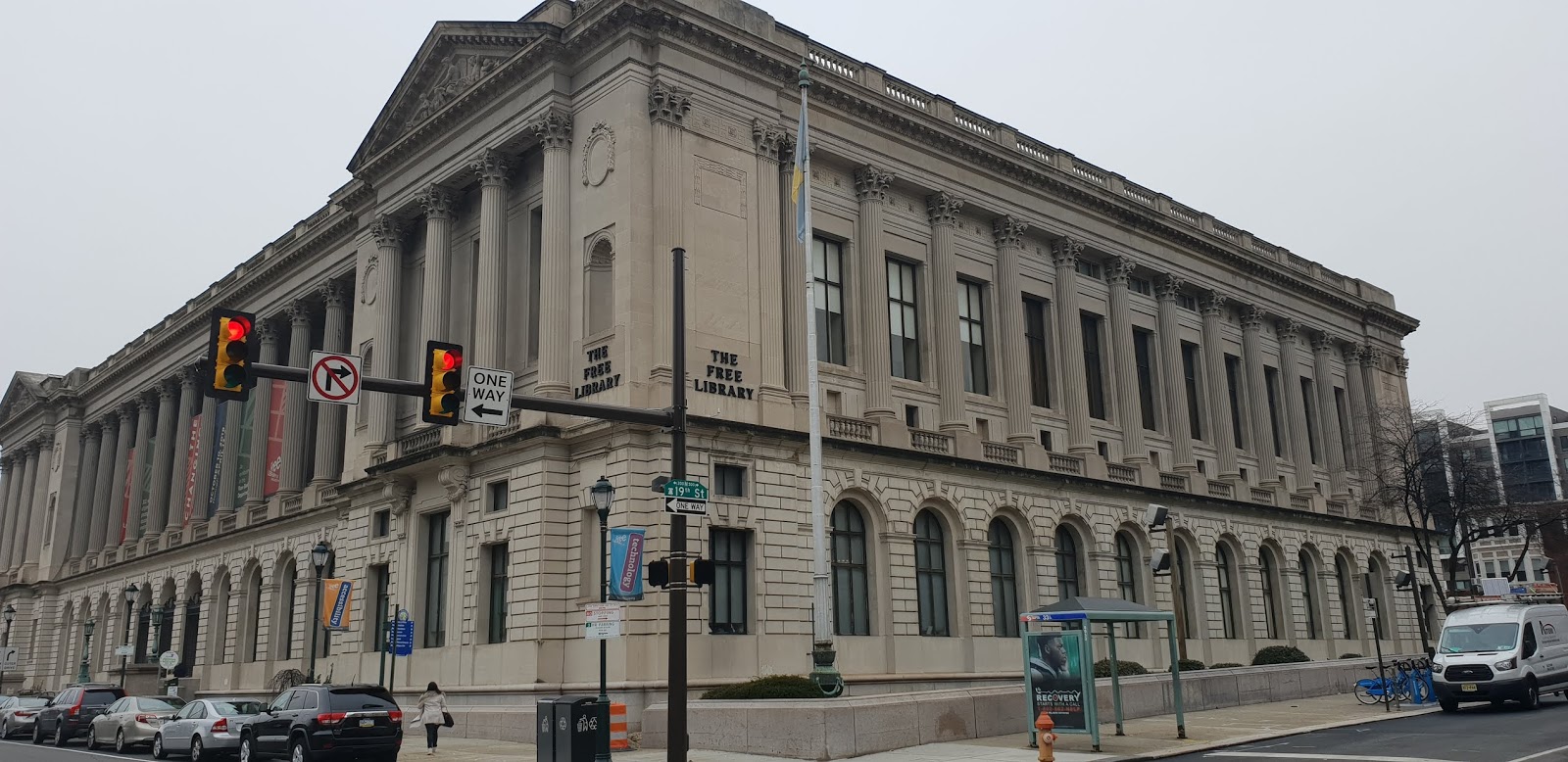
Once in Philadelphia, we managed to find the Swann Memorial Fountain at Logan Square…

and parked the car outside the Free Library.
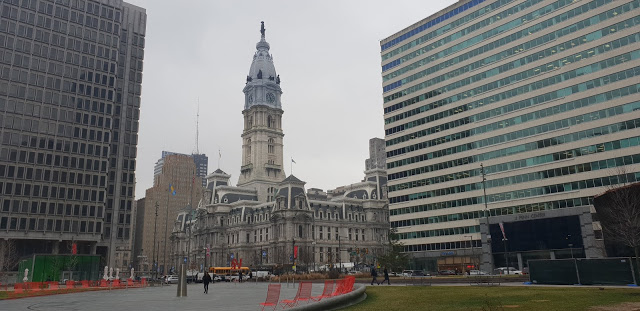
From there we walked to the city center, what some might call City Hall, a rather large and impressive stone structure, and then ended up at stop number six of the big bus tour.

Big bus tour

There are 27 stops of which we got on at 6 and got off at 1, managed by a miracle of fate to get back on at 1 and got off at 8 where our car was parked.  By then we were frozen solid.

But…

There’s always an intervening adventure with our outings and the quest was to find the best place to have a Philly Cheese Steak.

Between stops 1 and 6 when we were not on the bus, we hailed a cab, deciding not to wander around the city looking for a Philly Cheese Steak place ourselves.

We had a side mission to the side mission and got the cab driver to take us back to the car so we could lengthen the parking time.  This done, he took us to what he believed was the best Philly Cheese Steak place.

It was a long and convoluted ride that showed us the real Philadelphia, where the citizens live, not the showpiece tourist attractions.

It was somewhere in little Italy. A place called Geno’s steaks, a new and shiny restaurant where there was only seating outside.  Mid-afternoon, it was cold.

But were they the best Philly Cheese Steaks.  I’m not an expert so I don’t really know.  What I do know is the cheesy steak in a roll was absolutely delicious.  Freshly cooked in front of you, the steak slices were still dripping juices as they were put on the roll with a layer of cheese and onions which you have to ask for.

And at ten dollars each, it turned out to be less than the cab fare to get there.

Of course being dropped in Little Italy in America on the 20th Anniversary of the Sopranos, conjured up too many nightmares to be walking the streets in the fading afternoon lights.

Two boys on bikes who looked like thugs in hoodies scared us into a cab and back to the bus stop to do the last eight stops before going home.

All in all, a very interesting if not at times scary adventure.

In a word: Pause

Yes, when you are going at it like a bat out of hell, it might be an idea to take a pause and regroup.

That being a pause as an interruption to an activity.

In music, it’s a mark over a note.

Perhaps it’s a good idea to pause recording a TV show while the ads are on.  Networks don’t like it, but it makes the show make more sense without the distractions of advertisements, sometimes quite inane, or annoying.

What I just said, might give pause to my opposite number in this debate.

Have you been in a conversation, someone says something quite odd, and there’s a pregnant pause?

How did the word pregnant get into the conversation?  That, of course, usually means something significant will follow, but rarely does.  But it can also be a conversation killer where no one says anything.

Is that a wide eye in awe moment?  You did WHAT?

Then there is the word pours, sounds the same but is completely different.

In this case, the man pours water from the bucket on the plants.

Or my brother pours cold water on my plans.  Not literally, but figuratively, making me think twice about whether it would work or not.  Usually not.

Or a confession pours out of a man with a guilty conscience.  AKA sings like a bird.  Don’t you just love these quaint expressions?  It reminded me of a gangster film back in Humphrey Bogart’s day.

It never rains but it pours?  Another expression, when everything goes wrong.  A bit like home renovations really.

Really, it means to flow quickly and in large quantities, ie. rain pours down.

And if that isn’t bad enough, what about paws?

Sounds the same again, but, yes it’s what an animal has as feet, especially cats, dogs, and bears.

One use of it, out of context, of course, is ‘get your paws off me!’

And one rabbit paw might be good luck, but having two rabbit pows, I might win the lottery.

If only….


Searching for locations: The remnants of the wall that surrounded Beijing, China

The fortification walls, both an inner wall and an outer wall, surrounding Beijing city were built from the early 1400s to 1553.

The dimensions of the Inner city wall are:
          Length: 24 kilometers or 15 miles
          Height: 25 meters or 49 feet high
          Thickness, at ground level: 20 meters or 66 feet
                            at the top: 12 meters or 29 feet

It had nine gates.  The fortifications included gate towers, archways, watchtowers, barbicans, barbican towers, sluice gates, sluice gate towers, enemy sighting towers, corner guard towers, and a moat system.

The outer city wall had a length of 28 kilometers or 17 miles.

From 1911, after the collapse of the Qing Dynasty, the dismantling of the fortifications began.

In 1965, major deconstruction of the fortifications was commenced to allow for the construction of the 2nd wrong road, and Line 2 or the Beijing underground railway.

 In 1979, the government called off the demolition of the remaining city walls and named them cultural heritage sites. By this time, the only intact sections were the gate tower and watchtower at Zhengyangmen, the watchtower at Deshengmen, the guard tower at the southeast corner, the northern moats of the Inner city, the section of the Inner city wall south of the Beijing railway station, and a small section of Inner-city wall near Xibianmen.

For more reading, go to: https://en.wikipedia.org/wiki/Beijing_city_fortifications

As for our guide’s explanation of the fortifications: Leaving the Square to go to the Golden Mask Dynasty Show, we pass remnants of the wall that used to surround Beijing.

This wall was built in the early 15th century and was about 24 km long, up to 15 meters high and about 20 meters thick, and had nine gates, one of which still exists today.  In 1965 most of it was removed so that the second ring road and an underground railway line could be built.

Searching for locations: The apartments at Greve in Chianti, Tuscany, Italy

When we first planned to stay in Tuscany for a few days, we wanted to be in a central area.  We had thought of staying in Florence and making daily treks, but the tour operator we selected told us it would be better if we stayed closer to Arezzo.

We picked Greve in Chianti, and a place called Antico Pastificio, we booked a standard apartment with two bedrooms, and it was about as authentic Italian you could get.  The building we stayed in was the yellow pasta factory, and the apartment named ‘Iris’.

It was only steps away from the main square, shops, restaurants, and at the opposite end, the quaint ringing of church bells at various times during the day.

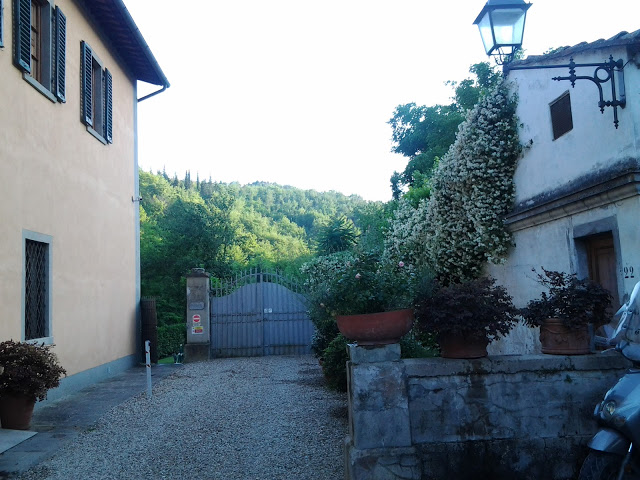
Gaining access was through a very narrow arch which required some deft driving and then up the road.  There were villas and two large apartment blocks.

You can just see the archway at the end of the road. 
This was the entrance to our room,

 along a passage and up the stairs, turning left at the top.

 Going straight ahead through the gate to the car park, 

and access to the grounds behind the buildings.

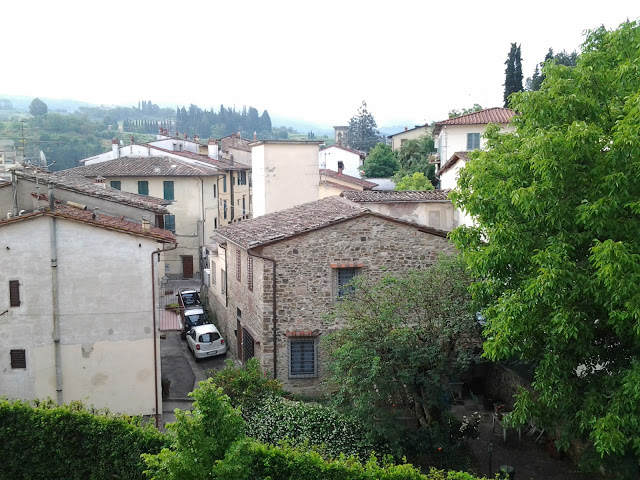
This was the view from the lounge/living room.  The days were hot, and on several evenings it rained, breaking the heat and making the evenings sitting by the window cool and refreshing.

 And the last view is looking towards the town piazza and the church

Searching for locations: The remnants of the wall that surrounded Beijing, China

The fortification walls, both an inner wall and an outer wall, surrounding Beijing city were built from the early 1400s to 1553.

The dimensions of the Inner city wall are:
          Length: 24 kilometers or 15 miles
          Height: 25 meters or 49 feet high
          Thickness, at ground level: 20 meters or 66 feet
                            at the top: 12 meters or 29 feet

It had nine gates.  The fortifications included gate towers, archways, watchtowers, barbicans, barbican towers, sluice gates, sluice gate towers, enemy sighting towers, corner guard towers, and a moat system.

The outer city wall had a length of 28 kilometers or 17 miles.

From 1911, after the collapse of the Qing Dynasty, the dismantling of the fortifications began.

In 1965, major deconstruction of the fortifications was commenced to allow for the construction of the 2nd wrong road, and Line 2 or the Beijing underground railway.

 In 1979, the government called off the demolition of the remaining city walls and named them cultural heritage sites. By this time, the only intact sections were the gate tower and watchtower at Zhengyangmen, the watchtower at Deshengmen, the guard tower at the southeast corner, the northern moats of the Inner city, the section of the Inner city wall south of the Beijing railway station, and a small section of Inner-city wall near Xibianmen.

For more reading, go to: https://en.wikipedia.org/wiki/Beijing_city_fortifications

As for our guide’s explanation of the fortifications: Leaving the Square to go to the Golden Mask Dynasty Show, we pass remnants of the wall that used to surround Beijing.

This wall was built in the early 15th century and was about 24 km long, up to 15 meters high and about 20 meters thick, and had nine gates, one of which still exists today.  In 1965 most of it was removed so that the second ring road and an underground railway line could be built.

Searching for locations: A bus tour of Philadelphia, USA

The Philadelphia Bus Tour, what we did see

To start with, we first joined this tour at stop number 6.

We had to find it first and that meant some pedestrian navigation, which took us first to the City Hall, a rather imposing structure, which we found later had a profound effect on Philadelphia sports teams.

According to the map, stop number 6 is Reading Terminal Market, Convention Centre, on 12th street on Filbert.  This was where we bought the tickets and boarded the bus that had a rather interesting guide aboard.

His favorite says was “And we’re good to go.”

Soon we would discover that his commentary was more orientated towards a younger audience, not that it bothered us.

Given the time restraints, we had, this was always going to be about looking and learning.

Stop number 7

City hall, Love Park.

This we had seen on our walk from where we left the car at the Free Library, near the Swann Memorial Fountain in Logan Park, the landmark that Rebecca had remembered from her last visit to Philadelphia.  Of course, then, it was not quite so frozen.

Love park, of course, was only notable to us in that it had a sculpture in place with the word Love rather stylized.  Apart from that, you’d hardly know it as a park

The city hall, well, that was something else, and when we looked at it, before going on the tour, it was a rather magnificent stone edifice.

After, well the guide filled us in, tallest building, highest and largest monument on William Penn, you get the gist.  37 feet tall, when eclipsed, the Philly sports teams all suffered slumps of one kind or another, until the problem was rectified.  Interesting story.

Stop number 8

18th Street and the Benjamin Franklin Parkway, or Logan Circle

This is the location of the Cathedral Basilica of Saints Peter and Paul.  A place where the Pope decided to give an audience and sent the city into a spin.

The same church has very high windows for the reason in the early days there was a problem with people wanting to throw Molotov cocktails through the windows.  A bit hard when they’re so high up.

Benjamin Franklin Parkway, of course, is interesting in itself as an avenue, not only for all of the flags of many nations of those who chose to live in Philadelphia.  We found ours, the one for Australia

This was also the stop where we needed to get off once the tour was finished, and time to head to the car, and go home, but that’s another story.

Stop number 10

Is that the stature of the Thinker, made famous, at least for me, from the old Dobie Gillis episodes, of God knows how many years ago?

Or, maybe it’s just the Rodin Museum on Benjamin Franklin Parkway.

There’s a whole story to go with that Statue and the fact it is one of many all over the world.

This one was made in France, cast in 1919 in Bronze, and is approximately 200cm x 130 cm by 140cm.

Stop number 11

Eastern State Penitentiary.  NW corner of 22nd Street and Fairmont Avenue.

This had a rather interesting story attached to it and had something to do with ghosts, but I wasn’t listening properly to the guide’s monologue.

But, later research shows, the fact it was once the most famous and expensive prison in the world.  Many also think it is haunted and is a favorite for visiting paranormal visitors.

Built around 1829, it was the first prison to have separate cells for prisoners.  It held, at various times, the likes of Al Capone and Willie Sutt

Stop number 18

The Philadelphia Museum of art, where we stop for a few minutes and look at the steps which were immortalized in the movie Rocky, yes he ran god knows how far to end up on the top of these steps.

Sorry, but I’m not that fit that I would attempt walking up them.  The view is just fine from inside the bus.  Of course, they might consider cleaning the windows a little so the view was clearer, but because it’s basically Perspex and scratched so that might not be possible.

Stop number 17

Back at Logan Circle, or Square if you prefer, but on the other side, closer to the Franklin Institute.  Benjamin Franklin’s name is used a lot in this city.

After that, it’s a blur, the Academy of Music, the University of the Arts, Pennsylvania Hospital, South Street, Vietnam Veterans Memorial, the USS Olympia, Penn’s Landing, and past the National Liberty Museum.  I’m sure somewhere in that blur was the intention of seeing the Liberty Bell, but I think I heard that it was not on show, and only a replica could be seen.

So much for the getting as an opportunity to see the real liberty bell, crack and all..

We get off and stop number 27, or Number 1, I was not quite sure.

What were we after?  The definitive Philly Cheese Steak.

In a word: lesson

I went to school and learned a lesson. We often hope that our children learn from these lessons, but sometimes the lesson learned was not the one intended.

This could be called a useful piece of practical wisdom, and for me that was, don’t get into fights at the back of the schoolyard.

The former lesson can be, on one hand, a section of school work, from a larger continuous topic, or, part of a book, which can be an exercise.

Then there’s the study of the past and the hope that we can learn from the lessons of the past.

Sadly, in a lot of cases, we don’t and are therefore doomed to repeat the past, only with far more devastating consequences.

A lesson can also be a passage from the bible.

Or is it lessen, where we reduce the costs which means lessen means reduce, to make less.

I could lessen the load if I gave someone else some of the work.

Or if I stopped eating candy, I could lessen the chances of clotting arteries.

No, I don’t think I will, just have less.

Searching for locations: On the road to Tiananmen Square, Beijing, China

One the first things you notice when driving around Beijing, other than the roads are congested with traffic, is the number of trees and flowers that have been planted, in the median strip as well as along the edges of the road.

What you also notice is the large number of multi-story apartment blocks, which are needed to house the millions of Beijing residents.  What we have, so far, rarely seen, is single-story houses.
These continuous areas of trees and rose bushes are, every now and then, broken up by very colorful garden beds:

Nearer to the square we are able to get up close to the flowers.  These, we are told, are a variation on the rose, one that flowers for nine months of the year.

They come in a variety of colors.

And they are literally everywhere you go, on the side of the roadway, often blotting out the concrete jungle behind them.

Searching for locations: On the road to Tiananmen Square, Beijing, China

One the first things you notice when driving around Beijing, other than the roads are congested with traffic, is the number of trees and flowers that have been planted, in the median strip as well as along the edges of the road.

What you also notice is the large number of multi-story apartment blocks, which are needed to house the millions of Beijing residents.  What we have, so far, rarely seen, is single-story houses.
These continuous areas of trees and rose bushes are, every now and then, broken up by very colorful garden beds:

Nearer to the square we are able to get up close to the flowers.  These, we are told, are a variation on the rose, one that flowers for nine months of the year.

They come in a variety of colors.

And they are literally everywhere you go, on the side of the roadway, often blotting out the concrete jungle behind them.

Searching for locations: The apartments at Greve in Chianti, Tuscany, Italy

When we first planned to stay in Tuscany for a few days, we wanted to be in a central area.  We had thought of staying in Florence and making daily treks, but the tour operator we selected told us it would be better if we stayed closer to Arezzo.

We picked Greve in Chianti, and a place called Antico Pastificio, we booked a standard apartment with two bedrooms, and it was about as authentic Italian you could get.  The building we stayed in was the yellow pasta factory, and the apartment named ‘Iris’.

It was only steps away from the main square, shops, restaurants, and at the opposite end, the quaint ringing of church bells at various times during the day.

Gaining access was through a very narrow arch which required some deft driving and then up the road.  There were villas and two large apartment blocks.

You can just see the archway at the end of the road. 
This was the entrance to our room,

 along a passage and up the stairs, turning left at the top.

 Going straight ahead through the gate to the car park, 

and access to the grounds behind the buildings.

This was the view from the lounge/living room.  The days were hot, and on several evenings it rained, breaking the heat and making the evenings sitting by the window cool and refreshing.

 And the last view is looking towards the town piazza and the church