Searching for locations: The Longjing Pearl Factory, Beijing, China

The Longjing Pearl Factory is located at:
No.2 Zuoan Gate Inner Street, ChongWen District, Beijing 100061 China.

This Pearl Center specializes in both freshwater and seawater pearls, with a reputation backed by the government of China, with a big selection and of the highest quality.  There were all kinds of jewelry made of pearls in different colors, shapes, and sizes.

They also had, as an interesting sideline, famous Chinese traditional cosmetics such as pearl cream and pearl powder, reputed to make your skin smoother, tenderer, and most importantly, younger.

We were advised of all of this well before we arrived at the factory, and of course, one suspected the glowing review, with emphasis on the fact it was a government operation and therefore trustworthy, suggested we should buy, meant the tour guide would receive a commission on each sale.

This is nothing new, it’s the same the world over, so it’s up to the visitor to buy or not to buy.

As soon as you get in the door you are taken to the group’s guide for the tour (and afterward, available for help on making purchases). who gives you a rundown on the different types and colors of pearls.  This briefly is,

Pearls come in two main categories: freshwater cultured pearls and saltwater cultured pearls. Various types of pearls are the result of the environment in which they live, and different cultivation techniques used by the pearl farmers. 

Freshwater cultured pearls are grown in lakes and rivers, whereas saltwater cultured pearls are grown in bodies of saltwater such as bays.  The most commonly used pearls are Freshwater pearls. 

Freshwater Pearls come in various pastel shades of white, pink, peach, lavender, plum, purple, and tangerine.  
South Sea cultured pearls come in shades of lustrous white, often with silver or rose overtones. 

Black pearls are known as Tahitian pearls and come most often in shades of black and gray. While a Tahitian pearl has a black body color, it will vary in its overtones, which most often will be green or pink.

Then there’s a demonstration, where one of the tour group is selected to pick an oyster out of the tank, and then there’s the guessing game as to how many pearls are in the shell, with the winner getting a pearl.

Guesses ranged from 1 to 23 and the answer was 26.  Nearest wins, and one for the person who picked the oyster out of the tank.  After this demonstration, we move on to the ways we can tell the difference between real and fake pearls.

It seems strange that they would, but we were guaranteed by both the tour guide and the lady delivering the lecture that the pearls we were about to buy were real, so how could we suspect there was anything dodgy about them?  Besides, now we could tell real from fake!

We then move onto the showroom floor where there are casements of pearl products, in the form of necklaces, earrings, and any number of variations and uses.  And, just to let you know, the prices are very, very expensive, even if they say they have a special.

Perhaps the best products, and those that found favor with many of the women on the tour, was the pearl cremes and powders.  These were not expensive, and, as we discovered later, actually worked as described.

Searching for locations: Hutongs, Beijing, China

What are Hutongs?

In Beijing Hutongs are formed by lines of traditional courtyard residences, called siheyuan.  Neighborhoods were formed by joining many hutongs together. These siheyuan are the traditional residences, usually occupied by a single or extended family, signifying wealth, and prosperity. 

Over 500 of these still exist.Many of these hutongs have been demolished, but recently they have become protected places as a means of preserving some Chinese cultural history.  They were first established in the Yuan Dynasty (1279-1368)Many of these Hutongs had their main buildings and gates built facing south, and lanes connecting them to other hutongs also ran north to south.

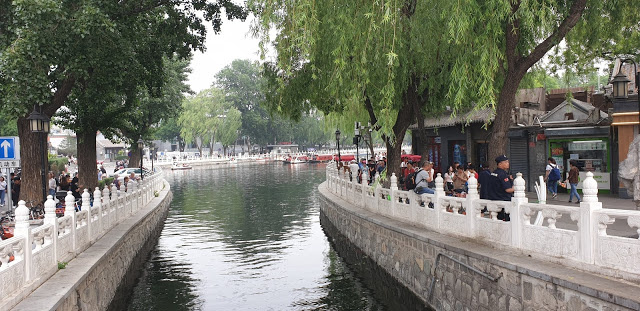
Many hutongs, some several hundred years old, in the vicinity of the Bell Tower and Drum Tower and Shichahai Lake are preserved and abound with tourists, many of which tour the quarter in pedicabs.

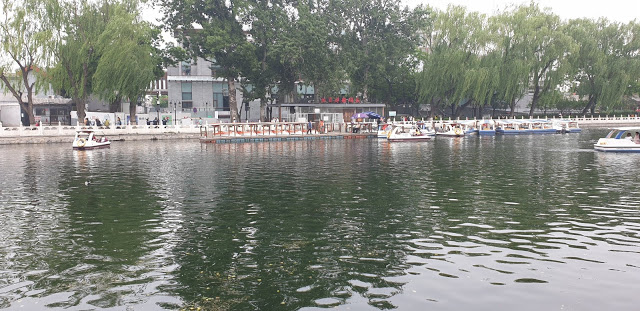
The optional tour also includes a visit to Shichahai, a historic scenic area consisting of three lakes (Qianhai, meaning Front Sea; Houhai, meaning Back Sea and Xihai, meaning West Sea), surrounding places of historic interest and scenic beauty and remnants of old-style local residences, Hutong and Courtyard.  

First, we had a short walk through the more modern part of the Hutong area and given some free time for shopping, but we prefer just to meander by the canal.  

There is a lake, and if we had the time, there were boats you could take.

With some time to spare, we take a quick walk down one of the alleyways where on the ground level are small shops, and above, living quarters.

Then we go to the bell and drum towers before walking through some more alleys was to where the rickshaws were waiting.
The Bell tower

And the Drum tower. Both still working today.

The rickshaw ride took us through some more back streets where it was clear renovations were being made so that the area could apply for world heritage listing.  Seeing inside some of the houses shows that they may look dumpy outside but that’s not the case inside.

The rickshaw ride ends outside the house where dinner will be served, and is a not so typical hose but does have all the elements of how the Chinese live, the boy’s room, the girl’s room, the parent’s room, the living area, and the North-south feng shui.

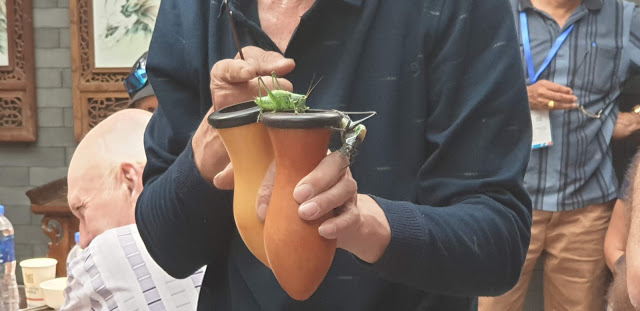
Shortly after we arrive, the cricket man, apparently someone quite famous in Beijing arrives and tells us all about crickets and then grasshoppers, then about cricket racing.  He is animated and clearly enjoys entertaining us westerners.

I’m sorry but the cricket stuff just didn’t interest me.  Or the grasshoppers.

As for dinner, it was finally a treat to eat what the typical Chinese family eats, and everything was delicious, and the endless beer was a nice touch.

And the last surprise, the food was cooked by a man.

In a word: Course

Yes, of course there’s a golf course.

Firstly, of course, means definitely so, and can be said when a revelation is realised, or sarcastically if the answer is obvious.

Then there’s a course, like a golf course where people chase a small usually white ball, sometimes to be found on a fairway, but more often than not in a bunker, in the water, or in the thicket.

It’s meant to be calming, but I’m betting more than one heart attack has been brought on by a slice, a six shot bunker exit, or any more than three putts on the green.

There’s also mini golf courses, less challenging, sometimes.

That course could also be the part of a creek or a river.

It can be a set of classes that makes up a course, I did a course in English literature

Then, rather topically, over the course of the election there was [you fill in the rest]

Then there’s my favourite, a four course dinner

Or when I’m unwell a course of antibiotics.

And lastly, in a supermarket how often does the trolley in front of you unexpectedly and randomly change course?

This is not to be confused with coarse

Which to be honest can be used sometimes to describe people who swear or are abrupt.  They were coarse people, that is unrefined.  These people often use coarse language and tell course jokes, meaning crude and offensive

It had a coarse texture, ie it was rough not smooth

And then there’s Corse which is not exactly an English word, but can refer to a corpse or dead body.

The writer’s toolbox

Travelling is always a good source of material to add to the writing store.

Writers collect anecdotes, descriptions of their fellow travellers, more the idiosyncrasies than an actual physical description, and of the experience, though it is all the better if it turns out to be really, really bad than good.

This equally applies to experiences in hotels, with hire cars, tourist spots and especially fellow travellers.

Start with the airline. This can make or break the start of a holiday and could be the difference between a great start or a horrid one.

We can usually accept the sardine arrangements, the lack of legroom, being within earshot of a screaming baby, or put up with the constant kicking in the back of the seat by the wretched uncontrollable child sitting behind you.

It’s having the person in front fully reclining their seat in your face that gets your goat. For an hour and a half or eight hours, it is still the biggest bone of contention when flying.

We are taking one airline down to Melbourne the one that makes a big deal out of the full service it provides, and another airline back, formerly a low-cost airline but now trying to match its so-called full-service rival.

The flight down is smooth, and the food reasonably good. The landing, even though the pilot was battling sharp crosswinds, was very heavy and left us in no doubt we had reached terra firma again. I’ve been on worse.

Hire cars are a rich field to pick over and I’ve read some interesting experiences involving even the best. So far I’ve not had a problem. I pre-booked as far in advance as possible to get a small fuel-efficient vehicle. Sometimes we are upgraded and while they think they are doing you a favour it is not necessarily the case, especially when you finish up with a large car that barely fits small provincial French roads one lane wide. It does happen.

There is also the waiting time at the car rental desk, particularly when it’s the rental company you picked, while other company desks are empty. You also quickly discover that most of the people in the queue didn’t think of pre-booking a car, which to my mind is expecting trouble with it being the peak holiday period.

We had to wait in a long queue after taking a chance it would be less crowded at the pick-up point than the desk in the airport terminal. It was no surprise to discover that a lot of other travellers had the same thought.

Hotels can also be one of the major letdowns of a holiday. If you are going to use a travel agent to pick a hotel for you, make sure you check as much as you can because no matter how it is described, seeing it, in reality, is always completely different than the pictures in a brochure and sometimes on the Internet. It requires research and a good look at TripAdvisor. Or word of mouth by someone you know and trust who has stayed there.

Take, for instance, staying in a five-star hotel the usual stomping ground of the rich and famous, it is always interesting to see how the less privileged fare. Where hotel staff are supposed to treat each guess equally it is not always the case. Certainly, if you’re flashing money around, the staff will be happy to take it though you may not necessarily get what you’re expecting.

We are lucky to be in the highest loyalty level and this accords us a number of privileges; this time working in our favour but it is not always the case. Privilege can sometimes count for nothing. It often depends on the humour of the front desk clerk and woe betide you if you get the receptionist from hell. Been there, done that, more than once.

Then there is the room. There is such a wide variety of rooms available even if the hotel site or brochure had representative pictures the odds are you can still get a room that is nothing like you’re expecting or were promised.

Believe me, there are rooms with a view, overlooking pigeon coops or air-conditioning vents.

A bone of contention often can be the location of the hotel and sometimes parking facilities not the least of which is the cost.  Valet parking; forget it.

We are reasonably near transport if we could walk, the km to the nearest bus or tram stop is a long long way when you can’t walk and that’s when the hotel starts to feel like a prison. Taxis may be cheap but when you have to use them three or four times a day it all adds up.

Be wary when a hotel says it is close to public transport. While that may be true in London, anywhere else especially in Europe you could find yourself in the middle of nowhere. Its when you discover your travel agent didn’t exactly lie but it is why that weekly rate was so cheap. In the end, the sum of the taxi fares and the accommodation turns out to be dearer than if you stayed at the Savoy.

So airline, hire car and hotel aside those front line experiences are fodder for the travel blogger, these people who are also known as road warriors.

I wondered why until we started travelling and discovered the incredible highs and lows, of flying, yes there are good and bad airlines and the bad are not confined to the low cost, of rental cars and of hotels. There is a very large gulf between five stars and three and sometimes three can be very generous. And of course, l now have a list of hotels l would never stay in again, the names of which might surprise you.

Unfortunately, my travel exploits are sometimes as boring as the day is long, but even then, there’s at least one calamity to deal with.

Our airport experiences are all without incident, although from time to time the sight of police or soldiers patrolling with guns can be disconcerting.

We have also experienced the odd problem in London at Heathrow firstly trying to get hep from the designated help staff and then to find the check-in desk of an airline apparently no one available knew existed.

That was momentarily exciting after phone calls were not answered and internet contact was not possible. Not until a little footwork found the agents desk and the misunderstanding was sorted out.

By the way, the airline itself was a pleasure to fly on, the staff pleasant and most of all we arrived just before the airport closed.

On the way home, only a flight stands between us and getting home. After days sometimes weeks it is that moment we all look forward to sleeping on our own beds making our own food and getting to the gym to work off those extra kilos put on by delicious hotel food or local fare where calorie counting is not part of the dining experience.

Of course, getting to the airport from the hotel can be an experience in itself whether by taxi perhaps the taxi driver from hell who knows only two speeds fast and stop and is also, unfortunately, colour blind.

Or whether you have arranged for a transfer only to discover it’s not coming because the company went out of business or you changed hotels and someone forgot to tell them.

Or the travel agent made a mistake or forgot to confirm the booking.

Oh yes, it happens.

We have a hire car and will be returning it t the same place. Let’s hope the signage at the airport makes it easy to find the rental place. In London we had a hell of a time trying to find it; good thing we were hours earlier than we should be.

And just because the sign says rental returns for the lane you’re in it doesn’t necessarily follow it’s the right lane. Then as you miss the exit, and get stuck on the one-way road system, all of a sudden you have left the airport and you’re heading back to the city.

If you’re running late …

But if everything goes to plan you get to the airport with time to spare.

We manage to arrive early at the airport. Rather than wait three hours for our flight we decide to try and get on an earlier departure. This will depend on our ticket type and whether there are seats available, preferably together.

We line up in the service queue, which by its very description means you have a long wait as service is mostly between difficult to impossible depending on the request.

We wait for twenty minutes. There’s a long queue behind us. Our request is taken care of quickly and efficiently making it almost seamless, certainly painless. I’m sure our request was one of the very few easy ones the staff will get.

Today it seems it is our lucky day. The transfer to an earlier flight is free and there are two seats available together. All we have to do is alert the pick-up driver at our destination we are going to be an hour earlier. Done.

Checking in bags is usually the bane of the traveller’s existence.

No matter which airport in whatever country you are departing from the only difference is the length of the queue; from incredibly long with a half-hour wait to the head of the line to up to an hour. Our queue is 15 to 20 minutes.

One assumes this is why intending passengers are asked to go to the airport two hours ahead of their fight. There are times of the day where the queues are horrendous, and that not only applies to Heathrow.

And if you are late, just panic.

And if your bags are overweight be prepared to have your credit card hammered.

Especially if you’re flying Air France from Venice to Paris. Domestically in Australia, it’s not so bad.

Now its time to relax. There is an hour before we have to be at the gate so just enough time to get coffee and a doughnut.

And be horrified at what shops charge for simple items like sandwiches. I think $10 is very expensive. But if you’re hungry and forgot to eat before getting to the airport then be prepared to pay more than you usually would for the same fare.

It’s also time to observe our fellow passengers, and there is always the one who has a last-minute dash for a plane that is just about to leave, passengers with panic-stricken looks.

We all know what happens if you miss the flight even as you’re downing that last cocktail in the airline lounge while thinking, yes they’ll hold the flight for me!

Apparently not because airlines want to keep their ‘on-time’ record.

Even so, there’s still three more calls for the missing passengers and then nothing. If they missed the plane there their problems are just beginning. It’s the same feeling you have when your name is called out before the flight starts loading.

Only once have we been called up and given an upgrade, and once in the US to be told we could take another flight because our flight was overbooked. Business-class was greatly appreciated and was worth the extra hour we had to wait.

The next bottleneck is the scanners and sometimes the queue here is very long and moving slowly because the scanners are set to pick up belts and shoes so people are scattered everywhere getting redressed and putting shoes on. Today being a weekday the queue is not so bad.

Loading is painless and reasonably organized except when the passengers in high numbered rows try to board by the front door instead of the rear door and clash midway in the plane. After they untangle themselves and get to their seats we’re ready to go.

This flight still has a manual safety demonstration which most people ignored but is slightly better than the video demonstration. Let’s hope we don’t go down over the water.

I’ve charted my path to the emergency exit and l have quite a few people before me. I guess there’s more than one way to be last off the plane.

Sometimes you get to pick who you get to sit next to, especially if you are travelling with your partner which this time l am, but in a three-seat arrangement, you have no control over who takes that third seat.

We are lucky this time because it will not become a tight squeeze but unfortunately, our fellow traveller has a cold and in a confined space for several hours it could turn out to be a problem.

The flight is smooth, the snacks edible, but there is no liquor service like the full-service rival but that might be a good thing.

No air rage on this flight.

Time flies, pardon the pun, and we have arrived. Even though it took forever for the baggage to be delivered we still got home early.

Until the next time, we fly.


Searching for locations: Tiananmen Square, Beijing, China

Tiananmen Square

Some interesting facts before we get out of the bus…

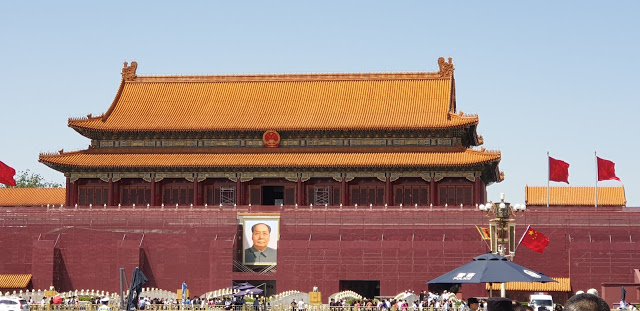
Tiananmen Square or Tian’anmen Square is in the centre of Beijing name after the Gate of Heavenly Peace, a gate that one separated the square from the Forbidden City.

The Square contains,

   the Monument to the People’s Heroes
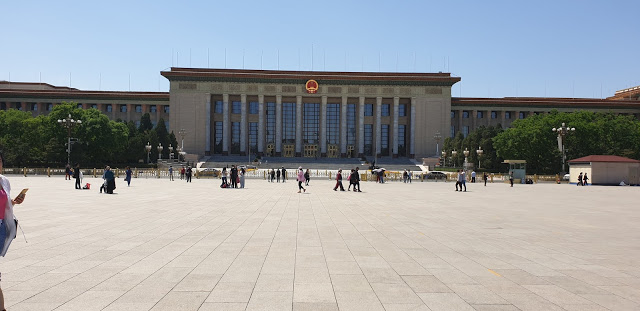
   the Great Hall of the People
   the National Museum of China
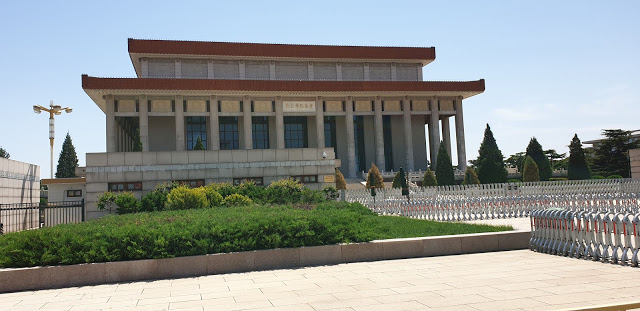
   the Mausoleum of Mao Zedong.

The square is about 109 acres and was designed and built in 1651, and since then been enlarged four times since, the most recent upgrade in the 1950s.

The Monument to the People’s Heroes

This is a ten-story obelisk built to commemorate the matters of the revolutions.  It was built between August 1952 and May 1958.  On the pedestal are reliefs depicting the eight major revolutionary episodes.

The Great Hall of the People

This was opened in September 1959, and covers 171809 square meters.  The Great Hall is the largest auditorium in China and can seat up to 10,000 people.  The State Banquet Hall can seat up to 5,000 diners.

The National Museum of China

This is one of the largest museums in the world and the second most visited museum in the world after the Louvre in Paris.   It was completed in 1959, and sits on 65 hectares, and rises four floors.  It has a permanent collection of over 1,000,000 items.

The Mauseloum of Mao Zedong

This was built shortly after his death, and completed on May 24th, 1977.  The embalmed body of the Chairman is preserved and on display in the center hall.

My own observations
This is huge; one of the largest public squares in the world, and if you’re going to walk it, like we did, make sure you’ve been exercising before you go.  It covers 44 hectares, borders on the Forbidden City, and has a memorial to Chairman Mao in the center of it.  But you cannot go near it, it’s fenced off, and it is guarded.

That’s both the statue and the square as there are random guards marching in random directions all the while watching us to see that we don’t misbehave.No one wants to find out what would happen if you jumped the fence around the statue, but I’m guessing you’ll have a few years to contemplate the stupidity of your actions with some very unhappy government officials.

 Around the edges of the square are huge buildings, on one side is the museum 

 and on the other is the Chinese equivalent of parliament.

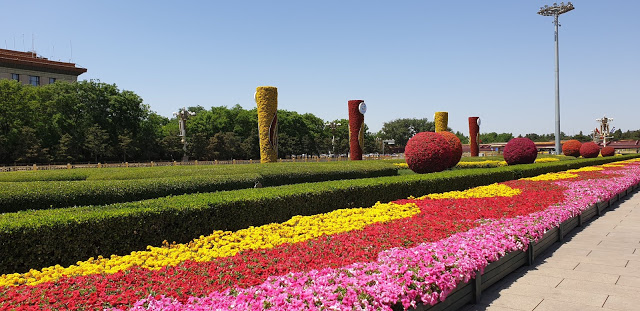
Around the sides are also large gardens

At one end, where the Forbidden City borders on the square, there’s a huge flag pole flying the Chinese flag, and this too like the monument is fenced off, and guarded by members of all of their armed services.  No tanks rolled out during our visit much to our disappointment.  There is no entrance to the Forbidden City from the square

 At the other end is the Mausoleum of Mao Zedong, which was closed the day we were there, as was the museum. 

 There are four sculptural groups installed outside the mausoleum.

Other than that, it’s just another square, albeit probably one of the largest in the world.  It can, we were told, hold about a million people.

In a word: needle

…

In the current times, the word needle is very polarising.

Will you have the vaccine, or not.  Is one of the reasons simply because you hate needles?

I know I do and have a fear factor of 100%.  Fortunately, I got very sick a few years ago and spent 10 days in the hospital, and was forced to have multiple needles every day.

Now it’s not so hard

But, I digress.

A needle is one of those things used in the medical profession mainly to deliver vaccines and medicine.  It is a very small cylinder.

A needle can be used to sew up a garment or make repairs.  This is a smallish piece of metal with an eyelet.

A needle can also be used to stitch up wounds, though it’s best you have a local anesthetic first.

Another way of using needles is to describe tiny icicles which hurt when they hit your face or your eyes.  It is called a needle effect.

Then, another use of the word, is to needle someone, that is to say, bombard them with questions, or annoy them.

It’s a pointer on a dial, like that of a fuel gauge, which for me, always seems to hover just above empty.  It can also be on a compass, where heading north is not always clear especially where magnets are nearby.

A fir tree’s leaves are more like needles.

You need one to play a record on a gramophone, not that they exist anymore.

Paradoxically it can also be used to describe a pointy rock or an obelisk-like “Cleopatra’s Needle”

It is also an etching tool.

The writer’s toolbox

Travelling is always a good source of material to add to the writing store.

Writers collect anecdotes, descriptions of their fellow travellers, more the idiosyncrasies than an actual physical description, and of the experience, though it is all the better if it turns out to be really, really bad than good.

This equally applies to experiences in hotels, with hire cars, tourist spots and especially fellow travellers.

Start with the airline. This can make or break the start of a holiday and could be the difference between a great start or a horrid one.

We can usually accept the sardine arrangements, the lack of legroom, being within earshot of a screaming baby, or put up with the constant kicking in the back of the seat by the wretched uncontrollable child sitting behind you.

It’s having the person in front fully reclining their seat in your face that gets your goat. For an hour and a half or eight hours, it is still the biggest bone of contention when flying.

We are taking one airline down to Melbourne the one that makes a big deal out of the full service it provides, and another airline back, formerly a low-cost airline but now trying to match its so-called full-service rival.

The flight down is smooth, and the food reasonably good. The landing, even though the pilot was battling sharp crosswinds, was very heavy and left us in no doubt we had reached terra firma again. I’ve been on worse.

Hire cars are a rich field to pick over and I’ve read some interesting experiences involving even the best. So far I’ve not had a problem. I pre-booked as far in advance as possible to get a small fuel-efficient vehicle. Sometimes we are upgraded and while they think they are doing you a favour it is not necessarily the case, especially when you finish up with a large car that barely fits small provincial French roads one lane wide. It does happen.

There is also the waiting time at the car rental desk, particularly when it’s the rental company you picked, while other company desks are empty. You also quickly discover that most of the people in the queue didn’t think of pre-booking a car, which to my mind is expecting trouble with it being the peak holiday period.

We had to wait in a long queue after taking a chance it would be less crowded at the pick-up point than the desk in the airport terminal. It was no surprise to discover that a lot of other travellers had the same thought.

Hotels can also be one of the major letdowns of a holiday. If you are going to use a travel agent to pick a hotel for you, make sure you check as much as you can because no matter how it is described, seeing it, in reality, is always completely different than the pictures in a brochure and sometimes on the Internet. It requires research and a good look at TripAdvisor. Or word of mouth by someone you know and trust who has stayed there.

Take, for instance, staying in a five-star hotel the usual stomping ground of the rich and famous, it is always interesting to see how the less privileged fare. Where hotel staff are supposed to treat each guess equally it is not always the case. Certainly, if you’re flashing money around, the staff will be happy to take it though you may not necessarily get what you’re expecting.

We are lucky to be in the highest loyalty level and this accords us a number of privileges; this time working in our favour but it is not always the case. Privilege can sometimes count for nothing. It often depends on the humour of the front desk clerk and woe betide you if you get the receptionist from hell. Been there, done that, more than once.

Then there is the room. There is such a wide variety of rooms available even if the hotel site or brochure had representative pictures the odds are you can still get a room that is nothing like you’re expecting or were promised.

Believe me, there are rooms with a view, overlooking pigeon coops or air-conditioning vents.

A bone of contention often can be the location of the hotel and sometimes parking facilities not the least of which is the cost.  Valet parking; forget it.

We are reasonably near transport if we could walk, the km to the nearest bus or tram stop is a long long way when you can’t walk and that’s when the hotel starts to feel like a prison. Taxis may be cheap but when you have to use them three or four times a day it all adds up.

Be wary when a hotel says it is close to public transport. While that may be true in London, anywhere else especially in Europe you could find yourself in the middle of nowhere. Its when you discover your travel agent didn’t exactly lie but it is why that weekly rate was so cheap. In the end, the sum of the taxi fares and the accommodation turns out to be dearer than if you stayed at the Savoy.

So airline, hire car and hotel aside those front line experiences are fodder for the travel blogger, these people who are also known as road warriors.

I wondered why until we started travelling and discovered the incredible highs and lows, of flying, yes there are good and bad airlines and the bad are not confined to the low cost, of rental cars and of hotels. There is a very large gulf between five stars and three and sometimes three can be very generous. And of course, l now have a list of hotels l would never stay in again, the names of which might surprise you.

Unfortunately, my travel exploits are sometimes as boring as the day is long, but even then, there’s at least one calamity to deal with.

Our airport experiences are all without incident, although from time to time the sight of police or soldiers patrolling with guns can be disconcerting.

We have also experienced the odd problem in London at Heathrow firstly trying to get hep from the designated help staff and then to find the check-in desk of an airline apparently no one available knew existed.

That was momentarily exciting after phone calls were not answered and internet contact was not possible. Not until a little footwork found the agents desk and the misunderstanding was sorted out.

By the way, the airline itself was a pleasure to fly on, the staff pleasant and most of all we arrived just before the airport closed.

On the way home, only a flight stands between us and getting home. After days sometimes weeks it is that moment we all look forward to sleeping on our own beds making our own food and getting to the gym to work off those extra kilos put on by delicious hotel food or local fare where calorie counting is not part of the dining experience.

Of course, getting to the airport from the hotel can be an experience in itself whether by taxi perhaps the taxi driver from hell who knows only two speeds fast and stop and is also, unfortunately, colour blind.

Or whether you have arranged for a transfer only to discover it’s not coming because the company went out of business or you changed hotels and someone forgot to tell them.

Or the travel agent made a mistake or forgot to confirm the booking.

Oh yes, it happens.

We have a hire car and will be returning it t the same place. Let’s hope the signage at the airport makes it easy to find the rental place. In London we had a hell of a time trying to find it; good thing we were hours earlier than we should be.

And just because the sign says rental returns for the lane you’re in it doesn’t necessarily follow it’s the right lane. Then as you miss the exit, and get stuck on the one-way road system, all of a sudden you have left the airport and you’re heading back to the city.

If you’re running late …

But if everything goes to plan you get to the airport with time to spare.

We manage to arrive early at the airport. Rather than wait three hours for our flight we decide to try and get on an earlier departure. This will depend on our ticket type and whether there are seats available, preferably together.

We line up in the service queue, which by its very description means you have a long wait as service is mostly between difficult to impossible depending on the request.

We wait for twenty minutes. There’s a long queue behind us. Our request is taken care of quickly and efficiently making it almost seamless, certainly painless. I’m sure our request was one of the very few easy ones the staff will get.

Today it seems it is our lucky day. The transfer to an earlier flight is free and there are two seats available together. All we have to do is alert the pick-up driver at our destination we are going to be an hour earlier. Done.

Checking in bags is usually the bane of the traveller’s existence.

No matter which airport in whatever country you are departing from the only difference is the length of the queue; from incredibly long with a half-hour wait to the head of the line to up to an hour. Our queue is 15 to 20 minutes.

One assumes this is why intending passengers are asked to go to the airport two hours ahead of their fight. There are times of the day where the queues are horrendous, and that not only applies to Heathrow.

And if you are late, just panic.

And if your bags are overweight be prepared to have your credit card hammered.

Especially if you’re flying Air France from Venice to Paris. Domestically in Australia, it’s not so bad.

Now its time to relax. There is an hour before we have to be at the gate so just enough time to get coffee and a doughnut.

And be horrified at what shops charge for simple items like sandwiches. I think $10 is very expensive. But if you’re hungry and forgot to eat before getting to the airport then be prepared to pay more than you usually would for the same fare.

It’s also time to observe our fellow passengers, and there is always the one who has a last-minute dash for a plane that is just about to leave, passengers with panic-stricken looks.

We all know what happens if you miss the flight even as you’re downing that last cocktail in the airline lounge while thinking, yes they’ll hold the flight for me!

Apparently not because airlines want to keep their ‘on-time’ record.

Even so, there’s still three more calls for the missing passengers and then nothing. If they missed the plane there their problems are just beginning. It’s the same feeling you have when your name is called out before the flight starts loading.

Only once have we been called up and given an upgrade, and once in the US to be told we could take another flight because our flight was overbooked. Business-class was greatly appreciated and was worth the extra hour we had to wait.

The next bottleneck is the scanners and sometimes the queue here is very long and moving slowly because the scanners are set to pick up belts and shoes so people are scattered everywhere getting redressed and putting shoes on. Today being a weekday the queue is not so bad.

Loading is painless and reasonably organized except when the passengers in high numbered rows try to board by the front door instead of the rear door and clash midway in the plane. After they untangle themselves and get to their seats we’re ready to go.

This flight still has a manual safety demonstration which most people ignored but is slightly better than the video demonstration. Let’s hope we don’t go down over the water.

I’ve charted my path to the emergency exit and l have quite a few people before me. I guess there’s more than one way to be last off the plane.

Sometimes you get to pick who you get to sit next to, especially if you are travelling with your partner which this time l am, but in a three-seat arrangement, you have no control over who takes that third seat.

We are lucky this time because it will not become a tight squeeze but unfortunately, our fellow traveller has a cold and in a confined space for several hours it could turn out to be a problem.

The flight is smooth, the snacks edible, but there is no liquor service like the full-service rival but that might be a good thing.

No air rage on this flight.

Time flies, pardon the pun, and we have arrived. Even though it took forever for the baggage to be delivered we still got home early.

Until the next time, we fly.
 

Searching for locations: The Longjing Pearl Factory, Beijing, China

The Longjing Pearl Factory is located at:
No.2 Zuoan Gate Inner Street, ChongWen District, Beijing 100061 China.

This Pearl Center specializes in both freshwater and seawater pearls, with a reputation backed by the government of China, with a big selection and of the highest quality.  There were all kinds of jewelry made of pearls in different colors, shapes, and sizes.

They also had, as an interesting sideline, famous Chinese traditional cosmetics such as pearl cream and pearl powder, reputed to make your skin smoother, tenderer, and most importantly, younger.

We were advised of all of this well before we arrived at the factory, and of course, one suspected the glowing review, with emphasis on the fact it was a government operation and therefore trustworthy, suggested we should buy, meant the tour guide would receive a commission on each sale.

This is nothing new, it’s the same the world over, so it’s up to the visitor to buy or not to buy.

As soon as you get in the door you are taken to the group’s guide for the tour (and afterward, available for help on making purchases). who gives you a rundown on the different types and colors of pearls.  This briefly is,

Pearls come in two main categories: freshwater cultured pearls and saltwater cultured pearls. Various types of pearls are the result of the environment in which they live, and different cultivation techniques used by the pearl farmers. 

Freshwater cultured pearls are grown in lakes and rivers, whereas saltwater cultured pearls are grown in bodies of saltwater such as bays.  The most commonly used pearls are Freshwater pearls. 

Freshwater Pearls come in various pastel shades of white, pink, peach, lavender, plum, purple, and tangerine.  
South Sea cultured pearls come in shades of lustrous white, often with silver or rose overtones. 

Black pearls are known as Tahitian pearls and come most often in shades of black and gray. While a Tahitian pearl has a black body color, it will vary in its overtones, which most often will be green or pink.

Then there’s a demonstration, where one of the tour group is selected to pick an oyster out of the tank, and then there’s the guessing game as to how many pearls are in the shell, with the winner getting a pearl.

Guesses ranged from 1 to 23 and the answer was 26.  Nearest wins, and one for the person who picked the oyster out of the tank.  After this demonstration, we move on to the ways we can tell the difference between real and fake pearls.

It seems strange that they would, but we were guaranteed by both the tour guide and the lady delivering the lecture that the pearls we were about to buy were real, so how could we suspect there was anything dodgy about them?  Besides, now we could tell real from fake!

We then move onto the showroom floor where there are casements of pearl products, in the form of necklaces, earrings, and any number of variations and uses.  And, just to let you know, the prices are very, very expensive, even if they say they have a special.

Perhaps the best products, and those that found favor with many of the women on the tour, was the pearl cremes and powders.  These were not expensive, and, as we discovered later, actually worked as described.

Searching for locations: The Golden Mask Dynasty Show, Beijing, China

The Golden Mask Dynasty Show was located at the OCT Theatre in Beijing’s Happy Valley. 

The theatre was quite full and the seats we had were directly behind the VIP area; as our guide told us, we had the best seats in the house. 

The play has 20 different dance scenes that depict war, royal banquets, and romance.  There are eight chapters and over 200 actors, and throughout the performance we were entertained by dancers, acrobats, costumes, lighting, and acoustics.

The story:

It is of romantic legend and historical memories, the Golden Mask Queen leads her army in defeating the invading Blue Mask King’s army, and afterwards the lands return to a leisurely pastoral life until the Queen forges a ‘mysterious tree’.  When the tree has grown, the Queen has a grand celebration, and releases the captured Blue soldiers, much to the admiration of the Blue Mask King.
This is followed by monstrous floods, and to save her people, and on the advice from the ‘mysterious tree’, the Queen sacrifices herself to save her people.  The Queen then turns into a golden sunbird flying in the sky blessing the people and that of the dynasty.

Billed as the best live show in China, described as a large scale dramatic musical, “The Golden Mask Dynasty” it lived up to its reputation and was thoroughly enjoyed by all.

It was not just singing dancing and acrobatics, it had a story and it was told so that language and cultural issues aside, it worked.  There was a narration of the story running beside the stage, but it was hard to divide attention between what was happening, and what was being related.

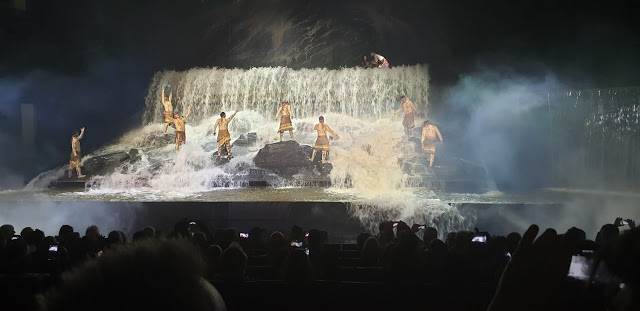
Then came the peacock dance, with live peacocks

And this was followed by a waterfall, well, I don’t think anyone in that audience could believe what they were seeing.

I know I was both astonished and in awe of the performance.

What a way to finish off our first day in Beijing.

Oh, sorry, that high was dented slightly when we had to go back to our room.

In a word: Meat

…

We all know what meat is, the flesh of an animal like cattle, pigs, sheep, even goats.

It can be used to describe a pie, such as a meat pie, but the odd thing is that it doesn’t have to have 100% meat in it.

It can be used in the context of humans, depending on when you eat certain types of food that will put meat on your bones.

Meat can also be used to describe the fleshy part of nuts, fruit, or eggs.

Then there’s the meat of the matter, which is the crux or basis of the argument or message you want to get across.

And a rather interesting if not obscure meaning is to describe a favorite occupation or activity.

…

Another form of the word is meet; what we do at a coffee shop, on a date, at a pub, or any number of different places.

We can gather together for a meeting, such as a board of directors or a committee.

It can be used to describe an athletic or swimming carnival.

How about you meet me halfway, in a negotiation, not on a long road trip

…

To dole out or allot something like punishment, is to mete it out.

Good thing then, we don’t live in the dark ages, all manner of bad punishments were meted put to the serfs.