Searching for locations: Vancouver, Canada – 3

It’s always a given that, whatever city you stay in, unless it’s overnight, you go on a tour and see the sights.

Even when you’re staying a short distance from the city, you may make the effort to catch a train or bus, then get on the hop-on, hop-off tour.  There’s always one in just about every city you visit.

Vancouver was no exception.

Except…

We arrived in the rain, went to sleep while the rain came down, woke up to the rain, and a heavy dose of jet lag or perhaps it was more that we had spent 24 and a half hours travelling from Brisbane to Vancouver via Shanghai.

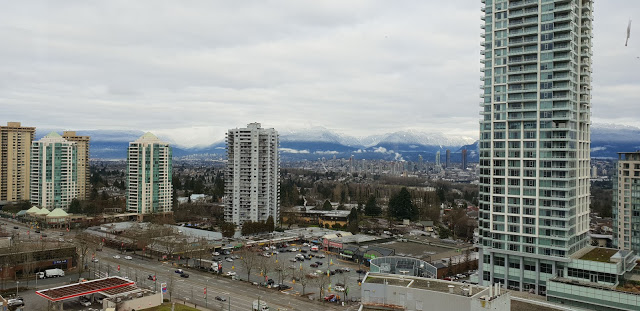
We had an excellent view out the window of our room, looking towards the shopping mall and the steady falling rain.
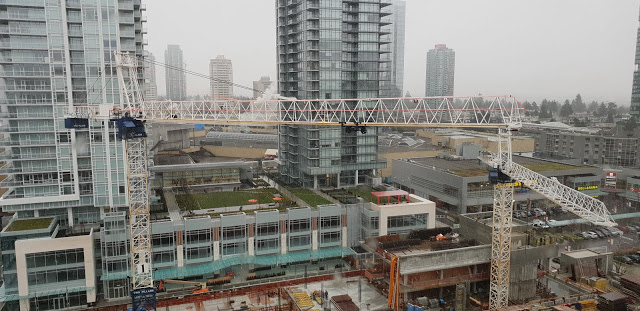
 I felt sorry watching the construction workers on the building site, which was the main vista we had to look at.

It could have been worse.  Endless mountains with snow on them.

What to do.  Venture out in the rain and go on the tour, on pop over to the shopping mall and pick up a few boxing day bargains, no, sorry, boxing week bargains.

We have had some experience going on hop-on, hop-off tours in open-top buses in the rain.  And the last time was not a pleasant experience, even though we learned a valuable lesson, not to stand in front of a cannon and yell ‘fire’.  Apparently, that’s how Admiral Nelson lost his arm.

But…

The shopping mall won.

We’d wait and see if the weather improved.  Hang on, isn’t Vancouver near Seattle, and doesn’t it rain 300 days of the year?

Not holding my breath.

I feel sorry for the construction workers again.  Still raining, still cold, and still no reason to get out of bed.

Day 2 in Vancouver turned out to be the same as day 1.

Hang on, there’s a development.

We’re on the 16th floor and up at those lofty heights, we can see not only the rain but intermingled with it a few flakes of snow.

Whilst we procrastinate about what we’re going to do, the snowflakes increase into small flurries.

Yep, we’re off to the mall again and going for a walk in the snow.

On the way back, we drop into the Boston Pizza, which has a sports bar, and there you can sit, drink, eat, and watch the ice hockey, or whatever sort of thing is going on at the time.

Today it’s a junior ice hockey tournament, but Canada is not playing.  Just the same, a long, cold beer and ice hockey? How close to heaven is that?

I can now cross that off the bucket list.

Day 3, we’re going on a great rail journey, well, we are going to get the train to the city and collect the rental car, a car on the booking form that was supposedly a Jeep Grand Cherokee or similar.

Of course, ‘or similar’ are the words to be feared here because in truth, the rental company can throw anything at you, so long as it matches the brief: three people and three large suitcases.

And, you guessed it…

The ‘or similar’ got us a Fort Flex.

Sounded like some place where exhausted soldiers were fending off the Indians in a last-ditch battle.

Perhaps one or two too many American movies, I think.
Searching for locations: Vancouver, Canada – 2

This morning we wake up to rain.  Or so we thought.  Taking a closer look out the window of our room on the 16th floor, we notice the rain is speckled with snowflakes.  As the morning progressed, the snow got harder until there were flurries.

 Later we discover this is called wet snow by the local Vancouverians, and whilst they winge a lot over the endless rain, to them rain is infinitely better than snow.

To us, by the afternoon, it was almost blizzard conditions, with lots of snow.  Then the only thing is that it does not accumulate on most of the ground so there are no drifts to play in.

Because the weather is so dismal, we decided not to go into Vancouver to do some sightseeing because the clouds were down to the ground, and then the snow set in.

Another interesting fact is that construction workers do not go off the job if it’s raining, or worse, when it is snowing.  Our room overlooks a new apartment complex under construction, and the workers battled on through what seemed like appalling conditions.

At four in the afternoon, the Maple Leafs are playing the Ohio Blue Jackets in Ohio.  It is a game we expect them to win.  Sparks is the goalkeeper, not Anderson; they’re playing back-to-back games, and Anderson’s starting tomorrow.

They win, four goals to two.  

Just before darkness falls, about four thirty, the snow stops, and there is a little rain, which melts the snow.

Time to go up to the executive lounge to get some snacks and coffee, then sleep because the next day we’re taking on the Trans Canada highway from Vancouver to Kamloops.

The forecast is for snow, more snow, and just for a change, more snow.

Searching for locations: Vancouver, Canada – 2

This morning we wake up to rain.  Or so we thought.  Taking a closer look out the window of our room on the 16th floor, we notice the rain is speckled with snowflakes.  As the morning progressed, the snow got harder until there were flurries.

 Later we discover this is called wet snow by the local Vancouverians, and whilst they winge a lot over the endless rain, to them rain is infinitely better than snow.

To us, by the afternoon, it was almost blizzard conditions, with lots of snow.  Then the only thing is that it does not accumulate on most of the ground so there are no drifts to play in.

Because the weather is so dismal, we decided not to go into Vancouver to do some sightseeing because the clouds were down to the ground, and then the snow set in.

Another interesting fact is that construction workers do not go off the job if it’s raining, or worse, when it is snowing.  Our room overlooks a new apartment complex under construction, and the workers battled on through what seemed like appalling conditions.

At four in the afternoon, the Maple Leafs are playing the Ohio Blue Jackets in Ohio.  It is a game we expect them to win.  Sparks is the goalkeeper, not Anderson; they’re playing back-to-back games, and Anderson’s starting tomorrow.

They win, four goals to two.  

Just before darkness falls, about four thirty, the snow stops, and there is a little rain, which melts the snow.

Time to go up to the executive lounge to get some snacks and coffee, then sleep because the next day we’re taking on the Trans Canada highway from Vancouver to Kamloops.

The forecast is for snow, more snow, and just for a change, more snow.

Searching for locations: The Maglev (Magnetic Levitation) Train, Shanghai, China

So, the first treat for the day is the high-speed magnetic train, something we only learned about after arriving in China and was not on any of the pre-tour documentation.

The train line connects Shanghai Pudong International Airport and Longyang Road Station (in the outskirts of central Pudong).  It is the oldest commercial maglev still in operation, and the first commercial high-speed maglev with cruising speed of 431 km/h (268 mph).  At full speed, the journey takes 7 minutes and 20 seconds to complete the distance of about 30 km.

Construction of the line began on March 1, 2001 and public services commenced on 1 January 2004.  It was built by a joint venture of Siemens and ThyssenKrupp from Kassel, Germany.

But, like visiting anything from a hotel, first we have to drive to the station and because we are leaving at 8, its peak hour traffic, and it takes 1 hour 10 minutes to get there.

The train also has a practical use and that is to take passengers from Shanghai to Pudong international airport as well as for those train enthusiasts, which is what we are.

On the train, it has the same sleek look as the bullet trains, but it is completely different, and you are able to see from the front of the train to the back.

Reputed to travel at 431 kph we take a seat and it is not long before the doors shut, and a loud humming noise is soon replaced by what sounds like an engine, then we start moving.  It sounds just like a normal train, and is a lot noisier than a normal bullet train.

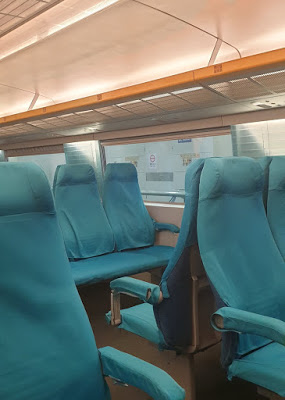
Seating on the train was nothing special, as one might expect

It didn’t take long before it hits the advertised speed of 431 kph.  This is not sustained for very long, because the distance is on 40 odd kilometers, and the whole trip takes about 7 minutes.

We go to the airport, and then we come back.  Is it worth the price, yes.  If you are a train enthusiast.

Searching for locations: The Maglev (Magnetic Levitation) Train, Shanghai, China

So, the first treat for the day is the high-speed magnetic train, something we only learned about after arriving in China and was not on any of the pre-tour documentation.

The train line connects Shanghai Pudong International Airport and Longyang Road Station (in the outskirts of central Pudong).  It is the oldest commercial maglev still in operation, and the first commercial high-speed maglev with cruising speed of 431 km/h (268 mph).  At full speed, the journey takes 7 minutes and 20 seconds to complete the distance of about 30 km.

Construction of the line began on March 1, 2001 and public services commenced on 1 January 2004.  It was built by a joint venture of Siemens and ThyssenKrupp from Kassel, Germany.

But, like visiting anything from a hotel, first we have to drive to the station and because we are leaving at 8, its peak hour traffic, and it takes 1 hour 10 minutes to get there.

The train also has a practical use and that is to take passengers from Shanghai to Pudong international airport as well as for those train enthusiasts, which is what we are.

On the train, it has the same sleek look as the bullet trains, but it is completely different, and you are able to see from the front of the train to the back.

Reputed to travel at 431 kph we take a seat and it is not long before the doors shut, and a loud humming noise is soon replaced by what sounds like an engine, then we start moving.  It sounds just like a normal train, and is a lot noisier than a normal bullet train.

Seating on the train was nothing special, as one might expect

It didn’t take long before it hits the advertised speed of 431 kph.  This is not sustained for very long, because the distance is on 40 odd kilometers, and the whole trip takes about 7 minutes.

We go to the airport, and then we come back.  Is it worth the price, yes.  If you are a train enthusiast.

Searching for locations: Old Shanghai, China

The old Shanghai refers to a small area of Shanghai that used to be walled in and remained that way until about 1912, when all but a small section of the wall was demolished.  With the advent of the concessions, Old Shanghai became the administrative centre until later, when it became a shopping complex.

Now it has many restored historical buildings as well as new buildings in a somewhat traditional style that has become one of Shanghai’s main tourist attractions, housing many shops and restaurants.

The “Old Town” is not exclusively old, as you still have a chance to take in the atmosphere if you wander into the quaint side streets.

But, on first viewing, walking down the street towards the complex, I’m not sure I’d go as far as to say this is in reality old Shanghai, except for what appears to be a true representation of it architecturally. 

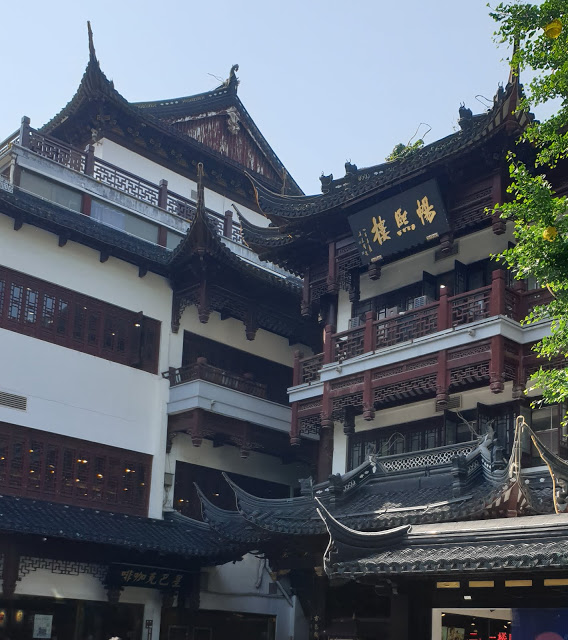
The buildings, which are shops and restaurants, are set out symmetrically, with streets, alleyways, and squares, which may prove that it was specially built for the tourists, and no mechanised traffic.

Anyway…

The buildings are magnificent, and a photographer’s delight, and you’d finish up having hundreds of photos by the time you leave.  All the buildings are exquisite representations of traditional Chinese architecture. 

As for buying stuff, remember if you’re not Chinese, you have the ‘sucker tourist’ stamp on your forehead, so be prepared to walk away if the vendors will not bargain.  

Nothing here is worth the price tag, and in our group, discounts like from 130 RMB to 50 RMB and from 1 for 1,200 to 2 for 950 RMB are common.

Here, common t-shirts that we can get for 3 dollars back home start at 150 RMB, which is roughly 35 dollars.  It’s that kind of market.

We end up in a tea room, on the third floor of the meeting point below, and discover all the tour guides sitting around a table counting money, and I have to say it’s the most $50 notes I’ve ever seen in one place.  

It is, we were told, where they discussed ‘strategy’.

The 2am Rant: Is there something wrong?

I asked myself that question when about 1000 odd words into a current short story, one that I continue to go back to, but found an initial reluctance to write, and now seems to be difficult to continue.

Is the reason because I don’t feel like writing, that I’ve written myself into a corner, the story isn’t flowing, or there’s something else I’d rather be doing…

Like, scouring the internet…

Working on writing some blog posts, like this one…

Checking my email…

Checking my other blogs to see how many people have viewed my recent posts,

Or just puddle with anything other than what I should be doing.

The thing is, I know where most of the stories are going, it’s just a matter of sitting down, picking up the threads, and writing. Certainly, I could be working on one or another right now.

But, something is nagging at me.

I thought it was that I wanted to write another Being Inspired piece, having the photo I wanted to use for inspiration in my head. I sat down this morning and started it, and got seven or eight paragraphs done, and then it was time to go down to breakfast.

Attention diverted.

I could have written more after breakfast, but that seemed to segue into a chat over coffee that ran into lunch. It’s odd how it seems there is so much to talk about.

Then it’s been one excuse after another that has kept me from picking up that story and running with it. I could do it now, but that reluctance remains.

Perhaps tomorrow.

For now, I’m going to work on some crosswords and see if that doesn’t inspire me, and if it doesn’t I could always have an early night.

It’s the same every time we go away, on the run all day doing touristy stuff, making notes for later on, on the run, and then getting back to the room exhausted. After all, there is so much to see and do.

Maybe I’ll just reflect on today and worry about it tomorrow, except…

We have an equally hectic day planned.

Maybe I’ll get that holiday from writing after all.

Searching for locations: Old Shanghai, China

The old Shanghai refers to a small area of Shanghai that used to be walled in and remained that way until about 1912, when all but a small section of the wall was demolished.  With the advent of the concessions, Old Shanghai became the administrative centre until later, when it became a shopping complex.

Now it has many restored historical buildings as well as new buildings in a somewhat traditional style that has become one of Shanghai’s main tourist attractions, housing many shops and restaurants.

The “Old Town” is not exclusively old, as you still have a chance to take in the atmosphere if you wander into the quaint side streets.

But, on first viewing, walking down the street towards the complex, I’m not sure I’d go as far as to say this is in reality old Shanghai, except for what appears to be a true representation of it architecturally. 

The buildings, which are shops and restaurants, are set out symmetrically, with streets, alleyways, and squares, which may prove that it was specially built for the tourists, and no mechanised traffic.

Anyway…

The buildings are magnificent, and a photographer’s delight, and you’d finish up having hundreds of photos by the time you leave.  All the buildings are exquisite representations of traditional Chinese architecture. 

As for buying stuff, remember if you’re not Chinese, you have the ‘sucker tourist’ stamp on your forehead, so be prepared to walk away if the vendors will not bargain.  

Nothing here is worth the price tag, and in our group, discounts like from 130 RMB to 50 RMB and from 1 for 1,200 to 2 for 950 RMB are common.

Here, common t-shirts that we can get for 3 dollars back home start at 150 RMB, which is roughly 35 dollars.  It’s that kind of market.

We end up in a tea room, on the third floor of the meeting point below, and discover all the tour guides sitting around a table counting money, and I have to say it’s the most $50 notes I’ve ever seen in one place.  

It is, we were told, where they discussed ‘strategy’.

Searching for locations: The Bund, Shanghai, China

The Bund

The architecture along the Bund or Waitan is a living museum of the colonial history of the 1800s.  The area centers on a section of Zhongshan Road within the former Shanghai International Settlement.

The word bund means an embankment or an embanked quay.   It was initially a British settlement; later the British and American settlements were combined in the International Settlement.

The Bund is a mile-long stretch of waterfront promenade along the Huangpu River. There are 52 buildings of various architectural styles, including Gothic, baroque, and neoclassical styles. The area is often referred to as “the museum of buildings”.

Building styles include Romanesque Revival, Gothic Revival, Renaissance Revival, Baroque Revival, Neo-Classical or Beaux-Arts, as well as a number in Art Deco style.

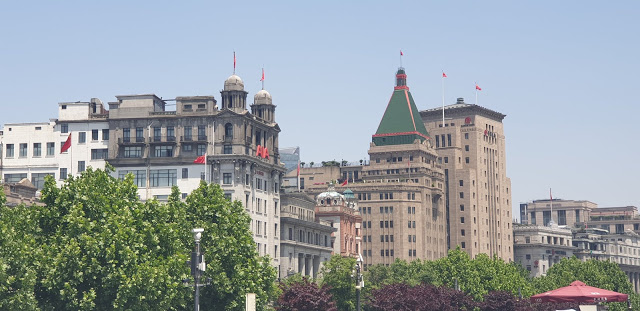
Having seen these buildings initially the night before, mostly lit up, our viewing this morning was from the land side, and particularly interesting in that the colonial architecture was really fascinating considering their location, but not surprising given Shanghai’s history.  A lot of these buildings would be more at home in London, that out in the far east.

The Bund waterfront is about two kilometers long and impossible to cover in the time allowed for this part of the tour.

There was just enough time to get photos of the waterfront and the old buildings.

Some of these buildings had odd shapes, like one on the far right that looks like a bottle opener.

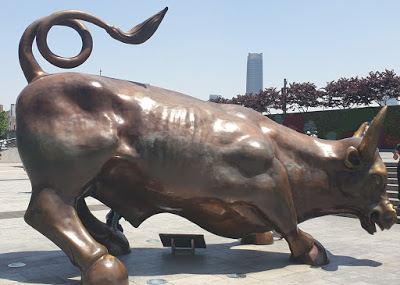
And, for some odd reason, a bull.

On the other side of the water, the sights that had been quite colorful the night before, were equally impressive though somewhat diminished by the haze.

Searching for locations: The Bund, Shanghai, China

The Bund

The architecture along the Bund or Waitan is a living museum of the colonial history of the 1800s.  The area centers on a section of Zhongshan Road within the former Shanghai International Settlement.

The word bund means an embankment or an embanked quay.   It was initially a British settlement; later the British and American settlements were combined in the International Settlement.

The Bund is a mile-long stretch of waterfront promenade along the Huangpu River. There are 52 buildings of various architectural styles, including Gothic, baroque, and neoclassical styles. The area is often referred to as “the museum of buildings”.

Building styles include Romanesque Revival, Gothic Revival, Renaissance Revival, Baroque Revival, Neo-Classical or Beaux-Arts, as well as a number in Art Deco style.

Having seen these buildings initially the night before, mostly lit up, our viewing this morning was from the land side, and particularly interesting in that the colonial architecture was really fascinating considering their location, but not surprising given Shanghai’s history.  A lot of these buildings would be more at home in London, that out in the far east.

The Bund waterfront is about two kilometers long and impossible to cover in the time allowed for this part of the tour.

There was just enough time to get photos of the waterfront and the old buildings.

Some of these buildings had odd shapes, like one on the far right that looks like a bottle opener.

And, for some odd reason, a bull.

On the other side of the water, the sights that had been quite colorful the night before, were equally impressive though somewhat diminished by the haze.