This is a spot behind a group of restaurants at Victoria Point, Queensland.
But it could be anywhere, like a spot we saw on a boat trip on a river in the Daintree, in far north Queensland
So, this could be a spot, not far inland from the ocean where smugglers, or drug runners come ashore, in a place so remote they would never get caught.
Unless an enterprising federal agent comes up with a plan to track them from the ocean side using satellite images, or reported sightings of suspicious activity.
My money is on a random sighting, a vague report files in a small town police station, and a body washed up in shore, apparently the victim of a crocodile attack. Or not a crocodile.
It cold be a fishing trip gone wrong in a backwater stream, a weekend away by a dialled group of friends, who are not really friends, which all comes to a head when one of the friends go missing.
Or, I’d you like the idea of historical drama, a story about the first expedition from the bottom of Australia to the very top, for the first time, with all the hazards of rivers to cross, paths to create though the bush, the heat, the animals, the local inhabitants who have yet to see Europeans.
To be honest, I would not want to be one of those early explorers, especially those who went inland and struck desert, or died just short of their goal.
Just as an aside, we did learn about these people, Hume and Hovell, Blaxland, Wentworth and Lawson, Burke and Wills, and others.
Instead of making a grand entrance, arriving in style and being greeted by important dignitaries, we are slinking in via an airplane, late at night. It’s hardly the entrance I’d envisaged. At 9:56 the plane touches down on the runway. Outside the plane, it is dark and gloomy and from what I could see, it had been raining. That could, of course, simply be condensation.
Once on the ground, everyone was frantically gathering together everything from seat pockets and sending pillows and blankets to the floor. A few were turning their mobile phones back on, and checking for a signal, and, perhaps, looking for messages sent to them during the last 12 hours. Or perhaps they were just suffering from mobile phone deprivation.
It took 10 minutes for the plane to arrive at the gate. That’s when everyone moves into overdrive, unbuckling belts, some before the seatbelt sign goes off, and are first out of their seats and into the overhead lockers. Most are not taking care that their luggage may have moved, but fortunately, no bags fall out onto someone’s head. The flight had been relatively turbulent free.
When as many people and bags have squeezed into that impossibly small aisle space, we wait for the door to open, and then the privileged few business and first-class passengers to depart before we can begin to leave. As we are somewhere near the middle of the plane, our wait will not be as long as it usually is. This time we avoided being at the back of the plane. Perhaps that privilege awaits us on the return trip.
Once off the plane, it is a matter of following the signs, some of which are not as clear as they could be. It’s why it took another 30 odd minutes to get through immigration, but that was not necessarily without a few hiccups along the way. We got sidetracked at the fingerprint machines, which seemed to have a problem if your fingers were not straight, not in the center of the glass, and then if it was generally cranky, which ours were, continue to tell you to try again, and again, and again, and again…That took 10 to 15 minutes before we joined an incredibly long queue of other arrivals,
A glance at the time, and suddenly it’s nearly an hour from the moment we left the plane.
And…
That’s when we got to the immigration officer, and it became apparent we were going to have to do the fingerprints yet again. Fortunately this time, it didn’t take as long. Once that done, we collected our bags, cleared customs by putting our bags through a huge x-ray machine, and it was off to find our tour guide.
We found several tour guides with their trip-a-deal flags waiting for us to come out of the arrivals hall. It wasn’t a difficult process in the end. We were in the blue group. Other people we had met on the plane were in the red group or the yellow group. The tour guide found, or as it turned out she found us, it was simply a matter of waiting for the rest of the group, of which there were eventually 28.Gathered together we were told we would be taking the bags to one place and then ourselves to the bus in another. A glance in the direction of the bus park, there were a lot of busses.
Here’s a thought, imagine being told your bus is the white one with blue writing on the side.
Yes, yours is, and 25 others because all of the tourist coaches are the same. An early reminder, so that you do not get lost, or, God forbid, get on the wrong bus, for the three days in Beijing, is to get the last five numbers of the bus registration plate and commit them to memory. It’s important. Failing that, the guide’s name is in the front passenger window.
Also, don’t be alarmed if your baggage goes in one direction, and you go in another. In a rather peculiar set up the bags are taken to the hotel by what the guide called the baggage porter. It is an opportunity to see how baggage handlers treat your luggage; much better than the airlines it appears.
That said, if you’re staying at the Beijing Friendship Hotel, be prepared for a long drive from the airport. It took us nearly an hour, and bear in mind that it was very late on a Sunday night.
Climbing out of the bus after what seemed a convoluted drive through a park with buildings, we arrive at the building that will be our hotel for the next three days. From the outside, it looks quite good, and once inside the foyer, that first impression is good. Lots of space, marble, and glass. If you are not already exhausted by the time you arrive, the next task is to get your room key, find your bags, get to your room, and try to get to be ready the next morning at a reasonable hour.
Sorry, that boat has sailed.
We were lucky, we were told, that our plane arrived on time, and we still arrived at the hotel at 12:52. Imagine if the incoming plane is late.
This was taken the following morning. It didn’t look half as bland late at night.
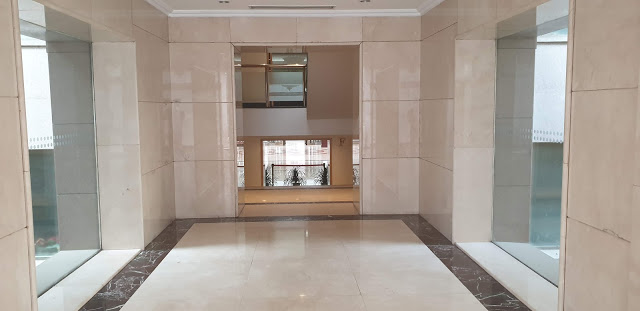
This is the back entrance to Building No 4 but is quite representative of the whole foyer, made completely of marble and glass. It all looked very impressive under the artificial lights, but not so much in the cold hard light of early morning.
This the foyer of the floor our room was on. Marble with interesting carpet designs. Those first impressions of it being a plush hotel were slowly dissipating as we got nearer and nearer to the room. From the elevator, it was a long, long walk.
So…Did I tell you about the bathroom in our room?
The shower and the toilet both share the same space with no divide and the shower curtain doesn’t reach to the floor. Water pressure is phenomenal. Having a shower floods the whole shower plus toilet area so when you go to the toilet you’re basically underwater.
Don’t leave your book or magazine on the floor or it will end up a watery mess.
And the water pressure is so hard that it could cut you in half. Only a small turn of the tap is required to get that tingling sensation going.
When we first planned to stay in Tuscany for a few days, we wanted to be in a central area. We had thought of staying in Florence and making daily treks, but the tour operator we selected told us it would be better if we stayed closer to Arezzo.
We picked Greve in Chianti, and a place called Antico Pastificio, we booked a standard apartment with two bedrooms, and it was about as authentic Italian you could get. The building we stayed in was the yellow pasta factory, and the apartment named ‘Iris’.
It was only steps away from the main square, shops, restaurants, and at the opposite end, the quaint ringing of church bells at various times during the day.
Gaining access was through a very narrow arch which required some deft driving and then up the road. There were villas and two large apartment blocks.
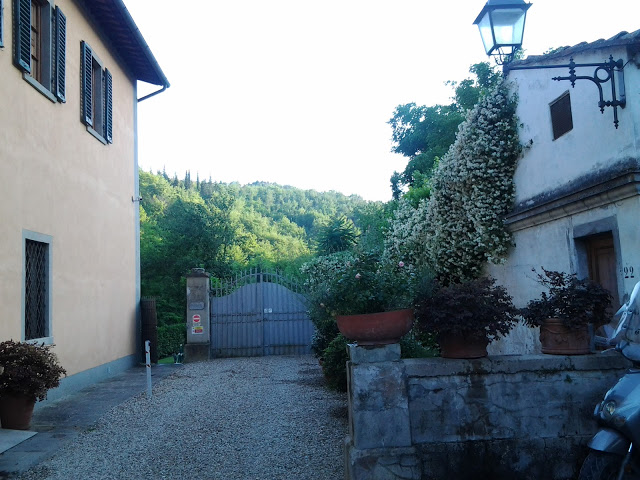
You can just see the archway at the end of the road. This was the entrance to our room,
along a passage and up the stairs, turning left at the top.
Going straight ahead through the gate to the car park,
and access to the grounds behind the buildings.
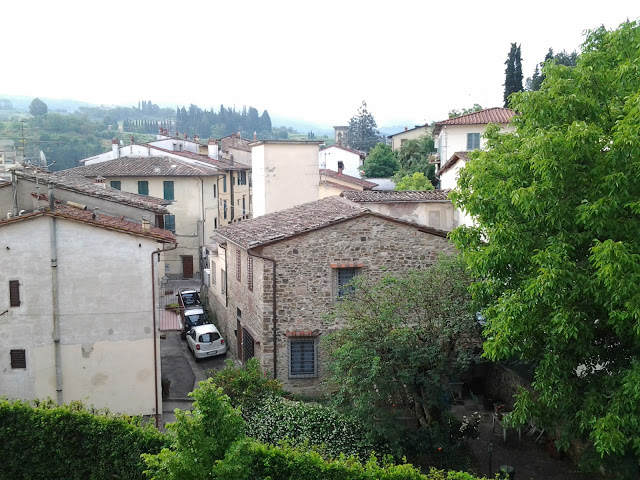
This was the view from the lounge/living room. The days were hot, and on several evenings it rained, breaking the heat and making the evenings sitting by the window cool and refreshing.
And the last view is looking towards the town piazza and the church
Instead of making a grand entrance, arriving in style and being greeted by important dignitaries, we are slinking in via an airplane, late at night. It’s hardly the entrance I’d envisaged. At 9:56 the plane touches down on the runway. Outside the plane, it is dark and gloomy and from what I could see, it had been raining. That could, of course, simply be condensation.
Once on the ground, everyone was frantically gathering together everything from seat pockets and sending pillows and blankets to the floor. A few were turning their mobile phones back on, and checking for a signal, and, perhaps, looking for messages sent to them during the last 12 hours. Or perhaps they were just suffering from mobile phone deprivation.
It took 10 minutes for the plane to arrive at the gate. That’s when everyone moves into overdrive, unbuckling belts, some before the seatbelt sign goes off, and are first out of their seats and into the overhead lockers. Most are not taking care that their luggage may have moved, but fortunately, no bags fall out onto someone’s head. The flight had been relatively turbulent free.
When as many people and bags have squeezed into that impossibly small aisle space, we wait for the door to open, and then the privileged few business and first-class passengers to depart before we can begin to leave. As we are somewhere near the middle of the plane, our wait will not be as long as it usually is. This time we avoided being at the back of the plane. Perhaps that privilege awaits us on the return trip.
Once off the plane, it is a matter of following the signs, some of which are not as clear as they could be. It’s why it took another 30 odd minutes to get through immigration, but that was not necessarily without a few hiccups along the way. We got sidetracked at the fingerprint machines, which seemed to have a problem if your fingers were not straight, not in the center of the glass, and then if it was generally cranky, which ours were, continue to tell you to try again, and again, and again, and again…That took 10 to 15 minutes before we joined an incredibly long queue of other arrivals,
A glance at the time, and suddenly it’s nearly an hour from the moment we left the plane.
And…
That’s when we got to the immigration officer, and it became apparent we were going to have to do the fingerprints yet again. Fortunately this time, it didn’t take as long. Once that done, we collected our bags, cleared customs by putting our bags through a huge x-ray machine, and it was off to find our tour guide.
We found several tour guides with their trip-a-deal flags waiting for us to come out of the arrivals hall. It wasn’t a difficult process in the end. We were in the blue group. Other people we had met on the plane were in the red group or the yellow group. The tour guide found, or as it turned out she found us, it was simply a matter of waiting for the rest of the group, of which there were eventually 28.Gathered together we were told we would be taking the bags to one place and then ourselves to the bus in another. A glance in the direction of the bus park, there were a lot of busses.
Here’s a thought, imagine being told your bus is the white one with blue writing on the side.
Yes, yours is, and 25 others because all of the tourist coaches are the same. An early reminder, so that you do not get lost, or, God forbid, get on the wrong bus, for the three days in Beijing, is to get the last five numbers of the bus registration plate and commit them to memory. It’s important. Failing that, the guide’s name is in the front passenger window.
Also, don’t be alarmed if your baggage goes in one direction, and you go in another. In a rather peculiar set up the bags are taken to the hotel by what the guide called the baggage porter. It is an opportunity to see how baggage handlers treat your luggage; much better than the airlines it appears.
That said, if you’re staying at the Beijing Friendship Hotel, be prepared for a long drive from the airport. It took us nearly an hour, and bear in mind that it was very late on a Sunday night.
Climbing out of the bus after what seemed a convoluted drive through a park with buildings, we arrive at the building that will be our hotel for the next three days. From the outside, it looks quite good, and once inside the foyer, that first impression is good. Lots of space, marble, and glass. If you are not already exhausted by the time you arrive, the next task is to get your room key, find your bags, get to your room, and try to get to be ready the next morning at a reasonable hour.
Sorry, that boat has sailed.
We were lucky, we were told, that our plane arrived on time, and we still arrived at the hotel at 12:52. Imagine if the incoming plane is late.
This was taken the following morning. It didn’t look half as bland late at night.
This is the back entrance to Building No 4 but is quite representative of the whole foyer, made completely of marble and glass. It all looked very impressive under the artificial lights, but not so much in the cold hard light of early morning.
This the foyer of the floor our room was on. Marble with interesting carpet designs. Those first impressions of it being a plush hotel were slowly dissipating as we got nearer and nearer to the room. From the elevator, it was a long, long walk.
So…Did I tell you about the bathroom in our room?
The shower and the toilet both share the same space with no divide and the shower curtain doesn’t reach to the floor. Water pressure is phenomenal. Having a shower floods the whole shower plus toilet area so when you go to the toilet you’re basically underwater.
Don’t leave your book or magazine on the floor or it will end up a watery mess.
And the water pressure is so hard that it could cut you in half. Only a small turn of the tap is required to get that tingling sensation going.
Sydney to Beijing – Qantas A330-200 Boarding 11:45, everyone on board by 12:02, for a 12:10 departure. Pushing back 12:12 Take off 12:27
Lunch Airline food is getting better but the fact they serve it up to you in a metal tray with a thick aluminum lid does nothing for the quality of the food inside. I get what the chef is trying to do but often there is too little of one thing and too much of another and what you finish up with is slop in a tray. Sometimes it’s edible sometimes it’s not. Sometimes the meat is tender and other times it’s like boot leather. As it is today. I think it’s pork, I should have had the chicken. Or perhaps it was chicken. I hate it when you can’t tell what it is that you’re eating. But, the drinks were good.
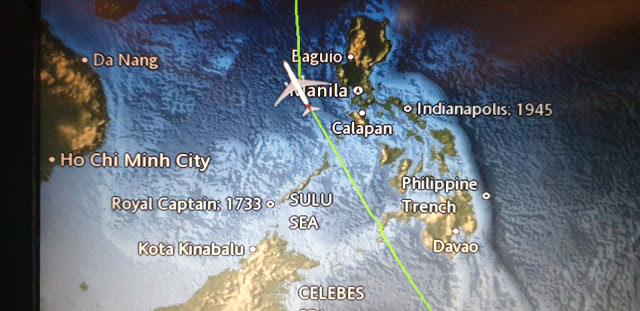
Rest or Sleep, maybe It’s going to take 11 hours and 20 minutes from Sydney to Beijing, a long time to sit in a plane with nothing much to do other than crosswords, read a book or newspaper or magazine, listen to music on your own device, or the in-flight entertainment, watch a movie again by the in-flight entertainment – if it works – or try to get some sleep. I started with the crosswords but got bored quickly. I fiddled with the in-flight entertainment, looked at the movies and tv shows but none really interested me, not then at least, so I set it to the flight path. Not exactly stellar entertainment, but it’s always interesting to know where the plane is. Or is it? If we crash, what good would it do me to know it’s somewhere over the ocean, not far from Manila, or somewhere else. It’s not as if I could phone someone up, on the way down, to let them know where we are. But, just after dinner, we still haven’t left Australia
However, by the time I’ve finished fiddling with and dismissing all of the entertainment alternatives, it’s back to the flight path and now we are…
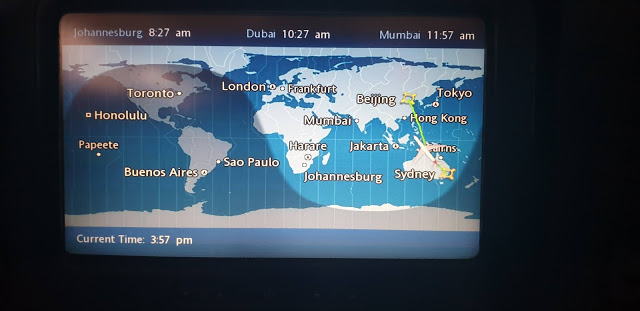
Somewhere approaching the Sulu Sea, which I’ve never heard of before, so it looks like I’ll have to study up on my geography when I get home.
OK, Manila looks like somewhere I’ve heard of, so we have to be flying over the Philippines. Not far left of that is Vietnam. Neither of those places is on my travel bucket list, so I’ll just look from up here and be satisfied with that.
Working, or not Chronic boredom is setting in by the time we are just past halfway to our destination. We are over 6 hours into the flight and there no possible way I’m going to get any sleep. I brought my Galaxy Tab loaded with a few of my novel outlines, and planning for missing chapters, thinking I might get a little thinking time in. Plane rides, I find, are excellent for getting an opportunity to write virtually unhindered by outside interruptions, if, of course, you discount the number of times people brush past, knocking your seat, the person in front lowering the seat into your face, or people around you continually asking you to turn off your light because they’re trying to sleep. Sorry, I say, but you can suffer my pain with me. It’s one of the joys of flying with over two hundred others in a claustrophobic environment. Besides, aren’t the lights supposed to be slanted so only I get the rays of light? Except, I guess when the fixed light doesn’t line up with where the airline has fixed the seat (usually so they can squash more people in). So, sorry, not sorry, take it up with the airline.
Back to work, and I put in some quality time on a part of the story that had been eluding me for a while. I knew what I wanted to write, but not how I was going to approach it, so that blissfully quiet and intense time worked in my favour, something that would not have happened back home. I won’t bore you with the synopsis, just suffice to say it’s finally down on paper, digitally that is, and it’s a huge step forward towards finishing it. There is, of course, the end play, the reading of the will but not before there are a few thrusts and parry’s by some of the players, but all in all the objective was to showcase a group of people with their strengths and weaknesses pushing their characters in various directions, some at odds with what is expected of them. But enough of that. A quick check of our position shows we’re still over water but closer to our destination, so much so, we might start the pre-landing rituals, starting with food.
Dinner 7:00 – Dinner is served, well, the lights go on and a lot of tired people try to shake the sleep, and sleeplessness, out of their systems. Then flight attendants that are far too cheerful, and must have beamed in from somewhere else, serve another interesting concoction that says what’s in it but you can’t really be sure of the ingredients. It comes and it goes.
9:10 – We begin our descent into Beijing, you know, that moment when the engines almost stop and there’s a sickening lurch and the plane heads downward. 9:56 – We touch down on the runway, in the dark and apparently it has been raining though from inside the plane you’d never know. 10:10 – the plane arrives at the gate, the usual few minutes to open the door, and, being closer to the front of the plane this time, it doesn’t take that long before the queue is moving.
Early or late, it doesn’t matter. After clearing customs and immigration, we have to go in search of our tour guide, waiting for us somewhere outside the arrivals terminal.
Sydney to Beijing – Qantas A330-200 Boarding 11:45, everyone on board by 12:02, for a 12:10 departure. Pushing back 12:12 Take off 12:27
Lunch Airline food is getting better but the fact they serve it up to you in a metal tray with a thick aluminum lid does nothing for the quality of the food inside. I get what the chef is trying to do but often there is too little of one thing and too much of another and what you finish up with is slop in a tray. Sometimes it’s edible sometimes it’s not. Sometimes the meat is tender and other times it’s like boot leather. As it is today. I think it’s pork, I should have had the chicken. Or perhaps it was chicken. I hate it when you can’t tell what it is that you’re eating. But, the drinks were good.
Rest or Sleep, maybe It’s going to take 11 hours and 20 minutes from Sydney to Beijing, a long time to sit in a plane with nothing much to do other than crosswords, read a book or newspaper or magazine, listen to music on your own device, or the in-flight entertainment, watch a movie again by the in-flight entertainment – if it works – or try to get some sleep. I started with the crosswords but got bored quickly. I fiddled with the in-flight entertainment, looked at the movies and tv shows but none really interested me, not then at least, so I set it to the flight path. Not exactly stellar entertainment, but it’s always interesting to know where the plane is. Or is it? If we crash, what good would it do me to know it’s somewhere over the ocean, not far from Manila, or somewhere else. It’s not as if I could phone someone up, on the way down, to let them know where we are. But, just after dinner, we still haven’t left Australia
However, by the time I’ve finished fiddling with and dismissing all of the entertainment alternatives, it’s back to the flight path and now we are…
Somewhere approaching the Sulu Sea, which I’ve never heard of before, so it looks like I’ll have to study up on my geography when I get home.
OK, Manila looks like somewhere I’ve heard of, so we have to be flying over the Philippines. Not far left of that is Vietnam. Neither of those places is on my travel bucket list, so I’ll just look from up here and be satisfied with that.
Working, or not Chronic boredom is setting in by the time we are just past halfway to our destination. We are over 6 hours into the flight and there no possible way I’m going to get any sleep. I brought my Galaxy Tab loaded with a few of my novel outlines, and planning for missing chapters, thinking I might get a little thinking time in. Plane rides, I find, are excellent for getting an opportunity to write virtually unhindered by outside interruptions, if, of course, you discount the number of times people brush past, knocking your seat, the person in front lowering the seat into your face, or people around you continually asking you to turn off your light because they’re trying to sleep. Sorry, I say, but you can suffer my pain with me. It’s one of the joys of flying with over two hundred others in a claustrophobic environment. Besides, aren’t the lights supposed to be slanted so only I get the rays of light? Except, I guess when the fixed light doesn’t line up with where the airline has fixed the seat (usually so they can squash more people in). So, sorry, not sorry, take it up with the airline.
Back to work, and I put in some quality time on a part of the story that had been eluding me for a while. I knew what I wanted to write, but not how I was going to approach it, so that blissfully quiet and intense time worked in my favour, something that would not have happened back home. I won’t bore you with the synopsis, just suffice to say it’s finally down on paper, digitally that is, and it’s a huge step forward towards finishing it. There is, of course, the end play, the reading of the will but not before there are a few thrusts and parry’s by some of the players, but all in all the objective was to showcase a group of people with their strengths and weaknesses pushing their characters in various directions, some at odds with what is expected of them. But enough of that. A quick check of our position shows we’re still over water but closer to our destination, so much so, we might start the pre-landing rituals, starting with food.
Dinner 7:00 – Dinner is served, well, the lights go on and a lot of tired people try to shake the sleep, and sleeplessness, out of their systems. Then flight attendants that are far too cheerful, and must have beamed in from somewhere else, serve another interesting concoction that says what’s in it but you can’t really be sure of the ingredients. It comes and it goes.
9:10 – We begin our descent into Beijing, you know, that moment when the engines almost stop and there’s a sickening lurch and the plane heads downward. 9:56 – We touch down on the runway, in the dark and apparently it has been raining though from inside the plane you’d never know. 10:10 – the plane arrives at the gate, the usual few minutes to open the door, and, being closer to the front of the plane this time, it doesn’t take that long before the queue is moving.
Early or late, it doesn’t matter. After clearing customs and immigration, we have to go in search of our tour guide, waiting for us somewhere outside the arrivals terminal.
When we first planned to stay in Tuscany for a few days, we wanted to be in a central area. We had thought of staying in Florence and making daily treks, but the tour operator we selected told us it would be better if we stayed closer to Arezzo.
We picked Greve in Chianti, and a place called Antico Pastificio, we booked a standard apartment with two bedrooms, and it was about as authentic Italian you could get. The building we stayed in was the yellow pasta factory, and the apartment named ‘Iris’.
It was only steps away from the main square, shops, restaurants, and at the opposite end, the quaint ringing of church bells at various times during the day.
Gaining access was through a very narrow arch which required some deft driving and then up the road. There were villas and two large apartment blocks.
You can just see the archway at the end of the road. This was the entrance to our room,
along a passage and up the stairs, turning left at the top.
Going straight ahead through the gate to the car park,
and access to the grounds behind the buildings.
This was the view from the lounge/living room. The days were hot, and on several evenings it rained, breaking the heat and making the evenings sitting by the window cool and refreshing.
And the last view is looking towards the town piazza and the church
When we first planned to stay in Tuscany for a few days, we wanted to be in a central area. We had thought of staying in Florence and making daily treks, but the tour operator we selected told us it would be better if we stayed closer to Arezzo.
We picked Greve in Chianti, and a place called Antico Pastificio, we booked a standard apartment with two bedrooms, and it was about as authentic Italian you could get. The building we stayed in was the yellow pasta factory, and the apartment named ‘Iris’.
It was only steps away from the main square, shops, restaurants, and at the opposite end, the quaint ringing of church bells at various times during the day.
Gaining access was through a very narrow arch which required some deft driving and then up the road. There were villas and two large apartment blocks.
You can just see the archway at the end of the road. This was the entrance to our room,
along a passage and up the stairs, turning left at the top.
Going straight ahead through the gate to the car park,
and access to the grounds behind the buildings.
This was the view from the lounge/living room. The days were hot, and on several evenings it rained, breaking the heat and making the evenings sitting by the window cool and refreshing.
And the last view is looking towards the town piazza and the church
When we first planned to stay in Tuscany for a few days, we wanted to be in a central area. We had thought of staying in Florence and making daily treks, but the tour operator we selected told us it would be better if we stayed closer to Arezzo.
We picked Greve in Chianti, and a place called Antico Pastificio, we booked a standard apartment with two bedrooms, and it was about as authentic Italian you could get. The building we stayed in was the yellow pasta factory, and the apartment named ‘Iris’.
It was only steps away from the main square, shops, restaurants, and at the opposite end, the quaint ringing of church bells at various times during the day.
Gaining access was through a very narrow arch which required some deft driving and then up the road. There were villas and two large apartment blocks.
You can just see the archway at the end of the road. This was the entrance to our room,
along a passage and up the stairs, turning left at the top.
Going straight ahead through the gate to the car park,
and access to the grounds behind the buildings.
This was the view from the lounge/living room. The days were hot, and on several evenings it rained, breaking the heat and making the evenings sitting by the window cool and refreshing.
And the last view is looking towards the town piazza and the church
I had once said that Grand Central Station, in New York, was large enough you could get lost in it. Especially if you were from out of town.
I know, I was from out of town, and though I didn’t quite get lost, back then I had to ask directions to go where I needed to.
It was also an awe-inspiring place, and whenever I had a spare moment, usually at lunchtime, I would go there and just soak in the atmosphere. It was large enough to make a list of places to visit, or find, or get a photograph from some of the more obscure places.
Today, I was just there to work off a temper. Things had gone badly at work, and even though I hadn’t done anything wrong, I still felt bad about it.
I came in the 42nd street entrance and went up to the balcony that overlooked the main concourse. A steady stream of people was coming and going, most purposefully, a few were loitering, and several police officers were attempting to move on a vagrant. It was not the first time.
But one person caught my eye, a young woman who had made a circuit of the hall, looked at nearly every destination board, and appeared to be confused. It was the same as I had felt when I first arrived.
Perhaps I could help.
The problem was, a man approaching a woman from out of left field would have a very creepy vibe to it, so it was probably best left alone.
After another half-hour of watching the world go by, I had finally got past the bad mood and headed back to work. I did a wide sweep of the main concourse, perhaps more for the exercise than anything else, and had reached the clock in the center of the concourse when someone turned suddenly, and I crashed into them.
Not badly, like ending up on the floor, but enough for a minor jolt. Of course, it was my fault because I was in another world at that particular moment.
“Oh, I am sorry.” A woman’s voice, very apologetic.
I was momentarily annoyed, then, when I saw who it was, it passed. It was the lost woman I’d seen earlier.
“No. Not your fault, but mine entirely. I have a habit of wandering around with my mind elsewhere.”
Was it fate that we should meet like this?
I noticed she was looking around, much the same as she had before.
“Can I help you?”
“Perhaps you can. There’s supposed to be a bar that dates back to the prohibition era here somewhere. Campbell’s Apartment, or something like that. I was going to ask…”
“Sure. It’s not that hard to find if you know where it is. I’ll take you.”
It made for a good story, especially when I related it to the grandchildren, because the punch line was, “and that’s how I met your grandmother.”