It’s quite remarkable to discover that your children are not unique.
For years I thought that we had spawned monsters that had quite likely come from another planet because the other children in the family seemed so different.
I didn’t realise that the parents had issued death threats if they so much as looked sideways while out.
It was where I suddenly realised that parents of children if taken at their word, could be mass murderers, or at the very best, the worst kind of bullies.
The threats of violence that they used, in any other circumstances would elicit a rather lengthy jail sentence.
I was guilty of it myself, and such threats had come to roll off the tongue so easily that you didn’t really know you were doing it.
If you don’t do this, I’ll kill you. There’s no thought to the significance of this statement, or the consequences if you were to actually do it.
No wonder the children just look at you like you’re deranged.
Of course, there are fewer murderous ways of dealing with the problem, but the sad fact is they have probably driven you into a blind rage and just past into that zone where you really have no idea what you’re saying.
Been there too.
But the revelation that all the other parents are the same, that you see them threatening their children with death or worse.
Then, after they’ve grown up and moved on as all children do, they return on odd occasions for Sunday lunch and there you begin to learn the stuff they did when younger that you never knew about
It’s seeming a rite of passage for all children, and it’s odd to hear others discussing it, especially when you hear someone else referring to their children the same as you do.
Did they come from the same planet too?
That’s when a friend told me the truth of the matter. All children are the same, they just live in different houses.
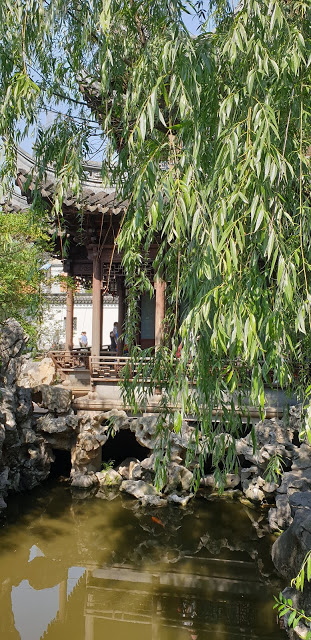
The Yu Gardens (or Yuyuan Gardens) are located at No. 137, Anren Street, Huangpu District, very close to the Old City God Temple, in the northeast of the Old City of Shanghai at Huangpu.
Yu Garden was first built in 1559 during the Ming Dynasty by Pan Yunduan and finished approximately 1577, created specifically as a private garden of the Pan family for Pan Yunduan’s parents to enjoy in their old age.
Yu Garden occupies an area of 5 acres, and is divided into six general areas:
-Sansui Hall which includes the Grand Rockery was originally used to entertain guests,
-Wanhua Chamber is a delicate building surrounded by derious cloisters,
-Dianchun Hall, built in 1820, includes Treasury Hall and the Hall of Harmony,
-Huijing Hall which includes Jade Water Corridor.
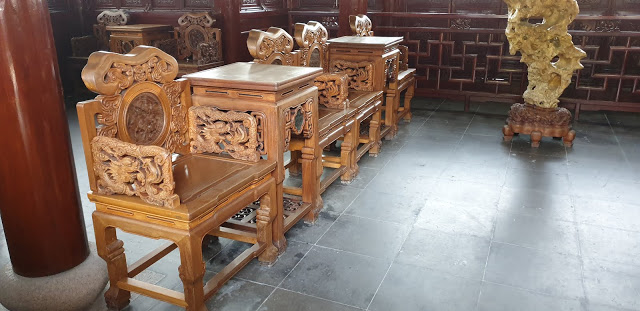
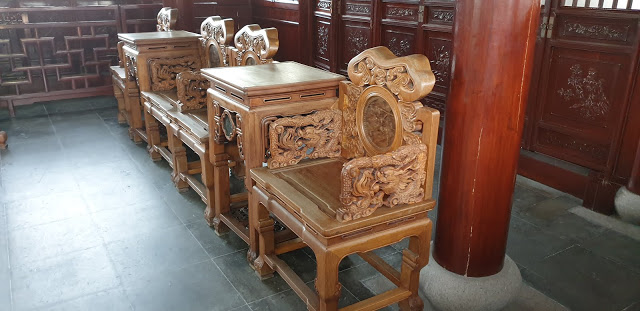
-Yuhua Hall which is furnished with rosewood pieces from the Ming Dynasty, and,
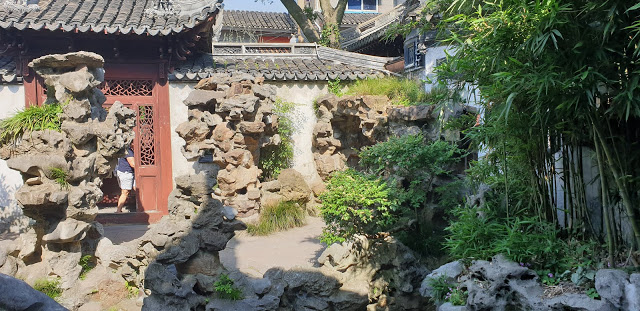
-The Inner Garden with rockeries, ponds, pavilions, and towers; first laid out in 1709. As the quietest part of Yu Gardens, it includes the Hall of Serenity and the Acting and Singing Stage.
The Mid-Lake Pavilion Teahouse, within the gardens, is the oldest teahouse in Shanghai.
A centerpiece of the gardens is the Exquisite Jade Rock, a 5-ton boulder that was originally meant for the Huizong Emperor (Northern Song Dynasty from 1100-1126 AD) but was salvaged from the Huangpu River after the boat carrying it had sunk.
These gardens house a lot of buildings that seemed to be a perfect blend of the old and the new, and if it was up to me, I’d keep the old. Both the building and the gardens they are set in are like an oasis in the middle of an industrial complex, and perhaps impractical for the number of people living in Shanghai.
All of the ponds had a lot of fish in them
It was a pleasant afternoon, for both a stroll through the gardens
In and out of the rockery on narrow pathways
And to look inside the buildings that were sparsely furnished
There was even an area set aside for entertainment.
So, the first treat for the day is the high-speed magnetic train, something we only learned about after arriving in China and was not on any of the pre-tour documentation.
The train line connects Shanghai Pudong International Airport and Longyang Road Station (in the outskirts of central Pudong). It is the oldest commercial maglev still in operation, and the first commercial high-speed maglev with cruising speed of 431 km/h (268 mph). At full speed, the journey takes 7 minutes and 20 seconds to complete the distance of about 30 km.
Construction of the line began on March 1, 2001 and public services commenced on 1 January 2004. It was built by a joint venture of Siemens and ThyssenKrupp from Kassel, Germany.
But, like visiting anything from a hotel, first we have to drive to the station and because we are leaving at 8, its peak hour traffic, and it takes 1 hour 10 minutes to get there.
The train also has a practical use and that is to take passengers from Shanghai to Pudong international airport as well as for those train enthusiasts, which is what we are.
On the train, it has the same sleek look as the bullet trains, but it is completely different, and you are able to see from the front of the train to the back.
Reputed to travel at 431 kph we take a seat and it is not long before the doors shut, and a loud humming noise is soon replaced by what sounds like an engine, then we start moving. It sounds just like a normal train, and is a lot noisier than a normal bullet train.
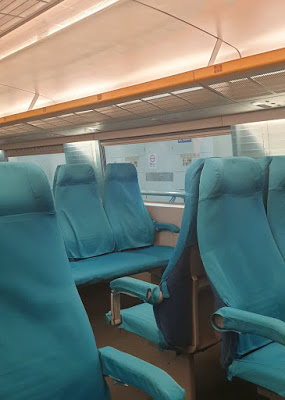
Seating on the train was nothing special, as one might expect
It didn’t take long before it hits the advertised speed of 431 kph. This is not sustained for very long, because the distance is on 40 odd kilometers, and the whole trip takes about 7 minutes.
We go to the airport, and then we come back. Is it worth the price, yes. If you are a train enthusiast.
When we arrive at the embarkation site we find at least 100 buses all lined up and parked, and literally thousands of Chinese and other Asians streaming through the turnstiles to get on another boat leaving earlier than ours.
Buses were just literally arriving one after the other stopping near where we were standing with a dozen or so other groups waiting patiently, and with people were everywhere it could only be described as organized chaos.
Someone obviously knew where everyone was supposed to go, and when it was our turn, we joined the queue. There were a lot of people in front of us, and a lot more behind, so I had to wonder just how big the boat was.
We soon found out.
And it was amusing to watch people running, yes, they were actually running, to get to the third level, or found available seating. Being around the first to board, we had no trouble finding a seat on the second level.
I was not quite sure what the name of the boat was, but it had 3 decks and VIP rooms and it was huge, with marble staircases, the sort you could make a grand entrance on. The last such ornate marble staircase we had seen was in a hotel in Hong Kong, and that was some staircase.
But who has marble staircases in a boat?
We’re going out across the water as far as the Bund and then turn around and come back about 30 to 40 minutes. By the time everyone was on board, there was no room left on the third level, no seats on the second level nor standing room at the end of the second level where the stairs up to the third level were.
No one wanted to pay the extra to go into the VIP lounge.
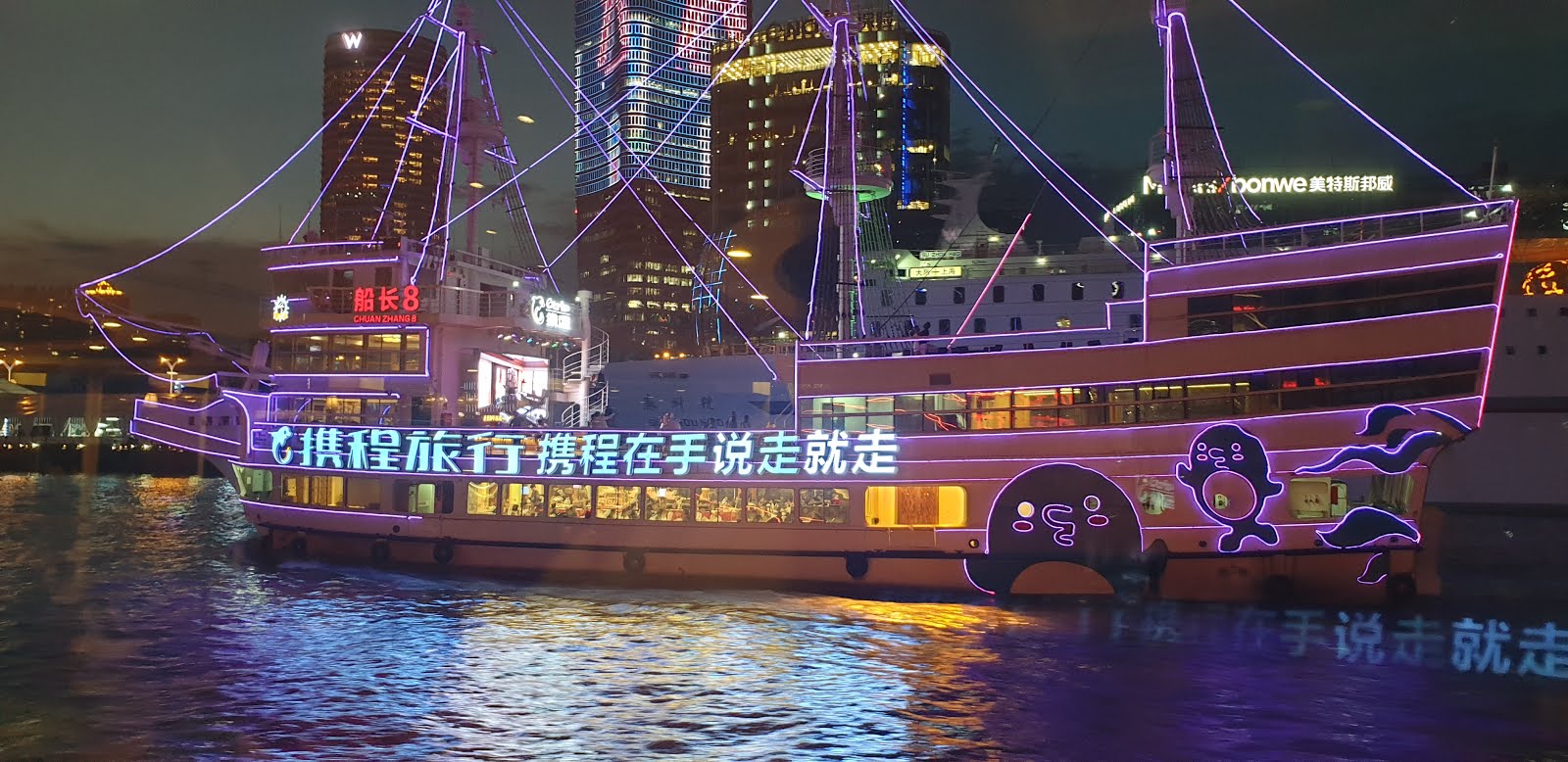
We were sitting by very large windows where it was warm enough watching the steady procession of the colored lights of other vessels, and outside the buildings.
It was quite spectacular, as were some of the other boats going out on the harbor.
All the buildings of the Bund were lit up
And along that part of the Bund was a number of old English style buildings made from sandstone, and very impressive to say the least.
On the other side of the harbour were the more modern buildings, including the communications tower, a rather impressive structure.
I had to go to the rear of the vessel to get a photo, a very difficult proposition given here was no space on the railing, not even on the stairs going up or down. It was just luck I managed to get some photos between passengers heads.
And, another view of that communications tower:
There was no doubt this was one of the most colourful night-time boat tours I’ve ever been on. Certainly, when we saw the same buildings the following day, they were not half as spectacular in daylight.
I never did get up to the third level to see what the view was like.
Perhaps not, but now seems to be an appropriate time, nearing the age of 70, to take stock.
We have achieved a lot in the last 15 or so years once the children had grown up and could look after themselves.
Unlike a lot of more modern couples who are doing the traveling in their 20s and 30s and then having children, we chose to do it the other way around.
To me, it seemed easier to deal with teenagers when we were in our 40s rather than our 60s. With the benefit of hindsight, I can truthfully say we were right.
We were older and wiser when we travelled and more aware of the dangers around us, sometimes overlooked or ignored by a youthful devil-may-care attitude.
But, in saying that ….
No, I don’t think I’ll be getting to see Mt Kilimanjaro, observing the wild animals in the Serengeti, climbing Mt Everest, or seeing the ancient pyramids.
But, if it is ever possible before I die, I still want to go to the Greek Islands, and, Santorini is at the top of my travel bucket list.
We’ve been to London. We’ve been to Paris and Euro Disney. We’ve been to Rome and seen the ancient ruins. We’ve been to Vienna, Schonbrunn Palace, and, particularly for us, a visit to Swarovski crystal world, near Innsbruck, we’ve been to Salzburg, and been on the Sound of Music tour.
We’ve been to Florence and loved it, we’ve been to Venice and loved that too, and we’ve spent a few days in the heart of Tuscany, and want to go back for longer, much longer.
In fact, that’s the second item on the travel bucket list.
We’ve also been to Singapore and Hong Kong, at first out of necessity as an airline stopover, but then we went back to see the city and tourist, and non-tourist attractions.
I will not forget staying at the Hong Kong Conrad hotel as a Diamond Hhonors member. Oh, the memories.
We’ve also stayed on the French Riviera, in a timeshare apartment in Antibes where every morning when out back you had a view of the shimmering Mediterranean if the sun was out.
Nice, Cannes, Monte Carlo, the billionaire’s yachts in Antibes harbour, Monte Carlo and ‘that’ casino, taking the same drive along the coast as Grace Kelly did in To Catch a Thief, and feeling like James Bond arriving for a new adventure, minus the half-million-dollar sports car.
But, now, crashing back to earth with a very hard thump ….
Travel in the future is looking difficult for both of us, not only financially but from a health aspect. We are both not as sprightly as we used to be.
Yet given the restraints and if it is at all possible, aside from the Greek Islands and Tuscany, the next items on the list are:
Germany, visiting both Berlin, from a cold war aspect, the Brandenburg gate springs to mind, and Munich at the time of the Octoberfest. As a beer drinker that is also high on my bucket list.
Scotland, more so since we’ve started watching Outlander, and besides being a beer drinker, I am also partial to a good Single Malt, the Whiskey Trail.
Ireland, because my wife’s previous name was Murphy and at some point, in the long distant past some relatives emigrated to Australia, and she would like to visit the country of her forebears.
But with the current state of the world, our health issues, and that all-important requisite money, or the lack of it, perhaps it’s time to visit other parts of our own country.
Perhaps it’s time to do a culinary trip, particularly down south. It’s practical and achievable and safe.
When we arrive at the embarkation site we find at least 100 buses all lined up and parked, and literally thousands of Chinese and other Asians streaming through the turnstiles to get on another boat leaving earlier than ours.
Buses were just literally arriving one after the other stopping near where we were standing with a dozen or so other groups waiting patiently, and with people were everywhere it could only be described as organized chaos.
Someone obviously knew where everyone was supposed to go, and when it was our turn, we joined the queue. There were a lot of people in front of us, and a lot more behind, so I had to wonder just how big the boat was.
We soon found out.
And it was amusing to watch people running, yes, they were actually running, to get to the third level, or found available seating. Being around the first to board, we had no trouble finding a seat on the second level.
I was not quite sure what the name of the boat was, but it had 3 decks and VIP rooms and it was huge, with marble staircases, the sort you could make a grand entrance on. The last such ornate marble staircase we had seen was in a hotel in Hong Kong, and that was some staircase.
But who has marble staircases in a boat?
We’re going out across the water as far as the Bund and then turn around and come back about 30 to 40 minutes. By the time everyone was on board, there was no room left on the third level, no seats on the second level nor standing room at the end of the second level where the stairs up to the third level were.
No one wanted to pay the extra to go into the VIP lounge.
We were sitting by very large windows where it was warm enough watching the steady procession of the colored lights of other vessels, and outside the buildings.
It was quite spectacular, as were some of the other boats going out on the harbor.
All the buildings of the Bund were lit up
And along that part of the Bund was a number of old English style buildings made from sandstone, and very impressive to say the least.
On the other side of the harbour were the more modern buildings, including the communications tower, a rather impressive structure.
I had to go to the rear of the vessel to get a photo, a very difficult proposition given here was no space on the railing, not even on the stairs going up or down. It was just luck I managed to get some photos between passengers heads.
And, another view of that communications tower:
There was no doubt this was one of the most colourful night-time boat tours I’ve ever been on. Certainly, when we saw the same buildings the following day, they were not half as spectacular in daylight.
I never did get up to the third level to see what the view was like.
Self-published authors are fully aware that perhaps the easiest part of the writing journey is the actual writing. Well, compared to the marketing aspect I believe it is.
I have read a lot of articles, suggestions, and tips and tricks to market the book to the reading public. It is, to say the least, a lot harder to market eBooks than perhaps their hard or paper-back relatives.
This is despite the millions of eReaders out there.
Then there is that other fickle part of the publishing cycle, the need for reviews.
Proper reviews of course.
As we are learning, reviews can be bought. And Amazon is out there seeking what it calls unverified reviews and reviewers and it had brought with it very strict control over who can leave a review, especially on Amazon.
Another site where reviews are taken seriously is the Goodreads website where I have established a presence, and expect in due course, some reviews.
But, all the advice I have seen and read tells me that reviews should not be paid for, and that reviews will come with sales. It might be a difficult cycle, more reviews mean more sales, etc.
And getting those first sales …
Therein lies the conundrum. It is a question of paying for advertising or working it out for ourselves. I guess if I were to get more sales, I could afford the advertising … yes, back on the merry-go-round!
And yet, the harder the road, the more I enjoy what I do. It is exhilarating while writing, it is a joy to finish the first draft, it is an accomplishment when it is published, but when you sell that first book, well, there is no other feeling like it.
West Lake is a freshwater lake in Hangzhou, China. It is divided into five sections by three causeways. There are numerous temples, pagodas, gardens, and artificial islands within the lake.
Measuring 3.2 kilometers (2 miles) in length, 2.8 kilometers (1.7 miles) in width, and 2.3 meters (7.5 feet) in average depth, the lake spreads itself in an area totaling 6.5 square kilometers (2.5 square miles).
The earliest recorded name for West Lake was the “Wu Forest River”, but over time it changed to two distinct names. One is “Qiantang Lake”, due to the fact that Hangzhou was called “Qiantang” in ancient times. The other, “West Lake”, due to the lake being west of the city
It’s about to get busy, with a number of activities planned, and the warmth of the day is starting to make an impact.
The tour starts in the car park about a kilometer away, but the moment we left the car park we were getting a taste of the park walking along a tree-lined avenue.
When we cross the road, once again dicing with death with the silent assassins on motor scooters.
We are in the park proper, and it is magnificent, with flowers, mostly at the start hydrangeas and then any number of other trees and shrubs, some carved into other flower shapes like a lotus.
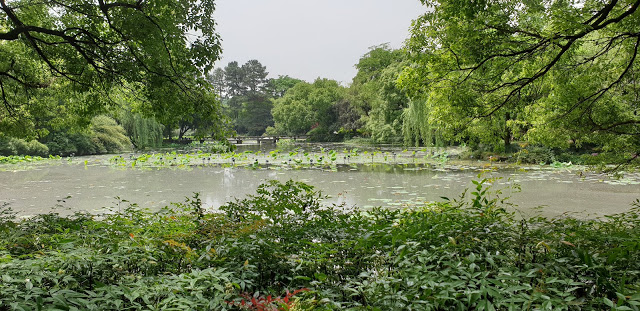
Then there was the lake and the backdrop of bridges and walkways.
.
And if you can tune out the background white noise the place would be great for serenity and relaxation.
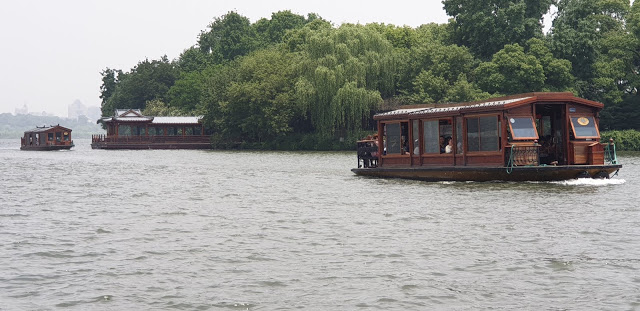
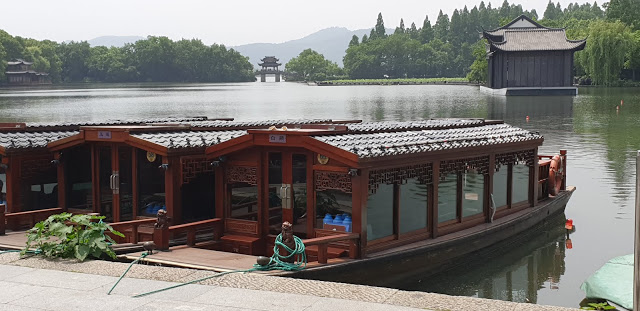
That, in fact, was how the boat ride panned out, about half an hour or more gliding across the lake in an almost silent boat, by an open window, with the air and the majestic scenery.
No, not that boat, which would be great to have lunch on while cruising, but the boat below:
Not quite in the same class, but all the same, very easy to tune out and soak it in.
It was peaceful, amazingly quiet, on a summery day
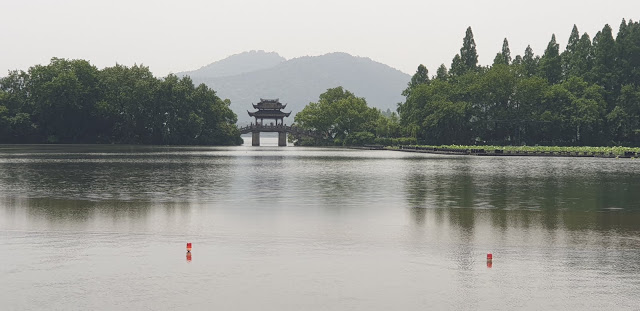
A pagoda in the hazy distance, an island we were about to circumnavigate.
Of all the legends, the most touching one is the love story between Bai Suzhen and Xu Xi’an. Bai Suzhen was a white snake spirit and Xu Xi’an was a mortal man.
They fell in love when they first met on a boat on the West Lake, and got married very soon after.
However, the evil monk Fa Hai attempted to separate the couple by imprisoning Xu Xi’an. Bai Suzhen fought against Fa Hai and tried her best to rescue her husband, but she failed and was imprisoned under the Leifeng Pagoda by the lake.
Years later the couple was rescued by Xiao Qing, the sister of Baisuzhen, and from then on, Bai Suzhen and Xu Xi’an lived together happily.
The retelling of the story varied between tour guides, and on the cruise boat, we had two. Our guide kept to the legend, the other tour guide had a different ending.
Suffice to say it had relevance to the two pagodas on the far side of the lake.
There was a cafe or restaurant on the island, but that was not our lunch destination.
Nor were the buildings further along from where we disembarked.
All in all the whole cruise took about 45 minutes and was an interesting break from the hectic nature of the tour.
Oh yes, and the boat captain had postcards for sale. We didn’t buy any.
Lunch
At the disembarkation point there was a mall that sold souvenirs and had a few ‘fast food’ shops, and a KFC, not exactly what we came to China for, but it seemed like the only place in town a food cautious Australian could eat at.
And when tried to get in the door, that’s where at least 3 busloads were, if they were not in the local Starbucks. Apparently, these were the places of first choice wherever we went.
The chicken supply by the time we got to the head of the line amounted to pieces at 22.5 RMB a piece and nuggets. Everything else had run out, and for me, there were only 5 pieces left. Good thing there were chips.
And Starbucks with coffee and cheesecake.
At least the setting for what could have been a picnic lunch was idyllic.