The time has come to work on the second draft for the editor, taking into account all of the suggested changes, and there are quite a few. So much for thinking I could put in an almost flawless manuscript.
…
I’m not going to get this finished, but there is an upside.
After writing the latest parts to the story, it gave me a sense of how it is going to end.
This story is probably the first where I had the end written before it started, a novel idea to writing stories, and it’s good to realize that after neatly 80,000 words, the end ties up the story exactly the way I wanted it to end.
It’s just what happens between the beginning and the end changed a lot during the month.
I dropped out the revenge part, which became a short story in itself, so it will be told later in a novella, and it made sense to stick to the original plan, the main character starts out as the protector, and is slowly drawn into the revolution.
He doesn’t have an active role in it, just maintaining a presence in the background, until Teresa forces his hand.
The rest, well, you’ll have to read the story when it’s finished. Tomorrow I’m going to try and write a blurb, that will give the reader some idea of what the story is about.
The time has come to work on the second draft for the editor, taking into account all of the suggested changes, and there are quite a few. So much for thinking I could put in an almost flawless manuscript.
…
We’re near the end, and I have to say, it has been hard work.
Today I’ve been writing, revising and reading. There are aspects to the flow that are bothering me, and I know I’m supposed to let it mull for a while before I start editing, but I’m like that, I have to do something about it now, not later.
While I’m doing that, I’ve been working on a musical theme for the writing and hit upon the big band sounds of the 1940s and ’50s.
I have always been fascinated by that era of music, particularly Benny Goodman, but not so much the Dorsey brothers.
It then led to the final chapter, as I was playing Sing, Sing, Sing, I had the vision, in the ballroom, just our main character, and Teresa, with a few selected guests.
I’m also one of those people who like happy endings to the stories, or at least until the next book in the series starts.
Instead of making a grand entrance, arriving in style and being greeted by important dignitaries, we are slinking in via an airplane, late at night. It’s hardly the entrance I’d envisaged. At 9:56 the plane touches down on the runway. Outside the plane, it is dark and gloomy and from what I could see, it had been raining. That could, of course, simply be condensation.
Once on the ground, everyone was frantically gathering together everything from seat pockets and sending pillows and blankets to the floor. A few were turning their mobile phones back on, and checking for a signal, and, perhaps, looking for messages sent to them during the last 12 hours. Or perhaps they were just suffering from mobile phone deprivation.
It took 10 minutes for the plane to arrive at the gate. That’s when everyone moves into overdrive, unbuckling belts, some before the seatbelt sign goes off, and are first out of their seats and into the overhead lockers. Most are not taking care that their luggage may have moved, but fortunately, no bags fall out onto someone’s head. The flight had been relatively turbulent free.
When as many people and bags have squeezed into that impossibly small aisle space, we wait for the door to open, and then the privileged few business and first-class passengers to depart before we can begin to leave. As we are somewhere near the middle of the plane, our wait will not be as long as it usually is. This time we avoided being at the back of the plane. Perhaps that privilege awaits us on the return trip.
Once off the plane, it is a matter of following the signs, some of which are not as clear as they could be. It’s why it took another 30 odd minutes to get through immigration, but that was not necessarily without a few hiccups along the way. We got sidetracked at the fingerprint machines, which seemed to have a problem if your fingers were not straight, not in the center of the glass, and then if it was generally cranky, which ours were, continue to tell you to try again, and again, and again, and again…That took 10 to 15 minutes before we joined an incredibly long queue of other arrivals,
A glance at the time, and suddenly it’s nearly an hour from the moment we left the plane.
And…
That’s when we got to the immigration officer, and it became apparent we were going to have to do the fingerprints yet again. Fortunately this time, it didn’t take as long. Once that done, we collected our bags, cleared customs by putting our bags through a huge x-ray machine, and it was off to find our tour guide.
We found several tour guides with their trip-a-deal flags waiting for us to come out of the arrivals hall. It wasn’t a difficult process in the end. We were in the blue group. Other people we had met on the plane were in the red group or the yellow group. The tour guide found, or as it turned out she found us, it was simply a matter of waiting for the rest of the group, of which there were eventually 28.Gathered together we were told we would be taking the bags to one place and then ourselves to the bus in another. A glance in the direction of the bus park, there were a lot of busses.
Here’s a thought, imagine being told your bus is the white one with blue writing on the side.
Yes, yours is, and 25 others because all of the tourist coaches are the same. An early reminder, so that you do not get lost, or, God forbid, get on the wrong bus, for the three days in Beijing, is to get the last five numbers of the bus registration plate and commit them to memory. It’s important. Failing that, the guide’s name is in the front passenger window.
Also, don’t be alarmed if your baggage goes in one direction, and you go in another. In a rather peculiar set up the bags are taken to the hotel by what the guide called the baggage porter. It is an opportunity to see how baggage handlers treat your luggage; much better than the airlines it appears.
That said, if you’re staying at the Beijing Friendship Hotel, be prepared for a long drive from the airport. It took us nearly an hour, and bear in mind that it was very late on a Sunday night.
Climbing out of the bus after what seemed a convoluted drive through a park with buildings, we arrive at the building that will be our hotel for the next three days. From the outside, it looks quite good, and once inside the foyer, that first impression is good. Lots of space, marble, and glass. If you are not already exhausted by the time you arrive, the next task is to get your room key, find your bags, get to your room, and try to get to be ready the next morning at a reasonable hour.
Sorry, that boat has sailed.
We were lucky, we were told, that our plane arrived on time, and we still arrived at the hotel at 12:52. Imagine if the incoming plane is late.
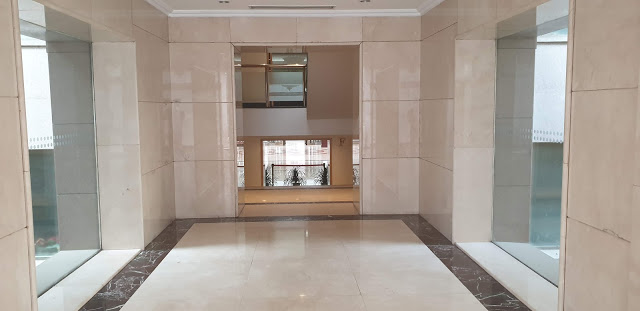
This was taken the following morning. It didn’t look half as bland late at night.
This is the back entrance to Building No 4 but is quite representative of the whole foyer, made completely of marble and glass. It all looked very impressive under the artificial lights, but not so much in the cold hard light of early morning.
This the foyer of the floor our room was on. Marble with interesting carpet designs. Those first impressions of it being a plush hotel were slowly dissipating as we got nearer and nearer to the room. From the elevator, it was a long, long walk.
So…Did I tell you about the bathroom in our room?
The shower and the toilet both share the same space with no divide and the shower curtain doesn’t reach to the floor. Water pressure is phenomenal. Having a shower floods the whole shower plus toilet area so when you go to the toilet you’re basically underwater.
Don’t leave your book or magazine on the floor or it will end up a watery mess.
And the water pressure is so hard that it could cut you in half. Only a small turn of the tap is required to get that tingling sensation going.
It’s quite remarkable to discover that your children are not unique.
For years I thought that we had spawned monsters that had quite likely come from another planet because the other children in the family seemed so different.
I didn’t realise that the parents had issued death threats if they so much as looked sideways while out.
It was where I suddenly realised that parents of children if taken at their word, could be mass murderers, or at the very best, the worst kind of bullies.
The threats of violence that they used, in any other circumstances would elicit a rather lengthy jail sentence.
I was guilty of it myself, and such threats had come to roll off the tongue so easily that you didn’t really know you were doing it.
If you don’t do this, I’ll kill you. There’s no thought to the significance of this statement, or the consequences if you were to actually do it.
No wonder the children just look at you like you’re deranged.
Of course, there are fewer murderous ways of dealing with the problem, but the sad fact is they have probably driven you into a blind rage and just past into that zone where you really have no idea what you’re saying.
Been there too.
But the revelation that all the other parents are the same, that you see them threatening their children with death or worse.
Then, after they’ve grown up and moved on as all children do, they return on odd occasions for Sunday lunch and there you begin to learn the stuff they did when younger that you never knew about
It’s seeming a rite of passage for all children, and it’s odd to hear others discussing it, especially when you hear someone else referring to their children the same as you do.
Did they come from the same planet too?
That’s when a friend told me the truth of the matter. All children are the same, they just live in different houses.
When we first planned to stay in Tuscany for a few days, we wanted to be in a central area. We had thought of staying in Florence and making daily treks, but the tour operator we selected told us it would be better if we stayed closer to Arezzo.
We picked Greve in Chianti, and a place called Antico Pastificio, we booked a standard apartment with two bedrooms, and it was about as authentic Italian you could get. The building we stayed in was the yellow pasta factory, and the apartment named ‘Iris’.
It was only steps away from the main square, shops, restaurants, and at the opposite end, the quaint ringing of church bells at various times during the day.
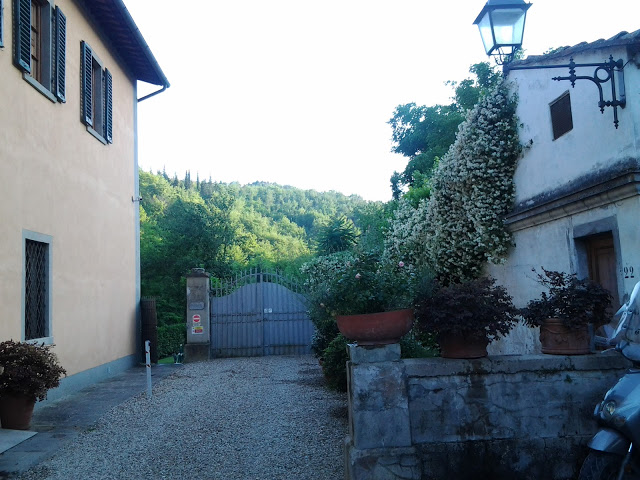
Gaining access was through a very narrow arch which required some deft driving and then up the road. There were villas and two large apartment blocks.
You can just see the archway at the end of the road. This was the entrance to our room,
along a passage and up the stairs, turning left at the top.
Going straight ahead through the gate to the car park,
and access to the grounds behind the buildings.
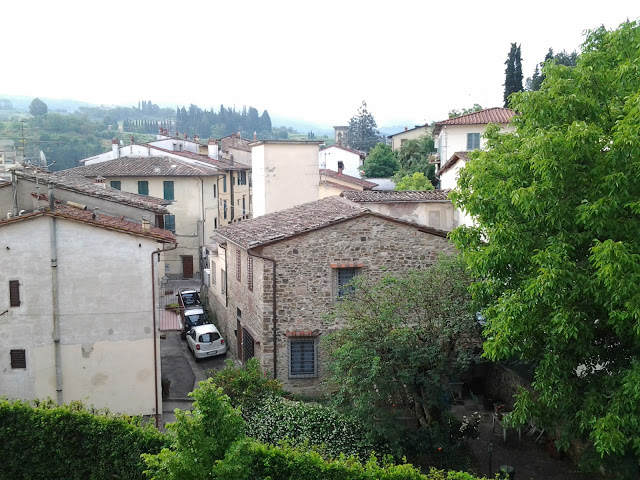
This was the view from the lounge/living room. The days were hot, and on several evenings it rained, breaking the heat and making the evenings sitting by the window cool and refreshing.
And the last view is looking towards the town piazza and the church
The time has come to work on the second draft for the editor, taking into account all of the suggested changes, and there are quite a few. So much for thinking I could put in an almost flawless manuscript.
…
Sometimes it takes a failure to make a success.
Well, that’s the theme I’m running with.
Of course, the leaders of the revolution take that failed attempt as a bad sign, but a severe setback sometimes causes that sort of introspection.
And the revolutionaries never quite know who’s on their side and who isn’t.
And there are those who are trying to keep out of harm’s way, do their job, and still get caught up in the middle of a war.
Revolutions are more than just the capture of radio stations, army barracks, and the airport. It’s always a good thing when a country doesn’t have too many airports or army bases. It also helps that the country is small and manageable and that its current leaders are corrupt and self-serving, and some very dangerous.
They are also helped by having the heart and soul of the citizens, not so much that they would take up arms and fight, rather, do nothing and get in the way. That in itself could be dangerous, but sometimes people act without thinking of the consequences.
Those you would least expect to step up and be counted.
It’s going to take more words than I have before it is supposed to be written by the end of the month, so this story is going to run into overtime.
So, stay tuned, for daily reports on how the revolution is progressing.
The time has come to work on the second draft for the editor, taking into account all of the suggested changes, and there are quite a few. So much for thinking I could put in an almost flawless manuscript.
…
We’re near the end, and I have to say, it has been hard work.
Today I’ve been writing, revising and reading. There are aspects to the flow that are bothering me, and I know I’m supposed to let it mull for a while before I start editing, but I’m like that, I have to do something about it now, not later.
While I’m doing that, I’ve been working on a musical theme for the writing and hit upon the big band sounds of the 1940s and ’50s.
I have always been fascinated by that era of music, particularly Benny Goodman, but not so much the Dorsey brothers.
It then led to the final chapter, as I was playing Sing, Sing, Sing, I had the vision, in the ballroom, just our main character, and Teresa, with a few selected guests.
I’m also one of those people who like happy endings to the stories, or at least until the next book in the series starts.
Instead of making a grand entrance, arriving in style and being greeted by important dignitaries, we are slinking in via an airplane, late at night. It’s hardly the entrance I’d envisaged. At 9:56 the plane touches down on the runway. Outside the plane, it is dark and gloomy and from what I could see, it had been raining. That could, of course, simply be condensation.
Once on the ground, everyone was frantically gathering together everything from seat pockets and sending pillows and blankets to the floor. A few were turning their mobile phones back on, and checking for a signal, and, perhaps, looking for messages sent to them during the last 12 hours. Or perhaps they were just suffering from mobile phone deprivation.
It took 10 minutes for the plane to arrive at the gate. That’s when everyone moves into overdrive, unbuckling belts, some before the seatbelt sign goes off, and are first out of their seats and into the overhead lockers. Most are not taking care that their luggage may have moved, but fortunately, no bags fall out onto someone’s head. The flight had been relatively turbulent free.
When as many people and bags have squeezed into that impossibly small aisle space, we wait for the door to open, and then the privileged few business and first-class passengers to depart before we can begin to leave. As we are somewhere near the middle of the plane, our wait will not be as long as it usually is. This time we avoided being at the back of the plane. Perhaps that privilege awaits us on the return trip.
Once off the plane, it is a matter of following the signs, some of which are not as clear as they could be. It’s why it took another 30 odd minutes to get through immigration, but that was not necessarily without a few hiccups along the way. We got sidetracked at the fingerprint machines, which seemed to have a problem if your fingers were not straight, not in the center of the glass, and then if it was generally cranky, which ours were, continue to tell you to try again, and again, and again, and again…That took 10 to 15 minutes before we joined an incredibly long queue of other arrivals,
A glance at the time, and suddenly it’s nearly an hour from the moment we left the plane.
And…
That’s when we got to the immigration officer, and it became apparent we were going to have to do the fingerprints yet again. Fortunately this time, it didn’t take as long. Once that done, we collected our bags, cleared customs by putting our bags through a huge x-ray machine, and it was off to find our tour guide.
We found several tour guides with their trip-a-deal flags waiting for us to come out of the arrivals hall. It wasn’t a difficult process in the end. We were in the blue group. Other people we had met on the plane were in the red group or the yellow group. The tour guide found, or as it turned out she found us, it was simply a matter of waiting for the rest of the group, of which there were eventually 28.Gathered together we were told we would be taking the bags to one place and then ourselves to the bus in another. A glance in the direction of the bus park, there were a lot of busses.
Here’s a thought, imagine being told your bus is the white one with blue writing on the side.
Yes, yours is, and 25 others because all of the tourist coaches are the same. An early reminder, so that you do not get lost, or, God forbid, get on the wrong bus, for the three days in Beijing, is to get the last five numbers of the bus registration plate and commit them to memory. It’s important. Failing that, the guide’s name is in the front passenger window.
Also, don’t be alarmed if your baggage goes in one direction, and you go in another. In a rather peculiar set up the bags are taken to the hotel by what the guide called the baggage porter. It is an opportunity to see how baggage handlers treat your luggage; much better than the airlines it appears.
That said, if you’re staying at the Beijing Friendship Hotel, be prepared for a long drive from the airport. It took us nearly an hour, and bear in mind that it was very late on a Sunday night.
Climbing out of the bus after what seemed a convoluted drive through a park with buildings, we arrive at the building that will be our hotel for the next three days. From the outside, it looks quite good, and once inside the foyer, that first impression is good. Lots of space, marble, and glass. If you are not already exhausted by the time you arrive, the next task is to get your room key, find your bags, get to your room, and try to get to be ready the next morning at a reasonable hour.
Sorry, that boat has sailed.
We were lucky, we were told, that our plane arrived on time, and we still arrived at the hotel at 12:52. Imagine if the incoming plane is late.
This was taken the following morning. It didn’t look half as bland late at night.
This is the back entrance to Building No 4 but is quite representative of the whole foyer, made completely of marble and glass. It all looked very impressive under the artificial lights, but not so much in the cold hard light of early morning.
This the foyer of the floor our room was on. Marble with interesting carpet designs. Those first impressions of it being a plush hotel were slowly dissipating as we got nearer and nearer to the room. From the elevator, it was a long, long walk.
So…Did I tell you about the bathroom in our room?
The shower and the toilet both share the same space with no divide and the shower curtain doesn’t reach to the floor. Water pressure is phenomenal. Having a shower floods the whole shower plus toilet area so when you go to the toilet you’re basically underwater.
Don’t leave your book or magazine on the floor or it will end up a watery mess.
And the water pressure is so hard that it could cut you in half. Only a small turn of the tap is required to get that tingling sensation going.
It’s quite remarkable to discover that your children are not unique.
For years I thought that we had spawned monsters that had quite likely come from another planet because the other children in the family seemed so different.
I didn’t realise that the parents had issued death threats if they so much as looked sideways while out.
It was where I suddenly realised that parents of children if taken at their word, could be mass murderers, or at the very best, the worst kind of bullies.
The threats of violence that they used, in any other circumstances would elicit a rather lengthy jail sentence.
I was guilty of it myself, and such threats had come to roll off the tongue so easily that you didn’t really know you were doing it.
If you don’t do this, I’ll kill you. There’s no thought to the significance of this statement, or the consequences if you were to actually do it.
No wonder the children just look at you like you’re deranged.
Of course, there are fewer murderous ways of dealing with the problem, but the sad fact is they have probably driven you into a blind rage and just past into that zone where you really have no idea what you’re saying.
Been there too.
But the revelation that all the other parents are the same, that you see them threatening their children with death or worse.
Then, after they’ve grown up and moved on as all children do, they return on odd occasions for Sunday lunch and there you begin to learn the stuff they did when younger that you never knew about
It’s seeming a rite of passage for all children, and it’s odd to hear others discussing it, especially when you hear someone else referring to their children the same as you do.
Did they come from the same planet too?
That’s when a friend told me the truth of the matter. All children are the same, they just live in different houses.
The time has come to work on the second draft for the editor, taking into account all of the suggested changes, and there are quite a few. So much for thinking I could put in an almost flawless manuscript.
…
We’re near the end, and I have to say, it has been hard work.
Today I’ve been writing, revising and reading. There are aspects to the flow that are bothering me, and I know I’m supposed to let it mull for a while before I start editing, but I’m like that, I have to do something about it now, not later.
While I’m doing that, I’ve been working on a musical theme for the writing and hit upon the big band sounds of the 1940s and ’50s.
I have always been fascinated by that era of music, particularly Benny Goodman, but not so much the Dorsey brothers.
It then led to the final chapter, as I was playing Sing, Sing, Sing, I had the vision, in the ballroom, just our main character, and Teresa, with a few selected guests.
I’m also one of those people who like happy endings to the stories, or at least until the next book in the series starts.