Harry Walthenson, Private Detective

Harry is embarking on his second case, this time with Felicity as his investigative partner.  This time it’s closer to home when his father goes missing leaving a cryptic note behind.  Harry’s mother becomes the client, giving Harry the job of finding him.

But, all is not what it appears.

His father’s colleagues are sure he’s just taken off with a new mistress, something he apparently does from time to time.  His associates seem unworried about his departure.

And when Harry and Felicity discover a connection between his father and a major crime family, people who are possibly responsible for the near-death experience Harry had during his last investigation, things start to heat up in more ways than one.

Who is Emil Florenz, a golf partner, psychiatrist, and property developer?

Who is Augustus Shawville, the proverbial international man of mystery?

Who is Orville Argeter, an accountant who has numerous clients who often find themselves on the wrong side of the legal ledger?

Then there’s a host of family connections,

The forever looming specter of Harry’s grandfather, Jeremiah Walthenson, deceased

His first wife, Giselle White, divorced, who works in the practice’s archive, disillusioned and disappointed in the way her marriage ended

Alicia Wentworth an alleged gold digger and the woman who stole Jeremiah away from Giselle, and is suspected by the family of murdering Jeremiah for his fortune

Harry’s mother, Elsie Wilkinson, one of the Boston Wilkinson’s who are wealthy beyond imagining, and who once had a relationship with Florenz.

Who, of these, knows the truth?

Well, it’s time to find out.

Short Story writing: don’t try this at home!

This is not a treatise on how to write short stories.  Everyone has one in them, possibly more, and me, well, it’s how I keep the wolves from the door.

Yes, I read my stories to them and they fall asleep.

Or maybe not, I’m never quite sure what effect anything I write has on anyone.  And, reading a lot of the posts on how to handle bad reviews and rejection, such a recurrent theme, I don’t think I want to.

Ignorance is bliss, is it not?

Well, one day I’m sure something will happen.  It’s probably in the seven stages of writing:


Euphoria

Planning

Research

Writing

Failure

Search for the guilty

Distinction for the uninvolved


I guess you don’t fail if you don’t put it out there.  Searching for the guilty, well, there’s only one person to blame, the editor, and distinction for the uninvolved, didn’t your friend, relation, confidente, significant other, say it wasn’t going to work?

But, despite everything, I like writing short stories and try to produce one in a single sitting.  I try to keep the word count down, but the stories, somehow they just evolve in my head and don’t want to end the main character’s story.

In reality, there is no end to the story unless they die, and then, of course, the story branches off, just like a family tree,

Some stories are so intricate, they need another story to fill in the gaps, and then another because the plot is running through your head at a thousand miles an hour and your fingers won’t stop typing, because if you do, it will all dissipate into thin air like smoke.

Stories can, you know, dissipate like smoke, one minute your mining a rich vein the next, you’ve hit a ton of worthless quartz.

Then all the constraints come into play, nagging at the back of your mind, and you find yourself waking up in a bath of sweat crying out, I didn’t do it, the crime that is, not lose the best 2,000 words you’ve ever written.

But that’s all of those words you write, isn’t it?

But I digress, and I’ll write some more on the subject, what was it again?


The first case of PI Walthenson – “A Case of Working With the Jones Brothers”

This case has everything, red herrings, jealous brothers, femme fatales, and at the heart of it all, greed.

See below for an excerpt from the book…

Coming soon!
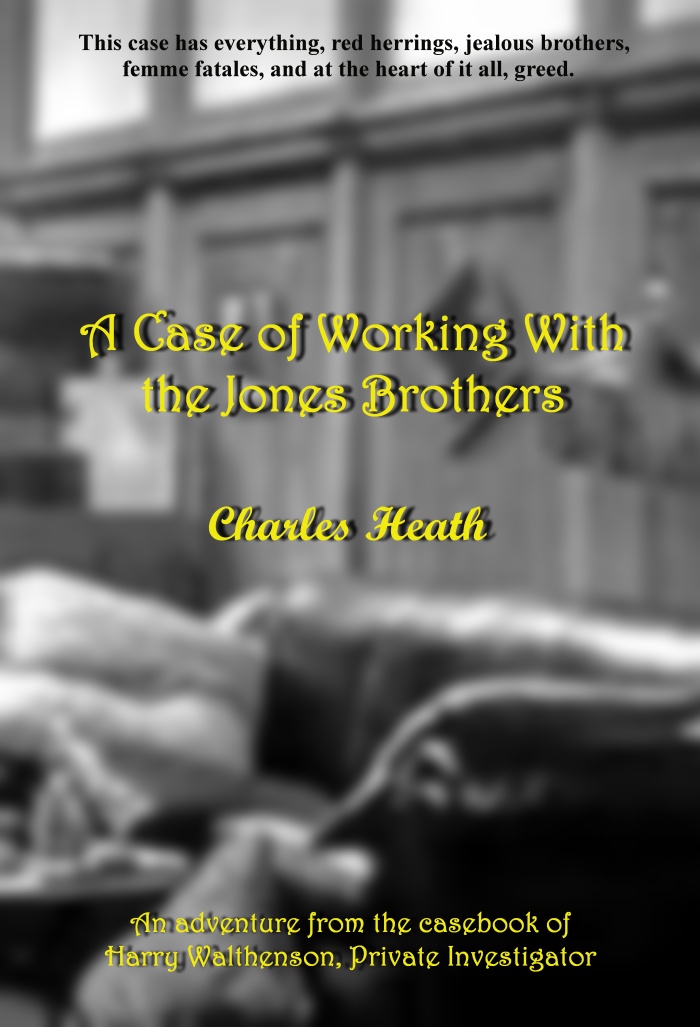
PIWalthJones1


An excerpt from the book:


When Harry took the time to consider his position, a rather uncomfortable position at that, he concluded that he was somehow involved in another case that meant very little to him.

Not that it wasn’t important in some way he was yet to determine, it was just that his curiosity had got the better of him, and it had led to this: sitting in a chair, securely bound, waiting for someone one of his captors had called Doug.

It was not the name that worried him so much, it was the evil laugh that had come after the name was spoken.

Doug what?  Doug the ‘destroyer’, Doug the ‘dangerous’, Doug the ‘deadly’; there was any number of sinister connotations, and perhaps that was the point of the laugh, to make it more frightening than it was.

But there was no doubt about one thing in his mind right then: he’d made a mistake.  A very big. and costly, mistake.  Just how big the cost, no doubt he would soon find out.

His mother, and his grandmother, the wisest person he had ever known, had once told him never to eavesdrop.

At the time he couldn’t help himself and instead of minding his own business, listening to a one-sided conversation which ended with a time and a place.  The very nature of the person receiving the call was, at the very least, sinister, and, because of the cryptic conversation, there appeared to be, or at least to Harry, criminal activity involved.

For several days he had wrestled with the thought of whether he should go.  Stay on the fringe, keep out of sight, observe and report to the police if it was a crime.  Instead, he had willingly gone down the rabbit hole.

Now, sitting in an uncomfortable chair, several heat lamps hanging over his head, he was perspiring, and if perspiration could be used as a measure of fear, then Harry’s fear was at the highest level.

Another runnel of sweat rolled into his left eye, and, having his hands tied, literally, it made it impossible to clear it.  The burning sensation momentarily took his mind off his predicament.  He cursed and then shook his head trying to prevent a re-occurrence.  It was to no avail.

Let the stinging sensation be a reminder of what was right and what was wrong.

It was obvious that it was the right place and the right time, but in considering his current perilous situation, it definitely was the wrong place to be, at the worst possible time.


It was meant to be his escape, an escape from the generations of lawyers, what were to Harry, dry, dusty men who had been in business since George Washington said to the first Walthenson to step foot on American soil, ‘Why don’t you become a lawyer?” when asked what he could do for the great man.

Or so it was handed down as lore, though Harry didn’t think Washington meant it literally, the Walthenson’s, then as now, were not shy of taking advice.

Except, of course, when it came to Harry.

He was, Harry’s father was prone to saying, the exception to every rule.  Harry guessed his father was referring to the fact his son wanted to be a Private Detective rather than a dry, dusty lawyer.  Just the clothes were enough to turn Harry off the profession.

So, with a little of the money Harry inherited from one of his aunts, he leased an office in Gramercy Park and had it renovated to look like the Sam Spade detective agency, you know the one, Spade and Archer, and The Maltese Falcon.

There’s a movie and a book by Dashiell Hammett if you’re interested.

So, there it was, painted on the opaque glass inset of the front door, ‘Harold Walthenson, Private Detective’.

There was enough money to hire an assistant, and it took a week before the right person came along, or, more to the point, didn’t just see his business plan as something sinister.  Ellen, a tall cool woman in a long black dress, or so the words of a song in his head told him, fitted in perfectly.

She’d seen the movie, but she said with a grin, Harry was no Humphrey Bogart.

Of course not, he said, he didn’t smoke.

Three months on the job, and it had been a few calls, no ‘real’ cases, nothing but missing animals, and other miscellaneous items.  What he really wanted was a missing person.  Or perhaps a beguiling, sophisticated woman who was as deadly as she was charming, looking for an errant husband, perhaps one that she had already ‘dispatched’.

Or for a tall, dark and handsome foreigner who spoke in riddles and in heavily accented English, a spy, or perhaps an assassin, in town to take out the mayor.  The man was such an imbecile Harry had considered doing it himself.

Now, in a back room of a disused warehouse, that wishful thinking might be just about to come to a very abrupt end, with none of the romanticized trappings of the business befalling him.  No beguiling women, no sinister criminals, no stupid policemen.

Just a nasty little man whose only concern was how quickly or how slowly Harry’s end was going to be.

© Charles Heath 2019


Writing about writing a book – Day 19

I’m still working on the sequence of flashbacks for the story, filling out the back story to how Bill became associated with a man called Colonel Davenport.

It is important to remember that while Davenport may have begun with good intentions, it was not difficult to go slowly mad given the conditions.  This character, Davenport, runs a multitude of operations within the war zone, turning a huge profit and setting up a business for when the war ended.

Bill meets his Davenport’s cronies and then the man himself.  Life is not what it seems, and working for him is not a guarantee of safety, so Bill not only has to watch out for the enemy but also those with whom he also works.


Part 3 – In the Service of Davenport

Davenport and punishment

Busted mission, the first threat to Davenport

Manilow’s death – and how he got there

More on Manilow, the night before his death

Taken to rendezvous with Davenport’s boss

Identify Davenport by ‘sniveling morons’

Sniper – killing Ellen’s father – set up

Sniper – Killing Ellen’s father, execution

Planes and death


Bill gets to meet an interesting cast of characters, not the least of which is Davenport’s right-hand men, and a very unlucky lad who was supposed to see through his tour in the command station far from the war zone, and who is connected to a person close to him.

He was also unwittingly involved in a murder, one set up by Davenport, and one designed to keep his silence.


Part 4 – The Lead up to Capture, and in a POW camp

The object that Davenport is seeking

After R & R revoked, retrieved by Davenport for the last mission

Capture by Cho’s forces, delivered by Davenport’s men

In the POW Camp, and the arrival of Cho

Day of Rescue from Cho

Ellen and Jacobson after rescue in the hospital


Bill’s safety may have been assured had he simply toed the line, but, while on a secret mission with Davenport’s men, he sees an opportunity to take some evidence of Davenport’s activities, as an act of self-preservation.

Of course, he doesn’t reckon with the ruthlessness of Davenport and ends up in a camp where Bill is handed over to the chief interrogator, a friend of Davenport’s.  There is no doubt what Cho’s mission is.

But, like all seemingly simple plans, it doesn’t go the way Davenport wants, Bill does not talk, and is eventually rescued.


Part 5 – Post Rescue and Transworld

Employment at Transworld, then first interrogation via Collins

In hospital immediately after being shot

Davenport in my hospital room, post being shot

Recognize Jorgenson


Davenport discovers Bill was rescued, and that is has lost his memory of all the time in his service, so just in case Bill does, one day, remember, he will be there to get the answers, and the missing information.

It is almost a story within a story, and maybe one day will be published as such.

At least now I have some idea of how to work the much larger story into the flashbacks, as a prelude to what happens to Bill once he realizes who is behind everything that is happening at Transworld.


© Charles Heath 2015-2020

A writer isn’t just a writer

Is he, or she?

No, we have any number of other functions, so the notion we can sit down all day every day and just write is a misnomer.

I know for a fact I can’t.

I have jobs to do around the house, and therein lies the problem.

I sit down, once the jobs for that part of the day are done, and fire up the computer, or sometimes sharpen the pencils.

Then, free to write, it’s like starting the lawnmower, wait till it settles into a steady rhythm, and then, as you begin to mow the lawn, it runs out of petrol.

Yes, that’s happened to me a few times, and only goes to highlight the other problems.

When you have to do something else, your mind is happily working on the book, story, article, piece, or whatever, and then, when you sit down, your mind is on the next lot of chores.

Only the most disciplined mind can separate the two so that each allotted timed time is allotted to the task.

Me, I suck at that.

Like now.  I want to get on with one of my longer stories, and my mind is telling me I have to write a blog post.

So, I’m writing the blog post.

I know that tomorrow I’m not going to get much writing time because the grandchildren are over for a mini stay and we’re going to see Doolittle.

But, can I get it done now?

No.  In the background, the Australia vs India one day cricket match is murmuring, and we’re not doing so good.  It’s a necessary distraction, but I still haven’t learned to multitask.

Perhaps it’s too late for that.

Anyway, I got to go.  We just got a wicket, and the tide is turning.

I hope!

In a word: Right

Am I right?  Or is that correct?

In the moral sense, or in answering a question?

Do I have a right to …

As an entitlement?

Maybe

But right means generally to be correct, but the word itself can be used, like many others in a variety of ways

Such as, do we have any rights any more, since the government is slowly shutting down our freedoms, and, you guessed it, rights.

What about a right angle, we know this as being an angle of 90 degrees

How about I right a wrong, returning a bad situation to a good one?

Are you left-handed or right-handed?

Are you one of those people who can’t tell their left from their right?

And who was it that decided what was your left or your right, ever thought about that?  I didn’t until just now.  Good luck finding an answer on Google.

And how many times have you wished you were in the right place at the right time???

Then, of course, if English is a second language, how about confusing right with write.

Means something quite different, doesn’t it?

How about rite?  Yes, I guess if we were in the habit of chopping chicken heads off and dancing around a fire, that might be its meaning,

But…

It too has a lot of different meanings

Are you confused yet?

“The Devil You Don’t”, be careful what you wish for

Now only $0.99 for a short time at  https://amzn.to/2Xyh1ow


John Pennington’s life is in the doldrums.  Looking for new opportunities, prevaricating about getting married, the only joy on the horizon was an upcoming visit to his grandmother in Sorrento, Italy.

Suddenly he is left at the check-in counter with a message on his phone telling him the marriage is off, and the relationship is over.

If only he hadn’t promised a friend he would do a favour for him in Rome.

At the first stop, Geneva, he has a chance encounter with Zoe, an intriguing woman who captures his imagination from the moment she boards the Savoire, and his life ventures into uncharted territory in more ways than one.

That ‘favour’ for his friend suddenly becomes a life-changing event, and when Zoe, the woman who he knows is too good to be true, reappears, danger and death follows.

Shot at, lied to, seduced, and drawn into a world where nothing is what it seems, John is dragged into an adrenaline-charged undertaking, where he may have been wiser to stay with the ‘devil you know’ rather than opt for the ‘devil you don’t’.

newdevilcvr3

Digging into the past

It seems rather strange reading letters that were written by my parents before they were married.

They’re not love letters, but just words, words that knowing my father and mother as I do, seem so totally at odds with that knowledge.

The thing is, I never knew anything of that era existed, even though I knew my mother was a hoarder, and we didn’t discover the extent of that phobia until it was time to move them from their last residence to the retirement home.

There were cases and boxes filled with papers, letters, cuttings, and everything else in between.  Nothing had been thrown out.

And whilst I knew those letters existed, there was the yuk factor involved, such that I would never want to read them because, well, that was my parents’ stuff.

So, all of it was sorted, most of it thrown away, and only what we thought was of any intrinsic value was kept.  Those letters were part of the ‘keep’ pile and ended up in an old metal steamer trunk, and there they have lived for about ten years.

With the recent cleaning of my office, much to Chester’s disdain, the trunk suddenly looked out of place in a clean room.

My grandchildren ‘found’ this trunk and started looking through the contents and finished up with the letters.

And, being the curious people, they were, they started reading them, of course, stumbling over understanding the handwriting, which was based on what we learned in school, cursive script.  That meant I had to interpret the writing for them.

Talk about morbid curiosity!

And like I said, in reading them, formed the impression that these two correspondents were nothing like the people I knew growing up.

These letters dated from 1948 and 1949 when they were married in June of 1949.  There was no doubt it was a different time, and they were different people.  My mother came from a country town and went to work in Melbourne around that time.  I know that during the war, those years from 1939 to 1945 she was a student at Dandenong High School.

It was odd to realize that considering we eventually moved to Dandenong, and that may have had something to do with it.

My father served in the war till 1946, and then after being discharged from the army, worked as a projectionist until he went overseas for nearly a year, ostensibly to see how the war had affected Europe.  After that, he went back to being a projectionist at the Athenaeum in Melbourne, and later on, not knowing much of his work history, he would always tell us about the movies, especially those that came up on television.

There’s more I’m sure, like the fact my mother had another chap on the go at the same time, but it seems he was not interested in settling down.

Perhaps more will come to light in further reading, but like it said, it seems very strange to be reading those letters, much like walking over a grave; it gives me the odd shiver down the spine.

No doubt, the next time the grandchildren visit there will be another installment.

They, at least, think the story is fascinating.

What means this ‘every cloud has a silver lining’?

People use this expression a lot, and despite their best intentions, what does it really mean?

Perhaps, literally, it means that bad times are like dark clouds, blocking out the sun, but we can see the lights rays behind them, and that is the silver lining.  This seems to be the most common explanation.

Where did it originate?

It is said that John Milton used the phrase ‘silver lining’ in his ‘Comus: A Mask Presented at Ludlow Castle in 1634, but it was not until much later, in Victorian England that it was expressed in more uplifting language in The Dublin Magazine in 1840, in the review of a novel, Marian; or, a Young Maid’s Fortunes.

But, figuratively, we like to think that in the event of something bad happening, there will always be something better to come from it.

It probably goes hand in hand with two other interesting expressions, things can’t get any worse, maybe because I’ve hit rock bottom.

Of course, in the first instance, you say things can’t get any worse, but they generally do, as in bad things happen in threes.

We tend to believe, for whatever reason, that if it has happened twice then it’ll happen again.  So, while we may think lightning never strikes twice in the same place, in fact, it has.  What are the odds it’ll happen to me?

Then, misfortunes never come singly, which tends to suggest that bad events or situations always come in groups.  That’s why when one person dies, it’s unfortunate, two people die, it prompts the notion that there will be another.

We always hope it doesn’t, but we are not necessarily surprised if it does.

In the second instance, rock bottom is said to be caused by poor lifestyle choices.  Can you go any lower, supposedly not, but…

There’s another saying which came out of an old movie I was watching one night, very late, and that was ‘he’s lower than a snake’s belly in a wagon rut’.

Wow!

Just saying.

To compound this line of thought, let’s add one more, ‘It never rains, it just pours’, with several variations on the wording, but the intent is the same and suggests that unfortunate events happen in quantity.

Sadly, it happens more often than not.


Past conversations with my cat – 41

20160907_135509

This is Chester. He had been shocked by my transformation into someone he least likely expected to find in his domain.

After a chastisement, I told him he could expect more shocks in the days to follow.

Why he asks. All I want is a peaceful life lying in the sun by the window, and no pesky mice to chase.

Sorry, I say. I’m playing roles for my next book. Trying to get the feel for the character.

A drunk, a fool, and a man who does household chores. You’re failed in all three, just in case you want to know what I think.

I don’t.

The cat doesn’t have a sense of humour, or if he does, I’m not seeing it.

I think you’ve got it wrong. Not a drunk, a man with physical disabilities, not a fool but a clown who’s lost his will to perform, and yes, I am the one who does the cooking and cleaning,

And who’s in charge of feeding you?  Anything else you care to add?

Looking good, keep up the good work, but how about fresh fish rather than that packet stuff.