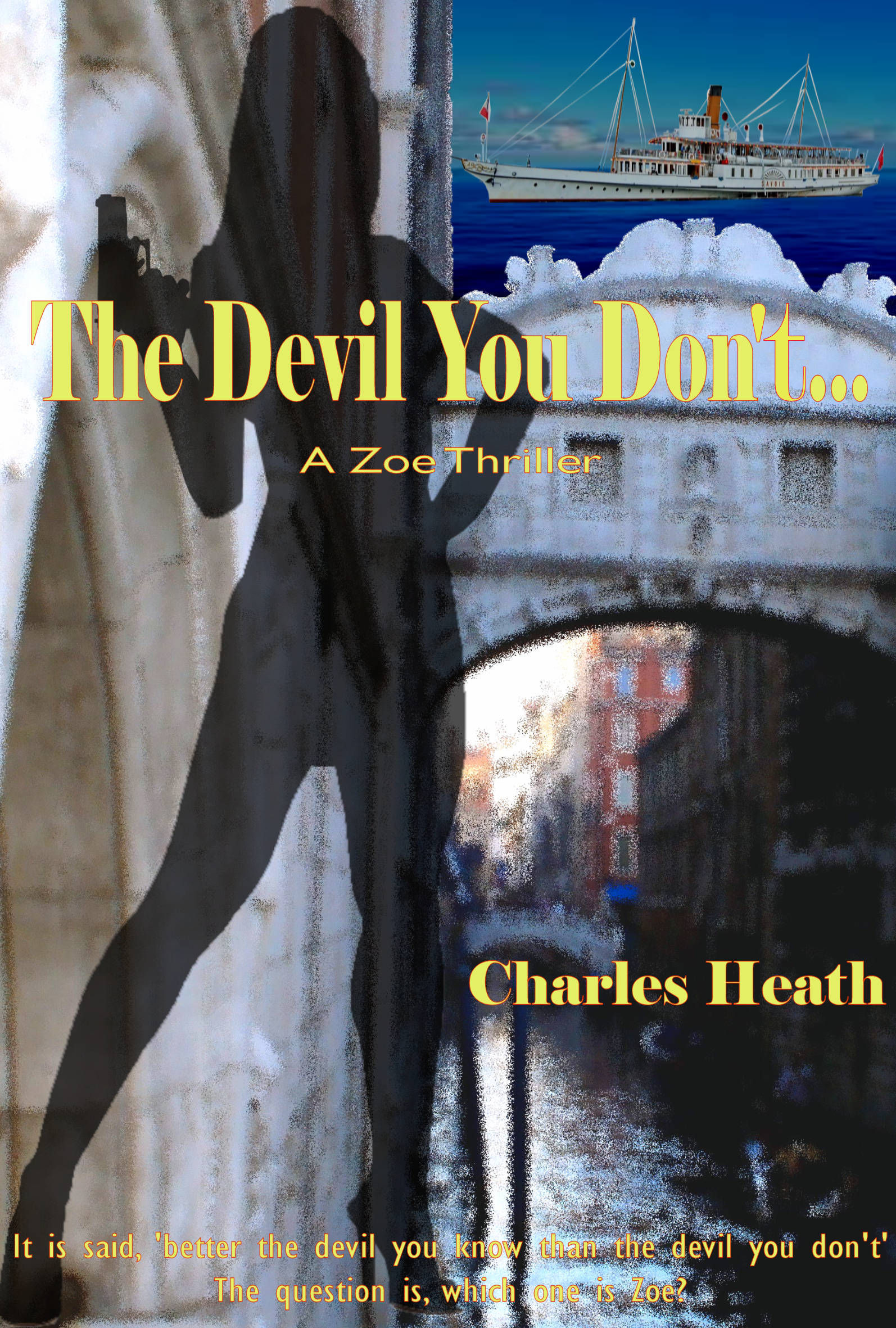
“The Devil You Don’t” – A beta readers view

It could be said that of all the women one could meet, whether contrived or by sheer luck, what are the odds it would turn out to be the woman who was being paid a very large sum to kill you.

John Pennington is a man who may be lucky in business, but not so lucky in love. He has just broken up with Phillipa Sternhaven, the woman he thought was the one, but relatives and circumstances, and perhaps because she was a ‘princess’, may also have contributed to the end result.

So, what do you do when you are heartbroken?

That is a story that slowly unfolds, from the first meeting with his nemesis on Lake Geneva, all the way to a hotel room in Sorrento, where he learns the shattering truth.

What should have been a high turns out to be something else entirely, and from that point every thing goes to hell in a handbasket.

He suddenly realises his so-called friend Sebastian has not exactly told him the truth about a small job he asked him to do, the woman he is falling in love with is not quite who she says she is, and he is caught in the middle of a war between two men who consider people becoming collateral damage as part of their business.

The story paints the characters cleverly displaying all their flaws and weaknesses. The locations add to the story at times taking me back down memory lane, especially to Venice where in those back streets I confess it’s not all that hard to get lost.

All in all a thoroughly entertaining story with, for once, a satisfying end.

…

Available on Amazon here: https://amzn.to/2Xyh1ow

…

The cinema of my dreams – I always wanted to see the planets – Episode 24

This is why we have technical people

…

It wasn’t such an outlandish idea, as much as it was hard to prove it was possible. That is, of course, traversing very long distances in a very short amount of time.

Yes, space is a vacuum, and stuff floats, and can be propelled quickly, just not quickly enough that it would not take a long time to get to the edge of our known universe, given our current technology.

And time wasn’t something we wanted to spend getting there and back

Now, out of thin air, a rather quaint but inapplicable expression to describe where we were now, we had two myths shattered, that we were alone in the universe, and that we were at the limit of how fast we could go.

I got the distinct impression the people we just met had the answers. We just had to find them, well, catch up with them first, and ask them if they would share.

Whilst we were standing by the ‘Ionosphere’, I summonsed both Chalmers and the duty scientist to my day room, to prepare for the update from number one, whom I had advised earlier to relay over the secure channel.

…

But before I got the time to brief them on my theory, number one reported in.

“Firstly, there had been only one casualty and as far as we can tell. Everyone was affected by what appears to be a short stoppage of the life support systems which virtually put everyone to sleep. All of the major systems are back on line, except for the propulsion unit, which, it seems the override cut in when the ship exceeded the maximum speed. The chief engineer is rebooting the controlling computer system which should fix the problem. No one, not even the designers of the propulsion unit, or the ship itself, expected it would ever exceed the maximum design speed, an error that the chief engineers will be taking up with the manufacturers if and when they get home.”

“We can assume then the ship will be able to resume its voyage.”

“Yes sir. I’ve advised the Captain we’ll be standing off until they advise everything is back online.”

“Any explanations as to what happened?”

The Captain of the ‘Ionosphere’ spoke, “One of the scientists discovered what could only be described as an anomaly, with the same sort of properties a black hole has, though it was not a black hole. We headed towards it and then suddenly we were being pulled into it, though there was no discernable hole on the viewer. We tried to escape it, and apparently failed. The last thing I remember, or anyone else for that matter, was the ship going dark, like everything had stopped. Until I was woken by your officer. I cannot explain how we got here, except to say that under normal circumstances, it would take many months to travel the same distance.”

“Did you see any other ships about?”

“We were the only people in that quadrant, as far as I was aware.”

Number one came back at that point, “The sensor log shows there might have been something out there, though it didn’t define what it was. I’m sending a download of the log over as we speak for analysis. One possibility though, based on the information we’ve been using to follow the ship that kidnapped the Captain, is that there is similar energy readings recorded just before the jump.”

Chalmers was first to speak, “When you say jump, what exactly does that mean?”

“We have been looking at the log, and it’s recorded a jump that started near Jupiter, to where we are now. Based on my understanding of astrophysics, and given the short time frame, the only logical explanation is that they were sucked into a sort of black hole, or a rupture in time/space. Whatever caused it, it’s in the realm of science fiction.”

“So was the notion that there was another intelligent life out here, and yet we have found that not to be the case. Whoever these people are, I suspect they have conquered the ability to travel long distances, very quickly, especially if they are, as they said, from another galaxy.”

“You have met other life?” The captain of the ‘Ionosphere’ seemed surprised.

“Yes. They attacked one of our freighters on its way to Venus and stole the plutonium rods needed to keep the base there going. They also kidnapped our Captain, and we were in pursuit of their vessel when we discovered your ship drifting. And it’s my theory your ship may have been dragged into a vortex left behind as they move from location to location. A theory my people will be working on, unless they come up with a better explanation.”

Number one came back, “I’ve just been advised by the Chief Engineer, everything is back online, and we’re no longer needed. I’ll make sure the data transfer is complete and we’ll depart. Anything else?”

“No.”

The transmission complete, I turned to the two scientists. “Soon as you get the data, find out what happened. When we run into these other people, I need to know the right questions to ask them.”

“The odds are we won’t understand,” Chalmers said.

“I thought it was universally acknowledged that if we did find intelligent life out here, the one universal language would be science.”

“That was true based on what we knew before today. Now we know there’s intelligent life out here, everything has changed.”

“Then buckle up for the ride of your life. I want answers sooner rather than later.”

…

© Charles Heath 2021

Betwixt metaphorical houses

It’s like working in two offices, one uptown, and one downtown.

I have two blogs, this one, and another which is purely for writing, and generally, a lot of starts and not a lot of finishes. I get ideas, and it’s a place to store them, and give a few people some amusement at my, sometimes, improbable situations and far-fetched stories.

Here I try to be more serious.

I have the ceiling, the cinema of my dreams. Here anything is possible, like jumping from a helicopter about to explode, and survive, and get out of a sinking ship, like Houdini. Of course, there is always one time when it doesn’t work, and Houdini knows that all too well.

Over there, I have a series which I started here, long ago, where I take a photograph and write a story inspired by it. The interesting thing about that is I could probably use the same photograph over and over, and it would inspire a different tale.

I know, if I was running a writing class, everyone would see that photograph differently.

But what amazes me sometimes is the fact the story is not directly related to the theme. It got me thinking about how we view our experiences, and what triggers memories. I’ve discovered that it doesn’t necessarily happen by correlation, say, for instance, a memory of being in New York might be triggered by a visit to a cafe in Cloncurry.

I try to do one of these every day, but sometimes it’s hard work. Writing itself can be some days, particularly when the words are lurking there, behind that invisible, impenetrable, rock wall.

OK, so I’m stuck in the middle of writing a piece over there, and I’ve come over here to whinge.

But, enough. I’ll let you know what the cinema of my dreams is showing, later.

The cinema of my dreams – I always wanted to write a war story – Episode 42

For a story that was conceived during those long boring hours flying in a steel cocoon, striving to keep away the thoughts that the plane and everyone in it could just simply disappear as planes have in the past, it has come a long way.

Whilst I have always had a fascination with what happened during the second world war, not the battles or fighting, but in the more obscure events that took place, I decided to pen my own little sidebar to what was a long and bitter war.

And, so, it continues…

——

The Standartenfuhrer checked his gun and settled his nerves for an onslaught.  If they were going to die, then he was going to kill as many of them as he could.

He threw his hand pistol to Mayer.  “Shoot anything that comes in the door.”

Mayer fumbled the weapon, dropping it on the floor, then finding it hard, with cold hands, to pick it up.  Perhaps his life wasn’t sufficiently in danger to be more proactive.

The Standartenfuhrer shook his head.  Boffins were all the same.  The slightest threat and they went weak at the knees. And Mayer was no exception.

Mayer managed to get the gun into his hand.

“Don’t forget to turn off the safety.”

Mayer looked at the gun, and found the switch.

At the same time, another burst of gunfire ricocheted off the walls of the hut.  It was followed by a harsh order to stop firing, and save the ammunition for the enemy.  There was also a mutter about alerting the enemy, but that ship had sailed.

The soldiers seemed content to shoot randomly at the cabin, rather than check to see if anyone was inside, and soon the sounds of men, guns, and dogs were gone.  The dogs had not picked up their scent, and the Standartenfuhrer had managed to cover their tracks sufficiently to keep them at bay.

Relief, but not enough to rest.  The Standartenfuhrer knew they had to keep moving.

In the background, both could hear a stream locomotive at slow speed passing.  In the circuitous route they’d taken to escape, they must have circled back towards the railway line which must be on the other side of the forest.

That proximity of the railway line would work in their favor because the next phase of the journey was going to be on a train.

Just not one full of soldiers, if possible.

After a half-hour, just to ensure the soldiers didn’t return, the Standartenfuhrer dragged himself up off the ground.

“We’d better move.  They’re likely to come back, or had a second sweep when they don’t find us.”

“Surely we can have a rest.”

“If you want to get caught.  I don’t have to tell you what they’ll do to you if they capture you.”

“Probably send me back to that hell hole.”

“Hitler is not that forgiving.  The odds are you’ll be handed over to the SS and I’m sure you’ve seen what those people are capable of.”

He had, especially with the forced labor from the Jewish camps and POW camps.  At times it beggared belief.

Mayer dragged himself up off the floor.

The Standartenfuhrer checked his weapon, then looked out through the crack in the door.  It was dark and snowing, not too heavy, but enough to hide their movement.  It was a shame their coats were dark, they would stand out against the white background, but it couldn’t be helped.  That was a problem for daylight, still some hours away.

“Keep your weapon handy.  You may need it.”

Mayer was worried his hands would be too cold and stiff, and instead of having it in his hand, slipped it into his pocket.  He didn’t think too many people would be about at this hour.

“Once outside, head straight for the trees, as fast as you can.”

The Standartenfuhrer was in the doorway one second, gone the next, and Mayer followed.  He could just see the dark figure in front of him, then almost ran into him when he stopped just past the first line of trees.

He could see lights intermittently through the trees, a train or houses along the railway line perhaps.

It was much darker in the forest, and they had to go slower, picking their way through the trees, running into low branches, and getting a face full of wet snow, often trickling down the back of their necks.

It was cold, wet, and very uncomfortable.

The Standartenfuhrer stopped.  The trees had thinned and the lights became more pronounced.  They could now definitely hear a locomotive close by, and a train well lit up stopped.  The windows were fogged from condensation on the inside, but it was clear enough to see heads.

It was a passenger train, waiting.

A piercing whistle shattered the relative quiet, and another train coming in the other direction at speed flashed passed very loudly, the wheels of the carriages clanking on the track joints.  An empty freight train with many flat cars, going back to Germany.

Then suddenly shouting, a whistle, and gunfire.

A man was running towards them,, and several soldiers were in pursuit, randomly shooting in his direction, and into the forest.  A shot hit the running person and they fell.

Mayer heard a thud and a groan, then realized that the Standartenfuhrer had been hit.  By the time he turned the Standartenfuhrer over, he was dead.

Mayer ducked out of sight just before torchlight shone on the spot he was crouching.

There was another shout, and the soldiers started heading towards him.

——-

© Charles Heath 2020-2022

The cinema of my dreams – Was it just another surveillance job – Episode 57

This story is now on the list to be finished so over the new few weeks, expect a new episode every few days.

The reason why new episodes have been sporadic, there are also other stories to write, and I’m not very good at prioritizing.

But, here we are, a few minutes opened up and it didn’t take long to get back into the groove.

Things are about to get complicated…


I hadn’t realised until I said it out loud to someone who would not understand the significance of it, just how far-fetched the reason was.

But in my newly adopted world, it made perfect sense.

 Spies dealt with many things, mostly the notion of a threat, and the removal of it, whether it is an object like a USB or a person, or persons, who could make the threat become a reality.

This threat started with a laboratory working for the military to produce biological weapons.  Then the funding stopped, for whatever reason, and the laboratory had to cover its losses.

What better way than to hawk the formula on the dark web?

Someone perceived that the laboratory would become a threat and dispatched operatives to monitor the situation.

The worst-case scenario occurs, but from a different standpoint, the outrage of a community-conscious scientist who didn’t like the idea of people creating monstrous weapons and steals the formula to leak to the media.

The laboratory is shut down by the government before the formula could be sold, but there is a copy in play via the scientist.

The scientist, and therefore the threat, neutralised.

The threat then moves to his wife, who contacts someone in the Department, likely but not necessarily Dobbin, who then assigns O’Connell to find the wife and offer a lot of cash for the formula.

She agrees.

Somehow, the planted operatives, Severin and Maury discover the wife and O’Connell’s arrangement.

They create a surveillance group with the intention of monitoring the handover and then try to remove both O’Connell and the wife.

For what reason.  The threat would have been removed unless O’Connell and Dobbin had another agenda.  Why then when Dobbin rescued O’Connell, did O’Connell then turn on him?

A relationship with the wife?

Or was it simply the thought of making a huge sum of money, one both O’Connell and the wife could retire on.  He would not be the first spy to sell his soul for twenty pieces of silver.

But the good news, was we had Severin’s assassin.

The plan from there was to hand her over to the Detective Inspector, who didn’t have an agenda other than getting to the truth and keeping Jan away from Dobbin, or anyone who could set her free.

That plan was quashed the moment I saw Dobbin turn up at the scene.  He knew where Severin would be, he must know Severin was meeting with me, and he had sent Jan.

The fact I was still alive meant he wanted something from me.

The question was whether he knew if Jan had been taken off the playing field.

“What the hell is he doing here?”

It was the exact question in my head, though I was closer to answer than she was.

“Run interference, or worse, take over this case too.”

“I thought that was left in the hands of MI5.”

“He turned up after you left.”

She shrugged.  “Above my pay grade, to be honest.  He can have it.  I prefer to deal with the mundane, common thieves or murderers.  None of this cloak-and-dagger stuff.   I’ll tell my Super about the biological stuff, but you have to admit it is a bit farfetched.  There’s a more rational explanation for these deaths, you just have to look harder.  Now, if there’s nothing else?”

Too late to escape, Dobbin had circled around and reached us before I could disappear.

“You seem to turn up to department crime scenes with alarming regularity, Sam.  Any particular reason you’re here?”

The Detective Inspector had expected him to talk to her, not me.

“He’s just another possible witness on the periphery of a crime.  You’re here because?

“It’s one of our people.  I’m afraid…”

“…you’re going to have to take over?  Be my guest.  Your friend here is altogether far too uncooperative, like the rest of you.  I am going to file a formal complaint.”

.“And I’m sure it will be seen by the relevant people.”

She just shrugged and walked away, waving her hand at no one in particular

I waited until she was out of hearing range and asked, “So, why didn’t Jan shoot me too?”

…

© Charles Heath 2020-2023

Skeletons in the closet, and doppelgangers

A story called “Mistaken Identity”

…

How many of us have skeletons in the closet that we know nothing about? The skeletons we know about generally stay there, but those we do not, well, they have a habit of coming out of left field when we least expect it.

In this case, when you see your photo on a TV screen with the accompanying text that says you are wanted by every law enforcement agency in Europe, you’re in a state of shock, only to be compounded by those same police, armed and menacing, kicking the door down.

I’d been thinking about this premise for a while after I discovered my mother had a boyfriend before she married my father, a boyfriend who was, by all accounts, the man who was the love of her life.

Then, in terms of coming up with an idea for a story, what if she had a child by him that we didn’t know about, which might mean I had a half brother or sister I knew nothing about. It’s not an uncommon occurrence from what I’ve been researching.

There are many ways of putting a spin on this story.

Then, in the back of my mind, I remembered a story an acquaintance at work was once telling us over morning tea, that a friend of a friend had a mother who had a twin sister and that each of the sisters had a son by the same father, without each knowing of the father’s actions, both growing up without the other having any knowledge of their half brother, only to meet by accident on the other side of the world.

It was an encounter that in the scheme of things might never have happened, and each would have remained oblivious of the other.

For one sister, the relationship was over before she discovered she was pregnant, and therefore had not told the man he was a father. It was no surprise the relationship foundered when she discovered he was also having a relationship with her sister, a discovery that caused her to cut all ties with both of them and never speak to either from that day.

It’s a story with more twists and turns than a country lane!

And a great idea for a story.

That story is called ‘Mistaken Identity’.

“Trouble in Store” – Short stories my way: Still working on the start

I have reworked the first part of the story with a few new elements about the characters and changed a few of the details of how the characters finish up in the shop before the policewoman makes her entrance.

This is part of the new first section that involves Jack:


Jack was staring down the barrel of a gun.

He had gone down to the corner shop to get a pack of cigarettes.

He had to hustle because he knew the shopkeeper, Alphonse, liked to close at 11:00 pm sharp.  His momentum propelled him through the door, causing the customer warning bell to ring loudly as the door bashed into it, and before the sound had died away, he knew he was in trouble.

It took a second, perhaps three, to sum up the situation. 

A young girl, about 16 or 17, scared, looking sideways at a man on the ground, then Alphonse, and then Jack.  He recognized the gun, a Luger, German, relic of WW2, perhaps her father’s souvenir, or more likely a stolen weapon, now pointing at him then Alphonse, then back to him.

Jack took another second or two to consider if he could disarm her.  No, the distance was too great.  He put his hands out where she could see them.  No sudden movements, try to remain calm, his heart rate up to the point of cardiac arrest.  No point making a bad situation worse.

Pointing with the gun, she said, “Move closer to the counter where I can see you better.”

Everything but her hand steady as a rock.  Only telltale sign of stress, the bead of perspiration on her brow.  It was 40 degrees Fahrenheit in the shop.

Jack shivered and then did as he was told. 

A few seconds more for him to decide she was in an unpredictable category.

“What’s wrong with your friend?”  Jack tried the friendly approach after he’d taken the three steps sideways necessary to reach the counter.

The shopkeeper, Alphonse, who, Jack noted seemed to have aged another ten years in the last few months, spoke instead; “I suspect he’s an addict, looking for a score.  At the end of his tether, my guess, and her to get some money.”

A simple hold up that had gone wrong.  Wrong time, wrong place, in more ways than one Jack thought, now realizing he had walked into a very dangerous situation.  She didn’t look like a user.  The boy on the ground, he did, and he looked like he was going through the beginnings of withdrawal.

Oddly, though, Jack had noticed a look pass between the shopkeeper and the girl.

 “All you had to go was give us the money, and we wouldn’t be here, now.”  She was glaring back at Alphonse.  “You can still make this right.”

A flicker of memory jumped out of the depths on Jack’s mind, something discussed at the dinner table with their neighbors, something about the shop as a pick-up point for drugs.

The boy on the floor, he was not here for the money.

Jack thought he’d try another approach.  “Look, I don’t want trouble, and you don’t want trouble.  I’ll go, forget this ever happened.  You might want to do the same.”

The girl looked like she was thinking.  The gun, though, still moved between him and the shopkeeper.

Another assessment of the girl; this was not her real home.  She was from a better class of people, a different part of town.  Caught up in a downward spiral because of her friend on the floor.

Caught in a situation she was not equipped to deal with.

That didn’t bode well for his, or anyone else in that shop right then, health.


© Charles Heath 2016-2020

An excerpt from “One Last Look”: Charlotte is no ordinary girl

This is currently available at Amazon here:  http://amzn.to/2CqUBcz

…

I’d read about out-of-body experiences, and like everyone else, thought it was nonsense.  Some people claimed to see themselves in the operating theatre, medical staff frantically trying to revive them, and being surrounded by white light.

I was definitely looking down, but it wasn’t me I was looking at.

It was two children, a boy and a girl, with their parents, in a park.

The boy was Alan.  He was about six or seven.  The girl was Louise, and she was five years old.  She had long red hair and looked the image of her mother.

I remember it now, it was Louise’s birthday and we went down to Bournemouth to visit our Grandmother, and it was the last time we were all together as a family.

We were flying homemade kites our father had made for us, and after we lay there looking up at the sky, making animals out of the clouds.  I saw an elephant, Louise saw a giraffe.

We were so happy then.

Before the tragedy.

When I looked again ten years had passed and we were living in hell.  Louise and I had become very adept at survival in a world we really didn’t understand, surrounded by people who wanted to crush our souls.

It was not a life a normal child had, our foster parents never quite the sort of people who were adequately equipped for two broken-hearted children.  They tried their best, but their best was not good enough.

Every day it was a battle, to avoid the Bannister’s and Archie in particular, every day he made advances towards Louise and every day she fended him off.

Until one day she couldn’t.

Now I was sitting in the hospital, holding Louise’s hand.  She was in a coma, and the doctors didn’t think she would wake from it.  The damage done to her was too severe.

The doctors were wrong.

She woke, briefly, to name her five assailants.  It was enough to have them arrested.  It was not enough to have them convicted.

Justice would have to be served by other means.

I was outside the Bannister’s home.

I’d made my way there without really thinking, after watching Louise die.  It was like being on autopilot, and I had no control over what I was doing.  I had murder in mind.  It was why I was holding an iron bar.

Skulking in the shadows.  It was not very different from the way the Bannister’s operated.

I waited till Archie came out.  I knew he eventually would.  The police had taken him to the station for questioning, and then let him go.  I didn’t understand why, nor did I care.

I followed him up the towpath, waiting till he stopped to light a cigarette, then came out of the shadows.

“Wotcha got there Alan?” he asked when he saw me.  He knew what it was, and what it was for.

It was the first time I’d seen the fear in his eyes.  He was alone.

“Justice.”

“For that slut of a sister of yours.  I had nuffing to do with it.”

“She said otherwise, Archie.”

“She never said nuffing, you just made it up.”  An attempt at bluster, but there was no confidence in his voice.

I held up the pipe.  It had blood on it.  Willy’s blood.  “She may or may not have Archie, but Willy didn’t make it up.  He sang like a bird.  That’s his blood, probably brains on the pipe too, Archie, and yours will be there soon enough.”

“He dunnit, not me.  Lyin’ bastard would say anything to save his own skin.”  Definitely scared now, he was looking to run away.

“No, Archie.  He didn’t.  I’m coming for you.  All of you Bannisters.  And everyone who touched my sister.”

It was the recurring nightmare I had for years afterwards.

I closed my eyes and tried to shut out the thoughts, the images of Louise, the phone call, the visit to the hospital and being there when she succumbed to her injuries.  Those were the very worst few hours of my life.

She had asked me to come to the railway station and walk home with her, and I was running late.  If I had left when I was supposed to, it would never have happened and for years afterwards, I blamed myself for her death.

If only I’d not been late…

When the police finally caught the rapists, I’d known all along who they’d be; antagonists from school, the ring leader, Archie Bannister, a spurned boyfriend, a boy whose parents, ubiquitously known to all as ‘the Bannister’s, dealt in violence and crime and who owned the neighbourhood.  The sins of the father had been very definitely passed onto the son.

At school, I used to be the whipping boy, Archie, a few grades ahead of me, made a point of belting me and a few of the other boys, to make sure the rest did as they were told.  He liked Louise, but she had no time for a bully like him, even when he promised he would ‘protect’ me.

I knew the gang members, the boys who tow-kowed to save getting beaten up, and after the police couldn’t get enough information to prosecute them because everyone was too afraid to speak out, I went after Willy.  There was always a weak link in a group, and he was it.

He worked in a factory, did long hours on a Wednesday and came home after dark alone.  It was a half mile walk, through a park.  The night I approached him, I smashed the lights and left it in darkness.  He nearly changed his mind and went the long way home.

He didn’t.

It took an hour and a half to get the names.  At first, when he saw me, he laughed.  He said I would be next, and that was four words more than he knew he should have said.

When I found him alone the next morning I showed him the iron bar and told him he was on the list.  I didn’t kill him then, he could wait his turn, and worry about what was going to happen to him.

When the police came to visit me shortly after that encounter, no doubt at the behest of the Bannister’s, the neighbourhood closed ranks and gave me an ironclad alibi.  The Bannister’s then came to visit me and threatened me.  I told them their days were numbered and showed them the door.

At the trial, he and his friends got off on a technicality.  The police had failed to do their job properly, but it was not the police, but a single policeman, corrupted by the Bannisters.

Archie could help but rub it in my face.  He was invincible.

Joe Collins took 12 bullets and six hours to bleed out.  He apologized, he pleaded, he cried, he begged.  I didn’t care.

Barry Mills, a strong lad with a mind to hurting people, Archie’s enforcer, almost got the better of me.  I had to hit him more times than I wanted to, and in the end, I had to be satisfied that he died a short but agonizing death.

I revisited Willy in the hospital.  He’d recovered enough to recognize me, and why I’d come.  Suffocation was too good for him.

David Williams, second in command of the gang, was as tough and nasty as the Bannisters.  His family were forging a partnership with the Bannister’s to make them even more powerful.  Outwardly David was a pleasant sort of chap, affable, polite, and well mannered.  A lot of people didn’t believe he could be like, or working with, the Bannisters.

He and I met in the pub.  We got along like old friends.  He said Willy had just named anyone he could think of, and that he was innocent of any charges.  We shook hands and parted as friends.

Three hours later he was sitting in a chair in the middle of a disused factory, blindfolded and scared.  I sat and watched him, listened to him, first threatening me, and then finally pleading with me.  He’d guessed who it was that had kidnapped him.

When it was dark, I took the blindfold off and shone a very bright light in his eyes.  I asked him if the violence he had visited upon my sister was worth it.  He told me he was just a spectator.

I’d read the coroner’s report.  They all had a turn.  He was a liar.

He took nineteen bullets to die.

Then came Archie.

The same factory only this time there were four seats.  Anna Bannister, brothel owner, Spike Bannister, head of the family, Emily Bannister, sister, and who had nothing to do with their criminal activities.  She just had the misfortune of sharing their name.

Archie’s father told me how he was going to destroy me, and everyone I knew.

A well-placed bullet between the eyes shut him up.

Archie’s mother cursed me.  I let her suffer for an hour before I put her out of her misery.

Archie remained stony-faced until I came to Emily.  The death of his parents meant he would become head of the family.  I guess their deaths meant as little to him as they did me.

He was a little more worried about his sister.

I told him it was confession time.

He told her it was little more than a forced confession and he had done nothing to deserve my retribution.

I shrugged and shot her, and we both watched her fall to the ground screaming in agony.  I told him if he wanted her to live, he had to genuinely confess to his crimes.  This time he did, it all poured out of him.

I went over to Emily.  He watched in horror as I untied her bindings and pulled her up off the floor, suffering only from a small wound in her arm.  Without saying a word she took the gun and walked over to stand behind him.

“Louise was my friend, Archie.  My friend.”

Then she shot him.  Six times.

To me, after saying what looked like a prayer, she said, “Killing them all will not bring her back, Alan, and I doubt she would approve of any of this.  May God have mercy on your soul.”

Now I was in jail.  I’d spent three hours detailing the deaths of the five boys, everything I’d done; a full confession.  Without my sister, my life was nothing.  I didn’t want to go back to the foster parents; I doubt they’d take back a murderer.

They were not allowed to.

For a month I lived in a small cell, in solitary, no visitors.  I believed I was in the queue to be executed, and I had mentally prepared myself for the end.

Then I was told I had a visitor, and I was expecting a priest.

Instead, it was a man called McTavish. Short, wiry, and with an accent that I could barely understand.

“You’ve been a bad boy, Alan.”

When I saw it was not the priest I told the jailers not to let him in, I didn’t want to speak to anyone.  They ignored me.  I’d expected he was a psychiatrist, come to see whether I should be shipped off to the asylum.

I was beginning to think I was going mad.

I ignored him.

“I am the difference between you living or dying Alan, it’s as simple as that.  You’d be a wise man to listen to what I have to offer.”

Death sounded good.  I told him to go away.

He didn’t.  Persistent bugger.

I was handcuffed to the table.  The prison officers thought I was dangerous.  Five, plus two, murders, I guess they had a right to think that.  McTavish sat opposite me, ignoring my request to leave.

“Why’d you do it?”

“You know why.”  Maybe if I spoke he’d go away.

“Your sister.  By all accounts, the scum that did for her deserved what they got.”

“It was murder just the same.  No difference between scum and proper people.”

“You like killing?”

“No-one does.”

“No, I dare say you’re right.  But you’re different, Alan.  As clean and merciless killing I’ve ever seen.  We can use a man like you.”

“We?”

“A group of individuals who clean up the scum.”

I looked up to see his expression, one of benevolence, totally out of character for a man like him.  It looked like I didn’t have a choice.

Trained, cleared, and ready to go.

I hadn’t realized there were so many people who were, for all intents and purposes, invisible.  People that came and went, in malls, in hotels, trains, buses, airports, everywhere, people no one gave a second glance.

People like me.

In a mall, I became a shopper.

In a hotel, I was just another guest heading to his room.

On a bus or a train, I was just another commuter.

At the airport, I became a pilot.  I didn’t need to know how to fly; everyone just accepted a pilot in a pilot suit was just what he looked like.

I had a passkey.

I had the correct documents to get me onto the plane.

That walk down the air bridge was the longest of my life.  Waiting for the call from the gate, waiting for one of the air bridge staff to challenge me, stepping onto the plane.

Two pilots and a steward.  A team.  On the plane early before the rest of the crew.  A group that was committing a crime, had committed a number of crimes and thought they’d got away with it.

Until the judge, the jury and their executioner arrived.

Me.

Quick, clean, merciless.  Done.

I was now an operational field agent.

I was older now, and I could see in the mirror I was starting to go grey at the sides.  It was far too early in my life for this, but I expect it had something to do with my employment.

I didn’t recognize the man who looked back at me.

It was certainly not Alan McKenzie, nor was there any part of that fifteen-year-old who had made the decision to exact revenge.

Given a choice; I would not have gone down this path.

Or so I kept telling myself each time a little more of my soul was sold to the devil.

I was Barry Gamble.

I was Lenny Buckman.

I was Jimmy Hosen.

I was anyone but the person I wanted to be.

That’s what I told Louise, standing in front of her grave, and trying to apologize for all the harm, all the people I’d killed for that one rash decision.  If she was still alive she would be horrified, and ashamed.

Head bowed, tears streamed down my face.

God had gone on holiday and wasn’t there to hand out any forgiveness.  Not that day.  Not any day.

New York, New Years Eve.

I was at the end of a long tour, dragged out of a holiday and back into the fray, chasing down another scumbag.  They were scumbags, and I’d become an automaton hunting them down and dispatching them to what McTavish called a better place.

This time I failed.

A few drinks to blot out the failure, a blonde woman who pushed my buttons, a room in a hotel, any hotel, it was like being on the merry-go-round, round and round and round…

Her name was Silvia or Sandra, or someone I’d met before, but couldn’t quite place her.  It could be an enemy agent for all I knew or all I cared right then.

I was done.

I’d had enough.

I gave her the gun.

I begged her to kill me.

She didn’t.

Instead, I simply cried, letting the pent up emotion loose after being suppressed for so long, and she stayed with me, holding me close, and saying I was safe, that she knew exactly how I felt.

How could she?  No one could know what I’d been through.

I remembered her name after she had gone.

Amanda.

I remembered she had an imperfection in her right eye.

Someone else had the same imperfection.

I couldn’t remember who that was.

Not then.

I had a dingy flat in Kensington, a place that I rarely stayed in if I could help it.  After five-star hotel rooms, it made me feel shabby.

The end of another mission, I was on my way home, the underground, a bus, and then a walk.

It was late.

People were spilling out of the pub after the last drinks.  Most in good spirits, others slightly more boisterous.

A loud-mouthed chap bumped into me, the sort who had one too many, and was ready to take on all comers.

He turned on me, “Watch where you’re going, you fool.”

Two of his friends dragged him away.  He shrugged them off, squared up.

I punched him hard, in the stomach, and he fell backwards onto the ground.  I looked at his two friends.  “Take him home before someone makes mincemeat out of him.”

They grabbed his arms, lifted him off the ground and took him away.

Out of the corner of my eye, I could see a woman, early thirties, quite attractive, but very, very drunk.  She staggered from the bar, bumped into me, and finished up sitting on the side of the road.

I looked around to see where her friends were.  The exodus from the pub was over and the few nearby were leaving to go home.

She was alone, drunk, and by the look of her, unable to move.

I sat beside her.  “Where are your friends?”

“Dunno.”

“You need help?”

She looked up, and sideways at me.  She didn’t look the sort who would get in this state.  Or maybe she was, I was a terrible judge of women.

“Who are you?” she asked.

“Nobody.”  I was exactly how I felt.

“Well Mr Nobody, I’m drunk, and I don’t care.  Just leave me here to rot.”

She put her head back between her knees, and it looked to me she was trying to stop the spinning sensation in her head.

Been there before, and it’s not a good feeling.

“Where are your friends?” I asked again.

“Got none.”

“Perhaps I should take you home.”

“I have no home.”

“You don’t look like a homeless person.  If I’m not mistaken, those shoes are worth more than my weekly salary.”  I’d seen them advertised, in the airline magazine, don’t ask me why the ad caught my attention.

She lifted her head and looked at me again.  “You a smart fucking arse are you?”

“I have my moments.”

“Have them somewhere else.”

She rested her head against my shoulder.  We were the only two left in the street, and suddenly in darkness when the proprietor turned off the outside lights.

“Take me home,” she said suddenly.

“Where is your place?”

“Don’t have one.  Take me to your place.”

“You won’t like it.”

“I’m drunk.  What’s not to like until tomorrow.”

I helped her to her feet.  “You have a name?”

“Charlotte.”

The wedding was in a small church.  We had been away for a weekend in the country, somewhere in the Cotswolds, and found this idyllic spot.  Graves going back to the dawn of time, a beautiful garden tended by the vicar and his wife, an astonishing vista over hills and down dales.

On a spring afternoon with the sun, the flowers, and the peacefulness of the country.

I had two people at the wedding, the best man, Bradley, and my boss, Watkins.

Charlotte had her sisters Melissa and Isobel, and Isobel’s husband Giovanni, and their daughter Felicity.

And one more person who was as mysterious as she was attractive, a rather interesting combination as she was well over retirement age.  She arrived late and left early.

Aunt Agatha.

She looked me up and down with what I’d call a withering look.  “There’s more to you than meets the eye,” she said enigmatically.

“Likewise I’m sure,” I said.  It earned me an elbow in the ribs from Charlotte.  It was clear she feared this woman.

“Why did you come,” Charlotte asked.

“You know why.”

Agatha looked at me.  “I like you.  Take care of my granddaughter.  You do not want me for an enemy.”

OK, now she officially scared me.

She thrust a cheque into my hand, smiled, and left.

“Who is she,” I asked after we watched her depart.

“Certainly not my fairy godmother.”

Charlotte never mentioned her again.

Zurich in summer, not exactly my favourite place.

Instead of going to visit her sister Isobel, we stayed at a hotel in Beethovenstrasse and Isobel and Felicity came to us.  Her husband was not with her this time.

Felicity was three or four and looked very much like her mother.  She also looked very much like Charlotte, and I’d remarked on it once before and it received a sharp rebuke.

We’d been twice before, and rather than talk to her sister, Charlotte spent her time with Felicity, and they were, together, like old friends.  For so few visits they had a remarkable rapport.

I had not broached the subject of children with Charlotte, not after one such discussion where she had said she had no desire to be a mother.  It had not been a subject before and wasn’t once since.

Perhaps like all Aunts, she liked the idea of playing with a child for a while and then give it back.

Felicity was curious as to who I was, but never ventured too close.  I believed a child could sense the evil in adults and had seen through my facade of friendliness.  We were never close.

But…

This time, when observing the two together, something quite out of left field popped into my head.  It was not possible, not by any stretch of the imagination, but I thought she looked like my mother.

And Charlotte had seen me looking in their direction.  “You seem distracted,” she said.

“I was just remembering my mother.  Odd moment, haven’t done so for a very long time.”

“Why now?”  I think she had a look of concern on her face.

“Her birthday, I guess,” I said, the first excuse I could think of.

Another look and I was wrong.  She looked like Isobel or Charlotte, or if I wanted to believe it possible, Melissa too.

I was crying, tears streaming down my face.

I was in pain, searing pain from my lower back stretching down into my legs, and I was barely able to breathe.

It was like coming up for air.

It was like Snow White bringing Prince Charming back to life.  I could feel what I thought was a gentle kiss and tears dropping on my cheeks, and when I opened my eyes, I saw Charlotte slowly lifting her head, a hand gently stroking the hair off my forehead.

And in a very soft voice, she said, “Hi.”

I could not speak, but I think I smiled.  It was the girl with the imperfection in her right eye.  Everything fell into place, and I knew, in that instant that we were irrevocably meant to be together.

“Welcome back.”

© Charles Heath 2016-2019

onelastlookcoverfinal2

The End is never The End

Can you actually say you know the exact moment a story is done, finished, and that’s it?

For me, the end never quite seems to be the end, that point where you finally draw a line in the sand and say, that’s it, I’m done, step away from the typewriter.

But are we ever satisfied the story is done, can we not make one more change, it’s just a little tweak, it won’t take long.

Please!

My editor tolerated three ‘minor’ changes.

Firstly, a change of name for a character

Secondly, consistency of word use, such as times and contractions

Thirdly, I wasn’t happy with the overall story, and it needed some more action. More writing, more editing, more prevaricating.

It took three weeks to sort out all of those issues, and last night I send the final draft to the Editor.

It’s like watching your child go to school on their first day. Not knowing what will happen but expecting everything will be fine.

This morning I sat in front of the computer, a blank sheet of paper on the screen. I know it’s not a matter of starting the next story from scratch; I have so many started and finished, sitting in the wings to be ‘tinkered with’.

It’s my way of savoring the moment.

Just before I dive back into the murky waters.

The cinema of my dreams – I always wanted to write a war story – Episode 41

For a story that was conceived during those long boring hours flying in a steel cocoon, striving to keep away the thoughts that the plane and everyone in it could just simply disappear as planes have in the past, it has come a long way.

Whilst I have always had a fascination with what happened during the second world war, not the battles or fighting, but in the more obscure events that took place, I decided to pen my own little sidebar to what was a long and bitter war.

And, so, it continues…

——

Jackerby trusted no one.  He had been given orders by someone further up the ranks than Wallace and his people, someone who suspected that some or all of the Englishmen turned German turned Englishmen were traitors. 

The only men he could trust fully were those who had come with him in the glider, a dozen at most.  It’s why he had just completed a secret briefing with his second in command who would take over the operation if anything happened to him.

Not that it would, but he liked the idea of being prepared, and humoring the others into believing they were essential to the operation.  Eckhardt would be a good man in a crisis, battle scarred from the Russian front, and glad to be on this operation for obvious reasons.

He would do anything Jackerby asked, even kill Wallace and Johannsen if he was required to.

That might yet be necessary because Wallace didn’t seem interested in going after Atherton which made him think that Wallace wasn’t all that he appeared to be.  Atherton was a thorn in their operation and had to be eliminated.  The fact Wallace and Johannsen didn’t agree with him raised suspicions as to their motives.

Was there ultimately going to be a triple cross?

He had been lurking in the shadows when Wallace gave the drunken fool Leonardo his orders to go down to the village.  More defectors.  Jackerby couldn’t understand why anyone would want to leave the Reich, especially when they were winning the war, and, if it were up to him, he’d executer the lot of them not send them back.

But, orders were orders.

He went back to Eckhardt and told him he was going down to the village to observe Leonardo and his team in action, and that he was in charge of the men in his absence.

Eckhardt, on the other hand, knew that Jackerby, if he could find a way that would not cause them trouble, was going to eliminate Leonardo because they were a liability.  The plan was once Leonardo and his men were gone, Jackerby would take over rounding up the defectors.  Or, more to the point, they would go missing before reaching the castle.  There was only one that mattered, the rest were dead weight.  And once the prize had been captured, Jackerby would escort him home and collect the kudos for himself and his men.

The ultimate prize; leave to reunite briefly with their families and a cushy job in Berlin, away from the horrors of war in the trenches.

Leonardo and the five others that made up the resistance left the castle by one of the underground tunnels.  Leonardo knew of two, both of them shown to him by Carlo.  He knew that Carlo knew where more were, but Carlo was not particularly helpful at the best of times.

He also knew Carlo might be stupid enough to storm the castle, especially after what Leonardo had done to Martina, and, when it hadn’t happened, he suspected Atherton had appealed to him to wait.

Atherton, too, he knew had some idea of the layout of the castle, have been told to keep an eye on Atherton when he first arrived because he was reportedly an archaeologist.  Leonardo had, and reported back to Wallace that it appeared Atherton had been surveying the castle.  He had simply been told to keep Atherton under surveillance, and make notes of any discoveries, and particularly what Atherton was doing.

He had, not that it amounted to much.  Not when he realized Leonardo was following him.  Leonardo decided not to tell Wallace Atherton had rumbled him, just that he was roaming the passages looking for something.

It had worked so far and kept Wallace off his back, but it wasn’t going to last.

Bottom line, Leonardo had to find and kill Atherton before any trouble started, otherwise, it would be his neck on the block.

Jackerby followed.

It wasn’t hard to follow Leonardo because he and his man were the last people to know what stealth was.  He could hear them crashing through the forest between the castle and the village up to 250 meters away, he was making so much noise.

But, Jackerby thought, perhaps Leonardo didn’t need to worry about alerting his presence to Atherton, not if he was already working with him.

To Jackerby and his paranoia, it made sense.  Maybe he was going to meet with Atherton right now and do a deal with the defectors.  How many others had turned up at the village in the last week or so, and never made it to the castle?

He was right, Jackerby told himself, not to trust them.  Everyone, in the end, was an enemy of the Reich.

It took 20 minutes to reach the outskirts of the village, and when Jackerby could see the edge of the woods, and the barn and remains of the farmhouse just the other side of the tree line, he dropped back, found a suitable observation point, and waited.

Leonardo and his men had stopped at the back of the barn, and one of his men was about to go find the defectors.  The rest of Leonardo’s men would wait with him, and surprise their guests, before taking them back to the castle.

As far as “Jackerby was concerned, they would never reach the castle, and this time, he would take care of Leonardo, and the others.

It would be easy to say that Atherton had killed all the members of the resistance, and then got killed himself in a shootout with Jackerby.  It was a plausible reason for all the deaths, though he would have to come up with a suitable excuse for leaving the castle and following Leonardo and his men when Wallace had expressly forbidden it.

Wallace.

Perhaps if he got his hands on Atherton he’d ask him if Wallace was a traitor.

——-

© Charles Heath 2020-2021