Writing stories can be fun

There is more going on in the story front, and just to keep my mind active, or tortured, as the case may be, there are a number of other stories I’m working on.

In particular, there is the story with the description, what happens after an action-packed start.

Quite a lot. In the third section of the story, after being shot out of the sky, interrogated, flown into northern Nigeria, and then crossed into the Democratic Republic of the Congo, to search search for two men being held to ransom, our players finally made it home.

Previous attempts to rescue them had failed, this one had to succeed. It’s a matter of dealing with local militias who are tricky to deal with and then get out of the country after affecting the rescue.

At times, while writing it, looking at a map and using google earth to see what it is like, I felt like I was there looking down the barrel of a gun, and then, in the helter-skelter of getting to the evacuation point, I’m sure my heart rate had lifted considerably, particularly when the battered DC3 was about to be shot at with air to air missiles.

Just imagine this …

A DC3 versus a very maneuverable helicopter. I was on the edge of my seat.

Next is the surveillance story where nothing is as it seems, which in the espionage business is nothing unusual. Nor is the fact you cannot trust anyone.

It starts out as a routine surveillance operation until a shop front explodes a moment or two after the target passes it. In the ensuing mayhem, the target reappears, now in fear of his life, and our main character tracks him to an alley where he is murdered before his eyes.

Soon after the two men whom our main character is working for appearing and start asking questions that make our main character think that they had perpetrated a hit on him, and decides that something is not right.

From there, the deeper he probes, the more interesting the characters and developments. Who was the target? What was he doing that got him killed? What does he have that everyone wants?

I’m about to start on the next phase of this story…

Then there is what I call comic light relief, the writing of stories inspired by photographs I’ve taken. Some, however, have exceeded the 1,000-word limit that I’ve set, only because I want to explore the story more, and some are spread over a number of stories.

The first book of stories, 1 to 50 are to be published soon. Currently, I’m working on number 148 of the third volume of stories, but number 88 is my favorite so far, simply because it involves a starship.


Mistaken Identity – The Editor’s Draft – Day 3

I have been working on the story, the editor is asking for a second draft after making suggested changes – and I’m now working on it

…

My writing effort for the two days, yesterday and today amounted to about 6,000 words, which by any stretch of the imagination is a good two days.

But, here’s the thing. I went over if briefly yesterday, and reworked about 2,000 words, and then today I looked at the rest.

Yesterday was a bad day for continuity, and I found myself beset with innumerable distractions. Being Good Friday probably had a lot to do with it.

Today, there were also distractions, but not as bad, and at least from the outset, I got to read the words from start to end.

And, yes, they needed a little work, and, yes, I realise we should not be editing, but writing.

Sorry, but not sorry. It had to be done, and now I feel better about it.

Today’s effort amounts to 4,454 words, for a total, so far, of 8,368.

More tomorrow.

The cinema of my dreams – I always wanted to write a war story – Episode 10

For a story that was conceived during those long boring hours flying in a steel cocoon, striving to keep away the thoughts that the plane and everyone in it could just simply disappear as planes have in the past, it has come a long way.

Whilst I have always had a fascination in what happened during the second world war, not the battles or fighting, but in the more obscure events that took place, I decided to pen my own little sidebar to what was a long and bitter war.

And, so, it continues…

…

We walked slowly towards the end of the passage, each time I passed a cell I had a look in, and noted if it had a prisoner or not.  By the end of the passage, I counted six prisoners, and one was a woman.’

She just looked at me sullenly, and I guess if it was light enough, that look would be with pleading eyes.  Sadly, I couldn’t save her, or the other five.

At the end of the corridor, we retraced our steps towards the hall, along the passage where I counted another three prisoners, then up the stairs to the ground level.  We came out into a better-lit alcove with arches leading in three directions.

Straight ahead was the hall.

We turned to the left.  Along another passage that seemed to run the length of the wall, what I thought was the stone battlement that made up one side of the castle, looking out over fields, with a village in the distance.

What I thought was the opposite side to the guard tower I’d been in earlier.

I tried to figure out if that’s where we were, and if my memory served me correctly, we were heading towards the wall that was built into the mountainside, in which case we’d go up another set of stairs, at the top of which would be an exit, or turning right, to a room that once served as the guards quarters, now used for kitchen supplies.

What else was here?  My mind was blank.

Up the steps, so far I was right, ahead of a thick wooden door, locked, so we turned right and passed a small room.  I’d forgotten it, but it was the radio room, wires leading out a small arrow slit window to the aerial.   The man in front stumbled, then regained his gait.

I could hear the man behind me shaking his head.

“Halt,” the man behind me barked. 

The man in front stopped dead, and I crashed into him.  I felt rather than saw the fist come towards me; it was not for me, but the other guard, who, preoccupied with not falling, never saw it coming.

He went down like the proverbial ask of potatoes, no idea what happened.

My turn?

A hand landed on my shoulder, thrusting me towards the door to the storeroom.  “Go, now.  The door on the other side is open, head down to the creek and follow it.  Someone will meet you.”

I half turned, “Who…”

“No time.  Go.  And shut the door behind you.”  I felt him thrust a gun in my hand.  “Hit me.”

I hesitated.

“Do it, or I’ll be shot.”

I shrugged and hit him.  He slowly slid to the floor.  A second glance, no, I didn’t know who he was, the headed for the back of the storeroom.  The door was open.  A cautious look before stepping out, I  saw no one but heard breathing.  Jack.  How did the dog know I’d be here?

I closed the door behind me and heard the lock engage, then after a pat on Jack’s head, he led the way.

© Charles Heath 2019

Searching for locations: Vancouver to Kamloops, Canada

This morning started with a visit to the car rental place in Vancouver.  It reinforced the notion that you can be given the address and still not find the place.  It happened in Washington where it was hiding in the back of the main railway station, and it happened again in Vancouver when it was hidden inside a hotel.

We simply walked straight past it.  Pity there wasn’t a sign to let people know.

However…

We went in expecting a Grand Jeep Cherokee and walked out with a Ford Flex, suitable for three people and four large suitcases.  It actually seats 7, but forget the baggage, you’d be lucky to get two large suitcases in that configuration.

It is more than adequate for our requirements.

Things to note, it was delivered with just over a quarter of a tank of gas, and it had only done about 11,000 km, so it’s relatively new.  It’s reasonably spacious, and when the extra seats are folded down, there is plenty of baggage space.

So far, so good.

We finally leave the hotel about half-past ten, and it is raining.  It is a simple task to get on Highway 1, the TransCanada Highway, initially, and then onto Highway 5, the Coquihalla highway for the trip to Kamloops.

It rains all the way to the top of the mountain, progress hampered from time to time by water sprays from both vehicles and trucks.  The rain is relentless.  At the top of the mountain, the rain turns into snow and the road surface to slush.  It’s 0 degrees, but being the afternoon, I was not expecting it to turn to ice very quickly.

On the other side of the mountain, closer to Kamloops, there was sleet, then rain, then nothing, the last 100kms or so, in reasonably dry conditions.

Outside Kamloops, and in the town itself, there was evidence of snow recently cleared, and slushy roads.  Cars in various places were covered in snow, indicating the most recent falls had been the night before.

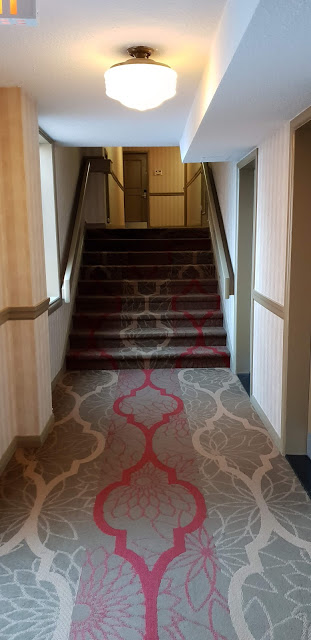
We’re staying at the Park Hotel, a heritage building, apparently built in the later 1920s.  In the style of the time, it is a little like a rabbit warren with passages turning off in a number of directions, and showing it is spread across a number of different buildings.

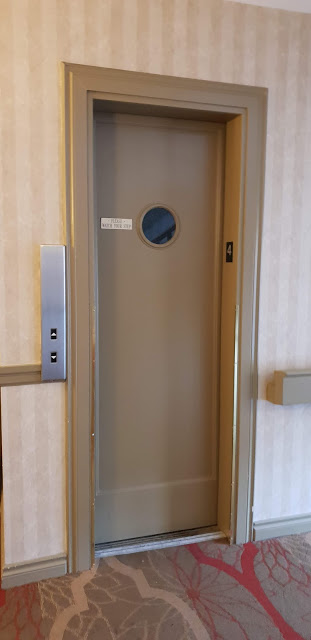
It has the original Otis elevator that can take a maximum of four passengers, and a sign on the wall that says “no horseplay inside the elevator” which is a rather interesting expression that only someone of my vintage would understand.  And, for those without a sense of humor, you definitely couldn’t fit a horse in it to play with.

The thing is, how do you find a balance between keeping the old world charm with modern day expectations.  You can’t.  Some hotels try valiantly to get that balance.  Here, it is simply old world charm, which I guess we should be grateful for because sooner rather than later it’s going to disappear forever.

In my writer’s mind, given the importance of the railways, this was probably a thriving place for travelers and once upon a time, there were a lot more hotels like this one.

The refinement of an old idea

I write about spies, washed out, worn out, or thrown out.

It’s always in the back of my mind, sometimes fuelled by a piece in the paper that has a sense of conspiracy about it, and from there, an idea starts turning into words that need to find their way to paper.

Then, if that’s the extent of the first draft, sometimes it goes into the ‘I will come back to this later’ folder and, sometimes, it’s gone and forgotten.

Until I wake up suddenly in the middle of the night, an old story with a new idea fills my head, and I have to get it down.

Then, it will bother me over the next few days, until I give it the attention it’s calling out for.  This will often lead to more writing, but planning leading to a synopsis.

The first sentence of a novel is always the hardest. Like I guess many others, I sit and ponder what I’m going to write, whether it will be relevant, whether it will pull the reader into my world, and cause them to read on.

And that’s the objective, to capture the reader’s imagination and want to see what’s going to happen next.

The problem is, we have to set the scene.

Or do we?

Do we need to cover the who, what, where, and when criteria in that first sentence? Can we just start with the edge-of-the-seat suspense, like,

The first bullet hit the concrete wall about six inches above my head with a resounding thwack that scared the living daylights out of me. The second, sent on its way within a fraction of a second of the first found its mark, the edge of my shoulder, slicing through the material, and creasing skin and flesh. There was blood and then panic.

Milliseconds later my brain registered the near-miss and sent the instruction: get down you idiot.

I hit the ground just as another bullet slammed into the concrete where my head had just been.

It can use some more work, fewer commas, and perhaps shorter, sharper sentences to convey the urgency and danger.

Perhaps we could paint a picture of the main character.

He tentatively has the name Jackson Galsworthy. He has always aspired to be a ‘secret agent’ or ‘spy’ and but through luck more than anything else, he was given his opportunity. The problem is he failed his first test and failure means washing out of the program.

What had ‘they’ said? When the shit hits the fan, you need to be calm, cool, and collected. He’d been anything but.

Maybe we’ll flesh the character out as we go along.

OK, I just had another thought for an opening,

Light snow was still falling, past the stage where each flake dissolved as it hit the ground, and now starting to gather in white patches.

It was cold, very cold, and even with the three layers I still shivered.

What surprised me was the silence, but, of course, it was a graveyard beside an ancient church, and everyone who had attended the funeral service had left.

It was a short service for the few that came, and a shorter burial. No one seemed keen to hang around, not with the evening darkness and the snow setting in.

I stood, not far from the filled grave looking at it, but not looking at it. Was I expecting it’s occupant to rise again? Was I expecting forgiveness? I certainly didn’t deserve it.

The truth is, I was responsible for this person’s death, making a mistake a more seasoned professional might not, and the reason why I was shown the door. I had been given very simple instructions; protect this man at all costs.

It was going to be a simple extraction, go in, get the target, and get out before anyone noticed.

A pity then I was the only one who got that memo.

It’s a start, but with the TV going on in the background, Chester complaining about something, and the weeds in the yard are getting higher, there’s too much else going to consider this even a start.

It’s an idea.  Perhaps I can expand on it later.

…

© Charles Heath 2020-2023

The cinema of my dreams – I never wanted to go to Africa – Episode 35

Our hero knows he’s in serious trouble.

The problem is, there are familiar faces and a question of who is a friend and who is foe made all the more difficult because of the enemy, if it was the enemy, simply because it didn’t look or sound or act like the enemy.

Now, it appears, his problems stem from another operation he participated in, and because of it, he has now been roped into what might be called a suicide mission.


04:00 in Africa was an interesting time of the morning, especially after a few hours of intense rain during the night.  I could see what the Colonel meant if it had been raining because outside the barracks it was very wet.

Whilst the others appeared to get some sleep, in a much better environment than the back of an aircraft, I lay awake, at first waiting for the sound of the aircraft leaving, and then listening to the rain that started an hour or so later, followed by the sounds that came afterward.  It was never silent, and there was always that suspicion of being attacked when you’re at your most vulnerable.  I had a weapon ready, just in case.

Outside the cloud cover had gone and it looked like it would be a fine day.

When I did the headcount, I noticed Mobley was missing as agreed, and by the time we had assembled, the cars had arrived.  We would be driving ourselves in a convoy behind Monroe and the Colonel, who was no longer dressed in army fatigues, along with Jacobi and one of his guards.

For the trip, we had been supplied with the western notion of jungle wear, safari suits, that identified us not only garrulous visitors, but typical tourists hardly prepared for what was to come.  It made a good cover for a group of ‘fools’ making a documentary.  

All we had to do was get to the location for the exchange of the hostages reportedly between Aba, a town in the Democratic Republic of the Congo, and somewhere on the outskirts of the Park.  It was going to be an easy drive from Uganda to Aba, then the situation might change.

I was going to be in the rear vehicle, with Leslie Davies.  The more I thought about her being assigned to this mission, it seemed she was here solely for her ability to fly anything with wings.  It was the part that was missed on her resume, perhaps for a reason, but whatever that reason was, it would become clear eventually.


We left at 04:05.  Monroe had a slight problem starting her car.

Other than exchanging a few words before getting on the plane and then getting off the plane, Davies and I had not spoken.  After half an hour of driving in silence, I decided to break the ice.

“What did you do to get nominated for this mission?”

A glance sideways gave me no indication of her thoughts, or what look was hidden behind the aviator sunglasses.  I hadn’t seen her smile, or talk to any of the other team members other than a few brief words with Monroe, likely because she was the only other female.

Even then, I didn’t get the impression they were going to be best friends.

“Best you don’t know.”

Her reply came about three minutes after I’d asked, and at a point where I assumed she was going to ignore me.

“Let’s say I’m curious.”

“Curiosity killed the cat.”

“I’m not a cat.”

Another two minutes of silence, then, “Disobeyed a direct order.”

Not as bad as killing your immediate superior because you didn’t like him.  And I could sympathize.  Some orders were utterly ridiculous.

“Not a bad thing.”

“Not what the court-martial thought.”

I noticed she didn’t use sir.  I could live with that.

“You volunteer?”

“In a manner of speaking.  You?”

She raised her glasses slightly and gave me a sideways glance.

“In a manner of speaking.  Been here before, not that it was for very long, and in a different part of the country, but the powers that be deemed my experience adequate for the mission.”

“I take it the mission isn’t to take pictures of animals?”

It might.  Just not the animals you’re expecting.”


It was our lucky day.  At the Vurra customs post we were met by a Ugandan official who had been forewarned of our arrival, and whom I expect was well compensated for his work, and after going through a half-hour of paperwork, we were taken to the Congo counterpart with whom Jacobi weaved his magic.

I say lucky because the border crossing was often closed, either because of the weather, the road conditions, or the fact neither country was talking to the other, though it was more to do with the Congo villagers and their dispute over lands that stretched into Uganda.

We arrived with a number of trucks, to join a long line waiting to cross, and included were several United Nations vehicles.

Everyone seemed to take the delays and administrative diligence in their stride.

We were moving again, behind several tracks, almost an hour and a half after arriving.  All of the crates of equipment had been opened and inspected, as had our packs, and the raft of documents Monroe had been supplied.  She had a satellite phone at the ready in case we needed to make any calls, though I was not sure what Bamfield would have been able to do.

But, after a few tense moments, everyone lost interest in the documentary crew and moved onto the next vehicle.

Jacobi said it was the easiest crossing he’d made.

About a half-hour, after we had driven on our way, then my radio crackled, and Mobley reported in.  He had just crossed over and was behind us, and a number of trucks.

I got a strange look from Davies.

“Insurance,” was all I said.  “Which no one else needs to know about.”

The road was not exactly in the best of condition in places and having four-wheel drives was a help.  The lie of the land was quite flat, and we passed a lot of small villages and curious looks from the villagers.  Some parts of the road were quite bad, and we had to drive very slowly, especially where it was damp, but for the most part, it was reasonably dry and the roads were navigable.

Other times, Jacobi said, after the rains, those same roads were impossible to drive on and would often see villagers out trying to help the truck drivers keep moving.

I had expected to run into a number of soldiers, but for the first few hours after leaving the border, there wasn’t a lot to see other than flat land, villages, and people on the side of the road, along with the occasional vehicle, belying the fact it was a major road between the border and a town called Aba, a distance that was measured at about 170 kilometers.

Anywhere else in the world it would have taken about an hour and a half, but here, it was early afternoon and finally on a stretch of reasonable road into Aba.  A refuel and we’d be on our way quickly.  The first of the kidnappers appointed times was 16:00 hours and I was hoping the roads would get us there by that time.


© Charles Heath 2019-2020

The first case of PI Walthenson – “A Case of Working With the Jones Brothers”

This case has everything, red herrings, jealous brothers, femme fatales, and at the heart of it all, greed.

See below for an excerpt from the book…

Coming soon!

PIWalthJones1

An excerpt from the book:

When Harry took the time to consider his position, a rather uncomfortable position at that, he concluded that he was somehow involved in another case that meant very little to him.

Not that it wasn’t important in some way he was yet to determine, it was just that his curiosity had got the better of him, and it had led to this: sitting in a chair, securely bound, waiting for someone one of his captors had called Doug.

It was not the name that worried him so much, it was the evil laugh that had come after the name was spoken.

Doug what? Doug the ‘destroyer’, Doug the ‘dangerous’, Doug the ‘deadly’; there was any number of sinister connotations, and perhaps that was the point of the laugh, to make it more frightening than it was.

But there was no doubt about one thing in his mind right then: he’d made a mistake. A very big. and costly, mistake. Just how big the cost, no doubt he would soon find out.

His mother, and his grandmother, the wisest person he had ever known, had once told him never to eavesdrop.

At the time he couldn’t help himself and instead of minding his own business, listening to a one-sided conversation which ended with a time and a place. The very nature of the person receiving the call was, at the very least, sinister, and, because of the cryptic conversation, there appeared to be, or at least to Harry, criminal activity involved.

For several days he had wrestled with the thought of whether he should go. Stay on the fringe, keep out of sight, observe and report to the police if it was a crime. Instead, he had willingly gone down the rabbit hole.

Now, sitting in an uncomfortable chair, several heat lamps hanging over his head, he was perspiring, and if perspiration could be used as a measure of fear, then Harry’s fear was at the highest level.

Another runnel of sweat rolled into his left eye, and, having his hands tied, literally, it made it impossible to clear it. The burning sensation momentarily took his mind off his predicament. He cursed and then shook his head trying to prevent a re-occurrence. It was to no avail.

Let the stinging sensation be a reminder of what was right and what was wrong.

It was obvious that it was the right place and the right time, but in considering his current perilous situation, it definitely was the wrong place to be, at the worst possible time.

It was meant to be his escape, an escape from the generations of lawyers, what were to Harry, dry, dusty men who had been in business since George Washington said to the first Walthenson to step foot on American soil, ‘Why don’t you become a lawyer?” when asked what he could do for the great man.

Or so it was handed down as lore, though Harry didn’t think Washington meant it literally, the Walthenson’s, then as now, were not shy of taking advice.

Except, of course, when it came to Harry.

He was, Harry’s father was prone to saying, the exception to every rule. Harry guessed his father was referring to the fact his son wanted to be a Private Detective rather than a dry, dusty lawyer. Just the clothes were enough to turn Harry off the profession.

So, with a little of the money Harry inherited from one of his aunts, he leased an office in Gramercy Park and had it renovated to look like the Sam Spade detective agency, you know the one, Spade and Archer, and The Maltese Falcon.

There’s a movie and a book by Dashiell Hammett if you’re interested.

So, there it was, painted on the opaque glass inset of the front door, ‘Harold Walthenson, Private Detective’.

There was enough money to hire an assistant, and it took a week before the right person came along, or, more to the point, didn’t just see his business plan as something sinister. Ellen, a tall cool woman in a long black dress, or so the words of a song in his head told him, fitted in perfectly.

She’d seen the movie, but she said with a grin, Harry was no Humphrey Bogart.

Of course not, he said, he didn’t smoke.

Three months on the job, and it had been a few calls, no ‘real’ cases, nothing but missing animals, and other miscellaneous items. What he really wanted was a missing person. Or perhaps a beguiling, sophisticated woman who was as deadly as she was charming, looking for an errant husband, perhaps one that she had already ‘dispatched’.

Or for a tall, dark and handsome foreigner who spoke in riddles and in heavily accented English, a spy, or perhaps an assassin, in town to take out the mayor. The man was such an imbecile Harry had considered doing it himself.

Now, in a back room of a disused warehouse, that wishful thinking might be just about to come to a very abrupt end, with none of the romanticized trappings of the business befalling him. No beguiling women, no sinister criminals, no stupid policemen.

Just a nasty little man whose only concern was how quickly or how slowly Harry’s end was going to be.

© Charles Heath 2019

Searching for locations: Vancouver, Canada – 4

Staying at Hampton Inn and Suites downtown, whatever that means because it looks like we are in the middle of nowhere.

But, judging by the crowd in the breakfast room, it’s a popular hotel.  Of course, it is Sunday morning so this could be the weekend escape people.

Two things I remember about staying in Hampton Inns is firstly the waffles and whipped butter.  It’s been five years but nothing has changed, they are as delicious as ever.  The other, its where I discovered vanilla flavored milk for coffee, and it, too, is addictive.

They also used to have flat burgers that were made out of sausage meat which was delicious, but on the first day, they were not on the menu.

Nevertheless, it was still a very yummy breakfast.

After some research into where we might find this pixmi unicorn, it appears that it is available at a ‘toys are us’ store in one of the suburbs of Vancouver.  So, resuming the quest, we took a taxi to West Broadway, the street the store is located.

A quick search of the store finds where the toys we’re looking for are, after asking one of the sales staff, and we find there are at least a dozen of them.  Apparently, they are not as popular in Canada as the might be in America.  Cheaper too, because the exchange rate for Canadian dollars is much better than for American dollars.  Still, 70 dollars for a stuffed toy is a lot of money.

We also get some slime, stuff that our middle granddaughter seems to like playing with.

After shopping we set off down West Broadway, the way we had come, looking for a taxi to return us to the hotel.  There’s no question of walking back to the hotel.

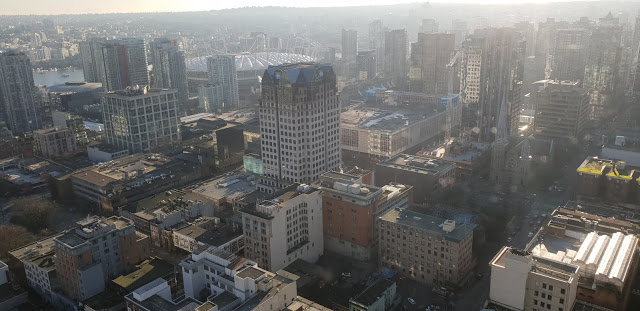
A few hours later we walk to the observation tower, which was not very far from the hotel,

a place where we could get a 360-degree view of the city of Vancouver although it was very difficult to see any of the old buildings because they were hidden by the newer buildings, nor could we see the distant mountains because of the haze.

After leaving the tower we walked down Water Street to see the steam clock and the old world charm of a cobbled street and old buildings

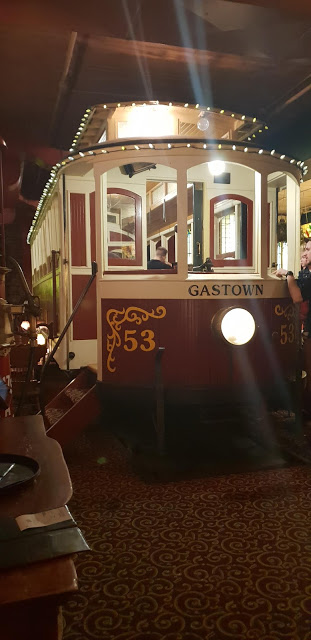
We stopped at the Spaghetti Factory Italian restaurant for dinner and is so popular that we have to wait, 10 minutes to start with.  It doesn’t take all that long to order and have the food delivered to the table.  Inside the restaurant, there is an actual cable car but we didn’t get to sit in it.

I have steak, rare, mushrooms, and spaghetti with marinara sauce.  No, marinara doesn’t mean seafood sauce but a very tasty tomato-based sauce.  The steak was absolutely delicious and extremely tender which made it more difficult to cut with a steak knife.

The write up for the marinara sauce is, ‘it tastes so fresh because it is made directly from vine-ripened tomatoes, not from concentrate, packed within 6 hours of harvest.  We combine them with fresh, high-quality ingredients such as caramelised onions, roasted garlic and extra virgin olive oil’.

Oh, and did I mention they have a streetcar right there in the middle of the restaurant

I’m definitely going to try and make this when we get home.

After dinner, we return to the observation tower,  the ticket allowing us to go back more than once, and see the sights at night time.  I can’t say it was all that spectacular.

Another day has gone, we are heading home tomorrow.

‘Sunday in New York’ – A beta reader’s view

I’m not a fan of romance novels but …

There was something about this one that resonated with me.

This is a novel about a world generally ruled by perception, and how people perceive what they see, what they are told, and what they want to believe.

I’ve been guilty of it myself as I’m sure we all have at one time or another.

For the main characters Harry and Alison there are other issues driving their relationship.

For Alison, it is a loss of self-worth through losing her job and from losing her mother and, in a sense, her sister.

For Harry, it is the fact he has a beautiful and desirable wife, and his belief she is the object of other men’s desires, and one in particular, his immediate superior.

Between observation, the less than honest motives of his friends, a lot of jumping to conclusions based on very little fact, and you have the basis of one very interesting story.

When it all comes to a head, Alison finds herself in a desperate situation, she realises only the truth will save their marriage.

But is it all the truth?

What would we do in similar circumstances?

Rarely does a book have me so enthralled that I could not put it down until I knew the result. They might be considered two people who should have known better, but as is often the case, they had to get past what they both thought was the truth.

And the moral of this story, if it could be said there is one, nothing is ever what it seems.

…

Available on Amazon here: amzn.to/2H7ALs8

…

Mistaken Identity – The Editor’s Draft – Day 1

I have been working on the story, the editor is asking for a second draft after making suggested changes – and I’m now working on it

…

It’s a story I’ve been thinking about – the notion that you could be mistaken for someone else, and put down a first, rather hazy draft.

And that someone else was someone who is on the run and wanted by the police.

Of course, finding that first sentence that is going to drag the reader down the rabbit hole of the story to come takes longer than it does to write the first chapter and didn’t survive the editor’s critical eye

But, after a few hours of deliberation, I had to agree with him, and now the game’s afoot.

So, the MC is a travel agent, one that prefers to go on his own tours so that he can truthfully tell his clients what places, hotels, and travel services are really like.

I’ve noticed that when travel writers do reviews, they seem to get different rooms and experiences than us poor travellers, no more noticeable than when we stayed in San Gimignano. The hotel sounded wonderful, and the description of the room overlooking the town square was fantastic. Pity then we were shoved into a small room out the back, overlooking pigeon coops, and a shower that continually broke down.

It’s probably this disappointment that provided some inspiration for the book.

But rather than being a travelogue, I’m adding some mystery, and suspense to make it more readable.

Today’s effort amounts to 1,700 words, for a total, so far, of 1,700.

More tomorrow.