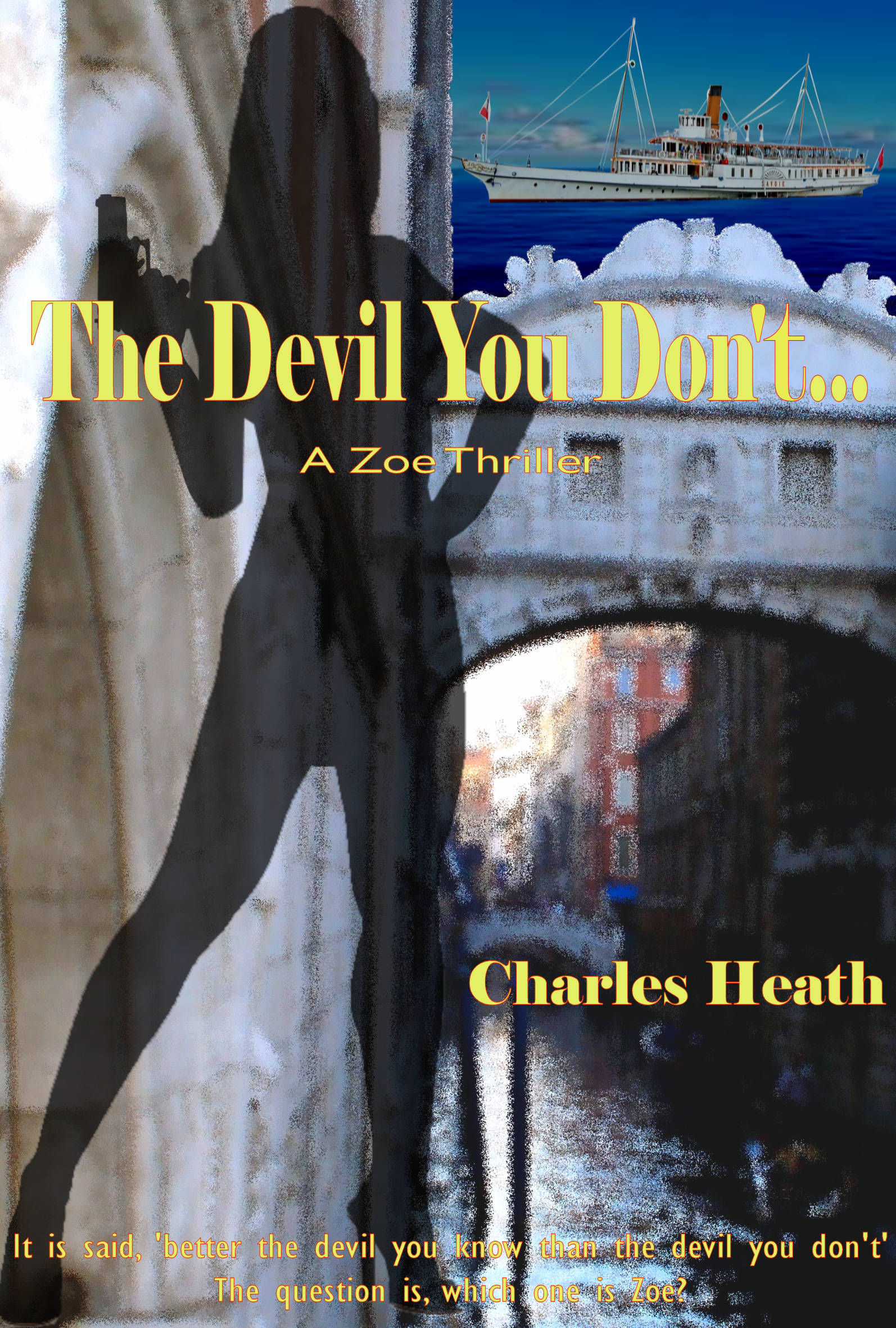
So, standard practice tells us that as writers we must avoid cliches at all costs.
It’s a great idea. Because you are writing to potentially a great many people, the notion that most of them will have no idea what you are talking about, or understand the relevance, it’s best not to leave them perplexed when they read something they don’t understand.
A great example of this was many years ago when I worked with a chap who was a recent immigrant from Russia. His English was reasonable, that is, he could speak in a manner I could understand, but there were times when he stopped, searching for the English equivalent.
I would have called it a quaint accent. Others would be less accommodating.
But…
I found that I tended to speak with a lot of English idioms and cliches, some of which he did not understand, and so I spent a lot of time translating them. He was not at all ashamed of not knowing them, but wanted to.
Thus, for a few months, I became an ESL teacher and found it quite amusing, especially when he told me what the Russian equivalents were. And, yes, Russians do have their own cliches, and we westerners cop a few really interesting ones.
And, yes, I use cliches in stories, or at least until the third draft when I realise that they don’t belong, and even when they last a little longer, the editor’s blue pencil gets them every time.
Day 112 – What if the book you’re writing has a similar plot and characters to another book
…
The “Accidental Copycat”: What to Do When Your Story Feels Too Familiar
We’ve all been there. You’re halfway through your manuscript, the plot is finally clicking, and then—thud. You’re scrolling through a bookstore shelf or browsing Goodreads, and you see it. A book that was published two years ago that features a protagonist agonisingly similar to yours, a plot twist you thought was genius, and a setting that feels like a carbon copy of your own world.
Panic sets in. Am I a thief? Is my book unoriginal? Should I delete the file and start over?
Take a deep breath. Before you hit “delete,” let’s unpack why this happens and why it’s usually not the catastrophe you think it is.
1. The “Great Ideas” Phenomenon
There is an old adage in the writing world: “There are no new stories, only new ways to tell them.”
Human storytelling is built on archetypes. Whether it’s the Hero’s Journey, the “Enemies to Lovers” trope, or the “Small Town Secret,” we are all drawing from the same well of universal themes. If your book feels similar to another, it’s likely because those themes resonate with the collective human experience.
If you didn’t consciously sit down with that other book open on your desk to copy it, you aren’t stealing. You are simply participating in a genre.
2. The Difference Between Trope and Theft
There is a massive difference between plot points and execution.
The Trope: Two characters get stuck in an elevator and fall in love.
The Theft: You copy the specific dialogue, the unique way one character clears their throat, the specific backstory about their dying goldfish, and the exact sequence of events down to the minute.
If you are using the same general framework as another author, you are writing in a genre. If you are using their specific, unique creative choices (their “voice,” their specific, non-trope-based world-building quirks, or their specific phrasing), that’s where the ethical line blurs.
3. Your Perspective is Your “Secret Sauce”
Even if you and another author started with the same “what if” prompt, your story will end up completely different. Why? Because you are not that author.
Your Life Experience: The way you describe grief, love, or a sunrise is colored by your own unique traumas, joys, and perspective.
Your Character Voice: Characters are the sum of their choices. If your protagonist makes a choice different from the “original” character, the entire ripple effect of the story changes.
Your Pacing and Tone: One author might write your shared plot as a dark, gritty noir; another might write it as a bubbly, fast-paced comedy.
4. How to Conduct a “Sanity Check”
If the similarities still bother you, perform these three steps to gain clarity:
Read the “Other” Book: It sounds counterintuitive, but if you haven’t read it, you might be scaring yourself over nothing. Read it to see if the “similarities” are actually just superficial tropes.
Identify the “Soul” of Your Story: Ask yourself, “What is the one thing I am trying to say that no one else can say exactly like me?” If you can answer that, lean harder into that element.
Twist the Narrative: If you feel like your plot beat is too derivative, change it. Give your character a different motivation. Put the story in a different setting. Introduce an antagonist that complicates the “cliché.”
The Bottom Line
Originality isn’t about being the first person to come up with an idea; it’s about being the most authentic person to express it.
Don’t let the fear of “stealing” paralyse your creativity. If you are writing from a place of genuine passion, your voice will shine through, regardless of how many other books explore similar territory. Keep writing. The world hasn’t read your version yet—and that version is the only one that truly matters.
One the first things you notice when driving around Beijing, other than the roads are congested with traffic, is the number of trees and flowers that have been planted, in the median strip as well as along the edges of the road.
What you also notice is the large number of multi-story apartment blocks, which are needed to house the millions of Beijing residents. What we have, so far, rarely seen, is single-story houses. These continuous areas of trees and rose bushes are, every now and then, broken up by very colorful garden beds:
Nearer to the square we are able to get up close to the flowers. These, we are told, are a variation on the rose, one that flowers for nine months of the year.
They come in a variety of colors.
And they are literally everywhere you go, on the side of the roadway, often blotting out the concrete jungle behind them.
Aside from being the short form of the name Joseph, ie a man’s name, there is also a derivative for women, Jo.
The name Joe is said to be used from the mid-1800s.
My favourite Joe name is Joe Bloggs, and he features in some of my stories.
It’s anonymous enough for someone to use as a cover when booking into a sleazy motel and is a little more refined than Smith or Jones, names that more than likely already feature in the register.
Jo could be a short form for Josephine, a name I’m sure some women would prefer not to be called.
But…
Did you know it’s also a name given to a cup of coffee?
Well, that didn’t make much of a splash. I don’t think anyone these days refers to coffee as Joe because there are so many different variations with names I couldn’t pronounce let alone spell, I think it’s been lost in the mists of time because there was only one type of coffee.
It was called coffee. Funny about that.
However…
There is another definition, and that is for the ‘average Joe’, an ordinary fellow who works for a living.
Odd, because I thought that was what most of us did, but perhaps it refers to tradespeople, or blue collar workers, not the white collar brigade.
Hang on, isn’t there a GI Joe, a universal description of the average soldier?
“Sunday in New York” is ultimately a story about trust, and what happens when a marriage is stretched to its limits.
When Harry Steele attends a lunch with his manager, Barclay, to discuss a promotion that any junior executive would accept in a heartbeat, it is the fact his wife, Alison, who previously professed her reservations about Barclay, also agreed to attend, that casts a small element of doubt in his mind.
From that moment, his life, in the company, in deciding what to do, his marriage, his very life, spirals out of control.
There is no one big factor that can prove Harry’s worst fears, that his marriage is over, just a number of small, interconnecting events, when piled on top of each other, points to a cataclysmic end to everything he had believed in.
Trust is lost firstly in his best friend and mentor, Andy, who only hints of impending disaster, Sasha, a woman whom he saved, and who appears to have motives of her own, and then in his wife, Alison, as he discovered piece by piece damning evidence she is about to leave him for another man.
Can we trust what we see with our eyes or trust what we hear?
Haven’t we all jumped to conclusions at least once in our lives?
Can Alison, a woman whose self-belief and confidence is about to be put to the ultimate test, find a way of proving their relationship is as strong as it has ever been?
Beijing Zoo Founded in 1906 during the late Qing dynasty, it is the oldest Zoo in China. It also has an aquarium and has 450 land-based species, some of which are rare and endemic to China like the Giant Panda, and 500 marine-based species. Other rare animals to be seen are the Red Panda, the Golden Snub-nosed Monkey, the South China Tiger, the White Lipped deer, the Chinese alligator, the Yak, and the Snow Leopard.
Most of the original animals were bought in 1908 from Germany by the viceroy of Liangjiang Duanfang. The Zoo first opened on June 16th, 1908. Currently, the Zoo grounds resemble classical Chinese gardens, and among the attractions are a number of Qing dynasty buildings to view, as well as an Elephant hall, a Lion and tiger hall, a Monkey hall, and a Panda hall. In all, there are 30 halls. The Zoo is located at 137 Xizhimen WaiDajie in Xicheng district, near the 2nd ring road.
We are primarily at the Zoo to see the Pandas, and there is a specific hall devoted to them, and by the way, it costs extra to see them. Everyone in our group is particularly interested in seeing them because it’s rare that any can be found anywhere else in the world. Perhaps if there had been more time, another hour, maybe, it might have made all the difference, but I think that extra time might have clashed with the pearl factory, and that, for obvious reasons, was deemed to be more important.
Our first stop is in the Panda hall.
There are two pandas that we can see, one of whom is a little camera shy, and the other, above, who is demonstrating how pandas eat bamboo. They are behind a large glass wall, and you have to wait for the opportunity to get a good photo, and sometimes, only enough to include the top of the head of the person in front of you. Unfortunately, the Chinese visitors don’t understand the polite excuse me in English and can, at times, be rude enough to shove their way to the front.
What is also a problem is the uncooperativeness of the pandas to pose for photos. I guess there’s no surprise there, given the thousands of visitors every day with only one purpose in mind. We counted ourselves lucky to get the photos we did.
The hall itself is built onto the external enclosure, where there are several giant pandas, some of whom were on show, and were relatively lethargic, as though they had a big weekend, and we’re sleeping it off, like this panda below:
Then, remarkably, we came across one that decided to be a little more energetic and did a walk in front of hundreds of Chinese who had undoubtedly come to show their children the animals.
This Panda was also easier to photograph, whereas the other panda, one chewing on a morning feast of bamboo, saw a lot of pushing and shoving by the spectators to get the best spot to take his photograph. Having manners just doesn’t cut it here, so do what you have to get that photograph.
We also saw a couple of monkeys that were in the panda enclosure, but they were not much of a side benefit. They may have been there to use the Panda’s exercise equipment, though it was not quite like what we use. There was no time really to wander off to see much else, but apparently, there were also red pandas, and surprisingly, a category called Australian animals. But who goes to another country to view their own animals? The cutest animals were the stuffed pandas, and they were quite reasonably priced.
What happens when your past finally catches up with you?
…
Christmas is just around the corner, a time to be with family. For Will Mason, an orphan since he was fourteen, it is a time for reflection on what his life could have been, and what it could be.
Until a chance encounter brings back to life the reasons for his twenty years of self-imposed exile from a life only normal people could have. From that moment, Will’s life slowly starts to unravel, and it’s obvious to him that it’s time to move on.
This time, however, there is more at stake.
Will has broken his number one rule: don’t get involved.
With his nemesis, Eddie Jamieson, suddenly within reach, and a blossoming relationship with an office colleague, Maria, about to change everything, Will has to make a choice. Quietly leave, or finally, make a stand.
But as Will soon discovers, when other people are involved there is going to be terrible consequences no matter what choice he makes.
Day 112 – What if the book you’re writing has a similar plot and characters to another book
…
The “Accidental Copycat”: What to Do When Your Story Feels Too Familiar
We’ve all been there. You’re halfway through your manuscript, the plot is finally clicking, and then—thud. You’re scrolling through a bookstore shelf or browsing Goodreads, and you see it. A book that was published two years ago that features a protagonist agonisingly similar to yours, a plot twist you thought was genius, and a setting that feels like a carbon copy of your own world.
Panic sets in. Am I a thief? Is my book unoriginal? Should I delete the file and start over?
Take a deep breath. Before you hit “delete,” let’s unpack why this happens and why it’s usually not the catastrophe you think it is.
1. The “Great Ideas” Phenomenon
There is an old adage in the writing world: “There are no new stories, only new ways to tell them.”
Human storytelling is built on archetypes. Whether it’s the Hero’s Journey, the “Enemies to Lovers” trope, or the “Small Town Secret,” we are all drawing from the same well of universal themes. If your book feels similar to another, it’s likely because those themes resonate with the collective human experience.
If you didn’t consciously sit down with that other book open on your desk to copy it, you aren’t stealing. You are simply participating in a genre.
2. The Difference Between Trope and Theft
There is a massive difference between plot points and execution.
The Trope: Two characters get stuck in an elevator and fall in love.
The Theft: You copy the specific dialogue, the unique way one character clears their throat, the specific backstory about their dying goldfish, and the exact sequence of events down to the minute.
If you are using the same general framework as another author, you are writing in a genre. If you are using their specific, unique creative choices (their “voice,” their specific, non-trope-based world-building quirks, or their specific phrasing), that’s where the ethical line blurs.
3. Your Perspective is Your “Secret Sauce”
Even if you and another author started with the same “what if” prompt, your story will end up completely different. Why? Because you are not that author.
Your Life Experience: The way you describe grief, love, or a sunrise is colored by your own unique traumas, joys, and perspective.
Your Character Voice: Characters are the sum of their choices. If your protagonist makes a choice different from the “original” character, the entire ripple effect of the story changes.
Your Pacing and Tone: One author might write your shared plot as a dark, gritty noir; another might write it as a bubbly, fast-paced comedy.
4. How to Conduct a “Sanity Check”
If the similarities still bother you, perform these three steps to gain clarity:
Read the “Other” Book: It sounds counterintuitive, but if you haven’t read it, you might be scaring yourself over nothing. Read it to see if the “similarities” are actually just superficial tropes.
Identify the “Soul” of Your Story: Ask yourself, “What is the one thing I am trying to say that no one else can say exactly like me?” If you can answer that, lean harder into that element.
Twist the Narrative: If you feel like your plot beat is too derivative, change it. Give your character a different motivation. Put the story in a different setting. Introduce an antagonist that complicates the “cliché.”
The Bottom Line
Originality isn’t about being the first person to come up with an idea; it’s about being the most authentic person to express it.
Don’t let the fear of “stealing” paralyse your creativity. If you are writing from a place of genuine passion, your voice will shine through, regardless of how many other books explore similar territory. Keep writing. The world hasn’t read your version yet—and that version is the only one that truly matters.
There’s something to be said for a story that starts like a James Bond movie, throwing you straight in the deep end, a perfect way of getting to know the main character, David, or is that Alistair?
A retired spy, well, not so much a spy as a retired errand boy, David’s rather wry description of his talents, and a woman that most men would give their left arm for, not exactly the ideal couple, but there is a spark in a meeting that may or may not have been a setup.
But as the story progressed, the question I kept asking myself was why he’d bother.
And, page after unrelenting page, you find out.
Susan is exactly the sort of woman to pique his interest. Then, inexplicably, she disappears. That might have been the end of it, but Prendergast, that shadowy enigma, David’s ex-boss who loves playing games with real people, gives him an ultimatum: find her or come back to work.
Nothing like an offer that’s a double-edged sword!
A dragon for a mother, a sister he didn’t know about, Susan’s BFF who is not what she seems or a friend indeed, and Susan’s father, who, up till David meets her, couldn’t be less interested, his nemesis proves to be the impossible dream, and he’s always just that one step behind.
When the rollercoaster finally came to a halt, and I could start breathing again, it was an ending that was completely unexpected.
But it was just another episode of the helicopter story, we’re back on the ground after that fateful jump, things are not going quite as planned.
Do they ever in life or death situations?
… Yards were like miles, and I didn’t have the time to reach the weapon. I could see the pickup going around the burning wreck as he of the helicopter and approach me.
But, being the optimist I was I had to try.
And fail.
The pickup was on me before I’d made it halfway, stopping about a foot from me. Any further and it would have run me over.
I got to my knees and put my hands on my head not giving them any immediate reason to kill me. The man who had fired the rocket got out of the vehicle moments after it stopped.
A man in military garb, not very old. And not a foreigner. I was expecting South American, but not ostensibly one of us. A glance inside the vehicle showed the driver was a woman, in civilian clothes.
A surprise, yes.
“Mr. James I presume.” English, well spoken.
Another surprise or more than one, that he spoke English and knew who I was.
“We were expecting you but not be quite so dramatic entrance. Please stand.”
Kneeling had been difficult; I was not quite sure how standing was going to work. I was still recovered from the impromptu exit from the helicopter.
I tried and fell back on the ground. I looked up at him. “Sorry, the legs are still a little rubbery.”
He simply shook his head, leaned over and dragged me to my feet, then slung me over his shoulder, carried me to the rear of the pickup and tossed me in. I just managed to avoid hitting my head on the floor.
The man climbed in the back and then slapped the back of the cab.
Crunching gears, an over-revving engine, then a jerky start. It was not going to be a comfortable journey.