365 Days of writing, 2026 – My Second Story 20

More about my second novel

Worthington was in a state, now realising that he had become a target, and immediately assumed it was Zoe at the end of the sniper rifle.

He considers calling John and telling him what just happened, but if Zoe was there with him… 

No, better to attend to the problems at hand.  Arabella wasn’t dead, but it had come very close.  And, he suspected, it was because he had asked her to get a drink for him, and if she had not moved, the damage would be far less.

It was important then to go to the hospital with her and make sure he was there when she woke up to explain what had just happened.  If she would ever speak to him again, that is.

Meanwhile, John is ‘collected’ at his hotel and taken to Olga.  When he wakes up in a rather quaint bedroom or what seems to be a house in the countryside, he only remembers being in the hotel, then nothing.

When he is escorted to the meeting room, it is not the sort of interrogation he was expecting, but he is fascinated with the old Russian woman who claims to be Zoe’s mentor and teacher, and says that she has no interest in harming him; she only wants Zoe back.

John works out that the woman is, in fact, Alistair’s mother and presses her for more information about Zoe.

The cinema of my dreams – I never wanted to go to Africa – Episode 34

Our hero knows he’s in serious trouble.

The problem is, there are familiar faces and a question of who is a friend and who is foe made all the more difficult because of the enemy, if it was the enemy, simply because it didn’t look or sound or act like the enemy.

Now, it appears, his problems stem from another operation he participated in, and because of it, he has now been roped into what might be called a suicide mission.

I had hoped we’d land in daylight, but I could see the benefits of arriving at the landing strip after darkness had fallen, and a more primitive form of landing lights had been used.

Less interest from the local people and no bright lights lighting up the runway.

The only lights I could see from the air were the primitive landing lights, fires burning in used fuel drums, and a glimmer of light emanating from two of the buildings set back from the airstrip.

It did worry me, probably more than it should, that the pilots would be landing a plane of this size in virtually a paddock, flying by the seat of their pants, and all credit to them if they got the plane on the ground.  I guessed they’d flown into more than one hot spot around the world, and at least at this one, they were not being shot at.

Their turn around would be quick, just enough time to take on a small amount of fuel and then leave.  No one had said if it would be a fuel tanker or by drums and hand pumps.

The plane had a short distance to go from the end of the runway to what might be called terminal buildings.  The moment the engines were cut, there was a flurry of movement, and after the fuselage door was quickly opened by the co-pilot, then the rear access ramp lowered and standing at the end, once it hit the ground, I could see a tanker and a Land Rover heading towards the rear of the plane, with only small headlamps on.

Monroe had joined me.  Behind me was a hive of activity as the team moved the crates of camera equipment to the end of the ramp, and then the individual packs.  Jacobi was escorted down on the ground by his two-man guard.

“Is this necessary,” he asked as he passed by me

I ignored him.

The Range Rover stopped just by the bottom of the ramp, and two men got out, one I assumed was Colonel Chiswick, former British Army, came over to train the local soldiers, and didn’t go home, and the other a Ugandan soldier with Sergeant stripes.  Perhaps this was one of their airfields feeding supplies and troops for border patrol duties.

Monroe went down first, and I followed.

Chiswick came up to me, holding out a hand.  “James, I presume?”  I shook it.

I nodded towards Jill, “And Monroe.”

“Welcome to nowhere in particular.”

In the distance, another three Range Rovers were heading towards the plane and then stopped within easy distance of the ramp to easily facilitate the moving of the camera equipment into the rear.  Drivers of the cars ushered them, taking their packs and putting them in the back.

I saw a meaningful look pass between Jacobi and Chiswick.  They knew each other.  No surprises there.  If Chiswick was running this base, then he’d have to know about Jacobi whom we knew had friends in all the high places on every side of the fence.

Another car pulled up, a jeep.  “For your man to get to the base.  I gather he has his instructions?”

Mobley nodded, threw his pack in the back, and the jeep drove off.

“Nice night,” Chiswick said, finally, “Glad it’s not raining, or it would have been a rather sticky landing.”

“How long before the plane leave?”

“About an hour.  Don’t worry.  Planes come and go here all the time, so no one really cares much.”

The crates, packs and other men were loaded and taken away.  Monroe had a final word to the pilot, now down on the ground and supervising the fuel loading, then joined me in the Colonel’s car.

“You’ll be leaving just before first light.  Best to get away before the villagers stir.  There will be one or two curious souls, but they’re harmless.  The soldiers here have been informed that you are here for a training exercise, nothing unusual as we get squads from all over from time to time.  As I said, your arrival will have caused little interest.”

From the locals.  It was anyone else other than the locals I was worried about. 

“Excellent.”


There was not much else to talk about in the few minutes it took to get to the compound at the back of the so-called terminal buildings.  It consisted of about ten large barracks, an administration building, and what looked to be a mess.

Pale lights were showing from one of the barracks, and seeing the cars parked out the front, I assumed this was where we would stay until we departed.

The Colonel didn’t get out of the car.  “We’ll be leaving at 04:00 tomorrow morning.  Make sure you’re ready to go.”

“You’re coming too?”

“Bamfield asked me.  Wants to make sure you had someone who knows the lie of the land.”

“I thought you’d delegate that to a few of the soldiers.”

“No.  Can’t have them involved in an incursion or there will be trouble.  This is an off the book’s operation.  Looking forward to it, actually.  There are a few people over there I’d like to have a talk to if we get the time.”

I shrugged.  Just one more problem to deal with.  The Colonel didn’t strike me as being a talker, but a man who let actions define who he was.  And just because Bamfield vouched for him didn’t mean he might be not be working on his own retirement fund.

© Charles Heath 2019-2022

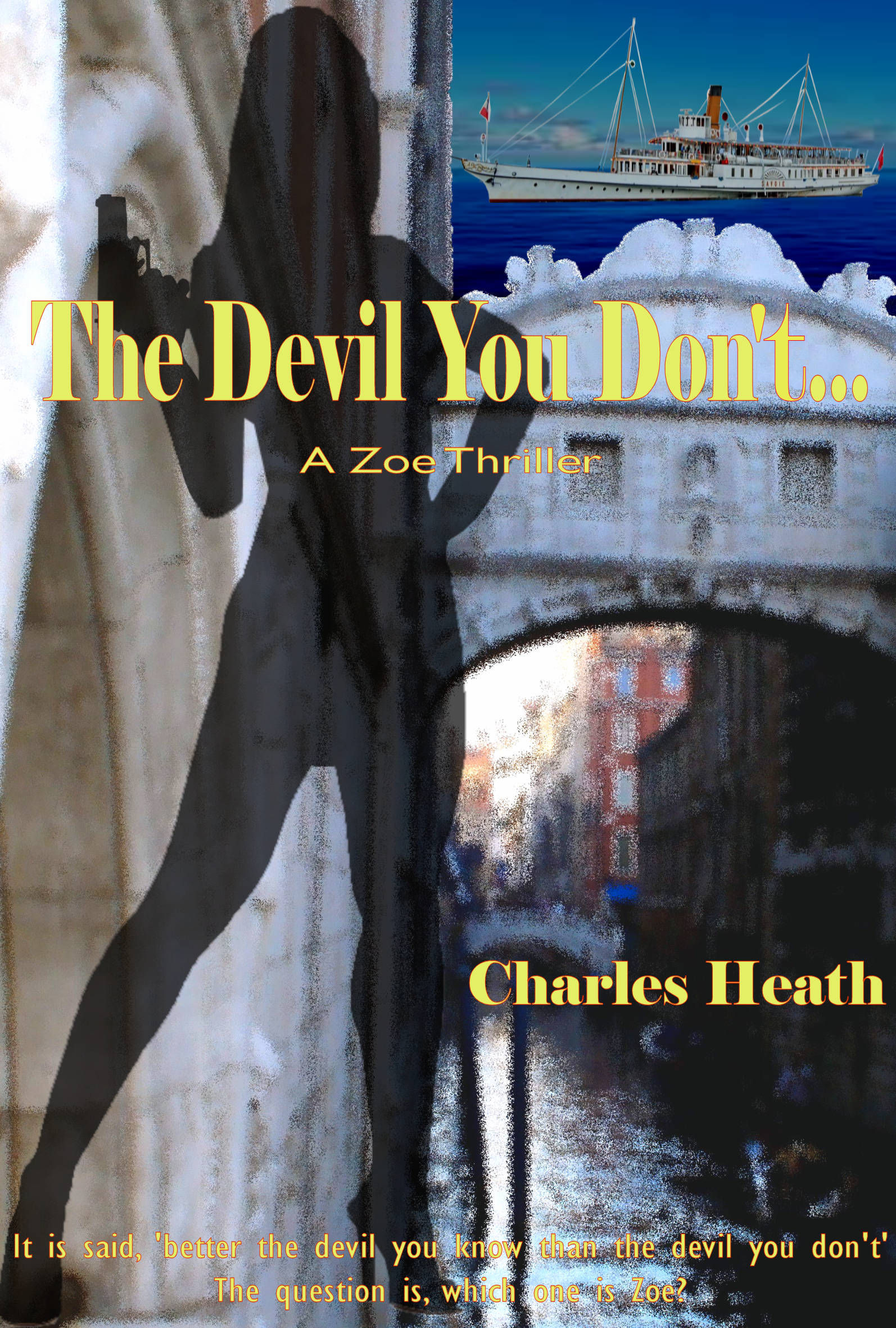
“The Devil You Don’t”, she was the girl you would not take home to your mother!

Now only $0.99 at https://amzn.to/2Xyh1ow

John Pennington’s life is in the doldrums. Looking for new opportunities, and prevaricating about getting married, the only joy on the horizon was an upcoming visit to his grandmother in Sorrento, Italy.

Suddenly he is left at the check-in counter with a message on his phone telling him the marriage is off, and the relationship is over.

If only he hadn’t promised a friend he would do a favour for him in Rome.

At the first stop, Geneva, he has a chance encounter with Zoe, an intriguing woman who captures his imagination from the moment she boards the Savoire, and his life ventures into uncharted territory in more ways than one.

That ‘favour’ for his friend suddenly becomes a life-changing event, and when Zoe, the woman who he knows is too good to be true, reappears, danger and death follow.

Shot at, lied to, seduced, and drawn into a world where nothing is what it seems, John is dragged into an adrenaline-charged undertaking, where he may have been wiser to stay with the ‘devil you know’ rather than opt for the ‘devil you don’t’.

newdevilcvr6

The Cinema of My Dreams – It ended in Sorrento – Episode 56

Looking for a missing countess

No one mentioned the real Countess or her sister.

Did they know?  Did Dicostini have them?  He had to.

Cecilia was very disappointed she couldn’t shoot anyone.  I was too, for different reasons.

Perhaps the only good thing to come out of it was that it didn’t look like Juliet was a party to the whole plan, just a part of it if Plan A didn’t work.

Cecelia packed up the rifle and I replaced everything in the hamper. 

“That was fun?”

“Wasn’t it?”

“How did you guess?”

“I would have sooner if the research team had done its job properly.  There was only one thing that could cause this level of trouble.  Greed.  It’s not what we usually deal with.  I prefer power-crazy megalomaniacs trying to take over the world.”

“I could write a script.  What do you think?”

“Been done to death I would think.”

“Are we going back to smash a few heads?  I feel like a little gratuitous violence, especially against that lot.”

“As tempting as those sounds, no.  We now have to do a search of every one of their properties, starting with those without any signs of life.  Long, hard, and tedious.”

“Are you trying to make it sound exciting?”

I gave her a searching look.  “You’re crazy, you know that.”

“Of course.  Why do you think I’m here with you.”

We had a week, but I was hoping it would not take that long.  There were less than ten other properties where the women could be located, and we started with the two closest.

The property we were on, now, would have to wait until after dark.  Cecelia had noted that there were a half dozen workers tending the vines during the day, as well as office and maintenance staff.  Quite a few employees for a place that wasn’t financially viable.

The nearest was another plot of vines, with a different grape variety, and I suspect possibly added from another winery that wasn’t viable.  Cecelia picked them as either Trebbiano or Vermentino, using her cell phone to identify them.

That’s how boring the search was going.  Three outbuildings that reeked of musty wine, quite a few old barrels, or barrels waiting to be filled, and old farm machinery that was rusting out.

There was also a vintage BMW under a tarpaulin that might be worth quite a sum of money.  If it didn’t have the front smashed in.  I took a photograph of the car for future reference, that thought that Anna believed Dicostini was responsible for the death of her husband.

Was that the car involved in the accident?

The second property was more of less the same as the first, but this one had a villa on it, fallen into disrepair.  There were a few people working in the fields next to the property, so we had to be careful not to be seen.

It was a large house, musty, with little furniture and large open spaces.  It must have been a comfortable place once.  I checked for a basement while Cecelia checked for an attic, or signs of life upstairs.  I found there were new locks in the doors and a room with two beds, unmade, and by the look of the dust layer, hadn’t been used in a few years.

It was an initial ray of hope very quickly snuffed out.

Day one was over, with no progress to report.  I sent a message to Rodby in code, just in case his new ‘wife’ accidentally on purpose picked up his phone.

I wondered how that was going for him.  It would be a situation he had not had to deal with before, and maybe this would hasten his thoughts to retiring and getting out of what was becoming a very dirty business.

On our way back to the hotel, Cecilia said, “What do you think Francesca’s been up to?”

“I’d be surprised if she didn’t go to see Anna.”

“For what purpose.”

“I’m sure her boss would like her to touch base, and assure her everything that can be done, is being done.”

“Except they’re waiting for us to do their job for them.”

“As long as we find them, it doesn’t matter.  It’s going to get a little tricky if we can’t liberate them without letting anyone know.  There’s no telling how much collateral damage there’ll be.”

“There never is, but I like to try and avoid it if possible.  Rodby likes his ‘by any and all means possible’, but, as you know, I operate differently.  You stick with me for too long you might lose your objectivity.”

“Maybe that’s why I’m here.  I’m usually the exact opposite.”

I would not have pegged her for an ‘all means possible’ person, but then she was an actress and was very good at being different people.  Her strength lay in being a total chameleon.  Then that picture in my mind of her with the sniper rifle at Larry’s mother’s place left me with a shiver down my spine.

I would wrap this up as quickly as possible, send her home, and go back to my once quiet life.

© Charles Heath 2023

365 Days of writing, 2026 – 142

Day 142 – Writing is many contradictions

The Art of the Split Consciousness: Why Every Writer Must Be Two People

Writing is a profession built on paradox. We sit in silence to communicate with the world; we spend hours in solitude to understand the collective human experience; and, perhaps most curiously, we must be both the creator and the critic at the exact same moment.

Albert Camus, a titan of literature and philosophy, famously captured this internal friction when he noted that a writer “must be two persons.”

But what does it mean to split one’s consciousness in the service of the craft? And why is this internal duality the secret to truly connecting with an audience?

The Creator and the Stranger

Camus argued that a writer must possess a dual identity to effectively “translate what one feels into what one wants others to feel.”

If you only write from the perspective of the Creator, you are essentially journaling. You are purging your own emotions, fueled by the raw, unrefined intensity of your personal experience. This is necessary for the spark of an idea, but it is rarely enough to sustain a reader. The Creator knows exactly what you mean; the Creator feels the weight of the memories behind every word.

But the reader? The reader arrives at your page as a stranger. They don’t know your context, your history, or the specific ache in your chest that birthed the sentence.

This is where the second person—the Stranger—must step in.

The Power of Detachment

The “Stranger” is the part of the writer that treats the manuscript like an alien artifact. It is the cold, analytical eye that looks at a paragraph and asks, “Does this make sense if I have never lived this moment?”

To write well is to master the art of detachment. You must be able to step outside of your own ego and look at your prose as if you were picking it up in a library, written by an author you’ve never met. When you read as a stranger, you start to notice where the logic gaps are, where the prose becomes self-indulgent, and where the emotional core is buried under too many adjectives.

Bridging the Gap: Why Writers Need Readers

Ultimately, the goal of this internal division is connection. We don’t write solely to process our thoughts; we write to bridge the gap between two minds.

Camus knew that writing is a form of translation. You are taking the abstract, messy, and deeply personal language of your internal life and converting it into a language that others can consume, understand, and feel. Without that “Stranger” perspective, we are merely shouting into a void. We are writing for the person who already knows what we’re saying: ourselves.

Embracing the Duality

If you find yourself struggling to edit your own work, or feeling like your writing doesn’t quite “land” with your audience, you might be leaning too heavily on one side of your personality.

You need the Creator to dream up the vision, to bleed onto the page, and to find the truth. But you need the Stranger to finish the job. You need the Stranger to be the audience-in-residence—the one who holds the pen steady and asks, “Is this true for them, too?”

Writing is a contradiction because it requires you to be both deeply vulnerable and completely objective. It’s a difficult balance to strike, but it’s the only way to ensure that what we feel, someone else will feel, too.

So, the next time you sit down to write, don’t just ask yourself what you want to say. Ask yourself if the stranger reading your work will understand why it matters.

The 2am Rant: I find myself in a very strange world

And I don’t know how I got here. I have a sneaking suspicion that I stepped through a portal, only I didn’t recognise it as one until I reached this side.

I say this side because the world I’m in now is not the world I remember from a while back, well, perhaps a year or so. Time passes very slowly here.

Before everything made sense, China didn’t hate us, and we had just finished touring some of the most remarkable sights of that very country.

There was no coronavirus and I didn’t fear for my life, and the fact I had a compromised immune system didn’t matter a hoot, except for the constant pain in my lower back and hands, the result of psoriatic arthritis going berserk as I get older.

My grandchildren were in school, alternately loving and hating it, and every Friday I would get one from school and she would tell me how her world was hell, and I had no idea what it was like.

Another would start all her sentences with ‘basically’, and the other would end hers with ‘like’.

I would lament the fact our schools no longer teach proper English, and we could sit around and talk about the YA novel I was writing for them, and that they were the characters in this mythical kingdom. And, yes, they are princesses, if not crotchety one day, and all smiles and goodness the next.

And, in an instant, that whole world was blown away.

Am I angry? I was. A year is too long to be mad at everyone and everything.

Have I a different outlook on life? Yes, I live every day as if it was my last, because the truth is, it just might be.

Can I travel anywhere? No. There’s too much risk in a world where few people under the age of 65 care about consequences.

Is there a reason to live? You may well ask.

I have thought about this often, lying awake in bed every morning, asking myself why I would bother getting up. I can’t go anywhere, I can’t do very much.

But…

We have here an almost remarkable record in keeping the coronavirus at bay, so we have some freedom. We can’t leave the country, and every other month a state or two closes its borders, so travelling outside the state is too risky. The schools are back, and I resumed pick-up duties last Friday, and, yes, the sweetness of the complaints about school life is like music to my ears.

Have I a reason to live? Yes. There are three girls, and grandchildren, one 13, one 16, and one 19. The 13-year-old is in the first year of secondary school, the 16-year-old lamenting the fourth year of secondary school, and the 19-year-old is about to embark on the terrors of tertiary education. She can also drive herself, a shred of independence that has changed her outlook, going from a child to someone more mature.

I hadn’t realized how much their lives were in such a constant state of change. Nor had I realized how much they prefer to tell me about it rather than their parents.

So, the answer to that deep and meaningful question is, is there a reason to live?

Yes. We can have so many things we think are essential to living our lives taken away, but in the end, they are all but superficial. You can lose a car, some of your mobility, a house, or any sort of chattel, but they are insignificant. What matters most, and always will, is family. I’m lucky, and indeed, extremely grateful, to have mine so near.

Now I suppose I should be getting to bed. Tomorrow, I have just been informed, I’m rostered on in what is known as ‘poppy’s taxi’.

And ready to hear the next enthralling episode of school life these days.

What I learned about writing – Patronage, good or bad

Three Jobs for One Dream: Is Patronage a Blessing or a Breaking Point?

Ah, the writer’s life. It’s often romanticised, conjuring images of solitary genius, ink-stained fingers, and profound insights emerging from quiet contemplation. But behind many of those published tomes and celebrated screenplays, there’s a less glamorous, often unspoken reality: the support system. Specifically, the partner who shoulders the financial burden, allowing the artist to pursue their muse.

This brings us to a crucial question that buzzes in the ears of many aspiring writers and their long-suffering loved ones: Is patronage for writers, particularly from a spouse, a noble sacrifice or a ticking time bomb?

The Romantic Ideal vs. The Hard Realities

Let’s start with the ideal. The notion that a spouse should work three jobs – the early morning shift, the afternoon grind, and the late-night gig – all to allow their other half to finally tackle that novel, screenplay, or poetry collection they’ve always dreamed of writing. On the surface, it speaks of deep love, unwavering belief, and a shared vision for a future where one partner’s creative potential is fully realised. It’s an echo of historical patronage, albeit a deeply personal and intimate one.

And sometimes, it works. Sometimes, that sacrifice leads to a breakthrough, a published work, and a shared sense of accomplishment that strengthens the bond. The story of the supportive partner becomes part of the legend, a testament to true love and artistic dedication.

But let’s be honest, those success stories are often the exception, not the rule. More frequently, this intense level of spousal patronage breeds a complex cocktail of emotions that can corrode the very foundation of a relationship.

The Weight of Expectation and the Erosion of Self

Imagine the partner working those three jobs. Their days are a blur of labour, their nights are for crashing, not connecting. Their own dreams, hobbies, and personal growth are shelved indefinitely. They’re not just bringing home the bacon; they’re the entire farm.

On the other side, the writer, theoretically freed to create, often carries a crushing weight of expectation. Every blank page feels like a failure. Every hour not spent writing feels like a betrayal of the sacrifice being made for them. The pressure to “make it” becomes immense, turning the creative process, which should be joyful, into a source of debilitating anxiety.

This imbalance isn’t just financial. It’s emotional, physical, and psychological.

  • For the working partner: Resentment begins to brew. Why are their dreams less important? Why is their exhaustion not acknowledged? Loneliness can set in, as the shared life they once had morphs slowly into one person supporting another’s isolated pursuit.
  • For the writer: Guilt gnaws. The fear of failure paralyses. Self-doubt magnifies. The creative well, instead of being nurtured, can dry up under the immense pressure to justify the cost.

At What Point Does It Become a Breaking Point?

This is the critical question. When does a loving dedication transform into an unsustainable burden? It’s rarely a sudden explosion; it’s more often a slow, insidious erosion, like water carving a canyon.

The breaking point isn’t just about financial strain, though that’s a huge part of it. It’s when:

  1. Communication ceases: Conversations become solely about bills, children, or the writer’s progress, with no room for personal connection, shared joys, or the working partner’s struggles.
  2. Resentment openly festers: Passive-aggressive comments, silent treatments, or outright arguments become commonplace, revealing the deep-seated anger and frustration.
  3. Physical and mental health deteriorate: The working partner is constantly exhausted, stressed, or depressed. The writer is crippled by anxiety, guilt, or isolation.
  4. The “dream” becomes an excuse: When the creative project repeatedly fails to materialise, or shows no significant progress despite years of sacrifice, the partner may start to see it not as a dream, but as an endless deferment of a shared future.
  5. A lack of reciprocity: The working partner realises their sacrifice is not being met with gratitude, practical help (where possible), or a concrete plan for future balance, but rather an expectation of continued, uncritical support.
  6. Loss of shared identity: The couple stops being a partnership and becomes a patron-artist dynamic, with clear roles but little give-and-take.

Finding a Sustainable Path Forward

So, is spousal patronage inherently bad? Not necessarily. But the extreme scenario of one partner working three jobs for years on end is almost certainly unsustainable and, frankly, unfair.

Instead of an all-or-nothing approach, consider a more balanced, communicative, and realistic path:

  • Open and Honest Communication: Regularly discuss finances, progress, expectations, and most importantly, how both partners are feeling.
  • Set Clear Timelines and Goals: “I’ll focus on writing for X months/years, and if it hasn’t generated income/interest by then, we’ll re-evaluate.” This provides a roadmap and reduces open-ended sacrifice.
  • Shared Responsibility: Can the writer contribute in other ways? Part-time work, freelancing, managing the household, picking up childcare? Even a small income can alleviate significant pressure.
  • Define Success Beyond Publication: Success can also mean completing a draft, getting positive feedback, or simply the joy of the creative process.
  • Prioritize the Relationship: Remember why you’re together. Your shared life, well-being, and happiness should take precedence over any single project.

The journey of a writer is often long and arduous. Support is invaluable. But that support should never come at the cost of the supporter’s well-being, nor should it become an endless burden that ultimately breaks the very relationship it sought to nurture. True partnership means nurturing both the individual dreams and the collective future.

What are your thoughts? Have you experienced or witnessed similar sit

Searching for locations – Lake Louise, Canada

I was not sure what I expected to see when we first arrived at the Fairmont Hotel in Lake Louise, Alberta, Canada.

I’d seen endless photographs both in Winter and in Summer, and the problem with photos is that they never quite prepare you for reality.

That’s not to say that our first impression was of incredible scenery, it was of the front door if it could be called that, where we pulled up in the car, and then, if the sub-zero temperatures, a mad rush to get the baggage out, and get into the warmth of the foyer, which was almost the size of several football fields, and then some.

Check-in was quick and easy, and then we went to our room on the first floor.  I had hoped to be higher up, but, being a corner room, when we got there, the views could not be more majestic.

I could not believe there were people who were willing to take a sleigh ride in the minus degree temperatures.  Don’t let the sunny aspect fool you; it’s freezing cold, literally, outside.

The lake had frozen over, and a closer look showed there was a skating rink, an ice castle, and a hockey rink as well.  People were skating and walking over the frozen surface of the lake.

No skating or walking on thin ice here.

Venturing outside into the cold, you have to be rugged up, and definitely, have both a hat and gloves.  It was minus six degrees.

There’s this amazing hotel, just like you would see in the movies

A frozen lake where you’re half expecting to open up and a huge spaceship, or something else, come out

Mountainsides to climb, but only if you are stark staring mad.  And, of course, if you don’t freeze to death before you get there.

Our room, believe it or not, is on the extreme right-hand side, just above the first roofline.

Tomorrow we will venture further out onto the lake.

Tonight, it’s dinner in the main restaurant.

In a word: Story

All of us writers know what this is, the sort of combination of words that all come together as a story.  A tale about anything, whether it is true or just plain fiction.

A story can be long, or it can be short.  It could be a magazine or newspaper article, or it could be what a child tells their mother or father when they get into trouble.

Come to think of it, I think that’s where I got an interest in writing stories, because as a child, I was always in trouble.

Of course, if you are telling certain types of stories, then it’s bound to be a lie.  And made even worse if it is gossip!

That story might even be my interpretation of events, and as it happens, no two stories may be the same, especially if I and others had witnessed the same event.

This is not to be confused with the other version, storey, which is a single level in a building, one that might have thirty or more stories.

And, just to add to the confusion, living in Brisbane in Australia, we have the Storey Bridge.

Another excerpt from “Strangers We’ve Become” – A sequel to ‘What Sets Us Apart’

It was the first time in almost a week that I made the short walk to the cafe alone.  It was early, and the chill of the morning was still in the air.  In summer, it was the best time of the day.  When Susan came with me, it was usually much later, when the day was much warmer and less tolerable.

On the morning of the third day of her visit, Susan said she was missing the hustle and bustle of London, and by the end of the fourth she said, in not so many words, she was over being away from ‘civilisation’.  This was a side of her I had not seen before, and it surprised me.

She hadn’t complained, but it was making her irritable.  The Susan that morning was vastly different to the Susan on the first day.  So much, I thought, for her wanting to ‘reconnect’, the word she had used as the reason for coming to Greve unannounced.

It was also the first morning I had time to reflect on her visit and what my feelings were towards her.  It was the reason I’d come to Greve: to soak up the peace and quiet and think about what I was going to do with the rest of my life.

I sat in my usual corner.  Maria, one of two waitresses, came out, stopped, and there was no mistaking the relief in her manner.  There was an air of tension between Susan and Maria I didn’t understand, and it seemed to emanate from Susan rather than the other way around.  I could understand her attitude if it was towards Alisha, but not Maria.  All she did was serve coffee and cake.

When Maria recovered from the momentary surprise, she said, smiling, “You are by yourself?”  She gave a quick glance in the direction of my villa, just to be sure.

“I am this morning.  I’m afraid the heat, for one who is not used to it, can be quite debilitating.  I’m also afraid it has had a bad effect on her manners, for which I apologise.  I cannot explain why she has been so rude to you.”

“You do not have to apologise for her, David, but it is of no consequence to me.  I have had a lot worse.  I think she is simply jealous.”

It had crossed my mind, but there was no reason for her to be.  “Why?”

“She is a woman, I am a woman, she thinks because you and I are friends, there is something between us.”

It made sense, even if it was not true.  “Perhaps if I explained…”

Maria shook her head.  “If there is a hole in the boat, you should not keep bailing but try to plug the hole.  My grandfather had many expressions, David.  If I may give you one piece of advice, as much as it is none of my business, you need to make your feelings known, and if they are not as they once were, and I think they are not, you need to tell her.  Before she goes home.”

Interesting advice.  Not only a purveyor of excellent coffee, but Maria was also a psychiatrist who had astutely worked out my dilemma.  What was that expression, ‘not just a pretty face’?

“Is she leaving soon?” I asked, thinking Maria knew more about Susan’s movements than I did.

“You would disappoint me if you had not suspected as much.  Susan was having coffee and talking to someone in her office on a cell phone.  It was an intense conversation.  I should not eavesdrop, but she said being here was like being stuck in hell.  It is a pity she does not share your love for our little piece of paradise, is it not?”

“It is indeed.  And you’re right.  She said she didn’t have a phone, but I know she has one.  She just doesn’t value the idea of getting away from the office.  Perhaps her role doesn’t afford her that luxury.”

And perhaps Alisha was right about Maria, that I should be more careful.  She had liked Maria the moment she saw her.  We had sat at this very table, the first day I arrived.  I would have travelled alone, but Prendergast, my old boss, liked to know where ex-employees of the Department were, and what they were doing.

She sighed.  “I am glad I am just a waitress.  Your usual coffee and cake?”

“Yes, please.”

Several months had passed since we had rescued Susan from her despotic father; she had recovered faster than we had thought, and settled into her role as the new Lady Featherington, though she preferred not to use that title, but go by the name of Lady Susan Cheney.

I didn’t get to be a Lord, or have any title, not that I was expecting one.  What I had expected was that Susan, once she found her footing as head of what seemed to be a commercial empire, would not have time for details like husbands, particularly when our agreement made before the wedding gave either of us the right to end it.

There was a moment when I visited her recovering in the hospital, where I was going to give her the out, but I didn’t, and she had not invoked it.  We were still married, just not living together.

This visit was one where she wanted to ‘reconnect’ as she called it, and invite me to come home with her.  She saw no reason why we could not resume our relationship, conveniently forgetting she indirectly had me arrested for her murder, charges both her mother and Lucy vigorously pursued, and had the clone not returned to save me, I might still be in jail.

It was not something I would forgive or forget any time soon.

There were other reasons why I was reluctant to stay with her, like forgetting small details, an irregularity in her character I found odd.  She looked the same, she sounded the same, she basically acted the same, but my mind was telling me something was not right.  It was not the Susan I first met, even allowing for the ordeal she had been subjected to.

But, despite those misgivings, there was no question in my mind that I still loved her, and her clandestine arrival had brought back all those feelings.  But as the days passed, I began to get the impression my feelings were one-sided and she was just going through the motions.

Which brought me to the last argument, earlier, where I said if I went with her, it would be business meetings, social obligations, and quite simply her ‘celebrity’ status that would keep us apart.  I reminded her that I had said from the outset I didn’t like the idea of being in the spotlight, and when I reiterated it, she simply brushed it off as just part of the job, adding rather strangely that I always looked good in a suit.  The flippancy of that comment was the last straw, and I left before I said something I would regret.

I knew I was not a priority.  Maybe somewhere inside me, I had wanted to be a priority, and I was disappointed when I was not.

And finally, there was Alisha.  Susan, at the height of the argument, had intimated she believed I had an affair with her, but that elephant was always in the room whenever Alisha was around.  It was no surprise when I learned Susan had asked Prendergast to reassign her to other duties. 

At least I knew what my feelings for Alisha were, and there were times when I had to remember she was persona non grata.  Perhaps that was why Susan had her banished, but, again, a small detail; jealousy was not one of Susan’s traits when I first knew her.

Perhaps it was time to set Susan free.

When I swung around to look in the direction of the lane where my villa was, I saw Susan.  She was formally dressed, not in her ‘tourist’ clothes, which she had bought from one of the local clothing stores.  We had fun that day, shopping for clothes, a chore I’d always hated.  It had been followed by a leisurely lunch, lots of wine and soul searching.

It was the reason why I sat in this corner; old habits die hard.  I could see trouble coming from all directions, not that Susan was trouble or at least I hoped not, but it allowed me the time to watch her walking towards the cafe in what appeared to be short, angry steps; perhaps the culmination of the heat wave and our last argument.

She glared at me as she sat, dropping her bag beside her on the ground, where I could see the cell phone sitting on top.  She followed my glance down, and then she looked unrepentant back at me.

Maria came back at the exact moment she was going to speak.  I noticed Maria hesitate for a second when she saw Susan, then put her smile in place to deliver my coffee.

Neither spoke nor looked at each other.  I said, “Susan will have what I’m having, thanks.”

Maria nodded and left.

“Now,” I said, leaning back in my seat, “I’m sure there’s a perfectly good explanation as to why you didn’t tell me about the phone, but that first time you disappeared, I’d guessed you needed to keep in touch with your business interests.  I thought it somewhat unwisethat you should come out when the board of one of your companies was trying to remove you, because of what was it, an unexplained absence?  All you had to do was tell me there were problems and you needed to remain at home to resolve them.”

My comment elicited a sideways look, with a touch of surprise.

“It was unfortunate timing on their behalf, and I didn’t want you to think everything else was more important than us.  There were issues before I came, and I thought the people at home would be able to manage without me for at least a week, but I was wrong.”

“Why come at all.  A phone call would have sufficed.”

“I had to see you, talk to you.  At least we have had a chance to do that.  I’m sorry about yesterday.  I once told you I would not become my mother, but I’m afraid I sounded just like her.  I misjudged just how much this role would affect me, and truly, I’m sorry.”

An apology was the last thing I expected.

“You have a lot of work to do catching up after being away, and of course, in replacing your mother and gaining the requisite respect as the new Lady Featherington.  I think it would be for the best if I were not another distraction.  We have plenty of time to reacquaint ourselves when you get past all these teething issues.”

“You’re not coming with me?”  She sounded disappointed.

“I think it would be for the best if I didn’t.”

“Why?”

“It should come as no surprise to you that I’ve been keeping an eye on your progress.  You are so much better doing your job without me.  I told your mother once that when the time came I would not like the responsibilities of being your husband.  Now that I have seen what it could possibly entail, I like it even less.  You might also want to reconsider our arrangement, after all, we only had a marriage of convenience, and now that those obligations have been fulfilled, we both have the option of terminating it.  I won’t make things difficult for you if that’s what you want.”

It was yet another anomaly, I thought; she should look distressed, and I would raise the matter of that arrangement.  Perhaps she had forgotten the finer points.  I, on the other hand, had always known we would not last forever.  The perplexed expression, to me, was a sign she might have forgotten.

Then, her expression changed.  “Is that what you want?”

“I wasn’t madly in love with you when we made that arrangement, so it was easy to agree to your terms, but inexplicably, since then, my feelings for you changed, and I would be sad if we parted ways.  But the truth is, I can’t see how this is going to work.”

“In saying that, do you think I don’t care for you?”

That was exactly what I was thinking, but I wasn’t going to voice that opinion out loud.  “You spent a lot of time finding new ways to make my life miserable, Susan.  You and that wretched friend of yours, Lucy.  While your attitude improved after we were married, that was because you were going to use me when you went to see your father, and then almost let me go to prison for your murder.”

“I had nothing to do with that, other than to leave, and I didn’t agree with Lucy that you should be made responsible for my disappearance.  I cannot be held responsible for the actions of my mother.  She hated you; Lucy didn’t understand you, and Millie told me I was stupid for not loving you in return, and she was right.  Why do you think I gave you such a hard time?  You made it impossible not to fall in love with you, and it nearly changed my mind about everything I’d been planning so meticulously.  But perhaps there was a more subliminal reason why I did because after I left, I wanted to believe, if anything went wrong, you would come and find me.”

“How could you possibly know that I’d even consider doing something like that, given what you knew about me?”

“Prendergast made a passing comment when my mother asked him about you; he told us you were very good at finding people and even better at fixing problems.”

“And yet here we are, one argument away from ending it.”

I could see Maria hovering, waiting for the right moment to deliver her coffee, then go back and find Gianna, the café owner, instead.  Gianna was more abrupt and, for that reason, was rarely seen serving the customers.  Today, she was particularly cantankerous, banging the cake dish on the table and frowning at Susan before returning to her kitchen.  Gianna didn’t like Susan either.

Behind me, I heard a car stop, and when she looked up, I knew it was for her.  She had arrived with nothing, and she was leaving with nothing.

She stood.  “Last chance.”

“Forever?”

She hesitated and then shook away the look of annoyance on her face.  “Of course not.  I wanted you to come back with me so we could continue working on our relationship.  I agree there are problems, but it’s nothing we can’t resolve if we try.”

I had been trying.  “It’s too soon for both of us, Susan.  I need to be able to trust you, and given the circumstances, and all that water under the bridge, I’m not sure if I can yet.”

She frowned at me.  “As you wish.”  She took an envelope out of her bag and put it on the table.  “When you are ready, it’s an open ticket home.  Please make it sooner rather than later.  Despite what you think of me, I have missed you, and I have no intention of ending it between us.”

That said, she glared at me for a minute, shook her head, then walked to the car.  I watched her get in and the car drive slowly away.

No kiss, no touch, no looking back. 

© Charles Heath 2018-2025

strangerscover9