In a word: Vision

I had one myself once, whether it was a peek into my future, or whether it was just playing out a scene for one of my stories, it was rather intense.

That variation of the word vision is one that uses one’s imagination. I do it quite a lot, and I call it the cinema of my dreams.

But…

Vision, in the simplest sense of the word, is sight, what you see.

People can try to make it better, like movie studios, who have called it rather interesting titles such as VistaVision or Panavision, either of which sounds quite remarkable, and it may have been back in the day, but it’s probably quite ordinary these days.

A vision, in another sense, might be something like a dream as mentioned before, which might happen when we are asleep, but if awake, it might be because we are very bored with our job and we’re imagining what it would be like at Santorini or the Bahamas, or anywhere but where you are now.

It might also describe our particular slant on what else we would like to happen, whether at work or somewhere else, but it’s usually confined to our closest circle of friends. Bosses never invite nor want to hear plebs ideas of improving their lot.

Hence, I have a vision…

But no one will listen. Perhaps if I was Martin Luther King, things might be different.

Then, at the end of it all…

There are visions and then there are visions, like seeing something that no one else can see, whether driven by hallucinogenic drugs or magic mushrooms, or you just happened to be there to see what no one else could.

Dragons, lizard people, or the Virgin Mary.

And no, I have not seen any of the above.

Yet.

An excerpt from “What Sets Us Apart”, a mystery with a twist

See the excerpt from the story below, just a taste of what’s in store…

http://amzn.to/2Eryfth

whatsetscover

McCallister was old school, a man who would most likely fit in perfectly campaigning on the battlefields of Europe during the Second World War. He’d been like a fish out of water in the army, post-Falklands, and while he retired a hero, he still felt he’d more to give.

He’d applied and was accepted as head of a SWAT team, and, watching him now as he and his men disembarked from the truck in almost military precision, a look passed between Annette, the police liaison officer, and I that said she’d seen it all before. I know I had.

There was a one in four chance his team would be selected for this operation, and she had been hoping it would be one of the other three. While waiting for them to arrive she filled me in on the various teams. His was the least co-operative, and the more likely to make ad-hoc decisions rather than adhere to the plan, or any orders that may come from the officer in charge.

This, she said quite bluntly, was going to end badly.

I still had no idea why Prendergast instructed me to attend the scene of what looked to be a normal domestic operation, but as the nominated expert in the field in these types of situations, it was fairly clear he wasn’t taking any chances. It was always a matter of opinion between us, and generally I lost.

In this case, it was an anonymous report identifying what the authorities believed were explosives in one of the dockside sheds where explosives were not supposed to be.

The only reason why the report was given any credence was the man, while not identifying himself by name, said he’d been an explosive expert once and recognized the boxes. That could mean anything, but the Chief Constable was a cautious man.

With his men settled and preparing their weapons, McCallister came over to the command post, not much more than the SUV my liaison and I arrived in, with weapons, bulletproof vests, and rolls of tape to cordon off the area afterward. We both had coffee, steaming in the cold early morning air. Dawn was slowly approaching and although rain had been forecast it had yet to arrive.

A man by the name of Benson was in charge. He too had groaned when he saw McCallister.

“A fine morning for it.” McCallister was the only enthusiastic one here.

He didn’t say what ‘it’ was, but I thought it might eventually be mayhem.

“Let’s hope the rain stays away. It’s going to be difficult enough without it,” Benson said, rubbing his hands together. We had been waiting for the SWAT team to arrive, and another team to take up their position under the wharf, and who was in the final stages of securing their position.

While we were waiting we drew up the plan. I’d go in first to check on what we were dealing with, and what type of explosives. The SWAT team, in the meantime, were to ensure all the exits to the shed were covered. When I gave the signal, they were to enter and secure the building. We were not expecting anyone inside or out, and no movement had been detected in the last hour since our arrival and deployment.

“What’s the current situation?”

“I’ve got eyes on the building, and a team coming in from the waterside, underneath. Its slow progress, but they’re nearly there. Once they’re in place, we’re sending McKenzie in.”

He looked in my direction.

“With due respect sir, shouldn’t it be one of us?” McCallister glared at me with the contempt that only a decorated military officer could.

“No. I have orders from above, much higher than I care to argue with, so, McCallister, no gung-ho heroics for the moment. Just be ready to move on my command, and make sure you have three teams at the exit points, ready to secure the building.”

McCallister opened his mouth, no doubt to question those orders, but instead closed it again. “Yes sir,” he muttered and turned away heading back to his men.

“You’re not going to have much time before he storms the battlements,” Benson quietly said to me, a hint of exasperation in his tone. “I’m dreading the paperwork.”

It was exactly what my liaison officer said when she saw McCallister arriving.

The water team sent their ‘in position’ signal, and we were ready to go.

In the hour or so we’d been on site nothing had stirred, no arrivals, no departures, and no sign anyone was inside, but that didn’t mean we were alone. Nor did it mean I was going to walk in and see immediately what was going on. If it was a cache of explosives then it was possible the building was booby-trapped in any number of ways, there could be sentries or guards, and they had eyes on us, or it might be a false alarm.

I was hoping for the latter.

I put on the bulletproof vest, thinking it was a poor substitute for full battle armor against an exploding bomb, but we were still treating this as a ‘suspected’ case. I noticed my liaison officer was pulling on her bulletproof vest too.

“You don’t have to go. This is my party, not yours,” I said.

“The Chief Constable told me to stick to you like glue, sir.”

I looked at Benson. “Talk some sense into her please, this is not a kindergarten outing.”

He shrugged. Seeing McCallister had taken all the fight out of him. “Orders are orders. If that’s what the Chief Constable requested …”

Madness. I glared at her, and she gave me a wan smile. “Stay behind me then, and don’t do anything stupid.”

“Believe me, I won’t be.” She pulled out and checked her weapon, chambering the first round. It made a reassuring sound.

Suited up, weapons readied, a last sip of the coffee in a stomach that was already churning from nerves and tension, I looked at the target, one hundred yards distant and thought it was going to be the longest hundred yards I’d ever traversed. At least for this week.

A swirling mist rolled in and caused a slight change in plans.

Because the front of the buildings was constantly illuminated by large overhead arc lamps, my intention had been to approach the building from the rear where there was less light and more cover. Despite the lack of movement, if there were explosives in that building, there’d be ‘enemy’ surveillance somewhere, and, after making that assumption, I believed it was going to be easier and less noticeable to use the darkness as a cover.

It was a result of the consultation, and studying the plans of the warehouse, plans that showed three entrances, the main front hangar type doors, a side entrance for truck entry and exit and a small door in the rear, at the end of an internal passage leading to several offices. I also assumed it was the exit used when smokers needed a break. Our entry would be by the rear door or failing that, the side entrance where a door was built into the larger sliding doors. In both cases, the locks would not present a problem.

The change in the weather made the approach shorter, and given the density of the mist now turning into a fog, we were able to approach by the front, hugging the walls, and moving quickly while there was cover. I could feel the dampness of the mist and shivered more than once.

It was nerves more than the cold.

I could also feel rather than see the presence of Annette behind me, and once felt her breath on my neck when we stopped for a quick reconnaissance.

It was the same for McCallister’s men. I could feel them following us, quickly and quietly, and expected, if I turned around, to see him breathing down my neck too.

It added to the tension.

My plan was still to enter by the back door.

We slipped up the alley between the two sheds to the rear corner and stopped. I heard a noise coming from the rear of the building, and the light tap on the shoulder told me Annette had heard it too. I put my hand up to signal her to wait, and as a swirl of mist rolled in, I slipped around the corner heading towards where I’d last seen the glow of a cigarette.

The mist cleared, and we saw each other at the same time. He was a bearded man in battle fatigues, not the average dockside security guard.

He was quick, but my slight element of surprise was his undoing, and he was down and unconscious in less than a few seconds with barely a sound beyond the body hitting the ground. Zip ties secured his hands and legs, and tape his mouth. Annette joined me a minute after securing him.

A glance at the body then me, “I can see why they, whoever they are, sent you.”

She’d asked who I worked for, and I didn’t answer. It was best she didn’t know.

“Stay behind me,” I said, more urgency in my tone. If there was one, there’d be another.

Luck was with us so far. A man outside smoking meant no booby traps on the back door, and quite possibly there’d be none inside. But it indicated there were more men inside, and if so, it appeared they were very well trained. If that were the case, they would be formidable opponents.

The fear factor increased exponentially.

I slowly opened the door and looked in. A pale light shone from within the warehouse itself, one that was not bright enough to be detected from outside. None of the offices had lights on, so it was possible they were vacant. I realized then they had blacked out the windows. Why hadn’t someone checked this?

Once inside, the door closed behind us, progress was slow and careful. She remained directly behind me, gun ready to shoot anything that moved. I had a momentary thought for McCallister and his men, securing the perimeter.

At the end of the corridor, the extent of the warehouse stretched before us. The pale lighting made it seem like a vast empty cavern, except for a long trestle table along one side, and, behind it, stacks of wooden crates, some opened. It looked like a production line.

To get to the table from where we were was a ten-yard walk in the open. There was no cover. If we stuck to the walls, there was equally no cover and a longer walk.

We needed a distraction.

As if on cue, the two main entrances disintegrated into flying shrapnel accompanied by a deafening explosion that momentarily disoriented both Annette and I. Through the smoke and dust kicked up I saw three men appear from behind the wooden crates, each with what looked like machine guns, spraying bullets in the direction of the incoming SWAT members.

They never had a chance, cut down before they made ten steps into the building.

By the time I’d recovered, my head heavy, eyes watering and ears still ringing, I took several steps towards them, managing to take down two of the gunmen but not the third.

I heard a voice, Annette’s I think, yell out, “Oh, God, he’s got a trigger,” just before another explosion, though all I remember in that split second was a bright flash, the intense heat, something very heavy smashing into my chest knocking the wind out of me, and then the sensation of flying, just before I hit the wall.

I spent four weeks in an induced coma, three months being stitched back together and another six learning to do all those basic actions everyone took for granted. It was twelve months almost to the day when I was released from the hospital, physically, except for a few alterations required after being hit by shrapnel, looking the same as I always had.

But mentally? The document I’d signed on release said it all, ‘not fit for active duty; discharged’.

It was in the name of David Cheney. For all intents and purposes, Alistair McKenzie was killed in that warehouse, and for the first time ever, an agent left the Department, the first to retire alive.

I was not sure I liked the idea of making history.

© Charles Heath 2016-2020
Follow that cab… – A short story

Nothing ever good comes from eavesdropping.

Or, so my mother said, once, with such feeling that I suspect she had some experience of having done so. It might explain the enmity between her and her older sister, the aunt we never saw.

Except all that changed when I received an odd email from a woman who claimed to be that very aunt.

We had all been warned about scams that came from dubious sources online, and this initially struck me as one. I would need more information before I answered.

That meant poking the bear, that is, asking my mother about her sister.

And coming right out with the words she hoped she’d never heard.

“Aunt Guenivere sent me an email, asking if we could meet. It seems she wants to meet the nephew she hasn’t seen since I was born. What happened to you two?”

It brought a look of total hatred in return.

“You would be wise not to respond. That woman is just plain evil.”

“You do realise that a statement like that makes it even more imperative that I should meet her. If you’re not going to tell me what happened, I’m sure she will.”

“Then if you must, you must.”

It wasn’t resignation but suppressed rage. Whatever had happened, it was something she believed no one would believe her, or understand, least of all me.

With that, she stood and walked out of the room, leaving me with the ominous feeling that it would be the last time I saw her.

After verifying that my so-called aunt was Aunt Guenivere, I arranged a meeting in a public place, a tea room in Queens. And it wasn’t going to be hard to recognise her, she would just be an older version of my mother.

I knew this because I had found a photograph of my mother and her two sisters, all of whom looked very much alike. I’d known about the younger sister, who had died in an accidental car crash many years before, and what my mother regarded as a wasted life.

I saw her about the same time she saw me.

And she just made it to the table when her cell phone rang. She smiled, put a hand up and asked for a moment, and then went back outside. I watched her walk up and down, slowly at first, but I could see the conversation was getting heated.

After a few minutes, I went outside to see if I could be of any assistance.

Apparently not. One look was enough, and I knew what it meant. At least her sister and my mother shared the same facial expressions when angry.

Then the conversation ended. I thought, for a moment, she was going to throw the phone on the ground, and only just managed to stop herself.

Instead, she came over and said. “I’m sorry, but something has come up and I have to go. I’ll call you.”

With that, she waved down a taxi, one stopped, and she jumped in.

Another pulled in behind her taxi and, on the spur of the moment, said with a flourish, “Follow that cab.”

The driver turned to look at me and then said, “You’re kidding.”

I held up a hundred-dollar note and said, seriously, “This is yours if you don’t lose it.”

Incentive enough.

It was a lot easier to follow that taxi than I thought. We caught up and the first set of lights and then proceeded to miss every second intersection as if the universe knew I needed to keep her in sight.

All the way to the Upper West Side and a very expensive apartment block. I paid the cabbie and jumped out, just in time to see a very familiar figure join my aunt.

My father.

And they didn’t look like people who didn’t know each other, or who were at war.

They remained outside the apartment block, and I could see my father had arrived by cab, and it was waiting for him.

I got as close as I could, hidden effectively behind the bushes that lined the building entrance. They were speaking loudly, which surprised me

“What the hell were you thinking?” he said, not angrily, but I could tell he was agitated.

“I was thinking it was time someone told him the truth.”

What truth?

“You know what Evelyn thinks of that, and I do too. You made an agreement.”

“I’ve changed my mind. After all, he is my son, not hers.”

—–

© Charles Heath 2020-2025

Memories of the conversations with my cat – 75

As some may be aware, but many are not, Chester, my faithful writing assistant, mouse catcher, and general pain in the neck, passed away some years ago.

Recently, I was running a series based on his adventures, titled “Past Conversations with My Cat.”

For those who have not had the chance to read about all of his exploits, I will run the series again from Episode 1

These are the memories of our time together…

This is Chester. He’s now answering the phone.

I came down to the living room to find Chester on the counter next to the house phone, and the receiver sitting next to him.

I’m almost too afraid to ask, but, you know it is, nothing ventured, nothing gained.

“What have you done?”

“I thought I’d answer the phone for you. Thing is, they hung up.”

It’s a scam call. They ring up, you answer, they hang up knowing they’ve got a live number to call with their scam.

“Yep. Just sit tight, the scammers will start calling in half an hour.”

I put the receiver back.

“I’m getting back to work.”

“I’ll keep an eye on the phone. When they call, I’ll answer it.”

Yep. That’ll give the scammers something to think about.

Half an hour later, the phone rings. Instinctively I get up to answer it but Chester has answered it. That is, he has dislodged the receiver, and it’s sitting on the bench.

A voice is coming out of it. “This is Aaron. I’m from the Telstra technical department. Hello.”

Chester is looking at the phone, hearing the voice but not quite understanding.

He looks at me. “What is that guy’s problem. I told him I’m not interested. Doesn’t he get it?”

I hang up the phone. “They never get it. But don’t worry, they’ll call back again in an hour or so. Just tell them to go away.”

Chester looks at me with a whimsical smile. “This is going to be fun.”

My scam call problem is solved!

The cinema of my dreams – Was it just another surveillance job – Episode 41

I’m back home and this story has been sitting on the back burner for a few months, waiting for some more to be written.

The trouble is, there are also other stories to write, and I’m not very good at prioritizing.

But, here we are, a few minutes opened up and it didn’t take long to get back into the groove.

Chasing leads, maybe

I gave it about five minutes before I think I started breathing again and then headed back to Jennifer.

Or where I thought I had left her.

She wasn’t there. I think, in the end, it didn’t surprise me. She had been reluctant from the start so if I had to guess, she had done a bunk. This was not her fight, nor mine, but she had a ticket out. Why would you want to come back after being betrayed by the likes of Severin and Maury?

I hope she left the car behind.

Now that I was here there was no point leaving, so I took a few minutes to search the surrounding area, just in case she was still here, just someplace else, and when she wasn’t, I quickly and silently made my way back to the side of the house with the open door from a different direction.

There was another set of French doors, these curtained, and with an overhead light above the doorway, so I kept my distance in case there was a movement activator, another which looked to be a servant’s entrance at the back. Neither door looked to be an easy viable entrance.

The original side door was still unlocked, with no lights or movement inside.

I waited, then opened the door wide enough to slip through. Again, I waited in case there was a silent alarm, then when nothing stirred, slipped through and closed the door behind me.

On the other side of the door, it was quite dark, except now I could see, on one wall, the dying embers of a fire. Someone had been in the room earlier and most likely gone to bed.

It meant the house was occupied.

It also meant I had to be careful.

On the other side of the doors, it was a lot warmer. Again I waited a few minutes, just in case someone came, and, when they didn’t, I pulled out a small torch and turned it on.

In front of me were two chairs and a table, one I would have walked into without a light. The walls had shelves and those shelves were filled with books. Some behind glass doors, others not. There was another chair by the fire, and beside it, a stack of cooks, and a table with had an empty glass and a bottle, and a pair of reading glasses.

The downstairs reading room.

I cross the room slowly, hoping there were no squeaky floorboards, to be expected in an old house like this one. The timber flooring was exposed only at the edges of the room, the rest of the floor covered in a large, discolored, and fraying carpet square.

It was old, like everything else in the room.

I was tempted to have a look at how far the books dated back to but resisted the urge. I was looking for information on the owner.

At the doorway to what looked like a passage, I turned off the torch and peered out. It was not exactly dark, my eyes had adjusted to the low-level light from low wattage lights about a foot above the floor.

Lights to help guide the way at night.

Left, rooms, right, rooms, at the end of the passage a wide doorway leading towards the other side of the house. Larger rooms perhaps.

I turned right and headed towards the front, and they stopped at the doorway to the next room. I’d deliberately walked on the carpet runner in the middle of the passage, and just managed to catch my foot when one part of the floor creaked softly.

The room next door was almost the same as the one I’d entered by, with chairs and shelves but only on two sides. This room had a long window and no French doors.

On one side there was a writing desk, open, with papers scatted on the writing surface. I quickly crossed the room to it, switched on the light, and checked.

Bills. In the name of Mrs. Marianne Quigley. This had to be Adam Quigley’s mother, and by deduction, O’Connell’s mother.

Proof I was in the right place.

Then I heard the squeak of a floorboard followed by the clicking sound of a gun being cocked.

“Don’t move, or I’ll shoot. Hands in the air. And don’t make me ask twice.”

Hands up it was.

© Charles Heath 2020-2022

Writing a book in 365 days – 238

Day 238

Writing exercise

She believed every one of his lies, the gaudier and more divorced from any semblance of possibility, the better.

….

Listening to her subject, John Terrance Wilkins Jamieson, the third, if you will, a name that in any other situation would have been one held in utter reverence, Amy quickly remembered the instructions of her handler.

‘Make him feel like you have his complete confidence, flatter him, feed the ego, draw the story out of him, it will come in layers, the first few, like topsoil, to be dug out and put aside, the next, the hard cover, the clay if you will. This will be hard to extract and require prompting, but not too much, and then, well, we shall see what we shall see.’

It hadn’t been that difficult. She knew the type, knew the levers to pull and the buttons to push, ever so gently. He was a man with a story, and he would tell it in his time, not hers, but it would come. It was not her job to sort the wheat from the chaff, just to be the one to dig.

They had been sitting in that room for an hour, she asking questions and he dodging them, making her the focus of the interview, and her bringing it back on track. Then it was time for a metaphorical yank…

“So, the people I represent are willing to pay, and pay a lot, for your story. But, and let me stress this one important point, they will pay only if I believe you have told me the truth. You’re probably thinking, I could tell this silly girl anything, and if I put just the right amount of emphasis and heart into it, I can make her believe anything. You probably could, if you wanted to, but you have to wonder, does she know anything about this? Is there more than one source? Does she know enough from all the peripheral information that is out there, truth and fiction?”

A little hardening of the tone, a little wariness creeping into his eyes. “Do you?”

“That’s for me to know and for you to find out. After all, you did ask for me, and I assume you believe that I have the credibility from previous stories that will give your story credence, set the narrative, as it were. You need me more than I need you, Mr Jamieson.”

He regarded her now with a degree of respect. “Call me John, please.”

“Wait an hour, and if I think you deserve it, I will.”


Jackson Jamieson, estranged father, said in an earlier interview when she was seeking background on the only son, one whom his father had hoped would take over the family business, not burn it to the ground. Shortly after that, his son had disappeared a few years back, but he still believed he was out there, somewhere. He did not recognise the man in the photo Amy had shown him, even though he had the same name. He didn’t have the scar running along the hairline on the left side of the forehead.

That was because it was not his son. Only a week before, the police had discovered that Jackson’s real son had died in a boating accident when John had been on holiday, and his remains, recently discovered and stored unidentified in a box in a lab, had a DNA test run on them, quite by accident. They had tested the wrong set of remains in another cold case. They were holding details of the remains’ identity until the fake Jackson was in custody.

As a result, the fake Jackson had been arrested, but only on the charge of impersonating a dead person, and by a quirk of fate, had been released from jail, and he had then disappeared. An APB went out, came across Amy’s desk, and she recognised Jackson as a man working as a barista at her usual coffee haunt.

She had gone to the police, but instead of arresting him, the devised a plan that would use her to get his story, and after a week, there were now in a special room, which she had described as an interview room for the media outlet she worked for, and she was going to record his story, just to make sure she didn’t get anything wrong.

And for the lead Detective on the case to step in in things got problematic.

They didn’t.

He simply wove a very believable story, woven into the fabric of the truth, what he believed to be the truth, and a set of lies, particularly well woven, from the moment he had gone overboard, hit his head, lost his memory, finally remembered who he was, and the everything that had happened from that point on was not his fault. He just happened to be in the same place at the same time, and there was nothing he could have done differently.

He took no responsibility, cursed his father as an angry, greedy, law-breaking monster who had perpetrated everything and dumped the blame on him. The only evidence the police had was his lies, and it was all circumstantial.

She believed him. She had one of those faces. And the training over the course of her career to make a subject feel at home, and safe, to tell their story in their own words, in their own time.

The story: complete and utter fairytale stuff, but she had to admit he was one of the best liars she had ever met. But as the saying goes, liars need to have good memories. It was clear that he and the real Jackson had spoken at length over the dealings with the father, and the feelings of inadequacy and inferiority forced upon him by the father; to an extent, it was almost like talking to the real Jackson.

But it was what he didn’t know about the real Jackson. The details his father and mother knew, the sort of detail the real Jackson would never have shared with anyone.

They reached the end of the interview, and Amy closed her notebook. She had been making notes and had a list of details and questions in her own particular brand of shorthand listed in it. She had seen him trying to read it, without looking like he could.

He was, nevertheless, quite confident he had won her over.

The door opened, and a man came into the room. John was immediately wary. “What are you?”

“The publisher’s Chief Editor. Just for the record, it everything you just told us the truth, the whole truth and nothing but the truth?”

“Of course, why would I lie?”

“To save yourself from life imprisonment for murder. We found the real John’s body, and he was definitely murdered. Since you were the only two in the boat, which you claim he fell out of, we can assume you were there at the time of his death. A confession, Richard. That’s your real name, Richard Watkins. I am arresting you on the suspicion of murdering John Jamieson….”

Amy got her story, just not the one Richard hoped it would be.

©  Charles Heath  2025

Searching for locations: Hohensalzburg Castle, Salzburg, Austria

Hohensalzburg Castle sits atop the Festungsberg, accessed by a cable car.

The castle itself dominates the Salzburg skyline.

thecatle

Below is a view down into Salzburg from the castle walls.

We had lunch at a café, the Salzburg Fortress Café, that overlooked the countryside.  This was where we were introduced to Mozart Gold Chocolate Cream added to our coffee.

The square below featured in the Sound of Music.

salzburg1

Among the more interesting objects to be seen, the gun below shows what some of the castle’s armaments might have been.  These cannons, in the ‘Firing Gallery’ date back to the thirty years war in the early 1600’s.

I’m not perfect…

I was told a long time ago I wasn’t perfect, and it didn’t bother me. Then.

But it’s true. I don’t always get it right, sometimes I get annoyed and say things in the heat of the moment that perhaps shouldn’t be said, and sometimes I can be ‘difficult’.

I’ll be the first in line to say my blog isn’t perfect, in fact sometimes it bothers me some of the bits and pieces that go up because I doubt if they’re interesting, at the time, to anyone but me.

Perhaps it’s because I chose to be a writer.

It’s a hard slog at the best of times. Getting ideas, carving out time to write, having to live a normal life as distinct from that of living in a garret, on your own, writing that next great Nobel prize for literature, or is it a Pulitzer?

I don’t get that, I don’t have that, and I don’t want that.

For those of us living on that ‘edge’ of finding time to write, maintain a blog, keep up with social media, do the daily chores and watch some television, something has to give.

So, I’m not getting any writing done if I’m working on the blog, or I’m on social media. If I’m doing the blog, something else has to be sacrificed.

Mostly it’s my blog. My blog is about writing stuff, visiting places that have been or will be used in stories, and once, a recalcitrant cat who sadly has passed on. It also has running episodic stories, usually four different at a time.

It also had about 2,000 past posts. When I don’t get the time to do my blog, which has been mostly for the last three months off and on, I sometimes repackage or repeat past posts, just to keep it ticking over, much like a scoreboard.

It is also a tool for advertising my books and stories, and what’s coming (if only I stopped using social media) and these are repeated every four or five days. It’d the equivalent of advertising because I can’t afford other advertising. If this is an annoyance, I’m sorry.

And just so everyone knows, I will always keep writing, not because I want to become the next James Patterson, though it would be nice, I write because I want to, and it pleases me when someone reads something I write, and they like it. It is the greatest compliment of all, and I believe in encouragement. It’s why I spend a lot of that social media time highlighting other writers so they can build a following.

After all, we are all in the same boat, it would just be nice if we were all rowing in the same direction.

PI Walthenson’s second case – A case of finding the ‘Flying Dutchman’.

Known only to a few, there is a legend that a ship named the ‘Flying Dutchman’ left Nazi Germany in the last weeks of the war and set sail for America, escorted by U-boats, under a different name. Aboard was a trove of treasure and gold worth a ‘king’s ransom’.

It was said that it had been sent to a group of American Nazis to create the Fourth Reich at an appropriate time. Over the years since many expeditions off the coast had searched, but found no trace of the vessel or the treasure.

In other words, it was just a legend created to boost tourism.

Fast forward to 2024. Our intrepid private detective, Harry Walthenson, overhears a conversation at Grand Central Station. It was the oddness of the message that caught his attention. An investigation turned up nothing out of the ordinary, and he thinks no more about it.

Then Harry is kidnapped, interrogated, and asked questions over and over about a date and a place, why he went there, and when he could not give satisfactory answers, he was beaten half to death and left for dead on a rubbish heap. He was lucky that it was a living space for homeless men; otherwise, he would have died.

In the aftermath, he once again gives it no more thought.

After resolving his first case successfully, there’s no rest. Harry’s angry mother comes to his office and demands that he find out where his father has gone. She believes he has run off with a mistress, not for the first time.

Perhaps it was not the wisest decision she has made, because Harry promises to investigate, and adds that she might not like what he finds.

He soon discovered he does not like what he finds, that his father’s friends, a cabal formed at University, have two who are his mother’s current lovers, and another, a criminal blackmailing his father.

Felicity, now his partner, working on a different case, and trying to get answers, uncovers a crime family involved in guarding a disused warehouse on the docks, where she believes Harry had been taken for interrogation, and subsequently dumped nearby to die.

Why are they up to? What is so important that the empty warehouse needs guarding? Who is employing them?

Harry, following up on the death of the blackmailer, traces his death back to an enforcer employed by his grandfather. His mother’s grandfather was a pre-war industrialist who made his fortune in war munitions and shipbuilding.

He was also a member of the American Nazi party.

When Harry also discovers a logbook belonging to a so-called wartime Liberty ship the “Paul Revere” in brackets ‘Freiheitskämpfer’, hidden by his father, and written in a code that is not readily identifiable.

It is no longer a matter of a father who has run off with his mistress; it is a very frightened man in fear of his life, running from a group who will stop at nothing to get the logbook back. And when Harry discovers a family connection to the group, it becomes a race against time to decode the log and find his father before his grandfather does.

Coming soon: Harry Walthenson’s new adventure – A case of finding the ‘Flying Dutchman’

Searching for locations: Salzburg, Austria

Along with My Fair Lady, another of my favorite musicals was Sound of Music and having seen it a number of times over the years, it had conjured up a number of images of Salzburg in my mind, and with them a desire to go there.  We had been to Salzburg once before, an overnight train stop between Vienna and Innsbruck, an afterthought, but what we saw then was reason enough to come back later and spend several days.

A pity then the day we arrived, and for much of our stay, it rained.  But, like hardened travelers, very little stops us from doing anything, and particularly sightseeing.

We stayed at the Crowne Plaza – The Pitter in a very well-appointed room.  Breakfast included, it was a great way to start the day.  The afternoon we arrived we went for a short walk to the old city passing through the Mirabelle gardens with the Pegasus Fountain, Rose Garden, and Dwarves Garden.  Later we discovered that the archway had been used in part of the filming of Sound of Music.

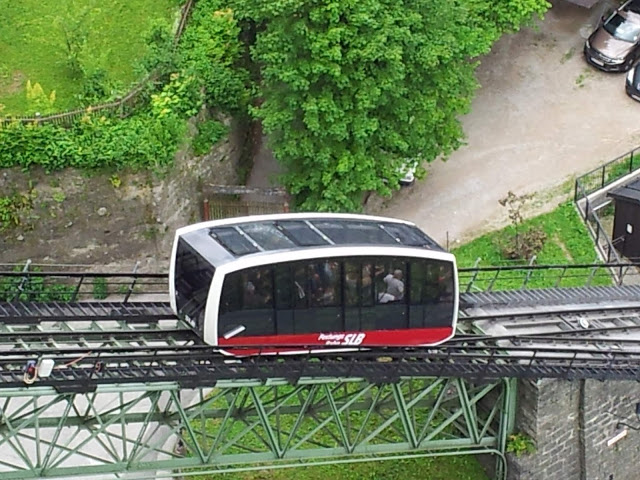
We took the Festungsbahn funicular railway up to the Fortress Hohensalzburg, dating back to 1077, and the largest fortress still standing in Europe.  We spent a pleasant afternoon wandering through the rooms and exhibits and then had lunch at a café, the Salzburg Fortress Café, that overlooked the countryside.  This was where we were introduced to Mozart Gold Chocolate Cream added to our coffee.

It led us to search for the product which we eventually found in a confectionary store, Holzemayr in the Alter Markt.  Not only sis we find the Gold liqueur there was also a dark chocolate variety as well.  We bought a whole box to bring back with us, as well as a number of other chocolates including Victor Schmidt Austrian Mozart Balls, a delicious chocolate and marzipan combination.

With another afternoon to spare we visited the Salzburg Residence which previously housed Salzburg’s ruling prince-archbishops.  We visited the reception rooms and living quarters, as well as the Gallery.  It is as ornate as any of the palaces in Austria, resplendent with furnishings and paintings.  After that, the visit to Mozart’s birthplace was something of an anticlimax.

But, what we were in Salzburg for, the Sound of Music tour, and the places we visited:

The Mirabelle gardens, where Maria sang Do Re Mi in front of the gates to the gardens.  We spent some time here before and after the tour, and also has a look inside the Mirabelle Palace, which is not open to the public as it is the city administrative offices.

Leopoldskron Palace where the boating scene was filmed as well as exteriors.  They were not allowed to film inside the place and were only allowed to use the exterior.  An interesting tidbit of information, one of the children nearly drowned.

Heilbrunn palace is now home to the gazebo where Rolf and Leisl sang their song, ‘16 going on 17’.  The interesting part of this was the fact the Gazebo used to film the scene was much larger than the actual Gazebo on display.

The walkway from the fortress back to the old city passes Nonnberg Abbey where Maria was a novice, and where the opening scenes were filmed.  A number of scenes were filmed here, including the song ‘Maria’ in the courtyard.  The tour only showed the exterior of the Abbey.

Salzburg lake district where panorama and picnic scenes were filmed.  Even on the dullest of days, during which throughout our tour in continually rained, the scenery was still magnificent.

Mondsee church, where the wedding scenes were filmed.  It was surprising just how small the church really is.  It was also a stop to have afternoon tea or some ‘famous’ apple strudel.

Needless to say, we watched Sound of Music straight after the tour and managed to pick out all of the places we had been to.  The only downside to the tour, singing along to the songs.  I’m sorry, but I do not sing, and some of those that were, well, I say no more.