The cinema of my dreams – It continued in London – Episode 31

An interview with Alessandro

The disguise was almost perfect.  Detective Inspector Johnson was that typical policeman, based in the man who taught me, the suit, slightly crumpled, the while shirt with tie not completely knotted. The sort a wife, if he had one, would have fixed before he left for work.  The shoes, practical, the overcoat, seen better days but well looked after.

All that was missing was the slightly overworked and frustrated look, hair slightly askew, a ritual cup of coffee in a cardboard cup almost drunk.  The man looking back at me in the hotel window was almost the epitome of the Detect Inspector I modelled myself on.

It was just another day at the office.

I got out of the car and told the two officers Anothony had arranged to meet me, ic case there was trouble, to sit tight until I called them.

I went in and crossed purposefully to the reception desk and pulled out my warrant card.  When the clerk looked at me, I showed him the card.  “Detective Inspector Johnson, Metropolitan police. Can you tell me if Alessandro Burkehardt is in the hotel?”

The clerk looked at the warrant card, then excused himself and went into a back room where no doubt the man in charge was lurking.

A few minutes later, a woman came out, the clerk following her.

“What is the nature of your business with Mr Burkehardt?”

“The disappearance of his sister-in-law, the Countess Burkehardt.  You might be able to tell me, when did she check out?”

“I’ve told the police already.”

“Then you’re going to tell me again.  And after that, I would like to know where Mr Burkehardt is, and then a detailed explanation as to why only the CCTV camera in the areas where the Congress would be noticed coming and going were conveniently non-functional.”

“Who…”

“Told me?  I asked the security company that installed your system just how many cameras there were and their locations.  You haven’t been very helpful in our inquiries which is why I’m now here.  Now, if you have any objections, I will have you arrested for obstructing a police officer.”

Then I glared at her.

This was a very high-up manager, used to treating anyone under the status of King like dirt under her feet.  I knew the type.

“Mr Burkhardt is dining in the breakfast room.”

“Thank you.  I’ll be back.”

I had no doubt at some point Rodby would learn of my arrival, and if she was a friend of Mrs Rodby, that would make matters worse.  There was an old boys’ network, but there was also an old girls’ network, and they were not people to cross.

It wasn’t hard to pick him out among the diners, sitting at a table with a cup of coffee and a newspaper.  It was the same man I had seen in the hotel when bringing the countess back.  For a moment I wondered if he had seen me arrive with the countess, and he had asked about me.  This would go badly if he knew I was not a Detective inspector.

Only one wat to find out.  “Mr Alessandro Burkehardt?”

He lowered the paper a fraction and looked at me.  Nothing like the man in the tuxedo the other day, and no recognition in his eyes.

“Who are you?”

“Detective Inspector Johnson, of the Metropolitan Police.  I have come to ask you about your Sister-in-law, the Contessa.  She had been reported as missing.”

“That’s absurd.”

“Then you know where she is?  Thank goodness for that.  People are worried.  Tell me, where is she now?”

“If I knew that, I’d tell you.  But she is not missing as you say.  If she was, my family would know.  She has security you know?”

“I didn’t.  Where can I find them, or at least a representative who could tell me her location.”

“That’s none of your business.  If I say she’s not missing, she’s not missing.  Now go about your business.”

I smiled wanly, as the good Inspector did when he was about to deliver bad news.  “Fine.  But out front there are two officers waiting to take you into protective custody.  The fact you cannot tell me where she is, tells me that there is something going on in relation to her safety.  This will unfortunately create a scene for which I apologise in advance, but it is necessary.  Unless you have a more truthful answer to my question.”

“Are you accusing me of lying?”

He stood up quickly dropping the newspaper on the table and bumping his chair.  People around us were curious, to begin with, but now it had developed into a showstopping event.  All I needed was a newspaper photographer or reporter to be nearby and this would go viral.

“You are not being straight with me, nor were you with the first police responders when they asked if you knew where she was.  Once in protective custody, you will have the opportunity to talk to a superior officer if you feel you have been treated incorrectly.  But I warn you, the fact the countess is missing has caused concern at the highest levels, and they only call me when the situation is serious.”

I was trying to keep calm and the tremor of fear out of my tone, but this was getting out of control very quickly.  I had expected pushback, but not to the extent that he was giving me.  I knew he knew something about her whereabouts and was using bluff to get past me.  If I had to take him back to the office, Rodby was going to have a meltdown.

“Let’s take this to a conference room.”

He too had noticed the furore it was creating.

I had won a momentary reprieve.

© Charles Heath 2023

A 2am Rant: Don’t do today what you can do tomorrow?

It’s a common mantra, where people honestly believe that they will live long enough to get everything done.

That is, until you go to a funeral for a person who died long before they should.

Funerals are by definition sad occasions. It is a time to reflect on the life of the deceased, a time when everyone who knew them comes together to celebrate their life, a lifetime spread over many, many years.

It is also a time when the whole family comes together, like births and weddings, where we discover the changes to those we haven’t seen in a long time, particularly when the family is spread out all over the country. And, sometimes, surprise new members, young and old.

I’ve certainly had a few of those.

It can also be a moment in time when you begin to reflect on your own mortality, especially when the deceased was in their 40s.

The fact is, death can strike you down at any time. While trying not to be morbid, with the threat of a viral death always a new possibility, and the fact that it does not discriminate age-wise, it’s not possible to discount the possibility that it might happen to you.

And, sitting in the back row, listening to the eulogy, you can’t help but think about how much or how little time you have left, and, quite possibly, what it is you have or haven’t done with your life.

Perhaps the question should be, are you going to put off till tomorrow what you can do today?

The sad fact is, we all do. We all believe we will have plenty of time to get things done. We live by several rather interesting mantras,

  • old enough to know better and young enough not to care
  • Don’t do today what you can do tomorrow
  • There’s plenty of time to go on that overseas trip

How many people have died young, and done nothing of what they had planned to do later in life?

I know that I was one of those people who thought if I worked hard, by the time I reached retirement, everything would be paid off, the children would have moved on, and we would have enough money to live out our days in relative comfort, and we would have the time to see the world in leisure.

Then, something changed.

For our 30th wedding anniversary, we were going to go on that once-in-a-lifetime holiday, before all those goals had been reached. Perhaps we had an inkling that we might not be able to travel when older, that if we didn’t do it then, it would never happen.

It was perhaps fortuitous that we did.

Now past retirement, older but not necessarily wiser, travelling anywhere is difficult, and our financial situation is not what we had planned. All of those dreams would have been shattered had we not moved everything forward by about 20 years.

And with the global pandemic starting about the same time we originally planned to start our worldly travels, had we stuck to the plan, it would never have eventuated.

Was it good management, foresight, or just good luck?

We’ll never know.

But something I do know, and it is the best advice I can give anyone.

Don’t put off today what you can do tomorrow.

Why?

No one realises tomorrow never comes.

What I learned about writing – Journalism is a great learning ground for writers

It comes as no surprise that many writers, when they are asked about how they got into writing, say they were once journalists.

This is because journalism is a great background. You learn to get to the crux of any story in one paragraph, asking five basic questions: who, what, where, when, and why.

In the commission of any story, sooner or later, you ask the question: at what point does a writer become a journalist?

Quite often, journalists become writers because of their vast experience in observing and writing about the news, sometimes in the category of ‘truth is stranger than fiction’.

I did journalism at university and thought I would never get to use it.  I had to interview people, write articles, and act as an editor.  The hardest part was the headlines. Thank God that’s usually a problem for the editor. It’s about as much fun as coming up with a title for the book.

But, for example…

Several opportunities arose over the last few months to dig out the journalist hat, put it on, and go to work.

Where?

Hospital.  I’ve had to go there a few times more in the last few months than I have in recent years.

And I’d forgotten just how interesting hospitals are, especially the waiting room in the Emergency department.

After the second or third visit, I began observing the people who were waiting and ran through various scenarios as to the reason for their visit.  None may have been true, but it certainly was an exercise in creative writing, or would make an excellent article.

Similarly, once we got inside the inner sanctum where the real work is done, there were any number of crises and operations going on, and plenty of material for when I might need to include a hospital scene in one of my stories.

Or I could write a volume in praise of the people who work there and what they have to endure.  Tending the sick, injured and badly injured is not a job for the faint-hearted.

Research, which is one of the most important tools a journalist uses, if it could be called a ‘tool’, turns up in the unlikeliest of places.  Doctors who answer questions, not necessarily about the malady, nurses who tell you about what it’s like in Emergency on nights you really don’t want to be there, and other patients and their families, all having a perspective and a story to tell, while waiting patiently for a diagnosis and then treatment so they can go home.

We get to go this time at about four in the morning.  Everyone is tired.  More people are waiting.  Outside, it is cool, and the first rays of light are coming over the horizon as dawn is about to break.

I ponder the question without an answer, a question one of the nurses asked a youngish doctor, tossed out in conversation, but was there more intent to it, what he was doing on Saturday night?

He didn’t answer.  Another crisis, another patient.

I suspect he was about to say, where else would he be, but on duty in the Emergency.

365 Days of writing, 2026 – 117

Day 117 – Is writing fiction an escape from reality

The Plunge: Why Fiction Isn’t an Escape—It’s a Collision with Reality

When people think of fiction, they often think of “escapism.” They imagine the reader curled up in a leather chair, clutching a paperback like a life raft, waiting to be spirited away to a land of dragons, interstellar empires, or swooning Victorian romances. The common assumption is that we read—and write—to get away from the messiness of our actual lives.

But the Southern Gothic master Flannery O’Connor had a vastly different, more jarring perspective. She famously suggested that writing (and reading) fiction is not a retreat into fantasy, but a “plunge into reality.” For O’Connor, fiction is not a sedative; it is a shock to the system.

But what did she mean by that? And why would a medium built on “made-up” stories be more real than the world we walk through every day?

The Myth of the Ivory Tower

We often treat reality as a surface-level phenomenon: the bills we pay, the traffic we sit in, and the small talk at the office. We mistake the mundane for the “real.”

O’Connor believed that our day-to-day lives are often shielded by habit, social propriety, and a deep-seated desire to look away from the darker, more profound truths of human existence. We live in a state of semi-consciousness, buffered by the comforts of our routines.

When you sit down to write serious fiction, you cannot stay on that surface level. To create a character that rings true, you have to strip away the pleasantries. You have to descend into the motivations, the flaws, the spiritual hungers, and the terrifying contradictions that define human nature.

Fiction as a “Shock to the System”

O’Connor’s stories—filled with grotesque characters, sudden violence, and moments of divine mystery—are famous for their lack of comfort. She didn’t write to soothe the reader; she wrote to wake them up.

When she talked about fiction being a “plunge into reality,” she was describing a process of confrontation. A well-crafted story forces the reader to look at things they’d rather ignore: the cruelty we are capable of, the absurdity of our own self-importance, and the jagged edges of truth.

If you are writing fiction, you aren’t hiding from reality; you are excavating it. You are taking the raw, incoherent chaos of the human experience and tightening it into a narrative lens. By the time the reader closes the book, if the work is good, they shouldn’t feel “escaped.” They should feel exposed. They should feel as though they’ve just been shaken awake.

The Mirror of the Grotesque

O’Connor famously said, “To the hard of hearing you shout, and for the almost-blind you draw large and startling figures.”

This is why her work is so often shocking. She used the “grotesque” not to be weird for the sake of it, but to force the reader to focus on reality. Because we have become so desensitised to the “normal” world, we need something startling—something slightly distorted—to help us see clearly again.

When we write fiction, we are essentially holding a mirror up to the world. But we don’t hold it up to show the world its own reflection in the mirror; we hold it up to show the world the things it refuses to see when it looks in the mirror of daily life.

Why It Matters

If we view writing only as an escape, we limit the power of the craft. We treat it as a toy rather than a tool.

When you approach the blank page, don’t ask yourself, “How can I make this world different from mine?” Instead, ask, “How can I capture the reality of this world more accurately?” How can I convey the heaviness of a choice, the shame of a secret, or the terror of an epiphany?

Writing isn’t about running away from the world. It is the brave act of diving headlong into the fray. It is the act of looking at the human condition—with all its blood, bone, and light—and refusing to blink.

As O’Connor knew, the truth is often a shock. But it is only through that shock that we ever truly find our way home.

Searching for locations: The Longjing Pearl Factory, Beijing, China

The Longjing Pearl Factory is located at:
No.2 Zuoan Gate Inner Street, ChongWen District, Beijing 100061 China.

This Pearl Centre specialises in both freshwater and seawater pearls, with a reputation backed by the government of China, and a big selection of the highest quality.  There were all kinds of jewellery made of pearls in different colours, shapes, and sizes.

They also had, as an interesting sideline, famous Chinese traditional cosmetics such as pearl cream and pearl powder, reputed to make your skin smoother, tender, and most importantly, younger.

We were advised of all of this well before we arrived at the factory, and of course, one suspected the glowing review, with emphasis on the fact it was a government operation and therefore trustworthy, suggested we should buy, which meant the tour guide would receive a commission on each sale.

This is nothing new; it’s the same the world over, so it’s up to the visitor to buy or not to buy.

As soon as you get in the door, you are taken to the group’s guide for the tour (and afterwards, available for help on making purchases). who gives you a rundown on the different types and colours of pearls.  This is briefly,

Pearls come in two main categories: freshwater cultured pearls and saltwater cultured pearls. Various types of pearls are the result of the environment in which they live, and different cultivation techniques used by the pearl farmers. 

Freshwater cultured pearls are grown in lakes and rivers, whereas saltwater cultured pearls are grown in bodies of saltwater such as bays.  The most commonly used pearls are Freshwater pearls. 

Freshwater Pearls come in various pastel shades of white, pink, peach, lavender, plum, purple, and tangerine.  
South Sea cultured pearls come in shades of lustrous white, often with silver or rose overtones. 

Black pearls are known as Tahitian pearls and come most often in shades of black and grey. While a Tahitian pearl has a black body colour, it will vary in its overtones, which most often will be green or pink.

Then there’s a demonstration, where one of the tour group is selected to pick an oyster out of the tank, and then there’s the guessing game as to how many pearls are in the shell, with the winner getting a pearl.

Guesses ranged from 1 to 23, and the answer was 26.  Nearest wins, and one for the person who picked the oyster out of the tank.  After this demonstration, we move on to the ways we can tell the difference between real and fake pearls.

It seems strange that they would, but we were guaranteed by both the tour guide and the lady delivering the lecture that the pearls we were about to buy were real, so how could we suspect there was anything dodgy about them?  Besides, now we can tell real from fake!

We then move onto the showroom floor, where there are cases of pearl products, in the form of necklaces, earrings, and any number of variations and uses.  And, just to let you know, the prices are very, very high, even if they say they have a special.

Perhaps the best products, and those that found favour with many of the women on the tour, were the pearl creams and powders.  These were not expensive, and, as we discovered later, actually worked as described.

In a word: Rain

Well, isn’t it just like you to rain on my parade?

Yes, and don’t we need a lot of rain because of the bushfires that are burning out of control?

Rain is that stuff that falls from the sky, sometimes at the awkwardest of times, like when you leave your umbrella in the car.

And rain can be a problem in sub-zero temperatures and high winds when it almost takes on the form of multiple miniature knives.  Rain and snow together, sleep, but that’s something else.

Of course, it could always rain cats and dogs, a rather interesting occurrence if it ever happened.

This should not be confused with the word rein.

As any horseperson would know this is what helps control a horse

But, it doesn’t have to be a horse, it might be that you are told to rein in your attack dog

Or rein in your excesses

Or alternatively, give a person free rein to go about their business.

Then there is reign, that period of time when a monarch rules, and it seems in England women hold the record for the longest reign, Queen Victoria, and Queen Elizabeth II

That’s distinct from the office oligarchs who seem to think they reign over the plebs

“The Things We Do For Love”

Would you give up everything to be with the one you love?

Is love the metaphorical equivalent to ‘walking the plank’; a dive into uncharted waters?

For Henry, the only romance he was interested in was a life at sea, and when away from it, he strived to find sanctuary from his family and perhaps life itself.  It takes him to a small village by the sea, a place he never expected to find another just like him, Michelle, whom he soon discovers is as mysterious as she is beautiful.

Henry had long since given up the notion of finding romance, and Michelle couldn’t get involved for reasons she could never explain, but in the end, both acknowledged that something had happened the moment they first met.  

Plans were made, plans were revised, and hopes were shattered.

A chance encounter causes Michelle’s past to catch up with her, and whatever hope she had of having a normal life with Henry, or anyone else, is gone.  To keep him alive, she has to destroy her blossoming relationship, an act that breaks her heart and shatters his.

But can love conquer all?

It takes a few words of encouragement from an unlikely source to send Henry and his friend Radly on an odyssey into the darkest corners of the red-light district in a race against time to find and rescue the woman he finally realises is the love of his life.

The cover, at the moment, looks like this:

lovecoverfinal1

Is love the metaphorical equivalent to ‘walking the plank’; a dive into uncharted waters?

For Henry, the only romance he was interested in was a life at sea, and when away from it, he strived to find sanctuary from his family and perhaps life itself.  It takes him to a small village by the sea, s place he never expected to find another just like him, Michelle, whom he soon discovers is as mysterious as she is beautiful.

Henry had long since given up the notion of finding romance, and Michelle couldn’t get involved for reasons she could never explain, but in the end, both acknowledge that something happened the moment they first met.  

Plans were made, plans were revised, and hopes were shattered.

A chance encounter causes Michelle’s past to catch up with her, and whatever hope she had of having a normal life with Henry, or anyone else, is gone.  To keep him alive she has to destroy her blossoming relationship, an act that breaks her heart and shatters his.

But can love conquer all?

It takes a few words of encouragement from an unlikely source to send Henry and his friend Radly on an odyssey into the darkest corners of the red-light district in a race against time to find and rescue the woman he finally realizes is the love of his life.

The cover, at the moment, looks like this:

lovecoverfinal1

Searching for locations: Tiananmen Square, Beijing, China

Some interesting facts before we get out of the bus…

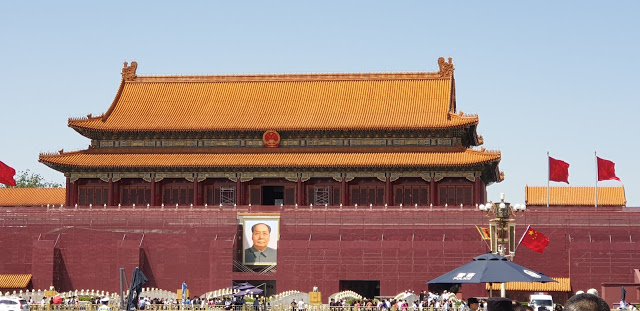
Tiananmen Square or Tian’anmen Square is in the centre of Beijing, named after the Gate of Heavenly Peace, a gate that separates the square from the Forbidden City.

The Square contains,

   The Monument to the People’s Heroes
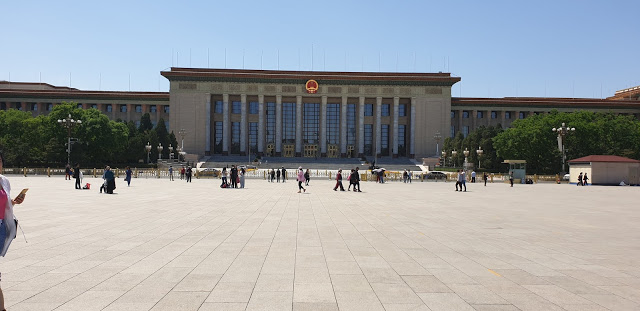
   The Great Hall of the People
   The National Museum of China
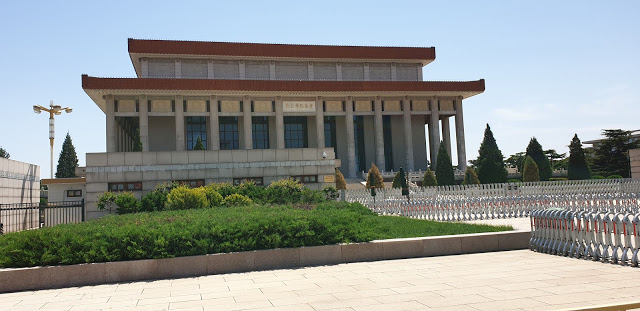
   The Mausoleum of Mao Zedong.

The square is about 109 acres and was designed and built in 1651, and since then has been enlarged four times, the most recent upgrade in the 1950s.

The Monument to the People’s Heroes

This is a ten-story obelisk built to commemorate the matters of the revolutions.  It was built between August 1952 and May 1958.  On the pedestal are reliefs depicting the eight major revolutionary episodes.

The Great Hall of the People

This was opened in September 1959, and covers 171809 square meters.  The Great Hall is the largest auditorium in China and can seat up to 10,000 people.  The State Banquet Hall can seat up to 5,000 diners.

The National Museum of China

This is one of the largest museums in the world and the second most visited museum in the world after the Louvre in Paris.   It was completed in 1959, and sits on 65 hectares, and rises four floors.  It has a permanent collection of over 1,000,000 items.

The Mausoleum of Mao Zedong

This was built shortly after his death, and completed on May 24th, 1977.  The embalmed body of the Chairman is preserved and on display in the centre hall.

My own observations
This is huge; one of the largest public squares in the world, and if you’re going to walk it, like we did, make sure you’ve been exercising before you go.  It covers 44 hectares, borders on the Forbidden City, and has a memorial to Chairman Mao in the centre of it.  But you cannot go near it; it’s fenced off, and it is guarded.

That’s both the statue and the square, as random guards are marching in random directions, all the while watching us to see that we don’t misbehave. No one wants to find out what would happen if you jumped the fence around the statue, but I’m guessing you’ll have a few years to contemplate the stupidity of your actions with some very unhappy government officials.

Around the edges of the square are huge buildings, and on one side is the museum 

and on the other is the Chinese equivalent of parliament.

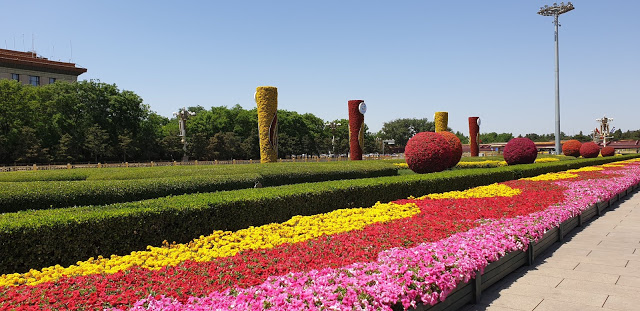
Around the sides are also large gardens

At one end, where the Forbidden City borders on the square, there’s a huge flag pole flying the Chinese flag, and this, too, like the monument, is fenced off and guarded by members of all of their armed services.  No tanks rolled out during our visit, much to our disappointment.  There is no entrance to the Forbidden City from the square

At the other end is the Mausoleum of Mao Zedong, which was closed the day we were there, as was the museum. 

There are four sculptural groups installed outside the mausoleum.

Other than that, it’s just another square, albeit probably one of the largest in the world.  It can, we were told, hold about a million people.

An excerpt from “If Only” – a work in progress

Investigation of crimes doesn’t always go according to plan, nor does the perpetrator get either found or punished.

That was particularly true in my case.  The murderer was incredibly careful in not leaving any evidence behind, to the extent that the police could not rule out whether it was a male or a female.

At one stage, the police thought I had murdered my own wife, though how I could be on a train at the time of the murder was beyond me.  I had witnesses and a cast-iron alibi.

The officer in charge was Detective First Grade Gabrielle Walters.  She came to me on the day after the murder seeking answers to the usual questions like, when was the last time you saw your wife, did you argue, the neighbours reckon there were heated discussions the day before.

Routine was the word she used.

Her fellow detective was a surly piece of work whose intention was to get answers or, more likely, a confession by any or all means possible.  I could sense the raging violence within him.  Fortunately, common sense prevailed.

Over the course of the next few weeks, once I’d been cleared of committing the crime, Gabrielle made a point of keeping me informed of the progress.

After three months, the updates were more sporadic, and when, for lack of progress, it became a cold case, communication ceased.

But it was not the last time I saw Gabrielle.

The shock of finding Vanessa was more devastating than the fact that she was now gone, and those images lived on in the same nightmare that came to visit me every night when I closed my eyes.

For months, I was barely functioning, to the extent that I had all but lost my job and quite a few friends, particularly those who were more attached to Vanessa rather than me.

They didn’t understand how it could affect me so much, and since it had not happened to them, my tart replies of ‘you wouldn’t understand’ were met with equally short retorts.  Some questioned my sanity, even, for a time, so did I.

No one, it seemed, could understand what it was like, no one except Gabrielle.

She was by her own admission, damaged goods, having been the victim of a similar incident, a boyfriend who turned out to be an awfully bad boy.  Her story varied only in that she had been made to witness his execution.  Her nightmare, in reliving that moment in time, was how she was still alive and, to this day, had no idea why she’d been spared.

It was a story she told me one night, some months after the investigation had been scaled down.  I was still looking for the bottom of a bottle and an emotional mess.  Perhaps it struck a resonance with her; she’d been there and managed to come out the other side.

What happened became our secret, a once-only night together that meant a great deal to me, and by mutual agreement, it was not spoken of again.  It was as if she knew exactly what was required to set me on the path to recovery.

And it had.

Since then, we saw each other about once a month in a cafe.   I had been surprised to hear from her again shortly after that eventful night when she called to set it up, ostensibly for her to provide me with any updates on the case, but perhaps we had, after that unspoken night, formed a closer bond than either of us wanted to admit.

We generally talked for hours over wine, then dinner and coffee.  It took a while for me to realise that all she had was her work; personal relationships were nigh on impossible in a job that left little or no spare time for anything else.

She’d always said that if I had any questions or problems about the case, or if there was anything that might come to me that might be relevant, even after all this time, all I had to do was call her.

I wondered if this text message was in that category.  I was certain it would interest the police, and I had no doubt they could trace the message’s origin, but there was that tiny degree of doubt about whether or not I could trust her to tell me what the message meant.

I reached for the phone, then put it back down again.  I’d think about it and decide tomorrow.

© Charles Heath 2018-2020

365 Days of writing, 2026 – 117

Day 117 – Is writing fiction an escape from reality

The Plunge: Why Fiction Isn’t an Escape—It’s a Collision with Reality

When people think of fiction, they often think of “escapism.” They imagine the reader curled up in a leather chair, clutching a paperback like a life raft, waiting to be spirited away to a land of dragons, interstellar empires, or swooning Victorian romances. The common assumption is that we read—and write—to get away from the messiness of our actual lives.

But the Southern Gothic master Flannery O’Connor had a vastly different, more jarring perspective. She famously suggested that writing (and reading) fiction is not a retreat into fantasy, but a “plunge into reality.” For O’Connor, fiction is not a sedative; it is a shock to the system.

But what did she mean by that? And why would a medium built on “made-up” stories be more real than the world we walk through every day?

The Myth of the Ivory Tower

We often treat reality as a surface-level phenomenon: the bills we pay, the traffic we sit in, and the small talk at the office. We mistake the mundane for the “real.”

O’Connor believed that our day-to-day lives are often shielded by habit, social propriety, and a deep-seated desire to look away from the darker, more profound truths of human existence. We live in a state of semi-consciousness, buffered by the comforts of our routines.

When you sit down to write serious fiction, you cannot stay on that surface level. To create a character that rings true, you have to strip away the pleasantries. You have to descend into the motivations, the flaws, the spiritual hungers, and the terrifying contradictions that define human nature.

Fiction as a “Shock to the System”

O’Connor’s stories—filled with grotesque characters, sudden violence, and moments of divine mystery—are famous for their lack of comfort. She didn’t write to soothe the reader; she wrote to wake them up.

When she talked about fiction being a “plunge into reality,” she was describing a process of confrontation. A well-crafted story forces the reader to look at things they’d rather ignore: the cruelty we are capable of, the absurdity of our own self-importance, and the jagged edges of truth.

If you are writing fiction, you aren’t hiding from reality; you are excavating it. You are taking the raw, incoherent chaos of the human experience and tightening it into a narrative lens. By the time the reader closes the book, if the work is good, they shouldn’t feel “escaped.” They should feel exposed. They should feel as though they’ve just been shaken awake.

The Mirror of the Grotesque

O’Connor famously said, “To the hard of hearing you shout, and for the almost-blind you draw large and startling figures.”

This is why her work is so often shocking. She used the “grotesque” not to be weird for the sake of it, but to force the reader to focus on reality. Because we have become so desensitised to the “normal” world, we need something startling—something slightly distorted—to help us see clearly again.

When we write fiction, we are essentially holding a mirror up to the world. But we don’t hold it up to show the world its own reflection in the mirror; we hold it up to show the world the things it refuses to see when it looks in the mirror of daily life.

Why It Matters

If we view writing only as an escape, we limit the power of the craft. We treat it as a toy rather than a tool.

When you approach the blank page, don’t ask yourself, “How can I make this world different from mine?” Instead, ask, “How can I capture the reality of this world more accurately?” How can I convey the heaviness of a choice, the shame of a secret, or the terror of an epiphany?

Writing isn’t about running away from the world. It is the brave act of diving headlong into the fray. It is the act of looking at the human condition—with all its blood, bone, and light—and refusing to blink.

As O’Connor knew, the truth is often a shock. But it is only through that shock that we ever truly find our way home.