Searching for locations – Port Macquarie – Day 3 – Part 1

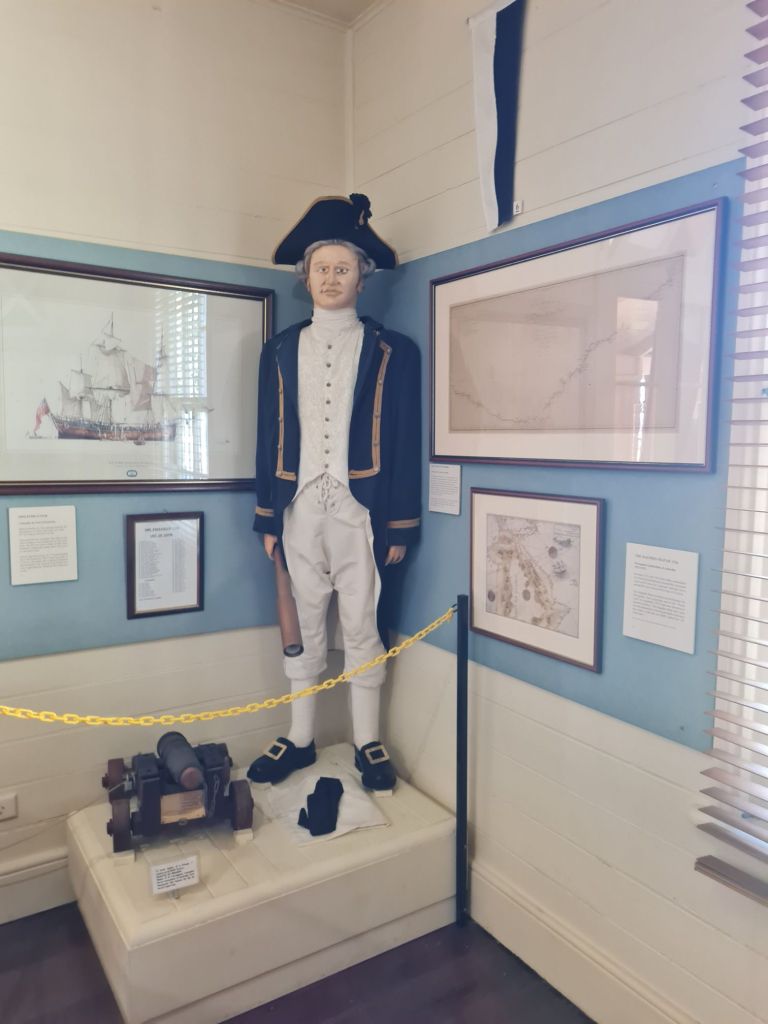
The Maritime Museum

The three houses that make up the maritime museum used to be the pilot’s houses. They were built between 1896 and 1937. There used to be four but one was relocated to another part of Port Macquarie.

In between two of the buildings is, of all things, a sea mine

they also have several model ships which are up for sale.

They have sailors dressed in the way they were back in the 1820s

A cannon of one their warships

And models of the ships that brought the soldiers, convicts, and free settlers to Australia

There is an interesting collection of flags that were once used to communicate from ship to ship or shore, before the advent of radio.

365 Days of writing, 2026 – 64

Day 64 – Pick a side

Speak Yourself Your Own Way – In Other Words, Pick a Side

“The most courageous act is still to think for yourself. Aloud.”
— Coco Chanel

In a world that rewards smoothness, consensus, and “politically correct” chatter, it can feel dangerously easy to slip into the comfortable grey zone of “neutrality.” We skim the headlines, like‑share the most palatable meme, and keep our opinions tucked away in the safety of the private inbox. Yet the very act of living—of showing up in the world—requires us to speak ourselves our own way. In practice, that means picking a side and letting that choice shape the language, the tone, and the conviction behind our words.

Below is a roadmap for anyone who’s ever felt the tug‑of‑war between wanting to belong and yearning to be heard. It’s a call to step out of the echo chamber, sharpen your voice, and own the space you occupy—both online and offline.


1. Why “Neutral” Is Actually a Position

Neutrality isn’t a blank page; it’s a faint watermark.

When you decide not to take a stance, you implicitly endorse the status quo. If you stay silent on climate change, you’re indirectly supporting the systems that keep emissions high. If you never voice your discomfort with workplace micro‑aggressions, you let the culture that tolerates them persist.

The hidden cost:

  • Moral fatigue – you expend mental energy worrying about offending, which erodes authenticity.
  • Lost influence – decision‑makers notice those who speak up; the quiet ones fade into the background statistics.
  • Identity drift – without a declared side, your personal brand becomes a vague, undifferentiated blur.

Understanding that “neutral” is a covert side helps the first step: recognising the need to speak for yourself, your own way.


2. Discover Your Core Compass

Before you can speak confidently, you need a compass—a set of values that feels as unshakeable as a lighthouse in a storm.

ExerciseWhat It Looks LikeOutcome
Values InventoryWrite down 12–15 values (e.g., justice, curiosity, humor). Highlight the top 5 that feel non‑negotiable.A distilled list that guides every decision.
Story MiningRecall moments when you felt most alive, proud, or outraged. What values were in play?Patterns that reveal hidden convictions.
Future LetterImagine yourself 10 years from now, looking back. What would you be proud to have stood for?A forward‑looking “mission statement.”

When you can articulate why you care, you’ll know what side you’re picking.


3. The Anatomy of an Authentic Voice

A voice isn’t just what you say; it’s how you say it. Below are the elements that, once calibrated, make your speech unmistakably yours.

ComponentGuidelineExamples
ToneMatch the emotion of your message. Empathy for personal stories, urgency for calls to action.“I feel deeply about this” vs. “We must act now.”
VocabularyChoose words that are true to your background—no need for pretentious jargon.A tech‑entrepreneur might say “scalable,” while a teacher says “student‑centered.”
PacingVary sentence length to keep listeners engaged. Short bursts for impact, longer sentences for nuance.“Enough.” (pause) “We need change.”
StorytellingAnchor abstract ideas in concrete anecdotes.“When I first saw the polluted river, I thought….”
ConsistencyReinforce your side across platforms—social media, meetings, email signatures.A sustainability advocate consistently shares zero‑waste tips.

Practice these elements in low‑stakes situations (Twitter threads, group chats) before moving to higher‑visibility arenas.


4. Picking a Side Without Burning Bridges

You might wonder, “Will I alienate friends, colleagues, or customers?” The answer is yes—but not necessarily in a bad way. When you clearly declare a side, you attract people who align with you and filter out those who don’t. That’s the secret to building a community that actually supports your mission.

Tips for a graceful side‑pick:

  1. Start with “I.” Frame statements as personal convictions rather than universal mandates.
    “I believe we need a living wage” sounds less confrontational than “Everyone must agree we need a living wage.”
  2. Invite Dialogue, Not Debate.
    Offer a why and ask what others think.
    “I’m curious—how do you see the impact of remote work on work‑life balance?”
  3. Show Humility. Acknowledge you’re still learning; be open to data that refutes your stance.
    “I’m still reading up on this, but here’s why I’m leaning toward X.”
  4. Find Common Ground. Even on polarised topics, there’s usually a shared value (e.g., safety, fairness). Anchor your side there.
    “Both of us want safer streets; I think redesigning traffic flow is the most effective route.”
  5. Set Boundaries. If a conversation turns toxic, politely disengage. Your reputation benefits more from consistency than from endless argument.

5. Real‑World Examples: When Speaking Your Own Way Made a Difference

PersonSide PickedImpact
Greta ThunbergClimate crisis urgencyBecame a global catalyst for youth climate activism; policy discussions shifted.
Malala YousafzaiGirls’ right to educationInternational legislation and funding for girls’ schools surged.
Simon SinekLeadership rooted in “Why”Companies adopted purpose‑first strategies, boosting employee engagement.
Megan RapinoeGender equality & LGBTQ+ rights in sportAccelerated NFL and FIFA policy reviews on equality.
John Green (author)Mental‑health openness in YA literatureDestigmatized depression among teens; inspired school counseling programs.

These figures didn’t shy away from controversy. They picked a side early, refined their message, and let authenticity drive their influence.


6. Action Plan: 7 Steps to Speak Yourself Your Own Way Today

  1. Write a One‑Sentence Declaration – “I stand for ___ because ___.” Keep it visible (phone lock screen, notebook cover).
  2. Pick One Platform – Twitter, Instagram Stories, a team Slack channel—choose where you’ll post your first statement.
  3. Craft a Mini‑Story – Share a personal anecdote that illustrates why that side matters to you.
  4. Invite Feedback – End with a genuine question that prompts others to share their view.
  5. Schedule Follow‑Up – Set a reminder to revisit the conversation in a week; iterate based on responses.
  6. Audit Your Presence – Look at past posts; remove or revise anything that contradicts your declared side.
  7. Celebrate Small Wins – Did a colleague thank you for your perspective? Did you feel lighter after posting? Acknowledge it.

7. Overcoming the Fear of “Being Labelled”

The biggest mental block is the fear that once you pick a side, you’ll be pigeonholed forever. Remember:

  • Labels are tools, not prisons. “Activist” can open doors to collaborations you’d otherwise miss.
  • Your side can evolve. As new information arrives, you can pivot—just be transparent about the change.
  • People respect consistency more than conformity. A brand that constantly flips its stance loses trust faster than one that stands firm, even when unpopular.

Closing Thought

“Speak yourself your own way” isn’t a call for loudness; it’s a summons for honesty. It’s the invitation to pick a side, not because the world demands it, but because your inner compass demands it. When you do, you carve out a space where others can find you, understand you, and, most importantly, choose to walk alongside you.

So, what side will you claim today? Write it, shout it, tweet it, discuss it over coffee—just make sure it’s yours, unmistakably and unapologetically.

Your voice is the most valuable currency you have. Spend it wisely.


Ready to take the first step? Drop a comment below with your one‑sentence declaration. Let’s start a dialogue that proves speaking for yourself, your own way, really does change the conversation.

Inspiration, maybe – Volume 1

50 photographs, 50 stories, of which there is one of the 50 below.

They all start with –

A picture paints … well, as many words as you like.  For instance:

lookingdownfromcoronetpeak

And the story:

It was once said that a desperate man has everything to lose.

The man I was chasing was desperate, but I, on the other hand, was more desperate to catch him.

He’d left a trail of dead people from one end of the island to the other.

The team had put in a lot of effort to locate him, and now his capture was imminent.  We were following the car he was in, from a discrete distance, and, at the appropriate time, we would catch up, pull him over, and make the arrest.

There was nowhere for him to go.

The road led to a dead-end, and the only way off the mountain was back down the road were now on.  Which was why I was somewhat surprised when we discovered where he was.

Where was he going?

“Damn,” I heard Alan mutter.  He was driving, being careful not to get too close, but not far enough away to lose sight of him.

“What?”

“I think he’s made us.”

“How?”

“Dumb bad luck, I’m guessing.  Or he expected we’d follow him up the mountain.  He’s just sped up.”

“How far away?”

“A half-mile.  We should see him higher up when we turn the next corner.”

It took an eternity to get there, and when we did, Alan was right, only he was further on than we thought.”

“Step on it.  Let’s catch him up before he gets to the top.”

Easy to say, not so easy to do.  The road was treacherous, and in places just gravel, and there were no guard rails to stop a three thousand footfall down the mountainside.

Good thing then I had the foresight to have three agents on the hill for just such a scenario.

Ten minutes later, we were in sight of the car, still moving quickly, but we were going slightly faster.  We’d catch up just short of the summit car park.

Or so we thought.

Coming quickly around another corner we almost slammed into the car we’d been chasing.

“What the hell…” Aland muttered.

I was out of the car, and over to see if he was in it, but I knew that it was only a slender possibility.  The car was empty, and no indication where he went.

Certainly not up the road.  It was relatively straightforward for the next mile, at which we would have reached the summit.  Up the mountainside from here, or down.

I looked up.  Nothing.

Alan yelled out, “He’s not going down, not that I can see, but if he did, there’s hardly a foothold and that’s a long fall.”

Then where did he go?

Then a man looking very much like our quarry came out from behind a rock embedded just a short distance up the hill.

“Sorry,” he said quite calmly.  “Had to go if you know what I mean.”

I’d lost him.

It was as simple as that.

I had been led a merry chase up the hill, and all the time he was getting away in a different direction.

I’d fallen for the oldest trick in the book, letting my desperation blind me to the disguise that anyone else would see through in an instant.

It was a lonely sight, looking down that road, knowing that I had to go all that way down again, only this time, without having to throw caution to the wind.

“Maybe next time,” Alan said.

“We’ll get him.  It’s just a matter of time.”

© Charles Heath 2019-2021

Find this and other stories in “Inspiration, maybe”  available soon.

InspirationMaybe1v1

In a word: While

How long is a piece of string?

Yes, that’s the meaning of the word while.

Simply because I want you to wait here while I go down the shops.

How long will that be?

I don’t know.  A while.  Anything from half an hour to a lifetime.

Then there’s another way of using the word:  While I do this can you do that.

This is more definite but still ambiguous.  How long will that be?

As long as it takes.  Anything from half an hour to a lifetime.

it is by definition, a period of time.

Then it gets more ambiguous, in that the arrangements say in place while he is alive.

Being a murder mystery writer and reader, it becomes a sufficient reason to kill a wealthy relative to get their inheritance.  But, if murder is not in mind, then it can be anything from a half-hour to a lifetime!

Less of an enigma is this use of the word:  I’m going the while away the time playing computer games.

At least you know how long that’s going to be, i.e. till you get bored.

This is not to be confused with the word wile, which means to use a cunning or devious means to get someone to do your bidding.

We’ve all heard of feminine wiles.  Granddaughters are experts in using them, I can personally attest to that.

There are other meanings but these are no longer used in modern English.

First Dig Two Graves

A sequel to “The Devil You Don’t”

Revenge is a dish best served cold – or preferably so when everything goes right

Of course, it rarely does, as Alistair, Zoe’s handler, discovers to his peril. Enter a wildcard, John, and whatever Alistair’s plan for dealing with Zoe was dies with him.

It leaves Zoe in completely unfamiliar territory.

John’s idyllic romance with a woman who is utterly out of his comfort zone is on borrowed time. She is still trying to reconcile her ambivalence after being so indifferent for so long.

They agree to take a break, during which she disappears. John, thinking she has left without saying goodbye, refuses to accept the inevitable and calls on an old friend for help in finding her.

After the mayhem and being briefly reunited, she recognises an inevitable truth: there is a price to pay for taking out Alistair; she must leave and find them first, and he would be wise to keep a low profile.

But keeping a low profile just isn’t possible, and enlisting another friend, a private detective and his sister, a deft computer hacker, they track her to the border between Austria and Hungary.

What John doesn’t realise is that another enemy is tracking him to find her too. It could have been a grand tour of Europe. Instead, it becomes a race against time before enemies old and new converge for what will be an inevitable showdown.

The cinema of my dreams – I always wanted to see the planets – Episode 33

Space is the ultimate getaway…

Our mission, to explore other galaxies and find, if there was, new life forms, was one that we knew might be a life long mission. It was one of the reasons I signed on; put simply there was nothing back on earth to keep me there.

Everyone had signed on, knowing that it was possible they might never return home, and, indeed, at the start of the voyage, that had been a distinct possibility.

We had not known about the upscaled propulsion, nor the weaponry the ship had, but that, I worked out in the end, was more deliberate on the part of space command. The less people back home who knew of our capabilities, the better.

Having got past the attack, and the discovery of a base on Oberon, one of Uranus’s moons, we were free to go back to our primary mission.

To be honest, I was happy we’d been told to resume our mission. There was a lot of items on the ship that needed fixing, modifying, or upgrading, and it would take time, that time it would take us to get to the first stopover on a long voyage.

And perhaps a little relieved that the Admiral had confirmed my appointment as Captain, not his first choice, but that given experience and time in space, I was certainly the most qualified.

There was something else he was going to say, you know when people stop short, and I though about asking him, but in the end, decided it couldn’t be anything that was a deal breaker.

That first day after leaving Uranus, I gave the speech that the former captain was going to give, and whether he wrote it or not, it seemed fitting, and poignant.

Ftom the outset, it was going to be a voyage measured in years, and it still would be, though not quite as long as first thought.

At the speed of light, it was a four year journey from our planet, to the next known earth like planet in the next galaxy, a planet named Proxima b.

By all accounts it was unliveable, but making observations from 4 and a half light years away was hardly what I would call a thorough review.

Perhaps closer up it might have more redeeming features. It might even support life. We’d find out when we got there.

In that, there was a debate about the true speed of this vessel, and over the ensuing weeks, the subject of a guessing game that all crew members could participate in went from a rumour to reality, except the engineers.

As we approached what might be Pluto’s orbit, it was a strange feeling being so far out from home, and I had expected to see more than just the inky darkness outside the ship, but any impression we might have assumed we would see from watching old Scy Fy episodes of interstellar travel was far from the reality.

In fact, there were times when it hardly felt like we were moving. There were times when it felt like just like being back on earth, except the city was within the confines of a very large ship with no roads out of town.

A holiday was a trip to the virtual reality centre, where it was possible to go anywhere or do anything without leaving your armchair. There were theatres, restaurants, sporting facilities, even a mall. There was a library, a school, and a group of crew representatives who were there to work on issues any member of the crew had.

I played squash and tennis and the occasional game of basketball, and the rest of the time, meetings, inspections, and the watch. My favourite was the night shift, not that there was any distinction between day and night, but one of the crews concerns was that lack of a boundary that designated days, so we instituted a version of day and night, and Engineering marvel at creating a world based on New York’s standard time.

All that took three months before everyone had settled into a routine.

Of course, it couldn’t last.

© Charles Heath 2021

A photograph from the inspirational bin – 49

What story does it inspire?

This photo was taken at a Castello in Tuscany, Italy, and was quite interesting.

I was fascinated as to what was behind the door in front, and up the stairs to the right. I was guessing, up the stairs was the exit from the ballroom, but it might be something else quite banal.

Behind me was the room that had all the names of the family who had lived at the castle.

More interesting was the fact there was the old castle, going back centuries, and the new castle, not so old.

But…

One could cast their minds back to the 1500s perhaps and imagine the castle, on a hill, overlooking what are now vineyards, but could once have been the forest.

Extensive gardens at the back could have been where the jousting and other games could have taken place.

There would be a feasting hall, the kitchens, the servants, and there was a keep.

Italy had a rich history of each of the towns launching raids on other towns, and these towns were walled in, like San Gimignano, with 14 watch towers around the perimeter, where the fortifications were such they kept out the oncoming marauders.

Siena is much the same, a walled town.

Each had a large central square, and Siena famously holds the Il Palio di Siena every year in theirs.

Just being in Tuscany is almost inspiration enough for any sort of story with Tuscany as the backdrop.

“Trouble in Store” – Short stories my way: Setting the scene

I used to like writing short stories, somewhere between two and five thousand words, but, in the end, it was too hard work.

No chance of getting into stride with a location description, no real chance of giving a background to a character, it was simply a case of diving straight in.

But …

I’ve been thinking about writing a short story, starting it with a short succinct sentence that will set the tone.

Something like:  “Jack was staring down the barrel of a gun”

What then?

Should he start analysing what sort of gun it was, did it have a light trigger, was the person holding it shaking, a man, a woman, or a child?

Location, in a house, a disused factory, a shop, a petrol station, or the side of the road.

So, where was Jack?

Something like:  “He had gone down to the corner shop to get a pack of cigarettes.”

For himself or someone else?  Is it day, is it night, or somewhere in between?

Something like:  “He had to hustle because he knew the shopkeeper, Alphonse, liked to close at 11:00 pm sharp, and came through the door, the sound of the bell ringing loudly, and the door bashed into it.”

So, Jack’s state of mind, he is in a hurry, careless, coming through the door, not expecting anything out of the ordinary.

How would you react when you saw a gun, pointed at Alphonse, until the sound of the door warning bell attracted the gunman’s attention?

Is it a gunman?

Something like:  “It took a second, perhaps three, to sum up the situation.  Young girl, about 16 or 17, scared, looking sideways at a man on the ground, Alphonse, and then Jack.  A Luger, German, a relic of WW2, perhaps her father’s souvenir, now pointing at him.”

The punch line:  Cigarettes can kill in more ways than one.

The revelation:  The corner store also supplied the local drug addicts.

The revised start is now:

Jack was staring down the barrel of a gun.

He had gone down to the corner shop to get a pack of cigarettes.

He had to hustle because he knew the shopkeeper, Alphonse, liked to close at 11:00 pm sharp.  His momentum propelled him through the door, causing the customer warning bell to ring loudly as the door bashed into it, and before the sound had died away, he knew he was in trouble.

It took a second, perhaps three, to sum up the situation. 

Young girl, about 16 or 17, scared, looking sideways at a man on the ground, then Alphonse, and then Jack.  He recognised the gun, a Luger, a German relic of WW2, perhaps her father’s souvenir, now pointing at him, then Alphonse, then back to him.

Jack to another second or two to consider if he could disarm her.  No, the distance was too great.  He put his hands out where she could see them.  No sudden movements, try to remain calm, his heart rate up to the point of cardiac arrest.

Pointing with the gun, she said, “Come in, close the door, and move towards the counter.”

Everything but her hand was steady as a rock.  The only telltale sign of stress, the bead of perspiration on her brow.  It was 40 degrees Fahrenheit in the shop.

Jack shivered and then did as he was told.  She was in an unpredictable category.

“What’s wrong with your friend?”  Jack tried the friendly approach as he took several slow steps sideways towards the counter.

The shopkeeper, Alphonse, seemed calmer than usual, or the exact opposite spoke instead, “I suspect he’s an addict, looking for a score.  At the end of his tether, my guess, he came to the wrong place.” 

Wrong time, wrong place, in more ways than one, Jack thought, now realising he had walked into a very dangerous situation.  She didn’t look like a user.  The boy on the ground, he did, and he looked like he was going through the beginnings of withdrawal.

 “Simmo said you sell shit.  You wanna live, ante up.”  She was glaring at Alphonse. 

The language was not her own; she had been to a better class of school, a good girl going through a bad boy phase.

Next time, point of view.

© Charles Heath 2016-2026

365 Days of writing, 2026 – 63

Day 63 – Criticism

To What Extent Should We Take on Criticism?

When feedback feels like a gift, a weapon, or something in‑between, how do we decide what to keep?


1. The Three Faces of Criticism

TypeWhat It Looks LikeWhat It Does to YouHow to Spot It
Constructive“I love your concept, but the pacing feels rushed. Maybe try a slower intro?”Sparks curiosity, nudges improvement, builds confidence.Specific, actionable, delivered with respect.
Soul‑Destroying“You’re terrible at this. Nobody will ever take you seriously.”Triggers shame, self‑doubt, and in extreme cases, burnout.Vague, personal attacks, “you’re” language, often unqualified.
Context‑Dependent“Your work is okay, but… [insert personal bias]Can feel uplifting or crushing depending on your mindset that day.Mixed signals: compliments tangled with criticism, delivered by someone whose opinion you value (or fear).

Bottom line: Not all criticism is created equal. Recognizing the category is the first step toward deciding whether to let it in.


2. Why Our State of Mind Matters

Our brain is a filter—it amplifies what it’s primed to hear.

  • Stress‑High, Confidence‑Low → Even a gentle suggestion can feel like a dagger.
  • Rested, Curious, & Secure → The same suggestion is a roadmap.

Neuroscience backs this up: under cortisol spikes, the amygdala hijacks the prefrontal cortex, making us react emotionally before we can reason. In other words, the same words can be a lifeline or a landmine—depending on the internal weather.


3. A Quick Self‑Check Before You Swallow (or Spit Out) Feedback

  1. Pause. Take three breaths.
  2. Identify the source.
    • Authority? Peer? Stranger?
    • Do they have expertise or a vested interest?
  3. Ask yourself:
    • Is the feedback specific?
    • Does it focus on the work, not the person?
    • Is there a pattern or is this a one‑off?
  4. Rate the impact (1‑5).
    • 1‑2 = Minimal (maybe let it drift away).
    • 3 = Worth a second look.
    • 4‑5 = Deep dive required—either to apply or to guard against toxicity.

If the answer to “Is it specific?” is no, you’re probably dealing with soul‑destroying or context‑dependent criticism. If it’s yes, you’ve likely encountered something constructive.


4. Strategies for Each Kind

A. Constructive Criticism – Welcome It Home

  • Summarise and confirm. “So you’re saying the climax needs more tension?”
  • Create an action plan. Turn the suggestion into a tiny experiment.
  • Give thanks. A simple “Thanks for pointing that out” reinforces healthy feedback loops.

B. Soul‑Destroying Criticism – Set Boundaries

  • Detach the person from the message. “I hear you’re upset, but I’m not going to let this define me.”
  • Limit exposure. If it’s a chronic source (e.g., a toxic boss), consider escalation, mediation, or a change in environment.
  • Re‑anchor with evidence. List recent successes, testimonials, or metrics that counteract the negativity.

C. Context‑Dependent Criticism – Check Your Lens

  • Mind‑state audit. Ask, “Am I already feeling insecure about this?” If yes, give yourself a grace period before reacting.
  • Seek a second opinion. Ask a trusted colleague: “What do you think of this feedback?”
  • Experiment with reframing. Turn “Your design feels too busy” into “How can we simplify the visual hierarchy?” – you keep agency over the direction.

5. Building a Resilient Feedback Muscle

PracticeHow It WorksTime Investment
Morning “Feedback Forecast”Write down one thing you’re open to hearing that day.5 min
Weekly “Critique De‑brief”Review all feedback received, categorize, and log actions taken.15 min
Monthly “Mindset Reset”Meditate or journal on successes; remind yourself of your core values.10‑20 min
Quarterly “Source Audit”Evaluate who’s influencing your perception—keep the constructive, prune the toxic.30 min

Consistent practice turns the act of receiving criticism from a high‑stakes gamble into a low‑stakes habit.


6. When to Say “No, Thanks”

  • If the criticism is a personal attack – you have the right to walk away.
  • If it’s coming from someone who consistently undermines you – consider limiting that relationship.
  • If it’s irrelevant to your goals – politely thank them and redirect: “I appreciate your viewpoint; I’m focusing on X right now.”

Saying “no” isn’t a sign of weakness; it’s a declaration that you are the steward of your own growth.


7. Takeaway Cheat Sheet

QuestionAnswerAction
Is the feedback specific and about the work?Yes → Likely constructive.Take notes, apply, thank.
Is the tone attacking or demeaning?Yes → Soul‑destroying.Set boundaries, seek support, document.
Am I feeling vulnerable right now?Yes → Context‑dependent.Pause, revisit later, get a second opinion.
Do I trust the source’s expertise?No → Treat with caution.Verify, ask clarifying questions, research.

Print this table, stick it on your desk, and refer to it the next time a comment lands in your inbox.


Closing Thought

Criticism is inevitable—like the weather, it will come in sun, rain, or storms. The art isn’t in how much we take on; it’s in what we choose to carry forward. By learning to read the type of feedback, checking our mental climate, and setting intentional boundaries, we transform criticism from a potential wrecking ball into a sculptor’s tool.

So, the next time someone says, “That could be better,” ask yourself: “Is this a chisel or a hammer?” And then decide whether to pick it up, set it down, or toss it aside.

Happy creating, staying resilient, and curating the feedback that truly serves you.


If this post resonated with you, share it with a friend who could use a healthier relationship with criticism, or drop a comment below with your own strategies for sifting the good from the gut‑punch.

What I learned about writing – Good grammar!

This is the sort that doesn’t leave beta readers saying “Good Grief!” over and over.

But…

There is writing the way people sometimes speak, which is hard, good grammar, and the way it should be written. Especially in historical fiction, I find that the lower classes in the 1700s and 1800s were literate enough to speak properly, after a fashion, when employed as servants and other staff. Still, the question is what level of education they reached.

Of course, it is a matter of deciding whether these characters will speak as they would have at the time, or in a manner the reader can understand.

Other than that, good writing is literate and understandable, with no overuse of adjectives that the common reader will not understand, and there should not be obscure similies and sayings, an order I sometimes forget to tell myself.

Perhaps it is an idea to keep several grammar references on the desk just in case you start having fights with the grammar checker, which I do from time to time. It doesn’t recognise the speech that I use, which is basically common knowledge, but not built into the grammar checker.

Grammar checkers are like artificial intelligence; they are only as good as the person who programs them and provides them with grammar examples.

When running it across a 500-page document, and its eccentricities start flaring, it gets a little annoying, particularly when you can’t turn it off. Still, it picked up quite a few errors that
I didn’t, and I guess that left me a little miffed.