What I learned about writing – Writing is the supreme solace.

Perhaps it can be.

I remember when my mother died. It was the closest I had ever been in the presence of death.

I got a phone call to tell me I should come to the hospital; she was not going to last much longer.  I was on the way out the door when the call said she had passed.

That was followed by going to the hospital, where I stayed for an hour, trying to assemble my thoughts.

In that moment when I first saw her, I felt numb.  And much as I hate to say it, she was not much of a mother to me or any of us, for that matter, and I never really understood why.

Our grandmother, her mother, had been more caring and considerate.

For a few days after, I guess I went through a period where I tried to think of all the good things about her, but the bad still intruded.  Those thoughts included my father, who was still alive, and had we been on speaking terms, perhaps it might have helped.

Instead, I was left with mixed emotions.

A few days later, I started putting words on paper, deciding that I would try to put together a eulogy of sorts, in case it was called for.

Writing about it was a form of solace, a period where I could address what it was that I felt, and at the end of it, I felt better.

Only later, much later, when I started digging into the family genealogy, did a lot of stuff start making sense.

Like most people, she was as complicated as the day was long. 

She had an older sister whom I believe she was very jealous of; she had a boyfriend who was a local boy, since she was sixteen, writing continually during the war after he signed up, and writing about the life they would have together.

She had an explosive temper and managed at one time or another to alienate or get on the wrong side of everybody she cared about, and girlfriends in particular.  That tempered extended, eventually to her boyfriend, now home from the war, and I believe they were looking forward to getting married.

A row put an end to it.  He didn’t answer her letters of apology and ignored a telegram she sent, an indication of how badly she had fractured their relationship.

It’s 1946, and she’s working in Melbourne. 

My father had gone overseas, why, we’ll never know, and ended up with his own matrimonial disaster, and having a wedding planned called off, he returned home disappointed and alone, going back to his old job of projectionist that he had before he enlisted.

It’s 1947, and he’s in the Snowy Mountain district as a roving projectionist.

I could only imagine how she and her family managed her disappointment situation, and her sister, who herself had married and had her own life, might account for my mother’s feelings towards her.

With that failed relationship in the past, her matrimonial prospects are now in the hands of a woman who is charged with finding a suitable husband.

That man was my father.

He gets the introduction, goes to see her, and she has gone home for the weekend to her parents’ house.  It’s not surprising she had had another row with her girlfriends, and she faces time alone in her room.

He writes, not in the same romantic flowery prose of her last boyfriend, but of how domestic his life is, and how much he needs a wife to do those chores.

The thing is, he is a returned serviceman and used to fending for himself.  This is not going to be a match made in heaven.  He has his own anger management issues and battles with his own family, and it’s no surprise to learn there were ultimatums and threats to call off the wedding.

And yet, in 1950, it finally went ahead.  There may have been compelling reasons, but one thing that was assured, neither of them advertised the fact that they had families, and we, as children, rarely, if ever, saw our aunts and uncles, only on rare occasions our grandparents.

Does snake me feel any better writing this down?

No.  It does, however, provide a deeper understanding of the two people who were my parents and sadness at the loss of never knowing my aunts, uncles and grandparents, and goes a long way towards explaining why I am the way I am.

Another excerpt from ‘Betrayal’; a work in progress

My next destination in the quest was the hotel we believed Anne Merriweather had stayed at.

I was, in a sense, flying blind because we had no concrete evidence she had been there, and the message she had left behind didn’t quite name the hotel or where Vladimir was going to take her.

Mindful of the fact that someone might have been following me, I checked to see if the person I’d assumed had followed me to Elizabeth’s apartment was still in place, but I couldn’t see him. Next, I made a mental note of seven different candidates and committed them to memory.

Then I set off to the hotel, hailing a taxi. There was the possibility the cab driver was one of them, but perhaps I was slightly more paranoid than I should be. I’d been watching the queue, and there were two others before me.

The journey took about an hour, during which time I kept an eye out the back to see if anyone had been following us. If anyone was, I couldn’t see them.

I had the cab drop me off a block from the hotel and then spent the next hour doing a complete circuit of the block the hotel was on, checking the front and rear entrances, the cameras in place, and the siting of the driveway into the underground carpark. There was a camera over the entrance, and one we hadn’t checked for footage. I sent a text message to Fritz to look into it.

The hotel lobby was large and busy, which was exactly what you’d want if you wanted to come and go without standing out. It would be different later at night, but I could see her arriving about mid-afternoon, and anonymous among the type of clientele the hotel attracted.

I spent an hour sitting in various positions in the lobby simply observing. I had already ascertained where the elevator lobby for the rooms was, and the elevator down to the car park. Fortunately, it was not ‘guarded’ but there was a steady stream of concierge staff coming and going to the lower levels, and, just from time to time, guests.

Then, when there was a commotion at the front door, what seemed to be a collision of guests and free-wheeling bags, I saw one of the seven potential taggers sitting by the front door. Waiting for me to leave? Or were they wondering why I was spending so much time there?

Taking advantage of that confusion, I picked my moment to head for the elevators that went down to the car park, pressed the down button, and waited.

The was no car on the ground level, so I had to wait, watching, like several others, the guests untangling themselves at the entrance, and an eye on my potential surveillance, still absorbed in the confusion.

The doors to the left car opened, and a concierge stepped out, gave me a quick look, then headed back to his desk. I stepped into the car, pressed the first level down, the level I expected cars to arrive on, and waited what seemed like a long time for the doors to close.

As they did, I was expecting to see a hand poke through the gap, a latecomer. Nothing happened, and I put it down to a television moment.

There were three basement levels, and for a moment, I let my imagination run wild and considered the possibility that there were more levels. Of course, there was no indication on the control panel that there were any other floors, and I’d yet to see anything like it in reality.

With a shake of my head to return to reality, the car arrived, the doors opened, and I stepped out.

A car pulled up, and the driver stepped out, went around to the rear of his car, and pulled out a case. I half expected him to throw me the keys, but the instant glance he gave me told him was not the concierge, and instead brushed past me like I wasn’t there.

He bashed the up button several times impatiently and cursed when the doors didn’t open immediately. Not a happy man.

Another car drove past on its way down to a lower level.

I looked up and saw the CCTV camera, pointing towards the entrance, visible in the distance. A gate that lifted up was just about back in position and then made a clunk when it finally closed. The footage from the camera would not prove much, even if it had been working, because it didn’t cover the life lobby, only in the direction of the car entrance.

The doors to the other elevator car opened, and a man in a suit stepped out.

“Can I help you, sir? You seem lost.”

Security, or something else. “It seems that way. I went to the elevator lobby, got in, and it went down rather than up. I must have been in the wrong place.”

“Lost it is, then, sir.” I could hear the contempt for Americans in his tone. “If you will accompany me, please.”

He put out a hand ready to guide me back into the elevator. I was only too happy to oblige him. There had been a sign near the button panel that said the basement levels were only to be accessed by the guests.

Once inside, he turned a key and pressed the lobby button. The doors closed, and we went up. He stood, facing the door, not speaking. A few seconds later, he was ushering me out to the lobby.

“Now, sir, if you are a guest…”

“Actually, I’m looking for one. She called me and said she would be staying in this hotel and to come down and visit her. I was trying to get to the sixth floor.”

“Good. Let’s go over the the desk and see what we can do for you.”

I followed him over to the reception desk, where he signalled one of the clerks, a young woman who looked and acted very efficiently, and told her of my request, but then remained to oversee the proceeding.

“Name of guest, sir?”

“Merriweather, Anne. I’m her brother, Alexander.” I reached into my coat pocket and pulled out my passport to prove that I was who I said I was. She glanced cursorily at it.

She typed the name into the computer, and then we waited a few seconds while it considered what to output. Then, she said, “That lady is not in the hotel, sir.”

Time to put on my best-confused look. “But she said she would be staying here for the week. I made a special trip to come here to see her.”

Another puzzled look from the clerk, then, “When did she call you?”

An interesting question to ask, and it set off a warning bell in my head. I couldn’t say today, it would have to be the day she was supposedly taken.

“Last Saturday, about four in the afternoon.”

Another look at the screen, then, “It appears she checked out Sunday morning. I’m afraid you have made a trip in vain.”

Indeed, I had. “Was she staying with anyone?”

I just managed to see the warning pass from the suited man to the clerk. I thought he had shown an interest when I mentioned the name, and now I had confirmation. He knew something about her disappearance. The trouble was, he wasn’t going to volunteer any information because he was more than just hotel security.

“No.”

“Odd,” I muttered. “I thought she told me she was staying with a man named Vladimir something or other. I’m not too good at pronouncing those Russian names. Are you sure?”

She didn’t look back at the screen. “Yes.”

“OK, now one thing I do know about staying in hotels is that you are required to ask guests with foreign passports their next destination, just in case they need to be found. Did she say where she was going next?” It was a long shot, but I thought I’d ask.

“Moscow. As I understand it, she lives in Moscow. That was the only address she gave us.”

I smiled. “Thank you. I know where that is. I probably should have gone there first.”

She didn’t answer; she didn’t have to, her expression did that perfectly.

The suited man spoke again, looking at the clerk. “Thank you.” He swivelled back to me. “I’m sorry we can’t help you.”

“No. You have more than you can know.”

“What was your name again, sir, just in case you still cannot find her?”

“Alexander Merriweather. Her brother. And if she is still missing, I will be posting a very large reward. At the moment, you can best contact me via the American Embassy.”

Money is always a great motivator, and that thoughtful expression on his face suggested he gave a moment’s thought to it.

I left him with that offer and left. If anything, the people who were holding her would know she had a brother, that her brother was looking for her, and equally that brother had money.

© Charles Heath – 2018-2025

Searching for locations – Port Macquarie – Day 5 – Part 4

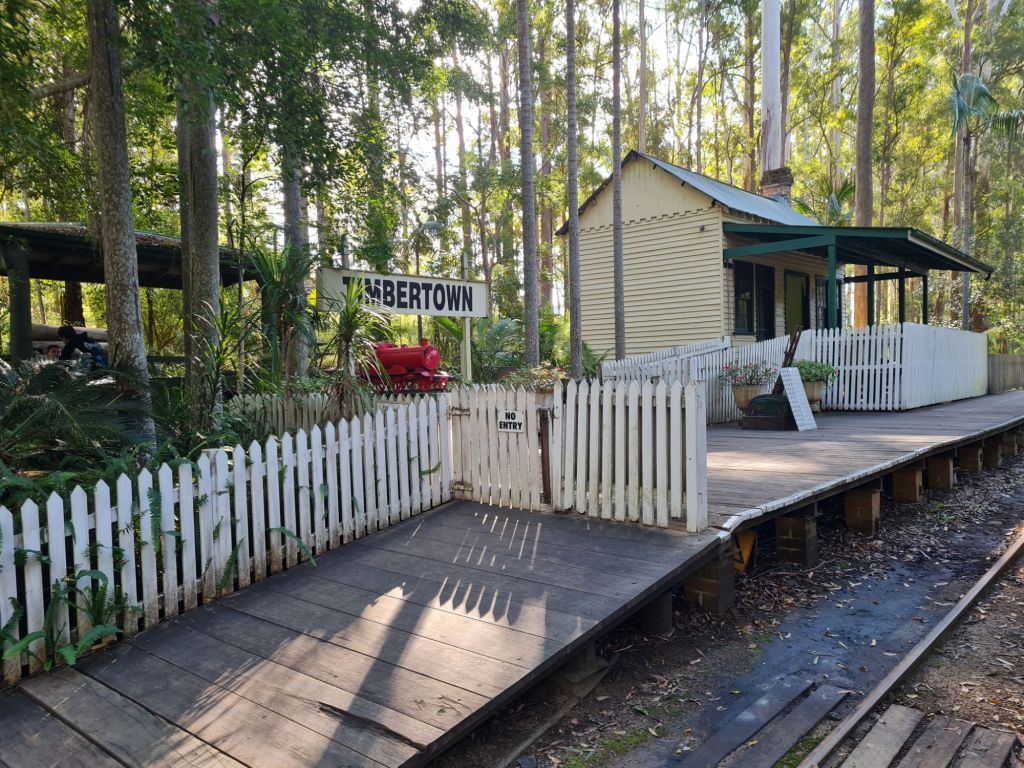
Timber town – The Steam Train

The station

It was almost an anticlimax waiting for the train to arrive, and, heralded by several whistles, it did not disappoint.

Whilst not as large as the real commuter railway engines, it didn’t matter.  It arrived with three colourful carriages, and everyone was waiting to jump on board.

Just for show, the driver reversed the train through the station, then brought it back slowly so everyone could get a photo moment of the train arriving at the station.

Then, everyone was aboard, and we were off.  It was a large circular track that went around the outskirts of the whole Timbertown site.

It was slow in places. The engine was pulling quite a load, and at least once it felt like it was going to stop.

But, no, we made it.  Towards the end there was a large trestle bridge.

The train travels over 595 mm tracks for 2.4 km.  It also travels over the longest 595 mm gauge trestle bridge in the southern hemisphere.

The locomotive, number 12271, built by John Fowler and Co, a company that found a niche building narrow gauge equipment for the cane fields, was built in 1910 and recently had its 125th birthday.

The locomotive, also known as the Green Hornet, worked most of its life at the Macknade Sugar Mill near Ingham in northern Queensland, before being sold to Timbertown.

It was restored to working order in March 2022.

“Sunday in New York”, a romantic adventure that’s not a walk in the park!

“Sunday in New York” is ultimately a story about trust, and what happens when a marriage is stretched to its limits.

When Harry Steele attends a lunch with his manager, Barclay, to discuss a promotion that any junior executive would accept in a heartbeat, it is the fact his wife, Alison, who previously professed her reservations about Barclay, also agreed to attend, that casts a small element of doubt in his mind.

From that moment, his life, in the company, in deciding what to do, his marriage, his very life, spirals out of control.

There is no one big factor that can prove Harry’s worst fears, that his marriage is over, just a number of small, interconnecting events, when piled on top of each other, points to a cataclysmic end to everything he had believed in.

Trust is lost firstly in his best friend and mentor, Andy, who only hints of impending disaster, Sasha, a woman whom he saved, and who appears to have motives of her own, and then in his wife, Alison, as he discovered piece by piece damning evidence she is about to leave him for another man.

Can we trust what we see with our eyes or trust what we hear?

Haven’t we all jumped to conclusions at least once in our lives?

Can Alison, a woman whose self-belief and confidence is about to be put to the ultimate test, find a way of proving their relationship is as strong as it has ever been?

As they say in the classics, read on!

Purchase:

http://tinyurl.com/Amazon-SundayInNewYork

365 Days of writing, 2026 – 71

Day 71 – Luck

Writing Is a Blend of Drafts, Practice, Patience… and (Yes) Luck
How much does luck really matter, and can you manufacture your own?


1. The Four Pillars of the Writing Process

PillarWhat It Looks Like in PracticeWhy It Matters
DraftA messy, imperfect first version that never sees the light of day.Gets ideas out of your head and onto paper before they evaporate.
PracticeWriting daily, experimenting with genre, studying the craft.Turns raw talent into reliable skill; the more you write, the better you become at spotting what works.
PatienceAllowing stories to simmer, waiting for feedback, revising until the narrative sings.Prevents rushed, half‑baked work and gives you the space to notice subtle improvements.
LuckThe right eyes on the right piece at the right time.Bridges the gap between “good enough” and “published, celebrated, paid.”

Most writers feel comfortable dissecting the first three. They’re concrete, measurable, and—most importantly—controllable. Luck, on the other hand, feels ethereal, like a gust of wind you can’t predict or direct. Yet, it’s a factor that many successful authors (and their agents, editors, and readers) cite as a turning point in their careers.


2. Luck: Myth, Mystery, or Measurable Influence?

a. The “Right Person” Phenomenon

The story you’ll hear a thousand times: “I sent my manuscript to 50 agents, and the 51st said yes.”

  • Statistical reality: If an agent receives 200 submissions a week and picks one, the odds are 0.5 % per submission. That’s a very real, quantifiable element of luck.
  • Why it matters: Even a superb manuscript can sit in the abyss of an overburdened inbox forever without that serendipitous glance.

b. Timing is Everything

A dystopian novel released in 2024 lands in a saturated market; a similar story in 2008 rides the wave of post‑9/11 anxiety and becomes a bestseller.

  • External factors: Cultural mood, current events, emerging trends, even algorithm changes on platforms like Amazon or TikTok.
  • The luck factor: Being in sync with the zeitgeist often feels like luck, but it’s also a product of awareness and timing.

c. Network Effects

A friend shares your article on LinkedIn, it goes viral, and a publishing house reaches out.

  • The roulette wheel: Who you know, where you post, which forum you frequent—these are chance encounters that can catapult a piece from obscurity to spotlight.

Bottom line: Luck isn’t a mystical force; it’s the intersection of your work with unpredictable external variables. And that intersection is not completely out of your control.


3. Engineering Your Own Luck

If luck is a probability, you can raise the odds. Below are proven tactics that writers use to manufacture their own good fortune.

1️⃣ Show Up Consistently (The Visibility Engine)

  • Why it works: The more you publish—whether it’s blog posts, flash fiction, or LinkedIn threads—the higher the chance one piece lands in the right feed at the right moment.
  • Action step: Commit to a minimum output (e.g., 500 words a day or one medium‑length article per week). Use a content calendar to keep yourself accountable.

2️⃣ Target the Right Gatekeepers

  • Research before you pitch: Identify agents, editors, or influencers whose recent purchases align with your genre or theme.
  • Personalise: Mention a specific piece they’ve championed and explain why your manuscript complements it.
  • Result: You’re no longer sending a blind shot in the dark; you’re aiming at a moving target you’ve studied.

3️⃣ Leverage “Micro‑Virality” Platforms

  • Twitter, TikTok, Substack, Medium: These ecosystems reward shareable, bite‑sized content. A well‑crafted hook can earn thousands of impressions overnight.
  • Tip: Repurpose a chapter excerpt into a 280‑character “teaser” or a 30‑second video reading. Cross‑post to maximise reach.

4️⃣ Build a Community First

  • Why it matters: A loyal readership will champion your work, give honest feedback, and amplify your voice.
  • How: Host virtual writing circles, participate in genre‑specific Discord servers, or run a monthly newsletter with exclusive drafts.
  • Outcome: When you finally release a book, you already have a built‑in launch squad.

5️⃣ Collect Data, Iterate, and Scale

  • Track metrics: Open rates, click‑throughs, submission response rates.
  • A/B test subject lines, cover designs, query letters.
  • Refine: Treat each launch as an experiment; the data reveals which “luck‑generating” tactics actually work for you.

6️⃣ Stay Informed About Industry Shifts

  • Subscribe to trade newsletters (Publishers Weekly, The Bookseller, etc.).
  • Attend virtual conferences and note emerging trends (e.g., the rise of interactive fiction or AI‑assisted storytelling).
  • Result: You can anticipate the next wave and position your manuscript to ride it—turning what looks like luck into strategic timing.

4. A Real‑World Example: From “Luck” to “Preparedness + Opportunity”

Case Study – Maya Patel, debut sci‑fi author

  1. Draft & Practice: Wrote three full manuscripts over four years, revising each based on beta‑reader feedback.
  2. Patience: Held back on publishing, waiting for the right moment to submit to agents specialized in climate‑fiction.
  3. Manufactured Luck:
  • Joined a niche Discord for “eco‑thrillers.”
  • Shared a 1,000‑word excerpt, which was retweeted by a popular environmental activist.
  • The tweet caught the eye of an agent who listed “eco‑drama” as a current interest.
  • Within two weeks, Maya’s manuscript was under contract.

Maya’s story illustrates that the “lucky” agent discovery was the result of deliberate community building and strategic exposure.


5. The Mindset Shift: From “I’m Unlucky” to “I’m Luck-Optimising.”

Fixed‑Luck ThoughtLuck‑Optimizing Reframe
“I never get noticed; it’s just bad luck.”“I need more visibility points where luck can happen.”
“If I’m not published by 30, it’s fate.”“I’ll create multiple launch pathways—self‑publish, serialized web‑novel, audiobooks.”
“Publishers are gatekeepers I can’t influence.”“I can build relationships with them through consistent, high‑quality content.”

By treating luck as a resource you can attract rather than a random wind you must endure, you shift from passive resignation to active agency.


6. Quick‑Start Checklist: Crafting Your Own Luck

✅Action
1Set a daily word‑count goal and log it for 30 days.
2Compile a list of 10 agents/editors who have sold books similar to yours.
3Publish a 500‑word excerpt on two social platforms this week.
4Join one writing community (Discord/Reddit/Slack) and contribute weekly.
5Track the performance of each post (views, shares, comments).
6Review data every two weeks; tweak headlines, posting times, or formats.
7Pitch one query letter per week, using the personalized research you did.
8Celebrate every small win—an extra comment, a retweet, a beta‑reader endorsement.

Consistently checking off these items builds “luck capital” that compounds over time.


7. The Bottom Line

Writing success is rarely a straight line from draft → practice → patience → publication. Luck—those unpredictable moments when the right person sees the right piece—plays a genuine role. But luck is not a cosmic lottery ticket you either draw or don’t. It’s a probability that you can raise dramatically by:

  1. Increasing the number of opportunities (more drafts, more posts, more pitches).
  2. Targeting the right people (research, personalisation).
  3. Timing your releases (stay current, watch industry trends).
  4. Cultivating a community that will champion your work.

When you combine solid craft with a systematic “luck‑building” strategy, you turn the nebulous element of fortune into a replicable part of your writing business.

Remember: “Luck is what happens when preparation meets opportunity.”—Seneca (or at least a modern writer’s version of it).
So keep drafting, keep practicing, keep being patient, and then engineer the circumstances where luck can finally knock on your door.


Ready to boost your luck? Drop a comment below with the first step you’ll take today, and let’s hold each other accountable. Happy writing! ✍️🚀

“Echoes From The Past”, the past doesn’t necessarily stay there


What happens when your past finally catches up with you?

Christmas is just around the corner, a time to be with family. For Will Mason, an orphan since he was fourteen, it is a time for reflection on what his life could have been, and what it could be.

Until a chance encounter brings back to life the reasons for his twenty years of self-imposed exile from a life only normal people could have. From that moment, Will’s life slowly starts to unravel, and it’s obvious to him that it’s time to move on.

This time, however, there is more at stake.

Will has broken his number one rule: don’t get involved.

With his nemesis, Eddie Jamieson, suddenly within reach, and a blossoming relationship with an office colleague, Maria, about to change everything, Will has to make a choice. Quietly leave, or finally, make a stand.

But as Will soon discovers, when other people are involved there is going to be terrible consequences no matter what choice he makes.

https://amzn.to/2CYKxu4

newechocover5rs

In a word: Tap

There is nothing worse than, when lying in bed unable to get to sleep, you hear every noise in the house and out, but none worse than a dripping tap.

It’s often not because someone forgot to turn the tap off, but because a washer is on its last legs.

There are taps for the fallen brave, but aside from the fact that is the name of a piece of music, I think it’s also the title of a film.  But taps itself is a bugle call at dusk, and also played at military funerals.

Then there’s that income stream that you can tap into, other than your next-door neighbour’s power supply.

But what would be far more interesting than to tap into a phone line and listen in?  Even though eavesdroppers never hear anything good about themselves, you could learn something you didn’t want to know.

Then we can go back to the 1930s and a series of films that starred one of my favourite actors Fred Astaire, who was, of course, a tap dancer, along with Ginger Rogers.

In fact, my middle granddaughter is quite a good tap dancer.

And, lastly, was that a tap on the door, or a tap in the window?

‘What Sets Us Apart’ – A beta reader’s view

There’s something to be said for a story that starts like a James Bond movie, throwing you straight in the deep end, a perfect way of getting to know the main character, David, or is that Alistair?

A retired spy, well, not so much a spy as a retired errand boy, David’s rather wry description of his talents, and a woman that most men would give their left arm for, not exactly the ideal couple, but there is a spark in a meeting that may or may not have been a setup.

But as the story progressed, the question I kept asking myself was why he’d bother.

And, page after unrelenting page, you find out.

Susan is exactly the sort of woman to pique his interest.  Then, inexplicably, she disappears.  That might have been the end of it, but Prendergast, that shadowy enigma, David’s ex-boss who loves playing games with real people, gives him an ultimatum: find her or come back to work.

Nothing like an offer that’s a double-edged sword!

A dragon for a mother, a sister he didn’t know about, Susan’s BFF who is not what she seems or a friend indeed, and Susan’s father, who, up till David meets her, couldn’t be less interested, his nemesis proves to be the impossible dream, and he’s always just that one step behind.

When the rollercoaster finally came to a halt, and I could start breathing again, it was an ending that was completely unexpected.

I’ve been told there’s a sequel in the works.

Bring it on!

The book can be purchased here:  http://amzn.to/2Eryfth

The cinema of my dreams – I always wanted to see the planets – Episode 40

Sorry, but it was the only option at the time

“What’s the situation with the other ship?”

Number one had come up to the bridge and was standing over the navigator, looking at the screen.

“Sir, might I remind you…”  Nancy began.

“We’ll discuss the ethics later, but right now we don’t have much of a choice.  I expect you to keep what just happened to yourself for the time being.  Am I understood?”

I wasn’t silencing her, it was a matter for reports and discussions in due course.

“Understood, sir.”

“Very good.  Just be ready to be in the boarding party when we catch up with them.”

Her expression told me that she was far from impressed with my decision, but, I wasn’t about to test our ship’s defenses against an unknown quantity.  That might come later, after a discussion with the military commander.

“Later, then.”  She gave me a last witheringly look, then left.

Number one turned.  “What happened over there?”

“Not for discussion right now.  The ship?”

“About fifteen minutes at maximum speed.   They seemed to have stopped.  No indication if they’re having problems.”

“Lay in a course and get us there, maximum speed.”

A moment later the navigator said, “Awaiting the order, air.”

“Go.”

A slight shift inside the ship as it gathered momentum, then the dampeners kicked in.

“Time to target 11 minutes, 35 seconds sir.” 

He didn’t add the “give or take” at the end signifying that it was a serious situation.

“Code Red, military commander to the bridge.”

The lights dimmed and a hush came over the bridge.

“Have we had time to analyze the data on the Russian ship or the alien vessel?”

“For the Russian ship, yes.  Schematics, vulnerabilities, propulsion.  A scaled version of ours, no doubt stolen by their spies, but without some of the modifications we think. It appears its maximum speed is about 60% of ours.”

“Then we can catch them if they try to escape?”

“If we need to, but I’m not sure why we’d want to?”

“There are reasons which at the moment you don’t need to worry about.  Just get us there, and be ready to go after them if they try to leave.”

“Sir.” 

He was also unhappy because our remit was not to be attacking our own ships, but there were always extenuating circumstances, circumstances that I needed to take up with the Admiral before I took any sort of action.

The military commander stepped on the bridge.  “You want to see me?”

“Come with me.  Number one, keep me posted on progress.”

I ushered the commander into my day room.

“I hear we’ve just made first contact.”

“You could say that.  They are following us, on our way to the Russian ship.  At the moment I don’t have the luxury of knowing whether or not the Russians committed atrocities, but the commander of the alien vessel says they did.  To prevent this ship from being destroyed I told him we would apprehend those involved and jointly sort out the mess. It was the best plan I could come up with in the time frame, and we don’t know much about the alien vessel.”

“A sticky situation then.”

“Not even the half of it General.  Our first encounter and already we’re behind the eight ball.  This is not exactly how I envisioned it, but our fellow humans have managed to let us down badly.  Now, you’ve got about 10 minutes to prepare for various outcomes, but that ship can’t be allowed to leave, and, if the alien vessel attacks us, you have to defend us.”

“Battles used to be so much easier, on the ground. Very well.  I’ll see you on the bridge.”

While I had a great deal of autonomy aboard the ship, because we were a long way from home and the sheer distance over which communications had to travel through subspace would make them difficult at best, I didn’t have high hopes of getting hold of the Admiral in the time I had available to me. Of course, the relay satellites we dropped along the way would help boost the signal, but when you’re hoping to rely on something in a crisis, it invariably will let you down.

The situation was one that fell within the guidelines where I needed to brief the Admiral of intended actions so at the very least if there were consequences, he would be in a position to comment, defend, or more likely apportion blame.

This would not be an issue if we were the only ship out on the edge of space, but we were not.

While talking to the General I had started the call but was not expecting to raise him. Given the parameters needed on a good day, and because this was urgent, I wasn’t expecting anything.

I was surprised when a blurry picture of his office appeared on my screen, before it crystallised into the Admiral sitting on the front of his desk. It was almost as if he had been expecting a call.  There would be a lag, but a lag I could live with.

“Captain, we calculated you must be getting close to Pluto’s orbit.  How are you?”

“Everything is fine, and you’re right, we are close to seeing what’s beyond our galaxy.  But, there’s a problem.  There’s another ship out here from earth, been over the border, one that’s neither alien or in our ship register.”

I waited.

“The infamous Russian or Chinese ship?”

“Yes.  But more significantly, we have made contact with an alien race, as have these other humans, and the experience has left the aliens with a severe mistrust of our intentions.  So much so, when we met, I was presented with an ultimatum.  Suffice to say, I’m left in a position where I have to oversee justice against some of that crew.  We don’t have time to discuss the details, it’s a situation where I’ll have to find a mutually beneficial resolution, or our exploration aspirations will be over before they start.”

It was a lot for him to digest.

“Is it likely to cause a problem with the other human ship?”

“The alien captain demanded we detain the guilty crew members, and have them face a judiciary.  I’ve negotiated a presence, but I’m not sure just what the limits of participation will be.”

“How long have you got?”

A look at the top of my screen told me we were on station with the other earth vessel, with the alien ship not far away.

“We’re there, now, so it’s minutes rather than hours.  For the moment it’s simply a heads up.  I’ll get back to you as soon as I can.  You might want to ask some hard questions as to who is out here, sir, because they’re not helping our cause.”

It was exactly the situation the Space Alliance had predicted would happen if we were to present a fractured front to whomever might be out there.  Armed with the knowledge I’d just passed on, the data file the scientific team had assembled, he would be able to ask the hard questions, and hopefully get answers

“It would seem not. But, just so you know, we have just had a conference with what appears to be the command center of the Russian vessel, which, I can now tell you, is a joint venture between the Russians and the Chinese. Further, they claim their ship is being unjustly harassed by the alien who, according to them, simply took exception to them for no apparent reason. Someone is not telling us the whole story.”

“What do you make of it?”

“Since they lied about building a ship, and then sending it out into space without telling us, and given the arrogance shown during the conference, I’d say, from the body language of the Chief of Operations, they have something to hide. You have the authority to take whatever action you deem necessary while walking that very thin line of diplomacy.

“We have a diplomat in the crew.”

“Of course.  Keep me informed of developments, and remember, you are representing the whole world.”

No pressure then.

© Charles Heath 2021-2022

A photograph from the inspirational bin – 56

What story does it inspire?

While the first thought you might have of what this photograph represents might be of the water, yet again, as it is the same place as that of yesterday, in contrast, this was two days later and later in the day.

What fascinated me this time was the clouds.

I have it in mind that we always seem to imagine that very large alien spaceships are going to come out of the clouds, and that one I saw, well, I stood there for a while half expecting to witness the first alien visit.

It’s probably too much to expect that they would come to Australia first before they went to America, and even less so Queensland.

Except of course, they came to see Surfer’s Paradise, stay in one of the many hotels overlooking the beach and ocean, go to one of a zillion restaurants, get in some surfing, or just laze around for a week or so before they did what they came to do.

Just think, your famous catchline could be, “A funny thing happened on the way to the casino … I ran into this group of aliens … or at least I think they were aliens, it’s hard to tell the way our younger generation gets around these days…”