Inspiration, maybe – Volume 1

50 photographs, 50 stories, of which there is one of the 50 below.

They all start with –

A picture paints … well, as many words as you like.  For instance:

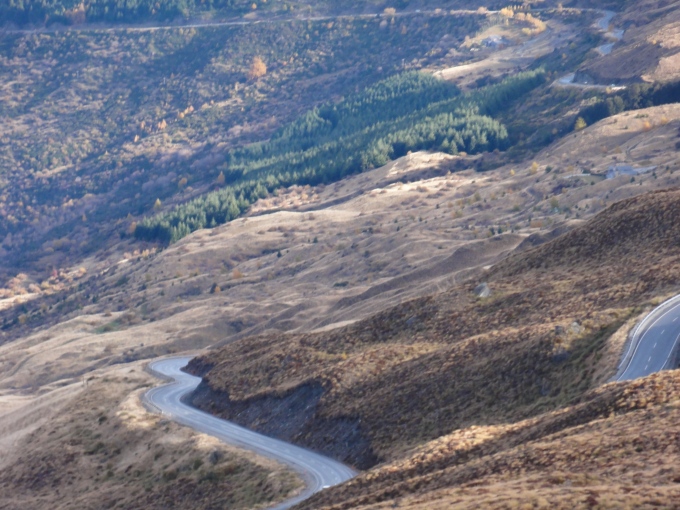
lookingdownfromcoronetpeak

And the story:

It was once said that a desperate man has everything to lose.

The man I was chasing was desperate, but I, on the other hand, was more desperate to catch him.

He’d left a trail of dead people from one end of the island to the other.

The team had put in a lot of effort to locate him, and now his capture was imminent.  We were following the car he was in, from a discrete distance, and, at the appropriate time, we would catch up, pull him over, and make the arrest.

There was nowhere for him to go.

The road led to a dead-end, and the only way off the mountain was back down the road were now on.  Which was why I was somewhat surprised when we discovered where he was.

Where was he going?

“Damn,” I heard Alan mutter.  He was driving, being careful not to get too close, but not far enough away to lose sight of him.

“What?”

“I think he’s made us.”

“How?”

“Dumb bad luck, I’m guessing.  Or he expected we’d follow him up the mountain.  He’s just sped up.”

“How far away?”

“A half-mile.  We should see him higher up when we turn the next corner.”

It took an eternity to get there, and when we did, Alan was right, only he was further on than we thought.”

“Step on it.  Let’s catch him up before he gets to the top.”

Easy to say, not so easy to do.  The road was treacherous, and in places just gravel, and there were no guard rails to stop a three thousand footfall down the mountainside.

Good thing then I had the foresight to have three agents on the hill for just such a scenario.

Ten minutes later, we were in sight of the car, still moving quickly, but we were going slightly faster.  We’d catch up just short of the summit car park.

Or so we thought.

Coming quickly around another corner we almost slammed into the car we’d been chasing.

“What the hell…” Aland muttered.

I was out of the car, and over to see if he was in it, but I knew that it was only a slender possibility.  The car was empty, and no indication where he went.

Certainly not up the road.  It was relatively straightforward for the next mile, at which we would have reached the summit.  Up the mountainside from here, or down.

I looked up.  Nothing.

Alan yelled out, “He’s not going down, not that I can see, but if he did, there’s hardly a foothold and that’s a long fall.”

Then where did he go?

Then a man looking very much like our quarry came out from behind a rock embedded just a short distance up the hill.

“Sorry,” he said quite calmly.  “Had to go if you know what I mean.”

I’d lost him.

It was as simple as that.

I had been led a merry chase up the hill, and all the time he was getting away in a different direction.

I’d fallen for the oldest trick in the book, letting my desperation blind me to the disguise that anyone else would see through in an instant.

It was a lonely sight, looking down that road, knowing that I had to go all that way down again, only this time, without having to throw caution to the wind.

“Maybe next time,” Alan said.

“We’ll get him.  It’s just a matter of time.”

© Charles Heath 2019-2021

Find this and other stories in “Inspiration, maybe”  available soon.

InspirationMaybe1v1

Searching for locations: Rome, Italy

We visited Rome in August

It was verrrry hot.

We flew into Rome’s Leonardo da Vinci-Fiumicino airport after a rather bumpy flight from London.  Unlike most other airports the plane parked at a satellite terminal and after we disembarked we had to catch a train to the main terminal.

The most notable memory of this airport was my daughter’s discovery of a salami shop.

We had booked a transfer to take us to the hotel the Roma Corso Trieste Mercure in Via Gradisca from the airport.  It was a white air-conditioned van and so far we had avoided the heat.

One of the rooms had faulty air conditioning an absolute must as the rooms were very hot without it and necessitated a room change which was done quickly and efficiently.

The hotel was in the suburbs and without a car we were dependent on public transport.  According to the reception staff, there was a bus stop nearby, and a longer walk to the tram or light railway.  The bus seemed to be the best option as it would take us to the central terminal near the railway station, where all tour buses also operated from, and particularly the open-top buses that went to all the major tourist attractions.

That first day basically was given over to travelling, arriving by plane and settling into the hotel, thus we didn’t get to feel the force of the heat.  That came the next day.

After a walk around the hotel precinct to get our bearings and see what shops and restaurants were available, on returning to the hotel we were faced with limited choices of room service or to go out for dinner.

My daughter and l go for a long walk up Via Nomentana to find several shops and a restaurant.  We went into the restaurant and sat down.   We waited for 10 minutes and got no service nor did anyone come and ask us if we wanted to order food so instead we left somewhat disappointed and go next door to what seemed to be the Italian version of a delicatessen and ordered sandwiches and beer.   I bought a half dozen cans of Moretti beer two of which I drank on the way home.

It was still very hot even at eight at night and the sandwiches are delicious.  It just might be by that time we were starving and anything would have tasted great.

The next morning we are up and ready to chance the weather and some history.  Breakfast at the hotel is limited but very good.

We were going to use public transport and I’d studied up on the Internet.

Travelling on the bus required pre-purchase of tickets which could be bought in certain shops and locally when exploring the area near the hotel, l found a tobacconist.

Next, we needed to understand how to use the tickets. There was no one on the bus who could help so when l tried to scan the tickets and it failed, l gave up.  We had the same issue each day and in the end, the tickets never got used.

The trip to central Rome by bus took about 15 minutes.  In the morning it was reasonably cool and showed us a little of suburban Rome.  We also saw the trams but we would not be able to use them because our hotel not on a direct route.

That first full day we decided to go and see the Vatican.

Not understanding buses and which one we needed to get to the Vatican, we took a taxi.

Wow.  It was the metaphorical equivalent of driving over the edge of a cliff with a daredevil.  It was quite literally terrifying.

Or maybe we just didn’t know that this was probably the way people drove in Rome.

Shaken but delivered in one piece we found ourselves in the square opposite St Peters Basilica.

The square is impressive, with the statues atop a circular colonnaded walkway.  The church is incredible and took a few hours to take in and to top off the day we did a tour of the Vatican museum which took the rest of the afternoon.

Then it was back to the delicatessen for more sandwiches and beer, and an interesting discussion with several elderly Italian ladies, of which I did not understand one word.

On the second full day we decided to use one of the open-top bus tours and eventually decided on the hop-on hop-off tour simply because the bus was at the central transport terminal for trains and buses and it was getting hotter.

Our first stop was the Colosseum.  There were other monuments nearby, such as the Arch of Constantine, but as the heat factor increased we joined the queue to go into the Colosseum and gladly welcomed the shade once we got inside.

The queue was long and the wait equally so, but it was worth the wait.  It would be more interesting if they could restore part of it to its former glory so we could get a sense of the place as it once was.  But alas that may never happen, but even so, it is still magnificent as a ruin.

Outside in the heat, it was off to the ruins which were a longish walk from the Colosseum, taking Via Sacra, not far from the Arch of Constantine.  This day in the walkway there were a number of illegal vendors, selling knockoff goods such as handbags and watches, and who, at the first sight of the police, packed up their wares in a blanket and ran.

Included in these ruins were The Roman Forum, or just a few columns remaining, the Palatine Hill, Imperial Fori, including the Forum of Augustus, the Forum of Caesar, and more specifically the Forum of Trajan.  It was, unfortunately very hot and dusty in the ruins the day we visited.

We walked all the way to the Foro Romano and the Septimus Severo Arch at the other end of the ruins, past the Temple of Caesar.  I found it very difficult to picture what it was like when the buildings were intact, so I bought a guide to the ruins which showed the buildings as ruins and an overlay of how they would have looked.  The buildings, then, would be as amazing as the Colosseum, and it would have been interesting to have lived back then, though perhaps not as a Christian.

I lost count of the number of bottles of water we bought, but the word ‘frizzante’ was ringing in my ears by the end of the day.  Fortunately, the water did not cost a lot to buy.

At the end of the day, we caught the hop on hop off the bus at the Colosseum and decided not to get off and see any more monuments but observe them from the bus.  The only one I remember seeing was Circo Massimo.  Perhaps if we’d known it was going to be twice as hot on the bus, yes, there was no air-conditioning; we may have chosen another form of transport to get back to the hotel.

On the third and last day in Rome, we decided to go to the Trevi Fountain, see the pantheon and walk up the Spanish Steps.  We spent most of the morning in the cool of a café watching the tourists at the fountain.  By the time we reached the top of the Spanish Steps, we were finished.

An excerpt from “Strangers We’ve Become” – Coming Soon

I wandered back to my villa.

It was in darkness.  I was sure I had left several lights on, especially over the door so I could see to unlock it.

I looked up and saw the globe was broken.

Instant alert.

I went to the first hiding spot for the gun, and it wasn’t there.  I went to the backup and it wasn’t there either.  Someone had found my carefully hidden stash of weapons and removed them.

Who?

There were four hiding spots and all were empty.  Someone had removed the weapons.  That could only mean one possibility.

I had a visitor, not necessarily here for a social call.

But, of course, being the well-trained agent I’d once been and not one to be caught unawares, I crossed over to my neighbor and relieved him of a weapon that, if found, would require a lot of explaining.

Suitably armed, it was time to return the surprise.

There were three entrances to the villa, the front door, the back door, and a rather strange escape hatch.  One of the more interesting attractions of the villa I’d rented was its heritage.  It was built in the late 1700s, by a man who was, by all accounts, a thief.  It had a hidden underground room which had been in the past a vault but was now a wine cellar, and it had an escape hatch by which the man could come and go undetected, particularly if there was a mob outside the door baying for his blood.

It now gave me the means to enter the villa without my visitors being alerted, unless, of course, they were near the vicinity of the doorway inside the villa, but that possibility was unlikely.  It was not where anyone could anticipate or expect a doorway to be.

The secret entrance was at the rear of the villa behind a large copse, two camouflaged wooden doors built into the ground.  I move aside some of the branches that covered them and lifted one side.  After I’d discovered the doors and rusty hinges, I’d oiled and cleaned them, and cleared the passageway of cobwebs and fallen rocks.  It had a mildew smell, but nothing would get rid of that.  I’d left torches at either end so I could see.

I closed the door after me, and went quietly down the steps, enveloped in darkness till I switched on the torch.  I traversed the short passage which turned ninety degrees about halfway to the door at the other end.  I carried the key to this door on the keyring, found it and opened the door.  It too had been oiled and swung open soundlessly.

I stepped in the darkness and closed the door.

I was on the lower level under the kitchen, now the wine cellar, the ‘door’ doubling as a set of shelves which had very little on them, less to fall and alert anyone in the villa.

Silence, an eerie silence.

I took the steps up to the kitchen, stopping when my head was level with the floor, checking to see if anyone was waiting.  There wasn’t.  It seemed to me to be an unlikely spot for an ambush.

I’d already considered the possibility of someone coming after me, especially because it had been Bespalov I’d killed, and I was sure he had friends, all equally as mad as he was.  Equally, I’d also considered it nigh on impossible for anyone to find out it was me who killed him because the only people who knew that were Prendergast, Alisha, a few others in the Department, and Susan.

That raised the question of who told them where I was.

If I was the man I used to be, my first suspect would be Susan.  The departure this morning, and now this was too coincidental.  But I was not that man.

Or was I?

I reached the start of the passageway that led from the kitchen to the front door and peered into the semi-darkness.  My eyes had got used to the dark, and it was no longer an inky void.  Fragments of light leaked in around the door from outside and through the edge of the window curtains where they didn’t fit properly.  A bone of contention upstairs in the morning, when first light shone and invariably woke me up hours before I wanted to.

Still nothing.

I took a moment to consider how I would approach the visitor’s job.  I would get a plan of the villa in my head, all entrances, where a target could be led to or attacked where there would be no escape.

Coming in the front door.  If I was not expecting anything, I’d just open the door and walk-in.  One shot would be all that was required.

Contract complete.

I sidled quietly up the passage staying close to the wall, edging closer to the front door.  There was an alcove where the shooter could be waiting.  It was an ideal spot to wait.

Crunch.

I stepped on some nutshells.

Not my nutshells.

I felt it before I heard it.  The bullet with my name on it.

And how the shooter missed, from point-blank range, and hit me in the arm, I had no idea.  I fired off two shots before a second shot from the shooter went wide and hit the door with a loud thwack.

I saw a red dot wavering as it honed in on me and I fell to the floor, stretching out, looking up where the origin of the light was coming and pulled the trigger three times, evenly spaced, and a second later I heard the sound of a body falling down the stairs and stopping at the bottom, not very far from me.

Two assassins.

I’d not expected that.

The assassin by the door was dead, a lucky shot on my part.  The second was still breathing.

I checked the body for any weapons and found a second gun and two knives.  Armed to the teeth!

I pulled off the balaclava; a man, early thirties, definitely Italian.  I was expecting a Russian.

I slapped his face, waking him up.  Blood was leaking from several slashes on his face when his head had hit the stairs on the way down.  The awkward angle of his arms and legs told me there were broken bones, probably a lot worse internally.  He was not long for this earth.

“Who employed you?”

He looked at me with dead eyes, a pursed mouth, perhaps a smile.  “Not today my friend.  You have made a very bad enemy.”  He coughed and blood poured out of his mouth.  “There will be more …”

Friends of Bespalov, no doubt.

I would have to leave.  Two unexplainable bodies, I’d have a hard time explaining my way out of this mess.  I dragged the two bodies into the lounge, clearing the passageway just in case someone had heard anything.

Just in case anyone was outside at the time, I sat in the dark, at the foot of the stairs, and tried to breathe normally.  I was trying not to connect dots that led back to Susan, but the coincidence was worrying me.

A half-hour passed and I hadn’t moved.  Deep in thought, I’d forgotten about being shot, unaware that blood was running down my arm and dripping onto the floor.

Until I heard a knock on my front door.

Two thoughts, it was either the police, alerted by the neighbors, or it was the second wave, though why would they be knocking on the door?

I stood, and immediately felt a stabbing pain in my arm.  I took out a handkerchief and turned it into a makeshift tourniquet, then wrapped a kitchen towel around the wound.

If it was the police, this was going to be a difficult situation.  Holding the gun behind my back, I opened the door a fraction and looked out.

No police, just Maria.  I hoped she was not part of the next ‘wave’.

“You left your phone behind on the table.  I thought you might be looking for it.”  She held it out in front of her.

When I didn’t open the door any further, she looked at me quizzically, and then asked, “Is anything wrong?”

I was going to thank her for returning the phone, but I heard her breathe in sharply, and add, breathlessly, “You’re bleeding.”

I looked at my arm and realized it was visible through the door, and not only that, the towel was soaked in blood.

“You need to go away now.”

Should I tell her the truth?  It was probably too late, and if she was any sort of law-abiding citizen she would go straight to the police.

She showed no signs of leaving, just an unnerving curiosity.  “What happened?”

I ran through several explanations, but none seemed plausible.  I went with the truth.  “My past caught up with me.”

“You need someone to fix that before you pass out from blood loss.  It doesn’t look good.”

“I can fix it.  You need to leave.  It is not safe to be here with me.”

The pain in my arm was not getting any better, and the blood was starting to run down my arm again as the tourniquet loosened.  She was right, I needed it fixed sooner rather than later.

I opened the door and let her in.  It was a mistake, a huge mistake, and I would have to deal with the consequences.  Once inside, she turned on the light and saw the pool of blood just inside the door and the trail leading to the lounge.  She followed the trail and turned into the lounge, turned on the light, and no doubt saw the two dead men.

I expected her to scream.  She didn’t.

She gave me a good hard look, perhaps trying to see if I was dangerous.  Killing people wasn’t something you looked the other way about.  She would have to go to the police.

“What happened here?”

“I came home from the cafe and two men were waiting for me.  I used to work for the Government, but no longer.  I suspect these men were here to repay a debt.  I was lucky.”

“Not so much, looking at your arm.”

She came closer and inspected it.

“Sit down.”

She found another towel and wrapped it around the wound, retightening the tourniquet to stem the bleeding.

“Do you have medical supplies?”

I nodded.  “Upstairs.”  I had a medical kit, and on the road, I usually made my own running repairs.  Another old habit I hadn’t quite shaken off yet.

She went upstairs, rummaged, and then came back.  I wondered briefly what she would think of the unmade bed though I was not sure why it might interest her.

She helped me remove my shirt, and then cleaned the wound.  Fortunately, she didn’t have to remove a bullet.  It was a clean wound but it would require stitches.

When she’d finished she said, “Your friend said one day this might happen.”

No prizes for guessing who that friend was, and it didn’t please me that she had involved Maria.

“Alisha?”

“She didn’t tell me her name, but I think she cares a lot about you.  She said trouble has a way of finding you, gave me a phone and said to call her if something like this happened.”

“That was wrong of her to do that.”

“Perhaps, perhaps not.  Will you call her?”

“Yes.  I can’t stay here now.  You should go now.  Hopefully, by the time I leave in the morning, no one will ever know what happened here, especially you.”

She smiled.  “As you say, I was never here.”

© Charles Heath 2018-2022

strangerscover9

“The Enemy Within” – the editor’s third draft – Day 10

This book has been sitting in the ‘to-be-done’ tray, so this month it is going to get the final revision.

And so it begins…

Like I said, Day 8 was going to come back and bite

And, did it ever.

It’s got a lot to do with this fly-by-the-seat-of-your-pants thing. It’s fine writing a story making it up as you go, without an official plan. If the ideas keep flowing.

But when revising it’s easy to see the plot holes or potholes maybe, and I just fell in one.

So, going back to the start…

Were in Venice … did I tell you I love Venice … where the story starts.

It’s that age-old premise, a mission that’s blown before the agent left home base.

The mission is simple: a retired agent is pulled back into the field for one last job at the request of a very important asset in the field, to bring them out of the cold.

Our new agent, whose mentor is being recalled, is assigned to back his mentor up, without his knowledge, as a precaution. Why the secrecy is not explained.

That’s the premise, and only became clear when I reached Day 10.

Day 11 promises to be a lot more interesting now.

“Sunday in New York”, a romantic adventure that’s not a walk in the park!

“Sunday in New York” is ultimately a story about trust, and what happens when a marriage is stretched to its limits.

When Harry Steele attends a lunch with his manager, Barclay, to discuss a promotion that any junior executive would accept in a heartbeat, it is the fact his wife, Alison, who previously professed her reservations about Barclay, also agreed to attend, that casts a small element of doubt in his mind.

From that moment, his life, in the company, in deciding what to do, his marriage, his very life, spirals out of control.

There is no one big factor that can prove Harry’s worst fears, that his marriage is over, just a number of small, interconnecting events, when piled on top of each other, points to a cataclysmic end to everything he had believed in.

Trust is lost firstly in his best friend and mentor, Andy, who only hints of impending disaster, Sasha, a woman whom he saved, and who appears to have motives of her own, and then in his wife, Alison, as he discovered piece by piece damning evidence she is about to leave him for another man.

Can we trust what we see with our eyes or trust what we hear?

Haven’t we all jumped to conclusions at least once in our lives?

Can Alison, a woman whose self-belief and confidence is about to be put to the ultimate test, find a way of proving their relationship is as strong as it has ever been?

As they say in the classics, read on!

Purchase:

http://tinyurl.com/Amazon-SundayInNewYork

In a word: Lot

I’ve got a lot of time on my hands…

Or not.  It’s just an expression, where a lot means plenty.  Only the rich and idle seem to have a lot of time on their hands, and a lot of money, sometimes more than they know what to do with.

It spawns another saying, the devil finds work for idle hands.

This is distinct from the other form of a lot; a piece of land that can be used to build a house, an office building or warehouse, or just land to graze cattle or sheet.

For those with a lot of money, they can buy two lots or four lots.

Lot can also mean everything, i.e. he bought the lot.

Now it’s getting confusing, as only the English language can.

How about, there’s a lot of love in the room.   Well, it’s certainly not at a political debate that’s for sure!

Then, still having more money than sense I went to an auction and bid for two lots.  Unfortunately, there was someone else who had more money than I did.

My mother had a lot of quaint expressions; once we were sitting opposite a man of dubious character and she said, he’s a bad lot.

Back in the old days, and sometimes these, the word lot was used instead of lottery when names were put in a hat and one drawn as the winner.  Today its a little more sophisticated, balls are put in a cage.

And I was never happy with my lot in life.  Not till I got older, anyway.

“Echoes From The Past”, the past doesn’t necessarily stay there


What happens when your past finally catches up with you?

Christmas is just around the corner, a time to be with family. For Will Mason, an orphan since he was fourteen, it is a time for reflection on what his life could have been, and what it could be.

Until a chance encounter brings back to life the reasons for his twenty years of self-imposed exile from a life only normal people could have. From that moment Will’s life slowly starts to unravel and it’s obvious to him it’s time to move on.

This time, however, there is more at stake.

Will has broken his number one rule, don’t get involved.

With his nemesis, Eddie Jamieson, suddenly within reach, and a blossoming relationship with an office colleague, Maria, about to change everything, Will has to make a choice. Quietly leave, or finally, make a stand.

But as Will soon discovers, when other people are involved there is going to be terrible consequences no matter what choice he makes.

https://amzn.to/2CYKxu4

newechocover5rs

The cinema of my dreams – I always wanted to go on a treasure hunt – Episode 19

Here’s the thing…

Every time I close my eyes, I see something different.

I’d like to think the cinema of my dreams is playing a double feature but it’s a bit like a comedy cartoon night on Fox.

But these dreams are nothing to laugh about.

Once again there’s a new instalment of an old feature, and we’re back on the treasure hunt.

And the perils of writing on the fly often leads to back revisions to aid moving forward, and this is one of those occasions.  A few revisions were required.


Short of jumping over the side, there was no way we were getting away.  And judging from the expression on Rico’s face, now very plain to see halfway along the pier, he was not happy to see us.

Boggs stepped off the deck and joined me on the pier, just as Rico made it to where we were standing, just as it started in a gentle up and down motion with the water, churned up by a passing speed boat, but it was fear rather than the pier’s motions making me feel sick.

The sound of another boat caused me to glance in the opposite direction, out towards the sandbar, where I could see another large boat coming in our direction very quickly, and by the shape of it, quite possibly a police launch or the coast guard. 

Rico had seen it too.  “What have you done?”

“I called the police,” I said, trying to act braver than I felt.  Even with the police on their way, Rico could still do something we’d all regret.

“Why?”

Movement by the fishing store caught my eye, and I saw it was two of the men who’d left the boat with Rico earlier, retreating.  They’d seen the situation and were retreating.  A police car with its siren blaring and lights flashing just stopped at the entrance to the pier and two officers were getting out, guns in hand.

Those men would getaway.  Rico had seen them too and looked relieved.  Odd for a man about to find himself in a lot of trouble.

Boggs blurted out, “There’s a dead body in the cabin.”

Rico shook his head.  “That’s not possible.  I’ve been gone for an hour and it isn’t possible he put himself there.”

He looked around to see the officers coming from the land side of the pier.  There was no escape for him, or for us, but this could still end up a sticky situation for us if Rico decided to shoot his way out.  Boggs said he owned a gun, and if it was not on him, it might be in the boat.

Rico climbed on board and then moved to the hatch.  He lifted the hatch cover and folded it back to show an opening into the cabin.  It hadn’t been locked; it just looked like it was.  Just as the officers made it to the boat, he stepped in, then down into the cabin.

A minute later, when he came up  Rico looked visibly shaken like he’d seen a ghost.

The police launch had arrived just off the stern, kicking up the water and causing the boat and pier to rock violently, two men at either end ready to secure their boat to ours.  The land-based officers also arrived, somewhat out of breath, to join Boggs and I on the pier.

I recognised the officer who appeared to be in charge, a man called Johnson, the police chief’s deputy.  He was known to shoot first and ask questions later.  What worried me the most, he had his gun drawn and ready to shoot.

He looked at me, Rico, Boggs, then back to me.  “What’s this all about?”

“There’s a body in the cabin,” Boggs said before I could say a word, still sounding very frightened, but whether it was the body in the cabin, Rico’s fury at his meddling or the fact the police were involved was hard to say.

He switched his glare to Rico.  “That true?”

Rico nodded.  “I don’t know where it came from, but it wasn’t there an hour ago.”  A last look back at the cabin, he stepped off the boat onto the pier.

The seaman aboard the police launch slipped a rope over the bollard at the rear of our boat and then jumped on board to secure it.  Another seaman did the same at the bow.  Two more jumped on board, one covering Rico and the other going into the cabin.

When he came back up on deck he was talking into his cell phone.

I think Rico had a lot of explaining to do.


© Charles Heath 2019

The cinema of my dreams – I never wanted to go to Africa – Episode 41

Our hero knows he’s in serious trouble.

The problem is, there are familiar faces and a question of who is a friend and who is foe made all the more difficult because of the enemy, if it was the enemy, simply because it didn’t look or sound or act like the enemy.

Now, it appears, his problems stem from another operation he participated in, and because of it, he has now been roped into what might be called a suicide mission.


“That was far to bloody easy.”  I heard Monroe’s voice come over the radio, not long after we left the camp.

“It was a bit easier than I thought.  But I did make it quite clear if we didn’t all leave in one piece we’d reduce his camp to rubble with everyone in it.”

“He knows the territory.  Something’s waiting for us out here.”

Something indeed.

Back at the camp, not only had the commander’s men search for the hidden weapons, and, when everyone checked, were still there, they had also taken off the crates with the film equipment.  I was not sure what the commander was intending to do with the equipment, but what disappointed me was the fact we hadn’t taken the time to rescue the rocket launcher.

Now the commander had it.

If he bothered to search the crates properly.  I suspect he was yet to do so.  What we had rescued and successfully hidden were the C4 explosives and detonators.  They might come in useful at the airstrip.

Just before we reached the fork in the road, where we would be turning left to head towards the airfield, and surprisingly had not run into any of the commander’s men, we stopped and let Monroe and Shurl out to make a sweep towards the airstrip, not too far away.

I also called up Mobley to see how he was.

The Colonel answered.  “Everything is under control now.”

I didn’t like the sound of that.  “What happened?”

“The kidnappers send out a team to intercept us on the way to the airstrip.  It wasn’t a stretch to imagine they would know what we were planning because they’d know we would not be retracing out steps to Uganda.  Got them before they got a shot off.  I suspect there are Government troops at the airstrip, it’s too important to let anything happen to rich foreigners coming to see their wildlife reserve.  There are several troop carriers, and we’ve seen a few men on the outskirts patrolling.  There’s several at the gate if you could call it that.”

“Is there a plane there?”

“As it happens there is.  A grand old DC3.  It’s not a charter plane, so I’m guessing it belongs to an overentitled American big game hunter or the photographic variety.  At least I’m hoping that’s the case.”

“What do you recommend?”

“Not to storm the field.  You’re going to have to find another means of getting here, preferably without any fanfare.”

My first choice was to go in and get out, with as little firefight as possible, particularly in case they started shooting at the plane.  If I was reading between the lines properly, the Colonel was telling me there were more troops there than we could handle quickly and quietly.

“Very good.  Can you get sight on just how many troops are there, and if you can see who’s in charge?”

“Will try.”

Monroe had been standing next to me during the exchange.

“Three in place, two more on the perimeter, if we can cover as many as possible, you might be able to take the rest from the inside.”

Secreting the weapons again, maybe.  It was a possibility, but going in with hidden weapons, and then found by the guards at the gate, who would be more efficient and careful searchers than the kidnappers, it would create hostility and itchy trigger fingers.

“No.  We have to find some way of letting them feel as though they have complete control of the situation.  They know we’re coming; the commander would have told them.”  The only reason why he was still the cat who ate the canary.  He might even have told them he had some men waiting as the first line of defense.

The airstrip commander would then know we were armed and relatively dangerous.

It was time for yet another dangerous gambit.

I picked up the radio.  “Colonel?”

A second later, “Sergeant?”

“Whatever happens in the next twenty minutes or so, just ignore it.  It’s not much of a plan, but it will get us onto the field.”

“And then?”

“Hopefully some divine intervention.”

Monroe looked skeptical.  “You’re going to just drive up to the gate and surrender?”

“Not exactly.  It won’t be fait accompli until we reach the terminal, or hanger, or whatever the commander has set up as headquarters.  They’ll have most of our weapons, yes.  But they won’t have all of us.”

“No.  But they’ll know we have a sniper, so one of you are going to have to allow yourself to be captured, just to ease their minds.”

“Leaving one of us and Mobley and the Ugandans.  Can we trust them?”

“I hope so, otherwise this could go badly.  But, today, I’m an optimist.  We’ve got this far.”

Trying to show more confidence in the plan that I had.  It was always a worry when you had to trust people you didn’t know.  That had been the problem the last time.  At least this time we had managed to get the hostages.  It was always going to be a problem getting them out.

Monroe gave me one of her special, you’re a fool, looks.  “I hope you know what you’re doing.”  She then nodded in Shurl’s direction and they disappeared into the bush again.

I gestured to Davies to come over.

“Did you find out what sort of plane it is?”

“Hopefully.  The Colonel tells men there’s a DC3 off the airstrip.  I assume you can fly one.”

She smiled, the first time since this operation had started.  “Sure can.  I spent three summers putting one back together.  My dad has a sort of airplane museum.  A DC3, a DC4, and a Lancaster, a very sorry looking Lancaster at that.  Shouldn’t be a problem.”

“Then try to not get shot.”

“Do my very best not to.”

Once again, it was time to go.  Going into the unknown was getting to be the norm, but hopefully, this would be the last time.  I didn’t consider it wise to advise the hostages, they had their own problems to worry about.


© Charles Heath 2020

A photograph from the inspirational bin – 6

For those who are wondering what this is a photograph of, it is a tree bordered stream that runs along a long valley that runs from outside Canungra, in Queensland, to the Lamington National Park.

It’s near a place we like to stay for a few days when we want to get away from everything, and I mean everything. There is no television, and cell phone reception is awful if not non existent.

So, you can see the benefits.

Sitting at the table on the veranda overlooking the fields, and this stream, you have time to just think, or not, about what it might have been like before the settlers came.

What is was like when the explorers we seeking new places to live, and they chanced upon this valley. It it was me back then, I would have followed the stream.

But, as for a story…

I have read a great many stories for the explorers of this country, and the hazardous nature of their treks.

What seemed to be the most common theme was crossing from south to north, that is from Melbourne to the Northern most tip of Queensland, or from Adelaide to the Northern Territory. In both cases they would have to traverse a very dry, very hot outback where the sight of a stream, or river, like above, would have been very welcome.

For some, it became an impossible quest, and stuck in the desert, they eventually perished. That in itself, the trials and tribulations of an early explorer would make a great story.

Australia is a very fertile country around the coastal regions, but one you start venturing inland, it is dry, dusty and almost uninhabitable. Unless there’s water from rivers, streams, or underground, or mining settlements, there is very little else to see.

The exceptions to this are Uluru and Kakadu National Park, in the Northern Territory, Shark Bay and The Pinnacles in Western Australia, MacKenzie Falls in Victoria, The Simpson Desert, the Boodjamulla (Lawn Hill) National Park, and the Carnarvon Gorge in Queensland, to name a few.

One day I might get to see them.