“The Enemy Within” – the editor’s third draft – Day 9

This book has been sitting in the ‘to-be-done’ tray, so this month it is going to get the final revision.

And so it begins…

I’ve been thinking about the title.

Was not quite sure how this story was going to go because it is very difficult to think that you would betray your family, your friends, the people you work with, or on a grander scale, your country.

In the case of the latter, it is treason, and that’s a word that hasn’t been bandied around since the end of the second world war.

Until of course, the January 6 insurrection – if that was what it was. There seem to be two schools of thought on that matter.

But that has nothing to do with this story.

There are sayings that came out of Britain, like loose lips sink ships, that spies for the Nazis were everywhere, listening in keyholes. I saw a short film that was shown in the cinemas during the war showing examples of what those fifth columnists were like.

Yes, the enemy within, was also known as the fifth column.

Later there were people gathering documents and military and other secrets to sell to other countries like Russia.

Later still there are people who look like us, who are working for foreign countries, actively pursuing industrial information to copy products and processes.

You would not recognise them, and more than likely you wouldn’t know if they were trying to get you to tell them about certain things, recognising it as only an interest in what you do.

Fortunately, our story is not quite that dramatic, but it does give food for thought!

Enough rumination, it’s time to go back to work.

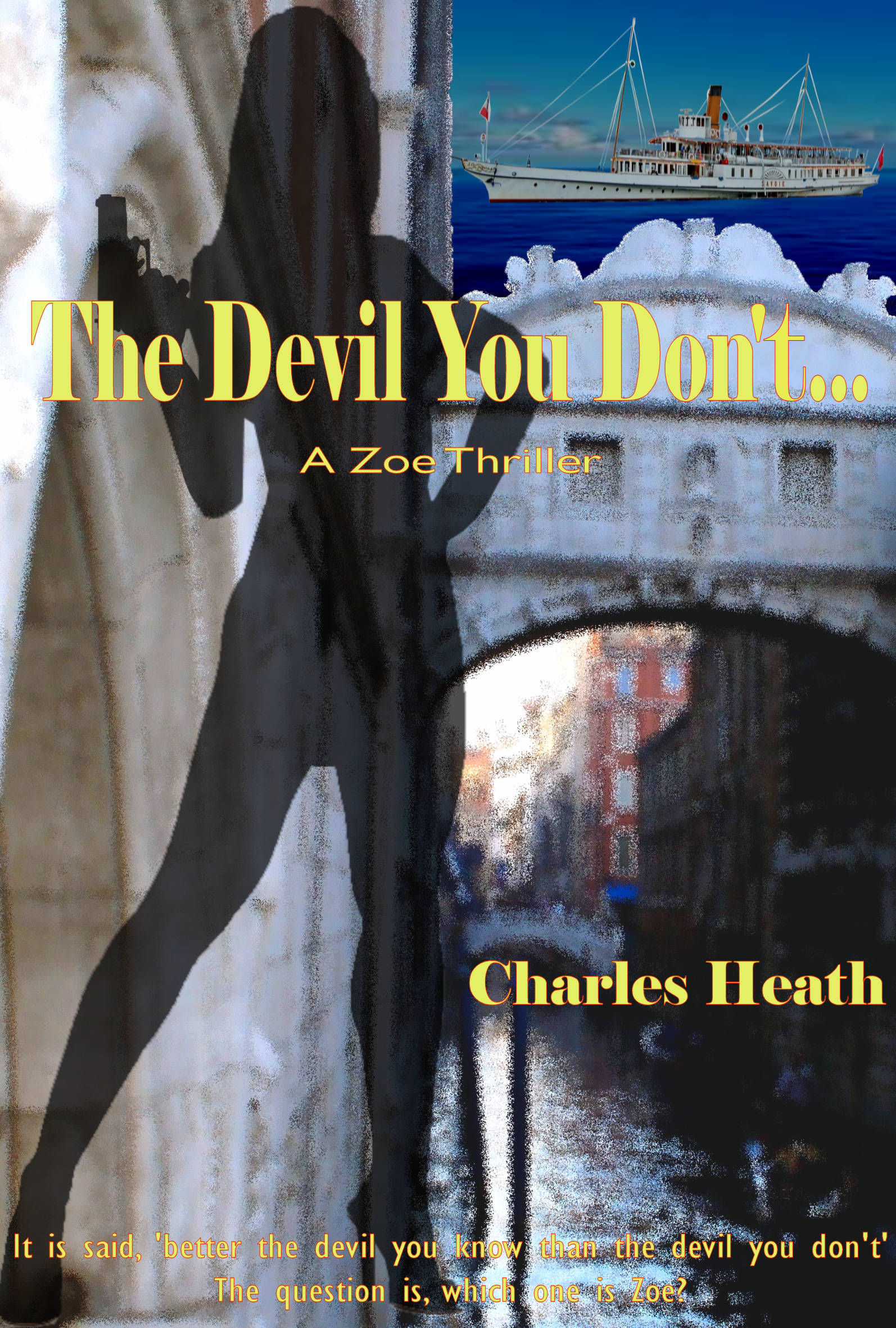
‘The Devil You Don’t’ – A beta reader’s view

It could be said that of all the women one could meet, whether contrived or by sheer luck, what are the odds it would turn out to be the woman who was being paid a very large sum to kill you.

John Pennington is a man who may be lucky in business, but not so lucky in love. He has just broken up with Phillipa Sternhaven, the woman he thought was the one, but relatives and circumstances, and perhaps because she was a ‘princess’, may also have contributed to the end result.

So, what do you do when you are heartbroken?

That is a story that slowly unfolds, from the first meeting with his nemesis on Lake Geneva, all the way to a hotel room in Sorrento, where he learns the shattering truth.

What should have been solace after disappointment, turns out to be something else entirely, and from that point, everything goes to hell in a handbasket.

He suddenly realizes his so-called friend Sebastian has not exactly told him the truth about a small job he asked him to do, the woman he is falling in love with is not quite who she says she is, and he is caught in the middle of a war between two men who consider people becoming collateral damage as part of their business.

The story paints the characters cleverly displaying all their flaws and weaknesses. The locations add to the story at times taking me back down memory lane, especially to Venice where, in those back streets I confess it’s not all that hard to get lost.

All in all a thoroughly entertaining story with, for once, a satisfying end.

Available on Amazon here: https://amzn.to/2Xyh1ow

In a word: While

How long is a piece of string?

Yes, that’s the meaning of the word while.

Simply because I want you to wait here while I go down the shops.

How long will that be?

I don’t know.  A while.  Anything from half an hour to a lifetime.

Then there’s another way of using the word:  While I do this can you do that.

This is more definite but still ambiguous.  How long will that be?

As long as it takes.  Anything from half an hour to a lifetime.

it is by definition, a period of time.

Then it gets more ambiguous, in that the arrangements say in place while he is alive.

Being a murder mystery writer and reader, it becomes a sufficient reason to kill a wealthy relative to get their inheritance.  But, if murder is not in mind, then it can be anything from a half-hour to a lifetime!

Less of an enigma is this use of the word:  I’m going the while away the time playing computer games.

At least you know how long that’s going to be, i.e. till you get bored.

This is not to be confused with the word wile, which means to use a cunning or devious means to get someone to do your bidding.

We’ve all heard of feminine wiles.  Granddaughters are experts in using them, I can personally attest to that.

There are other meanings but these are no longer used in modern English.

An excerpt from “Betrayal” – a work in progress

It could have been anywhere in the world, she thought, but it wasn’t.  It was in a city where if anything were to go wrong…

She sighed and came away from the window and looked around the room.  It was quite large and expensively furnished.  It was one of several she had been visiting in the last three months.

Quite elegant too, as the hotel had its origins dating back to before the revolution in 1917.  At least, currently, there would not be a team of KGB agents somewhere in the basement monitoring everything that happened in the room.

There was no such thing as the KGB anymore, though there was an FSB, but such organisations were of no interest to her.

She was here to meet with Vladimir.

She smiled to herself when she thought of him, such an interesting man whose command of English was as good as her command of Russian, though she had not told him of that ability.

All he knew of her was that she was American, worked in the Embassy as a clerk, nothing important, whose life both at work and at home was boring.  Not that she had blurted that out the first they met, or even the second.

That first time, at a function in the Embassy, was a chance meeting, a catching of his eye as he looked around the room, looking, as he had told her later, for someone who might not be as boring as the function itself.

It was a celebration, honouring one of the Embassy officials on his service in Moscow, and the fact he was returning home after 10 years.  She had been there once, and still hadn’t met all the staff.

They had talked, Vladimir knew a great deal about England, having been stationed there for a year or two, and had politely asked questions about where she lived, her family, and of course what her role was, all questions she fended off with an air of disinterested interest.

It fascinated him, as she knew it would, a sort of mental sparring as one would do with swords if this was a fencing match.

They had said they might or might not meet again when the party was over, but she suspected there would be another opportunity.  She knew the signs of a man who was interested in her, and Vladimir was interested.

The second time came in the form of an invitation to an art gallery, and a viewing of the works of a prominent Russian artist, an invitation she politely declined.  After all, invitations issued to Embassy staff held all sorts of connotations, or so she was told by the Security officer when she told him.

Then, it went quiet for a month.  There was a party at the American embassy and along with several other staff members, she was invited.  She had not expected to meet Vladimir, but it was a pleasant surprise when she saw him, on the other side of the room, talking to several military men.

A pleasant afternoon ensued.

And it was no surprise that they kept running into each other at the various events on the diplomatic schedule.

By the fifth meeting, they were like old friends.  She had broached the subject of being involved in a plutonic relationship with him with the head of security at the embassy.  Normally for a member of her rank, it would not be allowed, but in this instance it was.

She did not work in any sensitive areas, and, as the security officer had said, she might just happen upon something that might be useful.  In that regard, she was to keep her eyes and ears open and file a report each time she met him.

After that discussion, she got the impression her superiors considered Vladimir more than just a casual visitor on the diplomatic circuit.  She also formed the impression that he might consider her an ‘asset’, a word that had been used at the meeting with security and the ambassador.

It was where the word ‘spy’ popped into her head and sent a tingle down her spine.  She was not a spy, but the thought of it, well, it would be fascinating to see what happened.

A Russian friend.  That’s what she would call him.

And over time, that relationship blossomed, until, after a visit to the ballet, late and snowing, he invited her to his apartment not far from the ballet venue.  It was like treading on thin ice, but after champagne and an introduction to caviar, she felt like a giddy schoolgirl.

Even so, she had made him promise that he remain on his best behaviour.  It could have been very easy to fall under the spell of a perfect evening, but he promised, showed her to a separate bedroom, and after a brief kiss, their first, she did not see him until the next morning.

So, it began.

It was an interesting report she filed after that encounter, one where she had expected to be reprimanded.

She wasn’t.

It wasn’t until six weeks had passed when he asked her if she would like to take a trip to the country.  It would involve staying in a hotel, that they would have separate rooms.  When she reported the invitation, no objection was raised, only a caution; keep her wits about her.

Perhaps, she had thought, they were looking forward to a more extensive report.  After all, her reports on the places, and the people, and the conversations she overheard, were no doubt entertaining reading for some.

But this visit was where the nature of the relationship changed, and it was one that she did not immediately report.  She had realised at some point before the weekend away, that she had feelings for him, and it was not that he was pushing her in that direction or manipulating her in any way.

It was just one of those moments where, after a grand dinner, a lot of champagne, and delightful company, things happen.  Standing at the door to her room, a lingering kiss, not intentional on her part, and it just happened.

And for not one moment did she believe she had been compromised, but for some reason she had not reported that subtle change in the relationship to the powers that be, and so far, no one had any inkling.

She took off her coat and placed it carefully of the back of one of the ornate chairs in the room.  She stopped for a moment to look at a framed photograph on the wall, one representing Red Square.

Then, after a minute or two, she went to the mini bar and took out the bottle of champagne that had been left there for them, a treat arranged by Vladimir for each encounter.

There were two champagne flutes set aside on the bar, next to a bowl of fruit.  She picked up the apple and thought how Eve must have felt in the garden of Eden, and the temptation.

Later perhaps, after…

She smiled at the thought and put the apple back.

A glance at her watch told her it was time for his arrival.  It was if anything, the one trait she didn’t like, and that was his punctuality.  A glance at the clock on the room wall was a minute slow.

The doorbell to the room rang, right on the appointed time.

She put the bottle down and walked over to the door.

A smile on her face, she opened the door.

It was not Vladimir.  It was her worst nightmare.

© Charles Heath 2020

The cinema of my dreams – I always wanted to go on a treasure hunt – Episode 18

Here’s the thing…

Every time I close my eyes, I see something different.

I’d like to think the cinema of my dreams is playing a double feature but it’s a bit like a comedy cartoon night on Fox.

But these dreams are nothing to laugh about.

Once again there’s a new instalment of an old feature, and we’re back on the treasure hunt.


The pier had been moving gently up and down in response to a passing speed boat that had flouted the minimum speed law, like most of the speed boat owners.

On board the boat, the movement was more pronounced, and it was a bad time to remember that I get seasick, even standing on the pier.  My stomach was suddenly queasy.

Boggs was standing by the hatch that led down below.  It was locked with a big padlock so there was no way we were getting below.  Along the side of the boat was a raised section with windows, but there were curtained off, and the material was faded and looked dirty.

Boggs walked along the narrow walkway to the bow and tried the hatch in the middle of the foredeck.

I noticed the boat was tied to the pier fore and aft with some think rope and funny looking knots.  I don’t think I’d make a very good sailor.  I looked up to the top of the mast and it made me feel dizzy.  It was a long way up.

Behind me was an area where people could seat, and further back a large wheel which I assumed was how the boat was steered.  I could just see Rico standing behind it, captain’s hat on, looking all business-like.

“There’s nothing to see here,” I said, turning back towards Boggs, who was now coming along the other side of the cabin.  One slip and he’d be in the ocean.  I looked over the side and it didn’t look very deep.  I could even see some small fish swimming near the pylon that was covered below the waterline with seaweed.

Boggs stopped at the last window, then knelt down and peered in.

“What do you see?”

“There’s someone in there?”

“Rico?”

“No.  I saw him leave earlier.  Someone else.”

“You know who it is?”

“No.  Never seen him before.  A guy in a suit.  Not the sort of person I’d expect Rico to know, or have as a friend.”

“What’s he doing?”

Boggs changed his position to get a better look.  “He’s just sitting…oh my God, there’s blood.”

“Where?”

I moved quickly over to where Boggs was crouched.  “Give us a look?”  Curiosity was overtaking concern.

“Oh my God, oh my God,” Boggs said over and over.

I pulled out my phone and dialled 911.  When they asked me who I wanted, I said Police.  Then I looked over at the fishing shop and saw Rico and his friends coming back.

“Boggs.”

He ignored me, trying to get a better view.

“Boggs.  It’s Rico.”

Then the policeman answered, “What’s the nature of your emergency?”

“Dead man on a boat, Eden’s Landing, Pier 5, a boat called ‘Freedom Runner’.  And you’d better hurry.”

“Why?”

“Because the owners coming and he doesn’t look happy.”

Then to Boggs, “We got to get the hell out of here, now.”

But, by that time, there was nowhere to go.  Rico had seen us and was all but running to cut off our escape.


© Charles Heath 2019

The cinema of my dreams – I never wanted to go to Africa – Episode 42

Our hero knows he’s in serious trouble.

The problem is, there are familiar faces and a question of who is a friend and who is foe made all the more difficult because of the enemy, if it was the enemy, simply because it didn’t look or sound or act like the enemy.

Now, it appears, his problems stem from another operation he participated in, and because of it, he has now been roped into what might be called a suicide mission.

I was not sure how the Congo commander was going to react when four cars with people who looked more like mercenaries than a film crew turned up at the front gate.

Not that we had the film equipment to use as a cover. I guess that was the reason the kidnappers had removed it from our cars. One less reason to believe our story. I would have been curious to hear just how the commander had described us to his Congo counterpart.

Or what sort of treatment we were going to get. I don’t think the hostages were going to like the idea of becoming hostages again, albeit with a new set of ransom demands, and probably a lot of harsher treatment. Mercenaries could be rough, but they needed resources, and trying to negotiate with overly damaged goods wouldn’t set much of an example.

The Government military, on the other hand, would not be too particular. And capturing an invading enemy force, spies if you will, well, that was going to be a feather in the cap of the airfield commander.

But would he tip his hand at the gate or wait till we pulled up outside the headquarters building. If there was one.

We were about to find out. The gate was in sight and flanked by two very bright lights which we had all seen for about the last half mile, flickering through the undergrowth. The road was well made, and we would have made good time, but I deliberately slowed down to give Monroe time to get into place.

Another brief report from the Colonel told me they reckoned on 20 troops deployed at different parts of the field, just in case we decided to ‘sneak’ in on foot.

At the gate the road widened into a large turning circle for turning back cars.

I stopped right on top of the gate. A non-commissioned officer came out of a small shack by the gate and joined two men standing either side of the gate. Weapons weren’t pointed in our direction, but that could change quickly.

I was going with the film crew going home story first.

“Who are you?” I noticed the officer had a clipboard and made a show of looking at it, and the page underneath. “You are not on my list.”

“Probably not. We have been filming a documentary, and it’s time to go home. We have an aircraft coming in tomorrow morning to pick us up.”

One of the guards came through the gate and went down one side of each car, then came back up the other side, peering in through the windows. Back at the gate, he spoke to the officer.

“You have weapons. That is unusual for a film crew isn’t it?”

Highly, if we were anywhere else in the world. “We were warned about militias. Luckily we didn’t run into any.”

“Then, before you enter the airfield I suggest you, and your men, surrender any weapons.”

“Of course.” I relayed the instruction back through the cars. The soldier then came down the car and collected the weapons in a bag. As I’d assumed, we were not going to gain admission to the airstrip armed. It was probably also a law which in any country made perfect sense.

Once the soldier returned the officer had the gate opened, and came over to me.

“Fill in the form, and we’ll get you on your way soon enough.”

He handed me the clipboard, and then stepped away, taking out a radio unit of his own and spoke into it in a language I didn’t understand. Perhaps we should have kept Jacobi with us for a little longer so he could interpret.

When I filled out the form and handed it back, he said, “Drive up the road about a half-mile to a hanger and park your cars out the front. I suggest when getting out of the cars not to make any sudden or suspicious moves.”

Like we’d been told almost word for word back at the commander’s camp. Interesting.

The men at the gate didn’t follow us, but I did see, coming from two separate points back from the runway, or what looked to be the runway, two groups of five soldiers in each, in a proper formation. That was not the actions of a motley militia.

Serious soldiers perhaps.

It didn’t take long to reach the hanger, quite large, but in a sorry state of repair. Beside it was two old army huts that were in better repair and lit up. At the top of the steps of one stood the commander, a Captain. Clean, fresh, snug-fitting uniform, looking the part. Newly promoted, with something to prove.

With him were another six soldiers, armed and ready. That made 16 plus him. Where were the others?

Another non-commissioned officer came out of the hut and briefly spoke to his commander. Then he went back inside, and the commander came down the stairs to greet me. The rest of the team stood together, in front of the third car, and about 20 feet away. They were trying their best to cover the two hostages.

“Good evening Mr. James.” Reasonably good English, polite, but there was a slight edge to his tone.

“Good evening.”

“May I ask, which way do you come?”

“From Faradje, on the way to Nagero. I was going to drive into Nagero but changed my mind. Best to get here and be ready.”

“I heard there were some elements of the militia on the road. Did you meet any?”

“No. I was told that this country is quite safe and that we would not be harmed, thanks, I’m told to the good services of the Government’s military. You will be pleased to learn that it is quite safe, a point I will be spreading when I return home. Hopefully that will bring in more tourists.”

“If, as you say, you’ve been making a documentary, it seems odd to me that on one hand, you don’t have any equipment, and on the other, that you have not included Garamba.”

“A valid observation. We had to call the shooting off because two of our crew are ill and need to be returned home, and we left the equipment back in Faradje, our last stop, ready for the replacement crew who will be scheduled to fly in, in the next week or so.”

I had considered what I might say and tried to make it sound plausible, but in the end I don’t think it mattered what I said, especially if the other commander had forewarned the Captain of our impending arrival.

“Yes. That may be true, or it might not. I’m assuming the two sick members of your team are over next to the film crew. In that case, I believe both of us know that those men do not belong to your crew, but are escaped prisoners.”

He gestured towards his men and they went over to the group and extracted the two hostages.

Seemingly it was game over.

“So Commander Ntumba called you after we left?”

“Not a lot happens here without my knowing it. It was in his best interest to inform me.”

Something in the distance caught his eye, and I moved my line of sight to match his. Shurl, hands in the air, with two more soldiers behind him, coming from the bush line on the other side of the runway.

Commander Ntumba would also have told him about our sniper, as I’d surmised, and there was no mistaking the look of glee on his face. Outsmarting what he would consider a crack team of mercenaries from the United States.

I turned back and shrugged.

“Yes, he also told us about your sniper Mr. James. You didn’t think he was going to sneak up on us like he did Commander Ntumba did you?”

“It was worth a try,” I said in my best-defeated tone.

“Right. For the time being you will be kept in detention until I speak to my commander. You will not be leaving this airport. Your rescue plane, when it arrives, will be detained. I will have further questions for you later. Film crew indeed. Take them to B Block,” he said to the officer, then headed back up the stairs to his office.

As far as he was concerned, it had been all too easy.

© Charles Heath 2020
A photograph from the inspirational bin – 7

There is always something strange about certain photographs that is not evident when you take them.

For instance, the photograph above.

While this might look like some vegetation by the side of a river or stream, its that are of blackness behind what looks like steps up from the water level that adds a level of intrigue or mystery.

For instance:

We had spent two weeks slowly going upriver looking for a needle in a haystack. It was an apt description, because there had been quite a large number of likely spots, all of which after investigation, came to nothing.

I mean, the description Professor Bates had given is was as hazy as day is long in these parts.

His recollection: that it was what looked like a cave behind lush undergrowth, with steps fashioned out of stone.

It was all the more confuse. Because when we found him, he was drifting on a rough hewn and constructed raft, half dead from dehydration. We were told he’d been on the raft for nearly a week.

That meant the cave could be anywhere between where we found him at the 10 mile mark, and 200 miles further on based on river flow.

We were currently at the 150 mile mark and the river was losing depth and width, and soon there would not be enough water to continue in the boat.

It was dusk and too dark to continue. We’d been enthusiastic those first days, continuing on in the dark, on shifts, using the arc lamps.

Then after a week, having lights on made us target practise, and after sever brushes with death, and the loss of all the bulbs being shot out, we got the message.

There was the odd marauder during the day, but we had the width of the river for safety.  Now that had gone too, and we had lookouts posted, but seeing into the dense jungle was difficult.

But we got through another night with no activity, and come morning, what looked like the entrance to a cave was not fifteen feet from us.

All we had to was row over and check.

© Charles Heath 2020-2021

“The Enemy Within” – the editor’s third draft – Day 10

This book has been sitting in the ‘to-be-done’ tray, so this month it is going to get the final revision.

And so it begins…

Like I said, Day 8 was going to come back and bite

And, did it ever.

It’s got a lot to do with this fly-by-the-seat-of-your-pants thing. It’s fine writing a story making it up as you go, without an official plan. If the ideas keep flowing.

But when revising it’s easy to see the plot holes or potholes maybe, and I just fell in one.

So, going back to the start…

Were in Venice … did I tell you I love Venice … where the story starts.

It’s that age-old premise, a mission that’s blown before the agent left home base.

The mission is simple: a retired agent is pulled back into the field for one last job at the request of a very important asset in the field, to bring them out of the cold.

Our new agent, whose mentor is being recalled, is assigned to back his mentor up, without his knowledge, as a precaution. Why the secrecy is not explained.

That’s the premise, and only became clear when I reached Day 10.

Day 11 promises to be a lot more interesting now.

Searching for locations: Florence, Italy

Florence is littered with endless statues, and we managed to see quite a few,

If those statues came to life I wonder what they might tell us?

Like castles on the shores of the Rhine, there are only so many statues you can take photos of.  Below are some of those I thought significant

2013-06-17 09.16.14

Michelangelo’s David directs his warning gaze at someone else.

2013-06-17 09.16.24

The impressive muscles of Baccio Bandinelli’s Hercules from 1533. The worked-out demi-god is pulling the hair of Cacus, who will be clubbed and strangled.

2013-06-17 09.17.13

Achilles with Polyxena in arm, stepping over her brother’s body

2013-06-17 09.18.08

Menelaus supporting the body of Patroclus, in the Loggia dei Lan

2013-06-17 09.18.28

Statue of Hercules killing the Centaur by Giambologna in Loggia dei Lanzi. Piazza della Signoria.

On the back of the Loggia there are six marble female statues, probably coming from the Trajan’s Foro in Rome, discovered in 1541 and brought to Florence in 1789

There ain’t no mountain high enough

If only it was as easy to write one line of a song as it is to write a sentence, a paragraph, or a page of a book.  Of course, if you were to ask a songwriter the same question, he or she would probably twist it around, and not without reason.

The bottom line in all scenarios, whether writing a story, writing a song, or writing a letter, at times it feels like it is like climbing a mountain.

It’s why we have waste paper bins, and imaginary shooting practice sessions.  By the way, I don’t get very many scrunched paper balls in.

Curiously, we seem to categorize almost insurmountable problems in terms of climbing mountains.  Of course, I’ve yet to attempt to climb the north face of Mount Everest, but I suspect I’ll have to do a lot of practice to do so.

Maybe that’s what I need to do as a writer.  Practice, not climbing mountains.

Mountains have always been part of the metaphor for overcoming obstacles.  So, metaphorically, to overcome this ‘obstacle’, we can choose to climb over it, blow it up, or tunnel through it.

But the salient point is the same in all cases, obstacles, metaphorical or not, are not insurmountable, they just need time to find a solution.

So, in my case, there are two items to note when it comes to mountains, the first, I prefer to go through a tunnel, and the second, there’s not a mountain I’ve been up that hasn’t had a magnificent view.  Of course, getting to the top has been easy, I just hopped on the tram or the gondola.

After all, isn’t that what they’re there for?

Ok, flippancy aside, I have had to climb a few mountains of my own over the years, and, yes, it’s hard work, and, at times, I’ve wanted to give up.

But, not today.  Today is a good day.

And as the title says, ‘There ain’t no mountain high enough!’