The cinema of my dreams – I always wanted to write a war story – Episode 37

For a story that was conceived during those long boring hours flying in a steel cocoon, striving to keep away the thoughts that the plane and everyone in it could just simply disappear as planes have in the past, it has come a long way.

Whilst I have always had a fascination with what happened during the second world war, not the battles or fighting, but in the more obscure events that took place, I decided to pen my own little sidebar to what was a long and bitter war.

And, so, it continues…

Johannsen hadn’t signed up for this. He’d been in the room when Leonardo reported to Wallace, to tell him that the villagers had been neutralised, and he brought the ring leaders of the so-called resistance to the castle.

By his reckoning, Leonardo and his men had killed probably 20 or so people who had nothing to do with the war, other than try to live around the war going on in their backyard.

In fact, when he had arrived at the castle, the intention was to work with the locals and the resistance to facilitate the onward movement of prized defectors. Until Jackerby arrived, and the dynamic changed.

Johannsen hadn’t realised that Wallace was a double agent, not until it was too late.

The thing of it was, Wallace thought he was a double agent too, a belief Johannsen had taken extreme care not to dispel. And, where it was possible, he had tried to help those caught up in Wallace’s trap.

Wallace was already in situ at the castle when Johannsen arrived with another four men to join those already there, on order from London to vet the incoming defectors. Those four he had met at the plane, and he hadn’t realised they were not who they were supposed to be. By the time the four who had been replaced were found, it was too late to stop the mission.

That brought the complement to 10 including Wallace and himself. Then he received a message, one he assumed was from Thompson, advising the arrival of a further 5, Jackerby and four soldiers.

He soon discovered that those orders were false.

When Jackerby reported to Wallace, and the fact Wallace sent him out of the room, he stayed behind, hidden, to listen to the conversation. There he discovered he was in the midst of an enemy operation that had enlisted a number of double agents across Euprope from the German Army.

He then tried to warn Thompson in a coded message, but that had been substituted by Wallace with another, causing another lamb to be sent to the slaughter, Atherton. When Jackerby first arrived, he advised Wallace, not Johannsson, that Atherton was not one of them, so an attempt was made on,his life, but failed.

For a while that was the equivalent of throwing a cat among the pigeons.

By the time the paratroopers arrived, there was no effort to hide who they were or what they were doing. The castle was, for all intents and purposes, a Nazi stronghold, there to collect and execute defectors. All he had to do was play his part, and try not to rouse the suspicions of Jackerby, whom, it seemed, trusted no one.

Wallace wasn’t all that interested in being as suspicious as Jackerby, who had to be gestapo, or worse, one of the SS.

But luck was on Johansson side when he took a plan to Wallace that would essentially free Atherton, and then have Atherton lead them to the other resistance. It was also a master stroke to select Burke, a simple man who liked to think everything was his idea.

That Atherton had got away was no fault of his, but those charged with following him. Jackerby had tried to mess with him, but Wallace intervened, telling Jackerby that he had had missing people too and should be out there looking for them.

With any luck, Johansson thought, they would be dead, a likely result since none of them had come back yet.
Now, all he could do was sit and wait for Atherton and whoever was left from the resistance to come and stop Wallace, and especially Jackerby.

Johansson knew that Atherton had a good working knowledge of the castle’s architecture, because on one occasion they had discussed archaeology. Johansson was not an archaeologist, but had worked with one and an assistant, before the war, at several digs.

He was hoping Atherton had a idea where there might be a secret entrance to the castle. It was old, and in his spare time, he had been pacing out room measurements, looking for nooks and crannies, and anything else that would be useful.

He had found a room full of swords, not exactly in fighting condition, but might be useful in a situation that called for a weapon. After all, he had taken a few sword fighting lessons at the university.

He had traversed several stone passageways, found two different passageways from the upstairs down to the radio room, and beyond that, where there was an exit or entrance, what in modern terminology would be called the tradesman’s entrance.

It was for all intents and purposes, a back door.

He had also gone around the whole perimeter of the outer castle wall, looking for holes. When he thought about it, leaving holes in the wall was asking for trouble because the idea was to keep people out, not to leave quickly and quietly in the middle of a siege.

And this castle had seen a few sieges in its time. More than once if he could travel back in time, he would have like to see what it was like 200 years ago, or more.

But there were only three entrances or exits that he knew of. There were no grates on the ground, or anywhere within 20 yards of the exterior wall, or conveniently hidden in the surrounding forests.

He was also sure there were hidden passageways inside the castle that must go somewhere, a result of checking internal measurements of rooms, and a few came up oddly short a few yards.

Still down in the dungeon on another of his subterfuges, the new arrivals guard had just appeared.

“The woman is awake.”

“Thanks.”

Now, if he could just get some sense out of her.

© Charles Heath 2020-2021

Writing about writing a book – Day 16

As we now know Bill realizes that he had been captured and interrogated by someone, ostensibly Chinese, but not exactly from the Viet Kong

I’ve been pondering how Bill ends up in the hands of the Chinese, well, I know how he does, and this needs to be put down.

Some pieces of the puzzle are coming together.

”’

Davenport arrived at the airstrip where I was waiting in a makeshift building, with windows, easy chairs, a self-serve bar, and best of all air conditioning.  Waiting for the chopper that was bringing in my replacement from Singapore airport.

He didn’t normally come to see us off so I thought it either odd or just a change of heart.  He had brought the shiny Cadillac, an ostentatious piece of Americana that never failed to capture the local’s imagination.

Davenport was, I soon discovered, a man who liked to impress upon the world how great America was.  I hadn’t the heart to tell him it failed on me.

He had crisp fatigues on and looked as though he had just stepped out of the shower, very clean, very cool, and very refreshed.  The car’s air-conditioning would have helped.  We all got that first ride from the strip to the camp in that car, and it was memorable, to say the least.

The driver stayed in the car, engine running, as he stepped into the lounge.  “Chandler.”

“Sir.”  No snapping to attention, neither of us was in uniform.

“There’s been a change of plans.”

“Sir.”  This didn’t sound very good.

“Your replacement is not coming.  Some trouble on the plane over.  Can’t spare a man so you will have to fill in.  I’m sorry.”

I went to say that I’d done my rotation, but the look on his face told me it would fall on deaf ears, so instead, I shrugged, let the driver, who had appeared out of the car as if on cue, collect my case, and followed Davenport out to the car.

It was definitely cooler in the car.  Davenport slid in the other side, the driver closing his door, then got in himself.  I had to close my own.  We headed back towards the camp slowly.

“We need 6 men for this op, Bill.  I’ll find some way of making this up to you.”

I shrugged.  “If you say so.”

I’d been looking forward to getting out of the jungle and getting back to civilization, as well as Ellen, who had been waiting patiently for the last six months.  She would not be very happy when I finally got to tell her.

“Oh, but the way, I took the liberty of calling your wife and apologizing on your behalf and said you’d probably be another week at the most.  She didn’t seem to mind.  She sounds like a nice lady.”

“She is.  She has to put up with me.”

“Yes.  We all have that problem.”

I listened to the hum of the air conditioning, the only other sound inside the car.  Usually, Davenport had a symphony playing over the radio, but not today.  He seemed different, more aloof, but, then, after the altercation, I had with him recently, we hadn’t spoken much after that.  Not unless we had to.

“The job isn’t difficult,” he said when we were nearing the compound.  “Another prison camp, and this time the intel is solid.  Buggers were careless and we’ve got some pictures.  The only problem is getting there.  It’s going to be a bit of a hike.”

Another of his understatements.  I could remember the last ‘bit of a hike’.  “When do we leave?”

“First light tomorrow.  Chopper to the drop zone then a day’s march to the camp.  RV at the drop zone from day 4 till you get there.”

“Who’s in charge?”  I’d run the last operation so I was hoping it would carry forward.

“If you’d been staying instead of being a last-minute replacement, it would have been you.  Instead, we had to bring in a couple of specialists who have been on the ground here quite some time.  They know the terrain and the people.”

New guys.  I hated new guys.  Especially those who purport to have experience on the ground.  Invariably they didn’t and I’d had words with Davenport more than once about it, especially when we had such a high attrition rate.  I believed it was only a miracle that I had lasted this long, and I was now tempting providence this time around.

“I hope they are better than the last two.”

“They are.  I picked them myself.  At least you will be there to keep them on the straight and narrow.

Which was exactly what I didn’t want.

Damn.

Back at the compound, I dragged myself back to my old quarters, hoping they hadn’t given away my billet just yet.  It was a hut if you could call it that, which had seen better days, but it kept the rain out.

I shared it with another soldier, or ex, I didn’t really know, and he was not the sort of man you asked, and even less talkative than most.  I knew his name was Barry McDougall, that he was Scottish, he didn’t wear a kilt and had killed men with his bare hands, one in a barroom fight.

Allegedly.

I was not surprised.  He was six feet six inches tall, all muscle, and always surly, and unlike many of the English that had come and gone, didn’t complain about the heat.

I dumped my bag on the locker at the end of the bed and sat in one of the two well worn easy chairs.  Barry was in the other, reading.

He lowered the paper and looked at me.  “Back, huh?”

“Yes.”

“Miss the chopper?”

“No.”

“Beer’s cold.”

“Thanks.”

I got up and went to the fridge.  One of the perks of the job.  An endless supply of cold beer.

“Get me one too.”

I did and passed it to him, the sat down again.  He took the beer and went back to his paper.

“Seen the new guys,” I asked.

A voice from behind the paper, “Yes.”

“Any good?”

“No.”

“Another fun run in the jungle then?”

“Looks like it.”

We drank in silence.  What more could be said?

There is more but I have to let the words jumble around in my head while I sleep.  More on this tomorrow!

© Charles Heath 2018-2023

Searching for locations: New York to Vancouver

The flight from Newark via Air Canada to Vancouver is about 5:30pm so we are slated to be picked up by the limousine at about 2:30.

We have to be out of our room by 11am so we decided the day before that on our last day in New York we’d go to the Times Square red lobster. It gives us about three hours to get there, eat, and get back.

It’s always fun packing bags the day you leave, so most of the hard work was done earlier. This time it’s particularly a trial because we have so much stuff to fit into a small space, and weight considerations are always paramount because of the 23kg limit.

Outside is has gone from minus four to minus two in the two hours before we leave the hotel at 11:30, but that’s not so much of a problem because we have a long walk from 56th street to 41st street to warm us up.

At least today it’s not as cold, as it has been previously.

At Red Lobster it’s not difficult to make a decision on what to have, the mix-and-match special, with Lobster alfredo, filet mignon, and parrot island coconut shrimp, with Walt’s special, though that will remain a surprise until it is served.

To drink, it was the Blue moon beer, wheat type.

For appetizers, we had scones that are supposedly bread but to me are dipped in garlic butter and baked like a scone. Australian style. They are absolutely delicious.

There is an expression a ‘one-drink screamer’ and we’ve got one, but the truth is the drinks are very lethal. Pure alcohol and ice with a touch of soda.

The meals at this Red Lobster are definitely better than those we had in Vancouver, except for the pasta with lobster I had which was little more than a tasteless congealed mess after it reached the table. This did not detract from the deliciously cooked and served seafood that accompanied it.

All in all, after such a great lunch and the thought of having to walk ten blocks the decision was unanimous to get a cab which took us back to the hotel by a rather interesting, if not exactly the most direct, route. I think the driver guessed we were tourists.

We are picked up at the hotel by a driver in a large Toyota which had enough space for 3 passengers and all our bags. The driver was chatty and being foreign, preferred soccer to the other traditional American sport. Don’t ask me how the conversation turned to sports, but we may have mentioned we went to the ice hockey.

At Newark airport, all I have room for is a glass of burned beer, whatever that means, though it has an odd taste, and a Samuel Adams 76 special which was rather tasty.

Today we are flying in a Boeing 787-9 Dreamliner with a maximum of 298 passengers in three classes.

It looks very new even though it is about 6 months old. It has seating of 3 x 3 x 3, and we are in row 19, just behind the premium economy cabin, and the closest to the front of the plane of all the Air Canada flights.

Engine startup is loud at the lower revolutions with the vibration going through the airframe. Like all planes, the flaps being extended, it is very noisy. All of the vibrations go away when the engines are up to speed. On take off the engines at max are not as noisy as other planes and are relatively quiet. It will be interesting to see what the landing is like.

In-flight when not experiencing turbulence the ride is very smooth and reasonably quiet which is better than the other planes with seeming continuous engine whining and the flow of air past the fuselage.

The seats are comfortable but still just a little small and the middle passenger can be tightly squeezed in if the two on either side are larger than normal. The seats fully recline but the seatback is not completely in your face, and bearable when you recline your own seat.

There are several seats by the toilets that would be terrible on a long-distance flight because the passenger inevitably comes very close to the seat when entering and leaving. As for the toilets, they are larger than any of the other aeroplanes, and so too, coincidentally, are the windows.

The plane also makes the same amount of noise when it lands so I’m failing to see what’s so good about it. I’ve also been in an Airbus A350 and those planes are nothing to write home about either.

I suspect the only advantage of having planes is for airlines. Fewer costs and more sardined passengers.

It’s something else I can write off my bucket list.

When we arrive back in Vancouver it’s the same reasonably simple process to get through immigration.

Outside our driver is waiting and this time we have an Escalade picking us up. A very large SUV that fits us all and our luggage.

But…

We were lucky because we were supposed to be picked up in a sedan and the baggage would not have fitted which would have involved one of us taking a cab with the extra luggage.

He was in the neighbourhood and picked up the call. His advice, called the service and request a bigger car and pay the difference. We did. It was going to cost another 20 dollars.

As for the hotel, what is it with hotels and late-night arrivals? We get in, the check-in was smooth, we get to the room. Very large with a separate bedroom. But only a sofa bed.

It was not a desirable option, not before 24 hours in relatively squashed plane seats, so it necessitated a change of rooms to one a bit smaller, but a corner room with a reasonable view, and two proper beds.

Late night, need rest, but we have free breakfast so there will be no tarrying the next morning. We have to be down by 9am being Sunday.

Besides, we have a mission. There is a toys-are-us nearby and it does have the toy we want. All we need to find is a cab.

“Strangers We’ve Become” – Countdown to publishing in 8 Days

So what’s been happening?

Surveillance is in full swing, both at home and at the external office.

David discovers that Susan has a stepbrother, firstly by overhearing a conversation at the external office where works as the architect of the Russian palace rebuild, a man he has seen before.

He has a rather interesting name, was born in East Berlin to the same father, and different mothers, and has to go on a field trip.

David can see an opportunity to talk to him and follows him to France.

But, someone else is there which takes him very much by surprise and injects a sinister undertone to the visit.  Not everything is as it seems.

It’s also a chance to interrogate one of the new security team, accompanying him on his field trip, one that yields some very interesting information about the leader of the security team, and not-so-good news for the bodyguard.

When David returns, Alisha is discharged from the hospital and insists on helping David with the surveillance of the external office.

They are ensconced in a hotel room opposite the office, and her closeness brings problems for David of a different sort.

More is learned about why the new security team recommended by Prendergast is at Susan’s, and what might need to be done to help get rid of them, sooner rather than later; something that involves an estranged wife and missing daughter.

But just how are all of these titbits of information and characters connected, in what David no doubt believes is another of Prendergast’s elaborate schemes.

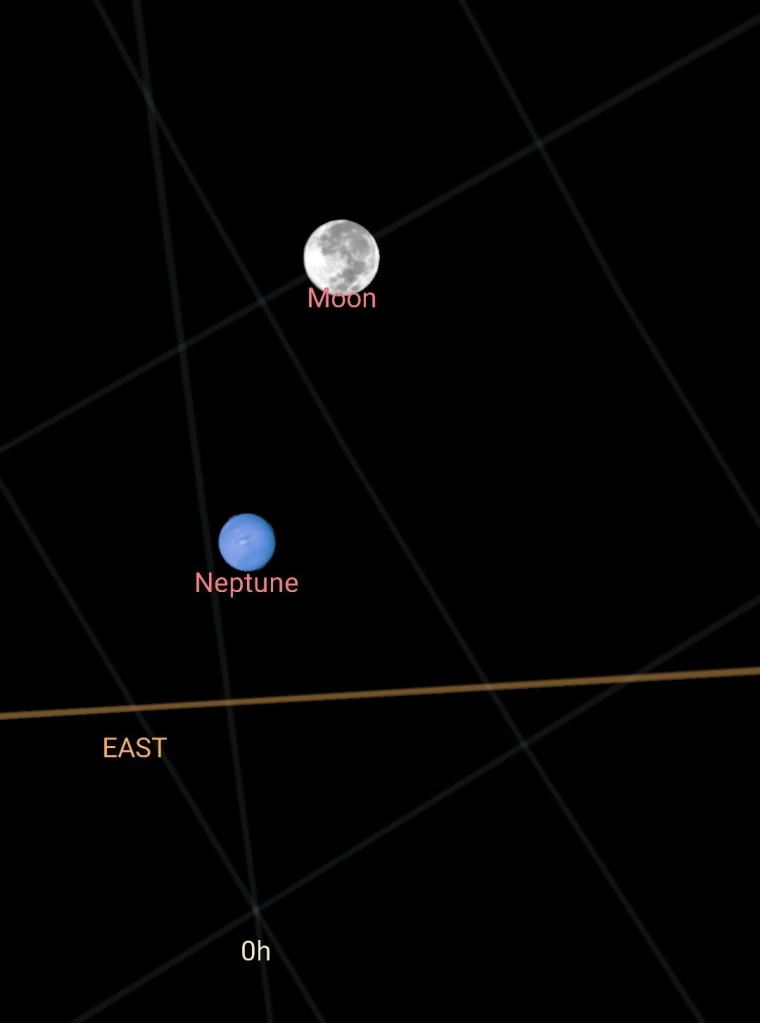
Another night of stargazing…

And this is what I found:

Neptune.

It got me thinking.

Why did we name the planets after mythological gods?

I did a little digging and found that the Romans named the five closest planets to the sun after their most important gods, this one, named after the god of the sea, which to the Romans was Poseidon, but in translation, Neptune, and matbe because it was ‘blue’.

Of course, we all know about King Neptune.

We also know about Poseidon, which was the fictional ship that got hit by a tidal wave, and was turned into a blockbuster movie.

But in terms of science fiction, which is not what I write, but I seem to spend a lot of time watching, it strikes me that seeing the moon, we could assume that the moon could be a stopping off point on a trip to the pouter planets.

I’m always surprised at the ingenuity of ‘Sci Fi’ writers in how they can turn what is scientifically impossible to live on but not necessarily impossible to get there (after a long sleep), into a place where we can destroy with equal rapaciousness as our own planet.

If I was going to write something, perhaps it would be about turning the planet into a holiday resort, staffed by robots…

Uh oh, that’s reminiscent of another ‘Sci Fi’ series. I’ll let you guess what it is.

In a word: Under

Under by itself is a rather boring word, you know, under the moon, under the sea, under the influence, which is not hard to be if you’ve been hypnotised or after a few drinks.

Under is anything beneath something else.

But let’s add it to some other words like,

Underrated, which means it is better than what others give it credit for.

Underwear is what you would wear underneath your clothes.

An understudy is a person who takes over a lead role when the lead is incapacitated. And how many understudies are guilty of harming the lead, in order to get a big break?

And not get away with it?

Understood, an agreement that might or might not be in writing that something will happen, that is, it is understood that I will be the next president.

Or not. Who on earth would really want to be president of anything?

So in the spirit of trying to confuse everyone all of the time, I have a conundrum in the form of a question, what is the difference between under and underneath?

To me there is none, you can be under the sea or underneath the sea, or under the table or underneath the table, but then there’s another, you can be under the influence but not underneath the influence, though technically you could, if you wanted to use confusing English.

And, just to add to the confusion further, I can say that the submarine sailed under the sea, underneath the sea, but, in actual fact, it doesn’t.

What is under the sea is the sand, or sea bed, and a submarine does not plough its way through the sand, does it?

What we really should be saying is that a submarine moves through the water.

Just saying…

“The Devil You Don’t”, she was the girl you would not take home to your mother!

Now only $0.99 at https://amzn.to/2Xyh1ow

John Pennington’s life is in the doldrums. Looking for new opportunities, and prevaricating about getting married, the only joy on the horizon was an upcoming visit to his grandmother in Sorrento, Italy.

Suddenly he is left at the check-in counter with a message on his phone telling him the marriage is off, and the relationship is over.

If only he hadn’t promised a friend he would do a favour for him in Rome.

At the first stop, Geneva, he has a chance encounter with Zoe, an intriguing woman who captures his imagination from the moment she boards the Savoire, and his life ventures into uncharted territory in more ways than one.

That ‘favour’ for his friend suddenly becomes a life-changing event, and when Zoe, the woman who he knows is too good to be true, reappears, danger and death follow.

Shot at, lied to, seduced, and drawn into a world where nothing is what it seems, John is dragged into an adrenaline-charged undertaking, where he may have been wiser to stay with the ‘devil you know’ rather than opt for the ‘devil you don’t’.

newdevilcvr6

The cinema of my dreams – I never wanted to go to Africa – Episode 42

Our hero knows he’s in serious trouble.

The problem is, there are familiar faces and a question of who is a friend and who is foe made all the more difficult because of the enemy, if it was the enemy, simply because it didn’t look or sound or act like the enemy.

Now, it appears, his problems stem from another operation he participated in, and because of it, he has now been roped into what might be called a suicide mission.

I was not sure how the Congo commander was going to react when four cars with people who looked more like mercenaries than a film crew turned up at the front gate.

Not that we had the film equipment to use as a cover. I guess that was the reason the kidnappers had removed it from our cars. One less reason to believe our story. I would have been curious to hear just how the commander had described us to his Congo counterpart.

Or what sort of treatment we were going to get. I don’t think the hostages were going to like the idea of becoming hostages again, albeit with a new set of ransom demands, and probably a lot of harsher treatment. Mercenaries could be rough, but they needed resources, and trying to negotiate with overly damaged goods wouldn’t set much of an example.

The Government military, on the other hand, would not be too particular. And capturing an invading enemy force, spies if you will, well, that was going to be a feather in the cap of the airfield commander.

But would he tip his hand at the gate or wait till we pulled up outside the headquarters building. If there was one.

We were about to find out. The gate was in sight and flanked by two very bright lights which we had all seen for about the last half mile, flickering through the undergrowth. The road was well made, and we would have made good time, but I deliberately slowed down to give Monroe time to get into place.

Another brief report from the Colonel told me they reckoned on 20 troops deployed at different parts of the field, just in case we decided to ‘sneak’ in on foot.

At the gate the road widened into a large turning circle for turning back cars.

I stopped right on top of the gate. A non-commissioned officer came out of a small shack by the gate and joined two men standing either side of the gate. Weapons weren’t pointed in our direction, but that could change quickly.

I was going with the film crew going home story first.

“Who are you?” I noticed the officer had a clipboard and made a show of looking at it, and the page underneath. “You are not on my list.”

“Probably not. We have been filming a documentary, and it’s time to go home. We have an aircraft coming in tomorrow morning to pick us up.”

One of the guards came through the gate and went down one side of each car, then came back up the other side, peering in through the windows. Back at the gate, he spoke to the officer.

“You have weapons. That is unusual for a film crew isn’t it?”

Highly, if we were anywhere else in the world. “We were warned about militias. Luckily we didn’t run into any.”

“Then, before you enter the airfield I suggest you, and your men, surrender any weapons.”

“Of course.” I relayed the instruction back through the cars. The soldier then came down the car and collected the weapons in a bag. As I’d assumed, we were not going to gain admission to the airstrip armed. It was probably also a law which in any country made perfect sense.

Once the soldier returned the officer had the gate opened, and came over to me.

“Fill in the form, and we’ll get you on your way soon enough.”

He handed me the clipboard, and then stepped away, taking out a radio unit of his own and spoke into it in a language I didn’t understand. Perhaps we should have kept Jacobi with us for a little longer so he could interpret.

When I filled out the form and handed it back, he said, “Drive up the road about a half-mile to a hanger and park your cars out the front. I suggest when getting out of the cars not to make any sudden or suspicious moves.”

Like we’d been told almost word for word back at the commander’s camp. Interesting.

The men at the gate didn’t follow us, but I did see, coming from two separate points back from the runway, or what looked to be the runway, two groups of five soldiers in each, in a proper formation. That was not the actions of a motley militia.

Serious soldiers perhaps.

It didn’t take long to reach the hanger, quite large, but in a sorry state of repair. Beside it was two old army huts that were in better repair and lit up. At the top of the steps of one stood the commander, a Captain. Clean, fresh, snug-fitting uniform, looking the part. Newly promoted, with something to prove.

With him were another six soldiers, armed and ready. That made 16 plus him. Where were the others?

Another non-commissioned officer came out of the hut and briefly spoke to his commander. Then he went back inside, and the commander came down the stairs to greet me. The rest of the team stood together, in front of the third car, and about 20 feet away. They were trying their best to cover the two hostages.

“Good evening Mr. James.” Reasonably good English, polite, but there was a slight edge to his tone.

“Good evening.”

“May I ask, which way do you come?”

“From Faradje, on the way to Nagero. I was going to drive into Nagero but changed my mind. Best to get here and be ready.”

“I heard there were some elements of the militia on the road. Did you meet any?”

“No. I was told that this country is quite safe and that we would not be harmed, thanks, I’m told to the good services of the Government’s military. You will be pleased to learn that it is quite safe, a point I will be spreading when I return home. Hopefully that will bring in more tourists.”

“If, as you say, you’ve been making a documentary, it seems odd to me that on one hand, you don’t have any equipment, and on the other, that you have not included Garamba.”

“A valid observation. We had to call the shooting off because two of our crew are ill and need to be returned home, and we left the equipment back in Faradje, our last stop, ready for the replacement crew who will be scheduled to fly in, in the next week or so.”

I had considered what I might say and tried to make it sound plausible, but in the end I don’t think it mattered what I said, especially if the other commander had forewarned the Captain of our impending arrival.

“Yes. That may be true, or it might not. I’m assuming the two sick members of your team are over next to the film crew. In that case, I believe both of us know that those men do not belong to your crew, but are escaped prisoners.”

He gestured towards his men and they went over to the group and extracted the two hostages.

Seemingly it was game over.

“So Commander Ntumba called you after we left?”

“Not a lot happens here without my knowing it. It was in his best interest to inform me.”

Something in the distance caught his eye, and I moved my line of sight to match his. Shurl, hands in the air, with two more soldiers behind him, coming from the bush line on the other side of the runway.

Commander Ntumba would also have told him about our sniper, as I’d surmised, and there was no mistaking the look of glee on his face. Outsmarting what he would consider a crack team of mercenaries from the United States.

I turned back and shrugged.

“Yes, he also told us about your sniper Mr. James. You didn’t think he was going to sneak up on us like he did Commander Ntumba did you?”

“It was worth a try,” I said in my best-defeated tone.

“Right. For the time being you will be kept in detention until I speak to my commander. You will not be leaving this airport. Your rescue plane, when it arrives, will be detained. I will have further questions for you later. Film crew indeed. Take them to B Block,” he said to the officer, then headed back up the stairs to his office.

As far as he was concerned, it had been all too easy.

© Charles Heath 2020

An excerpt from “One Last Look”: Charlotte is no ordinary girl

This is currently available at Amazon herehttp://amzn.to/2CqUBcz

I’d read about out-of-body experiences, and like everyone else, thought it was nonsense.  Some people claimed to see themselves in the operating theatre, medical staff frantically trying to revive them, and being surrounded by white light.

I was definitely looking down, but it wasn’t me I was looking at.

It was two children, a boy and a girl, with their parents, in a park.

The boy was Alan.  He was about six or seven.  The girl was Louise, and she was five years old.  She had long red hair and looked the image of her mother.

I remember it now, it was Louise’s birthday and we went down to Bournemouth to visit our Grandmother, and it was the last time we were all together as a family.

We were flying homemade kites our father had made for us, and after we lay there looking up at the sky, making animals out of the clouds.  I saw an elephant, Louise saw a giraffe.

We were so happy then.

Before the tragedy.

When I looked again ten years had passed and we were living in hell.  Louise and I had become very adept at survival in a world we really didn’t understand, surrounded by people who wanted to crush our souls.

It was not a life a normal child had, our foster parents never quite the sort of people who were adequately equipped for two broken-hearted children.  They tried their best, but their best was not good enough.

Every day it was a battle, to avoid the Bannister’s and Archie in particular, every day he made advances towards Louise and every day she fended him off.

Until one day she couldn’t.

Now I was sitting in the hospital, holding Louise’s hand.  She was in a coma, and the doctors didn’t think she would wake from it.  The damage done to her was too severe.

The doctors were wrong.

She woke, briefly, to name her five assailants.  It was enough to have them arrested.  It was not enough to have them convicted.

Justice would have to be served by other means.

I was outside the Bannister’s home.

I’d made my way there without really thinking, after watching Louise die.  It was like being on autopilot, and I had no control over what I was doing.  I had murder in mind.  It was why I was holding an iron bar.

Skulking in the shadows.  It was not very different from the way the Bannister’s operated.

I waited till Archie came out.  I knew he eventually would.  The police had taken him to the station for questioning, and then let him go.  I didn’t understand why, nor did I care.

I followed him up the towpath, waiting till he stopped to light a cigarette, then came out of the shadows.

“Wotcha got there Alan?” he asked when he saw me.  He knew what it was, and what it was for.

It was the first time I’d seen the fear in his eyes.  He was alone.

“Justice.”

“For that slut of a sister of yours.  I had nuffing to do with it.”

“She said otherwise, Archie.”

“She never said nuffing, you just made it up.”  An attempt at bluster, but there was no confidence in his voice.

I held up the pipe.  It had blood on it.  Willy’s blood.  “She may or may not have Archie, but Willy didn’t make it up.  He sang like a bird.  That’s his blood, probably brains on the pipe too, Archie, and yours will be there soon enough.”

“He dunnit, not me.  Lyin’ bastard would say anything to save his own skin.”  Definitely scared now, he was looking to run away.

“No, Archie.  He didn’t.  I’m coming for you.  All of you Bannisters.  And everyone who touched my sister.”

It was the recurring nightmare I had for years afterwards.

I closed my eyes and tried to shut out the thoughts, the images of Louise, the phone call, the visit to the hospital and being there when she succumbed to her injuries.  Those were the very worst few hours of my life.

She had asked me to come to the railway station and walk home with her, and I was running late.  If I had left when I was supposed to, it would never have happened and for years afterwards, I blamed myself for her death.

If only I’d not been late…

When the police finally caught the rapists, I’d known all along who they’d be; antagonists from school, the ring leader, Archie Bannister, a spurned boyfriend, a boy whose parents, ubiquitously known to all as ‘the Bannister’s, dealt in violence and crime and who owned the neighbourhood.  The sins of the father had been very definitely passed onto the son.

At school, I used to be the whipping boy, Archie, a few grades ahead of me, made a point of belting me and a few of the other boys, to make sure the rest did as they were told.  He liked Louise, but she had no time for a bully like him, even when he promised he would ‘protect’ me.

I knew the gang members, the boys who tow-kowed to save getting beaten up, and after the police couldn’t get enough information to prosecute them because everyone was too afraid to speak out, I went after Willy.  There was always a weak link in a group, and he was it.

He worked in a factory, did long hours on a Wednesday and came home after dark alone.  It was a half mile walk, through a park.  The night I approached him, I smashed the lights and left it in darkness.  He nearly changed his mind and went the long way home.

He didn’t.

It took an hour and a half to get the names.  At first, when he saw me, he laughed.  He said I would be next, and that was four words more than he knew he should have said.

When I found him alone the next morning I showed him the iron bar and told him he was on the list.  I didn’t kill him then, he could wait his turn, and worry about what was going to happen to him.

When the police came to visit me shortly after that encounter, no doubt at the behest of the Bannister’s, the neighbourhood closed ranks and gave me an ironclad alibi.  The Bannister’s then came to visit me and threatened me.  I told them their days were numbered and showed them the door.

At the trial, he and his friends got off on a technicality.  The police had failed to do their job properly, but it was not the police, but a single policeman, corrupted by the Bannisters.

Archie could help but rub it in my face.  He was invincible.

Joe Collins took 12 bullets and six hours to bleed out.  He apologized, he pleaded, he cried, he begged.  I didn’t care.

Barry Mills, a strong lad with a mind to hurting people, Archie’s enforcer, almost got the better of me.  I had to hit him more times than I wanted to, and in the end, I had to be satisfied that he died a short but agonizing death.

I revisited Willy in the hospital.  He’d recovered enough to recognize me, and why I’d come.  Suffocation was too good for him.

David Williams, second in command of the gang, was as tough and nasty as the Bannisters.  His family were forging a partnership with the Bannister’s to make them even more powerful.  Outwardly David was a pleasant sort of chap, affable, polite, and well mannered.  A lot of people didn’t believe he could be like, or working with, the Bannisters.

He and I met in the pub.  We got along like old friends.  He said Willy had just named anyone he could think of, and that he was innocent of any charges.  We shook hands and parted as friends.

Three hours later he was sitting in a chair in the middle of a disused factory, blindfolded and scared.  I sat and watched him, listened to him, first threatening me, and then finally pleading with me.  He’d guessed who it was that had kidnapped him.

When it was dark, I took the blindfold off and shone a very bright light in his eyes.  I asked him if the violence he had visited upon my sister was worth it.  He told me he was just a spectator.

I’d read the coroner’s report.  They all had a turn.  He was a liar.

He took nineteen bullets to die.

Then came Archie.

The same factory only this time there were four seats.  Anna Bannister, brothel owner, Spike Bannister, head of the family, Emily Bannister, sister, and who had nothing to do with their criminal activities.  She just had the misfortune of sharing their name.

Archie’s father told me how he was going to destroy me, and everyone I knew.

A well-placed bullet between the eyes shut him up.

Archie’s mother cursed me.  I let her suffer for an hour before I put her out of her misery.

Archie remained stony-faced until I came to Emily.  The death of his parents meant he would become head of the family.  I guess their deaths meant as little to him as they did me.

He was a little more worried about his sister.

I told him it was confession time.

He told her it was little more than a forced confession and he had done nothing to deserve my retribution.

I shrugged and shot her, and we both watched her fall to the ground screaming in agony.  I told him if he wanted her to live, he had to genuinely confess to his crimes.  This time he did, it all poured out of him.

I went over to Emily.  He watched in horror as I untied her bindings and pulled her up off the floor, suffering only from a small wound in her arm.  Without saying a word she took the gun and walked over to stand behind him.

“Louise was my friend, Archie.  My friend.”

Then she shot him.  Six times.

To me, after saying what looked like a prayer, she said, “Killing them all will not bring her back, Alan, and I doubt she would approve of any of this.  May God have mercy on your soul.”

Now I was in jail.  I’d spent three hours detailing the deaths of the five boys, everything I’d done; a full confession.  Without my sister, my life was nothing.  I didn’t want to go back to the foster parents; I doubt they’d take back a murderer.

They were not allowed to.

For a month I lived in a small cell, in solitary, no visitors.  I believed I was in the queue to be executed, and I had mentally prepared myself for the end.

Then I was told I had a visitor, and I was expecting a priest.

Instead, it was a man called McTavish. Short, wiry, and with an accent that I could barely understand.

“You’ve been a bad boy, Alan.”

When I saw it was not the priest I told the jailers not to let him in, I didn’t want to speak to anyone.  They ignored me.  I’d expected he was a psychiatrist, come to see whether I should be shipped off to the asylum.

I was beginning to think I was going mad.

I ignored him.

“I am the difference between you living or dying Alan, it’s as simple as that.  You’d be a wise man to listen to what I have to offer.”

Death sounded good.  I told him to go away.

He didn’t.  Persistent bugger.

I was handcuffed to the table.  The prison officers thought I was dangerous.  Five, plus two, murders, I guess they had a right to think that.  McTavish sat opposite me, ignoring my request to leave.

“Why’d you do it?”

“You know why.”  Maybe if I spoke he’d go away.

“Your sister.  By all accounts, the scum that did for her deserved what they got.”

“It was murder just the same.  No difference between scum and proper people.”

“You like killing?”

“No-one does.”

“No, I dare say you’re right.  But you’re different, Alan.  As clean and merciless killing I’ve ever seen.  We can use a man like you.”

“We?”

“A group of individuals who clean up the scum.”

I looked up to see his expression, one of benevolence, totally out of character for a man like him.  It looked like I didn’t have a choice.

Trained, cleared, and ready to go.

I hadn’t realized there were so many people who were, for all intents and purposes, invisible.  People that came and went, in malls, in hotels, trains, buses, airports, everywhere, people no one gave a second glance.

People like me.

In a mall, I became a shopper.

In a hotel, I was just another guest heading to his room.

On a bus or a train, I was just another commuter.

At the airport, I became a pilot.  I didn’t need to know how to fly; everyone just accepted a pilot in a pilot suit was just what he looked like.

I had a passkey.

I had the correct documents to get me onto the plane.

That walk down the air bridge was the longest of my life.  Waiting for the call from the gate, waiting for one of the air bridge staff to challenge me, stepping onto the plane.

Two pilots and a steward.  A team.  On the plane early before the rest of the crew.  A group that was committing a crime, had committed a number of crimes and thought they’d got away with it.

Until the judge, the jury and their executioner arrived.

Me.

Quick, clean, merciless.  Done.

I was now an operational field agent.

I was older now, and I could see in the mirror I was starting to go grey at the sides.  It was far too early in my life for this, but I expect it had something to do with my employment.

I didn’t recognize the man who looked back at me.

It was certainly not Alan McKenzie, nor was there any part of that fifteen-year-old who had made the decision to exact revenge.

Given a choice; I would not have gone down this path.

Or so I kept telling myself each time a little more of my soul was sold to the devil.

I was Barry Gamble.

I was Lenny Buckman.

I was Jimmy Hosen.

I was anyone but the person I wanted to be.

That’s what I told Louise, standing in front of her grave, and trying to apologize for all the harm, all the people I’d killed for that one rash decision.  If she was still alive she would be horrified, and ashamed.

Head bowed, tears streamed down my face.

God had gone on holiday and wasn’t there to hand out any forgiveness.  Not that day.  Not any day.

New York, New Years Eve.

I was at the end of a long tour, dragged out of a holiday and back into the fray, chasing down another scumbag.  They were scumbags, and I’d become an automaton hunting them down and dispatching them to what McTavish called a better place.

This time I failed.

A few drinks to blot out the failure, a blonde woman who pushed my buttons, a room in a hotel, any hotel, it was like being on the merry-go-round, round and round and round…

Her name was Silvia or Sandra, or someone I’d met before, but couldn’t quite place her.  It could be an enemy agent for all I knew or all I cared right then.

I was done.

I’d had enough.

I gave her the gun.

I begged her to kill me.

She didn’t.

Instead, I simply cried, letting the pent up emotion loose after being suppressed for so long, and she stayed with me, holding me close, and saying I was safe, that she knew exactly how I felt.

How could she?  No one could know what I’d been through.

I remembered her name after she had gone.

Amanda.

I remembered she had an imperfection in her right eye.

Someone else had the same imperfection.

I couldn’t remember who that was.

Not then.

I had a dingy flat in Kensington, a place that I rarely stayed in if I could help it.  After five-star hotel rooms, it made me feel shabby.

The end of another mission, I was on my way home, the underground, a bus, and then a walk.

It was late.

People were spilling out of the pub after the last drinks.  Most in good spirits, others slightly more boisterous.

A loud-mouthed chap bumped into me, the sort who had one too many, and was ready to take on all comers.

He turned on me, “Watch where you’re going, you fool.”

Two of his friends dragged him away.  He shrugged them off, squared up.

I punched him hard, in the stomach, and he fell backwards onto the ground.  I looked at his two friends.  “Take him home before someone makes mincemeat out of him.”

They grabbed his arms, lifted him off the ground and took him away.

Out of the corner of my eye, I could see a woman, early thirties, quite attractive, but very, very drunk.  She staggered from the bar, bumped into me, and finished up sitting on the side of the road.

I looked around to see where her friends were.  The exodus from the pub was over and the few nearby were leaving to go home.

She was alone, drunk, and by the look of her, unable to move.

I sat beside her.  “Where are your friends?”

“Dunno.”

“You need help?”

She looked up, and sideways at me.  She didn’t look the sort who would get in this state.  Or maybe she was, I was a terrible judge of women.

“Who are you?” she asked.

“Nobody.”  I was exactly how I felt.

“Well Mr Nobody, I’m drunk, and I don’t care.  Just leave me here to rot.”

She put her head back between her knees, and it looked to me she was trying to stop the spinning sensation in her head.

Been there before, and it’s not a good feeling.

“Where are your friends?” I asked again.

“Got none.”

“Perhaps I should take you home.”

“I have no home.”

“You don’t look like a homeless person.  If I’m not mistaken, those shoes are worth more than my weekly salary.”  I’d seen them advertised, in the airline magazine, don’t ask me why the ad caught my attention.

She lifted her head and looked at me again.  “You a smart fucking arse are you?”

“I have my moments.”

“Have them somewhere else.”

She rested her head against my shoulder.  We were the only two left in the street, and suddenly in darkness when the proprietor turned off the outside lights.

“Take me home,” she said suddenly.

“Where is your place?”

“Don’t have one.  Take me to your place.”

“You won’t like it.”

“I’m drunk.  What’s not to like until tomorrow.”

I helped her to her feet.  “You have a name?”

“Charlotte.”

The wedding was in a small church.  We had been away for a weekend in the country, somewhere in the Cotswolds, and found this idyllic spot.  Graves going back to the dawn of time, a beautiful garden tended by the vicar and his wife, an astonishing vista over hills and down dales.

On a spring afternoon with the sun, the flowers, and the peacefulness of the country.

I had two people at the wedding, the best man, Bradley, and my boss, Watkins.

Charlotte had her sisters Melissa and Isobel, and Isobel’s husband Giovanni, and their daughter Felicity.

And one more person who was as mysterious as she was attractive, a rather interesting combination as she was well over retirement age.  She arrived late and left early.

Aunt Agatha.

She looked me up and down with what I’d call a withering look.  “There’s more to you than meets the eye,” she said enigmatically.

“Likewise I’m sure,” I said.  It earned me an elbow in the ribs from Charlotte.  It was clear she feared this woman.

“Why did you come,” Charlotte asked.

“You know why.”

Agatha looked at me.  “I like you.  Take care of my granddaughter.  You do not want me for an enemy.”

OK, now she officially scared me.

She thrust a cheque into my hand, smiled, and left.

“Who is she,” I asked after we watched her depart.

“Certainly not my fairy godmother.”

Charlotte never mentioned her again.

Zurich in summer, not exactly my favourite place.

Instead of going to visit her sister Isobel, we stayed at a hotel in Beethovenstrasse and Isobel and Felicity came to us.  Her husband was not with her this time.

Felicity was three or four and looked very much like her mother.  She also looked very much like Charlotte, and I’d remarked on it once before and it received a sharp rebuke.

We’d been twice before, and rather than talk to her sister, Charlotte spent her time with Felicity, and they were, together, like old friends.  For so few visits they had a remarkable rapport.

I had not broached the subject of children with Charlotte, not after one such discussion where she had said she had no desire to be a mother.  It had not been a subject before and wasn’t once since.

Perhaps like all Aunts, she liked the idea of playing with a child for a while and then give it back.

Felicity was curious as to who I was, but never ventured too close.  I believed a child could sense the evil in adults and had seen through my facade of friendliness.  We were never close.

But…

This time, when observing the two together, something quite out of left field popped into my head.  It was not possible, not by any stretch of the imagination, but I thought she looked like my mother.

And Charlotte had seen me looking in their direction.  “You seem distracted,” she said.

“I was just remembering my mother.  Odd moment, haven’t done so for a very long time.”

“Why now?”  I think she had a look of concern on her face.

“Her birthday, I guess,” I said, the first excuse I could think of.

Another look and I was wrong.  She looked like Isobel or Charlotte, or if I wanted to believe it possible, Melissa too.

I was crying, tears streaming down my face.

I was in pain, searing pain from my lower back stretching down into my legs, and I was barely able to breathe.

It was like coming up for air.

It was like Snow White bringing Prince Charming back to life.  I could feel what I thought was a gentle kiss and tears dropping on my cheeks, and when I opened my eyes, I saw Charlotte slowly lifting her head, a hand gently stroking the hair off my forehead.

And in a very soft voice, she said, “Hi.”

I could not speak, but I think I smiled.  It was the girl with the imperfection in her right eye.  Everything fell into place, and I knew, in that instant that we were irrevocably meant to be together.

“Welcome back.”

© Charles Heath 2016-2019

onelastlookcoverfinal2

The cinema of my dreams – I always wanted to see the planets – Episode 54

An interesting conversation

The bridge was subdued as I came out of the elevator and made my way to the chair.  Number one was standing next to it.

“Where are we?” I asked him.

“Close enough to open communications.”

“The ships behind us?”

“Slowed to maintain distance, at the moment still out of communication range.”

“Time of arrival at the ships?”

“Ten minutes.”

“We’re being hailed,” the comms officer said, turning to look at me.

“Video?”

“Yes.”

To Number One, “Tell the General to get his team together and be ready to mobilise in 15 minutes.”

“Sir.”  He rushed out.  He would be back in 5 minutes or less.

To the communications officer, “On screen then.”

A male, one that looked very much like the others we had met earlier, and it made me think that at one time all the people in this part of the galaxy got along well enough to share the longevity technology to make them all look the same.

There were slight changes between them, because the man I was looking at had more human skin tones, whereas the others were much paler.  Perhaps they had advanced the technology to make them more lifelike.

“Captain.  I am assuming you are the vessel from Earth recently at Grurzek?”

“You would be correct.  To whom am I speaking, and don’t say that it is irrelevant.”

“I am a Commander of the Foroi.  I believe you have one of our people aboard your vessel.”

“We are bringing her back to her home world, yes.”

“We will take her from here.  We understand you are on a voyage of discovery, and you have come out of your way to deliver her.  We can relieve you of that responsibility.”

And what would happen after she boarded their ship?  I could only imagine, but one possibility that reached the top of the list, imprisonment and possibly death.

“I was charged with delivering her in person to her family members.  That means I cannot pass that responsibility to anyone else.”

There were no recognisable expressions on their faces and odd thought, but I would hate playing poker with these people.

But, by the length of the silence, I assumed my statement didn’t go well.

“I understand you are an honourable man, but we are dealing with matters I’d state which I’m sure you can understand, as you have these back where you come from.”

Did everybody know about us?

I glanced over at Number One, breathless but hiding it well and who nodded to confirm the General was in place, he was as intrigued as I was.  As was every member of the bridge crew.  They had the most experience with these new people, and for them, it was the reason they signed on.

“Matters of state indeed, but a promise is a promise, and I will be completing the mission.”

“That would be a very dangerous undertaking.”

Once again, the notion of threats was raised.

“What do you know of Earth?”  I thought I’d take a different path rather than take the bait.

I guess I was wrong about expressionless beings.  He was genuinely surprised.

“More than you might think.”

“Then can I assume from that all of you in this part of the galaxy was once united, sharing technology and intelligence?”

It wasn’t a leap to see that these people once lived together in harmony.  We on Earth were heading in that direction and would be interesting to find out what happened so we could avoid the same mistakes.

Not from this commander though.

“Then you’ll know that we will die for an ideal.  You will also know we have weapons that can cause a life extinction event.  No one has used it yet, more by good luck than good management, but we carry those weapons, just in case.  We call this weapon a deterrent against foolhardy.

“So, if you are thinking of coming here by force and taking her, and perhaps destroying any evidence of us, I’d think again.  We have a weapon aimed at each of your three vessels.  We have scanners that can pick up signs you are about to deploy weapons, as I’m sure you do.

“Take a deep breath, and we’ll talk again soon.”

A nod to the communications officer cut the feed.

“Are we dancing with death, sir?”  The first officer was a little tense, but we’d been here before.

“Sir, weapons are on each of the vessels, awaiting your orders.”  The General had been monitoring the conversation.

“Very good.  You know the drill if anything happens on the bridge.”

For a minute the air on the bridge was so thick you could literally cut through it with a knife.

The communications officer broke the silence, “one of the ships behind us is hailing.”

© Charles Heath 2021-2022