In a word: Murder

I started off thinking that murder was pretty straight forward, you know, someone pulls out a gun and shoots someone else: murder.  Of course, there are any other means of doing the same crime, by knife, poison, strangulation, or suffocation.

Or, by endless inane conversation.  Much less chance of going to jail with that one.

Its the stuff that keeps crime writers going, fictional detectives detecting and crime scene investigators analysing.

Still the fact someone might be getting away with murder, means they’ve successfully found a way to have their cake and eat it.

Come to think of it how many times have we used that word in vain, like when a child drives you to distraction, red-faced and you say with a great deal of conviction ‘you do that again I’ll murder you’.

Just make sure it doesn’t actually happen, or those words will come back to haunt you.

But this is only one aspect of using the word.

You could, if you want, scream blue murder, which is literally impossible.  In fact, what the does that really mean?

It can also refer to an onerous task or experience, hence the possibility that listening to that discussion about hot water bottles was absolute murder.

For one thing, it probably murdered an hour or two of my time.

It could also describe a comprehensive defeat, that we murdered the other side 86 to nothing.  Come to think of it, I never got to participate in such a game, so that might account for why I’d never heard it used before.

And, lastly…

Did you know it can refer to a flock of a particular type of bird, I think crows.

Betwixt metaphorical houses

It’s like working in two offices, one uptown, and one downtown.

I have two blogs, this one, and another which is purely for writing, and generally, a lot of starts and not a lot of finishes. I get ideas, and it’s a place to store them, and give a few people some amusement at my, sometimes, improbable situations and far-fetched stories.

Here I try to be more serious.

I have the ceiling, the cinema of my dreams. Here anything is possible, like jumping from a helicopter about to explode, and survive, and get out of a sinking ship, like Houdini. Of course, there is always one time when it doesn’t work, and Houdini knows that all too well.

Over there, I have a series which I started here, long ago, where I take a photograph and write a story inspired by it. The interesting thing about that is I could probably use the same photograph over and over, and it would inspire a different tale.

I know, if I was running a writing class, everyone would see that photograph differently.

But what amazes me sometimes is the fact the story is not directly related to the theme. It got me thinking about how we view our experiences, and what triggers memories. I’ve discovered that it doesn’t necessarily happen by correlation, say, for instance, a memory of being in New York might be triggered by a visit to a cafe in Cloncurry.

I try to do one of these every day, but sometimes it’s hard work. Writing itself can be some days, particularly when the words are lurking there, behind that invisible, impenetrable, rock wall.

OK, so I’m stuck in the middle of writing a piece over there, and I’ve come over here to whinge.

But, enough. I’ll let you know what the cinema of my dreams is showing, later.

Searching for locations: Terracotta Warriors and Horses Museum, X’ian, China

Terracotta Warriors and Horses Museum

A little history, and anecdotal advice first:

In 1974 a 26-year-old farmer, Yang Jide, was drilling a well and found fragments of the terracotta soldiers and bronze weapons.

What was discovered later was one of the biggest attended burial pits of China’s first feudal Emperor, Qin Shi Huang.  In the following years remains had been found in 3 pits, yielding at least 8,000 soldiers and horses, and over 100 chariots.  The soldiers were infantry, cavalry, and others.

Emperor Qin was born in 259 BC and died in 210 BC.  He began building a mausoleum for himself at the foot of Mount Li when he was 13.  Construction took 38 years, from 247 BC to 208 BC.  It was divided into 3 stages and involved 720,000 conscripts.

The pits of pottery figures are 1.5 km east of Emperor Qin’s mausoleum.  Pit 1 has about 6,000 terracotta armored warriors and horses and 40 wooden chariots.  Pit 2 is estimated to have over 900 terracotta warriors and 350 terracotta horses with about 90 wooden chariots.  Pit 3 had so far yielded only 66 pottery figures and one chariot drawn by four horses.

Official records say it was discovered later that it was likely Xiang Yu, a rebel, intentionally damaged the Mausoleum and the soldiers in the pits, by setting fire to the wooden roof rafters, and these fell on and broke the warriors into pieces.

However, we were told that after the terracotta warriors were completed, the Emperor ordered the builders to be killed so that they would not tell anyone about the warriors, and then of those that remained alive deliberately smashed all of the artifacts.

The thing is, all of the terracotta figures that have been found are in pieces, and they need computers to piece them back together again.

The visit:
The first impression is the size of the car park and the number of buses parked in the lot, and a hell of a lot more outside up the road an off on side streets.  Obviously, it costs money to park in the parking lot.

The other first impressions; the numbers waiting to get in were not as many as yesterday outside the forbidden city, in fact, a lot less.

Be warned there’s a long walk from the entrance gate where your bags are scanned and a body scan as well, before admittance.  This walk is through a landscaped area which it is expect might sometime in the future reveal more soldiers, or other artifacts.

At the end of the walk that takes about ten minutes, you can get a one-way ride to the second checkpoint, but we opted not to as no one else in our group did.

That walk is the warm-up exercise to an organized viewing of the exhibits after going through a second ticket checkpoint.  On the other side, we had to hand our tickets back to the tour guide which was disappointing not to end up with a memento of actually having been there.

So, on the other side in the courtyard, the guide told us the most important parts of the exhibition, that we should spend most of the time looking at pit 1, and then spent a little time in 2 which is only there in the first stages of excavation.  Then move onto the museum if only to see the replica chariots.

We do.

The chariots were small but interesting

The horses were better and intricately detailed

These are soldiers, perhaps complete examples of those types found in the end pit.

This is one of the archers.  You can tell by the way he wears his hair.

Pit 2

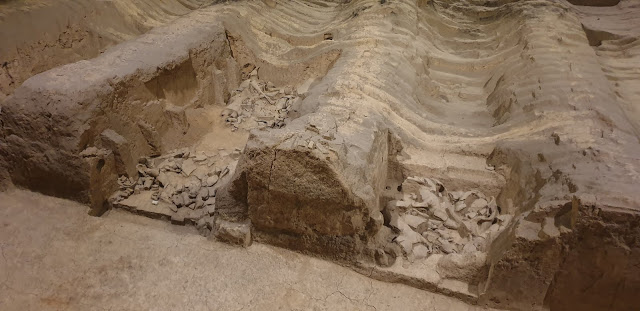
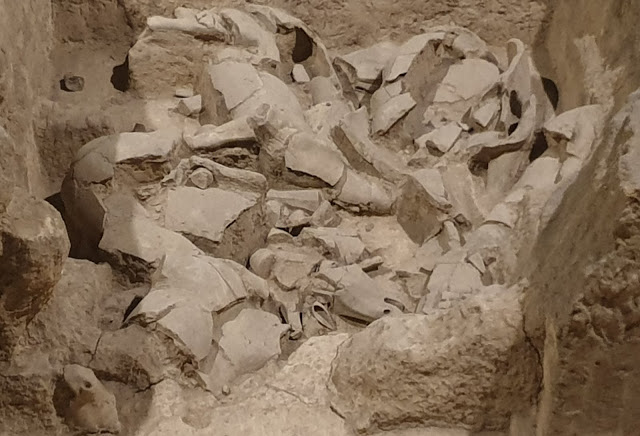
The excavation of this pit has only just begun, so it is possible to see where they have carefully removed the top cover, and you can see the broken parts of the warriors lying in a heap.

Some parts of the warriors are more discernible closer up

These parts are carefully extracted and taken to the ‘hospital’ where they are digitised and the computer will match each part with the warrior it belongs to.

Pit 1

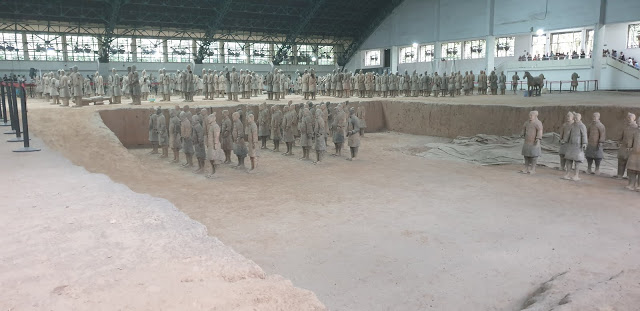
This has quite a number of standing soldiers that have been glued back together, but not necessarily complete and I notice a number if the statues were incomplete. And if they cannot find the missing pieces, then they are not added to or filled in.

The scale of the pit is enormous, and they have hardly scratched the surface in the restoration process.

What is there is a number of horses as well.

That’s at the front of the pit, a long line of statues, and what is clear is the location of the well where the first fragments were found by a farmer.

There are about eight lines of soldiers, and some lining the sides.

Midway down there is a large area currently under excavation

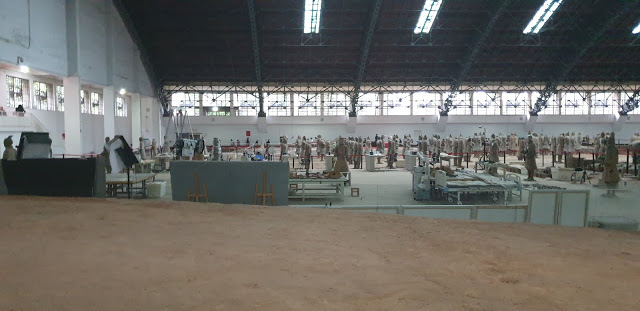
At the back is the hospital where the soldiers are reassembled.  There’s nearly a hundred in the various stages of rebuilding.  These days the soldiers are rebuilt using computer imaging.

The hospital area is where they are put back together

And these are some of the statues in various stages of reconstruction

Another two views of the size and scale of the reconstruction project

The coffee shop is also a sales centre, but there are too many people waiting for coffee and too few places to sit down.

The cinema of my dreams – I always wanted to write a war story – Episode 42

For a story that was conceived during those long boring hours flying in a steel cocoon, striving to keep away the thoughts that the plane and everyone in it could just simply disappear as planes have in the past, it has come a long way.

Whilst I have always had a fascination with what happened during the second world war, not the battles or fighting, but in the more obscure events that took place, I decided to pen my own little sidebar to what was a long and bitter war.

And, so, it continues…

——

The Standartenfuhrer checked his gun and settled his nerves for an onslaught.  If they were going to die, then he was going to kill as many of them as he could.

He threw his hand pistol to Mayer.  “Shoot anything that comes in the door.”

Mayer fumbled the weapon, dropping it on the floor, then finding it hard, with cold hands, to pick it up.  Perhaps his life wasn’t sufficiently in danger to be more proactive.

The Standartenfuhrer shook his head.  Boffins were all the same.  The slightest threat and they went weak at the knees. And Mayer was no exception.

Mayer managed to get the gun into his hand.

“Don’t forget to turn off the safety.”

Mayer looked at the gun, and found the switch.

At the same time, another burst of gunfire ricocheted off the walls of the hut.  It was followed by a harsh order to stop firing, and save the ammunition for the enemy.  There was also a mutter about alerting the enemy, but that ship had sailed.

The soldiers seemed content to shoot randomly at the cabin, rather than check to see if anyone was inside, and soon the sounds of men, guns, and dogs were gone.  The dogs had not picked up their scent, and the Standartenfuhrer had managed to cover their tracks sufficiently to keep them at bay.

Relief, but not enough to rest.  The Standartenfuhrer knew they had to keep moving.

In the background, both could hear a stream locomotive at slow speed passing.  In the circuitous route they’d taken to escape, they must have circled back towards the railway line which must be on the other side of the forest.

That proximity of the railway line would work in their favor because the next phase of the journey was going to be on a train.

Just not one full of soldiers, if possible.

After a half-hour, just to ensure the soldiers didn’t return, the Standartenfuhrer dragged himself up off the ground.

“We’d better move.  They’re likely to come back, or had a second sweep when they don’t find us.”

“Surely we can have a rest.”

“If you want to get caught.  I don’t have to tell you what they’ll do to you if they capture you.”

“Probably send me back to that hell hole.”

“Hitler is not that forgiving.  The odds are you’ll be handed over to the SS and I’m sure you’ve seen what those people are capable of.”

He had, especially with the forced labor from the Jewish camps and POW camps.  At times it beggared belief.

Mayer dragged himself up off the floor.

The Standartenfuhrer checked his weapon, then looked out through the crack in the door.  It was dark and snowing, not too heavy, but enough to hide their movement.  It was a shame their coats were dark, they would stand out against the white background, but it couldn’t be helped.  That was a problem for daylight, still some hours away.

“Keep your weapon handy.  You may need it.”

Mayer was worried his hands would be too cold and stiff, and instead of having it in his hand, slipped it into his pocket.  He didn’t think too many people would be about at this hour.

“Once outside, head straight for the trees, as fast as you can.”

The Standartenfuhrer was in the doorway one second, gone the next, and Mayer followed.  He could just see the dark figure in front of him, then almost ran into him when he stopped just past the first line of trees.

He could see lights intermittently through the trees, a train or houses along the railway line perhaps.

It was much darker in the forest, and they had to go slower, picking their way through the trees, running into low branches, and getting a face full of wet snow, often trickling down the back of their necks.

It was cold, wet, and very uncomfortable.

The Standartenfuhrer stopped.  The trees had thinned and the lights became more pronounced.  They could now definitely hear a locomotive close by, and a train well lit up stopped.  The windows were fogged from condensation on the inside, but it was clear enough to see heads.

It was a passenger train, waiting.

A piercing whistle shattered the relative quiet, and another train coming in the other direction at speed flashed passed very loudly, the wheels of the carriages clanking on the track joints.  An empty freight train with many flat cars, going back to Germany.

Then suddenly shouting, a whistle, and gunfire.

A man was running towards them,, and several soldiers were in pursuit, randomly shooting in his direction, and into the forest.  A shot hit the running person and they fell.

Mayer heard a thud and a groan, then realized that the Standartenfuhrer had been hit.  By the time he turned the Standartenfuhrer over, he was dead.

Mayer ducked out of sight just before torchlight shone on the spot he was crouching.

There was another shout, and the soldiers started heading towards him.

——-

© Charles Heath 2020-2022

The cinema of my dreams – Was it just another surveillance job – Episode 57

This story is now on the list to be finished so over the new few weeks, expect a new episode every few days.

The reason why new episodes have been sporadic, there are also other stories to write, and I’m not very good at prioritizing.

But, here we are, a few minutes opened up and it didn’t take long to get back into the groove.

Things are about to get complicated…


I hadn’t realised until I said it out loud to someone who would not understand the significance of it, just how far-fetched the reason was.

But in my newly adopted world, it made perfect sense.

 Spies dealt with many things, mostly the notion of a threat, and the removal of it, whether it is an object like a USB or a person, or persons, who could make the threat become a reality.

This threat started with a laboratory working for the military to produce biological weapons.  Then the funding stopped, for whatever reason, and the laboratory had to cover its losses.

What better way than to hawk the formula on the dark web?

Someone perceived that the laboratory would become a threat and dispatched operatives to monitor the situation.

The worst-case scenario occurs, but from a different standpoint, the outrage of a community-conscious scientist who didn’t like the idea of people creating monstrous weapons and steals the formula to leak to the media.

The laboratory is shut down by the government before the formula could be sold, but there is a copy in play via the scientist.

The scientist, and therefore the threat, neutralised.

The threat then moves to his wife, who contacts someone in the Department, likely but not necessarily Dobbin, who then assigns O’Connell to find the wife and offer a lot of cash for the formula.

She agrees.

Somehow, the planted operatives, Severin and Maury discover the wife and O’Connell’s arrangement.

They create a surveillance group with the intention of monitoring the handover and then try to remove both O’Connell and the wife.

For what reason.  The threat would have been removed unless O’Connell and Dobbin had another agenda.  Why then when Dobbin rescued O’Connell, did O’Connell then turn on him?

A relationship with the wife?

Or was it simply the thought of making a huge sum of money, one both O’Connell and the wife could retire on.  He would not be the first spy to sell his soul for twenty pieces of silver.

But the good news, was we had Severin’s assassin.

The plan from there was to hand her over to the Detective Inspector, who didn’t have an agenda other than getting to the truth and keeping Jan away from Dobbin, or anyone who could set her free.

That plan was quashed the moment I saw Dobbin turn up at the scene.  He knew where Severin would be, he must know Severin was meeting with me, and he had sent Jan.

The fact I was still alive meant he wanted something from me.

The question was whether he knew if Jan had been taken off the playing field.

“What the hell is he doing here?”

It was the exact question in my head, though I was closer to answer than she was.

“Run interference, or worse, take over this case too.”

“I thought that was left in the hands of MI5.”

“He turned up after you left.”

She shrugged.  “Above my pay grade, to be honest.  He can have it.  I prefer to deal with the mundane, common thieves or murderers.  None of this cloak-and-dagger stuff.   I’ll tell my Super about the biological stuff, but you have to admit it is a bit farfetched.  There’s a more rational explanation for these deaths, you just have to look harder.  Now, if there’s nothing else?”

Too late to escape, Dobbin had circled around and reached us before I could disappear.

“You seem to turn up to department crime scenes with alarming regularity, Sam.  Any particular reason you’re here?”

The Detective Inspector had expected him to talk to her, not me.

“He’s just another possible witness on the periphery of a crime.  You’re here because?

“It’s one of our people.  I’m afraid…”

“…you’re going to have to take over?  Be my guest.  Your friend here is altogether far too uncooperative, like the rest of you.  I am going to file a formal complaint.”

.“And I’m sure it will be seen by the relevant people.”

She just shrugged and walked away, waving her hand at no one in particular

I waited until she was out of hearing range and asked, “So, why didn’t Jan shoot me too?”

© Charles Heath 2020-2023

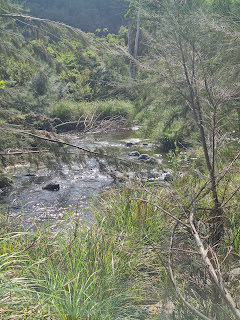
A photograph from the inspirational bin – 26

This is a section of what I would call a babbling book, part of the Canungra River, in a valley that is part of the Lamington National Park in Southern Queensland in Australia.

But as we writers are only too aware, it is so much more than that.

For instance: You could have been on a hike through the forest, and by a strange quirk of fate, got lost, and after staggering around in what was circles for a day, or two, you stumble across this creek. That thirst can now be slaked!

Alternatively, following a map to where you have been told there is gold, the river you have been paddling up had slowly narrowed down to this, and is going to make the rest of the journey by land, on foot, still a long way from the spot marked with an x.

Or you could just be on holiday, and this is a swimming hole and up or downriver, the best trout fishing to be found, and one of the best kept secrets. Except, when you finally take the plunge, a body floats to the surface, and suddenly, you are in the middle of a murder mystery.

Add to the situation the fact you are miles from anywhere, and that the killer could be nearby or gone, that idyllic stay in the cabin to be at one with nature is starting to look like the weekend in hell.

Once again, there are endless possibilities.

In a word: Maybe

This word, where I live, had taken on a new meaning.  We have telephone scammers who ask your name when you answer the phone, and when you say yes, they hang up.

It doesn’t take much imagination how they can use that recording.

So, I now answer the phone with maybe, which confuses the real callers who want to know if it is you.

Of course, maybe is one of those words that have so many meaning, but the best one is to use it while you have time to think of a proper answer.

For example, did you get the potatoes?  You haven’t been out, it slipped your mind, or you just plain forgot, but run with a ‘maybe’ so you can judge the reaction.

Angry face, you know no matter what, you’re in trouble.

Genial face, you know that it didn’t really matter and all is forgiven.

Then there’s the person who doesn’t know you and comes up to you in a crowded room.  Are you [put name here]?

Maybe.  We want to know if we’re in trouble, or if it for something good.

Using ‘maybe’ in writing probably isn’t the best word to us, but I like defying the experts.  You can always find a maybe or two in any of my books.

Skeletons in the closet, and doppelgangers

A story called “Mistaken Identity”

How many of us have skeletons in the closet that we know nothing about? The skeletons we know about generally stay there, but those we do not, well, they have a habit of coming out of left field when we least expect it.

In this case, when you see your photo on a TV screen with the accompanying text that says you are wanted by every law enforcement agency in Europe, you’re in a state of shock, only to be compounded by those same police, armed and menacing, kicking the door down.

I’d been thinking about this premise for a while after I discovered my mother had a boyfriend before she married my father, a boyfriend who was, by all accounts, the man who was the love of her life.

Then, in terms of coming up with an idea for a story, what if she had a child by him that we didn’t know about, which might mean I had a half brother or sister I knew nothing about. It’s not an uncommon occurrence from what I’ve been researching.

There are many ways of putting a spin on this story.

Then, in the back of my mind, I remembered a story an acquaintance at work was once telling us over morning tea, that a friend of a friend had a mother who had a twin sister and that each of the sisters had a son by the same father, without each knowing of the father’s actions, both growing up without the other having any knowledge of their half brother, only to meet by accident on the other side of the world.

It was an encounter that in the scheme of things might never have happened, and each would have remained oblivious of the other.

For one sister, the relationship was over before she discovered she was pregnant, and therefore had not told the man he was a father. It was no surprise the relationship foundered when she discovered he was also having a relationship with her sister, a discovery that caused her to cut all ties with both of them and never speak to either from that day.

It’s a story with more twists and turns than a country lane!

And a great idea for a story.

That story is called ‘Mistaken Identity’.

The cinema of my dreams – I never wanted to go to Africa – Episode 3

Dreaming I was in the desert…

But it was just another episode of the helicopter story, we’re back on the ground after that fateful jump, things are not going quite as planned.

Do they ever in life or death situations?


Yards were like miles, and I didn’t have the time to reach the weapon.  I could see the pickup going around the burning wreck as he of the helicopter and approach me.

But, being the optimist I was I had to try.

And fail.

The pickup was on me before I’d made it halfway, stopping about a foot from me.  Any further and it would have run me over.

I got to my knees and put my hands on my head not giving them any immediate reason to kill me.  The man who had fired the rocket got out of the vehicle moments after it stopped.

A man in military garb, not very old.  And not a foreigner.  I was expecting South American, but not ostensibly one of us.  A glance inside the vehicle showed the driver was a woman, in civilian clothes.

A surprise, yes.

“Mr. James I presume.”  English, well spoken.

Another surprise or more than one, that he spoke English and knew who I was.

“We were expecting you but not be quite so dramatic entrance.  Please stand.”

Kneeling had been difficult; I was not quite sure how standing was going to work.  I was still recovered from the impromptu exit from the helicopter.

I tried and fell back on the ground.  I looked up at him.  “Sorry, the legs are still a little rubbery.”

He simply shook his head, leaned over and dragged me to my feet, then slung me over his shoulder, carried me to the rear of the pickup and tossed me in.  I just managed to avoid hitting my head on the floor.

The man climbed in the back and then slapped the back of the cab.

Crunching gears, an over-revving engine, then a jerky start.  It was not going to be a comfortable journey.

© Charles Heath 2019-2022

An excerpt from “Amnesia”, a work in progress

I remembered a bang.
I remembered the car slewing sideways.
I remember another bang, and then it was lights out.
When I opened my eyes again, I saw the sky.
Or I could be underwater.
Everything was blurred.
I tried to focus but I couldn’t. My eyes were full of water.
What happened?
Why was I lying down?
Where was I?
I cast my mind back, trying to remember.
It was a blank.
What, when, who, why and where, questions I should easily be able to answer. Questions any normal person could answer.
I tried to move. Bad, bad mistake.
I did not realise the scream I heard was my own. Just before my body shut down.

“My God! What happened?”
I could hear, not see. I was moving, lying down, looking up.
I was blind. Everything was black.
“Car accident, hit a tree, sent the passenger flying through the windscreen. Pity to poor bastard didn’t get the message that seat belts save lives.”
Was I that poor bastard?
“Report?” A new voice, male, authoritative.
“Multiple lacerations, broken collar bone, broken arm in three places, both legs broken below the knees, one badly. We are not sure of internal injuries, but ruptured spleen, cracked ribs and pierced right lung are fairly evident, x-rays will confirm that and anything else.”
“What isn’t broken?”
“His neck.”
“Then I would have to say we are looking at the luckiest man on the planet.”
I heard shuffling of pages.
“OR1 ready?”
“Yes. On standby since we were first advised.”
“Good. Let’s see if we can weave some magic.”

Magic.
It was the first word that popped into my head when I surfaced from the bottom of the lake. That first breath, after holding it for so long, was sublime, and, in reality, agonising.

Magic, because it seemed like I’d spent a long time under water.
Or somewhere.
I tried to speak, but couldn’t. The words were just in my head.
Was it night or was it day?
Was it hot, or was it cold?
Where was I?
Around me it felt cool.
It was very quiet. No noise except for the hissing of air through an air-conditioning vent. Or perhaps that was the sound of pure silence. And with it the revelation that silence was not silent. It was noisy.
I didn’t try to move.
Instinctively, somehow I knew not to.
A previous bad experience?
I heard what sounded like a door opening, and very quiet footsteps slowly come into the room. They stopped. I could hear breathing, slightly laboured, a sound I’d heard before.
My grandfather.
He had smoked all his life, until he was diagnosed with lung cancer. But for years before that he had emphysema. The person in the room was on their way, down the same path. I could smell the smoke.
I wanted to tell whoever it was the hazards of smoking.
I couldn’t.
I heard a metallic clanging sound from the end of the bed. A moment later the clicking of a pen, then writing.
“You are in a hospital.” A female voice suddenly said. “You’ve been in a very bad accident. You cannot talk, or move, all you can do, for the moment, is listen to me. I am a nurse. You have been here for 45 days, and just come out of a medically induced coma. There is nothing to be afraid of.”
She had a very soothing voice.
I felt her fingers stroke the back of my hand.
“Everything is fine.”
Define fine, I thought. I wanted to ask her what ‘fine’ meant.
“Just count backwards from 10.”
Why?
I didn’t reach seven.

Over the next ten days, that voice became my lifeline to sanity. Every morning I longed to hear it, if only for the few moments she was in the room, those few waking moments when I believed she, and someone else who never spoke, were doing tests. I knew it had to be someone else because I could smell the essence of lavender. My grandmother had worn a similar scent.
It rose above the disinfectant.
I also believed she was another doctor, not the one who had been there the day I arrived. Not the one who had used some ‘magic’ and kept me alive.
It was then, in those moments before she put me under again, that I thought, what if I was paralysed? It would explain a lot. A chill went through me.

The next morning she was back.
“My name is Winifred. We don’t know what your name is, not yet. In a few days, you will be better, and you will be able to ask us questions. You were in an accident, and you were very badly injured, but I can assure you there will be no lasting damage.”
More tests, and then, when I expected the lights to go out, they didn’t. Not for a few minutes more. Perhaps this was how I would be integrated back into the world. A little bit at a time.
The next morning, she came later than usual, and I’d been awake for a few minutes. “You have bandages over your eyes and face. You had bad lacerations to your face, and glass in your eyes. We will know more when the bandages come off in a few days. Your face will take longer to heal. It was necessary to do some plastic surgery.”
Lacerations, glass in my eyes, car accident, plastic surgery. By logical deduction, I knew I was the poor bastard thrown through the windscreen. It was a fleeting memory from the day I was admitted.
How could that happen?
That was the first of many startling revelations. The second was the fact I could not remember the crash. Equally shocking, in that same moment was the fact I could not remember before the crash either, and only vague memories after.
But the most shattering of all these revelations was the one where I realised I could not remember my name.
I tried to calm down, sensing a rising panic.
I was just disoriented, I told myself. After 45 days in an induced coma, it had messed with my mind, and it was only a temporary lapse. Yes, that’s what it was, a temporary lapse. I would remember tomorrow. Or the next day.
Sleep was a blessed relief.

The next day I didn’t wake feeling nauseous. Perhaps they’d lowered the pain medication. I’d heard that morphine could have that effect. Then, how could I know that, but not who I am?
I knew now Winifred the nurse was preparing me for something very bad. She was upbeat, and soothing, giving me a new piece of information each morning. This morning, “You do not need to be afraid. Everything is going to be fine. The doctor tells me you are going to recover with very little scarring. You will need some physiotherapy to recover from your physical injuries, but that’s in the future. We need to let you mend a little bit more before then.”
So, I was not going to be able to leap out of bed, and walk out of the hospital any time soon. I don’t suppose I’d ever leapt out of bed, except as a young boy. I suspect I’d sustained a few broken bones. I guess learning to walk again was the least of my problems.
But, there was something else. I picked it up in the timbre of her voice, a hesitation, or reluctance. It sent another chill through me.
This time I was left awake for an hour before she returned.
This time sleep was restless.
There were scenes playing in my mind, nothing I recognised, and nothing lasting longer than a glimpse. Me. Others, people I didn’t know. Or perhaps I knew them and couldn’t remember them.
Until they disappeared, slowly like the glowing dot in the centre of the computer screen, before finally fading to black.

The morning the bandages were to come off she came in bright and early and woken me. I had another restless night, the images becoming clearer, but nothing recognisable.
“This morning the doctor will be removing the bandages over your eyes. Don’t expect an immediate effect. Your sight may come back quickly or it may come back slowly, but we believe it will come back.”
I wanted to believe I was not expecting anything, but I was. It was probably human nature. I did not want to be blind as well as paralysed. I had to have at least one reason to live.
I dozed again until I felt a gentle hand on my shoulder. I could smell the lavender, the other doctor was back. And I knew the hand on my shoulder was Winifred’s. She told me not to be frightened.
I was amazed to realise in that moment, I wasn’t.
I heard the scissors cutting the bandages.
I felt the bandage being removed, and the pressure coming off my eyes. I could feel the pads covering both eyes.
Then a moment where nothing happened.
Then the pads being gently lift and removed.
Nothing.
I blinked my eyes, once, twice. Nothing.
“Just hold on a moment,” Winifred said. A few seconds later I could feel a cool towel wiping my face, and then gently wiping my eyes. Perhaps there was ointment, or something else in them.
Then a flash. Well, not a flash, but like when a light is turned on and off. A moment later, it was brighter, not the inky blackness of before, but a shade of grey.
She wiped my eyes again.
I blinked a few more times, and then the light returned, and it was like looking through water, at distorted and blurry objects in the distance.
I blinked again, and she wiped my eyes again.
Blurry objects took shape. A face looking down on me, an elderly lady with a kindly face, surely Winifred, who was smiling. And on the opposite side of the bed, the doctor, a Chinese woman of indescribable beauty.
I nodded.
“You can see?”
I nodded again.
“Clearly?”
I nodded.
“Very good. We will just draw the curtains now. We don’t want to overdo it. Tomorrow we will be taking off the bandages on your face. Then, it will be the next milestone. Talking.”
I couldn’t wait.

When morning came, I found myself afraid. Winifred had mentioned scarring, there were bandages on my face. I knew, but wasn’t quite sure how I knew, I wasn’t the handsomest of men before the accident, so this might be an improvement.
I was not sure why I didn’t think it would be the case.
They came at mid morning, the nurse, Winifred, and the doctor, the exquisite Chinese. Perhaps she was the distraction, taking my mind of the reality of what I was about to see.
Another doctor came into the room, before the bandages were removed, and he was introduced as the plastic surgeon that had ‘repaired’ the ravages of the accident. It had been no easy job, but, with a degree of egotism, he did say he was one of the best in the world.
I found it hard to believe, if he was, that he would be at a small country hospital.
“Now just remember, what you might see now is not how you will look in a few months time.”
Warning enough.
The Chinese doctor started removing the bandages. She did it slowly, and made sure it did not hurt. My skin was very tender, and I suspect still bruised, either from the accident or the surgery, I didn’t know.
Then it was done.
The plastic surgeon gave his work a thorough examination and seemed pleased with his work. “Coming along nicely,” he said to the other doctor. He issued some instructions on how to manage the skin, nodded to me, and I thanked him before he left.
I noticed Winifred had a mirror in her hand, and was somewhat reticent in using it. “As I said,” she said noticing me looking at the mirror, “what you see now will not be the final result. The doctor said it was going to heal with very little scarring. You have been very fortunate he was available. Are you ready?”
I nodded.
She showed me.
I tried not to be reviled at the red and purple mess that used to be my face. At a guess I would have to say he had to put it all back together again, but, not knowing what I looked like before, I had no benchmark. All I had was a snippet of memory that told me I was not the tall, dark, and handsome type.
And I still could not talk. There was a reason, he had worked on that area too. Just breathing hurt. I think I would save up anything I had to say for another day. I could not even smile. Or frown. Or grimace.
“We’ll leave you for a while. Everyone needs a little time to get used to the change. I suspect you are not sure if there has been an improvement on last year’s model. Well, time will tell.”
A new face?
I could not remember the old one.
My memory still hadn’t returned.