In a word: Flower

It’s what we expect to see when we walk past the front of some houses but instead sometimes see lawn, rocks, or a disaster.

They are what makes the difference between a delightful street and an ugly one, and by that I mean flowers.

By definition though, it means the state or period in which the plant’s flowers have developed and opened/

Just beware the man who turns up with a bunch of flowers that look vaguely familiar to those that grow in your neighbour’s gardens.

They are also in abundance in horticultural gardens, and in florist shops.

My favourites are roses.

And just a word of warning, look out for triffids.  If you read John Wyndham science fiction you’ll know what I mean.

Another mean for the word is to reach the optimum stage of development, though the word bloom could also be used to describe the same thing.

There is another similar-sounding word, flour, but this is the stuff used to make bread, scones, and puddings.

By definition, it is the result of grinding wheat or other grains to a powder.

If something is said to be floury, then it means it is bland.


The cinema of my dreams – I always wanted to write a war story – Episode 39

For a story that was conceived during those long boring hours flying in a steel cocoon, striving to keep away the thoughts that the plane and everyone in it could just simply disappear as planes have in the past, it has come a long way.

Whilst I have always had a fascination with what happened during the second world war, not the battles or fighting, but in the more obscure events that took place, I decided to pen my own little sidebar to what was a long and bitter war.

And, so, it continues…

Leonardo was a fool, not that any of those who followed him would say that to his face, but all of them knew it and accepted that he made the best leader.

The reason for that, they all knew if anything went wrong, then the leader would be the first to be held accountable.

They all also knew that what Leonardo had done to Martina and Chiara, and the cold-blooded murder of the villagers, justifying it by saying they were collaborators, was also wrong, and had refused to take part in it.

Leonardo just thought they didn’t have the stomach to do what was necessary, failing to realize he was committing a crime, war or not.

Alberto, arguably the next man to take over the resistance group if anything happened to Leonardo, was nominally second in command and was there because he had the respect of the men, far more than their current leader.

He was the one who suspected there was something wrong at the castle, that the British soldiers there were not quite doing what they said they were there for.  He had seen, even directed, Germans seeking sanctuary in England in exchange for information, come, but not go.  Not like they did in the beginning.

And that man called Atherton, the one who arrived just before the paratroopers, he was British, and they had captured him.  The talk was that he was a German collaborator, but Alberto wasn’t convinced.

But, not having the full allegiance of all the resistance fighters, he could not say anything or try to organize the men to be more careful in their approach to those at the castle.  Leonardo still held sway with them. 

For now.

.

The Italians had their own section of the cells in the dungeons where they stayed, Leonardo, deeming it not safe in the village.  Alberto agreed because he had made several forays down there, only to discover that Leonardo would be shot on sight if he showed his face there again.  Some resistance they made, he thought, where they didn’t have the confidence of their own people.

Leonardo was up supping with the devil, as Alberto had been known to say, put of Leonardo’s earshot, and several of the men were resting.  The others, more loyal to Leonardo were in the cellar cell drinking their way through the wine stock and were most likely drunk and passed out.

Alberto didn’t care for the vintage, a subject that he was well versed in because before the war he had worked for the family of winemakers.  The wines stored, he had recognized when they’d first discovered them, as being of inferior quality, and had been left there rather than throwing it away.  Leonardo would not have known the difference.

“Something is not right.”  A voice from the corner, belonging to a man named Bolini, broke his reverie.  The truth was, he was tired and wished it were all done with.

“What makes you say that?” He asked.

“Killing the villagers.  What did they do wrong, other than just trying to survive?  It’s what we’re all trying to do.  It’s not our war.”

“You know what it’s like, stuck in the middle.  It’s a bit like the in-laws.  You don’t want them, but you’re stuck with them.”

“In-laws.  Don’t get me started.”  The other, a man named Christo, weighed in.  

“You do realize we may be held accountable for what happened back at the village,” Bolini had obviously been thinking about the repercussions.

“We brought the only witnesses here, and they sure as hell aren’t going to last long.  Not after what Leonardo did to them.”

“That’s possible, but we all know what happened.”

“But there are others outside who also know what happened, and if we want to keep out of trouble, we are going to have to take care of them,” Bolini said.

Alberto hadn’t quite got through considering the ramifications of what Fernando just did, and the fact they’d helped him.  Bolini was right, even if they hadn’t been as reckless, they were still going to be tarred with the same brush.

And Atherton was still out there.

The trouble with trying to clean up a mess is that eventually there’s a bigger mess to deal with.  Maybe it was time to get rid of Fernando.

The man called Wallace, the one who seemed to be in charge, came around the corner and stopped when he saw Alberto.

“Where’s your leader?”

Alberto pointed his head in the direction of the wine cellar.

Wallace shook his head, knowing what that meant.  “Tell him he’s got another pickup.  Two hours in the village.  A family, with two children.  Tell him to sober up, and if he doesn’t in time, you have my permission to shoot him.”

Surely the man wasn’t serious.

“Well, what are you sitting around for?  Get moving.”

Wallace cast a disapproving glance over the three, shook his head again, and left.

© Charles Heath 2020-2021

Searching for locations: Shanghai, China, by night.

When we arrive at the embarkation site we find at least 100 buses all lined up and parked, and literally thousands of Chinese and other Asians streaming through the turnstiles to get on another boat leaving earlier than ours.

Buses were just literally arriving one after the other stopping near where we were standing with a dozen or so other groups waiting patiently, and with people were everywhere it could only be described as organized chaos.

Someone obviously knew where everyone was supposed to go, and when it was our turn, we joined the queue.  There were a lot of people in front of us, and a lot more behind, so I had to wonder just how big the boat was.

We soon found out.

And it was amusing to watch people running, yes, they were actually running, to get to the third level, or found available seating.  Being around the first to board, we had no trouble finding a seat on the second level.

I was not quite sure what the name of the boat was, but it had 3 decks and VIP rooms and it was huge, with marble staircases, the sort you could make a grand entrance on.  The last such ornate marble staircase we had seen was in a hotel in Hong Kong, and that was some staircase.

But who has marble staircases in a boat?

We’re going out across the water as far as the Bund and then turn around and come back about 30 to 40 minutes.   By the time everyone was on board, there was no room left on the third level, no seats on the second level nor standing room at the end of the second level where the stairs up to the third level were.

No one wanted to pay the extra to go into the VIP lounge.

We were sitting by very large windows where it was warm enough watching the steady procession of the colored lights of other vessels, and outside the buildings.

It was quite spectacular, as were some of the other boats going out on the harbor.

All the buildings of the Bund were lit up

And along that part of the Bund was a number of old English style buildings made from sandstone, and very impressive to say the least.

On the other side of the harbour were the more modern buildings, including the communications tower, a rather impressive structure.

I had to go to the rear of the vessel to get a photo, a very difficult proposition given here was no space on the railing, not even on the stairs going up or down.  It was just luck I managed to get some photos between passengers heads.

And, another view of that communications tower:

There was no doubt this was one of the most colourful night-time boat tours I’ve ever been on.  Certainly, when we saw the same buildings the following day, they were not half as spectacular in daylight.

I never did get up to the third level to see what the view was like.

The unthinkable has happened…

I’m lying awake in the dark, my mind is racing with endless thoughts centred on a world wide disaster. There are things happening that could lead to what could only be described as a catastrophic event that leads to a dystopian world, one no one thought could possible happen.

Of course, it hasn’t happened, but could it…

Here’s how my mind is connecting the dots.

There are two superpowers, both nuclear equipped, and both antagonistic towards each other. Tensions have been rising, but not only with one country, but a number of countries.

In the other, an election comes and goes, there’s no decisive result, and it leads to skirmishes that eventually break out into the second civil war. No heed is paid to the virus that had been killing indiscriminately before, and seemingly had disappeared.

A fearsome world is watching what will happen as millions are being killed.

The adversarial country deems, when the civil war is at it’s zenith to attack an uncoordinated and vulnerable country, thinking no one would have their finger on the button. Nuclear weapons are launched on either side, other countries join in, and that plunges the world into a nightmare no one could have predicted.

It takes three months for the dust to settle, and to realise that more than three billion people have died from the nuclear fallout, and whole countries are now just infertile and dangerous wastelands.

And then the virus comes back, because there are no medical facilities, no fresh or running water, and no food. No electricity, no oil, no petrol, no vehicles, or transport of any kind.

In one decisive and utterly stupid move, everyone is back in the stone age, or worse.

Every day is a battle to survive, to keep away from the virus infected people, find food, find or build shelter, and above all, find water. All of which are not contaminated.

The land in one country that was more or less suffered two destroyed cities and caused millions of deaths, looks from a certain perspective, as though nothing has happened. There are tracts of land that are still fertile, near water, but have been taken over by the few who thought to have weapons and the forethought to create fiefdoms.

People can go there, but they are subjugated into what could be called slavery, and sacrifice everything, including their freedom, as the price to live. It’s inevitable that some will rule and others will follow, much like feudal England in the early years.

The people thought that their rights and freedom had been trampled on before the great conflagration, but now, they realise that was nothing compared to the new normal. Executions, heinous punishment for simple crimes, starvation and dehydration. The dreaded socialism that was earlier feared has come home to roost.

It’s not the first story of it’s type, it follows a fairly standard formula that I’ve read in a few books, each using a different premise for the reason, and taking a more reasonable line in the aftermath where people help each other rather than the few subjugating the masses.

To be honest, I don’t think there would be much kindness and co-operation in a world like that, simply because we’ve gone too far down the road being greedy and searching for power, particularly over others.

The meek will certainly not inherit the earth.

Of course, there’s always an exception to very rule, and this is the protagonist for this story.

Feel free to adapt it any way you like.

And let’s hope it doesn’t happen in reality.

It’s winter, it should be raining

Here’s the thing.

People just don’t like rain.  All I ever hear is complaints because they want to go away camping, they want to go shopping, or they have to go to children’s sports.

Not, of course, because they can’t mow the lawn!

And that pesky rain, well, it just makes everything more difficult.  Mud and dirt get trampled inside, the washing can’t be hung out to dry, it causes floods, it stops games being played, well, sometimes.  The pitch would have to be six feet under water before that happens.

But…

Let’s think about the rain for a moment.

What if we didn’t get any rain?

There would be a drought.  There might not be any water.  Everything outside that needed water to survive, the sort of water rain provides, would die.  Then we’d have no flowers, no trees, no grass, oh, quite possibly no food, or oxygen.

A bit radical don’t you think, no food, no water, and no oxygen?

Hey, wouldn’t that be an interesting premise for an apocalyptic novel?

Usually, in a post-apocalyptic world, there’s still rain, water, and oxygen, you’d p[robably have to fight for food, but no one seems to go down that unthinkable path of losing everything.

Seems that happened around the time of the dinosaurs, when that comet hit the earth, blotted out the sun, and everything died, well, nearly everything.  It’s what I think is called an Earth Life Extinction Event.

Some say the same might happen if we have a nuclear holocaust, say America and Russia deciding to launch nuclear weapons on each other for some insane reason, knowing full well they would be condemning the whole world to a terrible end.

Nearly happened, I’m guessing.  That would make a good story.  Hang on, it’s been done before, a dozen or more times, and usually saved by a single man or woman whose actions never reach the ears of what would be a grateful public.

We’re a long way from simply wishing the rain to go away and come again some other day, aren’t we?

Let’s let someone else worry about the big picture.

And let’s not start thinking about post-apocalyptic novels that could get scarily real one day.

Sigh!   Only three more months of winter to endure, and it’ll be spring again.

Oh, and it’s raining again outside.

The cinema of my dreams – I always wanted to go on a treasure hunt – Episode 47

Here’s the thing…

Every time I close my eyes, I see something different.

I’d like to think the cinema of my dreams is playing a double feature but it’s a bit like a comedy cartoon night on Fox.

But these dreams are nothing to laugh about.

Once again there’s a new installment of an old feature, and we’re back on the treasure hunt.

“A hundred square miles, that must have run up the coast close to Patterson’s Reach?” I asked.

Patterson’s reach was about five miles to the north, a small town, where there was little fishing done and allegedly a lot of ferrying drugs being dropped off by large ships coming along the offshore shipping lanes.  No one could prove it, and every trap set by the coast guard had failed to find any evidence.  That meant that someone was tipping them off.

It was also the domain of the Cossatino’s who discouraged anyone else from living there.  It was said that Cossatino owned all of the lands the town sat on and the people who lived there worked for him.

“Only as far as Patterson’s reach and then inland for about 20 miles, about as far as the Faultline and perhaps the closest point between the foothills and the sea.  Ormiston had bought all the land thinking that the treasure was buried on it.  You see, he had a map too, long before Boggs senior had started forging them for the Cossatino’s.”

And in hearing that it begged the question, who had first found the original map?  If Cossatino found it, then getting Boggs senior to forge a lot of useless maps would hide where it really was.

What if Boggs ‘original’ map was yet another elaborate forgery, given to him by Cossatino to create others?  I put that thought to one side.

I wondered if Boggs had been to see her, to get some background.  If there was going to be an expert on the treasure, if it existed or not, she would know.  In fact, she probably knew old man Ormiston.

“Does that map still exist?”

“Perhaps.  It was not found in his effects after he died.  Spent his last years in an asylum.  It wasn’t not finding the treasure, or losing his fortune that sent him mad, it was Alzheimer’s, poor old man.  Whatever documents that were found when his relatives cleaned the place out were brought to the library to be stored, cataloged at some point, and one day when someone decides to write a history of the area, no doubt they want to see the collection.”

“I couldn’t look at the papers?”

“Are you interested in writing a local history.  I’m sure your hunt for the treasure and the many fruitless other expeditions looking for it would make a very entertaining chapter.”

“Maybe I will.”

If that was what it took to look at the documents.  There might be something interesting to be found.  Especially if he kept a diary.  I thought it best not to ask, and fuel suspicions.

“Elmer said there might be relations of Ormiston still around here?”

“Yes, I did say that which I now regret.  There are, but I don’t know who they are.  I knew his wife’s family name was Maunchen, and that the Maunchens came from California originally, and there’s nothing to say they didn’t go back.  Certainly, the wife would be deceased by now, and they had three daughters, all of whom would have married, and changed names.  You’d have to go digging through wedding records in at least a dozen parishes.  If you were thinking of investigating.”

“Sound like too much hard work.  Besides, the treasure doesn’t; exist.  I’m only helping Boggs to keep him from doing something stupid.”

“Like father, like son, unfortunately.  You do realize the father made some outlandish claim in the hotel one night that he had found the clue to where the treasure was buried.   Trouble was, he was prone to making outlandish claims, and by that time, a drunkard.  He went missing the next day, and has never been seen since.”

“You think he found it?”

“No.  But I’m guessing someone thought he had and killed him trying to find out.  We’ll never know.”

“A lesson to be learned then.  I’ll keep an eye on Boggs junior just in case he’s thinking of making an equally outlandish claim.”

“You do that.”

She opened a drawer and pulled out a form and handed it to me.

“What’s this for?”

“A request to look at the archives.  You have to register, and I have to give you a special card, the key to the history of Arkwon County.”

Where it said signature, I signed it.

“You fill out the rest.  When do you want me to pick up the card?”

“Monday next week.  In the meantime, be careful.”

She said it like she knew I would be walking into trouble.

© Charles Heath 2020

An excerpt from “The Things We Do For Love”; In love, Henry was all at sea!

In the distance he could hear the dinner bell ringing and roused himself.  Feeling the dampness of the pillow, and fearing the ravages of pent up emotion, he considered not going down but thought it best not to upset Mrs. Mac, especially after he said he would be dining.

In the event, he wished he had reneged, especially when he discovered he was not the only guest staying at the hotel.

Whilst he’d been reminiscing, another guest, a young lady, had arrived.  He’d heard her and Mrs. Mac coming up the stairs, and then shown to a room on the same floor, perhaps at the other end of the passage.

Henry caught his first glimpse of her when she appeared at the door to the dining room, waiting for Mrs. Mac to show her to a table.

She was about mid-twenties, slim, long brown hair, and the grace and elegance of a woman associated with countless fashion magazines.  She was, he thought, stunningly beautiful with not a hair out of place, and make-up flawlessly applied.  Her clothes were black, simple, elegant, and expensive, the sort an heiress or wife of a millionaire might condescend to wear to a lesser occasion than dinner.

Then there was her expression; cold, forbidding, almost frightening in its intensity.  And her eyes, piercingly blue and yet laced with pain.  Dracula’s daughter was his immediate description of her.

All in all, he considered, the only thing they had in common was, like him, she seemed totally out of place.

Mrs. Mac came out of the kitchen, wiping her hands on her apron.  She was, she informed him earlier, chef, waitress, hotelier, barmaid, and cleaner all rolled into one.  Coming up to the new arrival she said, “Ah, Miss Andrews, I’m glad you decided to have dinner.  Would you like to sit with Mr. Henshaw, or would you like to have a table of your own?”

Henry could feel her icy stare as she sized up his appeal as a dining companion, making the hair on the back on his neck stand up.  He purposely didn’t look back.  In his estimation, his appeal rating was minus six.  Out of a thousand!

“If Mr. Henshaw doesn’t mind….”  She looked at him, leaving the query in mid-air.

He didn’t mind and said so.  Perhaps he’d underestimated his rating.

“Good.”  Mrs. Mac promptly ushered her over.  Henry stood, made sure she was seated properly and sat.

“Thank you.  You are most kind.”  The way she said it suggested snobbish overtones.

“I try to be when I can.”  It was supposed to nullify her sarcastic tone but made him sound a little silly, and when she gave him another of her icy glares, he regretted it.

Mrs. Mac quickly intervened, asking, “Would you care for the soup?”

They did, and, after writing the order on her pad, she gave them each a look, imperceptibly shook her head, and returned to the kitchen.

Before Michelle spoke to him again, she had another quick look at him, trying to fathom who and what he might be.  There was something about him.

His eyes, they mirrored the same sadness she felt, and, yes, there was something else, that it looked like he had been crying?  There was a tinge of redness.

Perhaps, she thought, he was here for the same reason she was.

No.  That wasn’t possible.

Then she said, without thinking, “Do you have any particular reason for coming here?”  Seconds later she realized she’s spoken it out loud, had hadn’t meant to actually ask, it just came out.

It took him by surprise, obviously not the first question he was expecting her to ask of him.

“No, other than it is as far from civilization, and home, as I could get.”

At least we agree on that, she thought.

It was obvious he was running away from something as well.

Given the isolation of the village and lack of geographic hospitality, it was, from her point of view, ideal.  All she had to do was avoid him, and that wouldn’t be difficult.

After getting through this evening first.

“Yes,” she agreed.  “It is that.”

A few seconds passed, and she thought she could feel his eyes on her and wasn’t going to look up.

Until he asked, “What’s your reason?”

Slight abrupt in manner, perhaps as a result of her question, and the manner in which she asked it.

She looked up.  “Rest.  And have some time to myself.”

She hoped he would notice the emphasis she had placed on the word ‘herself’ and take due note.  No doubt, she thought,  she had completely different ideas of what constituted a holiday than he, not that she had actually said she was here for a holiday.

Mrs. Mac arrived at a fortuitous moment to save them from further conversation.


Over the entree, she wondered if she had made a mistake coming to the hotel.  Of course, there had been no possible way she could know than anyone else might have booked the same hotel, but realized it was foolish to think she might end up in it by herself.

Was that what she was expecting?

Not a mistake then, but an unfortunate set of circumstances, which could be overcome by being sensible.

Yet, there he was, and it made her curious, not that he was a man, by himself, in the middle of nowhere, hiding like she was, but for very different reasons.

On discreet observance whilst they ate, she gained the impression his air of light-heartedness was forced and he had no sense of humor.

This feeling was engendered by his looks, unruly dark hair, and permanent frown.  And then there was his abysmal taste in clothes on a tall, lanky frame.  They were quality but totally unsuited to the wearer.

Rebellion was written all over him.

The only other thought crossing her mind, and rather incongruously, was he could do with a decent feed.  In that respect, she knew now from the mountain of food in front of her, he had come to the right place.

“Mr. Henshaw?”

He looked up.  “Henshaw is too formal.  Henry sounds much better,” he said, with a slight hint of gruffness.

“Then my name is Michelle.”

Mrs. Mac came in to take their order for the only main course, gather up the entree dishes, then return to the kitchen.

“Staying long?” she asked.

“About three weeks.  Yourself?”

“About the same.”

The conversation dried up.

Neither looked at the other, rather at the walls, out the window, towards the kitchen, anywhere.  It was, she thought, almost unbearably awkward.


Mrs. Mac returned with a large tray with dishes on it, setting it down on the table next to theirs.

“Not as good as the usual cook,” she said, serving up the dinner expertly, “but it comes a good second, even if I do say so myself.  Care for some wine?”

Henry looked at Michelle.  “What do you think?”

“I’m used to my dining companions making the decision.”

You would, he thought.  He couldn’t help but notice the cutting edge of her tone.  Then, to Mrs. Mac, he named a particular White Burgundy he liked and she bustled off.

“I hope you like it,” he said, acknowledging her previous comment with a smile that had nothing to do with humor.

“Yes, so do I.”

Both made a start on the main course, a concoction of chicken and vegetables that were delicious, Henry thought, when compared to the bland food he received at home and sometimes aboard my ship.

It was five minutes before Mrs. Mac returned with the bottle and two glasses.  After opening it and pouring the drinks, she left them alone again.

Henry resumed the conversation.  “How did you arrive?  I came by train.”

“By car.”

“Did you drive yourself?”

And he thought, a few seconds later, that was a silly question, otherwise she would not be alone, and certainly not sitting at this table. With him.

“After a fashion.”

He could see that she was formulating a retort in her mind, then changed it, instead, smiling for the first time, and it served to lighten the atmosphere.

And in doing so, it showed him she had another more pleasant side despite the fact she was trying not to look happy.

“My father reckons I’m just another of ‘those’ women drivers,” she added.

“Whatever for?”

“The first and only time he came with me I had an accident.  I ran up the back of another car.  Of course, it didn’t matter to him the other driver was driving like a startled rabbit.”

“It doesn’t help,” he agreed.

“Do you drive?”

“Mostly people up the wall.”  His attempt at humor failed.  “Actually,” he added quickly, “I’ve got a very old Morris that manages to get me where I’m going.”

The apple pie and cream for dessert came and went and the rapport between them improved as the wine disappeared and the coffee came.  Both had found, after getting to know each other better, their first impressions were not necessarily correct.

“Enjoy the food?” Mrs. Mac asked, suddenly reappearing.

“Beautifully cooked and delicious to eat,” Michelle said, and Henry endorsed her remarks.

“Ah, it does my heart good to hear such genuine compliments,” she said, smiling.  She collected the last of the dishes and disappeared yet again.

“What do you do for a living,” Michelle asked in an off-hand manner.

He had a feeling she was not particularly interested and it was just making conversation.

“I’m a purser.”

“A what?”

“A purser.  I work on a ship doing the paperwork, that sort of thing.”

“I see.”

“And you?”

“I was a model.”

“Was?”

“Until I had an accident, a rather bad one.”

“Oh, I’m sorry.”

So that explained the odd feeling he had about her.

As the evening had worn on, he began to think there might be something wrong, seriously wrong with her because she didn’t look too well.  Even the carefully applied makeup, from close up, didn’t hide the very pale, and tired look, or the sunken, dark ringed eyes.

“I try not to think about it, but it doesn’t necessarily work.  I’ve come here for peace and quiet, away from doctors and parents.”

“Then you will not have to worry about me annoying you.  I’m one of those fall-asleep-reading-a-book types.”

Perhaps it would be like ships passing in the night and then smiled to himself about the analogy.

Dinner now over, they separated.

Henry went back to the lounge to read a few pages of his book before going to bed, and Michelle went up to her room to retire for the night.

But try as he might, he was unable to read, his mind dwelling on the unusual, yet the compellingly mysterious person he would be sharing the hotel with.

Overlaying that original blurred image of her standing in the doorway was another of her haunting expressions that had, he finally conceded, taken his breath away, and a look that had sent more than one tingle down his spine.

She may not have thought much of him, but she had certainly made an impression on him.


© Charles Heath 2015-2020

lovecoverfinal1

The A to Z Challenge – Y is for “You’ve got it all wrong…”


How often do we make a judgment call simply on what we see?

I knew what I saw, and it looked exactly like a situation that, if you asked any ten others who witnessed it, they would agree with me.

And then there would always be one that wouldn’t.

The prosecution had made a very good case, the defense counsel had woven a brilliant tale from start to finish, and he delivered in an almost persuading tone, with the subliminal message, the defendant was not guilty.

I felt sorry for the prosecution because his delivery had been halting, filled with ums and ers and in the end, everyone, from the judge down, wanted it to end.

As for the jury, it was an odd assortment of characters, a lawyer, a builder, a plumber, a housewife, two sales staff, two clerks, a janitor, two retirees, and a motor mechanic.  I thought it would be the lawyer who would be the problem.

The trial had lasted 22 days, and over that time I noticed that groups would form, and discuss aspects of the case, each of the groups forming a different opinion.  Sometimes, the dynamics of the groups changed as more evidence and testimony was revealed.

But, I think on those first few days, opinions were made, and judgment was passed.

In my opinion, based on looking at the defendant, it could be said that she didn’t look like a murderer, nor did she seem capable of committing such a heinous act.   Having said that, as a throwaway first assumption, the lawyer nixed it in a second.  Knowing something of how these trials worked, he said there would have been a lot of careful grooming, dress down, but not to drab, look demure, not aggressive, and speak in a modulated tone, like everyday conversation.

In other words, he was basically telling us she was giving an academy award performance.

I certainly looked at her in a different light after that, but the fact remained, for some of us, that initial assessment said not guilty.

A few days before we had to deliberate, a very damning piece of video was tendered and we all watched as the defendant was shown talking to her alleged accomplice, the victim’s current girlfriend, and passing an enveloped which the defense claimed was the payoff for helping her dispose of her husband.

It seemed odd to me that someone had known she would be in that bar, perfectly placed under the CCTV camera, both women so easily recognizable.  Of course, the woman in question could not be found, and the inference was that she might also be one of the defendant’s victims.

Several people were called by the defense to assert a line of defense that the husband was a cruel man, who had treated his wife very badly indeed, to the extent her best friend remarked that she had turned up for work on several occasions with the results of what looked like a beating, and another, an ER nurse, had confirmed the defendant had visited the hospital on several occasions with lacerations consistent with what was considered spousal abuse.

Those photographs were quite confronting, but a question had to be asked, why had she not gone to the police with that evidence and let them deal with the husband.

The fact she hadn’t was one weakness in her defense.  The thing there was why the defense introduced such testimony because, to me, it confused the issue by pushing the jury into thinking she had killed him, but in mitigating circumstances.  Was she looking for a verdict of justifiable homicide?

From day two, after the lawyer had told us about how lawyers schooled their clients, I watched her carefully, when sitting beside her lawyer, or when on the stand.  There were interesting actions she made when certain events occurred, like brushing a stray lock of hair back behind her ear, like teasing it out with a slight shake of the head, in a subtle but obvious show of displeasure.  Like smoothing out the invisible wrinkles in her clothes, perfectly fitting and obviously made for her, but understated in a sense that she would stand out in a crown but not ostentatiously so.  It was almost a ritual when she came in at the start, and when she took the stand, preparing herself.

Perfectionist, maybe.  Or trying to convey a certain picture.  Certainly, in the early days before the trial began, the media had a field day with the case, whipped into an even bigger frenzy when the police finally arrested the wife for the murder of her husband.  Almost all of them said he had it coming, with page after page of revelations about a man who could not have done half the things he was accused of.

The trial by newspaper done, I suspect it was hard to find 12 unbiased men and women who could be trusted to make the right decision.  I knew 100 would be jurors had been called up.

Now, in the jury room for the third day, trying to reach a verdict, it was the lawyer trying to wrap it up.  He had a job to go back to.  So did everyone else, for that matter.

“So, in essence, we are all agreed, that she is not guilty.”

It had been an interesting change in his position on the morning of day three of our deliberation.  Before that, he wanted to hang her from the nearest yardarm.  Interestingly enough, that morning, after he had given us his reasons for changing his mind, it would have been unanimous, and over.

The thing is, I didn’t like the way he changed sides so easily or for the reasons he spoke of.

So, in that vote, I changed my decision to guilty, and watch a group of people who had been friendly suddenly become enemies.

But at that moment, that other ten didn’t interest me, it was the expression on the lawyer’s face.  He hadn’t expected the vote to go that way.  It was like he had been goading everyone into voting not guilty and weathering the storm because of his stance.  Had it been staged, had we been led down this path, and then all of a sudden, the verdict he wanted being reached?

I had to find out.

I watched the eleven raise their hands to vote not guilty.  I did not.  And immediately felt the looks of every one of those eleven on me.

“Why?” he asked.

By this time he had taken the lead, and the others had let him.  Now I suspect they would let him do the talking.

“You’ve got it all wrong.  The reasons are the same.  There are two sides to that tale you came up with this morning.  The problem I have is from being adamant she was guilty, and as you said, without a shadow of a doubt, now all of a sudden you’re having doubts.”

“So, you don’t think she’s guilty, you’re just voting that way because you suspect my motives?”

“What I think is irrelevant right now.  You need to convince me that you truly think she’s not guilty.  What is it you saw, or heard, or know that changed your mind.  It certainly had nothing to do with that so-called video in the bar being staged.  It has nothing to do with the fact they can’t find that woman so they can either verify or dispel the accusations being made she was an accomplice.   It had nothing to do with the fact you think she might have been goaded into it and was left with no other option.  In that case, it might well be a case of manslaughter rather than murder.  Is that what you’re trying to suggest?”

“I think given the evidence, or lack of concrete evidence against her, she is not guilty.”

“But given everything you have said, it seems to me you think she had some crime to answer for.”

“Hasn’t she suffered enough?”

“That might well be the case, but it doesn’t give you an excuse to murder., and there’s certainly no forensic evidence that she was defending herself against an attack at the time.  She should have taken her case to the police and have it investigated.  She chose not to, for reasons that were never fully explained.”

“And didn’t we hear that the husband had links to various police that might have made such an investigation a waste of time.  This was a woman trapped in a bad situation with no way out.”

It was a long way from where we, as jurors, were at the beginning of our deliberations.  The first vote at the end of the first day was four voted not guilty and eight voted guilty.  In the following days, a lot of arguments changed the decisions of those seven to vote not guilty, when they believed, in their own minds the defendant was guilty.

In my mind, the first instinct was usually correct.  Over time that decision was only changed because of expediency, not necessarily for the right reasons.  My first instinct was that she was, in fact, not guilty for all the reasons the lawyer cited.

“Look,” he said.  “We’ve been here for three days.  It’s an open and shut case.  Let’s vote.”

We did with the same result.  Eleven for not guilty and one against.

A hung jury.  I wasn’t going to be moved on my position, and so it went back to the court.  It was declared a mistrial and the defendant was returned to custody and a new trial was to be scheduled.

I was reading the paper’s version of events, and speculation on the result.  Several of the jurors had featured in the discussion, but none were willing to talk about the result or who was responsible for the hung jury, only that one juror had not agreed with the majority.  In some states, it was argued, it only required a majority, but in this and other states, quite rightly, it needed a unanimous decision to confer the death sentence.

Justice, it seemed to the writer of the piece, had prevailed.

They also believed that the plight of women trapped in marriages to violent men was a matter that should be looked at and that such women should be treated better in the eyes of the law.  It was not a position that I disagreed with.  What I disagreed with was the notion of jury tampering.

It was, apparently, the fifth time that a case such as this had a similar track record, that the deliberations of the jury had swung from an initial guilty verdict to not guilty at the hands of a single juror.  In each of the five cases, the circumstances were similar, the wife had endured violence by her husband, and then, in odd circumstances, the husband had finished up dead.

Someone had discerned a pattern, and this had been a test case.  In each of the other four cases, a not guilty verdict had been handed down by a jury that had also started with a majority guilty verdict, only to be worn down by a single juror with an agenda.  To get the defendant a not guilty verdict.

My job was to find out which juror it was that was there to change minds.  Then it was a case of finding links between him and four other jurors who were equally instrumental in obtaining a not guilty verdict.  In each of the five cases, there was irrefutable evidence that the defendant was, in fact, guilty of the charge, and the expectation was the legal system would prosecute them.

And then, in each of the cases, a weak prosecutor was selected, and a particular juror was selected by that prosecutor.  From there, the trail led back to a particular assistant District Attorney who had overseen each of the five cases.  The fact was, justice was not served, and four out of the five defendants had escaped justice.

Until now.

© Charles heath 2020-2021

‘Sunday in New York’ – A beta reader’s view

I’m not a fan of romance novels but …

There was something about this one that resonated with me.

This is a novel about a world generally ruled by perception, and how people perceive what they see, what they are told, and what they want to believe.

I’ve been guilty of it myself as I’m sure we all gave one time or another.

For the the main characters Harry and Alison there is others issues driving their relationship.

For Alison, it is a loss of self worth through losing her job and from losing her mother and, in a sense, her sister.

For Harry it is the fact he has a beautiful and desirable wife, and his belief she is the object of other men’s desires, and one in particular, his immediate superior.

Between observation, the less than honest motives of his friends, a lot of jumping to conclusions based on very little fact, and you have the basis of one very interesting story.

When it all come to a head, Alison finds herself in a desperate situation, she realises only the truth will save their marriage.

But is it all the truth?

What would we do in similar circumstances?

Rarely does a book have me so enthralled that I could not put it down until I knew the result. They might be considered two people who should have known better, but as is often the case, they had to get past what they both thought was the truth.

And the moral of this story, if it could be said there is one, nothing is ever what it seems.

Available on Amazon here: amzn.to/2H7ALs8

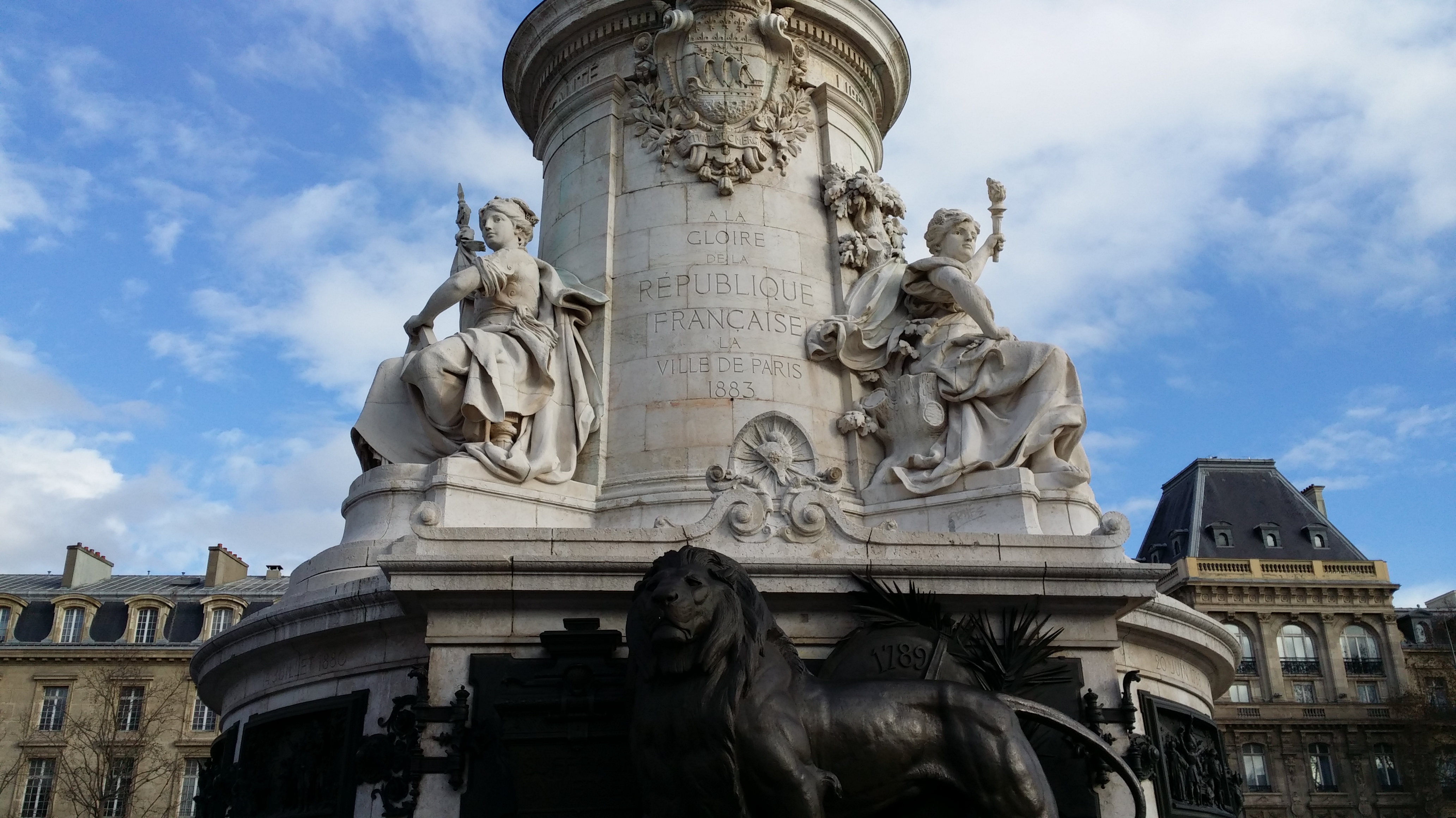
Searching for locations: Paris, France: Place de la Republique

Whilst a rather important place for the French, for us visitors, it has a convenient hotel located just behind the square, and an underground, or Metro station, underneath.

2014-01-07 11.43.05

Added to that was equally convenient cafes, one of which, The Cafe Republique, we had dinner every night.  The service and food were excellent, and we had no problems with the language barriers.

At the top of the monument is a bronze statue of Marianne, said to be the personification of France.

2014-01-07 11.43.41

Surrounding Marianne is three more statues, representing liberty, equality, and fraternity.

2014-01-07 11.43.32

At the base is a lion guarding what is said to be a ballot box.