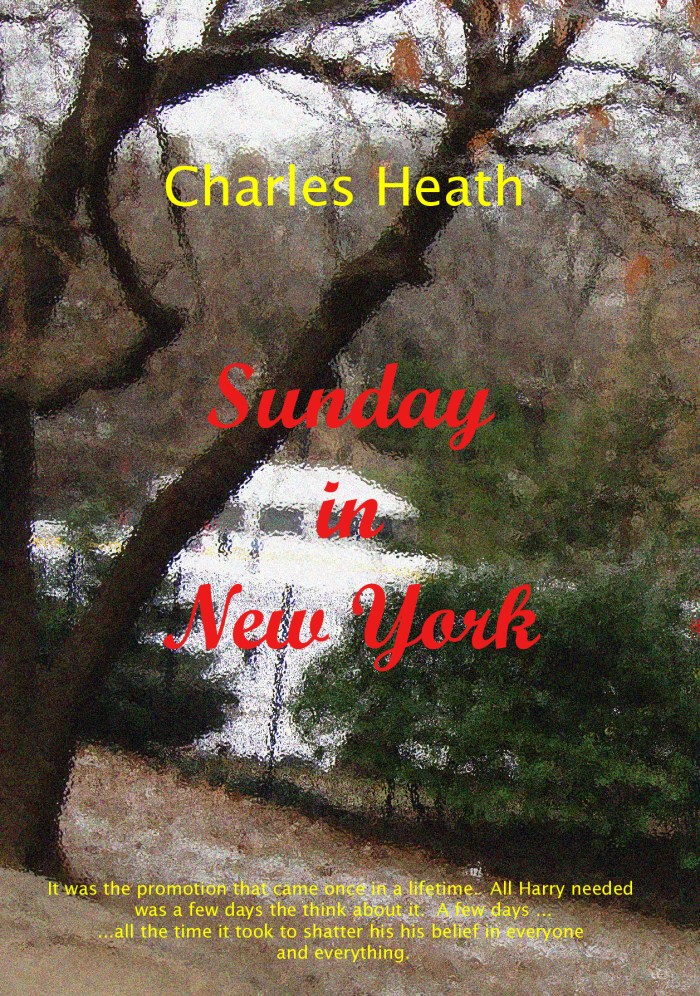
“Sunday in New York”, it’s a bumpy road to love

“Sunday in New York” is ultimately a story about trust, and what happens when a marriage is stretched to its limits.

When Harry Steele attends a lunch with his manager, Barclay, to discuss a promotion that any junior executive would accept in a heartbeat, it is the fact his wife, Alison, who previously professed her reservations about Barclay, also agreed to attend, that casts a small element of doubt in his mind.

From that moment, his life, in the company, in deciding what to do, his marriage, his very life, spirals out of control.

There is no one big factor that can prove Harry’s worst fears, that his marriage is over, just a number of small, interconnecting events, when piled on top of each other, points to a cataclysmic end to everything he had believed in.

Trust is lost firstly in his best friend and mentor, Andy, who only hints of impending disaster, Sasha, a woman whom he saved, and who appears to have motives of her own, and then in his wife, Alison, as he discovered piece by piece damning evidence she is about to leave him for another man.

Can we trust what we see with our eyes or trust what we hear?

Haven’t we all jumped to conclusions at least once in our lives?

Can Alison, a woman whose self-belief and confidence is about to be put to the ultimate test, find a way of proving their relationship is as strong as it has ever been?

As they say in the classics, read on!

Purchase:

http://tinyurl.com/Amazon-SundayInNewYork

A to Z Challenge 2020 – A is for: A funny thing happened…

A2020

There was no doubt the morning was going to end badly.

After all, it started with a bang, yes, a bang. That was the power meter blowing up. The sixty-year-old electrical wiring had finally given out. Or was it the three power boards running out of the single outlet attach to twelve different appliances?

It didn’t matter. No hot water, so no shower. No kettle or toaster, so no breakfast, unless you call a so-called power bar breakfast.

No phone, for that matter, to ring the electrician, and, yes, I forgot to charge my mobile phone, and now the power is out…

1% battery left. I try to dial the number and it dies.

So, on my way to work, a funny thing happened…

I ran into an old school friend I hadn’t seen for years, and probably never would, living just up the road. I’d left a half-hour earlier than usual, and I discovered she always left at that time. Came home later, too.  That’s why I’d never seen her.

Perhaps there is such a thing as a ‘silver lining’.


© Charles Heath 2020

An excerpt from “The Devil You Don’t”

Available on Amazon Kindle here:  https://amzn.to/2Xyh1ow


By the time I returned to the Savoie, the rain had finally stopped, and there was a streak of blue sky to offer some hope the day would improve.

The ship was not crowded, the possibility of bad weather perhaps holding back potential passengers.  Of those I saw, a number of them would be aboard for the lunch by Phillippe Chevrier.  I thought about it, but the Concierge had told me about several restaurants in Yvoire and had given me a hand-drawn map of the village.  I think he came from the area because he spoke with the pride and knowledge of a resident.

I was looking down from the upper deck observing the last of the boarding passengers when I saw a woman, notable for her red coat and matching shoes, making a last-minute dash to get on board just before the gangway was removed.  In fact, her ungainly manner of boarding had also captured a few of the other passenger’s attention.  Now they would have something else to talk about, other than the possibility of further rain.

I saw her smile at the deckhand, but he did not smile back.  He was not impressed with her bravado, perhaps because of possible injury.  He looked at her ticket then nodded dismissively, and went back to his duties in getting the ship underway.  I was going to check the departure time, but I, like the other passengers, had my attention diverted to the woman in red.

From what I could see there was something about her.  It struck me when the light caught her as she turned to look down the deck, giving me a perfect profile.  I was going to say she looked foreign, but here, as in almost anywhere in Europe, that described just about everyone.  Perhaps I was just comparing her to Phillipa, so definitively British, whereas this woman was very definitely not.

She was perhaps in her 30’s, slim or perhaps the word I’d use was lissom, and had the look and manner of a model.  I say that because Phillipa had dragged me to most of the showings, whether in Milan, Rome, New York, London, or Paris.  The clothes were familiar, and in the back of my mind, I had a feeling I’d seen her before.

Or perhaps, to me, all models looked the same.

She looked up in my direction, and before I could divert my eyes, she locked on.  I could feel her gaze boring into me, and then it was gone as if she had been looking straight through me.  I remained out on deck as the ship got underway, watching her disappear inside the cabin.  My curiosity was piqued, so I decided to keep an eye out for her.

I could feel the coolness of the air as the ship picked up speed, not that it was going to be very fast.  With stops, the trip would take nearly two hours to get to my destination.  It would turn back almost immediately, but I was going to stay until the evening when it returned at about half eight.  It would give me enough time to sample the local fare, and take a tour of the medieval village.

Few other passengers ventured out on the deck, most staying inside or going to lunch.  After a short time, I came back down to the main deck and headed forward.  I wanted to clear my head by concentrating on the movement of the vessel through the water, breathing in the crisp, clean air, and let the peacefulness of the surroundings envelope me.

It didn’t work.

I knew it wouldn’t be long before I started thinking about why things hadn’t worked, and what part I played in it.  And the usual question that came to mind when something didn’t work out.  What was wrong with me?

I usually blamed it on my upbringing.

I had one of those so-called privileged lives, a nanny till I was old enough to go to boarding school, then sent to the best schools in the land.  There I learned everything I needed to be the son of a Duke, or, as my father called it in one of his lighter moments, nobility in waiting.

Had this been five or six hundred years ago, I would need to have sword and jousting skills, or if it had been a few hundred years later a keen military mind.  If nothing else I could ride a horse, and go on hunts, or did until they became not the thing to do.

I learned six languages, and everything I needed to become a diplomat in the far-flung British Empire, except the Empire had become the Commonwealth, and then, when no-one was looking, Britain’s influence in the world finally disappeared.  I was a man without a cause, without a vocation, and no place to go.

Computers were the new vogue and I had an aptitude for programming.  I guess that went hand in hand with mathematics, which although I hated the subject, I excelled in.  Both I and another noble outcast used to toss ideas around in school, but when it came to the end of our education, he chose to enter the public service, and I took a few of those ideas we had mulled over and turned them into a company.

About a year ago, I was made an offer I couldn’t refuse.  There were so many zeroes on the end of it I just said yes, put the money into a very grateful bank, and was still trying to come to terms with it.

Sadly, I still had no idea what I was going to do with the rest of my life.  My parents had asked me to come back home and help manage the estate, and I did for a few weeks.  It was as long as it took for my parents to drive me insane.

Back in the city, I spent a few months looking for a mundane job, but there were very few that suited the qualifications I had, and the rest, I think I intimidated the interviewer simply because of who I was.  In that time I’d also featured on the cover of the Economist, and through my well-meaning accountant, started involving myself with various charities, earning the title ‘philanthropist’.

And despite all of this exposure, even making one of those ubiquitous ‘eligible bachelor’ lists, I still could not find ‘the one’, the woman I wanted to spend the rest of my life with.  Phillipa seemed to fit the bill, but in time she proved to be a troubled soul with ‘Daddy’ issues.  I knew that in building a relationship compromise was necessary, but with her, in the end, everything was a compromise and what had happened was always going to be the end result.

It was perhaps a by-product of the whole nobility thing.  There was a certain expectation I had to fulfill, to my peers, contemporaries, parents and family, and those who either liked or hated what it represented.  The problem was, I didn’t feel like I belonged.  Not like my friend from schooldays, and now obscure acquaintance, Sebastian.  He had been elevated to his Dukedom early when his father died when he was in his twenties.  He had managed to fade from the limelight and was rarely mentioned either in the papers or the gossip columns.  He was one of the lucky ones.

I had managed to keep a similarly low profile until I met Phillipa.  From that moment, my obscurity disappeared.  It was, I could see now, part of a plan put in place by Phillipa’s father, a man who hogged the limelight with his daughter, to raise the profile of the family name and through it their businesses.  He was nothing if not the consummate self-advertisement.

Perhaps I was supposed to be the last piece of the puzzle, the attachment to the establishment, that link with a class of people he would not normally get in the front door.  There was nothing refined about him or his family, and more than once I’d noticed my contemporaries cringe at the mention of his name, or any reference of my association with him.

Yet could I truthfully say I really wanted to go back to the obscurity I had before Phillipa?  For all her faults, there were times when she had been fun to be with, particularly when I first met her when she had a certain air of unpredictability.  That had slowly disappeared as she became part of her father’s plan for the future.  She just failed to see how much he was using her.

Or perhaps, over time, I had become cynical.

I thought about calling her.  It was one of those moments of weakness when I felt alone, more alone than usual.

I diverted my attention back to my surroundings and the shoreline.  Out of the corner of my eye, I could see the woman in the red coat, making a move.  The red coat was like a beacon, a sort of fire engine red.  It was not the sort of coat most of the women I knew would wear, but on her, it looked terrific.  In fact, her sublime beauty was the one other attribute that was distinctly noticeable, along with the fact her hair was short, rather than long, and jet black.

I had to wrench my attention away from her.

A few minutes later several other passengers came out of the cabin for a walk around the deck, perhaps to get some exercise, perhaps checking up on me, or perhaps I was being paranoid.  I waited till they passed on their way forward, and I turned and headed aft.

I watched the wake sluicing out from under the stern for a few minutes, before retracing my steps to the front of the ship and there I stood against the railing, watching the bow carve its way through the water.  It was almost mesmerizing.  There, I emptied my mind of thoughts about Phillipa, and thoughts about the woman in the red coat.

Until a female voice behind me said, “Having a bad day?”

I started, caught by surprise, and slowly turned.  The woman in the red coat had somehow got very close me without my realizing it.  How did she do that?  I was so surprised I couldn’t answer immediately.

“I do hope you are not contemplating jumping.  I hear the water is very cold.”

Closer up, I could see what I’d missed when I saw her on the main deck.  There was a slight hint of Chinese, or Oriental, in her particularly around the eyes, and of her hair which was jet black.  An ancestor twice or more removed had left their mark, not in a dominant way, but more subtle, and easily missed except from a very short distance away, like now.

Other than that, she was quite possibly Eastern European, perhaps Russian, though that covered a lot of territory.  The incongruity of it was that she spoke with an American accent, and fluent enough for me to believe English was her first language.

Usually, I could ‘read’ people, but she was a clean slate.  Her expression was one of amusement, but with cold eyes.  My first thought, then, was to be careful.

“No.  Not yet.”  I coughed to clear my throat because I could hardly speak.  And blushed, because that was what I did when confronted by a woman, beautiful or otherwise.

The amusement gave way to a hint of a smile that brightened her demeanor as a little warmth reached her eyes.  “So that’s a maybe.  Should I change into my lifesaving gear, just in case?”

It conjured up a rather interesting image in my mind until I reluctantly dismissed it.

“Perhaps I should move away from the edge,” I said, moving sideways until I was back on the main deck, a few feet further away.  Her eyes had followed me, and when I stopped she turned to face me again.  She did not move closer.

I realized then she had removed her beret and it was in her left side coat pocket.  “Thanks for your concern …?”

“Zoe.”

“Thanks for your concern, Zoe.  By the way, my name is John.”

She smiled again, perhaps in an attempt to put me at ease.  “I saw you earlier, you looked so sad, I thought …”

“I might throw myself overboard?”

“An idiotic notion I admit, but it is better to be safe than sorry.”

Then she tilted her head to one side then the other, looking intently at me.  “You seem to be familiar.  Do I know you?”

I tried to think of where I may have seen her before, but all I could remember was what I’d thought earlier when I first saw her; she was a model and had been at one of the showings.  If she was, it would be more likely she would remember Phillipa, not me.  Phillipa always had to sit in the front row.

“Probably not.”  I also didn’t mention the fact she may have seen my picture in the society pages of several tabloid newspapers because she didn’t look the sort of woman who needed a daily dose of the comings and goings, and, more often than not, scandal associated with so-called celebrities.

She gave me a look, one that told me she had just realized who I was.  “Yes, I remember now.  You made the front cover of the Economist.  You sold your company for a small fortune.”

Of course.  She was not the first who had recognized me from that cover.  It had raised my profile considerably, but not the Sternhaven’s.  That article had not mentioned Phillipa or her family.  I suspect Grandmother had something to do with that, and it was, now I thought about it, another nail in the coffin that was my relationship with Phillipa.

“I wouldn’t say it was a fortune, small or otherwise, just fortunate.”  Each time, I found myself playing down the wealth aspect of the business deal.

“Perhaps then, as the journalist wrote, you were lucky.  It is not, I think, a good time for internet-based companies.”

The latter statement was an interesting fact, one she read in the Financial Times which had made that exact comment recently.

“But I am boring you.”  She smiled again.  “I should be minding my own business and leaving you to your thoughts.  I am sorry.”

She turned to leave and took a few steps towards the main cabin.

“You’re not boring me,” I said, thinking I was letting my paranoia get the better of me.  It had been Sebastian on learning of my good fortune, who had warned me against ‘a certain element here and abroad’ whose sole aim would be to separate me from my money.  He was not very subtle when he described their methods.

But I knew he was right.  I should have let her walk away.

She stopped and turned around.  “You seem nothing like the man I read about in the Economist.”

A sudden and awful thought popped into my head.  Those words were part of a very familiar opening gambit.  “Are you a reporter?”

I was not sure if she looked surprised, or amused.  “Do I look like one?”

I silently cursed myself for speaking before thinking, and then immediately ignored my own admonishment.  “People rarely look like what they are.”

I saw the subtle shake of the head and expected her to take her leave.  Instead she astonished me.

“I fear we have got off on the wrong foot.  To be honest, I’m not usually this forward, but you seemed like you needed cheering up when probably the opposite is true.  Aside from the fact this excursion was probably a bad idea.  And,” she added with a little shrug, “perhaps I talk too much.”

I was not sure what I thought of her after that extraordinary admission. It was not something I would do, but it was an interesting way to approach someone and have them ignoring their natural instinct.  I would let Sebastian whisper in my ear for a little longer and see where this was going.

“Oddly enough, I was thinking the same thing.  I was supposed to be traveling with my prospective bride.  I think you can imagine how that turned out.”

“She’s not here?”

“No.”

“She’s in the cabin?”  Her eyes strayed in that direction for a moment then came back to me.  She seemed surprised I might be traveling with someone.

“No.  She is back in England, and the wedding is off.  So is the relationship.  She dumped me by text.”

OK, why was I sharing this humiliating piece of information with her?  I still couldn’t be sure she was not a reporter.

She motioned to an empty seat, back from the edge.  No walking the plank today.  She moved towards it and sat down.  She showed no signs of being cold, nor interested in the breeze upsetting her hair.  Phillipa would be having a tantrum about now, being kept outside, and freaking out over what the breeze might be doing to her appearance.

I wondered, if only for a few seconds if she used this approach with anyone else.  I guess I was a little different, a seemingly rich businessman alone on a ferry on Lake Geneva, contemplating the way his life had gone so completely off track.

She watched as I sat at the other end of the bench, leaving about a yard between us.  After I leaned back and made myself as comfortable as I could, she said, “I have also experienced something similar, though not by text message.  It is difficult, the first few days.”

“I saw it coming.”

“I did not.”  She frowned, a sort of lifeless expression taking over, perhaps brought on by the memory of what had happened to her.  “But it is done, and I moved on.  Was she the love of your life?”

OK, that was unexpected.

When I didn’t answer, she said, “I am sorry.  Sometimes I ask personal questions without realizing what I’m doing.  It is none of my business.”  She shivered.  “Perhaps we should go back inside.”

She stood, and held out her hand.  Should I take it and be drawn into her web?  I thought of Sebastian.  What would he do in this situation?

I took her hand in mine and let her pull me gently to my feet.  “Wise choice,” she said, looking up at the sky.

It just started to rain.


© Charles Heath 2015-2020

newdevilcvr6

I’ve always wanted to go on a Treasure Hunt – Part 37

Here’s the thing…

Every time I close my eyes, I see something different.

I’d like to think the cinema of my dreams is playing a double feature but it’s a bit like a comedy cartoon night on Fox.

But these dreams are nothing to laugh about.

Once again there’s a new installment of an old feature, and we’re back on the treasure hunt.


I took a moment longer to study the differences in the maps, trying to see what our edge was.

“So, according to this map, Alex would be looking for a stretch of shore with two rivers going inland, which you say are no longer there.”

“I do because they’re not.  Well, they’re not visible these days from the seaward side, and not really visible from shore either because I think one of the two might have started where the mini marina is.”

The mini marina wasn’t as marina as such, rather an area of seawater surrounded by a promenade with a bridge over the entrance from the ocean, and a lot of expensive Italian tiles.  It was part of the redevelopment of the old marina when the shopping mall had been built.

“Wasn’t that the old marina, which was part of the old navy yard for PT boats?”

Everyone knew the potted history of the town and the navy yard that put it briefly on the map.  There had been an inlet where a marina was built in the early days.  Then with war looming, the navy was looking for a place to build PT boats, carry out repairs to medium-sized warships, and train PT crews.

“One and the same.  There’s very little in the archives about what happened back then, but I did manage to find a document, mentioned in my father’s notebook, about the navy set up a base.  Attached to it was a geological report that stated two facts, the first, they would be building over a watercourse which at the time was believed to be underground, and secondly, deep foundations would be required.  In the event all of it was ignored, they built the port and it was operational up until the end of the war.”

After which as everyone knew they shut the facility down, put up fences and signs with the words hazardous and dangerous, and trespassers would be shot, and it sat there like a festering eyesore until a plan was mooted to turn the site into a mall.

It was a favorite place for us children to go and play, having the fearless mentality that every child was born with.  Yes, there were hazards on the grounds, in for form of rusting metal and hundreds of barrels holding what must have been hazardous material, but best of all, there were two nearly intact boats moored there, and I remembered being captain at least once on a vessel that had taken on everything the enemy had.

“And then they built a mall.”

He nodded.  “My father always said that it was doomed to failure. There’s a section in his notebook about an earlier plan to rebuild the marina with facilities to repair those new larger ocean-going yachts that proliferate in Bermuda and places like that, only he couldn’t find anyone to back the project.  The Benderby’s at the time didn’t like the idea, and since they basically owned the town nothing was going to happen without their approval.”

The mall, however, was something the Benderby’s could get their hooks into, in the building of it, then a slice of every business that moved in.  It would also be good for employment, and people employed mean customers for their other criminal activities.  Deals were made with the Cossatino’s and everyone was happy.  For a few years anyway.

That’s when a newspaper expose on the mall was published.

Exposes were never plucked out of thin air and presented, there had to be a catalyst.  There had been allegations of corruption regarding all aspects of the mall, from planning through the opening day, and especially in the building.  Allegations of payoffs to get approvals, substandard materials used, and the worst allegation, that the builder had not properly cleaned up the site before building commenced.

All of this came to a head when, not long after the tenth anniversary of opening, large cracks started to appear in the floors and walls, so bad that nearly half the mall, that part that had been built over the old navy base, had to be closed, and now was in danger of collapse.

The mini marina, the focal point for the mall, had also been closed because the pool had become polluted from the old navy base waste that had been improperly disposed of in the foundations rather than being properly removed and stored in a special dump.  But there had also been other problems like excess water continuously flooding the lower level carparks, and flowing into the sea pool making it unusable, and at times, very smelly.

Boggs’s father had discovered at the same time as his research for the treasure maps, that the water came from the underground river that had been mentioned in the geological report made before the naval base had been built.  Just because it hadn’t been there at the time, didn’t mean it wasn’t there at all.  It just depended on rainfall back up in the hills, and the year the problems started for the mall coincided with the wettest period for the area in more than 50 years.

His father’s notebook was a goldmine of information, Boggs said.

“It appears there was a lake right where the map says it was, about a hundred years ago.  Since then an earthquake caused a fault line that drained the lake and makes a river instead.  That river ran from the hills to the sea.  Until someone decided to build on the old lake, raised the level and piped the river underground, and drawing from it for the towns and sounding areas water supply.  That in effect reduced the water flow from the lake to the sea to a trickle, or rather a stream.

“But every now and then when it rains heavily and for a long period, the stream becomes a river, and it backs up until with nowhere else to go, it floods the mall carparks.  The lowest level carpark is actually the lowest depth of the river, and it comes out at the sea where the pool now is.  Unfortunately, with the old naval waste rotting in those old rusting barrels, it collects that waste and not only stinks up the mall but also the pool area which is why it’s now closed.

“And the bad news is, it can’t be fixed.  But that’s got nothing to do with our quest.  It’s just an aside to our quest, proving that three of the landmarks on the treasure map actually existed once, and in some form still do.  The thing is, neither the Benderby’s or the Cossatino’s will realize that which means we have a clear run at getting past the first hurdle and with any luck we will be able to identify the river from the hills which is the starting point.”

A simple job, no doubt in Boggs’s mind.  He never had any trouble coming up with hair-brained schemes, only the logistics to carry them out.  This one required proper transport because there was no way we’re going to be able to cycle there and back in a morning, the only time I had free for exploring.

“How do you propose we do this?”

“Rico’s car.  It’s sitting in the marina carpark.  The keys for it are on his boat.”

“Do you know how to drive?”

“I’ve had a few lessons.  How hard could it be?”

Ⓒ Charles Heath 2020

It was the end of the month

But in all the confusion, it slipped into April 1.

It’s time for the April fool jokes to happen, though anything like that, in this current climate of a pandemic, could not be excused as ‘I only wanted to cheer people up’.

If you wanted to do that, they could find a cure for this virus.

So, if you had asked me even a month ago how I would be feeling right now, it would be nothing like what I feel now.

Scared.

It’s not something that I have felt in a long time and never expected to for another 10 years at least, because I always thought I’d get to 75 at least.

That’s all out the window.  If I get the coronavirus, it’s going to be interesting.  I have underlying issues, not life-threatening if there was no virus, but, with the virus, well, this is not the time to go there.

Nor would I have thought that it would be strongly suggested I didn’t leave home unless I had a very good excuse.  Like buying food,  Sadly, we did not join all the other panic buyers and hoard, we still have to make a weekly shop.  Then there are the medicines, but that’s once every three to four weeks.

What am I complaining about?

There’s now plenty of time to write, time to do that gardening, time to do a few repairs around the house,  time to talk to your significant other, and time to torture the car.

Perhaps the last one holds some appeal, or perhaps it’s the other way around.

There’s time to read, too, and I have a library of over 3,000 books.  The problem is I can’t make up my mind what to read first.

So much time, so hard to make a decision.

Instead, I watch the COVID 19 statistics continually updating, looking for signs its abating.  There are none, 805,000 cases, and 39,654 deaths just ticked over.

I keep hearing the worst is yet to come.

It’s just one 1 am here, so I think I’ll go to bed.  Things have to be better tomorrow.

Don’t’ they?”

The thing about ‘must read’ lists

And that is, you don’t have to read any of the books on it.

Who really cares if you do or if you don’t?

It’s just a list of books that a particular writer, journalist, or editor puts together simply because they liked them and think you might also.

And sometimes weight of sales numbers will dictate popularity, and therefore some basis to any particular list.

Of course, this doesn’t work if all you read is comics or romance books like Mills and Boon.  Hey, that’s fine.  You’re reading and this is one of the most important aspects of life, to read, and sometimes, to learn.

I know that my life changed dramatically when I read books, lots of different sorts of books.  I’ve never recommended anyone read the dry, dusty tomes about neurosis for psychiatry, or a history of the Roman Empire simply because of it something I was interested in after I saw the film, Ben Hur.

In a similar manner when we go to school, the curriculum sometimes dictates we read certain books, whether this is to give us an understanding of life centuries before, or that there is some deeper, more sinister, meaning to it all, but some of those books I had to read, back then, the meaning was lost on me.

But should I not read them?  I know most of the kids in the class didn’t because they considered reading a waste of time.  There were more important things to do like chase girls and play a sport.  And torment the teachers.  From what I hear, little has changed.

But the point here is, in my case, I’m just giving you the drum on what I read to improve my literary understanding, of life, and of the world, and perhaps in a small way, help with my writing.  After all, writers must read, particularly in their genre so they have some idea of what readers want.

But again that two-word phrase ‘Must read’ is an unfortunate and often misused heading.  We do it all the time.  Ten films you ‘must-see’, ten things you ‘must-have’, ten places you ‘must go’ usually before you die.

It amuses me to see books with a 1000 somethings you must do before you die.  I will no doubt be well and truly dead before I get halfway through even one of those lists, that is, if I actually took any notice of them.

But, what’s more interesting is that I like to see how many I haven’t done, which is probably the reason why we buy the book, usually off the sale table.

In a word: Joe

Aside from being the short form of the name Joseph, ie a man’s name, there is also a derivative for women, Jo.

The name Joe is said to be used from the mid-1800s.

My favourite Joe name is Joe Bloggs, and he features in some of my stories.

It’s anonymous enough for someone to use as a cover when booking into a sleazy motel and is a little more refined than Smith or Jones, names that more than likely already feature in the register.

Jo could be a short form for Josephine, a name I’m sure some women would prefer not to be called.

But…

Did you know it’s also a name given to a cup of coffee?

Well, that didn’t make much of a splash.  I don’t think anyone these days refers to coffee as Joe because there are so many different variations with names I couldn’t pronounce let alone spell, I think it’s been lost in the mists of time because there was only one type of coffee.

It was called coffee.  Funny about that.

However…

There is another definition, and that is for the ‘average Joe’, an ordinary fellow who works for a living.

Odd, because I thought that was what most of us did, but perhaps it refers to tradespeople, or blue collar workers, not the white collar brigade.

Hang on, isn’t there a GI Joe, a universal description of the average soldier?

Conversations with my cat – 92

20160922_162007

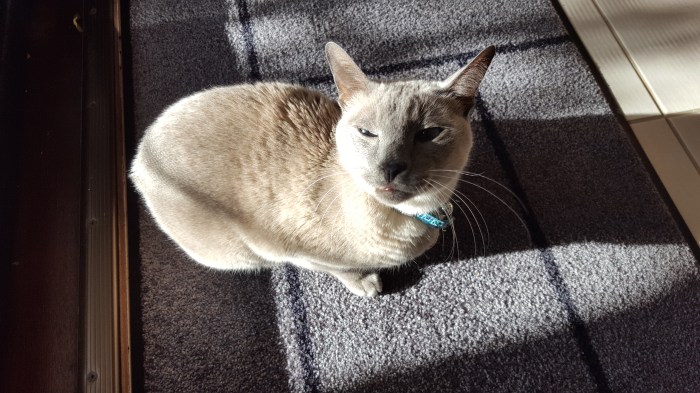
This is Chester.  He’s been missing a lot.

It’s the confined to quarters thing he doesn’t understand.  We had the discussion about the coronavirus, and the need to stay at home and only go out when there is a reason to go out, like to get food.

Which brought up another concern that he didn’t let go of,  that he didn’t think we had enough cat food or cat litter, or treats, though he didn’t define what he meant by treats.

I assumed it was real fish.

I didn’t tell him that it was a treat for us too, the cost of Barramundi and Salmon just a little expensive for pensioners.

Not that he remembered that we have been pensioners since April last year.

I swear that cat is getting more forgetful.  And, yes, that was another heated debate, whether he was getting dementia.

So, now he’s been taking to his hiding places, and keeping away from me, coming out only to get a pat or two from my other half, and give me the daggers look.  And eat, though some nights he turns his nose up at it.

You can tell his displeased because some of it ends up in his water bowl, and then sits by the water bowl and moans and groans till the water’s replaced.

I swear I’m going to go bonkers if we are forced to stay in the same place much longer.

His annual visit to the vet is coming up, and maybe I can get something for his grumpiness.