In a word: High or is it hie

When the boss says jump, the question is usually ‘how high’.

Not that it’s possible for many of us with a challenging centre of gravity to get much elevation.

High generally means height, how far something rises above ground level, is above our heads.

That plane flies very high in the sky.

Then there’s another meaning, increased intensity, such as a high temperature, a high fever, but my favourite is, a high dudgeon.

I’m still to get a definition on what a dudgeon is.

We have secondary schools here that we call high schools. Make of that what you will

And in the idiomatic world, flying high means we are very happy, and when were left high and dry then not so much. Unless it related to a ship, in which case a lot of people would be unhappy.

We can use high just about everywhere, high hopes, high ceilings, feelings that run high, a high chair for toddlers of course, high speed which may cause s crash and land you in a high security prison.

This is not to be confused with just plain hi which is a universal greeting.

But there is another, hie, which has a more obscure meaning, to hasten or go quickly.

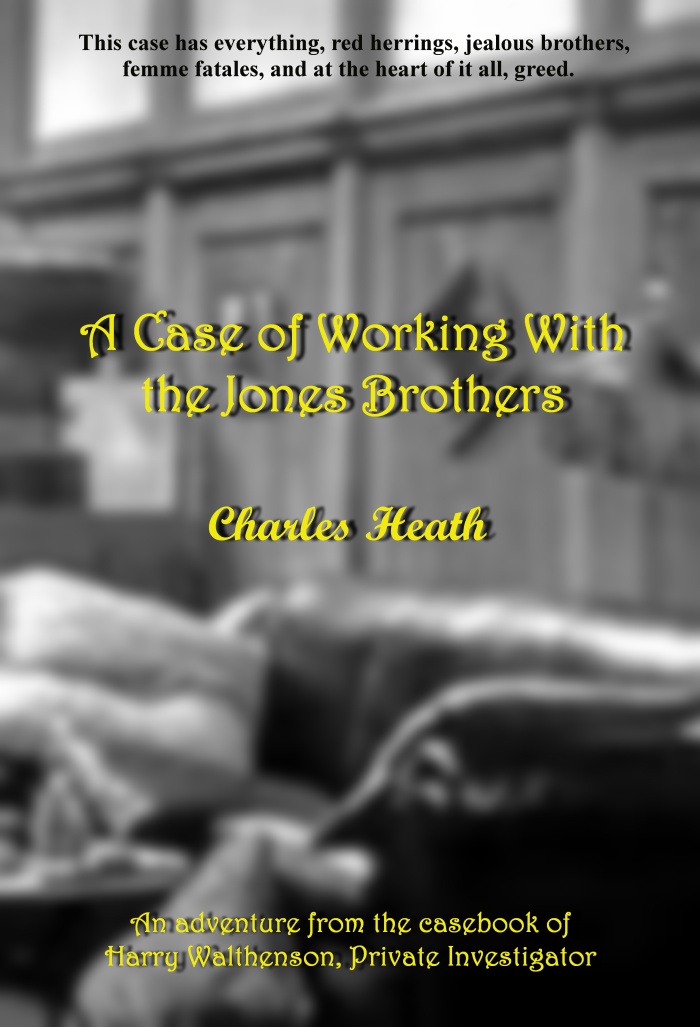
The first case of PI Walthenson – “A Case of Working With the Jones Brothers”

This case has everything, red herrings, jealous brothers, femme fatales, and at the heart of it all, greed.

Coming soon!

PIWalthJones1

I’ve been thinking…

And probably it is a matter of being better off not thinking, but

I’m sitting here and writing a piece for a novel about one of my characters, and all of a sudden I stop, right in the middle of where he’s about to get violently murdered if he lets his guard down.

Why have I stopped right there?

A strange through goes through my mind.

Did he remember to have breakfast, did he make the bed and tidy up after he got up?  Did he have to arrange to have his clothes cleaned, or were they cleaned for him?

Does he have a maid and a butler and a cook to do all those things?

The problem is, we don’t know what happened before he finished up in that precarious position.

We may know that he was taught to fight by a sen master, a swordsman, though I’m not sure if there is a requirement for fencing, to drive defensively, to kill people in more ways than you’ve had different dinners.

We may know that he was in a similar fight the day before, and his energy has been depleted and may be running on painkilling drugs.  Of course, if that’s the case, and knowing the side effect of some of those drugs, he may be impaired, and slower in reaction time, which might mean premature death.

But we don’t know if he ate anything, whether he slept well, or not at all (though sometimes it rates a mention more often than not as an afterthought or an excuse), whether he has any distracting thoughts, like what the hell am I doing here?

Everyday things which all of us, and I’m sure even the most successful of spies, have to deal with.

Just a thought.

Back to the fight, yes he wins, got a couple of slashed and there’s a copious amount of blood on his shirt.

Let’s not worry about whose going to clean up the mess, or do the washing.

A few running repairs with needle and thread, including the requisite grimaces in pain, someone else will clean the shirt, and yes, there’s always a cupboard full of clean clothes to change into.

Moving on…

All I wanted was a cup of coffee

How can something so simple become so complicated and complex?

In New York, it seemed impossible to get exactly what you would like.  The coffee there is driven by what the machine interprets you want, aside from the language constraints due to the fact that English (or American) comes in a zillion different flavours.

So, what do I like (you notice I don’t say ‘want’)

A double shot Latte with two sugars and half a shot of vanilla.  That’s in a large cup.

As we all know coffee can come in a regular, large, or extra-large cup, but, hang on, these cup sizes sometimes have names, and you need to know what these names are.

My efforts of pointing to the cup size in New York often had horrendous consequences, when the cup piles were close together.  Sometimes it was a double shot in a regular, and a single shot in an extra-large cup.

One even had the name benti, or bento, or something like that.

Being old and decrepit, my memory for cup sizes isn’t all that great, so using a name in one shop that doesn’t have that size, well, you get it.

It seems not only coffee makers in New York have a problem producing consistent coffee.

Perhaps, then that’s half the charm of drinking it, the fact that no cup is ever the same.

And, when an outlet gets it right, finally, they go and change the coffee bean supplier, and all of a sudden, it’s bitter, or it’s lighter, as coffee shops try to reduce their costs and maximise profits.

Six dollars is a lot of money for a cup of coffee unless of course, you have to feed that addiction in which case, you’ll have a cup at whatever the cost.

I need coffee right now, so its off te the cupboard to see what’s available.

Maccona instant, which is not bad

A Nespresso long black – ok, don’t get me started with Nespresso because they have numbers from 1 to 12, possibly more, recognising strengths, and I usually have a double shot using a 10 and a 12.

And, yes, they fool around with the type of beans they use because there seem to be inconsistencies in potency from time to time.

Then there’s coffee bags, much the same as tea bags, which produces and interestingly flavoured brew which I’m still trying to figure out.  It tastes like coffee, but there’s something else there, like … paper?

I opt for an instant.

Yes, I needed a coffee after writing this.

“The Things We Do For Love” – Coming soon

Is love the metaphorical equivalent to ‘walking the plank’; a dive into uncharted waters?

For Henry the only romance he was interested in was a life at sea, and when away from it, he strived to find sanctuary from his family and perhaps life itself.  It takes him to a small village by the sea, s place he never expected to find another just like him, Michelle, whom he soon discovers is as mysterious as she is beautiful.

Henry had long since given up the notion of finding romance, and Michelle couldn’t get involved for reasons she could never explain, but in the end both acknowledge that something happened the moment they first met.  

Plans were made, plans were revised, and hopes were shattered.

A chance encounter causes Michelle’s past to catch up with her, and whatever hope she had of having a normal life with Henry, or anyone else, is gone.  To keep him alive she has to destroy her blossoming relationship, an act that breaks her heart and shatters his.

But can love conquer all?

It takes a few words of encouragement from an unlikely source to send Henry and his friend Radly on an odyssey into the darkest corners of the red light district in a race against time to find and rescue the woman he finally realizes is the love of his life.

The cover, at the moment, looks like this:

lovecoverfinal1

A few random thoughts

It’s interesting what children are being taught these days as distinct from how we were all those years ago.

I went to school over 50 years ago, and we were predominantly taught arithmetic, which is now called maths, English, which was how to write properly, and spell words, and read from specified school texts rather than mainstream writers, geography, which was predominantly about the British Commonwealth, History, which was predominantly British history, and just a little about our own country, Australia, music, which we all hated, especially if we were picked for the school choir, and some other subjects I don’t remember.

Now, it seems there’s a different slant of how children learn the basics, and what I find is how English, written and spelt, is taught.  When you see the standard of the work being produced as a result of this teaching, you would throw your hands up in disgust.

And spelling, they spell the words the way they sound.  I mean, really?

Is it any wonder that when you listen to a teenagers conversation, if you can get them off their phones long enough, there are more ‘like’ and ‘but’ scatted through the sentence, and sadly, in a lot of cases, expletives.

Discipline and behaviour were very high priorities back then, too.

Primary education in our days was a perfect grounding for what came next, secondary school.  In primary school we were taught the values of discipline, there were no rowdy kids or any form of bad behaviour.  It just wasn’t tolerated.  That discipline started to slip as we entered secondary school, you know, slowly turning into smart arses as teenagers do, but discipline was enforced, and getting punished for bad behaviour was a definite deterrent.

I know, I was at the end of it quite a few times in my illustrious school days.

But I learned a great deal.

But the reason for this is the news my granddaughter came home with, where one member of her class deliberately set out to wreck their project simply because he hadn’t done one.  Spite, or jealousy?  Definitely bad behaviour, in our time, that kid would be front and centre at the headmaster’s office, handed a form of corporal punishment, and then expelled, or if not, sent home for a week to ponder his options.

The end result of this event, he earned some remedial classes.

That behaviour in schools is widely spread, and symptomatic of today’s society where parents are more preoccupied with their own problems which is the ground zero for the general bad behaviour of our youth.  No discipline and no consequences for their actions, either at home or at school.  How do expect to maintain law and order when a whole generation has no idea what law and order is?

At least, in this country, that wretched child can’t get his hands on a gun and go to the school and start shooting people.  For that, I guess, we should be grateful.
There are few words that are so universally noncommittal as ‘maybe’

This word, where I live, had taken on a new meaning.  We have telephone scammers who ask your name when you answer the phone, and when you say yes, they hang up.

It doesn’t take much imagination to consider how they can use that recording.

So, I now answer the phone with ‘maybe’, which confuses the real callers who want to know if it is you.

Of course, ‘maybe’ is one of those words that can have so many meaning, but the best one is to use it while you have time to think of a proper answer.

For example, did you get the potatoes?  You haven’t been out, it slipped your mind, or you just plain forgot, but run with a ‘maybe’ so you can judge the reaction.

Angry face, you know no matter what, you’re in trouble.

Genial face, you know that it didn’t really matter and all is forgiven.

Then there’s the person who doesn’t know you and comes up to you in a crowded room.  Are you [put name here]?

Maybe.  We want to know if we’re in trouble, or if it for something good, or that it is the husband or wife of the person you’ve3 just spent the last twenty minutes in animated conversation with.

Using ‘maybe’ in writing probably isn’t the best word to us, but I like defying the experts.  You can always find a ‘maybe’ or two in any of my books.

“Echoes From The Past”, buried, but not deep enough

What happens when your past finally catches up with you?

Christmas is just around the corner, a time to be with family. For Will Mason, an orphan since he was fourteen, it is a time for reflection on what his life could have been, and what it could be.

Until a chance encounter brings back to life the reasons for his twenty years of self-imposed exile from a life only normal people could have. From that moment Will’s life slowly starts to unravel and it’s obvious to him it’s time to move on.

This time, however, there is more at stake.

Will has broken his number one rule, don’t get involved.

With his nemesis, Eddie Jamieson, suddenly within reach, and a blossoming relationship with an office colleague, Maria, about to change everything, Will has to make a choice. Quietly leave, or finally, make a stand.

But as Will soon discovers, when other people are involved there is going to be terrible consequences no matter what choice he makes.

http://amzn.to/2F7gqAL

newechocover5rs


Conversations with my cat – 49

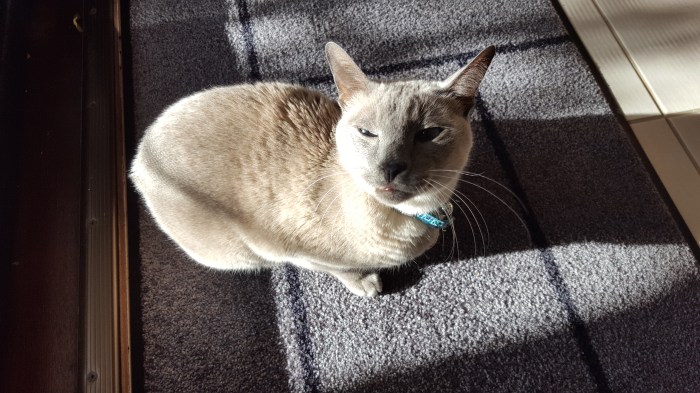
20160922_162007

This is Chester. We are at the delicate stage of peace negotiations.

The ceasefire has been rocky, to say the least.

Blame is being thrown about like confetti at a wedding.

And to top it off, it’s Friday the thirteenth.

Im fuĺly expecting Chester to change his coat to black, and walk in front of my path with an evil grin on his face.

There’s already been signs of his mischievousness.  A long time ago we bought him some fake mice to play with since he didn’t have the inclination to chase the real rodents. Little did we know he had hidden these away, to bring them out on black Friday.

And, sitting on the floor, giving me the death stare, I wonder what his intentions are.

Not good.

So, I ignore him. I go back to the computer and get on with the day’s work. I have episodes to write, some research for a project one of my granddaughters is working on, and a novel in the throes of a third edit.

Still, I can feel those beady eyes drilling into my back.

Enough.

Do what you like, I say, turning suddenly on him, causing him to jump. Just go away and let me get on with my work. Instantly, I realise I’ve lost the battle, as he stands, gives me a final smug look, and leaves the room.

Was that a swagger?

In a word: Dry

We all know what this means, without moisture, in other words not wet.

It could also mean dull factually, as in reading some non-fiction books, and quite often those prescribed as mandatory reading at school.

You could also have a dry sense of humour, where you have to be on your game to understand, or get, the humour.

It could also describe boredom by saying that it’s like watching paint dry.

For those who like a bit of a tipple, the last place you want to go is a dry bar, where no alcohol is served.

Perhaps this should be mandatory for weddings and funerals, places where feelings often run very high and do not need the stimulus of half a dozen double Scotches.

And speaking of alcohol and cider in particular, you can have it sweet, dry, or draft. Many people prefer dry, sometimes the drier the better, especially wine, and oddly martinis.

Aside from whether they are shaken or stirred.

But the most fascinating version of dry is dry cleaning. Just how can you ‘dry’ clean clothes?

Would that be what they call an oxymoron?