Quite often on holidays, we train ourselves to get up early because when you’re away in a different place, you don’t want to waste the day.
I’d like to think that since we can’t do a lot of the usual touristy activities we can sleep in and take a more leisurely approach to the day.
Not this morning.
Not yesterday, either, but for different reasons.
Today, it was the shooting pains down my leg from the bad back. Perhaps that walk to the coffee shop aggravated it, but since when did exercise harm you?
Anyway, finally giving up the notion of sleeping, I bounded out of bed, sorry slowly climbed out of bed with care, at 6:40 a.m. Unless you’re going on a tour that is the greatest thing since sliced bread, who, on holidays, gets out of bed at that hour.
Me, apparently.
Just four minutes after sunrise, which I missed.
I managed to get yesterday’s and was hoping to go one better and catch the sun coming over the horizon. Maybe tomorrow.
So, what do you do in such a hideous hour of the morning?
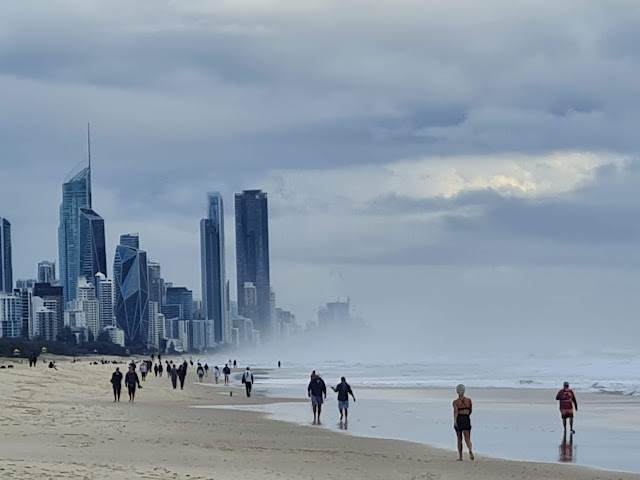
With the beach just 50 meters away, it was beckoning me to take a walk. When I looked, there were probably a half dozen people with their dogs taking a walk. And another three or four out for a power walk.
For me, it was going to be a leisurely stroll after picking my way across the loose sand to where it was a lot more solid.
The tide was on the way in, so every now and then, the water came up the beach near where most people walked.
By the time I started the foot traffic on the path had increased exponentially as had that on the shoreline along with the number of dogs exercising their owners, and a number of fishermen perhaps trying to land a fish for breakfast.
I had time to keep an eye on the cloud formations, and the waves came in, some a lot higher than others. That meant there were also a small number of die-hard surfers hoping to catch a big one.
You could see the rain out to sea, and with the forecast for rain later I entered of it was sitting out there waiting to arrive at the appointed time. I was just hoping it didn’t rain while I was out.
All in all, it was a pleasant hour or so up the beach and back. The hardest part, trudging over the loose sand, particularly after walking for the hour.
The fishermen had caught nothing.
The number of dogs had increased, but the power walkers had been replaced by families, visitors, and older people. I think if I lived here, I would be one more of the old people, out getting my daily exercise, and then stopping off at the coffee shop for a flat white and a cake.
And the best thing about it. It was still only half past eight in the morning and just in time for breakfast.
More Than Just Words: Why We’re All Hungry for Stories
Ever found yourself completely engrossed in a book, a captivating film, or even a friend’s animated anecdote? There’s a reason for that. It’s not just our idle entertainment; it’s a primal, fundamental part of who we are. We are, quite literally, hardwired for stories.
Think about it. From the earliest cave paintings depicting hunts and rituals to the grand epics passed down through generations, humanity has always relied on narrative. It’s how we make sense of the world, how we connect with each other, and how we leave our mark.
The Ancient Art of Immortality
At its core, storytelling is a form of history. It’s how we preserve the experiences, the triumphs, and the struggles of those who came before us. Before written records, oral traditions were the lifeblood of cultures, passing down knowledge, wisdom, and identity. The stories of elders became the lessons for the young, the myths explained the inexplicable, and the legends inspired courage.
But it’s more than just a historical record. Storytelling is also a profound act of immortality. When we share a story, we breathe life back into memories. We keep alive the spirit of individuals, the essence of moments, and the impact of events. A well-told story can transcend time, allowing us to feel present with people who are no longer with us, to understand perspectives different from our own, and to learn from their journeys. It’s through stories that our ancestors, our heroes, and even our ordinary lives can continue to resonate in the present and echo into the future.
Feeding the Soul
Beyond its historical and immortalizing qualities, storytelling simply feeds our souls. In a world often characterized by fleeting information and digital overload, a good story offers depth, connection, and emotional resonance.
Connection: Stories allow us to step into someone else’s shoes, fostering empathy and understanding. They remind us that despite our differences, we share universal human experiences – love, loss, fear, hope.
Meaning-Making: We use stories to process our own lives and the complexities of the world around us. They help us identify patterns, understand causes and effects, and find meaning in the chaos.
Inspiration: Stories of resilience, innovation, and courage can ignite our own imaginations and empower us to pursue our dreams. They show us what’s possible.
Escape and Joy: Sometimes, we just need to get lost in a different world. Stories offer a welcome escape, a chance to experience adventure, romance, or mystery, and to simply find joy in a well-crafted narrative.
The Power is in Your Hands (and Voice!)
So, the next time you’re drawn to a narrative, remember you’re tapping into something ancient and essential. And even more importantly, remember that you, too, are a storyteller. Your experiences, your memories, your unique perspective – they all have the power to inspire, to connect, and to offer a piece of yourself to the world.
Don’t underestimate the stories you hold. Share them. Write them down. Tell them to your children, your friends, your colleagues. Because in a world hungry for connection and meaning, every story is a gift, a tiny act of immortality, and a vital thread in the rich tapestry of human experience.
This story has been ongoing since I was seventeen, and just to let you know, I’m 71 this year.
Yes, it’s taken a long time to get it done.
Why, you might ask.
Well, I never gave it much interest because I started writing it after a small incident when I was 17, and working as a book packer for a book distributor in Melbourne
At the end of my first year, at Christmas, the employer had a Christmas party, and that year, it was at a venue in St Kilda.
I wasn’t going to go because at that age, I was an ordinary boy who was very introverted and basically scared of his own shadow and terrified by girls.
Back then, I would cross the street to avoid them
Also, other members of the staff in the shipping department were rough and ready types who were not backwards in telling me what happened, and being naive, perhaps they knew I’d be either shocked or intrigued.
I was both adamant I wasn’t coming and then got roped in on a dare.
Damn!
So, back then, in the early 70s, people looked the other way when it came to drinking, and of course, Dutch courage always takes away the concerns, especially when normally you wouldn’t do half the stuff you wouldn’t in a million years
I made it to the end, not as drunk and stupid as I thought I might be, and St Kilda being a salacious place if you knew where to look, my new friends decided to give me a surprise.
It didn’t take long to realise these men were ‘men about town’ as they kept saying, and we went on an odyssey. Yes, those backstreet brothels where one could, I was told, have anything they could imagine.
Let me tell you, large quantities of alcohol and imagination were a very bad mix.
So, the odyssey in ‘The things we do’ was based on that, and then the encounter with Diana. Well, let’s just say I learned a great deal about girls that night.
Firstly, not all girls are nasty and spiteful, which seemed to be the case whenever I met one. There was a way to approach, greet, talk to, and behave.
It was also true that I could have had anything I wanted, but I decided what was in my imagination could stay there. She was amused that all I wanted was to talk, but it was my money, and I could spend it how I liked.
And like any 17-year-old naive fool, I fell in love with her and had all these foolish notions. Months later, I went back, but she had moved on, to where no one was saying or knew.
Needless to say, I was heartbroken and had to get over that first loss, which, like any 17-year-old, was like the end of the world.
But it was the best hour I’d ever spent in my life and would remain so until I met the woman I have been married to for the last 48 years.
As Henry, he was in part based on a rebel, the son of rich parents who despised them and their wealth, and he used to regale anyone who would listen about how they had messed up his life
If only I’d come from such a background!
And yes, I was only a run away from climbing up the stairs to get on board a ship, acting as a purser.
I worked for a shipping company and they gave their junior staff members an opportunity to spend a year at sea working as a purser on a cargo ship that sailed between Melbourne, Sydney and Hobart in Australia.
One of the other junior staff members’ turn came, and I would visit him on board when he would tell me stories about life on board, the officers, the crew, and other events. These stories, which sounded incredible to someone so impressionable, were a delight to hear.
Alas, by that time, I had tired of office work and moved on to be a tradesman at the place where my father worked.
It proved to be the right move, as that is where I met my wife. Diana had been right; love would find me when I least expected it.
The Echo Chamber vs. The Trailblazer: Finding Your Authorial Voice
The blank page stares back, a vast expanse of possibility. As writers, we stand at a familiar crossroads, a debate as old as storytelling itself: should we meticulously study and emulate the voices of those who have come before us, or forge a path entirely our own? Should we lean into the comfortable and the familiar, or strive to create a new artistic vogue?
This isn’t just an abstract literary question; it’s a fundamental one that shapes our creative journey and ultimately, the impact of our words.
The Allure of the Echo: Why Copying Feels Right (Sometimes)
Let’s be honest, there’s a powerful temptation to mimic. When we encounter an author whose prose sings, whose characters leap off the page, or whose plot twists leave us breathless, it’s natural to want to bottle that magic.
Learning the Craft: Studying established authors is an invaluable apprenticeship. By dissecting their sentence structures, their pacing, their use of metaphor, we learn the mechanics of compelling storytelling. It’s like a musician learning scales before composing symphonies.
Finding Your Feet: Especially when starting out, adopting a style that resonates can provide a scaffolding. It offers a sense of direction and a model to follow, reducing the paralyzing fear of the unknown.
Connecting with an Audience: Sometimes, a familiar style taps into a pre-existing reader base. If you write in a genre with established conventions, a comfortable and predictable style can be a draw for those seeking that specific experience.
However, a life spent solely in the echo chamber risks becoming a pale imitation. The danger lies in mistaking appreciation for appropriation, and in becoming so enamored with another’s voice that we silence our own.
The Audacity of the Original: Charting Your Own Course
Conversely, the call to create something new, to be the trailblazer, is equally potent. It’s the spirit of innovation, of pushing boundaries, of leaving an indelible mark that is uniquely yours.
Authenticity and Connection: A truly original voice resonates deeply because it’s born from genuine experience, observation, and perspective. Readers connect with authenticity; they feel a genuine spark when they encounter something that feels fresh and true to the author.
Innovation and Evolution: Literature, like any art form, needs to evolve. New voices bring new ideas, new ways of seeing the world, and new techniques that can invigorate the literary landscape. Think of the authors who fundamentally changed how we tell stories – they weren’t afraid to deviate from the norm.
Finding Your Unique Power: Your life experiences, your quirks, your individual way of processing the world – these are the raw materials of your unique voice. To suppress them in favor of someone else’s is to dim your own light.
The Sweet Spot: Where Familiarity Meets the New
So, where does this leave us? Is it an either/or proposition? Not necessarily. The most compelling authors often strike a delicate balance.
Influence, Not Imitation: We are all influenced by what we read. The key is to absorb those influences, to understand why they work, and then to filter them through your own unique lens. Your voice is not built in a vacuum; it’s a tapestry woven with the threads of your experiences and the inspiration you’ve drawn from others.
Mastering the Familiar to Subvert It: Sometimes, the most groundbreaking work arises from a deep understanding of existing conventions. By mastering the familiar, you gain the power to play with it, to bend it, and ultimately, to subvert it in exciting and unexpected ways.
Seeking Your “Why”: Before you choose your path, ask yourself: Why am I writing this? What is the core message or feeling I want to convey? Your “why” will often guide you towards the most authentic and impactful voice, whether it’s a whisper of the familiar or a roar of the new.
The Verdict: Cultivate Your Own Garden
Ultimately, the pursuit of a unique authorial voice is not about rejecting all external influence. It’s about engaging with those influences critically, learning from them, and then, crucially, integrating them into your own distinct expression.
Don’t be afraid to experiment. Don’t be afraid to stumble. Don’t be afraid to sound a little like yourself, even if that self is still under construction. The world of literature is rich because of its diversity. It needs your echoes, yes, but more importantly, it thirsts for your original song. So, embrace the challenge, cultivate your own garden of words, and let your unique voice bloom.
Quite often on holidays, we train ourselves to get up early because when you’re away in a different place, you don’t want to waste the day.
I’d like to think that since we can’t do a lot of the usual touristy activities we can sleep in and take a more leisurely approach to the day.
Not this morning.
Not yesterday, either, but for different reasons.
Today, it was the shooting pains down my leg from the bad back. Perhaps that walk to the coffee shop aggravated it, but since when did exercise harm you?
Anyway, finally giving up the notion of sleeping, I bounded out of bed, sorry slowly climbed out of bed with care, at 6:40 a.m. Unless you’re going on a tour that is the greatest thing since sliced bread, who, on holidays, gets out of bed at that hour.
Me, apparently.
Just four minutes after sunrise, which I missed.
I managed to get yesterday’s and was hoping to go one better and catch the sun coming over the horizon. Maybe tomorrow.
So, what do you do in such a hideous hour of the morning?
With the beach just 50 meters away, it was beckoning me to take a walk. When I looked, there were probably a half dozen people with their dogs taking a walk. And another three or four out for a power walk.
For me, it was going to be a leisurely stroll after picking my way across the loose sand to where it was a lot more solid.
The tide was on the way in, so every now and then, the water came up the beach near where most people walked.
By the time I started the foot traffic on the path had increased exponentially as had that on the shoreline along with the number of dogs exercising their owners, and a number of fishermen perhaps trying to land a fish for breakfast.
I had time to keep an eye on the cloud formations, and the waves came in, some a lot higher than others. That meant there were also a small number of die-hard surfers hoping to catch a big one.
You could see the rain out to sea, and with the forecast for rain later I entered of it was sitting out there waiting to arrive at the appointed time. I was just hoping it didn’t rain while I was out.
All in all, it was a pleasant hour or so up the beach and back. The hardest part, trudging over the loose sand, particularly after walking for the hour.
The fishermen had caught nothing.
The number of dogs had increased, but the power walkers had been replaced by families, visitors, and older people. I think if I lived here, I would be one more of the old people, out getting my daily exercise, and then stopping off at the coffee shop for a flat white and a cake.
And the best thing about it. It was still only half past eight in the morning and just in time for breakfast.
No, there was no fish and chips on the menu today.
In fact, we did not venture far from the apartment. The only foray outside was to find a cafe and get a decent cup of coffee and breakfast if they had a reasonable breakfast menu.
We found a quaint cafe, which appeared to be an old house converted, with tables inside and out. That aged factor gave the place atmosphere, and it seemed a lot of people agreed; there were few tables free, and it was very busy.
Like most places these days, they have QR codes on the table that allow you to get the menu us on your phone, opening up a wide selection of fare.
Since we were there for breakfast and I like bacon and eggs, I ordered a bacon and egg burger (naturally) and a flat white coffee (my usual).
The coffee was perfect, but the bacon and egg burger? Well, it would have been great if they’d dialled down the tomato relish. I’m still trying to work out why gourmet burgers have to be ruined by lashings of very sharp relish.
Needless to say, tomorrow I will be getting it without the relish. It was fine other than that.
The walk was our morning exercise, and it bothers me that as we are getting older and our mobility issues worsening, the distance was almost a challenge. For people who find going to the supermarket difficult, it’s the idea of going out that makes us think twice about going away.
Because isn’t going away all about discovering new places and visiting the sights, all of which requires, you guessed it, walking.
This walk was slow but pleasant in the morning sun. In Queensland, this is the best time of the year where the temperatures are between 21 and 25, the skies are blue, and the days are almost idyllic. It is that period before the heat and humidity come and stay for 5 months.
That same walk in two months would be physically debilitating.
It’s for this reason we now select places to go where we don’t have to walk far or do much walking at all, just be able to sit and watch the world go by.
Or, in this case, the many different people who go out for a walk during the day, and when tired of that, watch the tide come in or go out.
It might be for some people a waste of time being in a place that certainly would merit a lot more exploring, we’ve been here and done that, and much prefer, these days, to watch the world go by.
And these apartments are just the place to do that!
The Echo Chamber vs. The Trailblazer: Finding Your Authorial Voice
The blank page stares back, a vast expanse of possibility. As writers, we stand at a familiar crossroads, a debate as old as storytelling itself: should we meticulously study and emulate the voices of those who have come before us, or forge a path entirely our own? Should we lean into the comfortable and the familiar, or strive to create a new artistic vogue?
This isn’t just an abstract literary question; it’s a fundamental one that shapes our creative journey and ultimately, the impact of our words.
The Allure of the Echo: Why Copying Feels Right (Sometimes)
Let’s be honest, there’s a powerful temptation to mimic. When we encounter an author whose prose sings, whose characters leap off the page, or whose plot twists leave us breathless, it’s natural to want to bottle that magic.
Learning the Craft: Studying established authors is an invaluable apprenticeship. By dissecting their sentence structures, their pacing, their use of metaphor, we learn the mechanics of compelling storytelling. It’s like a musician learning scales before composing symphonies.
Finding Your Feet: Especially when starting out, adopting a style that resonates can provide a scaffolding. It offers a sense of direction and a model to follow, reducing the paralyzing fear of the unknown.
Connecting with an Audience: Sometimes, a familiar style taps into a pre-existing reader base. If you write in a genre with established conventions, a comfortable and predictable style can be a draw for those seeking that specific experience.
However, a life spent solely in the echo chamber risks becoming a pale imitation. The danger lies in mistaking appreciation for appropriation, and in becoming so enamored with another’s voice that we silence our own.
The Audacity of the Original: Charting Your Own Course
Conversely, the call to create something new, to be the trailblazer, is equally potent. It’s the spirit of innovation, of pushing boundaries, of leaving an indelible mark that is uniquely yours.
Authenticity and Connection: A truly original voice resonates deeply because it’s born from genuine experience, observation, and perspective. Readers connect with authenticity; they feel a genuine spark when they encounter something that feels fresh and true to the author.
Innovation and Evolution: Literature, like any art form, needs to evolve. New voices bring new ideas, new ways of seeing the world, and new techniques that can invigorate the literary landscape. Think of the authors who fundamentally changed how we tell stories – they weren’t afraid to deviate from the norm.
Finding Your Unique Power: Your life experiences, your quirks, your individual way of processing the world – these are the raw materials of your unique voice. To suppress them in favor of someone else’s is to dim your own light.
The Sweet Spot: Where Familiarity Meets the New
So, where does this leave us? Is it an either/or proposition? Not necessarily. The most compelling authors often strike a delicate balance.
Influence, Not Imitation: We are all influenced by what we read. The key is to absorb those influences, to understand why they work, and then to filter them through your own unique lens. Your voice is not built in a vacuum; it’s a tapestry woven with the threads of your experiences and the inspiration you’ve drawn from others.
Mastering the Familiar to Subvert It: Sometimes, the most groundbreaking work arises from a deep understanding of existing conventions. By mastering the familiar, you gain the power to play with it, to bend it, and ultimately, to subvert it in exciting and unexpected ways.
Seeking Your “Why”: Before you choose your path, ask yourself: Why am I writing this? What is the core message or feeling I want to convey? Your “why” will often guide you towards the most authentic and impactful voice, whether it’s a whisper of the familiar or a roar of the new.
The Verdict: Cultivate Your Own Garden
Ultimately, the pursuit of a unique authorial voice is not about rejecting all external influence. It’s about engaging with those influences critically, learning from them, and then, crucially, integrating them into your own distinct expression.
Don’t be afraid to experiment. Don’t be afraid to stumble. Don’t be afraid to sound a little like yourself, even if that self is still under construction. The world of literature is rich because of its diversity. It needs your echoes, yes, but more importantly, it thirsts for your original song. So, embrace the challenge, cultivate your own garden of words, and let your unique voice bloom.
It was the first time in almost a week that I made the short walk to the cafe alone. It was early, and the chill of the morning was still in the air. In summer, it was the best time of the day. When Susan came with me, it was usually much later, when the day was much warmer and less tolerable.
On the morning of the third day of her visit, Susan said she was missing the hustle and bustle of London, and by the end of the fourth she said, in not so many words, she was over being away from ‘civilisation’. This was a side of her I had not seen before, and it surprised me.
She hadn’t complained, but it was making her irritable. The Susan that morning was vastly different to the Susan on the first day. So much, I thought, for her wanting to ‘reconnect’, the word she had used as the reason for coming to Greve unannounced.
It was also the first morning I had time to reflect on her visit and what my feelings were towards her. It was the reason I’d come to Greve: to soak up the peace and quiet and think about what I was going to do with the rest of my life.
I sat in my usual corner. Maria, one of two waitresses, came out, stopped, and there was no mistaking the relief in her manner. There was an air of tension between Susan and Maria I didn’t understand, and it seemed to emanate from Susan rather than the other way around. I could understand her attitude if it was towards Alisha, but not Maria. All she did was serve coffee and cake.
When Maria recovered from the momentary surprise, she said, smiling, “You are by yourself?” She gave a quick glance in the direction of my villa, just to be sure.
“I am this morning. I’m afraid the heat, for one who is not used to it, can be quite debilitating. I’m also afraid it has had a bad effect on her manners, for which I apologise. I cannot explain why she has been so rude to you.”
“You do not have to apologise for her, David, but it is of no consequence to me. I have had a lot worse. I think she is simply jealous.”
It had crossed my mind, but there was no reason for her to be. “Why?”
“She is a woman, I am a woman, she thinks because you and I are friends, there is something between us.”
It made sense, even if it was not true. “Perhaps if I explained…”
Maria shook her head. “If there is a hole in the boat, you should not keep bailing but try to plug the hole. My grandfather had many expressions, David. If I may give you one piece of advice, as much as it is none of my business, you need to make your feelings known, and if they are not as they once were, and I think they are not, you need to tell her. Before she goes home.”
Interesting advice. Not only a purveyor of excellent coffee, but Maria was also a psychiatrist who had astutely worked out my dilemma. What was that expression, ‘not just a pretty face’?
“Is she leaving soon?” I asked, thinking Maria knew more about Susan’s movements than I did.
“You would disappoint me if you had not suspected as much. Susan was having coffee and talking to someone in her office on a cell phone. It was an intense conversation. I should not eavesdrop, but she said being here was like being stuck in hell. It is a pity she does not share your love for our little piece of paradise, is it not?”
“It is indeed. And you’re right. She said she didn’t have a phone, but I know she has one. She just doesn’t value the idea of getting away from the office. Perhaps her role doesn’t afford her that luxury.”
And perhaps Alisha was right about Maria, that I should be more careful. She had liked Maria the moment she saw her. We had sat at this very table, the first day I arrived. I would have travelled alone, but Prendergast, my old boss, liked to know where ex-employees of the Department were, and what they were doing.
She sighed. “I am glad I am just a waitress. Your usual coffee and cake?”
“Yes, please.”
Several months had passed since we had rescued Susan from her despotic father; she had recovered faster than we had thought, and settled into her role as the new Lady Featherington, though she preferred not to use that title, but go by the name of Lady Susan Cheney.
I didn’t get to be a Lord, or have any title, not that I was expecting one. What I had expected was that Susan, once she found her footing as head of what seemed to be a commercial empire, would not have time for details like husbands, particularly when our agreement made before the wedding gave either of us the right to end it.
There was a moment when I visited her recovering in the hospital, where I was going to give her the out, but I didn’t, and she had not invoked it. We were still married, just not living together.
This visit was one where she wanted to ‘reconnect’ as she called it, and invite me to come home with her. She saw no reason why we could not resume our relationship, conveniently forgetting she indirectly had me arrested for her murder, charges both her mother and Lucy vigorously pursued, and had the clone not returned to save me, I might still be in jail.
It was not something I would forgive or forget any time soon.
There were other reasons why I was reluctant to stay with her, like forgetting small details, an irregularity in her character I found odd. She looked the same, she sounded the same, she basically acted the same, but my mind was telling me something was not right. It was not the Susan I first met, even allowing for the ordeal she had been subjected to.
But, despite those misgivings, there was no question in my mind that I still loved her, and her clandestine arrival had brought back all those feelings. But as the days passed, I began to get the impression my feelings were one-sided and she was just going through the motions.
Which brought me to the last argument, earlier, where I said if I went with her, it would be business meetings, social obligations, and quite simply her ‘celebrity’ status that would keep us apart. I reminded her that I had said from the outset I didn’t like the idea of being in the spotlight, and when I reiterated it, she simply brushed it off as just part of the job, adding rather strangely that I always looked good in a suit. The flippancy of that comment was the last straw, and I left before I said something I would regret.
I knew I was not a priority. Maybe somewhere inside me, I had wanted to be a priority, and I was disappointed when I was not.
And finally, there was Alisha. Susan, at the height of the argument, had intimated she believed I had an affair with her, but that elephant was always in the room whenever Alisha was around. It was no surprise when I learned Susan had asked Prendergast to reassign her to other duties.
At least I knew what my feelings for Alisha were, and there were times when I had to remember she was persona non grata. Perhaps that was why Susan had her banished, but, again, a small detail; jealousy was not one of Susan’s traits when I first knew her.
Perhaps it was time to set Susan free.
When I swung around to look in the direction of the lane where my villa was, I saw Susan. She was formally dressed, not in her ‘tourist’ clothes, which she had bought from one of the local clothing stores. We had fun that day, shopping for clothes, a chore I’d always hated. It had been followed by a leisurely lunch, lots of wine and soul searching.
It was the reason why I sat in this corner; old habits die hard. I could see trouble coming from all directions, not that Susan was trouble or at least I hoped not, but it allowed me the time to watch her walking towards the cafe in what appeared to be short, angry steps; perhaps the culmination of the heat wave and our last argument.
She glared at me as she sat, dropping her bag beside her on the ground, where I could see the cell phone sitting on top. She followed my glance down, and then she looked unrepentant back at me.
Maria came back at the exact moment she was going to speak. I noticed Maria hesitate for a second when she saw Susan, then put her smile in place to deliver my coffee.
Neither spoke nor looked at each other. I said, “Susan will have what I’m having, thanks.”
Maria nodded and left.
“Now,” I said, leaning back in my seat, “I’m sure there’s a perfectly good explanation as to why you didn’t tell me about the phone, but that first time you disappeared, I’d guessed you needed to keep in touch with your business interests. I thought it somewhat unwisethat you should come out when the board of one of your companies was trying to remove you, because of what was it, an unexplained absence? All you had to do was tell me there were problems and you needed to remain at home to resolve them.”
My comment elicited a sideways look, with a touch of surprise.
“It was unfortunate timing on their behalf, and I didn’t want you to think everything else was more important than us. There were issues before I came, and I thought the people at home would be able to manage without me for at least a week, but I was wrong.”
“Why come at all. A phone call would have sufficed.”
“I had to see you, talk to you. At least we have had a chance to do that. I’m sorry about yesterday. I once told you I would not become my mother, but I’m afraid I sounded just like her. I misjudged just how much this role would affect me, and truly, I’m sorry.”
An apology was the last thing I expected.
“You have a lot of work to do catching up after being away, and of course, in replacing your mother and gaining the requisite respect as the new Lady Featherington. I think it would be for the best if I were not another distraction. We have plenty of time to reacquaint ourselves when you get past all these teething issues.”
“You’re not coming with me?” She sounded disappointed.
“I think it would be for the best if I didn’t.”
“Why?”
“It should come as no surprise to you that I’ve been keeping an eye on your progress. You are so much better doing your job without me. I told your mother once that when the time came I would not like the responsibilities of being your husband. Now that I have seen what it could possibly entail, I like it even less. You might also want to reconsider our arrangement, after all, we only had a marriage of convenience, and now that those obligations have been fulfilled, we both have the option of terminating it. I won’t make things difficult for you if that’s what you want.”
It was yet another anomaly, I thought; she should look distressed, and I would raise the matter of that arrangement. Perhaps she had forgotten the finer points. I, on the other hand, had always known we would not last forever. The perplexed expression, to me, was a sign she might have forgotten.
Then, her expression changed. “Is that what you want?”
“I wasn’t madly in love with you when we made that arrangement, so it was easy to agree to your terms, but inexplicably, since then, my feelings for you changed, and I would be sad if we parted ways. But the truth is, I can’t see how this is going to work.”
“In saying that, do you think I don’t care for you?”
That was exactly what I was thinking, but I wasn’t going to voice that opinion out loud. “You spent a lot of time finding new ways to make my life miserable, Susan. You and that wretched friend of yours, Lucy. While your attitude improved after we were married, that was because you were going to use me when you went to see your father, and then almost let me go to prison for your murder.”
“I had nothing to do with that, other than to leave, and I didn’t agree with Lucy that you should be made responsible for my disappearance. I cannot be held responsible for the actions of my mother. She hated you; Lucy didn’t understand you, and Millie told me I was stupid for not loving you in return, and she was right. Why do you think I gave you such a hard time? You made it impossible not to fall in love with you, and it nearly changed my mind about everything I’d been planning so meticulously. But perhaps there was a more subliminal reason why I did because after I left, I wanted to believe, if anything went wrong, you would come and find me.”
“How could you possibly know that I’d even consider doing something like that, given what you knew about me?”
“Prendergast made a passing comment when my mother asked him about you; he told us you were very good at finding people and even better at fixing problems.”
“And yet here we are, one argument away from ending it.”
I could see Maria hovering, waiting for the right moment to deliver her coffee, then go back and find Gianna, the café owner, instead. Gianna was more abrupt and, for that reason, was rarely seen serving the customers. Today, she was particularly cantankerous, banging the cake dish on the table and frowning at Susan before returning to her kitchen. Gianna didn’t like Susan either.
Behind me, I heard a car stop, and when she looked up, I knew it was for her. She had arrived with nothing, and she was leaving with nothing.
She stood. “Last chance.”
“Forever?”
She hesitated and then shook away the look of annoyance on her face. “Of course not. I wanted you to come back with me so we could continue working on our relationship. I agree there are problems, but it’s nothing we can’t resolve if we try.”
I had been trying. “It’s too soon for both of us, Susan. I need to be able to trust you, and given the circumstances, and all that water under the bridge, I’m not sure if I can yet.”
She frowned at me. “As you wish.” She took an envelope out of her bag and put it on the table. “When you are ready, it’s an open ticket home. Please make it sooner rather than later. Despite what you think of me, I have missed you, and I have no intention of ending it between us.”
That said, she glared at me for a minute, shook her head, then walked to the car. I watched her get in and the car drive slowly away.
You have this incredible, fully working scale model of an Airbus A380 coming into land…
Imagine this: a majestic Airbus A380, the undisputed queen of the skies, gently descending, gear down, flaps extended, ready for touchdown… Now imagine that happening, not on a sprawling tarmac, but in your very own living room. Well, almost!
That’s the scenario I found myself in recently, courtesy of an incredible, fully functional scale model of the iconic Airbus A380. And let me tell you, this isn’t just a static display piece; oh no. This magnificent machine, stretching over a meter in length, has actually flown as a remote-controlled aircraft.
Now I can simulate tornadoes.
And, I have to say, it’s rather awe-inspiring to look at it.
The Power is REAL
If you’ve ever doubted the power of scaled-down engineering, allow me to dispel those doubts. I fired up those four engines in my lounge room – cautiously, I might add – and the thrust generated was enough to almost blow the curtains clean off their hooks from a good 40 feet away! Holding the plane down was a genuine struggle against its immense power. I’m pretty sure I could simulate a small tornado in here if I wanted to!
Beyond the raw power, it’s just awe-inspiring to behold. The sheer detail, the imposing presence – it truly captures the spirit of the real A380. Every curve, every engine nacelle, every bit of its massive scale is mesmerising.
For the Aviation Enthusiasts and RC Pilots: The Technical Marvel
For those of you, like me, who love to dive into the nitty-gritty of what makes such a marvel tick, here are the details that truly make this model stand out:
This isn’t just a model; it’s arguably the largest EPO (Expanded Polyolefin) model you’ll ever encounter. With a formidable wingspan of 1520mm (nearly 60 inches!) and powered by four potent 56mm ducted fans (EDFs), it’s guaranteed to turn heads at any airfield.
Despite its impressive dimensions, the designers have done a brilliant job making it surprisingly light and economical to fly, requiring just a 3000mAh 3S battery (though it can handle up to a 5000mAh for extended flights). This means less drain on your wallet and more time in the air.
And for those eager to get airborne, the good news is it arrives 95% pre-built. It includes a powerful 4 x 25A brushless EDF system and a steerable nose wheel, meaning you just need to add your own Tx/Rx (transmitter/receiver) and battery to get this giant taking to the skies.
This A380 model is more than just a hobbyist’s dream; it’s a testament to incredible engineering, both at the full scale and in miniature. The thrill of seeing it take flight, or even just feeling the raw power of its engines, is an experience I wouldn’t trade. It truly brings the majesty of aviation right into your hands.
Their love felt real, right at the moment, even though they never used the word.
Jack thought it was the day that would never happen.
Jennifer was just glad that she had finally shrugged off Damien. This thing, whatever this thing was, had become a breath of fresh air to be loved by someone unconditionally. Perhaps it was love, of a sort, but it was too soon, and she was still in aftershock.
Jack’s friends called it a rebound, and he was an easy target. Allen was even more pointed; he told his best friend she was using him.
They were sitting together at a table in the dining area at Uni, supposedly to talk over what had just happened in the previous class, or what didn’t happen, but they had caught sight of Jennifer some distance away with a bunch of her friends, girls that Allen called mean.
So had Jack until that fateful day when she came to him and told him her relationship with Damien was over, and then she started to cry. At first, he thought they were crocodile tears, but then it seemed real.
However, as Allen had said it would, it had not developed into anything meaningful; they would just ‘hang out’ and, as much as she professed to like being with him, she still hadn’t accepted a first date invitation.
Allen, being blunt, said she was looking for something better.
Now, looking at her across the great divide, he had to agree.
“I mean, seriously. Not one date in three months. And if that girl is even remotely still heartbroken, then I’m Superman.”
Theye watched her, laughing, animated, the queen bee among her friends, no doubt at all who the leader of the pack was. It was not hard for Jack to agree with Allen; one of the more telling points was that Jack was never invited when she was out with her friends.
“Well, if nothing else, I have a wannabe superhero friend.”
“Look, if you want any further proof, go over there and put her on the spot. I’m happy to write you the script because I know exactly how that’s going to go, and you know it too. It’s time to stop thinking you have any sort of a chance with her.
Then she turned, perhaps in response to a remark that one of her friends made, and saw Jack looking over at them.
“Oops,” Allen said. “Busted.”
She turned back, and they heard laughter. Not to be paranoid, but I suspect they all thought i was chump of the month.
Then she shrugged, changed her expression, and came over.
Both of them watched her, that distinctive style she had, like she was the queen, and everyone should get out of the way.
Jack guessed in that moment, his heart broke.
A minute later, she was standing next to where Jack was sitting. A glance over at Allen, who frowned at her, then she turned back, not so much as acknowledging his presence.
“Hi to you too, Jen.” He knew she hated that name.
She then turned back. “You are a little shit, Al. I don’t know why Jack gives you the time of day.”
Jack could plainly see that it wasn’t going to work if she could not accept his friends as hers too. The reasons why this wasn’t going to work were mounting up.
“I don’t know why you’re still leading him on.”
It was like I suddenly became an extra rather that the co-lead.
She turned back to me. “Let’s go, Jack. You should really really reconsider who you hang out with.”
“I have.”
“It’s about time.” She gave me one those what I labelled ‘come hither’ looks.
“Have you ever liked me at all, Jennifer. I mean what is this we have going, because it is not a meaningfoul relationship between two people who care about each other. I care, but I think, no, I now believe, you don’t. But i get it, Jennifer, I really do.”
“What are you talking about?”
“We don;t move in the same circle. You hate my friends, and I hate yours. it’s clear you don’t want me near that mean bunch or they might just tell me a few home truths. Or do what they do so well, and that’s make my life a misery. Too later, it’s already there. You were the one ray of light, but it seems that’s been extinguished.”
“What do you mean? I’ve always liked you.”
“And that’s the point. About now, in any other meaningful relationship, you would feeling something else. “
“Is this about going on a date? Well, that’s easily fixed. I’m free now.”
“You can really see yourself living in a smalled cramped apartment with 2.4 kids and a dead end job? Because that’s where this is heading. I might, if I’m, lucky get a reasonably good paying job, but you shrug off your studies, barely scraped through the first year, and this year…” I shrugged.
Someone I didn’t know, but who seemed to have a very good idea of what Jennifer was about, had told me what they called ‘home truths’ about the girl I idolised. It seems she was not worth the effort. I guess that short conversation was also weighing on my mind.
“It’s a date, Jack, not a proposal. Are we going?”
“I can see that it’s just a chore, so no. I don’t think it would be worth the effort. For you it’s just a free lunch.”
“You think I’m that shallow?”
“No. That would require you to have some feelings. Damien said that I should not get any grandios ideas about you because you belong to him. You’ve had your respite. I have to say, though, you taught me a very valuable lesson; not to want what is unobtainable.”
“Are you breaking up with me?”
“No. That would imply we had a thing together. We’ve never had a thing, Jennifer, I just had unrealisting aspirations. This is simply leave, laughing, and saying, ‘what a chump’. But, as a parting gesture, I did you a favour. I gave the teacher in charge of acting classes where he could find the best actress he’ll ever have in his class.”
“You are breaking up with me?”
Her expression changed to one of surprise, even shock. I didn;t think she was capable of it, or this was just one of her acting moments.
I shrugged again. “Call it whatever you like. You can go now, go tell your friends the chump wised up. I want to spend some time rubbishing your friends with Allen. Bye, Jennifer.”
It was with all the courage I could muster, and with an aching pain in my heart where i was sure it had shattered into pieces. As she turned around and left, Allen gave me the ‘I told you so’ look.
“Well, I’m as surprised as she was,” Allen said, after she disappeared back into the cafeteria. “For just a second, perhaps a little less, I thought she was genuinely surprised, but then, there is nothing genuine about her. You did the right thing, Jack. Plenty more fish in the sea.”
Since we were thousands of miles from the sea, that seemed to me to be a very bad analogy.
“Not for me.”
“Look, you loved, and you lost. It least you were given the change. I’d give my right arm just to be where you are right now. Get over it, and move on.”




 Thrills, Spills, and just a dash of Romance