Oreti village, Pukawa Bay, North Island, New Zealand
On the southern tip of Lake Taupo
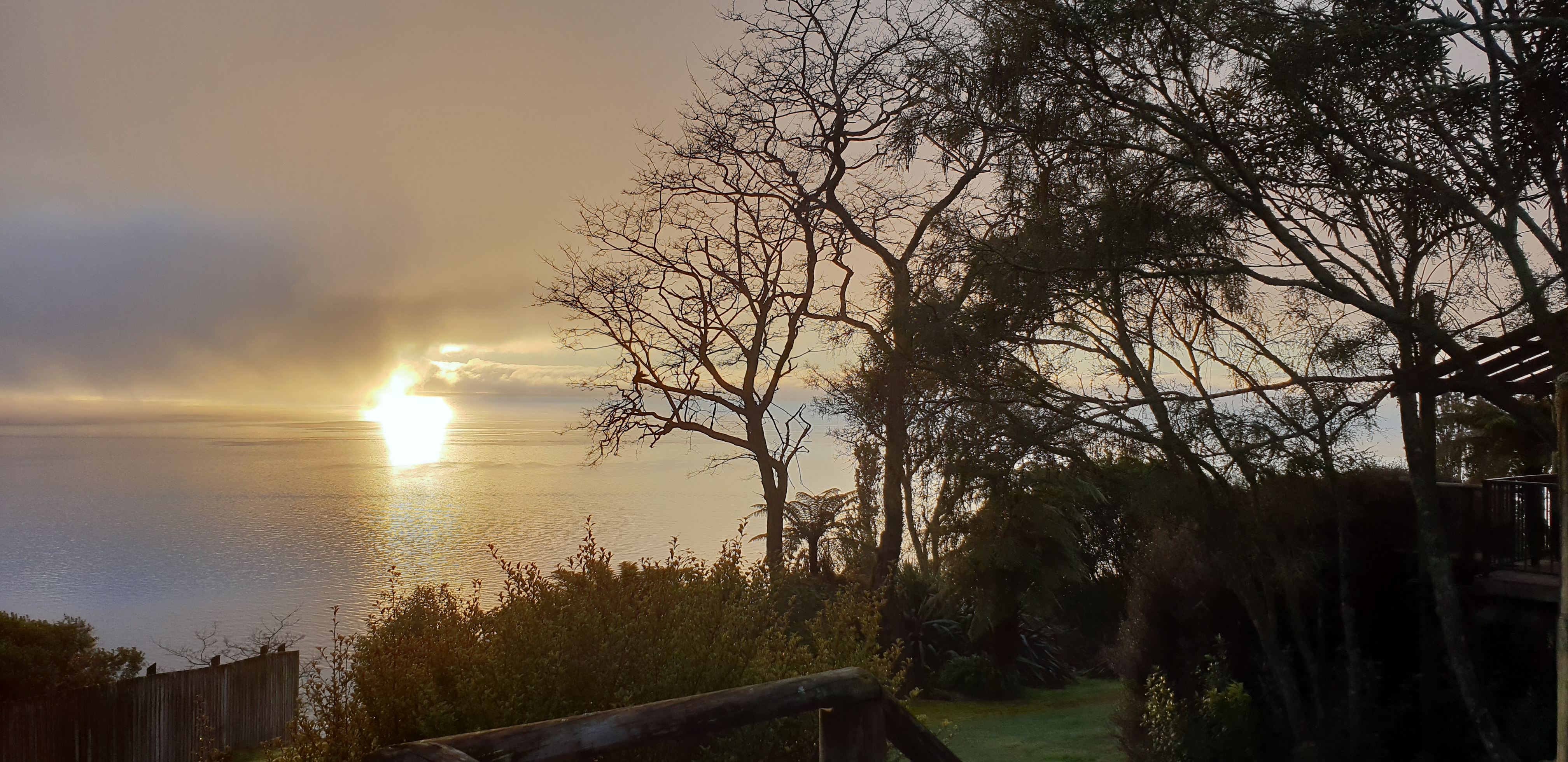
Our first morning there, a Saturday. Winter. Cold. And a beautiful sunrise.
This was taken from the balcony, overlooking the lake.
The sun is just creeping up over the horizon
It gradually gets lighter, and then the sun breaks free of the low cloud
It lights up the balcony
And the trees just beyond, a cascade of colorful ferns.
It looks like its going to be a fine day, our first for this trip, and we will be heading to the mountains to see snow, for the first time for two of our granddaughters.
Oreti village, Pukawa Bay, North Island, New Zealand
On the southern tip of Lake Taupo
Our first morning there, a Saturday. Winter. Cold. And a beautiful sunrise.
This was taken from the balcony, overlooking the lake.
The sun is just creeping up over the horizon
It gradually gets lighter, and then the sun breaks free of the low cloud
It lights up the balcony
And the trees just beyond, a cascade of colorful ferns.
It looks like its going to be a fine day, our first for this trip, and we will be heading to the mountains to see snow, for the first time for two of our granddaughters.
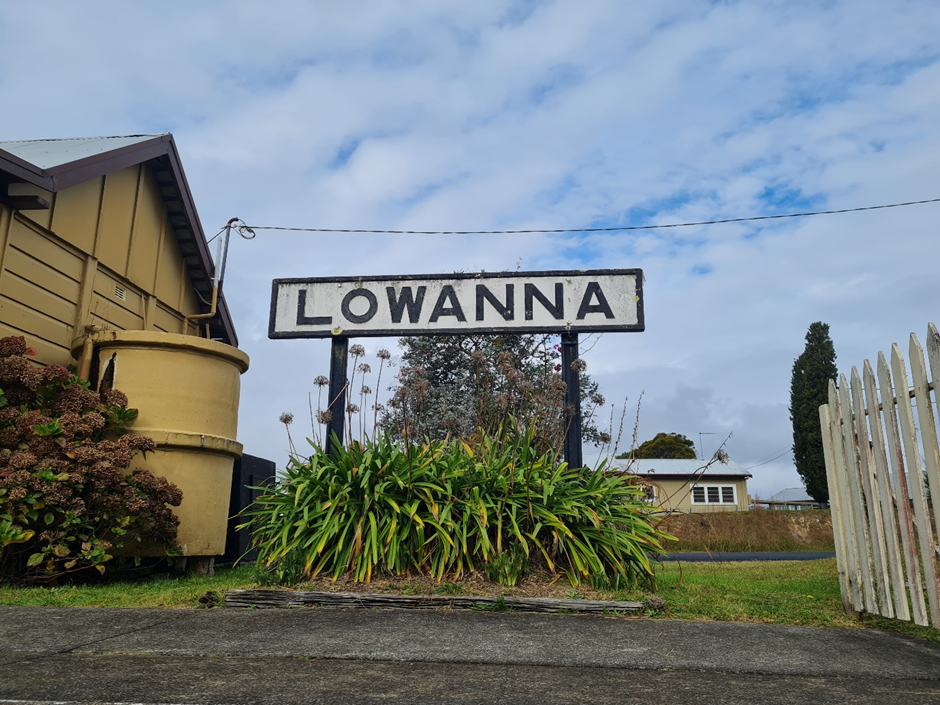
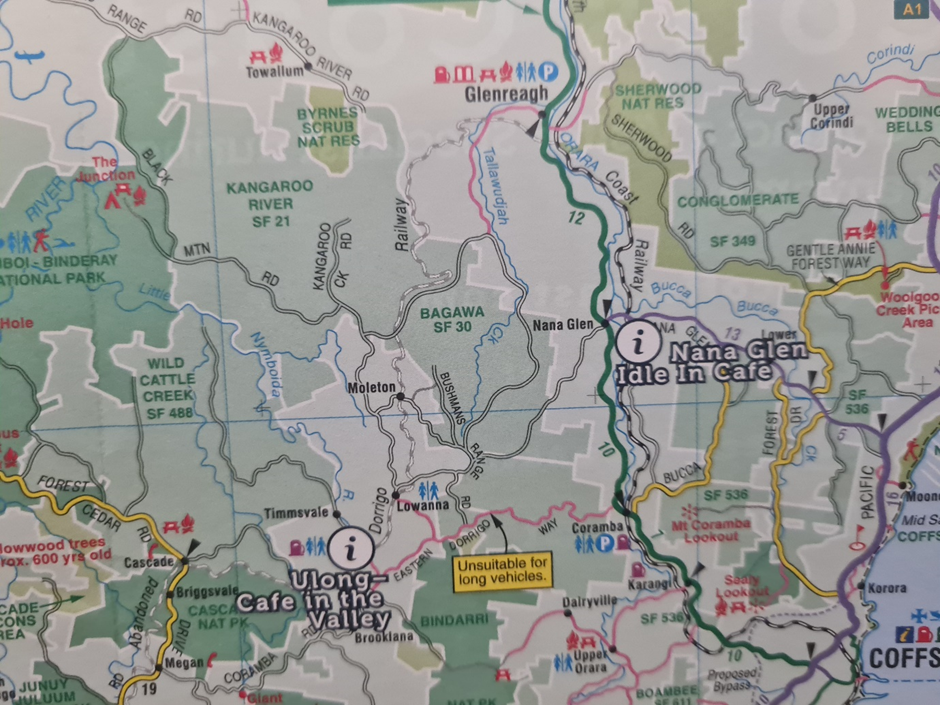
When You pick up a document that describes tourist attractions in Coffs Harbour, there’s one about the Orara Valley, and what caught my eye was firstly the Lowanna Railway Station.
To get there, you pass through Coramba, which has a railway line running through it, but any attempt to find the railway station will be met with disappointment.
But …
That’s not the railway story, that is the Glenreagh to Dorrigo line, first mooted in 1906, but not getting started until 1910, then halted because of the First World War and not completed until December 1924, and ran until October 1972.
However, back to Coramba…
The North Coast railway (the primary rail route in the Mid North Coast and Northern Rivers regions of New South Wales) passes through Coramba, which had a now-closed railway station from 1922. An attempt to find the station took us to a private residence, which obviously was once the station.
And then to the right historic station, in Lowanna…
Lowanna was the largest of the intermediate stations. It was an attended station, with a crossing loop and siding. Most of the timber was loaded at this location.
Opened 23-Dec-1924 and Closed 20-Sep-1975
What we were really looking for was the Lowanna Railway Station, which, when we put it in the GPS almost got us lost. We eventually found the refurbished station, and a rather run down platform, and rail tracks.
Lowanna was on the Dorrigo branch and lies on the north coast of NSW. It branches off the North Coast Line at Glenreagh and climbs up to the Dorrigo Plateau.
The Dorrigo area was settled in the early 1900s by pastoralists and tree fellers. Due to the steep terrain, it was decided to build a railway to allow products to be brought to nearby port towns. Several routes were surveyed, with the route from Glenreagh eventually chosen. The line climbs 664m over a length of 69km.
Apart from the endpoints of Dorrigo and Glenreagh, the station on this line was very small, often consisting of a short platform with a small shelter. The major traffic on this line was timber.
When You pick up a document that describes tourist attractions in Coffs Harbour, there’s one about the Orara Valley, and what caught my eye was firstly the Lowanna Railway Station.
To get there, you pass through Coramba, which has a railway line running through it, but any attempt to find the railway station will be met with disappointment.
But …
That’s not the railway story, that is the Glenreagh to Dorrigo line, first mooted in 1906, but not getting started until 1910, then halted because of the First World War and not completed until December 1924, and ran until October 1972.
However, back to Coramba…
The North Coast railway (the primary rail route in the Mid North Coast and Northern Rivers regions of New South Wales) passes through Coramba, which had a now-closed railway station from 1922. An attempt to find the station took us to a private residence, which obviously was once the station.
And then to the right historic station, in Lowanna…
Lowanna was the largest of the intermediate stations. It was an attended station, with a crossing loop and siding. Most of the timber was loaded at this location.
Opened 23-Dec-1924 and Closed 20-Sep-1975
What we were really looking for was the Lowanna Railway Station, which, when we put it in the GPS almost got us lost. We eventually found the refurbished station, and a rather run down platform, and rail tracks.
Lowanna was on the Dorrigo branch and lies on the north coast of NSW. It branches off the North Coast Line at Glenreagh and climbs up to the Dorrigo Plateau.
The Dorrigo area was settled in the early 1900s by pastoralists and tree fellers. Due to the steep terrain, it was decided to build a railway to allow products to be brought to nearby port towns. Several routes were surveyed, with the route from Glenreagh eventually chosen. The line climbs 664m over a length of 69km.
Apart from the endpoints of Dorrigo and Glenreagh, the station on this line was very small, often consisting of a short platform with a small shelter. The major traffic on this line was timber.
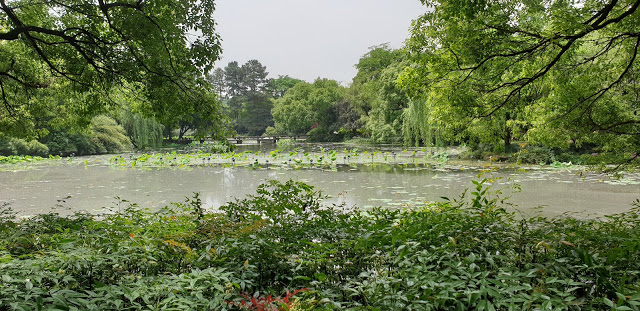
West Lake is a freshwater lake in Hangzhou, China. It is divided into five sections by three causeways. There are numerous temples, pagodas, gardens, and artificial islands within the lake.
Measuring 3.2 kilometers (2 miles) in length, 2.8 kilometers (1.7 miles) in width, and 2.3 meters (7.5 feet) in average depth, the lake spreads itself in an area totaling 6.5 square kilometers (2.5 square miles).
The earliest recorded name for West Lake was the “Wu Forest River”, but over time it changed to two distinct names. One is “Qiantang Lake”, due to the fact that Hangzhou was called “Qiantang” in ancient times. The other, “West Lake”, due to the lake being west of the city
It’s about to get busy, with a number of activities planned, and the warmth of the day is starting to make an impact.
The tour starts in the car park about a kilometer away, but the moment we left the car park we were getting a taste of the park walking along a tree-lined avenue.
When we cross the road, once again dicing with death with the silent assassins on motor scooters.
We are in the park proper, and it is magnificent, with flowers, mostly at the start hydrangeas and then any number of other trees and shrubs, some carved into other flower shapes like a lotus.
Then there was the lake and the backdrop of bridges and walkways.
.
And if you can tune out the background white noise the place would be great for serenity and relaxation.
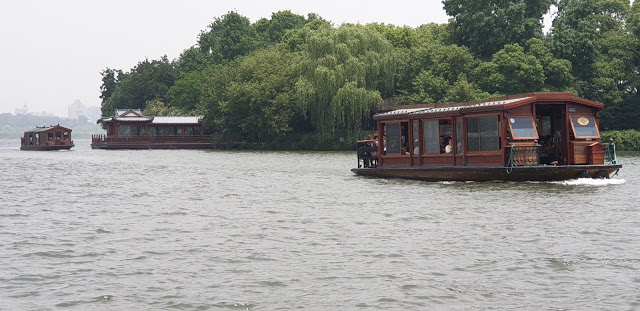
That, in fact, was how the boat ride panned out, about half an hour or more gliding across the lake in an almost silent boat, by an open window, with the air and the majestic scenery.
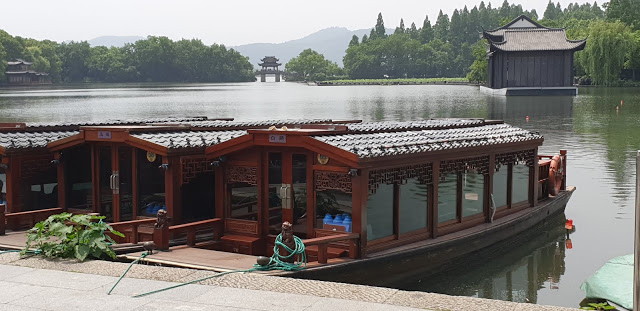
No, not that boat, which would be great to have lunch on while cruising, but the boat below:
Not quite in the same class, but all the same, very easy to tune out and soak it in.
It was peaceful, amazingly quiet, on a summery day
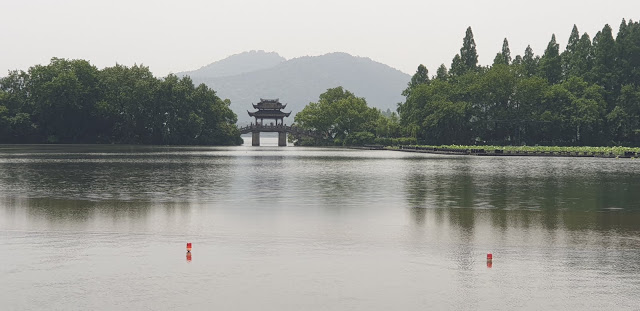
A pagoda in the hazy distance, an island we were about to circumnavigate.
Of all the legends, the most touching one is the love story between Bai Suzhen and Xu Xi’an. Bai Suzhen was a white snake spirit and Xu Xi’an was a mortal man.
They fell in love when they first met on a boat on the West Lake, and got married very soon after.
However, the evil monk Fa Hai attempted to separate the couple by imprisoning Xu Xi’an. Bai Suzhen fought against Fa Hai and tried her best to rescue her husband, but she failed and was imprisoned under the Leifeng Pagoda by the lake.
Years later the couple was rescued by Xiao Qing, the sister of Baisuzhen, and from then on, Bai Suzhen and Xu Xi’an lived together happily.
The retelling of the story varied between tour guides, and on the cruise boat, we had two. Our guide kept to the legend, the other tour guide had a different ending.
Suffice to say it had relevance to the two pagodas on the far side of the lake.
There was a cafe or restaurant on the island, but that was not our lunch destination.
Nor were the buildings further along from where we disembarked.
All in all the whole cruise took about 45 minutes and was an interesting break from the hectic nature of the tour.
Oh yes, and the boat captain had postcards for sale. We didn’t buy any.
Lunch
At the disembarkation point there was a mall that sold souvenirs and had a few ‘fast food’ shops, and a KFC, not exactly what we came to China for, but it seemed like the only place in town a food cautious Australian could eat at.
And when tried to get in the door, that’s where at least 3 busloads were, if they were not in the local Starbucks. Apparently, these were the places of first choice wherever we went.
The chicken supply by the time we got to the head of the line amounted to pieces at 22.5 RMB a piece and nuggets. Everything else had run out, and for me, there were only 5 pieces left. Good thing there were chips.
And Starbucks with coffee and cheesecake.
At least the setting for what could have been a picnic lunch was idyllic.
West Lake is a freshwater lake in Hangzhou, China. It is divided into five sections by three causeways. There are numerous temples, pagodas, gardens, and artificial islands within the lake.
Measuring 3.2 kilometers (2 miles) in length, 2.8 kilometers (1.7 miles) in width, and 2.3 meters (7.5 feet) in average depth, the lake spreads itself in an area totaling 6.5 square kilometers (2.5 square miles).
The earliest recorded name for West Lake was the “Wu Forest River”, but over time it changed to two distinct names. One is “Qiantang Lake”, due to the fact that Hangzhou was called “Qiantang” in ancient times. The other, “West Lake”, due to the lake being west of the city
It’s about to get busy, with a number of activities planned, and the warmth of the day is starting to make an impact.
The tour starts in the car park about a kilometer away, but the moment we left the car park we were getting a taste of the park walking along a tree-lined avenue.
When we cross the road, once again dicing with death with the silent assassins on motor scooters.
We are in the park proper, and it is magnificent, with flowers, mostly at the start hydrangeas and then any number of other trees and shrubs, some carved into other flower shapes like a lotus.
Then there was the lake and the backdrop of bridges and walkways.
.
And if you can tune out the background white noise the place would be great for serenity and relaxation.
That, in fact, was how the boat ride panned out, about half an hour or more gliding across the lake in an almost silent boat, by an open window, with the air and the majestic scenery.
No, not that boat, which would be great to have lunch on while cruising, but the boat below:
Not quite in the same class, but all the same, very easy to tune out and soak it in.
It was peaceful, amazingly quiet, on a summery day
A pagoda in the hazy distance, an island we were about to circumnavigate.
Of all the legends, the most touching one is the love story between Bai Suzhen and Xu Xi’an. Bai Suzhen was a white snake spirit and Xu Xi’an was a mortal man.
They fell in love when they first met on a boat on the West Lake, and got married very soon after.
However, the evil monk Fa Hai attempted to separate the couple by imprisoning Xu Xi’an. Bai Suzhen fought against Fa Hai and tried her best to rescue her husband, but she failed and was imprisoned under the Leifeng Pagoda by the lake.
Years later the couple was rescued by Xiao Qing, the sister of Baisuzhen, and from then on, Bai Suzhen and Xu Xi’an lived together happily.
The retelling of the story varied between tour guides, and on the cruise boat, we had two. Our guide kept to the legend, the other tour guide had a different ending.
Suffice to say it had relevance to the two pagodas on the far side of the lake.
There was a cafe or restaurant on the island, but that was not our lunch destination.
Nor were the buildings further along from where we disembarked.
All in all the whole cruise took about 45 minutes and was an interesting break from the hectic nature of the tour.
Oh yes, and the boat captain had postcards for sale. We didn’t buy any.
Lunch
At the disembarkation point there was a mall that sold souvenirs and had a few ‘fast food’ shops, and a KFC, not exactly what we came to China for, but it seemed like the only place in town a food cautious Australian could eat at.
And when tried to get in the door, that’s where at least 3 busloads were, if they were not in the local Starbucks. Apparently, these were the places of first choice wherever we went.
The chicken supply by the time we got to the head of the line amounted to pieces at 22.5 RMB a piece and nuggets. Everything else had run out, and for me, there were only 5 pieces left. Good thing there were chips.
And Starbucks with coffee and cheesecake.
At least the setting for what could have been a picnic lunch was idyllic.
The Henan Museum is one of the oldest museums in China. In June 1927, General Feng Yuxiang proposed that a museum be built, and it was completed the next year. In 1961, along with the move of the provincial capital, Henan Museum moved from Kaifeng to Zhengzhou.
It currently holds about 130,000 individual pieces, more of which are mostly cultural relics, bronze vessels of the Shang and Zhou Dynasties, and pottery and porcelain wares of the various dynasties.
Eventually, we arrive at the museum and get off the bus adjacent to a scooter track and despite the efforts of the guide, there’s no stopping them from nearly running us over.
We arrive to find the museum has been moved to a different and somewhat smaller building nearby as the existing, and rather distinctively designed, building is being renovated.
While we are waiting for the tickets to enter, we are given another view of industrial life in that there is nothing that resembles proper health and safety on worksites in this country, and the workers are basically standing on what looks to be a flimsy bamboo ladder with nothing to stop them from falling off.
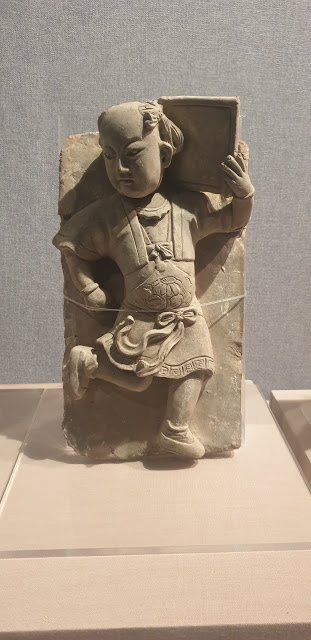
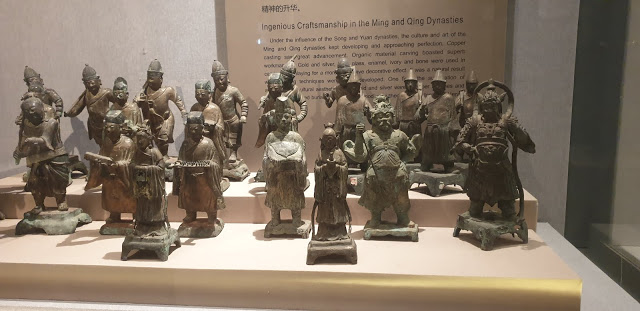
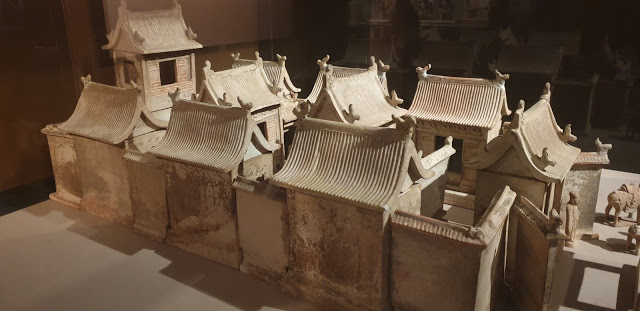
The museum itself has exhibits dating back a few thousand years and consist of bronze and ceramic items. One of the highlights was a tortoiseshell with reportedly the oldest know writing ever found.
Other than that it was a series of cooking utensils, a table, and ceramic pots, some in very good condition considering their age.
The Henan Museum is one of the oldest museums in China. In June 1927, General Feng Yuxiang proposed that a museum be built, and it was completed the next year. In 1961, along with the move of the provincial capital, Henan Museum moved from Kaifeng to Zhengzhou.
It currently holds about 130,000 individual pieces, more of which are mostly cultural relics, bronze vessels of the Shang and Zhou Dynasties, and pottery and porcelain wares of the various dynasties.
Eventually, we arrive at the museum and get off the bus adjacent to a scooter track and despite the efforts of the guide, there’s no stopping them from nearly running us over.
We arrive to find the museum has been moved to a different and somewhat smaller building nearby as the existing, and rather distinctively designed, building is being renovated.
While we are waiting for the tickets to enter, we are given another view of industrial life in that there is nothing that resembles proper health and safety on worksites in this country, and the workers are basically standing on what looks to be a flimsy bamboo ladder with nothing to stop them from falling off.
The museum itself has exhibits dating back a few thousand years and consist of bronze and ceramic items. One of the highlights was a tortoiseshell with reportedly the oldest know writing ever found.
Other than that it was a series of cooking utensils, a table, and ceramic pots, some in very good condition considering their age.
We walked another umpteen miles from the exhibition to a Chinese restaurant that is going to serve us Chinese food again with a beer and a rather potent pomegranate wine that has a real kick. It was definitely value for money at 60 yuan per person.
But perhaps the biggest thrill, if it could be called that, was discovering downstairs, the man who discovered the original pieces of a terracotta soldier when digging a well. He was signing books bought in the souvenir store, but not those that had been bought elsewhere.
Some of is even got photographed with him. Fifteen minutes of fame moment? Maybe.
After lunch, it was off to the station for another high-speed train ride, this time for about two and a half hours, from X’ian to Zhangzhou dong.
It’s the standard high-speed train ride and the usual seat switching because of weird allocation issues, so a little confusion reigns until the train departs at 5:59.
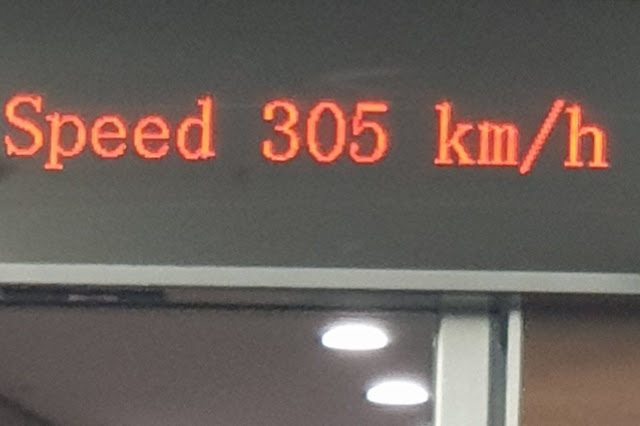
Once we were underway it didn’t take long before we hit the maximum speed
Twenty minutes before arrival, and knowing we only have three minutes to get off everyone is heading for the exit clogging up the passageway. It wasn’t panic but with the three-minute limit, perhaps organized panic would be a better description.
As it turned out, with all the cases near the door, the moment to door opened one of our group got off, and the other just started putting cases on the platform, and in doing so we were all off in 42 seconds with time to spare.
And this was despite the fact there were about twenty passengers just about up against the door trying to get in. I don’t think they expected to have cases flying off the train in their direction.
We find our way to the exit and our tour guide Dannie. It was another long walk to the bus, somewhat shabbier from the previous day, no leg room, no pocket, no USB charging point like the day before. Disappointing.
On the way from the station to the hotel, the tour guide usually gives us a short spiel on the next day’s activities, but instead, I think we got her life history and a song, delivered in high pitched and rapid Chinglish that was hard to understand.
Not at this hour of the night to an almost exhausted busload of people who’d had enough from the train. Oh, did I forgot the singing, no, it was an interesting rendition of ‘you are my sunshine’.
The drive was interesting in that it mostly in the dark. There was no street lighting and in comparison to X’ian which was very bright and cheerful, this was dark and gloomy.
Then close to the hotel our guide said that if we had any problems with the room, she would be in the lobby for half an hour.
That spoke volumes about the hotel they put us in.
We walked another umpteen miles from the exhibition to a Chinese restaurant that is going to serve us Chinese food again with a beer and a rather potent pomegranate wine that has a real kick. It was definitely value for money at 60 yuan per person.
But perhaps the biggest thrill, if it could be called that, was discovering downstairs, the man who discovered the original pieces of a terracotta soldier when digging a well. He was signing books bought in the souvenir store, but not those that had been bought elsewhere.
Some of is even got photographed with him. Fifteen minutes of fame moment? Maybe.
After lunch, it was off to the station for another high-speed train ride, this time for about two and a half hours, from X’ian to Zhangzhou dong.
It’s the standard high-speed train ride and the usual seat switching because of weird allocation issues, so a little confusion reigns until the train departs at 5:59.
Once we were underway it didn’t take long before we hit the maximum speed
Twenty minutes before arrival, and knowing we only have three minutes to get off everyone is heading for the exit clogging up the passageway. It wasn’t panic but with the three-minute limit, perhaps organized panic would be a better description.
As it turned out, with all the cases near the door, the moment to door opened one of our group got off, and the other just started putting cases on the platform, and in doing so we were all off in 42 seconds with time to spare.
And this was despite the fact there were about twenty passengers just about up against the door trying to get in. I don’t think they expected to have cases flying off the train in their direction.
We find our way to the exit and our tour guide Dannie. It was another long walk to the bus, somewhat shabbier from the previous day, no leg room, no pocket, no USB charging point like the day before. Disappointing.
On the way from the station to the hotel, the tour guide usually gives us a short spiel on the next day’s activities, but instead, I think we got her life history and a song, delivered in high pitched and rapid Chinglish that was hard to understand.
Not at this hour of the night to an almost exhausted busload of people who’d had enough from the train. Oh, did I forgot the singing, no, it was an interesting rendition of ‘you are my sunshine’.
The drive was interesting in that it mostly in the dark. There was no street lighting and in comparison to X’ian which was very bright and cheerful, this was dark and gloomy.
Then close to the hotel our guide said that if we had any problems with the room, she would be in the lobby for half an hour.
That spoke volumes about the hotel they put us in.














 Thrills, Spills, and just a dash of Romance