In Beijing Hutongs are formed by lines of traditional courtyard residences, called siheyuan. Neighborhoods were formed by joining many hutongs together. These siheyuan are the traditional residences, usually occupied by a single or extended family, signifying wealth, and prosperity.
Over 500 of these still exist.Many of these hutongs have been demolished, but recently they have become protected places as a means of preserving some Chinese cultural history. They were first established in the Yuan Dynasty (1279-1368)Many of these Hutongs had their main buildings and gates built facing south, and lanes connecting them to other hutongs also ran north to south.
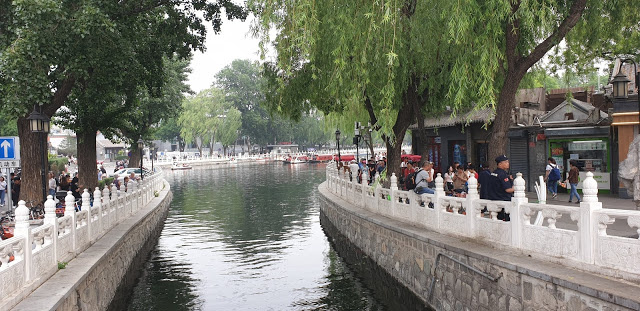
Many hutongs, some several hundred years old, in the vicinity of the Bell Tower and Drum Tower and Shichahai Lake are preserved and abound with tourists, many of which tour the quarter in pedicabs.
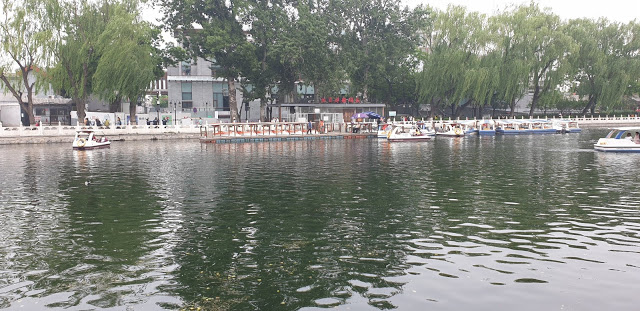
The optional tour also includes a visit to Shichahai, a historic scenic area consisting of three lakes (Qianhai, meaning Front Sea; Houhai, meaning Back Sea and Xihai, meaning West Sea), surrounding places of historic interest and scenic beauty and remnants of old-style local residences, Hutong and Courtyard.
First, we had a short walk through the more modern part of the Hutong area and given some free time for shopping, but we prefer just to meander by the canal.
There is a lake, and if we had the time, there were boats you could take.
With some time to spare, we take a quick walk down one of the alleyways where on the ground level are small shops, and above, living quarters.
Then we go to the bell and drum towers before walking through some more alleys was to where the rickshaws were waiting. The Bell tower
And the Drum tower. Both still working today.
The rickshaw ride took us through some more back streets where it was clear renovations were being made so that the area could apply for world heritage listing. Seeing inside some of the houses shows that they may look dumpy outside but that’s not the case inside.
The rickshaw ride ends outside the house where dinner will be served, and is a not so typical hose but does have all the elements of how the Chinese live, the boy’s room, the girl’s room, the parent’s room, the living area, and the North-south feng shui.
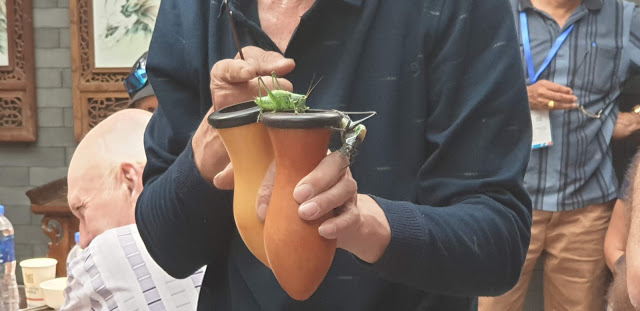
Shortly after we arrive, the cricket man, apparently someone quite famous in Beijing arrives and tells us all about crickets and then grasshoppers, then about cricket racing. He is animated and clearly enjoys entertaining us westerners.
I’m sorry but the cricket stuff just didn’t interest me. Or the grasshoppers.
As for dinner, it was finally a treat to eat what the typical Chinese family eats, and everything was delicious, and the endless beer was a nice touch.
And the last surprise, the food was cooked by a man.
Instead of making a grand entrance, arriving in style and being greeted by important dignitaries, we are slinking in via an airplane, late at night. It’s hardly the entrance I’d envisaged. At 9:56 the plane touches down on the runway. Outside the plane, it is dark and gloomy and from what I could see, it had been raining. That could, of course, simply be condensation.
Once on the ground, everyone was frantically gathering together everything from seat pockets and sending pillows and blankets to the floor. A few were turning their mobile phones back on, and checking for a signal, and, perhaps, looking for messages sent to them during the last 12 hours. Or perhaps they were just suffering from mobile phone deprivation.
It took 10 minutes for the plane to arrive at the gate. That’s when everyone moves into overdrive, unbuckling belts, some before the seatbelt sign goes off, and are first out of their seats and into the overhead lockers. Most are not taking care that their luggage may have moved, but fortunately, no bags fall out onto someone’s head. The flight had been relatively turbulent free.
When as many people and bags have squeezed into that impossibly small aisle space, we wait for the door to open, and then the privileged few business and first-class passengers to depart before we can begin to leave. As we are somewhere near the middle of the plane, our wait will not be as long as it usually is. This time we avoided being at the back of the plane. Perhaps that privilege awaits us on the return trip.
Once off the plane, it is a matter of following the signs, some of which are not as clear as they could be. It’s why it took another 30 odd minutes to get through immigration, but that was not necessarily without a few hiccups along the way. We got sidetracked at the fingerprint machines, which seemed to have a problem if your fingers were not straight, not in the center of the glass, and then if it was generally cranky, which ours were, continue to tell you to try again, and again, and again, and again…That took 10 to 15 minutes before we joined an incredibly long queue of other arrivals,
A glance at the time, and suddenly it’s nearly an hour from the moment we left the plane.
And…
That’s when we got to the immigration officer, and it became apparent we were going to have to do the fingerprints yet again. Fortunately this time, it didn’t take as long. Once that done, we collected our bags, cleared customs by putting our bags through a huge x-ray machine, and it was off to find our tour guide.
We found several tour guides with their trip-a-deal flags waiting for us to come out of the arrivals hall. It wasn’t a difficult process in the end. We were in the blue group. Other people we had met on the plane were in the red group or the yellow group. The tour guide found, or as it turned out she found us, it was simply a matter of waiting for the rest of the group, of which there were eventually 28.Gathered together we were told we would be taking the bags to one place and then ourselves to the bus in another. A glance in the direction of the bus park, there were a lot of busses.
Here’s a thought, imagine being told your bus is the white one with blue writing on the side.
Yes, yours is, and 25 others because all of the tourist coaches are the same. An early reminder, so that you do not get lost, or, God forbid, get on the wrong bus, for the three days in Beijing, is to get the last five numbers of the bus registration plate and commit them to memory. It’s important. Failing that, the guide’s name is in the front passenger window.
Also, don’t be alarmed if your baggage goes in one direction, and you go in another. In a rather peculiar set up the bags are taken to the hotel by what the guide called the baggage porter. It is an opportunity to see how baggage handlers treat your luggage; much better than the airlines it appears.
That said, if you’re staying at the Beijing Friendship Hotel, be prepared for a long drive from the airport. It took us nearly an hour, and bear in mind that it was very late on a Sunday night.
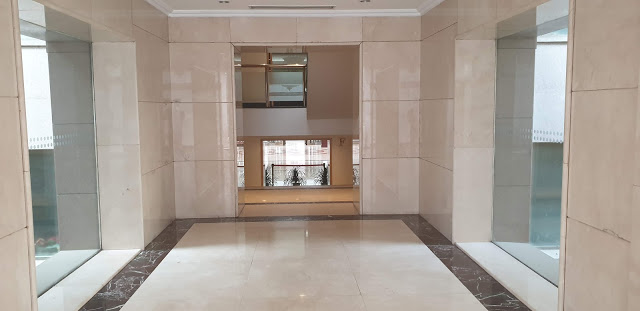
Climbing out of the bus after what seemed a convoluted drive through a park with buildings, we arrive at the building that will be our hotel for the next three days. From the outside, it looks quite good, and once inside the foyer, that first impression is good. Lots of space, marble, and glass. If you are not already exhausted by the time you arrive, the next task is to get your room key, find your bags, get to your room, and try to get to be ready the next morning at a reasonable hour.
Sorry, that boat has sailed.
We were lucky, we were told, that our plane arrived on time, and we still arrived at the hotel at 12:52. Imagine if the incoming plane is late.
This was taken the following morning. It didn’t look half as bland late at night.
This is the back entrance to Building No 4 but is quite representative of the whole foyer, made completely of marble and glass. It all looked very impressive under the artificial lights, but not so much in the cold hard light of early morning.
This the foyer of the floor our room was on. Marble with interesting carpet designs. Those first impressions of it being a plush hotel were slowly dissipating as we got nearer and nearer to the room. From the elevator, it was a long, long walk.
So…Did I tell you about the bathroom in our room?
The shower and the toilet both share the same space with no divide and the shower curtain doesn’t reach to the floor. Water pressure is phenomenal. Having a shower floods the whole shower plus toilet area so when you go to the toilet you’re basically underwater.
Don’t leave your book or magazine on the floor or it will end up a watery mess.
And the water pressure is so hard that it could cut you in half. Only a small turn of the tap is required to get that tingling sensation going.
The novel ‘Echoes from the past’ started out as a short story I wrote about 30 years ago, titled ‘The birthday’.
My idea was to take a normal person out of their comfort zone and led on a short but very frightening journey to a place where a surprise birthday party had been arranged.
Thus the very large man with a scar and a red tie was created.
So was the friend with the limousine who worked as a pilot.
So were the two women, Wendy and Angelina, who were Flight Attendants that the pilot friend asked to join the conspiracy.
I was going to rework the short story, then about ten pages long, into something a little more.
And like all re-writes, especially those I have anything to do with, it turned into a novel.
There was motivation. I had told some colleagues at the place where I worked at the time that I liked writing, and they wanted a sample. I was going to give them the re-worked short story. Instead, I gave them ‘Echoes from the past’
Originally it was not set anywhere in particular.
But when considering a location, I had, at the time, recently been to New York in December, and visited Brooklyn and Queens, as well as a lot of New York itself. We were there for New Years, and it was an experience I’ll never forget.
One evening we were out late, and finished up in Brooklyn Heights, near the waterfront, and there was rain and snow, it was cold and wet, and there were apartment buildings shimmering in the street light, and I thought, this is the place where my main character will live.
It had a very spooky atmosphere, the sort where ghosts would not be unexpected. I felt more than one shiver go up and down my spine in the few minutes I was there.
I had taken notes, as I always do, of everywhere we went so I had a ready supply of locations I could use, changing the names in some cases.
Fifth Avenue near the Rockefeller center is amazing at first light, and late at night with the Seasonal decorations and lights.
The original main character was a shy and man of few friends, hence not expecting the surprise party. I enhanced that shyness into purposely lonely because of an issue from his past that leaves him always looking over his shoulder and ready to move on at the slightest hint of trouble. No friends, no relationships, just a very low profile.
Then I thought, what if he breaks the cardinal rule, and begins a relationship?
But it is also as much an exploration of a damaged soul, as it is the search for a normal life, without having any idea what normal was, and how the understanding of one person can sometimes make all the difference in what we may think or feel.
Let me sum up this experience at the start, in one word.
Terrible.
I know it’s not much past post-Covid, but tell me, what were the airport administrators doing for two years, other than lamenting the lack of plane traffic and sitting on their hands? Did they think no one was ever going to travel again?
Let me suggest what they should have been doing, getting onto every one of the retailers that had to close, and making sure that from day one of reopening, it was back to pre-Covid.
Instead, it’s a desolate nightmare. There was only one dedicated Cafe and a bar and two bookshops down the Qantas end.
And the food was basically stale sandwiches and muffins. And if you don’t like muffins…
We had to walk a mile to get to the Cafe and get a decent cup of coffee and a toastie, which the Cafe itself and coffee and food scored a ten out of ten.
If you didn’t know it was there, God only knows what you would do if you wanted something decent.
Score out of ten for the Airport Administrators – minus 5
Since scoring that I had the unhappy experience of going to the men’s restroom. It was filthy. How hard could be for someone to check every half hour to clean up the obvious mess? I’ll let you imagine how that will affect their current score.
My other bugbear about airports is the scanning of bags before getting to the gate.
Melbourne for some reason has been the worst experience in quite literally the world because it is a complete mess, particularly if one thing goes wrong.
I hate it, and it was no better today and left me shaking, which only happens when I’m extremely stressed.
I can only hope it eventually gets better, but, sorry to say this but they’ve had nearly two years to get the process right and run much smoother, but it’s clear they’ve also just sat on their hands.
Maybe one day someone might do something about it, but we’re talking government here, and it takes them ten years just to create a green discussion paper.
So, not holding my breath.
Of course, in reading about the current parlous state of air travel throughout the world, it seems we are not the only ones having problems. I guess we should spare a thought for those going to Heathrow in London. The many times we’ve been there, it’s been borderline organized chaos, and yes, once, we had to wait an hour for our baggage, but now it seems it just disappears.
Glad I’m not going there any time soon.
But, soon, we’re taking the plunge again, and going to Hobart.
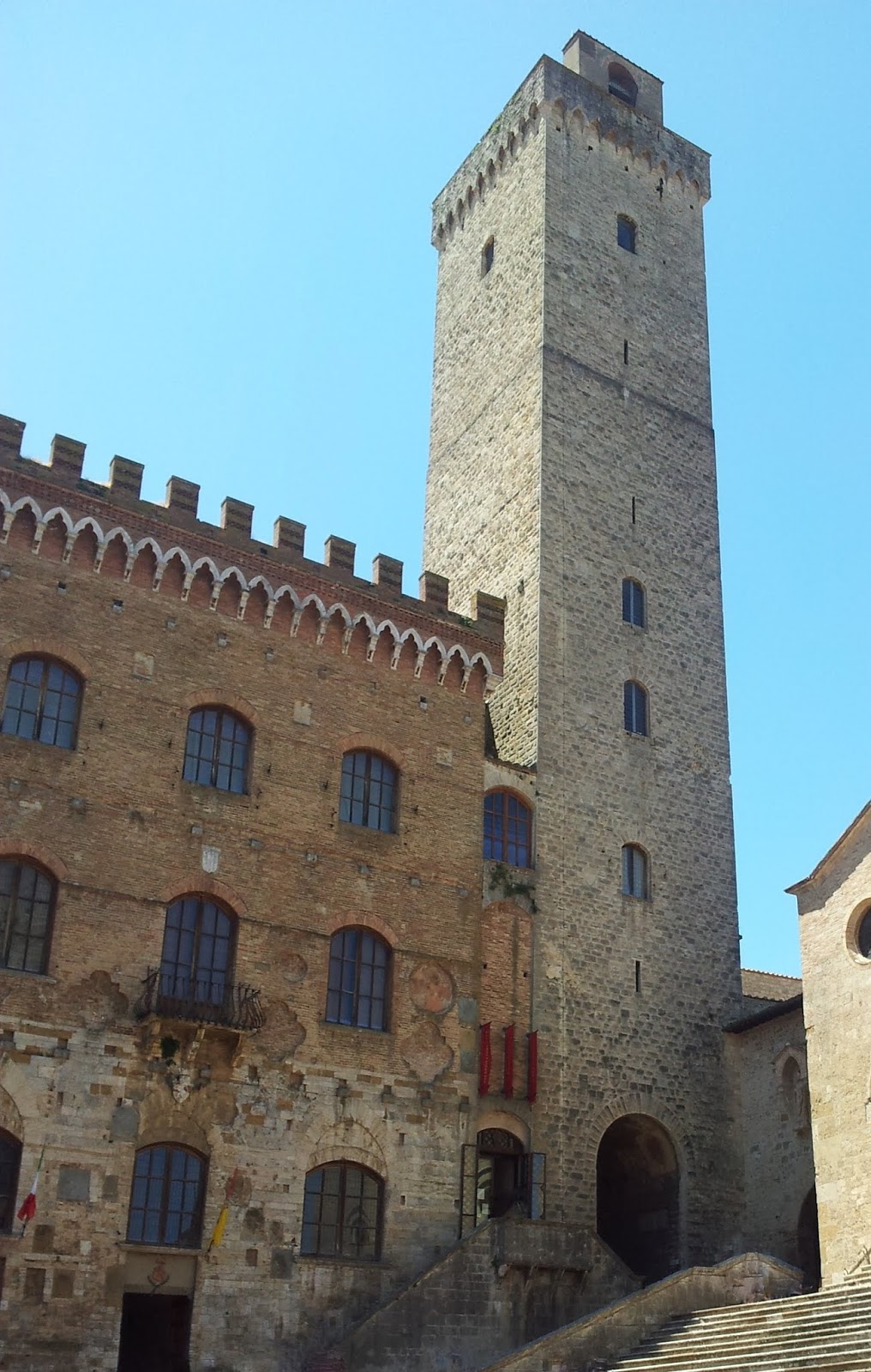
We have visited this town on a hill, famous for its fourteen towers, twice. The first time we stayed in a hotel overlooking the main piazza, and the second time, for a day visit, and return to a little restaurant tucked away off the main piazza for its home cooking.
No cars are allowed inside the town and parking is provided outside the town walls. You can drive up to the hotel to deliver your baggage, but the car must return to the carpark overnight.
This is one of the fourteen towers
I didn’t attempt to climb to the tower, which you can do in some of them, just getting up the church steps was enough for me. Inside the building was, if I remember correctly, a museum.
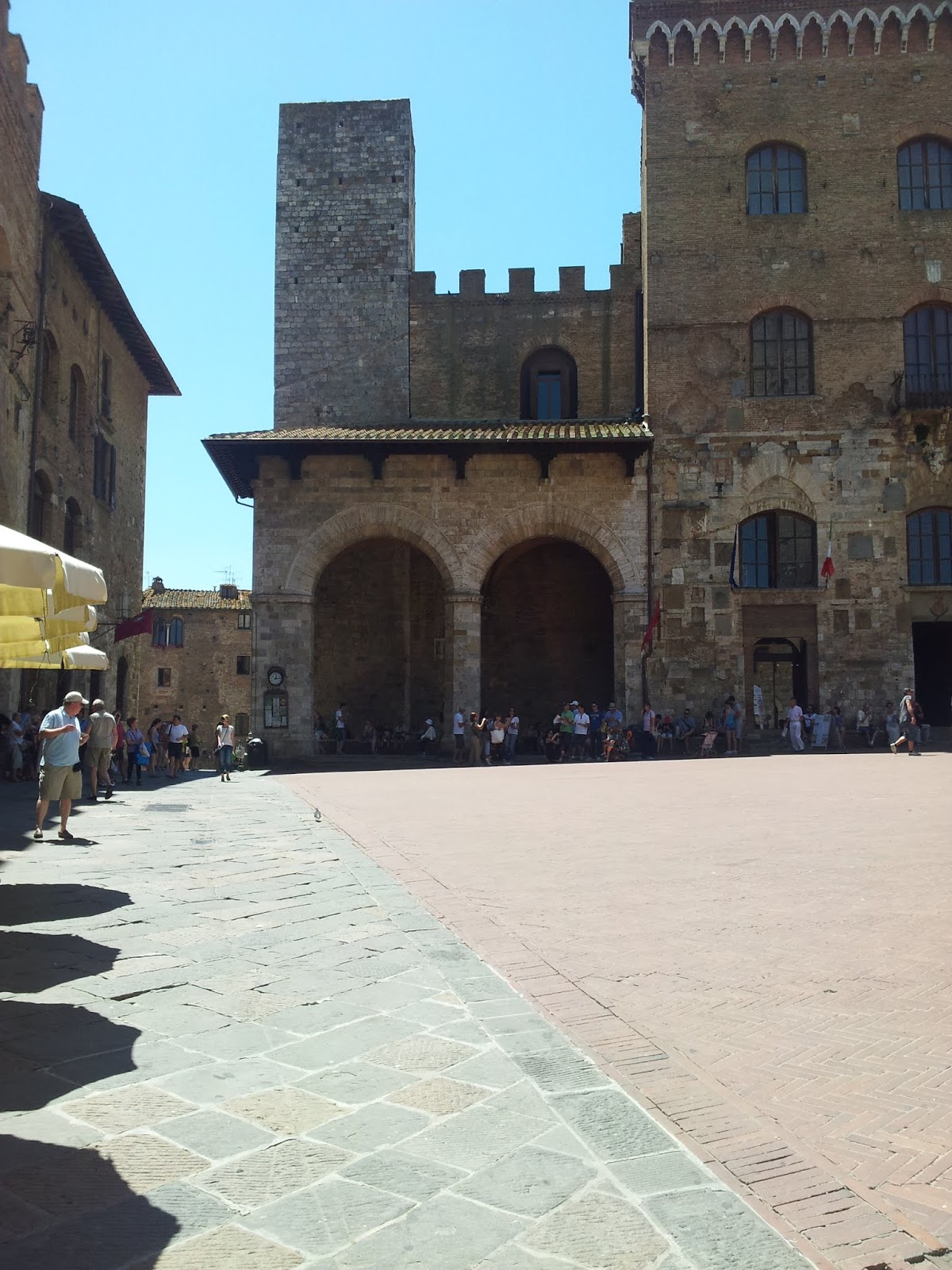
Looking up the piazza towards some battlements, and when you reach the top and turn left, there is a small restaurant on the right-hand side of the laneway that had the best wild boar pasta.
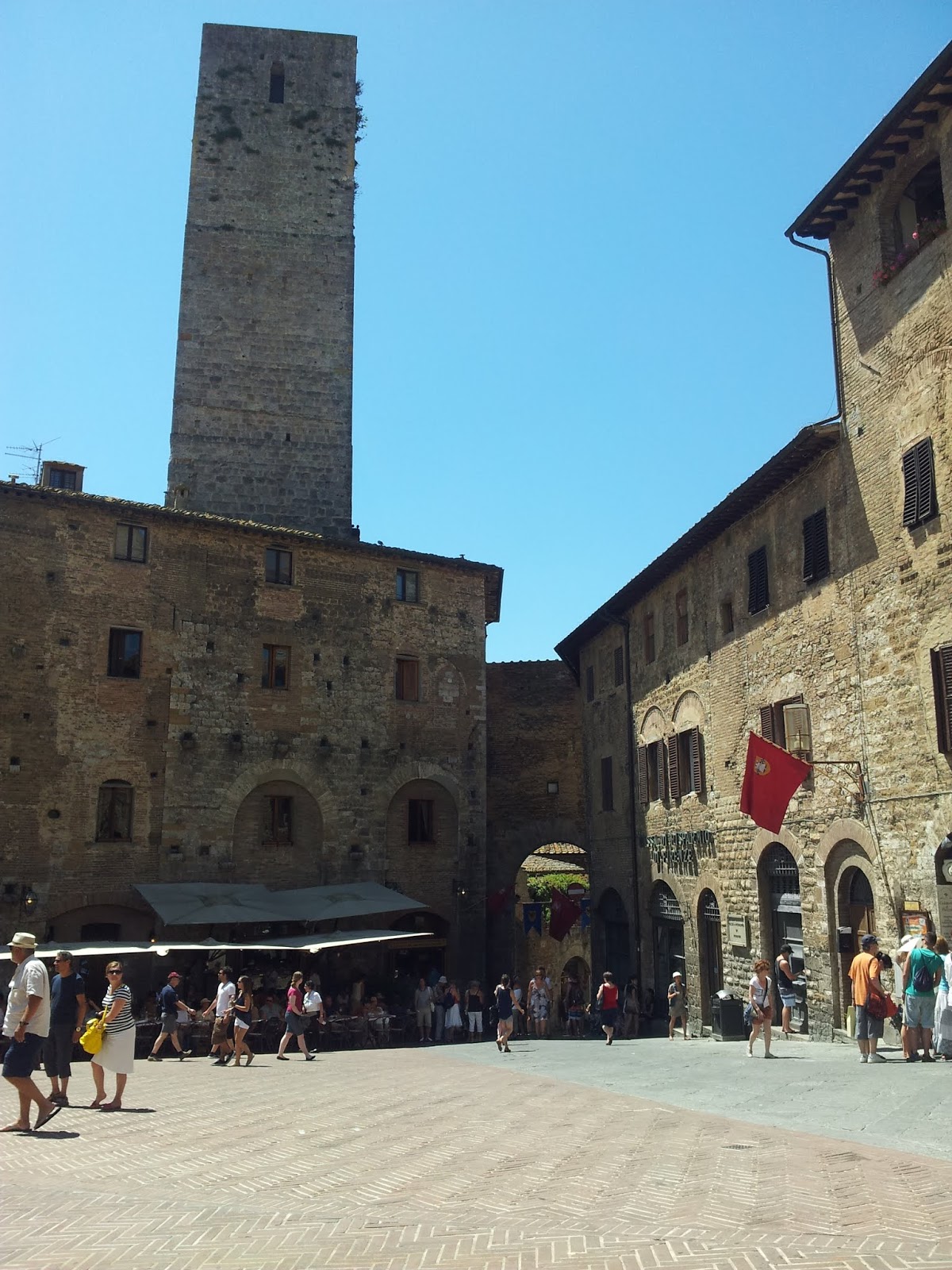
Another of the fourteen towers, and through the arch, down a lane to the gated fence that surrounds the town. The fortifications are quite formidable and there are several places along the fence where you can stand and look down the hill at the oncoming enemy (if there was one).
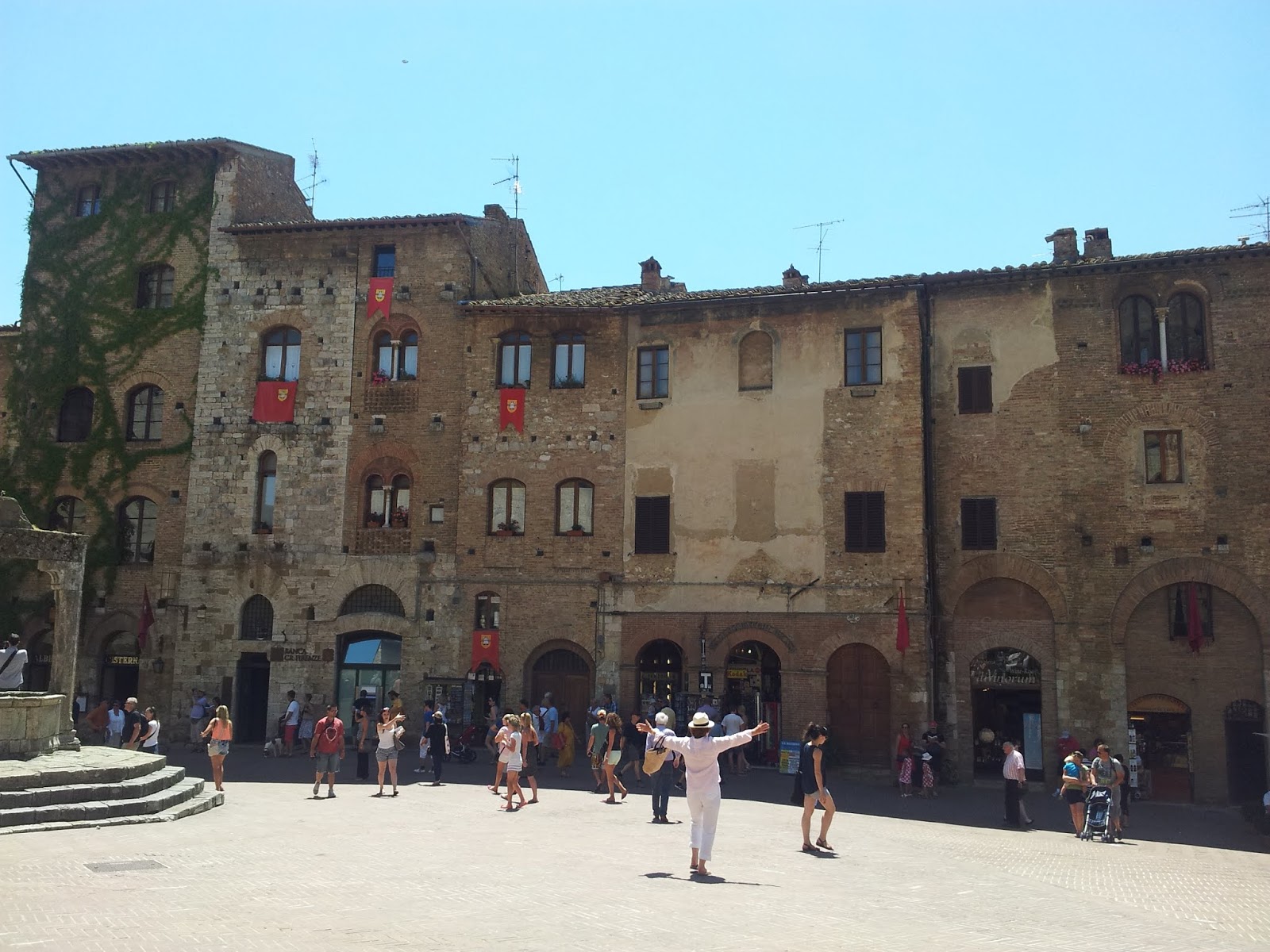
Part of the main piazza which is quite large, and on the right, the wishing well where my wish for a cooler day was not granted.
Officially, the Piazza della Cisterna is the most beautiful square of the town, San Gimignano. The well was built in 1273 and enlarged in 1346 by Podestà Guccio dei Malavolti.
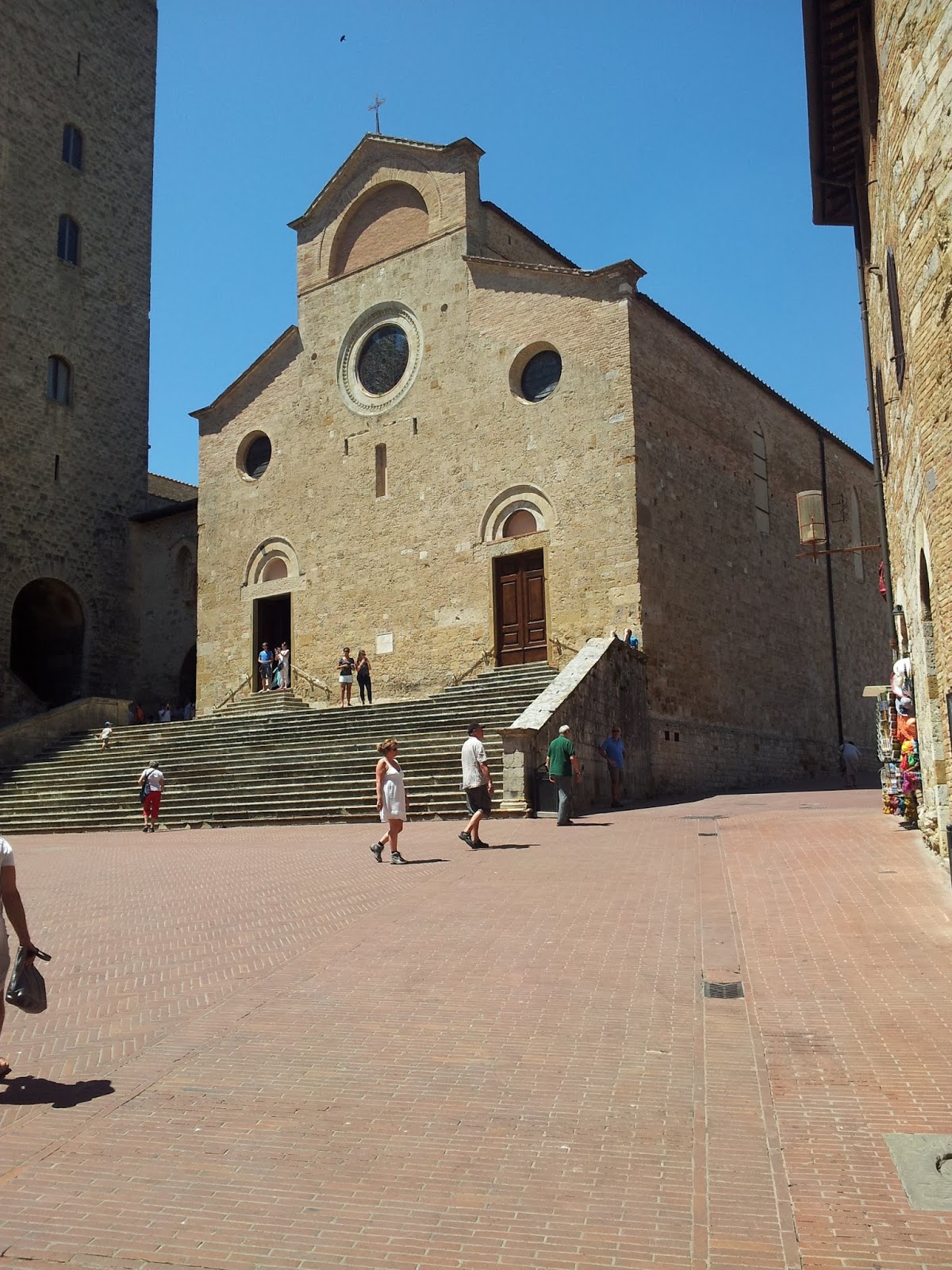
And not to be outdone by any other the other old towns, there is an old church, one of several. It is the Collegiate Church or the Duomo di San Gimignano, a monument of Romanesque architecture built around 1000 and enlarged over time.
Next door is the Museum of Sacred Art.
And I guess it’s rather odd to see television aerials on top of houses that are quite literally about a thousand years old. I wonder what they did back then for entertainment?
We flew into Rome’s Leonardo da Vinci-Fiumicino airport after a rather bumpy flight from London. Unlike most other airports the plane parked at a satellite terminal and after we disembarked we had to catch a train to the main terminal.
The most notable memory of this airport was my daughter’s discovery of a salami shop.
We had booked a transfer to take us to the hotel the Roma Corso Trieste Mercure in Via Gradisca from the airport. It was a white air-conditioned van and so far we had avoided the heat.
One of the rooms had faulty air conditioning an absolute must as the rooms were very hot without it and necessitated a room change which was done quickly and efficiently.
The hotel was in the suburbs and without a car we were dependent on public transport. According to the reception staff, there was a bus stop nearby, and a longer walk to the tram or light railway. The bus seemed to be the best option as it would take us to the central terminal near the railway station, where all tour buses also operated from, and particularly the open-top buses that went to all the major tourist attractions.
That first day basically was given over to travelling, arriving by plane and settling into the hotel, thus we didn’t get to feel the force of the heat. That came the next day.
After a walk around the hotel precinct to get our bearings and see what shops and restaurants were available, on returning to the hotel we were faced with limited choices of room service or to go out for dinner.
My daughter and l go for a long walk up Via Nomentana to find several shops and a restaurant. We went into the restaurant and sat down. We waited for 10 minutes and got no service nor did anyone come and ask us if we wanted to order food so instead we left somewhat disappointed and go next door to what seemed to be the Italian version of a delicatessen and ordered sandwiches and beer. I bought a half dozen cans of Moretti beer two of which I drank on the way home.
It was still very hot even at eight at night and the sandwiches are delicious. It just might be by that time we were starving and anything would have tasted great.
The next morning we are up and ready to chance the weather and some history. Breakfast at the hotel is limited but very good.
We were going to use public transport and I’d studied up on the Internet.
Travelling on the bus required pre-purchase of tickets which could be bought in certain shops and locally when exploring the area near the hotel, l found a tobacconist.
Next, we needed to understand how to use the tickets. There was no one on the bus who could help so when l tried to scan the tickets and it failed, l gave up. We had the same issue each day and in the end, the tickets never got used.
The trip to central Rome by bus took about 15 minutes. In the morning it was reasonably cool and showed us a little of suburban Rome. We also saw the trams but we would not be able to use them because our hotel not on a direct route.
That first full day we decided to go and see the Vatican.
Not understanding buses and which one we needed to get to the Vatican, we took a taxi.
Wow. It was the metaphorical equivalent of driving over the edge of a cliff with a daredevil. It was quite literally terrifying.
Or maybe we just didn’t know that this was probably the way people drove in Rome.
Shaken but delivered in one piece we found ourselves in the square opposite St Peters Basilica.
The square is impressive, with the statues atop a circular colonnaded walkway. The church is incredible and took a few hours to take in and to top off the day we did a tour of the Vatican museum which took the rest of the afternoon.
Then it was back to the delicatessen for more sandwiches and beer, and an interesting discussion with several elderly Italian ladies, of which I did not understand one word.
On the second full day we decided to use one of the open-top bus tours and eventually decided on the hop-on hop-off tour simply because the bus was at the central transport terminal for trains and buses and it was getting hotter.
Our first stop was the Colosseum. There were other monuments nearby, such as the Arch of Constantine, but as the heat factor increased we joined the queue to go into the Colosseum and gladly welcomed the shade once we got inside.
The queue was long and the wait equally so, but it was worth the wait. It would be more interesting if they could restore part of it to its former glory so we could get a sense of the place as it once was. But alas that may never happen, but even so, it is still magnificent as a ruin.
Outside in the heat, it was off to the ruins which were a longish walk from the Colosseum, taking Via Sacra, not far from the Arch of Constantine. This day in the walkway there were a number of illegal vendors, selling knockoff goods such as handbags and watches, and who, at the first sight of the police, packed up their wares in a blanket and ran.
Included in these ruins were The Roman Forum, or just a few columns remaining, the Palatine Hill, Imperial Fori, including the Forum of Augustus, the Forum of Caesar, and more specifically the Forum of Trajan. It was, unfortunately very hot and dusty in the ruins the day we visited.
We walked all the way to the Foro Romano and the Septimus Severo Arch at the other end of the ruins, past the Temple of Caesar. I found it very difficult to picture what it was like when the buildings were intact, so I bought a guide to the ruins which showed the buildings as ruins and an overlay of how they would have looked. The buildings, then, would be as amazing as the Colosseum, and it would have been interesting to have lived back then, though perhaps not as a Christian.
I lost count of the number of bottles of water we bought, but the word ‘frizzante’ was ringing in my ears by the end of the day. Fortunately, the water did not cost a lot to buy.
At the end of the day, we caught the hop on hop off the bus at the Colosseum and decided not to get off and see any more monuments but observe them from the bus. The only one I remember seeing was Circo Massimo. Perhaps if we’d known it was going to be twice as hot on the bus, yes, there was no air-conditioning; we may have chosen another form of transport to get back to the hotel.
On the third and last day in Rome, we decided to go to the Trevi Fountain, see the pantheon and walk up the Spanish Steps. We spent most of the morning in the cool of a café watching the tourists at the fountain. By the time we reached the top of the Spanish Steps, we were finished.
As part of a day tour by Very Tuscany Tours, we came to this quiet corner of Tuscany to have a look at an Italian winery, especially the Sangiovese grapes, and the Chianti produced here.
And what better way to sample the wine than to have a long leisurely lunch with matched wines. A very, very long lunch.
But first, a wander through the gardens to hone the appetite:
And a photo I recognize from many taken of the same building:
Then a tour of the wine cellar:
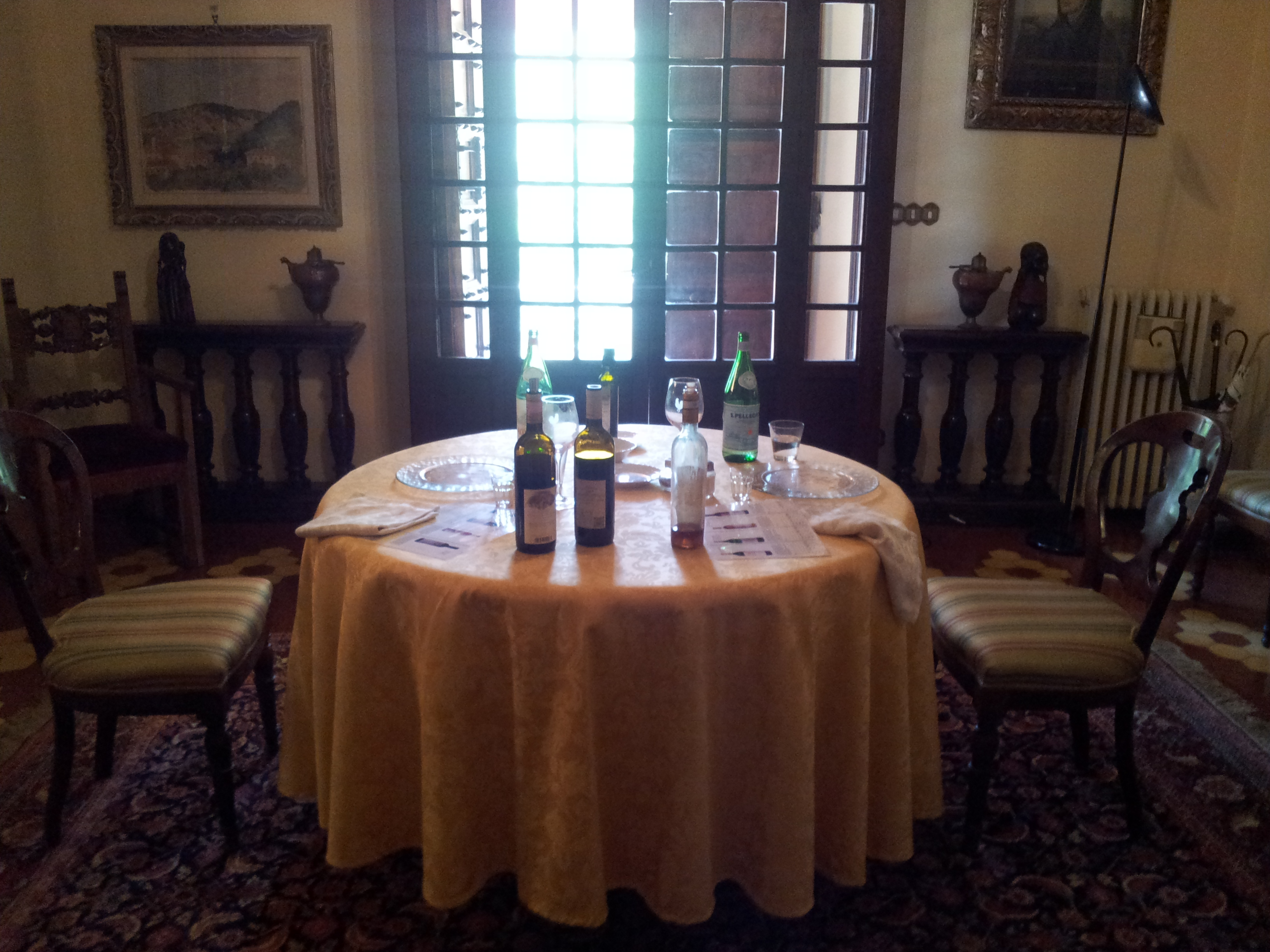
Then on to the most incredible and exquisite lunch and wine we have had. It was the highlight of our stay in Tuscany. Of course, we had our own private dining room:
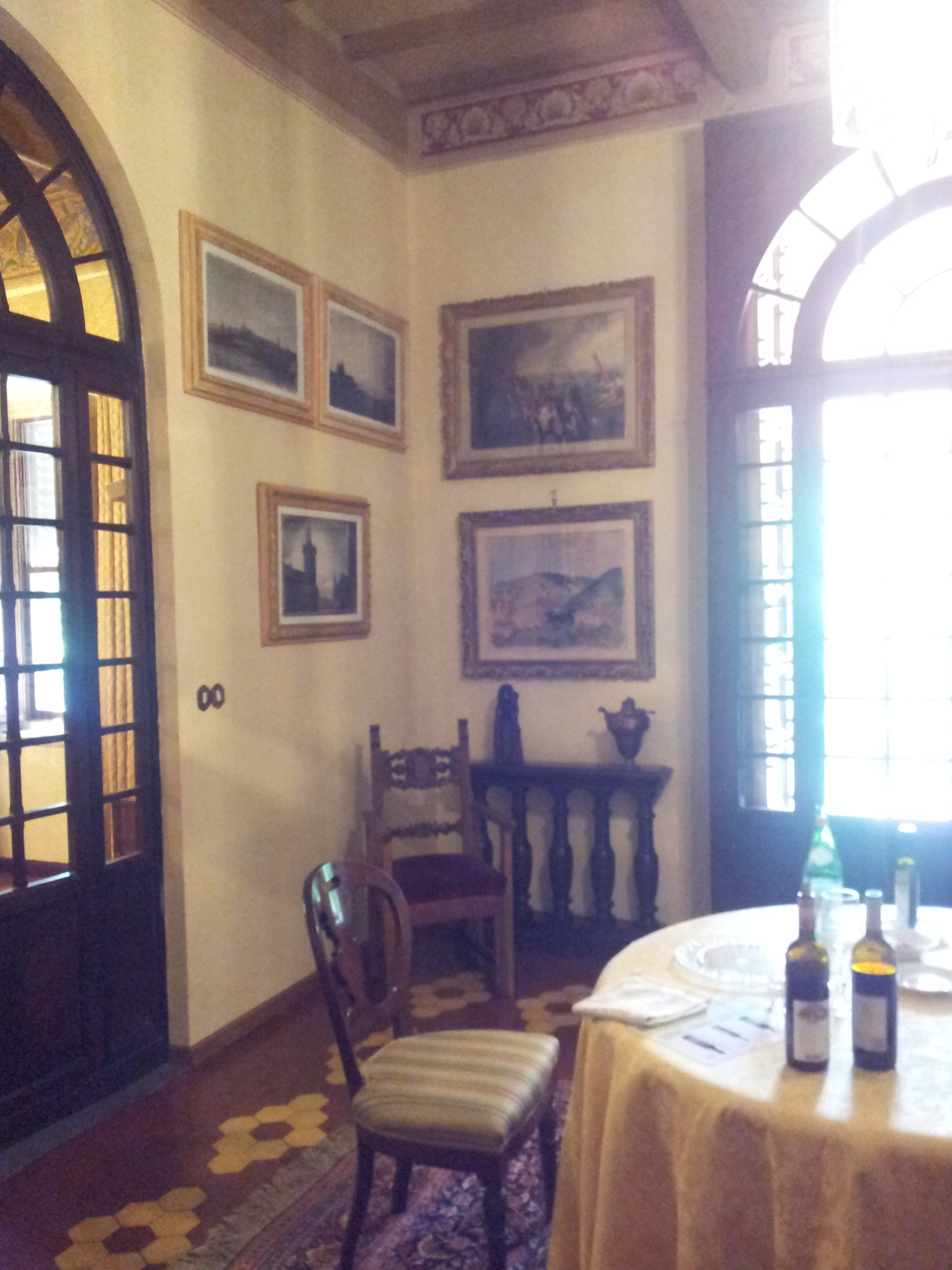
And time to study the paintings and prints on the walls while we finished with coffee and a dessert wine.
And of course, more wine, just so we could remember the occasion.
A fine day, on this trip a rarity, we decided to take the train to Windsor and see the castle.
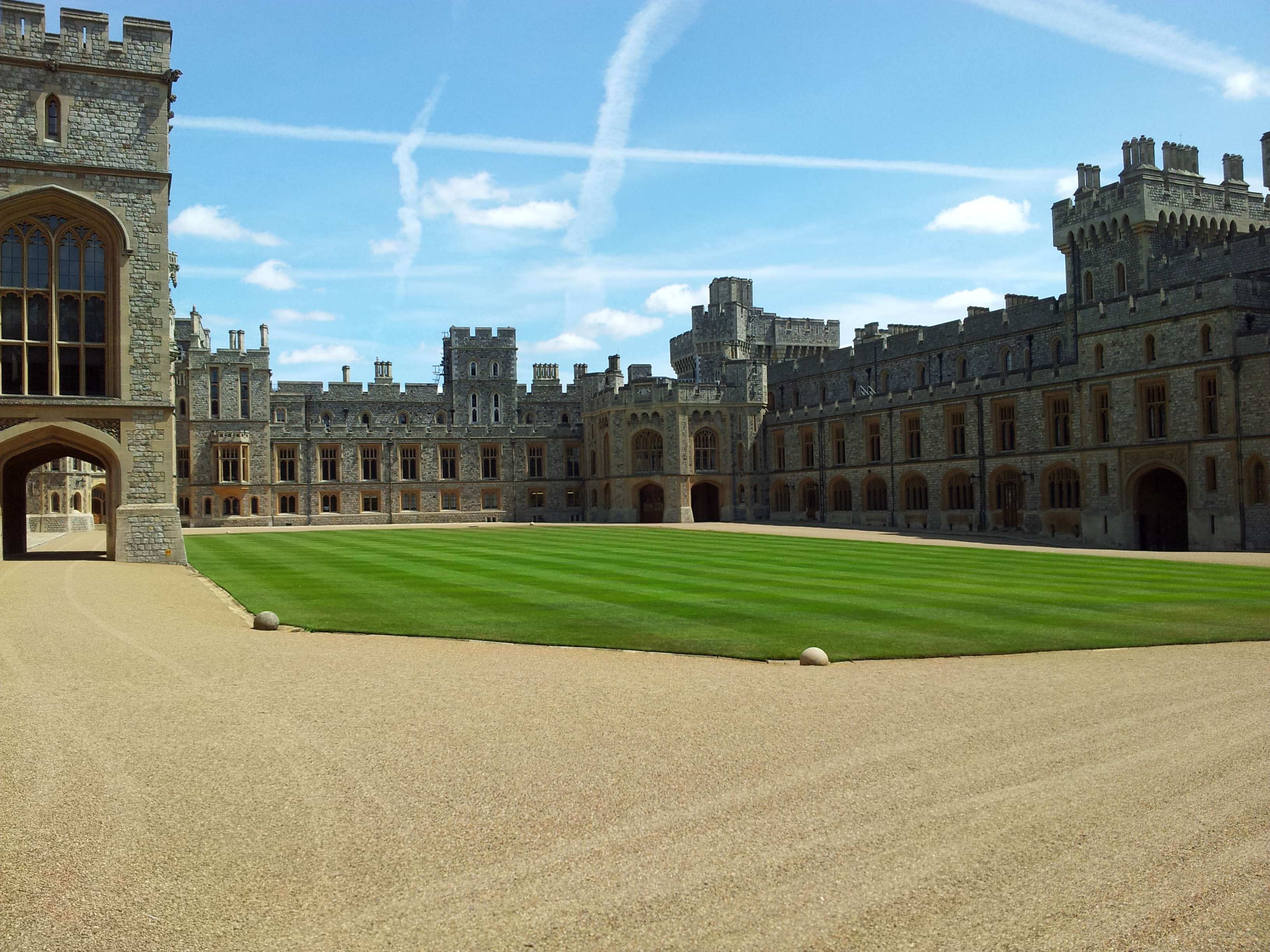
This is a real castle, and still in one piece, unlike a lot of castles.
Were we hoping to see the Queen, no, it was highly unlikely.
But there were a lot of planes flying overhead into Heathrow. The wind must have been blowing the wrong day, and I’m sure, with one passing over every few minutes, it must annoy the Queen if she was looking for peace and quiet.
Good thing then, when it was built, it was an ideal spot, and not under the landing path. I guess it was hard to predict what would happen 500 years in the future!
I’m not sure if this was the front gate or back gate, but I was wary of any stray arrows coming out of those slits either side of the entrance.
You just never know!
An excellent lawn for croquet. This, I think, is the doorway, on the left, where dignitaries arrive by car. The private apartments are across the back.
The visitor’s apartments. Not sure who that is on the horse.
St George’s Chapel. It’s a magnificent church for a private castle. It’s been very busy the last few months with Royal weddings.
The Round Tower, or the Keep. It is the castle’s centerpiece. Below it is the gardens.
Those stairs are not for the faint-hearted, nor the Queen I suspect. But I think quite a few royal children and their friends have been up and down them a few times.
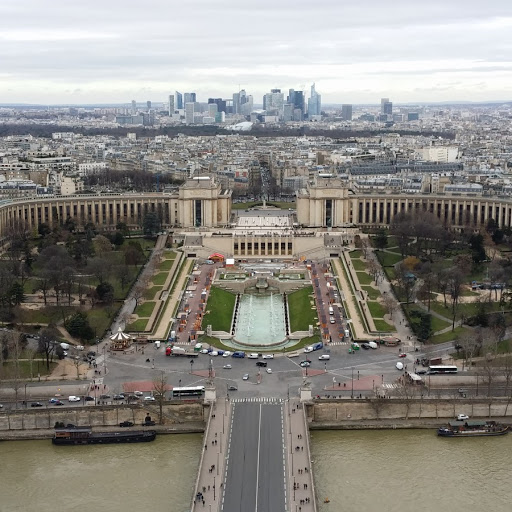
It was a cold but far from a miserable day. We were taking our grandchildren on a tour of the most interesting sites in Paris, the first of which was the Eiffel Tower.
We took the overground train, which had double-decker carriages, a first for the girls, to get to the tower.
We took the underground, or Metro, back, and they were fascinated with the fact the train carriages ran on road tires.
Because it was so cold, and windy, the tower was only open to the second level. It was a disappointment to us, but the girls were content to stay on the second level.
There they had the French version of chips.
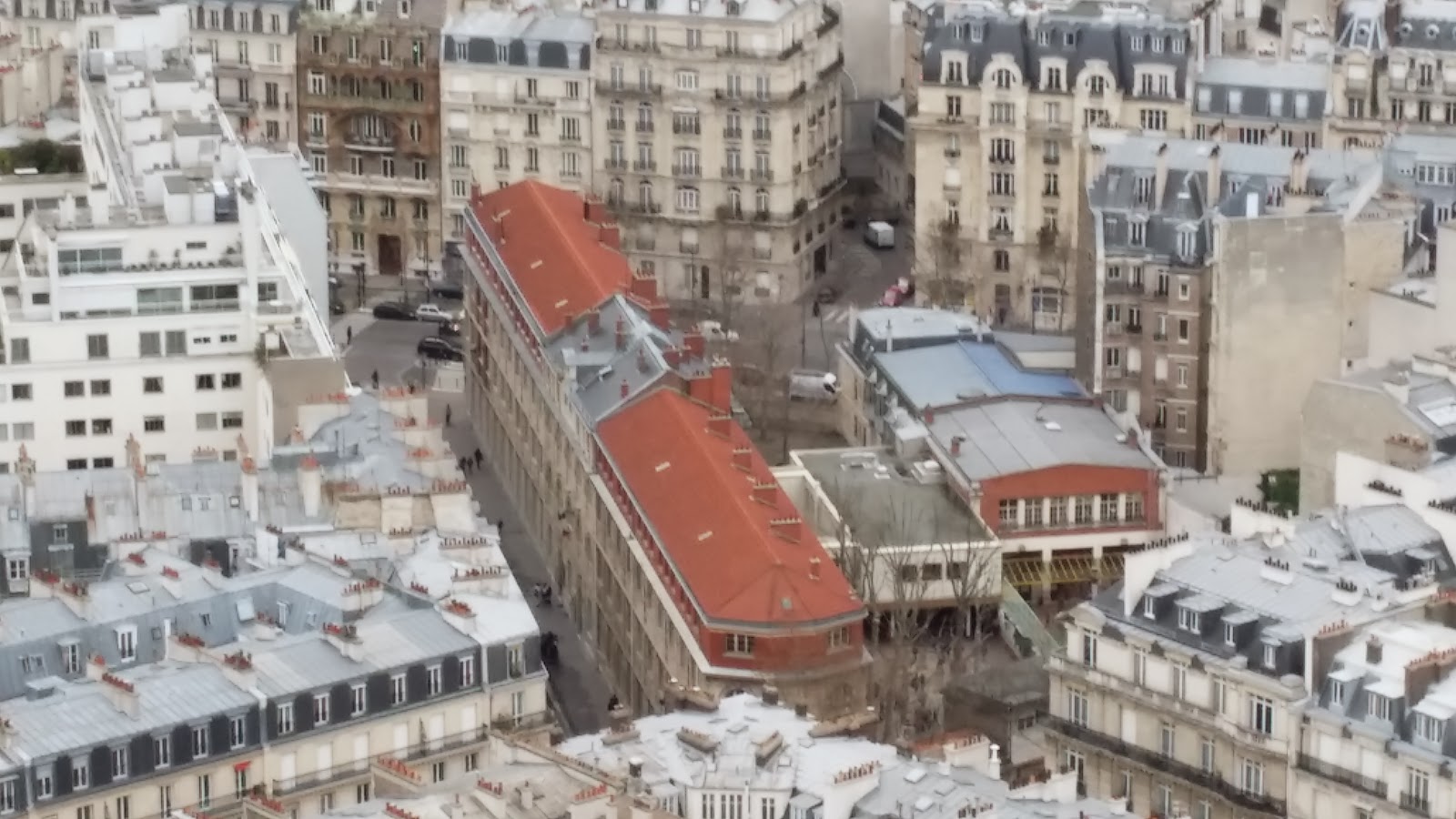
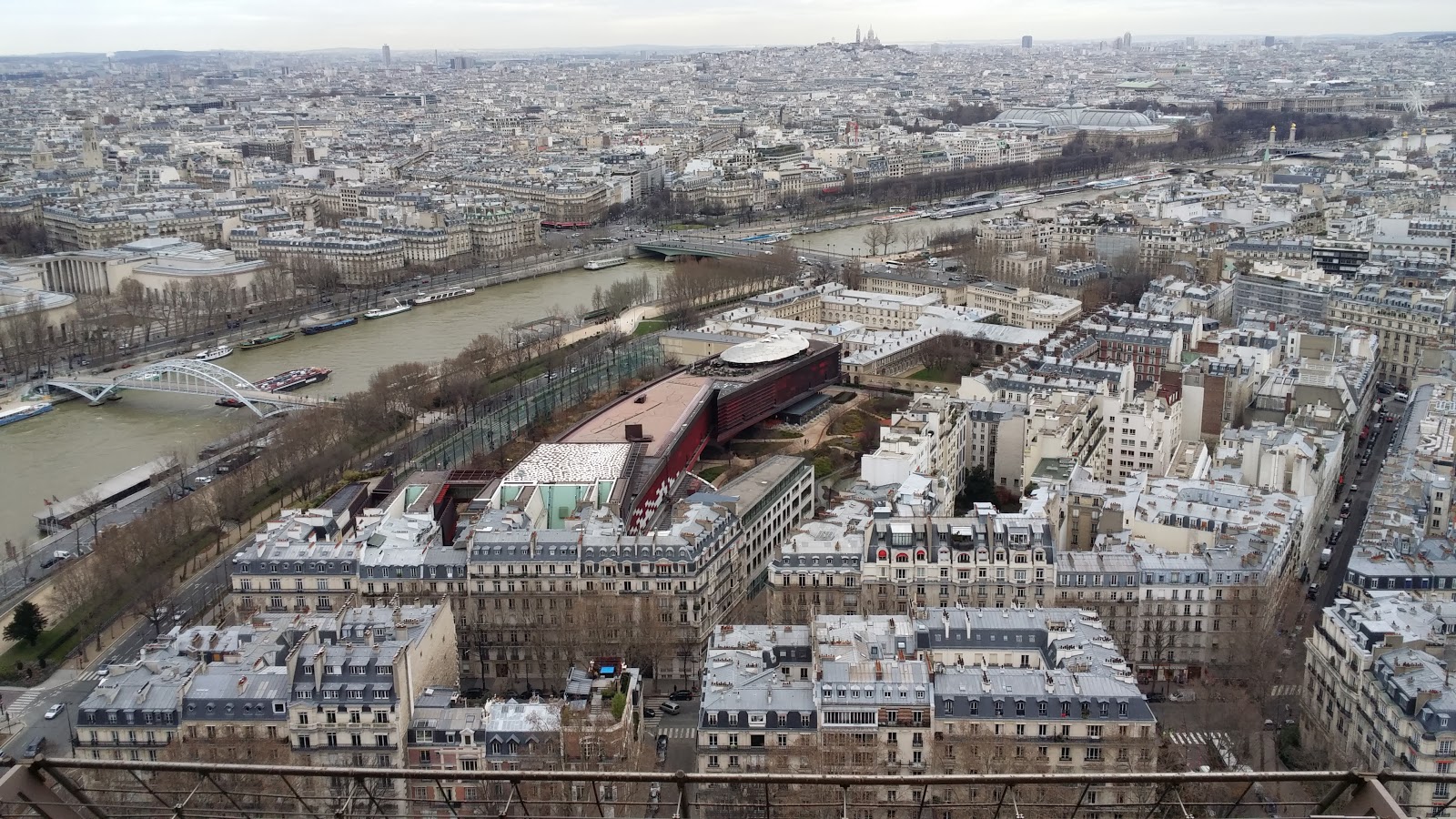
It was a dull day, but the views were magnificent.
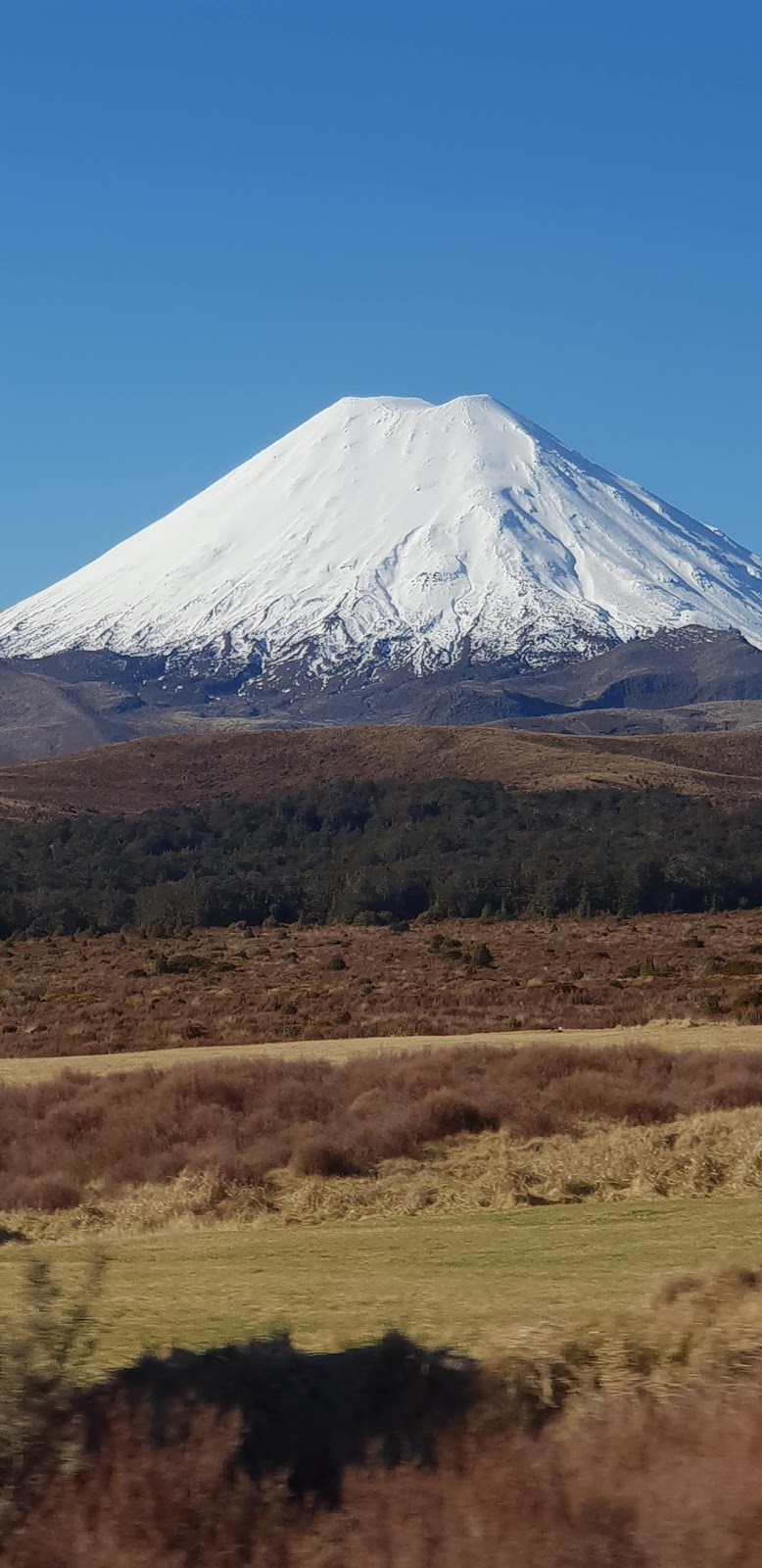
Mount Ngauruhoe is apparently still an active volcano, has been for 2,500 years or so, and last erupted on 19th February 1975, and reportedly has erupted around 70 times since 1839.
The mountain is usually climbed from the western side, from the Mangatepopo track.
This photo was taken in summer from the Chateau Tongariro carpark.
In late autumn, on one of our many visits to the area, the mountain was covered with a light sprinkling of snow and ice.
On our most recent visit, this year, in winter, it was fully covered in snow.