The Henan Museum is one of the oldest museums in China. In June 1927, General Feng Yuxiang proposed that a museum be built, and it was completed the next year. n 1961, along with the move of the provincial capital, Henan Museum moved from Kaifeng to Zhengzhou.
It currently holds about 130,000 individual pieces, more of which are mostly cultural relics, bronze vessels of the Shang and Zhou Dynasties, and pottery and porcelain wares of the various dynasties.
Eventually, we arrive at the museum and get off the bus adjacent to a scooter track and despite the efforts of the guide, there’s no stopping them from nearly running us over.
We arrive to find the museum has been moved to a different and somewhat smaller building nearby as the existing, and rather distinctively designed, building is being renovated.
While we are waiting for the tickets to enter, we are given another view of industrial life in that there is nothing that resembles proper health and safety on worksites in this country, and the workers are basically standing on what looks to be a flimsy bamboo ladder with nothing to stop them from falling off.
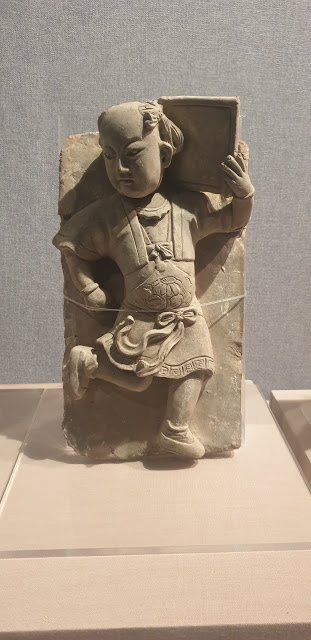
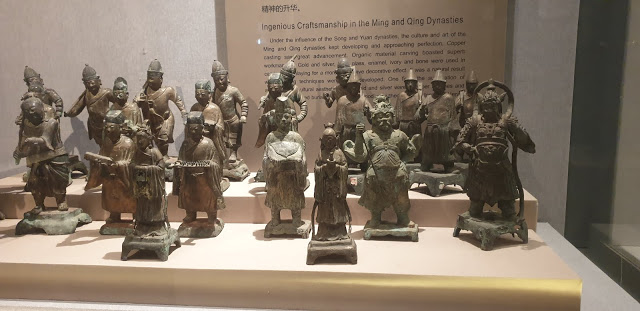
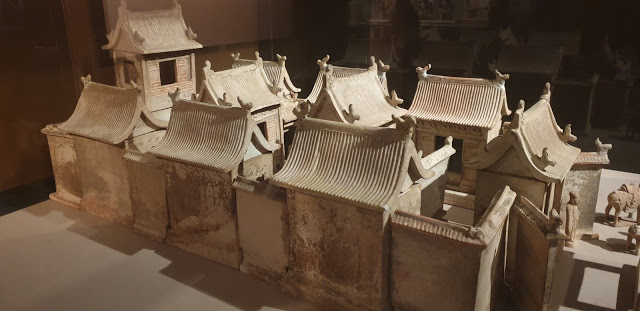
The museum itself has exhibits dating back a few thousand years and consist of bronze and ceramic items. One of the highlights was a tortoiseshell with reportedly the oldest know writing ever found.
Other than that it was a series of cooking utensils, a table, and ceramic pots, some in very good condition considering their age.
This morning we wake up to rain. Or so we thought. Taking a closer look out the window of our room on the 16th floor, we notice the rain is speckled with snowflakes. As the morning progressed the snow got harder until there were flurries.
Later we discover this is called wet snow by the local Vancouverians, and whilst they winge a lot over the endless rain, to them rain is infinitely better than snow.
To us, by the afternoon, it was almost blizzard conditions, with lots of snow. Then the only thing is that it does not accumulate on most of the ground so there are no drifts to play in.
Because the weather is so dismal we decided not to go into Vancouver to do some sightseeing because the clouds were down to the ground and then the snow set in.
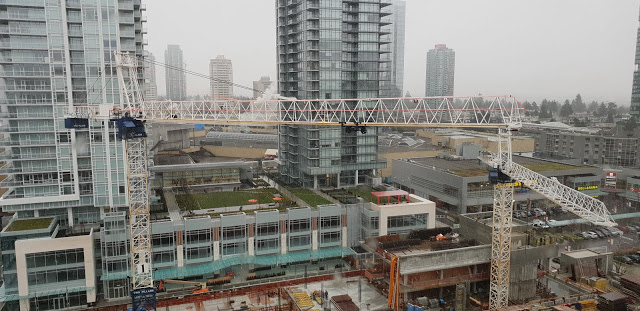
Another interesting fact is that construction workers do not go off the job if it’s raining, or worse when it is snowing. Our room overlooks a new apartment complex under construction and the workers battled on through what seemed like appalling conditions.
At four in the afternoon, the Maple Leafs are playing the Ohio Blue Jackets, in Ohio. It is a game we expect they will win. Sparks is the goalkeeper, not Anderson, they’re playing back to back games and Anderson’s starting tomorrow.
They win, four goals to two.
Just before darkness falls, about four thirty, the snow stops and there is a little rain, which melts the snow.
Time to go up to the executive lounge to get some snacks and coffee, then sleep because the next day we’re taking on the Trans Canada highway from Vancouver to Kamloops.
The forecast is for snow, more snow, and just for a change, more snow.
After another exhausting walk, by now the heat was beginning to take its toll on everyone, we arrived at the pagoda forest.
A little history first:
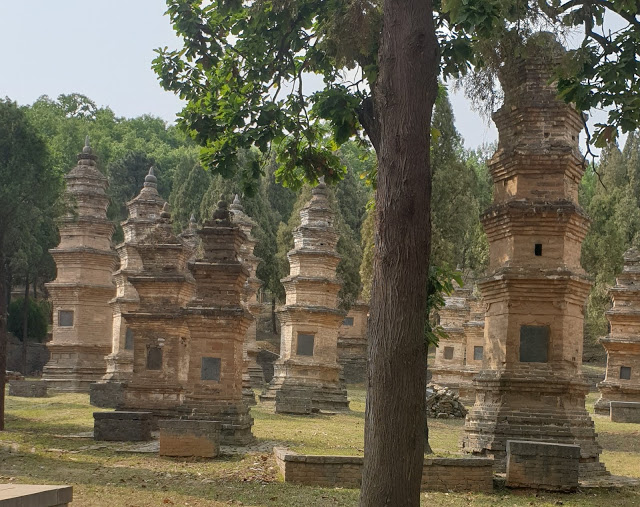
The pagoda forest is located west of the Shaolin Temple and the foot of a hill. As the largest pagoda forest in China, it covers approximately 20,000 square meters and has about 230 pagodas build from the Tang Dynasty (618-907) to the Qing Dynasty (1644-1911).
Each pagoda is the tomb of an eminent monk from the Shaolin Temple. Graceful and exquisite, they belong to different eras and constructed in different styles. The first pagoda was thought to be built in 791.
It is now a world heritage site.
No, it’s not a forest with trees it’s a collection of over 200 pagodas, each a tribute to a head monk at the temple and it goes back a long time. The tribute can have one, three, five, or a maximum of seven layers. The ashes of the individual are buried under the base of the pagoda.
The size, height, and story of the pagoda indicate its accomplishments, prestige, merits, and virtues. Each pagoda was carved with the exact date of construction and brief inscriptions and has its own style with various shapes such as a polygonal, cylindrical, vase, conical and monolithic.
This is one of the more recently constructed pagodas
There are pagodas for eminent foreign monks also in the forest.
From there we get a ride back on the back of a large electric wagon
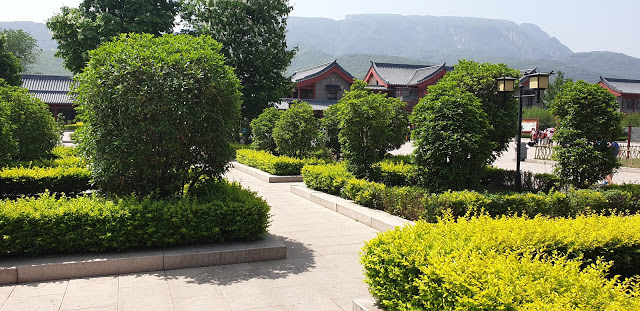
to the front entrance courtyard where drinks and ice creams can be bought, and a visit to the all-important happy place.
This morning started with a visit to the car rental place in Vancouver. It reinforced the notion that you can be given the address and still not find the place. It happened in Washington where it was hiding in the back of the main railway station, and it happened again in Vancouver when it was hidden inside a hotel.
We simply walked straight past it. Pity there wasn’t a sign to let people know.
However…
We went in expecting a Grand Jeep Cherokee and walked out with a Ford Flex, suitable for three people and four large suitcases. It actually seats 7, but forget the baggage, you’d be lucky to get two large suitcases in that configuration.
It is more than adequate for our requirements.
Things to note, it was delivered with just over a quarter of a tank of gas, and it had only done about 11,000 km, so it’s relatively new. It’s reasonably spacious, and when the extra seats are folded down, there is plenty of baggage space.
So far, so good.
We finally leave the hotel at about half-past ten, and it is raining. It is a simple task to get on Highway 1, the TransCanada Highway, initially, and then onto Highway 5, the Coquihalla Highway for the trip to Kamloops.
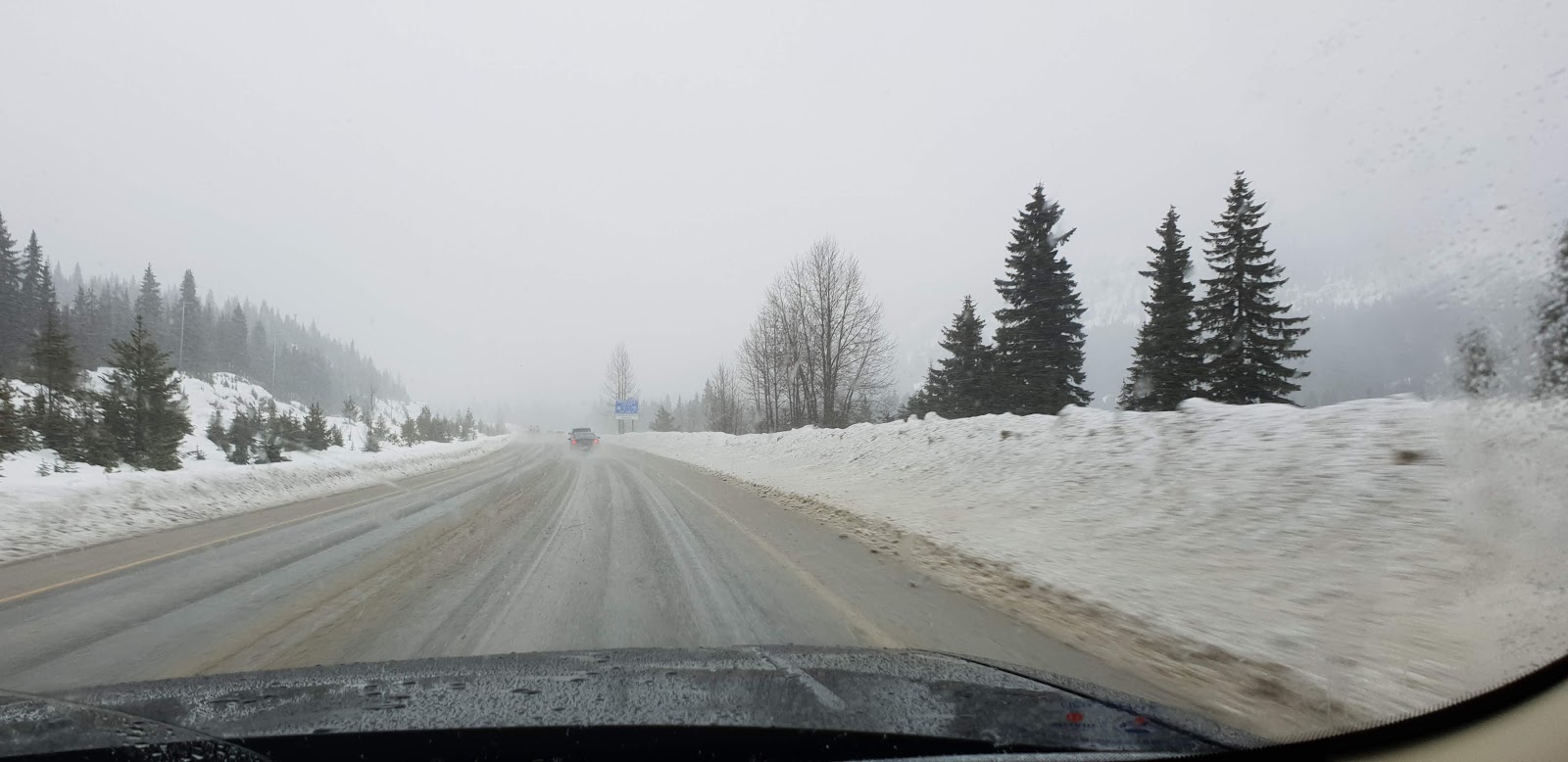
It rains all the way to the top of the mountain, progress hampered from time to time by water sprays from both vehicles and trucks. The rain is relentless. At the top of the mountain, the rain turns into snow and the road surface to slush. It’s 0 degrees, but being the afternoon, I was not expecting it to turn to ice very quickly.
On the other side of the mountain, closer to Kamloops, there was sleet, then rain, then nothing, the last 100kms or so, in reasonably dry conditions.
Outside Kamloops, and in the town itself, there was evidence of snow recently cleared, and slushy roads. Cars in various places were covered in snow, indicating the most recent falls had been the night before.
We’re staying at the Park Hotel, a heritage building, apparently built in the later 1920s. In the style of the time, it is a little like a rabbit warren with passages turning off in a number of directions, and showing it is spread across a number of different buildings.
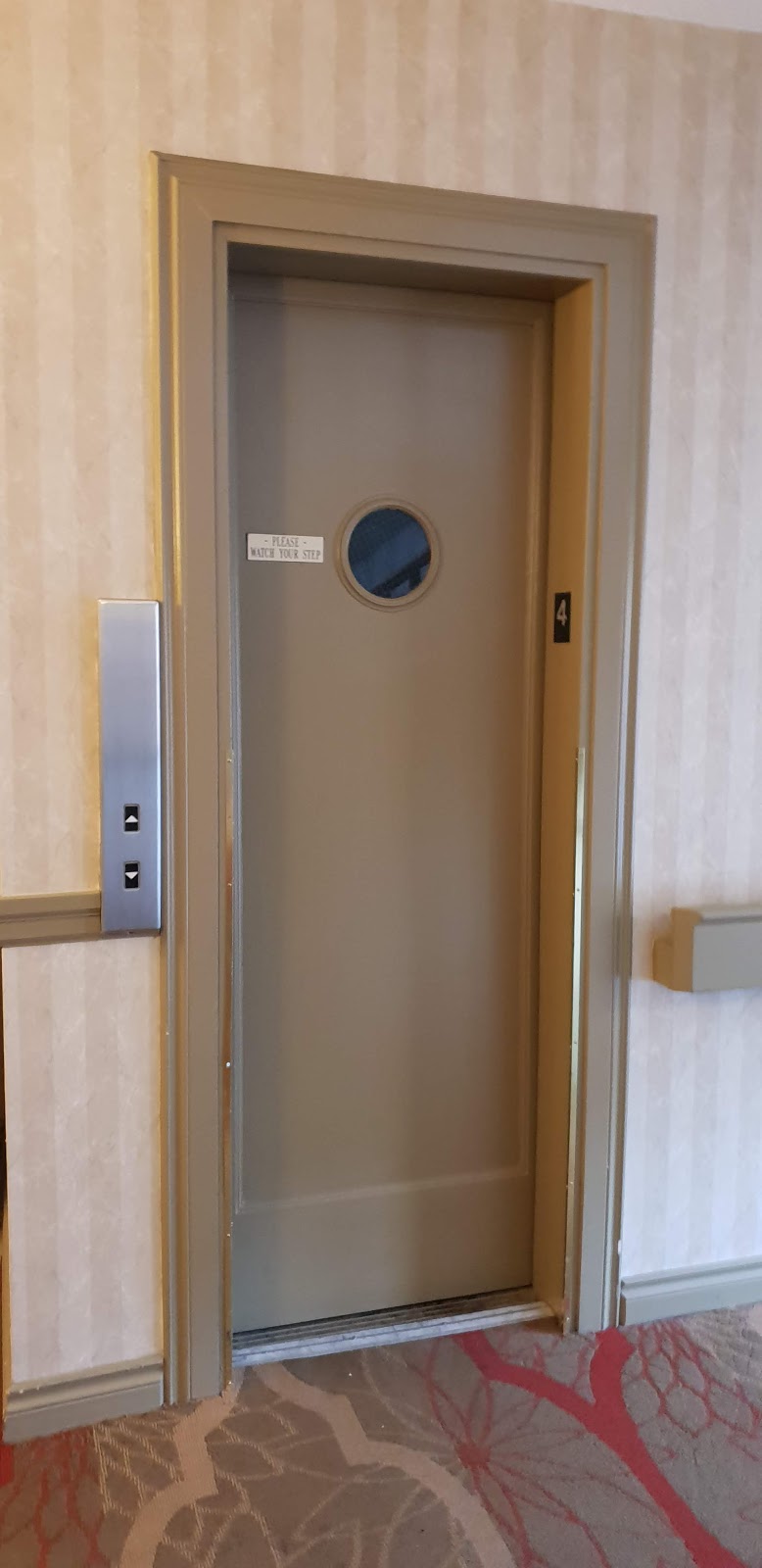
It has the original Otis elevator that can take a maximum of four passengers, and a sign on the wall that says “no horseplay inside the elevator” which is a rather interesting expression that only someone of my vintage would understand. And, for those without a sense of humor, you definitely couldn’t fit a horse in it to play with.
The thing is, how do you find a balance between keeping the old world charm with modern-day expectations. You can’t. Some hotels try valiantly to get that balance. Here, it is simply old world charm, which I guess we should be grateful for because sooner rather than later it’s going to disappear forever.
In my writer’s mind, given the importance of the railways, this was probably a thriving place for travelers, and once upon a time, there were a lot more hotels like this one.
This morning started with a visit to the car rental place in Vancouver. It reinforced the notion that you can be given the address and still not find the place. It happened in Washington where it was hiding in the back of the main railway station, and it happened again in Vancouver when it was hidden inside a hotel.
We simply walked straight past it. Pity there wasn’t a sign to let people know.
However…
We went in expecting a Grand Jeep Cherokee and walked out with a Ford Flex, suitable for three people and four large suitcases. It actually seats 7, but forget the baggage, you’d be lucky to get two large suitcases in that configuration.
It is more than adequate for our requirements.
Things to note, it was delivered with just over a quarter of a tank of gas, and it had only done about 11,000 km, so it’s relatively new. It’s reasonably spacious, and when the extra seats are folded down, there is plenty of baggage space.
So far, so good.
We finally leave the hotel at about half-past ten, and it is raining. It is a simple task to get on Highway 1, the TransCanada Highway, initially, and then onto Highway 5, the Coquihalla Highway for the trip to Kamloops.
It rains all the way to the top of the mountain, progress hampered from time to time by water sprays from both vehicles and trucks. The rain is relentless. At the top of the mountain, the rain turns into snow and the road surface to slush. It’s 0 degrees, but being the afternoon, I was not expecting it to turn to ice very quickly.
On the other side of the mountain, closer to Kamloops, there was sleet, then rain, then nothing, the last 100kms or so, in reasonably dry conditions.
Outside Kamloops, and in the town itself, there was evidence of snow recently cleared, and slushy roads. Cars in various places were covered in snow, indicating the most recent falls had been the night before.
We’re staying at the Park Hotel, a heritage building, apparently built in the later 1920s. In the style of the time, it is a little like a rabbit warren with passages turning off in a number of directions, and showing it is spread across a number of different buildings.
It has the original Otis elevator that can take a maximum of four passengers, and a sign on the wall that says “no horseplay inside the elevator” which is a rather interesting expression that only someone of my vintage would understand. And, for those without a sense of humor, you definitely couldn’t fit a horse in it to play with.
The thing is, how do you find a balance between keeping the old world charm with modern-day expectations. You can’t. Some hotels try valiantly to get that balance. Here, it is simply old world charm, which I guess we should be grateful for because sooner rather than later it’s going to disappear forever.
In my writer’s mind, given the importance of the railways, this was probably a thriving place for travelers, and once upon a time, there were a lot more hotels like this one.
In Beijing Hutongs are formed by lines of traditional courtyard residences, called siheyuan. Neighborhoods were formed by joining many hutongs together. These siheyuan are the traditional residences, usually occupied by a single or extended family, signifying wealth, and prosperity.
Over 500 of these still exist.Many of these hutongs have been demolished, but recently they have become protected places as a means of preserving some Chinese cultural history. They were first established in the Yuan Dynasty (1279-1368)Many of these Hutongs had their main buildings and gates built facing south, and lanes connecting them to other hutongs also ran north to south.
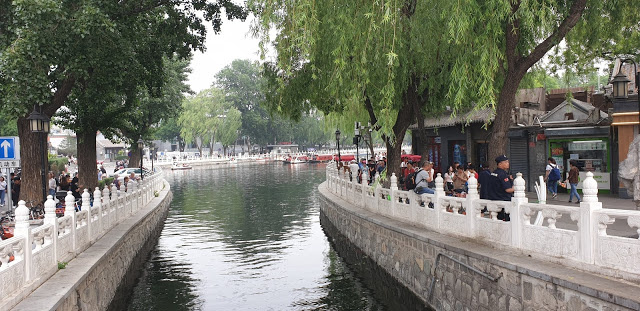
Many hutongs, some several hundred years old, in the vicinity of the Bell Tower and Drum Tower and Shichahai Lake are preserved and abound with tourists, many of which tour the quarter in pedicabs.
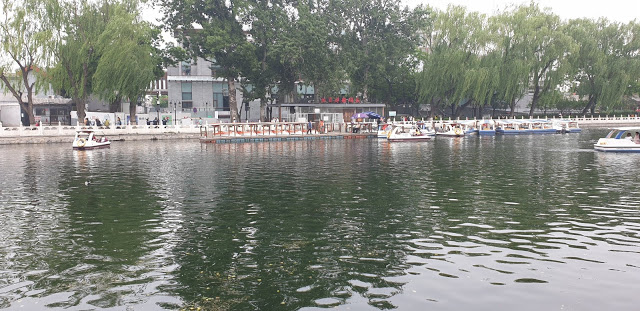
The optional tour also includes a visit to Shichahai, a historic scenic area consisting of three lakes (Qianhai, meaning Front Sea; Houhai, meaning Back Sea and Xihai, meaning West Sea), surrounding places of historic interest and scenic beauty and remnants of old-style local residences, Hutong and Courtyard.
First, we had a short walk through the more modern part of the Hutong area and given some free time for shopping, but we prefer just to meander by the canal.
There is a lake, and if we had the time, there were boats you could take.
With some time to spare, we take a quick walk down one of the alleyways where on the ground level are small shops, and above, living quarters.
Then we go to the bell and drum towers before walking through some more alleys was to where the rickshaws were waiting. The Bell tower
And the Drum tower. Both still working today.
The rickshaw ride took us through some more back streets where it was clear renovations were being made so that the area could apply for world heritage listing. Seeing inside some of the houses shows that they may look dumpy outside but that’s not the case inside.
The rickshaw ride ends outside the house where dinner will be served, and is a not so typical hose but does have all the elements of how the Chinese live, the boy’s room, the girl’s room, the parent’s room, the living area, and the North-south feng shui.
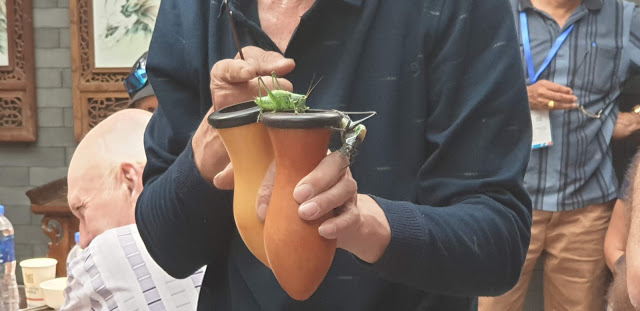
Shortly after we arrive, the cricket man, apparently someone quite famous in Beijing arrives and tells us all about crickets and then grasshoppers, then about cricket racing. He is animated and clearly enjoys entertaining us westerners.
I’m sorry but the cricket stuff just didn’t interest me. Or the grasshoppers.
As for dinner, it was finally a treat to eat what the typical Chinese family eats, and everything was delicious, and the endless beer was a nice touch.
And the last surprise, the food was cooked by a man.
Instead of making a grand entrance, arriving in style and being greeted by important dignitaries, we are slinking in via an airplane, late at night. It’s hardly the entrance I’d envisaged. At 9:56 the plane touches down on the runway. Outside the plane, it is dark and gloomy and from what I could see, it had been raining. That could, of course, simply be condensation.
Once on the ground, everyone was frantically gathering together everything from seat pockets and sending pillows and blankets to the floor. A few were turning their mobile phones back on, and checking for a signal, and, perhaps, looking for messages sent to them during the last 12 hours. Or perhaps they were just suffering from mobile phone deprivation.
It took 10 minutes for the plane to arrive at the gate. That’s when everyone moves into overdrive, unbuckling belts, some before the seatbelt sign goes off, and are first out of their seats and into the overhead lockers. Most are not taking care that their luggage may have moved, but fortunately, no bags fall out onto someone’s head. The flight had been relatively turbulent free.
When as many people and bags have squeezed into that impossibly small aisle space, we wait for the door to open, and then the privileged few business and first-class passengers to depart before we can begin to leave. As we are somewhere near the middle of the plane, our wait will not be as long as it usually is. This time we avoided being at the back of the plane. Perhaps that privilege awaits us on the return trip.
Once off the plane, it is a matter of following the signs, some of which are not as clear as they could be. It’s why it took another 30 odd minutes to get through immigration, but that was not necessarily without a few hiccups along the way. We got sidetracked at the fingerprint machines, which seemed to have a problem if your fingers were not straight, not in the center of the glass, and then if it was generally cranky, which ours were, continue to tell you to try again, and again, and again, and again…That took 10 to 15 minutes before we joined an incredibly long queue of other arrivals,
A glance at the time, and suddenly it’s nearly an hour from the moment we left the plane.
And…
That’s when we got to the immigration officer, and it became apparent we were going to have to do the fingerprints yet again. Fortunately this time, it didn’t take as long. Once that done, we collected our bags, cleared customs by putting our bags through a huge x-ray machine, and it was off to find our tour guide.
We found several tour guides with their trip-a-deal flags waiting for us to come out of the arrivals hall. It wasn’t a difficult process in the end. We were in the blue group. Other people we had met on the plane were in the red group or the yellow group. The tour guide found, or as it turned out she found us, it was simply a matter of waiting for the rest of the group, of which there were eventually 28.Gathered together we were told we would be taking the bags to one place and then ourselves to the bus in another. A glance in the direction of the bus park, there were a lot of busses.
Here’s a thought, imagine being told your bus is the white one with blue writing on the side.
Yes, yours is, and 25 others because all of the tourist coaches are the same. An early reminder, so that you do not get lost, or, God forbid, get on the wrong bus, for the three days in Beijing, is to get the last five numbers of the bus registration plate and commit them to memory. It’s important. Failing that, the guide’s name is in the front passenger window.
Also, don’t be alarmed if your baggage goes in one direction, and you go in another. In a rather peculiar set up the bags are taken to the hotel by what the guide called the baggage porter. It is an opportunity to see how baggage handlers treat your luggage; much better than the airlines it appears.
That said, if you’re staying at the Beijing Friendship Hotel, be prepared for a long drive from the airport. It took us nearly an hour, and bear in mind that it was very late on a Sunday night.
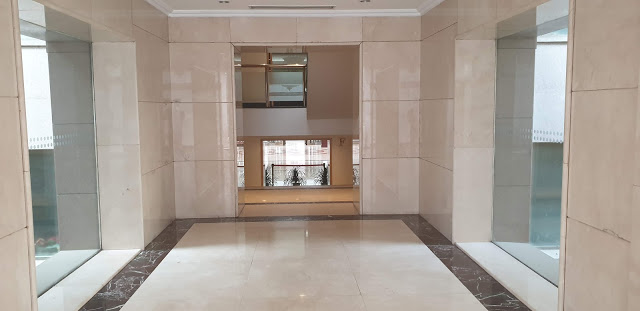
Climbing out of the bus after what seemed a convoluted drive through a park with buildings, we arrive at the building that will be our hotel for the next three days. From the outside, it looks quite good, and once inside the foyer, that first impression is good. Lots of space, marble, and glass. If you are not already exhausted by the time you arrive, the next task is to get your room key, find your bags, get to your room, and try to get to be ready the next morning at a reasonable hour.
Sorry, that boat has sailed.
We were lucky, we were told, that our plane arrived on time, and we still arrived at the hotel at 12:52. Imagine if the incoming plane is late.
This was taken the following morning. It didn’t look half as bland late at night.
This is the back entrance to Building No 4 but is quite representative of the whole foyer, made completely of marble and glass. It all looked very impressive under the artificial lights, but not so much in the cold hard light of early morning.
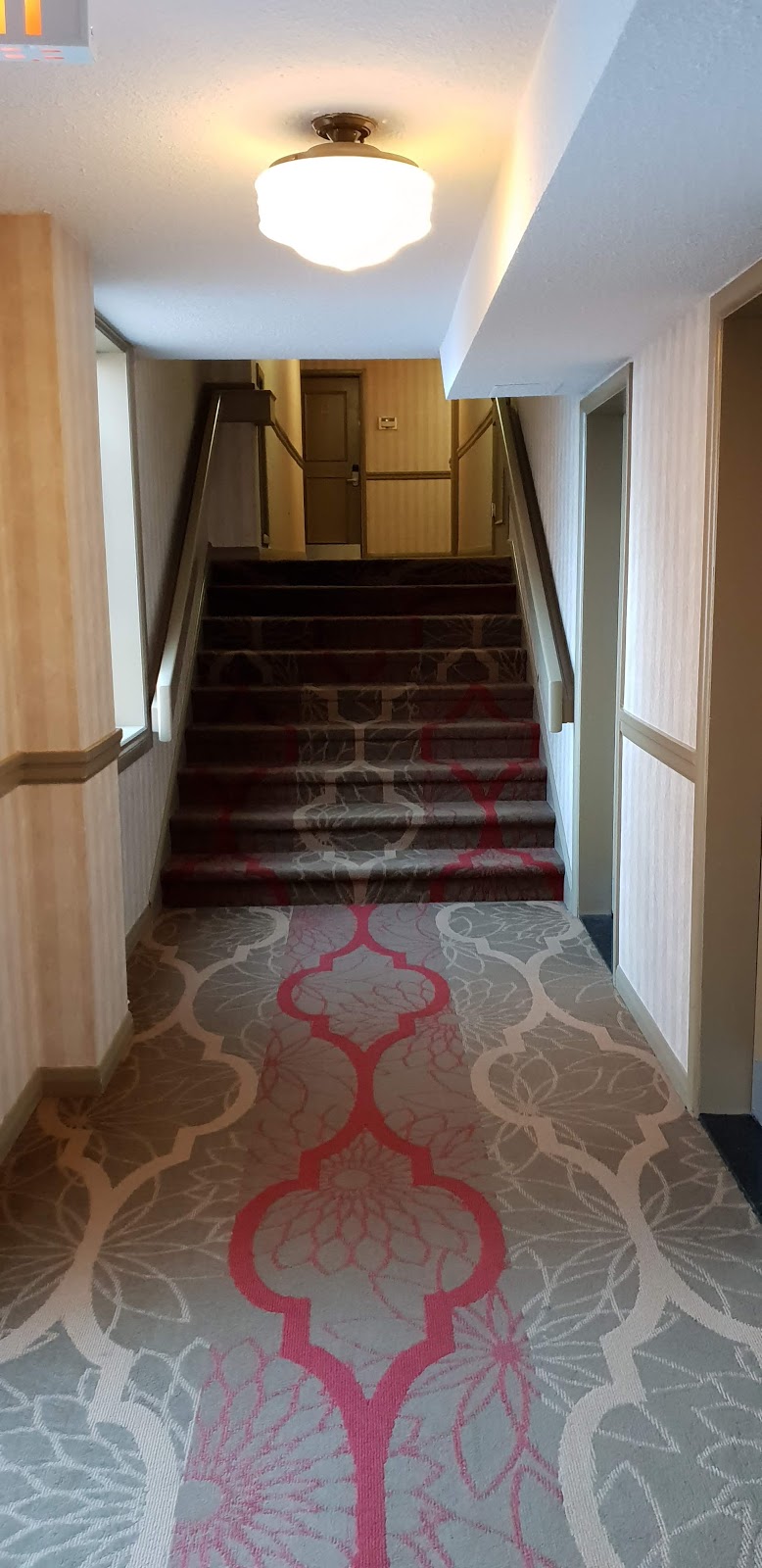
This the foyer of the floor our room was on. Marble with interesting carpet designs. Those first impressions of it being a plush hotel were slowly dissipating as we got nearer and nearer to the room. From the elevator, it was a long, long walk.
So…Did I tell you about the bathroom in our room?
The shower and the toilet both share the same space with no divide and the shower curtain doesn’t reach to the floor. Water pressure is phenomenal. Having a shower floods the whole shower plus toilet area so when you go to the toilet you’re basically underwater.
Don’t leave your book or magazine on the floor or it will end up a watery mess.
And the water pressure is so hard that it could cut you in half. Only a small turn of the tap is required to get that tingling sensation going.
Sydney to Beijing – Qantas A330-200 Boarding 11:45, everyone on board by 12:02, for a 12:10 departure. Pushing back 12:12 Take off 12:27
Lunch Airline food is getting better but the fact they serve it up to you in a metal tray with a thick aluminum lid does nothing for the quality of the food inside. I get what the chef is trying to do but often there is too little of one thing and too much of another and what you finish up with is slop in a tray. Sometimes it’s edible sometimes it’s not. Sometimes the meat is tender and other times it’s like boot leather. As it is today. I think it’s pork, I should have had the chicken. Or perhaps it was chicken. I hate it when you can’t tell what it is that you’re eating. But, the drinks were good.
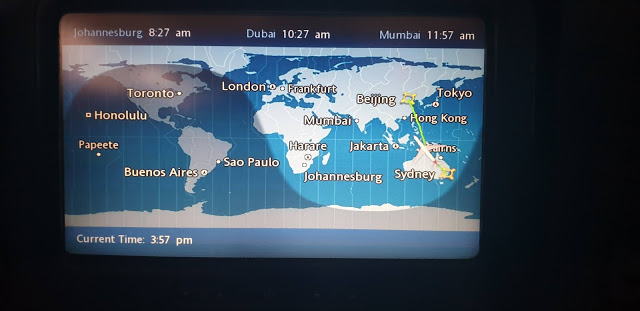
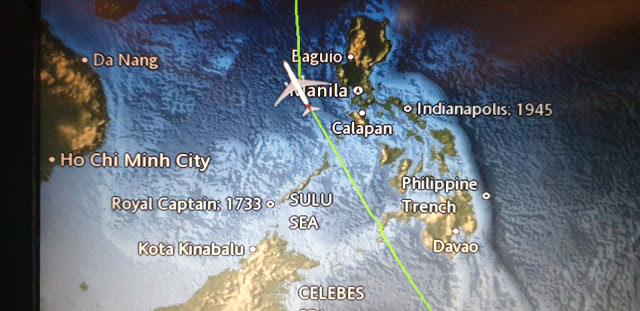
Rest or Sleep, maybe It’s going to take 11 hours and 20 minutes from Sydney to Beijing, a long time to sit in a plane with nothing much to do other than crosswords, read a book or newspaper or magazine, listen to music on your own device, or the in-flight entertainment, watch a movie again by the in-flight entertainment – if it works – or try to get some sleep. I started with the crosswords but got bored quickly. I fiddled with the in-flight entertainment, looked at the movies and tv shows but none really interested me, not then at least, so I set it to the flight path. Not exactly stellar entertainment, but it’s always interesting to know where the plane is. Or is it? If we crash, what good would it do me to know it’s somewhere over the ocean, not far from Manila, or somewhere else. It’s not as if I could phone someone up, on the way down, to let them know where we are. But, just after dinner, we still haven’t left Australia
However, by the time I’ve finished fiddling with and dismissing all of the entertainment alternatives, it’s back to the flight path and now we are…
Somewhere approaching the Sulu Sea, which I’ve never heard of before, so it looks like I’ll have to study up on my geography when I get home.
OK, Manila looks like somewhere I’ve heard of, so we have to be flying over the Philippines. Not far left of that is Vietnam. Neither of those places is on my travel bucket list, so I’ll just look from up here and be satisfied with that.
Working, or not Chronic boredom is setting in by the time we are just past halfway to our destination. We are over 6 hours into the flight and there no possible way I’m going to get any sleep. I brought my Galaxy Tab loaded with a few of my novel outlines, and planning for missing chapters, thinking I might get a little thinking time in. Plane rides, I find, are excellent for getting an opportunity to write virtually unhindered by outside interruptions, if, of course, you discount the number of times people brush past, knocking your seat, the person in front lowering the seat into your face, or people around you continually asking you to turn off your light because they’re trying to sleep. Sorry, I say, but you can suffer my pain with me. It’s one of the joys of flying with over two hundred others in a claustrophobic environment. Besides, aren’t the lights supposed to be slanted so only I get the rays of light? Except, I guess when the fixed light doesn’t line up with where the airline has fixed the seat (usually so they can squash more people in).So, sorry, not sorry, take it up with the airline.
Back to work, and I put in some quality time on a part of the story that had been eluding me for a while. I knew what I wanted to write, but not how I was going to approach it, so that blissfully quiet and intense time worked in my favor, something that would not have happened back hope. I won’t bore you with the synopsis, just suffice to say it’s finally down on paper, digitally that is, and it’s a huge step forward towards finishing it. There is, of course, the end play, the reading of the will but not before there’s a few thrusts and parry’s by some of the players, but all in all the objective was to showcase a group of people with their strengths and weaknesses pushing their characters in various directions, some at odds with what is expected of them. But enough of that. A quick check of our position shows we’re still over water but closer to our destination, so much so, we might start the pre-landing rituals, starting with food.
Dinner 7:00 – Dinner is served, well, the lights go on and a lot of tired people try to shake the sleep, and sleeplessness, out of their systems. Then flight attendants that are far too cheerful, and must have beamed in from somewhere else, serve another interesting concoction that says what’s in it but you can’t really be sure of the ingredients. It comes and it goes.
9:10 – We begin our descent into Beijing, you know, that moment when the engines almost stop and there’s a sickening lurch and the plane heads downward. 9:56 – We touch down on the runway, in the dark and apparently it has been raining though from inside the plane you’d never know. 10:10 – the plane arrives at the gate, the usual few minutes to open the door, and, being closer to the front of the plane this time, it doesn’t take that long before the queue is moving.
Early or late, it doesn’t matter. After clearing customs and immigration, we have to go in search of our tour guide, waiting for us somewhere outside the arrivals terminal.
A fine day, on this trip a rarity, we decided to take the train to Windsor and see the castle.
This is a real castle, and still in one piece, unlike a lot of castles.
Were we hoping to see the Queen, no, it was highly unlikely.
But there were a lot of planes flying overhead into Heathrow. The wind must have been blowing the wrong day, and I’m sure, with one passing over every few minutes, it must annoy the Queen if she was looking for peace and quiet.
Good thing then, when it was built, it was an ideal spot, and not under the landing path. I guess it was hard to predict what would happen 500 years in the future!
I’m not sure if this was the front gate or back gate, but I was wary of any stray arrows coming out of those slits either side of the entrance.
You just never know!
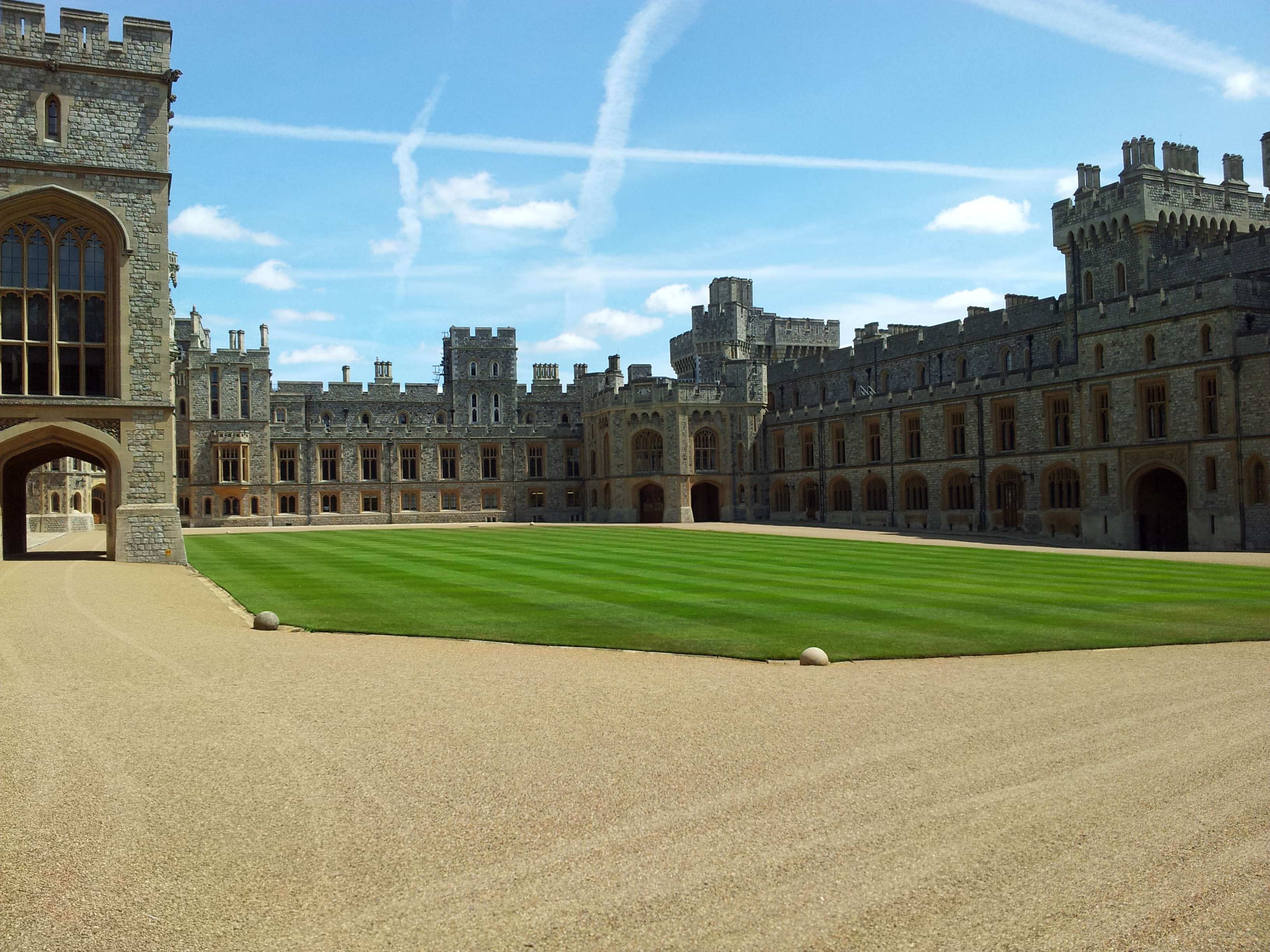
An excellent lawn for croquet. This, I think, is the doorway, on the left, where dignitaries arrive by car. The private apartments are across the back.
The visitor’s apartments. Not sure who that is on the horse.
St George’s Chapel. It’s a magnificent church for a private castle. It’s been very busy the last few months with Royal weddings.
The Round Tower, or the Keep. It is the castle’s centerpiece. Below it is the gardens.
Those stairs are not for the faint-hearted, nor the Queen I suspect. But I think quite a few royal children and their friends have been up and down them a few times.
A fine day, on this trip a rarity, we decided to take the train to Windsor and see the castle.
This is a real castle, and still in one piece, unlike a lot of castles.
Were we hoping to see the Queen, no, it was highly unlikely.
But there were a lot of planes flying overhead into Heathrow. The wind must have been blowing the wrong day, and I’m sure, with one passing over every few minutes, it must annoy the Queen if she was looking for peace and quiet.
Good thing then, when it was built, it was an ideal spot, and not under the landing path. I guess it was hard to predict what would happen 500 years in the future!
I’m not sure if this was the front gate or back gate, but I was wary of any stray arrows coming out of those slits either side of the entrance.
You just never know!
An excellent lawn for croquet. This, I think, is the doorway, on the left, where dignitaries arrive by car. The private apartments are across the back.
The visitor’s apartments. Not sure who that is on the horse.
St George’s Chapel. It’s a magnificent church for a private castle. It’s been very busy the last few months with Royal weddings.
The Round Tower, or the Keep. It is the castle’s centerpiece. Below it is the gardens.
Those stairs are not for the faint-hearted, nor the Queen I suspect. But I think quite a few royal children and their friends have been up and down them a few times.
















 Thrills, Spills, and just a dash of Romance