After another exhausting walk, by now the heat was beginning to take its toll on everyone, we arrived at the pagoda forest.
A little history first:
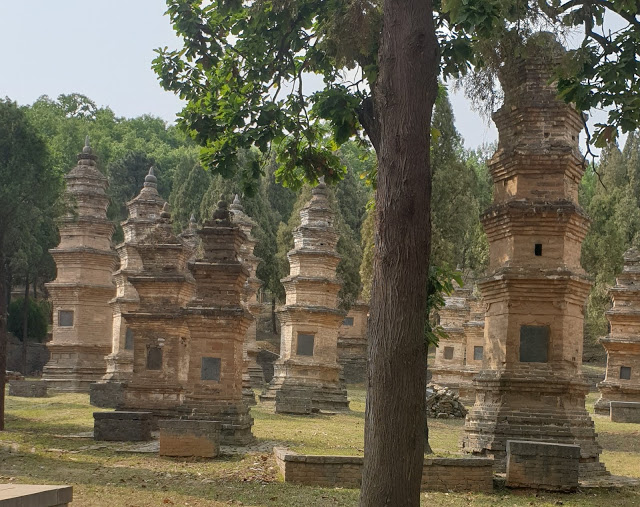
The pagoda forest is located west of the Shaolin Temple and the foot of a hill. As the largest pagoda forest in China, it covers approximately 20,000 square meters and has about 230 pagodas build from the Tang Dynasty (618-907) to the Qing Dynasty (1644-1911).
Each pagoda is the tomb of an eminent monk from the Shaolin Temple. Graceful and exquisite, they belong to different eras and constructed in different styles. The first pagoda was thought to be built in 791.
It is now a world heritage site.
No, it’s not a forest with trees it’s a collection of over 200 pagodas, each a tribute to a head monk at the temple and it goes back a long time. The tribute can have one, three, five, or a maximum of seven layers. The ashes of the individual are buried under the base of the pagoda.
The size, height, and story of the pagoda indicate its accomplishments, prestige, merits, and virtues. Each pagoda was carved with the exact date of construction and brief inscriptions and has its own style with various shapes such as a polygonal, cylindrical, vase, conical and monolithic.
This is one of the more recently constructed pagodas
There are pagodas for eminent foreign monks also in the forest.
From there we get a ride back on the back of a large electric wagon
to the front entrance courtyard where drinks and ice creams can be bought, and a visit to the all-important happy place.
After another exhausting walk, by now the heat was beginning to take its toll on everyone, we arrived at the pagoda forest.
A little history first:
The pagoda forest is located west of the Shaolin Temple and the foot of a hill. As the largest pagoda forest in China, it covers approximately 20,000 square meters and has about 230 pagodas build from the Tang Dynasty (618-907) to the Qing Dynasty (1644-1911).
Each pagoda is the tomb of an eminent monk from the Shaolin Temple. Graceful and exquisite, they belong to different eras and constructed in different styles. The first pagoda was thought to be built in 791.
It is now a world heritage site.
No, it’s not a forest with trees it’s a collection of over 200 pagodas, each a tribute to a head monk at the temple and it goes back a long time. The tribute can have one, three, five, or a maximum of seven layers. The ashes of the individual are buried under the base of the pagoda.
The size, height, and story of the pagoda indicate its accomplishments, prestige, merits, and virtues. Each pagoda was carved with the exact date of construction and brief inscriptions and has its own style with various shapes such as a polygonal, cylindrical, vase, conical and monolithic.
This is one of the more recently constructed pagodas
There are pagodas for eminent foreign monks also in the forest.
From there we get a ride back on the back of a large electric wagon
to the front entrance courtyard where drinks and ice creams can be bought, and a visit to the all-important happy place.
In Beijing Hutongs are formed by lines of traditional courtyard residences, called siheyuan. Neighborhoods were formed by joining many hutongs together. These siheyuan are the traditional residences, usually occupied by a single or extended family, signifying wealth, and prosperity.
Over 500 of these still exist.Many of these hutongs have been demolished, but recently they have become protected places as a means of preserving some Chinese cultural history. They were first established in the Yuan Dynasty (1279-1368)Many of these Hutongs had their main buildings and gates built facing south, and lanes connecting them to other hutongs also ran north to south.
Many hutongs, some several hundred years old, in the vicinity of the Bell Tower and Drum Tower and Shichahai Lake are preserved and abound with tourists, many of which tour the quarter in pedicabs.
The optional tour also includes a visit to Shichahai, a historic scenic area consisting of three lakes (Qianhai, meaning Front Sea; Houhai, meaning Back Sea and Xihai, meaning West Sea), surrounding places of historic interest and scenic beauty and remnants of old-style local residences, Hutong and Courtyard.
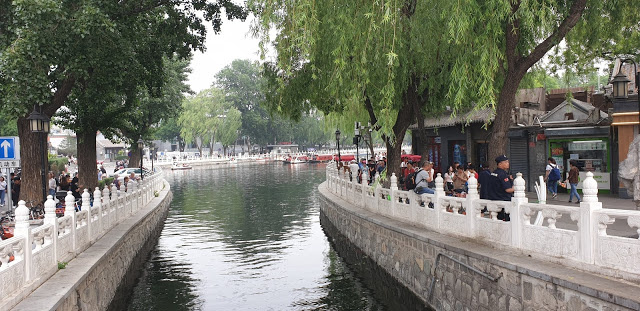
First, we had a short walk through the more modern part of the Hutong area and given some free time for shopping, but we prefer just to meander by the canal.
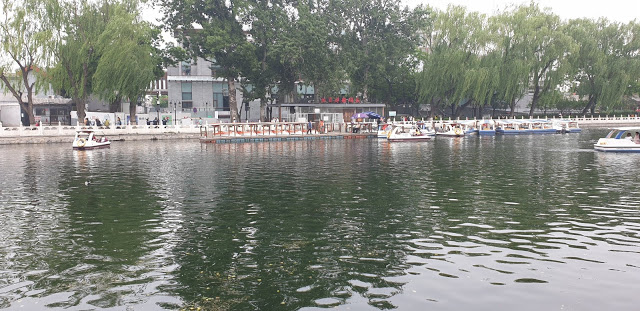
There is a lake, and if we had the time, there were boats you could take.
With some time to spare, we take a quick walk down one of the alleyways where on the ground level are small shops, and above, living quarters.
Then we go to the bell and drum towers before walking through some more alleys was to where the rickshaws were waiting. The Bell tower
And the Drum tower. Both still working today.
The rickshaw ride took us through some more back streets where it was clear renovations were being made so that the area could apply for world heritage listing. Seeing inside some of the houses shows that they may look dumpy outside but that’s not the case inside.
The rickshaw ride ends outside the house where dinner will be served, and is a not so typical hose but does have all the elements of how the Chinese live, the boy’s room, the girl’s room, the parent’s room, the living area, and the North-south feng shui.
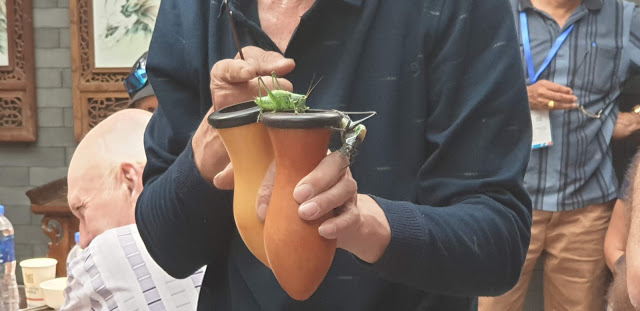
Shortly after we arrive, the cricket man, apparently someone quite famous in Beijing arrives and tells us all about crickets and then grasshoppers, then about cricket racing. He is animated and clearly enjoys entertaining us westerners.
I’m sorry but the cricket stuff just didn’t interest me. Or the grasshoppers.
As for dinner, it was finally a treat to eat what the typical Chinese family eats, and everything was delicious, and the endless beer was a nice touch.
And the last surprise, the food was cooked by a man.
In Beijing Hutongs are formed by lines of traditional courtyard residences, called siheyuan. Neighborhoods were formed by joining many hutongs together. These siheyuan are the traditional residences, usually occupied by a single or extended family, signifying wealth, and prosperity.
Over 500 of these still exist.Many of these hutongs have been demolished, but recently they have become protected places as a means of preserving some Chinese cultural history. They were first established in the Yuan Dynasty (1279-1368)Many of these Hutongs had their main buildings and gates built facing south, and lanes connecting them to other hutongs also ran north to south.
Many hutongs, some several hundred years old, in the vicinity of the Bell Tower and Drum Tower and Shichahai Lake are preserved and abound with tourists, many of which tour the quarter in pedicabs.
The optional tour also includes a visit to Shichahai, a historic scenic area consisting of three lakes (Qianhai, meaning Front Sea; Houhai, meaning Back Sea and Xihai, meaning West Sea), surrounding places of historic interest and scenic beauty and remnants of old-style local residences, Hutong and Courtyard.
First, we had a short walk through the more modern part of the Hutong area and given some free time for shopping, but we prefer just to meander by the canal.
There is a lake, and if we had the time, there were boats you could take.
With some time to spare, we take a quick walk down one of the alleyways where on the ground level are small shops, and above, living quarters.
Then we go to the bell and drum towers before walking through some more alleys was to where the rickshaws were waiting. The Bell tower
And the Drum tower. Both still working today.
The rickshaw ride took us through some more back streets where it was clear renovations were being made so that the area could apply for world heritage listing. Seeing inside some of the houses shows that they may look dumpy outside but that’s not the case inside.
The rickshaw ride ends outside the house where dinner will be served, and is a not so typical hose but does have all the elements of how the Chinese live, the boy’s room, the girl’s room, the parent’s room, the living area, and the North-south feng shui.
Shortly after we arrive, the cricket man, apparently someone quite famous in Beijing arrives and tells us all about crickets and then grasshoppers, then about cricket racing. He is animated and clearly enjoys entertaining us westerners.
I’m sorry but the cricket stuff just didn’t interest me. Or the grasshoppers.
As for dinner, it was finally a treat to eat what the typical Chinese family eats, and everything was delicious, and the endless beer was a nice touch.
And the last surprise, the food was cooked by a man.
The Golden Mask Dynasty Show was located at the OCT Theatre in Beijing’s Happy Valley.
The theatre was quite full and the seats we had were directly behind the VIP area; as our guide told us, we had the best seats in the house.
The play has 20 different dance scenes that depict war, royal banquets, and romance. There are eight chapters and over 200 actors, and throughout the performance we were entertained by dancers, acrobats, costumes, lighting, and acoustics.
The story:
It is of romantic legend and historical memories, the Golden Mask Queen leads her army in defeating the invading Blue Mask King’s army, and afterwards the lands return to a leisurely pastoral life until the Queen forges a ‘mysterious tree’. When the tree has grown, the Queen has a grand celebration, and releases the captured Blue soldiers, much to the admiration of the Blue Mask King. This is followed by monstrous floods, and to save her people, and on the advice from the ‘mysterious tree’, the Queen sacrifices herself to save her people. The Queen then turns into a golden sunbird flying in the sky blessing the people and that of the dynasty.
Billed as the best live show in China, described as a large scale dramatic musical, “The Golden Mask Dynasty” it lived up to its reputation and was thoroughly enjoyed by all.
It was not just singing dancing and acrobatics, it had a story and it was told so that language and cultural issues aside, it worked. There was a narration of the story running beside the stage, but it was hard to divide attention between what was happening, and what was being related.
Then came the peacock dance, with live peacocks
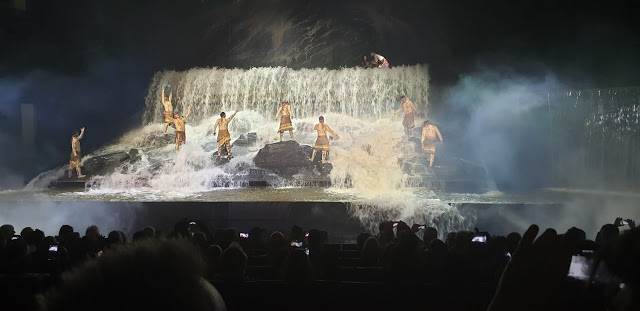
And this was followed by a waterfall, well, I don’t think anyone in that audience could believe what they were seeing.
I know I was both astonished and in awe of the performance.
What a way to finish off our first day in Beijing.
Oh, sorry, that high was dented slightly when we had to go back to our room.
The Golden Mask Dynasty Show was located at the OCT Theatre in Beijing’s Happy Valley.
The theatre was quite full and the seats we had were directly behind the VIP area; as our guide told us, we had the best seats in the house.
The play has 20 different dance scenes that depict war, royal banquets, and romance. There are eight chapters and over 200 actors, and throughout the performance we were entertained by dancers, acrobats, costumes, lighting, and acoustics.
The story:
It is of romantic legend and historical memories, the Golden Mask Queen leads her army in defeating the invading Blue Mask King’s army, and afterwards the lands return to a leisurely pastoral life until the Queen forges a ‘mysterious tree’. When the tree has grown, the Queen has a grand celebration, and releases the captured Blue soldiers, much to the admiration of the Blue Mask King. This is followed by monstrous floods, and to save her people, and on the advice from the ‘mysterious tree’, the Queen sacrifices herself to save her people. The Queen then turns into a golden sunbird flying in the sky blessing the people and that of the dynasty.
Billed as the best live show in China, described as a large scale dramatic musical, “The Golden Mask Dynasty” it lived up to its reputation and was thoroughly enjoyed by all.
It was not just singing dancing and acrobatics, it had a story and it was told so that language and cultural issues aside, it worked. There was a narration of the story running beside the stage, but it was hard to divide attention between what was happening, and what was being related.
Then came the peacock dance, with live peacocks
And this was followed by a waterfall, well, I don’t think anyone in that audience could believe what they were seeing.
I know I was both astonished and in awe of the performance.
What a way to finish off our first day in Beijing.
Oh, sorry, that high was dented slightly when we had to go back to our room.
The first stop is at a Jade Museum to learn the history of jade. In Chinese, jade is pronounced as “Yu” and it has a history in China of at least four thousand years. On the way there, we are given a story about one of the guide’s relatives who had a jade bracelet, and how it has saved her from countless catastrophes.It is, quite literally ‘the’ good luck charm. Chinese gamblers are known to have small pieces of jade in their hands when visiting the casinos, for good luck. I’m not sure anything could provide a gambler with any sort of luck given how the odds are always slanted towards the house.
At any rate, this is neither the time of the place to debunk a ‘well-known fact’.
On arrival, our guide hands us over to a local guide, a real staff member, and she begins with a discussion on jade while we watch a single worker working on an intricate piece, what looks to be a globe within a globe, sorry, there are two workers, and the second is working on a dragon.
At the end of the passage that passes by the workers, and before you enter the main showroom, you are dazzled by the ship and is nothing short of magnificent.
Then it’s into a small room just off the main showroom where we are taken through the colors, and the carving process in the various stages, without really being told how the magic happens.
Then it’s out into the main showroom where the sales are made, and before dispersing to look at the jade collection, she briefly tells us how to tell real and fake jade, and she does the usual trick of getting one of the tour group to model a piece.
Looks good, let’s move on. To bigger and better examples.
What interested me, other than the small zodiac signs and other smallish pieces on the ‘promotion’ table, was the jade bangle our tour guide told us about on the bus. If anyone needs one, it is my other half, with all the medical issues and her sometimes clumsiness, two particular maladies this object is supposed to prevent. Jade to the Chinese is Diamonds to westerners, and the jade bangle is often handed down to the females of the family from generation to generation, often as an engagement present, to be worn on the left hand, the one closest to the heart.
There are literally thousands of them, but, they have to be specially fitted to your wrist because if it’s too large, you might lose it if it slips off and I didn’t think it could be too small. Nor is it cheap, and needing a larger size, it is reasonably expensive. But it is jadeite, the more expensive of the types of jade, and it can only appreciate in value, not that we are interested in the monetary value, it’s more the good luck aspect.
We could use some of that.
But, just to touch on something that can be the bugbear of traveling overseas, is the subject of happy houses, a better name for toilets, and has become a recurrent theme on this tour. It’s better than blurting out the word toilet and it seems there can be some not so happy houses given that the toilets in China are usually squat rather than sit, even for women. And apparently, everyone has an unhappy house story, particularly the women, and generally in having to squat over a pit. Why is this a discussion point, it seems the jade factory had what we have come to call happy, happy houses which have more proper toilets, and a stop here before going on the great wall was recommended, as the ‘happy house’ at the wall is deemed to be not such a happy house.
Not even this dragon was within my price range. Thank heaven they had smaller more affordable models. The object of having a dragon, large or small, is that it should be placed inside the main door to the house so that money can come in.
It also seems that stuffing the dragon’s mouth with money is also good luck. We passed on doing that.
After spending a small fortune, there was a bonus, free Chinese tea. Apparently, we will be coming back, after the Great Wall visit, to have lunch upstairs.
The first stop is at a Jade Museum to learn the history of jade. In Chinese, jade is pronounced as “Yu” and it has a history in China of at least four thousand years. On the way there, we are given a story about one of the guide’s relatives who had a jade bracelet, and how it has saved her from countless catastrophes.It is, quite literally ‘the’ good luck charm. Chinese gamblers are known to have small pieces of jade in their hands when visiting the casinos, for good luck. I’m not sure anything could provide a gambler with any sort of luck given how the odds are always slanted towards the house.
At any rate, this is neither the time of the place to debunk a ‘well-known fact’.
On arrival, our guide hands us over to a local guide, a real staff member, and she begins with a discussion on jade while we watch a single worker working on an intricate piece, what looks to be a globe within a globe, sorry, there are two workers, and the second is working on a dragon.
At the end of the passage that passes by the workers, and before you enter the main showroom, you are dazzled by the ship and is nothing short of magnificent.
Then it’s into a small room just off the main showroom where we are taken through the colors, and the carving process in the various stages, without really being told how the magic happens.
Then it’s out into the main showroom where the sales are made, and before dispersing to look at the jade collection, she briefly tells us how to tell real and fake jade, and she does the usual trick of getting one of the tour group to model a piece.
Looks good, let’s move on. To bigger and better examples.
What interested me, other than the small zodiac signs and other smallish pieces on the ‘promotion’ table, was the jade bangle our tour guide told us about on the bus. If anyone needs one, it is my other half, with all the medical issues and her sometimes clumsiness, two particular maladies this object is supposed to prevent. Jade to the Chinese is Diamonds to westerners, and the jade bangle is often handed down to the females of the family from generation to generation, often as an engagement present, to be worn on the left hand, the one closest to the heart.
There are literally thousands of them, but, they have to be specially fitted to your wrist because if it’s too large, you might lose it if it slips off and I didn’t think it could be too small. Nor is it cheap, and needing a larger size, it is reasonably expensive. But it is jadeite, the more expensive of the types of jade, and it can only appreciate in value, not that we are interested in the monetary value, it’s more the good luck aspect.
We could use some of that.
But, just to touch on something that can be the bugbear of traveling overseas, is the subject of happy houses, a better name for toilets, and has become a recurrent theme on this tour. It’s better than blurting out the word toilet and it seems there can be some not so happy houses given that the toilets in China are usually squat rather than sit, even for women. And apparently, everyone has an unhappy house story, particularly the women, and generally in having to squat over a pit. Why is this a discussion point, it seems the jade factory had what we have come to call happy, happy houses which have more proper toilets, and a stop here before going on the great wall was recommended, as the ‘happy house’ at the wall is deemed to be not such a happy house.
Not even this dragon was within my price range. Thank heaven they had smaller more affordable models. The object of having a dragon, large or small, is that it should be placed inside the main door to the house so that money can come in.
It also seems that stuffing the dragon’s mouth with money is also good luck. We passed on doing that.
After spending a small fortune, there was a bonus, free Chinese tea. Apparently, we will be coming back, after the Great Wall visit, to have lunch upstairs.
Oreti village, Pukawa Bay, North Island, New Zealand
On the southern tip of Lake Taupo
Our first morning there, a Saturday. Winter. Cold. And a beautiful sunrise.
This was taken from the balcony, overlooking the lake.
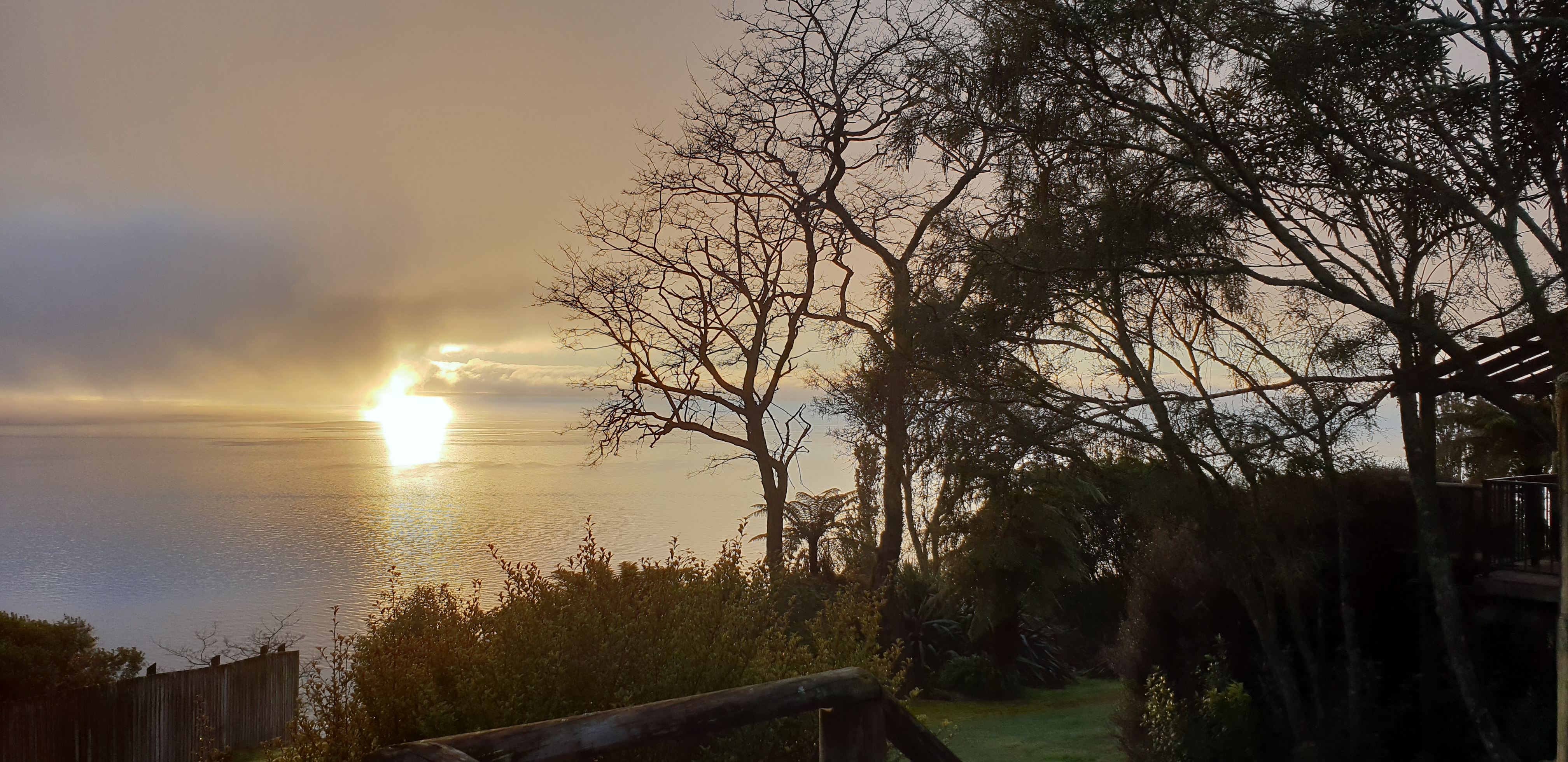
The sun is just creeping up over the horizon
It gradually gets lighter, and then the sun breaks free of the low cloud
It lights up the balcony
And the trees just beyond, a cascade of colorful ferns.
It looks like its going to be a fine day, our first for this trip, and we will be heading to the mountains to see snow, for the first time for two of our granddaughters.
Oreti village, Pukawa Bay, North Island, New Zealand
On the southern tip of Lake Taupo
Our first morning there, a Saturday. Winter. Cold. And a beautiful sunrise.
This was taken from the balcony, overlooking the lake.
The sun is just creeping up over the horizon
It gradually gets lighter, and then the sun breaks free of the low cloud
It lights up the balcony
And the trees just beyond, a cascade of colorful ferns.
It looks like its going to be a fine day, our first for this trip, and we will be heading to the mountains to see snow, for the first time for two of our granddaughters.











 Thrills, Spills, and just a dash of Romance