Searching for locations: The Castello di Brolio, Gaiole in Chianti, Tuscany, Italy

The castle is located in the southern Chianti Classico countryside and has been there for over ten centuries, and owned by the Ricasoli family since 1141.

Like any good castle, it has strong defences, and I was looking for a moat and drawbridge, but it looks like the moat has become a lawn.

The very high walls in places no doubt were built to keep the enemy out

The castle has been destroyed and rebuilt many times over the last 900 years.  It was part of the Florentine defences, and withstood, and succumbed to many battles with Siena, which is only 20 km away.  More recently, it still bears the scars of artillery fire and bombing in WW2.

The room at the top of this tower would have an excellent view of the countryside.

Here you can see the old and the new, the red brick part of the rebuilding in the 1800’s in the style of an English Manor

We did not get to see where that archway led.

Nor what was behind door number one at the top of these stairs.  Rest assured, many, many years ago someone wearing armour would have made the climb.   It would not pass current occupational health and safety these days with a number of stairs before a landing.

Cappella di San Jacopo.  Its foundations were laid in 1348.

Renovated in 1867-1869, it has a gabled façade preceded by a double stone staircase.  The interior, with a crypt where the members of the Ricasoli family are buried, has a nave divided into three spans with cross vaults.

The 1,200 hectares of the property include 240 hectares of vineyards and 26 of olive groves, in the commune of Gaiole.

Searching for locations: Rome, Italy

We visited Rome in August

It was hot.

It was verrrry hot.

We flew into Rome’s Leonardo da Vinci-Fiumicino airport after a rather bumpy flight from London.  Unlike most other airports the plane parked at a satellite terminal and after we disembarked we had to catch a train to the main terminal.

The most notable memory of this airport was my daughter’s discovery of a salami shop.

We had booked a transfer to take us to the hotel the Roma Corso Trieste Mercure in Via Gradisca from the airport.  It was a white air-conditioned van and so far we had avoided the heat.

One of the rooms had a faulty air conditioning an absolute must as the rooms were very hot without it and necessitated a room change which was done quickly and efficiently.

The hotel was in the suburbs and without a car we were dependent on public transport.  According to the reception staff, there was a bus stop nearby, and a longer walk to the tram or light railway.  The bus seemed to be the best option as it would take us to the central terminal near the railway station, where all tour buses also operated from, and particularly the open top buses that went to all the major tourist attractions.

That first day basically was given over to traveling, arriving by plane and settling into the hotel, thus we didn’t get to feel the force of the heat.  That came the next day.

After a walk around the hotel precinct to get our bearings and see what shops and restaurants were available, on returning to the hotel we were faced with the limited choices of room service or to go out for dinner.

My daughter and l go for a long walk up Via Nomentana to find several shops and a restaurant.  We went into the restaurant and sat down.   We waited for 10 minutes and got no service nor did anyone come and ask us if we wanted to order food so instead we left somewhat disappointed and go next door to what seems to be the Italian version of a delicatessen and order sandwiches and beer.   I bought a half dozen cans of Moretti beer two of which I drank on the way home.

It was still very hot even at eight at night and the sandwiches are delicious.  It just might be by that time we were starving and anything would have tasted great.

The next morning we are up and ready to chance the weather and some history.  Breakfast at the hotel is limited but very good.

We were going to use public transport and I’d studied up on the Internet.

Traveling on the bus required pre-purchase of tickets which could be bought in certain shops and locally when exploring the area near the hotel, l found a tobacconist.

Next, we needed to understand how to use the tickets. There was no one on the bus who could help so when l tried to scan the tickets and it failed, l gave up.  We had the same issue each day and in the end, the tickets never got used.

The trip to central Rome by bus took about 15 minutes.  In the morning it was reasonably cool and showed us a little of suburban Rome.  We also saw the trams but we would not be able to use them because our hotel not on a direct route.

That first full day we decided to go and see the Vatican.

Not understanding buses and which one we needed to get to the Vatican, we took a taxi.

Wow.  It was the metaphorical equivalent of driving over the edge of a cliff with a daredevil.  It was quite literally terrifying.

Or maybe we just didn’t know that this was probably the way people drove in Rome.

Shaken but delivered in one piece we found ourselves in the square opposite St Peters Basilica.

The square is impressive, with the statues atop a circular colonnaded walkway.  The church is incredible, and took a few hours to take in and to top off the day we did a tour of the Vatican museum which took the rest of the afternoon.

Then it was back to the delicatessen for more sandwiches and beer, and an interesting discussion with several elderly Italian ladies, of which I did not understand one word.

The second full day we decided to use one of the open top bus tours and eventually decided on the hop on hop off tour simply because the bus was at the central transport terminal for trains and buses and it was getting hotter.

Our first stop was the Colosseum.  There were other monuments nearby, such as the Arch of Constantine, but as the heat factor increased we joined the queue to go into the Colosseum and gladly welcomed the shade once we got inside.

The queue was long and the wait equally so, but it was worth the wait.  It would be more interesting if they could restore part of it to its former glory so we could get a sense of the place as it once was.  But alas that may never happen, but even so, it is still magnificent as a ruin.

Outside in the heat, it was off to the ruins which were a longish walk from the Colosseum, taking Via Sacra, not far from the Arch of Constantine.  This day in the walkway there were a number of illegal vendors, selling knockoff goods such as handbags and watches, and who, at the first sight of the police, packed up their wares in a blanket and ran.

Included in these ruins were The Roman Forum, or just a few columns remaining, the Palatine Hill, Imperial Fori, including the Forum of Augustus, the Forum of Caesar, and more specifically the Forum of Trajan.  It was, unfortunately very hot and dusty in the ruins the day we visited.

We walked all the way to the Foro Romano and the Septimus Severo Arch at the other end of the ruins, past the Temple of Caesar.  I found it very difficult to picture what it was like when the buildings were intact, so I bought a guide to the ruins which showed the buildings as ruins and an overlay of how they would have looked.  The buildings, then, would be as amazing as the Colosseum, and it would have been interesting to have lived back then, though perhaps not as a Christian.

I lost count of the number of bottles of water we bought, but the word ‘frizzante’ was ringing in my ears by the end of the day.  Fortunately, water did not cost a lot to buy.

At the end of the day, we caught the hop on hop off bus at the Colosseum and decided not to get off and see any more monuments but observe them from the bus.  The only one I remember seeing was Circo Massimo.  Perhaps if we’d know it was going to be twice as hot on the bus, yes, there was no air-conditioning; we may have chosen another form of transport to get back to the hotel.

The third and last day in Rome we decided to go to the Trevi Fountain, see the pantheon and walk up the Spanish Steps.  We spent most of the morning in the cool of a café watching the tourists at the fountain.  By the time we reached the top of the Spanish Steps, we were finished.


Searching for locations: Florence, Italy

Florence is littered with endless statues, and we managed to see quite a few,

If those statues came to life I wonder what they might tell us?

Like castles on the shores of the Rhine, there are only so many statues you can take photos of.  Below are some of those I thought significant

2013-06-17 09.16.14

Michelangelo’s David directs his warning gaze at someone else.

2013-06-17 09.16.24

The impressive muscles of Baccio Bandinelli’s Hercules from 1533. The worked-out demi-god is pulling the hair of Cacus, who will be clubbed and strangled.

2013-06-17 09.17.13

Achilles with Polyxena in arm, stepping over her brother’s body

2013-06-17 09.18.08

Menelaus supporting the body of Patroclus, in the Loggia dei Lan

2013-06-17 09.18.28

Statue of Hercules killing the Centaur by Giambologna in Loggia dei Lanzi. Piazza della Signoria.

On the back of the Loggia there are six marble female statues, probably coming from the Trajan’s Foro in Rome, discovered in 1541 and brought to Florence in 1789

Searching for locations: The Kingston Flyer, Kingston, New Zealand

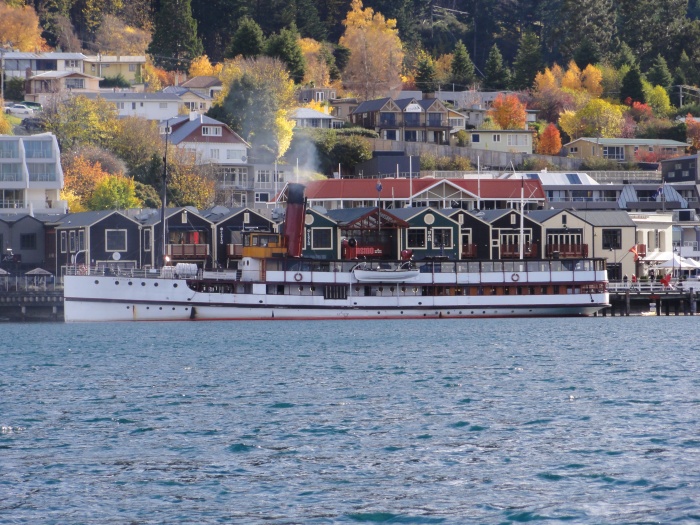
The Kingston Flyer was a vintage train that ran about 14km to Fairlight from Kingston, at the southern end of Lake Wakatipu, and back.

This tourist service was suspended in December 2012 because of locomotive issues.

However, before that, we managed to go on one of the tours, and it was a memorable trip.  Trying to drink a cup of tea from the restaurant car was very difficult, given how much the carriages moved around on the tracks.

The original Kingston Flyer ran between Kingston, Gore, Invercargill, and sometimes Dunedin, from the 1890s through to 1957.

There are two steam locomotives used for the Kingston Flyer service, the AB778 starting service in 1925, and the AB795 which started service in 1927.

The AB class locomotive was a 4-6-2 Pacific steam locomotive with a Vanderbilt tender, of which 141 were built between 1915 and 1927 some of which by New Zealand Railways Addington Workshops.

No 235 is the builder’s number for the AB778

There were seven wooden bodied passenger carriages, three passenger coaches, one passenger/refreshments carriage and two car/vans.  The is also a Birdcage gallery coach.  Each of the rolling stock was built between 1900 and 1923.  They were built at either of Addington, Petone, or Hillside.

I suspect the 2 on the side means second class

The passenger coach we traveled in was very comfortable.

This is one of the guard’s vans, and for transporting cargo.

The Kingston Railway Station

and cafe.

A poster sign advertising the Kingston Flyer

The running times for the tourist services, when it was running.

The story behind the story – Echoes from the Past

The novel ‘Echoes from the past’ started out as a short story I wrote about 30 years ago, titled ‘The birthday’.

My idea was to take a normal person out of their comfort zone and led on a short but very frightening journey to a place where a surprise birthday party had been arranged.

Thus the very large man with a scar and a red tie was created.

So was the friend with the limousine who worked as a pilot.

So were the two women, Wendy and Angelina, who were Flight Attendants that the pilot friend asked to join the conspiracy.

I was going to rework the short story, then about ten pages long, into something a little more.

And like all re-writes, especially those I have anything to do with, it turned into a novel.

There was motivation.  I had told some colleagues at the place where I worked at the time that I liked writing, and they wanted a sample.  I was going to give them the re-worked short story.  Instead, I gave them ‘Echoes from the past’

Originally it was not set anywhere in particular.

But when considering a location, I had, at the time, recently been to New York in December, and visited Brooklyn and Queens, as well as a lot of New York itself.  We were there for New Years, and it was an experience I’ll never forget.

One evening we were out late, and finished up in Brooklyn Heights, near the waterfront, and there was rain and snow, it was cold and wet, and there were apartment buildings shimmering in the street light, and I thought, this is the place where my main character will live.

It had a very spooky atmosphere, the sort where ghosts would not be unexpected.  I felt more than one shiver go up and down my spine in the few minutes I was there.

I had taken notes, as I always do, of everywhere we went so I had a ready supply of locations I could use, changing the names in some cases.

Fifth Avenue near the Rockefeller center is amazing at first light, and late at night with the Seasonal decorations and lights.

The original main character was a shy and man of few friends, hence not expecting the surprise party.  I enhanced that shyness into purposely lonely because of an issue from his past that leaves him always looking over his shoulder and ready to move on at the slightest hint of trouble.  No friends, no relationships, just a very low profile.

Then I thought, what if he breaks the cardinal rule, and begins a relationship?

But it is also as much an exploration of a damaged soul, as it is the search for a normal life, without having any idea what normal was, and how the understanding of one person can sometimes make all the difference in what we may think or feel.

And, of course, I wanted a happy ending.

Except for the bad guys.


Get it here:  https://amzn.to/2CYKxu4

newechocover5rs


Searching for locations: Murano, Italy

The first time we visited Venice, there was not enough time left to visit the glass-blowing factories on Murano.  We saved this for the next visit, and now more comfortable with taking the Vaporetto, boarded at San Marco for the short journey.

The view looking towards the cemetery:

The view looking down what I think was the equivalent to the main street, or where several of the glass-blowing factories and display shops were located:

Looking towards a workshop, this one costs us each a Euro to go in and observe a demonstration of glass blowing, and it still surprises me that some people would not pay

The oven where the glass is heated

And the finished product, the retail version of the horse that the glassblower created during the demonstration:

Then we bought some other glassware from the retail storefront, a candle holder

and a turtle.

Searching for locations: Venice, Italy (Again)

We have visited Venice twice, in 2006 and not so long ago.

Not much had changed from visit to visit.

Instead of staying in a hotel selected by a travel agent, the Savoia and Jolanda on the waterfront of Riva Degli Schiavoni, because I’m a Hilton Honors member, more recently we stayed at the Hilton Molino Stucky.  It was located on an island, Giudecca, and had its own transport from the hotel to St Mark’s Square for a very reasonable one-off charge for the stay.

hiltonmolinostuckey2

On our first visit, we traveled from Florence to Venice.  We were advised to take a water taxi to the hotel, not only the most direct route but to see some of Venice from the water.  The only drawback, you have to negotiate a price with the driver.

We were not very good negotiators, and it cost 60 Euros.

But, despite the cost, it was worth every Euro because the taxi driver took us by the scenic route, directly from the Station to the doorstep of our hotel.  For a first time in Venice, and you want to see it from the water, a water taxi is the best option.

2013-06-25 17.09.16

The first time we stayed at the Savoia and Jolanda Hotel, which was at the time quite old, and the room we had, on the ground floor, was comfortable enough, but being November, they had just stopped using the air conditioning, it was still quite warm and at times uncomfortable.

There were better rooms, but this was beyond the knowledge of the travel agent, and one of the reasons we stopped using agents to book hotels.

The most recent visit we had driven down from Salzburg to Venice airport where we had to return the hire car.  From there we were intending to take a private water taxi from the airport to the hotel, for an estimated 120 Euros.

We saved our money and took the ACTV public waterbus, from the airport to the hotel, with one stop.  It took a little over an hour and was equally as scenic.

venicecanals1

Our room in the Hilton was on one of the upper levels, floor four, and had a view of the canal, the large passenger ships coming and going, as well as a remarkable view of Venice itself as far up the canal to St Marks Square in one direction, and the port for the passenger ships in the other.

20130627_081601

We got to see three or four very large passenger ships come and go, along with a lot of other craft.  I hadn’t realized how busy the waterways, and the Grand Canal, were.

20130627_174408

Each evening after a day’s exploring we would end up in the Executive Lounge, and then one of the many restaurants, usually Il Molino for breakfast, and the Rialto Lobby Bar and Lounge for dinner.  After that, it was a stroll down the waterfront taking in the night air, and perhaps to walk off the delicious dinner.

Searching for locations: Somewhere in Tuscany, Italy, a hilltop town

It’s a town we visited in Italy when on a private tour.  Of course, I wrote it down on a notepad app on my phone at the time, and, yes, not long after that, an accidental reset lost all the data.

Now, I have no idea with the name of the town is, just that it was a picturesque stopover in the middle of a delightful private tour of Tuscany.

2013-06-20 10.12.54

There are narrow laneways that I suspect no one 300 hundred years ago planned for cars

2013-06-20 10.17.36

Narrower walkways that lead to very dark places


Walkways on the side of the hills that look down on the picturesque valleys

2013-06-20 10.15.27

And rather interesting hillsides, some of which provided inspiration for Leonardo da Vinci

2013-06-20 10.15.48

Or maybe it was this landscape, though it is difficult to see what could be found as inspiration in such a bland hillside

2013-06-20 10.15.55

A lot of houses, some of them quite large, nestled in amongst the trees

2013-06-20 10.17.41 (2)

Gardens, of sorts, balcony’s, not so big, and hidden doorways

2013-06-20 10.17.53 (2)

Even not so secret passageways between houses.

All in all, it was an interesting visit, and it made me wonder what it would be like to live here, all crowded together, rather than living on our relatively isolated quarter-acre blocks.

Searching for locations: Florence, Italy

Apologies now if I have misspelled any street, piazza or any other names.

The first time we arrived in Florence was by train, from Innsbruck in Austria.  We had been booked into the Hotel Brunelleschi, based on the fact it was built over part of a 12th-century monastery, it was conveniently located, and was a luxury hotel.

We took a taxi, not knowing how far it was, and found it tucked away in a street, via Sant’elisabetta, not far from Florence’s cathedral, the Duomo.  The taxi barely fitted through the streets.  First impressions, it was old, second impression, the room we were given was amazing, with a view over the main street, and wafting up from a food shop below, the aroma of newly baked waffles.  We had to have one.

Words cannot describe how amazing it was to wake up that first morning and look out at the bright sunshine and blue sky.  We were in for a hot day, but that wasn’t going to deter the tourist in us.  Of course, after we had a great breakfast.  I particularly liked the crispy bacon.

The first place on the list to visit was the Piazza del Duomo, where the cathedral is located, and the Porta del Paradiso.  We went into the church, and also did a side trip down into the crypt.  We did not climb to the top of Brunelleschi’s cupola.  We tried the pizza, and hearing that the gelato was very expensive in the main part of the city, ventured further afield and found a gelato vendor that was inexpensive.  As the day was very hot it was a welcome relief.

The Ponte Vecchio, the bridge that crosses the Arno.  We walked to the bridge, taking in the views up and down the river before crossing to the other side, then back towards the Piazza Santa Croce.  On our most recent visit there was a football competition, Calcio Fiorentino, in progress that had taken over the whole Piazza, and during the day there was a parade where all the teams and others dressed in the historic clothing dating back to the 15th century.

The Galleria dell’Accademia was also high on the list of places to visit, and we left the hotel early as we had heard the queues are long to get in.  They were right.  We were at the end of a very, very long queue stretching back to Via delgi Alfani.  We were in the queue for about an hour and a half and it didn’t seem to move very quickly.

Then some people passing by said that we could go to the Museo Di San Marco, and purchase tickets to enter the gallery at a particular time.  We had also read or heard something similar, and, taking a risk we left the queue and went in search.  We found it at the Piazza San Marco, purchased tickets for 13:30 and had time to have lunch before turning up at the entrance for our timeslot, and sure enough, with others who had also purchased tickets, we went in.

Just out of curiosity I went back to the queue to see when the people in front of us were, and they still had an hour before gaining admission.

We saw everything that was recommended, including the famous statue of David, though I had a lot of trouble taking a photo when people kept walking in front.

The Piazza Della Signoria has a large number of statues, including another of David, the Marzocco, the symbol of Florence, Il Perseo, the fountain of Neptune, Poseidon, Perseus with the head of Medusa, and a hall of statues adjacent to the Palazzo Vecchio.

Florence is old, the roads are cobbled and narrow, and there are many trails one can follow and discover something new at the end of every twist and turn.

I have to go back, other than the fact I need a new wallet and belt made from Italian leather.  My wife loves the purses and handbags, also leather, though the scarves have only recently been added to her list of most wanted items.

But, in reality, I want to simply soak up the atmosphere, relax, eat the pasta and drink the endless supply of Moretti’s.

Searching for Locations: Venice, Italy

Venice is definitely a city to explore.  It has an incredible number of canals and walkways, and each time we would start our exploration at St Marks square when it’s not underwater

Everyone I have spoken to about exploring Venice has told me how easy it is to get lost.  It has not happened to me, but with the infinite number of ways you can go, I guess it is possible.

We started our exploration of Venice in St Marks square, where, on one side there was the Museo di Palazzo Ducale and, next door, the Basilica di San Marco.  Early morning and/or at high tide, water can be seen bubbling up from under the square, partially flooding it.  I have seen this happen several times.  Each morning as we walked from the hotel (the time we stayed in the Savoia and Jolanda) we passed the Bridge of Sighs.

Around the other three sides of the square are archways and shops.  We have bought both confectionary and souvenirs from some of these stores, albeit relatively expensive.  Prices are cheaper in stores that are away from the square and we found some of these when we walked from St Marks square to the Railway station, through many walkways, and crossing many bridges, and passing through a number of small piazzas.

That day, after the trek, we caught the waterbus back to San Marco, and then went on the tour of the Museo di Palazzo Du which included the dungeons and the Bridge of Sighs from the inside.  It took a few hours, longer than I’d anticipated because there was so much to see.

The next day, we caught the waterbus from San Marco to the Ponte di Rialto bridge.  Just upstream from the wharf there was a very large passenger ship, and I noticed there were a number of passengers from the ship on the waterbus, one of whom spoke to us about visiting Venice.  I didn’t realize we looked like professional tourists who knew where we were going.

After a pleasant conversation, and taking in the views up and down the Grand Canal, we disembarked and headed for the bridge, looking at the shops, mostly selling upmarket and expensive gifts, and eventually crossing to the other side where there was a lot of small market type stalls selling souvenirs as well as clothes, and most importantly, it being a hot day, cold Limonata.  This was my first taste of Limonata and I was hooked.

Continuing on from there was a wide street at the end and a number of restaurants where we had lunch.  We had a map of Venice and I was going to plot a course back to the hotel, taking what would be a large circular route that would come out at the Accademia Bridge, and further on to the Terminal Fusina Venezia where there was another church to explore, the Santa Maria del Rosario.

This is a photo of the Hilton Hotel from the other side of the canal.

It was useful knowledge for the second time we visited Venice because the waterbus from the Hilton hotel made its first stop, before San Marco, there.  We also discovered on that second visit a number of restaurants on the way from the terminal and church to the Accademia Bridge.

This is looking back towards San Marco from the Accademia Bridge:

And this, looking towards the docks:

Items to note:

Restaurants off the beaten track were much cheaper and the food a lot different to that in the middle of the tourist areas.

There are a lot of churches, big and small, tucked away in interesting spots where there are small piazza’s.  You can look in all of them, though some asked for a small fee.

Souvenirs, coffee, and confectionary are very expensive in St Marks square.