I’m trying to write a period piece

Televison is a great recorder of the past, and most channels, and especially cable tv have great libraries of films that go back more than a hundred years.

And, whilst it’s possible that modern day films and television series can try to recapture the past, the English as an exception being very good at it, often it is impossible to capture it correctly.

But, if you have a film shot in the moment, then you have a visual record of what life, and what was once part of our world before you in all it’s dated glory. The pity of it is that, then, we never appreciated it.

After all, in those particular times, who had the time to figuratively stop and smell the roses. Back then as life was going on, we were all tied up with just trying to get through each day.

Years later, often on reflection, we try to remember the old days, and, maybe, remember some of what it was like, but the chances are that change came far too rapidly, and often too radical, that it erases what we thought we knew existed before.

My grandmothers house is a case in point. In it’s place is a multi lane super highway, and there’s nothing left to remind us, or anyone of it, just some old sepia photographs.

I was reminded of how volatile history really is when watching an old documentary, in black and white, and how the city I grew up in used to look.

Then, even though it seemed large to me then, it was a smaller city, with suburbs that stretched about ten or so miles in every direction, and the outer suburbs were where people moved to get a larger block, and countrified atmosphere.

Now, those outer suburbs are no longer spacious properties, the acreage subdivided and the old owners now much richer for a decision made with profit not being the motivator, and the current suburban sprawl is now out to forty or fifty miles.

The reason for the distance is no longer the thought of open spaces and cleaner air, the reason for moving now is that land further out is cheaper, and can make buying that first house more affordable.

This is where I tip my hat to the writers of historical fiction. I myself am writing a story based in the 1970s, and its difficult to find what is and isn’t time specific.

If only I had a dollar for every time I went to write the character pulling out his or her mobile phone.

What I’ve found is the necessity to research, and this has amounted to finding old films, documentaries of the day, and a more fascinating source of information, the newspapers of the day.

The latter especially has provoked a lot of memories and a lot of stuff I thought I’d forgotten, some of it by choice, but others that were poignant.

Yes, and don’t get me started on the distractions.

If only I’d started this project earlier…

‘Sunday in New York’ – A beta reader’s view

I’m not a fan of romance novels but …

There was something about this one that resonated with me.

This is a novel about a world generally ruled by perception, and how people perceive what they see, what they are told, and what they want to believe.

I’ve been guilty of it myself as I’m sure we all have at one time or another.

For the main characters Harry and Alison there are other issues driving their relationship.

For Alison, it is a loss of self-worth through losing her job and from losing her mother and, in a sense, her sister.

For Harry, it is the fact he has a beautiful and desirable wife, and his belief she is the object of other men’s desires, and one in particular, his immediate superior.

Between observation, the less than honest motives of his friends, a lot of jumping to conclusions based on very little fact, and you have the basis of one very interesting story.

When it all comes to a head, Alison finds herself in a desperate situation, she realises only the truth will save their marriage.

But is it all the truth?

What would we do in similar circumstances?

Rarely does a book have me so enthralled that I could not put it down until I knew the result. They might be considered two people who should have known better, but as is often the case, they had to get past what they both thought was the truth.

And the moral of this story, if it could be said there is one, nothing is ever what it seems.

Available on Amazon here: amzn.to/2H7ALs8

An excerpt from “Betrayal” – a work in progress

It could have been anywhere in the world, she thought, but it wasn’t.  It was in a city where if anything were to go wrong…

She sighed and came away from the window and looked around the room.  It was quite large and expensively furnished.  It was one of several she had been visiting in the last three months.

Quite elegant too, as the hotel had its origins dating back to before the revolution in 1917.  At least, currently, there would not be a team of KGB agents somewhere in the basement monitoring everything that happened in the room.

There was no such thing as the KGB anymore, though there was an FSB, but such organisations were of no interest to her.

She was here to meet with Vladimir.

She smiled to herself when she thought of him, such an interesting man whose command of English was as good as her command of Russian, though she had not told him of that ability.

All her knew of her was that she was American, worked in the Embassy as a clerk, nothing important, who life both at work and at home was boring.  Not that she had blurted that out the first tie she met, or even the second.

That first time, at a function in the Embassy, was a chance meeting, a catching of his eye as he looked around the room, looking, as he had told her later, for someone who might not be as boring as the function itself.

It was a celebration, honouring one of the Embassy officials on his service in Moscow, and the fact he was returning home after 10 years.  She had been there one, and still hadn’t met all the staff.

They had talked, Vladimir knew a great deal about England, having been stationed there for a year or two, and had politely asked questions about where she lived, her family, and of course what her role was, all questions she fended off with an air of disinterested interest.

It fascinated him, as she knew it would, a sort of mental sparring as one would do with swords, if this was a fencing match.

They had said they might or might not meet again when the party was over, but she suspected there would be another opportunity.  She knew the signs of a man who was interested in her, and Vladimir was interested.

The second time came in the form of an invitation to an art gallery, and a viewing of the works of a prominent Russian artist, an invitation she politely declined.  After all, invitations issued to Embassy staff held all sorts of connotations, or so she was told by the Security officer when she told him.

Then, it went quiet for a month.  There was a party at the American embassy and along with several other staff members, she was invited.  She had not expected to meet Vladimir, but it was a pleasant surprise when she saw him, on the other side of the room, talking to several military men.

A pleasant afternoon ensued.

And it was no surprise that they kept running into each other at the various events on the diplomatic schedule.

By the fifth meeting, they were like old friends.  She had broached the subject of being involved in a plutonic relationship with him with the head of security at the embassy.  Normally for a member of her rank it would not be allowed, but in this instance it was.

She did not work in any sensitive areas, and, as the security officer had said, she might just happen upon something that might be useful.  In that regard, she was to keep her eyes and ears open, and file a report each time she met him.

After that discussion she got the impression her superiors considered Vladimir more than just a casual visitor on the diplomatic circuit.  She also formed the impression the he might consider her an ‘asset’, a word that had been used at the meeting with security and the ambassador.

It was where the word ‘spy’ popped into her head and sent a tingle down her spine.  She was not a spy, but the thought of it, well, it would be fascinating to see what happened.

A Russian friend.  That’s what she would call him.

And over time, that relationship blossomed, until, after a visit to the ballet, late and snowing, he invited her to his apartment not far from the ballet venue.  It was like treading on thin ice, but after champagne and an introduction to caviar, she felt like a giddy schoolgirl.

Even so, she had made him promise that he remain on his best behaviour.  It could have been very easy to fall under the spell of a perfect evening, but he promised, showed her to a separate bedroom, and after a brief kiss, their first, she did not see him until the next morning.

So, it began.

It was an interesting report she filed after that encounter, one where she had expected to be reprimanded.

She wasn’t.

It wasn’t until six weeks had passed when he asked her if she would like to take a trip to the country.  It would involve staying in a hotel, that they would have separate rooms.  When she reported the invitation, no objection was raised, only a caution; keep her wits about her.

Perhaps, she had thought, they were looking forward to a more extensive report.  After all, her reports on the places, and the people, and the conversations she overheard, were no doubt entertaining reading for some.

But this visit was where the nature of the relationship changed, and it was one that she did not immediately report.  She had realised at some point before the weekend away, that she had feelings for him, and it was not that he was pushing her in that direction or manipulating her in any way.

It was just one of those moments where, after a grand dinner, a lot of champagne, and delightful company, things happen.  Standing at the door to her room, a lingering kiss, not intentional on her part, and it just happened.

And for not one moment did she believe she had been compromised, but for some reason she had not reported that subtle change in the relationship to the powers that be, and so far, no one had any inkling.

She took off her coat and placed it carefully of the back of one of the ornate chairs in the room.  She stopped for a moment to look at a framed photograph on the wall, one representing Red Square.

Then, after a minute or two, she went to the mini bar and took out the bottle of champagne that had been left there for them, a treat arranged by Vladimir for each encounter.

There were two champagne flutes set aside on the bar, next to a bowl of fruit.  She picked up the apple and thought how Eve must have felt in the garden of Eden, and the temptation.

Later perhaps, after…

She smiled at the thought and put the apple back.

A glance at her watch told her it was time for his arrival.  It was if anything, the one trait she didn’t like, and that was his punctuality.  A glance at the clock on the room wall was a minute slow.

The doorbell to the room rang, right on the appointed time.

She put the bottle down and walked over to the door.

A smile on her face, she opened the door.

It was not Vladimir.  It was her worst nightmare.

© Charles Heath 2020

Inspiration, maybe – Volume 1

50 photographs, 50 stories, of which there is one of the 50 below.

They all start with –

A picture paints … well, as many words as you like.  For instance:

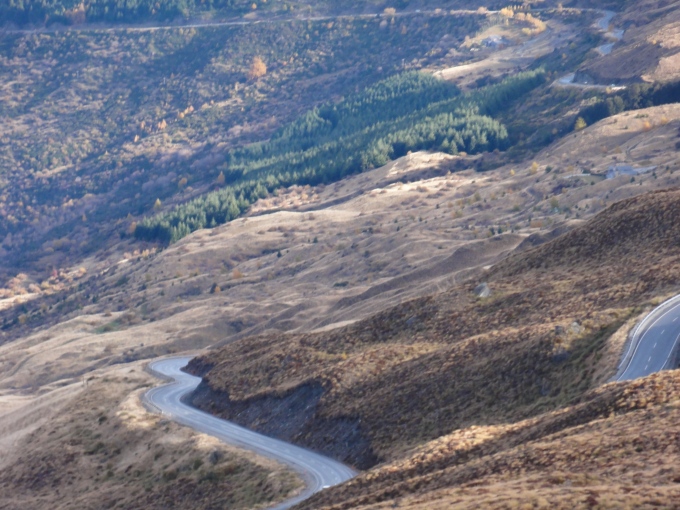
lookingdownfromcoronetpeak

And the story:

It was once said that a desperate man has everything to lose.

The man I was chasing was desperate, but I, on the other hand, was more desperate to catch him.

He’d left a trail of dead people from one end of the island to the other.

The team had put in a lot of effort to locate him, and now his capture was imminent.  We were following the car he was in, from a discrete distance, and, at the appropriate time, we would catch up, pull him over, and make the arrest.

There was nowhere for him to go.

The road led to a dead-end, and the only way off the mountain was back down the road were now on.  Which was why I was somewhat surprised when we discovered where he was.

Where was he going?

“Damn,” I heard Alan mutter.  He was driving, being careful not to get too close, but not far enough away to lose sight of him.

“What?”

“I think he’s made us.”

“How?”

“Dumb bad luck, I’m guessing.  Or he expected we’d follow him up the mountain.  He’s just sped up.”

“How far away?”

“A half-mile.  We should see him higher up when we turn the next corner.”

It took an eternity to get there, and when we did, Alan was right, only he was further on than we thought.”

“Step on it.  Let’s catch him up before he gets to the top.”

Easy to say, not so easy to do.  The road was treacherous, and in places just gravel, and there were no guard rails to stop a three thousand footfall down the mountainside.

Good thing then I had the foresight to have three agents on the hill for just such a scenario.

Ten minutes later, we were in sight of the car, still moving quickly, but we were going slightly faster.  We’d catch up just short of the summit car park.

Or so we thought.

Coming quickly around another corner we almost slammed into the car we’d been chasing.

“What the hell…” Aland muttered.

I was out of the car, and over to see if he was in it, but I knew that it was only a slender possibility.  The car was empty, and no indication where he went.

Certainly not up the road.  It was relatively straightforward for the next mile, at which we would have reached the summit.  Up the mountainside from here, or down.

I looked up.  Nothing.

Alan yelled out, “He’s not going down, not that I can see, but if he did, there’s hardly a foothold and that’s a long fall.”

Then where did he go?

Then a man looking very much like our quarry came out from behind a rock embedded just a short distance up the hill.

“Sorry,” he said quite calmly.  “Had to go if you know what I mean.”

I’d lost him.

It was as simple as that.

I had been led a merry chase up the hill, and all the time he was getting away in a different direction.

I’d fallen for the oldest trick in the book, letting my desperation blind me to the disguise that anyone else would see through in an instant.

It was a lonely sight, looking down that road, knowing that I had to go all that way down again, only this time, without having to throw caution to the wind.

“Maybe next time,” Alan said.

“We’ll get him.  It’s just a matter of time.”

© Charles Heath 2019-2021

Find this and other stories in “Inspiration, maybe”  available soon.

InspirationMaybe1v1

The first case of PI Walthenson – “A Case of Working With the Jones Brothers”

This case has everything, red herrings, jealous brothers, femme fatales, and at the heart of it all, greed.

See below for an excerpt from the book…

Coming soon!

PIWalthJones1

An excerpt from the book:

When Harry took the time to consider his position, a rather uncomfortable position at that, he concluded that he was somehow involved in another case that meant very little to him.

Not that it wasn’t important in some way he was yet to determine, it was just that his curiosity had got the better of him, and it had led to this: sitting in a chair, securely bound, waiting for someone one of his captors had called Doug.

It was not the name that worried him so much, it was the evil laugh that had come after the name was spoken.

Doug what? Doug the ‘destroyer’, Doug the ‘dangerous’, Doug the ‘deadly’; there was any number of sinister connotations, and perhaps that was the point of the laugh, to make it more frightening than it was.

But there was no doubt about one thing in his mind right then: he’d made a mistake. A very big. and costly, mistake. Just how big the cost, no doubt he would soon find out.

His mother, and his grandmother, the wisest person he had ever known, had once told him never to eavesdrop.

At the time he couldn’t help himself and instead of minding his own business, listening to a one-sided conversation which ended with a time and a place. The very nature of the person receiving the call was, at the very least, sinister, and, because of the cryptic conversation, there appeared to be, or at least to Harry, criminal activity involved.

For several days he had wrestled with the thought of whether he should go. Stay on the fringe, keep out of sight, observe and report to the police if it was a crime. Instead, he had willingly gone down the rabbit hole.

Now, sitting in an uncomfortable chair, several heat lamps hanging over his head, he was perspiring, and if perspiration could be used as a measure of fear, then Harry’s fear was at the highest level.

Another runnel of sweat rolled into his left eye, and, having his hands tied, literally, it made it impossible to clear it. The burning sensation momentarily took his mind off his predicament. He cursed and then shook his head trying to prevent a re-occurrence. It was to no avail.

Let the stinging sensation be a reminder of what was right and what was wrong.

It was obvious that it was the right place and the right time, but in considering his current perilous situation, it definitely was the wrong place to be, at the worst possible time.

It was meant to be his escape, an escape from the generations of lawyers, what were to Harry, dry, dusty men who had been in business since George Washington said to the first Walthenson to step foot on American soil, ‘Why don’t you become a lawyer?” when asked what he could do for the great man.

Or so it was handed down as lore, though Harry didn’t think Washington meant it literally, the Walthenson’s, then as now, were not shy of taking advice.

Except, of course, when it came to Harry.

He was, Harry’s father was prone to saying, the exception to every rule. Harry guessed his father was referring to the fact his son wanted to be a Private Detective rather than a dry, dusty lawyer. Just the clothes were enough to turn Harry off the profession.

So, with a little of the money Harry inherited from one of his aunts, he leased an office in Gramercy Park and had it renovated to look like the Sam Spade detective agency, you know the one, Spade and Archer, and The Maltese Falcon.

There’s a movie and a book by Dashiell Hammett if you’re interested.

So, there it was, painted on the opaque glass inset of the front door, ‘Harold Walthenson, Private Detective’.

There was enough money to hire an assistant, and it took a week before the right person came along, or, more to the point, didn’t just see his business plan as something sinister. Ellen, a tall cool woman in a long black dress, or so the words of a song in his head told him, fitted in perfectly.

She’d seen the movie, but she said with a grin, Harry was no Humphrey Bogart.

Of course not, he said, he didn’t smoke.

Three months on the job, and it had been a few calls, no ‘real’ cases, nothing but missing animals, and other miscellaneous items. What he really wanted was a missing person. Or perhaps a beguiling, sophisticated woman who was as deadly as she was charming, looking for an errant husband, perhaps one that she had already ‘dispatched’.

Or for a tall, dark and handsome foreigner who spoke in riddles and in heavily accented English, a spy, or perhaps an assassin, in town to take out the mayor. The man was such an imbecile Harry had considered doing it himself.

Now, in a back room of a disused warehouse, that wishful thinking might be just about to come to a very abrupt end, with none of the romanticized trappings of the business befalling him. No beguiling women, no sinister criminals, no stupid policemen.

Just a nasty little man whose only concern was how quickly or how slowly Harry’s end was going to be.

© Charles Heath 2019

The cinema of my dreams – I never wanted to go to Africa – Episode 21

Our hero knows he’s in serious trouble.

The problem is, there are familiar faces and a question of who is a friend and who is foe made all the more difficult because of the enemy, if it was the enemy, simply because it didn’t look or sound or act like the enemy.

Now, it appears, his problems stem from another operation he participated in.

Lallo delivered that statement with deceptive calm, and I didn’t miss the inference.  That is if he was trying to say that anyone associated with that operation was likely to end up dead sooner rather than later.

Food for thought indeed, and suddenly it explained the reason for this interrogation.  And though I didn’t want to believe it, or even think it possible, Breeman might be in some way connected with that operation.  Or someone involved in it.

Suddenly I found my mid connecting dots, real or imaginary, that led back to Breeman requesting my transfer, knowing who I was, and then becoming closer in a way that was not expected, or could be explained, which had consequences if it came to light.

That was what Bamfield was alluding to in the desert camp.

But even Lallo had to admit it would be stretch at best to tie what was a random event being selected for what was basically an off-book training flight to being shot down, and link to a failed operation, and a suspicious suicide by Treen. 

Especially when it was Bamfield’s own men who shot the helicopter out of the sky because we had so-called encroached the no-fly zone.  Yet, by extension, if those people knew the proximity of the helicopter to the ground, and how thorough my survival training had been, that posed a whole new raft of questions, which, right then, I didn’t want to think about.

No, it was utterly ridiculous.  My thoughts were simply the manna which drove conspiracy theories.  Lallo was jumping to conclusions, and even I was guilty of the same offence.

Time to put it out of my mind, and answer the question, even if it sounded rhetorical.  “It was the Colonel who tried to kill me, not the person who sent me on that operation.  Are you trying to tell me Bamfield is involved in more than one conspiracy?”

Lallo simply shook his head, made a note in his notebook, and turned the page.

“Let’s go back to the day you were assigned to the ill-fated exercise.  How many of your number at that particular base, are available for helicopter duty?”

“Four.”

“Who assigns the missions?”

“Operations.”

“Not the commanding officer?”

“No.”

“And in this particular case, when you were sent on the fatal mission?”

“I had to countersign the order.  I didn’t see her name on the form.”

“But she would know, or be able to make suggestions.”

There was a group who made those decisions, not any one person, and it was possible anyone of that group could make a suggestion.  But, as for Breeman, I doubt she was interested in that level of micromanagement.

Yet there was a suggestion I’d been moved off the active roster, and that it was possibly on her orders.  Perhaps it would be best not to say anything about that.  It also begged the question of why.  Had she known something might happen to me?  Or did she have an idea what might happen for another reason?

“Anything is possible, but I’m not privy to the machinations of command.  I just do as I’m ordered.”

He smiled thinly.  “I’m sure you’d say that even if it wasn’t true.”

Lallo was becoming an annoying little gnat, so I decided to treat him like one.  “Is there an actual point to these questions, other than to dredge up past history, make erroneous accusations, and base all your conclusions on conjecture?”

“I simply deal with the facts before me.”  It was almost a childish response.

A face hovered outside the ward door, and he noticed it.

“Excuse me.”  He put down the notebook and headed out the door.  Monroe remained, looking menacing.

Was someone else listening, and didn’t like the turn of events?

© Charles Heath 2019-2021

“What are the odds…”, a short story


I’m not a betting man.

I’d been to the horse races a few times, but every time I backed a horse to win, it would come last, and if I backed it to place, it would come fourth.

Then, every time I bought a lottery ticket, my numbers never seemed to come out, as if they were heavier than the others.

You get the picture, gambling, and I didn’t get along.

That being said, Vernon, a friend from school days, and then, having made the graduate program for the same company, remained friends into adult life. He was a betting man, he bet me he would be married first, he picked horses that came first, and always walked out of a casino with more than he walked in with.

And he was right, he got married first, had children first, settled into a manager’s role, and was content.

I was not so eager to follow in his footsteps; I often said that I hadn’t found the right girl yet, but the truth was, I wasn’t exactly putting myself out there. A couple of bad experiences had put me off the whole idea.

He had a side bet with another of our friends that I would not get married before I was forty. He had mentioned it to me some time ago, and I’d agreed with him; it was a safe bet.

The thing was, Evie had learned about that bet, and it was, in her mind, a situation tailor-made for her, being Vernon’s very popular wife, and not one to pass up a romantic challenge. Not after Vernon had suddenly decided to make a bet with her, to find me a girlfriend. With a time limit, of course, of six weeks. Just to make it interesting.

Of course, I had no clue this challenge existed, not until much later.

What I did knew was that she had a vast array of both married and single girlfriends and acquaintances, and was known to throw memorable parties on a Friday night. She had issued me with a standing invitation a long time ago, one that kept promising to honour, but I never seemed to get there.

I knew some of her friends were singles, and that she had a reputation of being something of a matchmaker. Vernon told me that those Friday night affairs were where some of his other friends had found romance and that it wouldn’t surprise him if I was not a target.

I agreed with him, but coincidentally, right after he said this, I got a call from Evie who all but ordered me to attend this Friday’s festivities. I was going to decline, but she added it was Chloe’s fifth birthday, and as her Godfather, I was obligated to attend.

It had been an honour when Vernon first asked me, it still is, but it seemed to me it was going to be used for some other reason, so I was going to have to be on my guard.

Over the years I had met most of Evie’s girlfriends and they were fun, yes, I’d heard about the exploits on weekends in Vegas, but it was not for me. I was the quiet, shy type, and they, in a nutshell, were not.
I’d met most of Evie’s family. She was one of five girls, the one in the middle. The two older sisters were professionals, one a doctor, the other, Geraldine, a lawyer. The two younger sisters were more hands-on, the second youngest, Zoe, was a home caterer, and the youngest, Yasmine, with no head for, or desire to own, a business, was more carefree. Like Evie, she was family orientated and still lived with her parents. The most level-headed, and the one they all turned to for advice, was Melanie, the eldest.

She was the first person I saw after I arrived. I thought I would get there early because I never wanted to make an entrance.

“I haven’t seen you around for a while,” Melanie said, already a champagne flute filled, in her hand. Something else I knew, she liked to drink wine. She was also married, but I remembered her husband was away a lot.

“Part of the low profile I try to keep. How is Leonard, still the king of frequent flyer points?” His travels had finally earned him a special card reserved for very few.

“He’s in Paris, probably with his mistress.” She shrugged. “Husbands are like accessories these days. You can keep them or throw them out. I’m sure Genevieve will get tired of his soon and send him back.”

A unique attitude, for one who was supposed to give advice.

“You’re still not married, I see, Good choice. Marriage these days seems to be only good for a year or two, then sue the other for everything they’ve got. Sorry, I lost a case today, so I’m feeling a little cynical. Come back when I’ve had a dozen champagnes.”

She suddenly spotted one of Vernon’s neighbours and headed in his direction.

Zoe was walking past with a tray of canapes in her hand and stopped. “Ian? It is you. It’s so long since I’ve seen you.”

“Geraldine’s wedding. You catered that. A splendid feast I might add.”

Geraldine’s wedding had been a year ago, and after everyone had gone home, I found Zoe out the back in tears. She didn’t tell me then what had happened, but we talked for hours. Out of all the Wolverhampton’s, she was the most sensible, and the one I liked the most. But, like all those like her, she was spoken for.

“It was. How have you been?”

“Working, eating, sleeping, repeat.”

“It’s a bit like that, isn’t it? It gets to the point where all the days seem to run into each other, and in the end, you don’t know what day it is. That’s why I have a smartphone. It’s certainly smarter than I am.”

Something I had learned in that discussion was the fact she suffered from low self-esteem, perhaps from being a younger sister, perhaps because her parents had higher hopes for her than just being a caterer. Given her grades at school and later university, she could have been anything.

I was going to disagree with her and sing her praises, but one of her serving staff came up, and told her there was a problem.

She sighed, handed the tray to the new girl, and with a wan smile, disappeared towards the back of the house.

I thought then that I should leave because I doubted I would be missed.
Whenever I had to go to a party, particularly like one of these, where no one was sitting, and everyone was mingling, I usually set myself a task, picking a focal point and then following it all night. This night it turned out to be Zoe. I was curious about how she managed, running staff, organizing food and drinks, organizing the waitstaff, and managing crises.

In between times, Evie was introducing me to various people, married and unmarried, without appearing to do her ‘magical’ thing. Vernon made sure I remained in the mainstream, and not ‘hiding’ as he called it, and the conversation centred on football and baseball when I was with the men, and about vacations and children when I was with the married women and their husbands, and gossip when I was with the single and divorced women.

And all the while I kept an eye on Zoe, zipping in and out of the back rooms, in earnest discussion with what I assumed were prospective new clients, and occasionally on the phone. Not once did she take a spell, and relax for a few minutes.

It was, I had to admit by the end of the night, a pleasant way to spend a few hours, made all the more pleasant by not having to worry about Evie trying to ‘match; me to any of her single friends, though she made sure I knew who they were. Of course, as always, there was not one or another that fitted what was my subconscious selection test. There was one whom I agreed to call and have coffee, but that was an open-ended arrangement, done to please Evie more than anything else.

After the last guest left, I wandered out the back. Vernon had asked me to stay, and sample a new after-dinner wine he had discovered.

I’d been there for about half an hour when, instead of Vernon, Zoe came out with two glasses in hand.

“Vernon has stood you up, I’m afraid. He’s getting to be an old married man who had to be in bed before midnight. You’ll just have to settle for my company.”

“So long as you are going to tell me how I should be married, have two and a half children, and be living in a grand house in the suburbs, your company will be fine.”

She handed me a glass and sat next to me on the swing seat. It was a clear, cool night, and I’d been spending time searching the stars for constellations. Sorry, I was never very good at astronomy.

“You don’t want that?”

“I don’t know what I want. Wouldn’t that all fall into place when you found the perfect partner?”

“Is there such a thing as a perfect partner? We start out thinking that, think we’ve found it, then the bastard goes off and had an affair.”

There was a lot of anger in those last few words of her statement. It explained the few heated exchanges I’d seen her have in what she thought were private moments. I wasn’t prying, I just happened to be nearby at the time.

“Then perhaps my expectations have been set too high. I’m sorry.”

“Don’t be. Everyone told me what he was like.” She shrugged. “Another box ticked for life’s experiences.”

We drank wine and sat in silence. Unlike some others that evening, where it was kind of awkward, I didn’t feel that with Zoe. In fact, I was not sure what it felt like. Companionable?

“Look, I don’t have the best sort of shoulder to cry on, but if you need someone to listen, it’s one thing I’m good at.”

There were tears forming in her eyes and I’d only just noticed them in the moonlight.

“I could do with a hug. Are you any good at those?”

“I could try, and you could let me know. Always looking to add strings to that proverbial bow.”

She smiled. “What are you doing tomorrow?”

“Nothing in particular. Why?”

“I need someone to just take me away from all this, if only for an hour or two. Vernon said you have a cabin by the lake, and I’ve never been fishing. Is it too forward for me to ask, I mean, sorry, sometimes I just speak before I think.”

“One thing at a time. Hug first, then fishing. Maybe.”
Upstairs, Evie rested her head on Vernon’s shoulder as they both looked out over the back garden, and, more specifically at Ian and Zoe on the swing chair.

“What are the odds, Eve. I told you he had a thing for her,” Vernon said.

“I would have said ten to one against. It’s so unlike her. I mean, he’s just so boring.”

“Is he now? That’s just the impression he gives everyone else. So much for your matchmaking.”

© Charles Heath 2020-2022

“One Last Look”, nothing is what it seems

A single event can have enormous consequences.

A single event driven by fate, after Ben told his wife Charlotte he would be late home one night, he left early, and by chance discovers his wife having dinner in their favourite restaurant with another man.

A single event where it could be said Ben was in the wrong place at the wrong time.

Who was this man? Why was she having dinner with him?

A simple truth to explain the single event was all Ben required. Instead, Charlotte told him a lie.

A single event that forces Ben to question everything he thought he knew about his wife, and the people who are around her.

After a near-death experience and forced retirement into a world he is unfamiliar with, Ben finds himself once again drawn back into that life of lies, violence, and intrigue.

From London to a small village in Tuscany, little by little Ben discovers who the woman he married is, and the real reason why fate had brought them together.

It is available on Amazon here:  http://amzn.to/2CqUBcz

The cinema of my dreams – It’s a treasure hunt – Episode 18

Here’s the thing…

Every time I close my eyes, I see something different.

I’d like to think the cinema of my dreams is playing a double feature but it’s a bit like a comedy cartoon night on Fox.

But these dreams are nothing to laugh about.

Once again there’s a new instalment of an old feature, and we’re back on the treasure hunt.


The pier had been moving gently up and down in response to a passing speed boat that had flouted the minimum speed law, like most of the speed boat owners.

On board the boat, the movement was more pronounced, and it was a bad time to remember that I get seasick, even standing on the pier.  My stomach was suddenly queasy.

Boggs was standing by the hatch that led down below.  It was locked with a big padlock so there was no way we were getting below.  Along the side of the boat was a raised section with windows, but there were curtained off, and the material was faded and looked dirty.

Boggs walked along the narrow walkway to the bow and tried the hatch in the middle of the foredeck.

I noticed the boat was tied to the pier fore and aft with some think rope and funny looking knots.  I don’t think I’d make a very good sailor.  I looked up to the top of the mast and it made me feel dizzy.  It was a long way up.

Behind me was an area where people could seat, and further back a large wheel which I assumed was how the boat was steered.  I could just see Rico standing behind it, captain’s hat on, looking all business-like.

“There’s nothing to see here,” I said, turning back towards Boggs, who was now coming along the other side of the cabin.  One slip and he’d be in the ocean.  I looked over the side and it didn’t look very deep.  I could even see some small fish swimming near the pylon that was covered below the waterline with seaweed.

Boggs stopped at the last window, then knelt down and peered in.

“What do you see?”

“There’s someone in there?”

“Rico?”

“No.  I saw him leave earlier.  Someone else.”

“You know who it is?”

“No.  Never seen him before.  A guy in a suit.  Not the sort of person I’d expect Rico to know, or have as a friend.”

“What’s he doing?”

Boggs changed his position to get a better look.  “He’s just sitting…oh my God, there’s blood.”

“Where?”

I moved quickly over to where Boggs was crouched.  “Give us a look?”  Curiosity was overtaking concern.

“Oh my God, oh my God,” Boggs said over and over.

I pulled out my phone and dialled 911.  When they asked me who I wanted, I said Police.  Then I looked over at the fishing shop and saw Rico and his friends coming back.

“Boggs.”

He ignored me, trying to get a better view.

“Boggs.  It’s Rico.”

Then the policeman answered, “What’s the nature of your emergency?”

“Dead man on a boat, Eden’s Landing, Pier 5, a boat called ‘Freedom Runner’.  And you’d better hurry.”

“Why?”

“Because the owners coming and he doesn’t look happy.”

Then to Boggs, “We got to get the hell out of here, now.”

But, by that time, there was nowhere to go.  Rico had seen us and was all but running to cut off our escape.


© Charles Heath 2019

“Call me!” – a short story

You know what it’s like on Monday morning, especially if it’s very cold and the double glazing is failing miserably to keep the cold out.

It was warm under three blankets thick sheets and a doona, and I didn’t want to get up.

It doesn’t help if in the last few months, the dream job you once had turned into a drudge, and there was any number of reasons to stay home rather than go into the office. Once, that was trying to find an excuse to stay home because you’d rather go to work.

That was a long time ago or felt like it.

My cell phone vibrated; an incoming message, or more likely a reminder. I reached out into the icy wasteland that was the distance from under the covers to my phone on the bedside table. It was very cold out there, and for a moment I regretted that impulse to check.

It was a reminder; I had a meeting at HR with the manager. I had thought I might be eligible for redundancy since the company was in the throes of a cost-cutting exercise. Once I might have been apprehensive, but now, given my recent change in department and responsibility, I was kind of hoping now that it was.

I felt a hand on my shoulder. “Time to get up sleepy head. You have a meeting to go to, not one to be late.”

It felt strange to wake up with someone else in the bed. My luck in that department hadn’t been all that hood lately, but something changed, and at the usual Friday night after-work drinks at the pub, I ran into one of the PA’s I’d seen around, one who was curious to meet me as much as I was to meet her.

One thing had led to another and when I asked her if she wanted to drop in on the way home, she did.

“I’d prefer not to. I can think of better things to do.”

“So, could I but that’s not the point. Five more minutes, then I’m pushing you out.”

She snuggled into my back, and I could feel the warmth of her body, and having the exact opposite effect than she intended. But she was right. It was important, and I had to go. But, in the meantime, it was four more minutes and counting.

When you get a call from the head of HR it usually means one of two things, a promotion, or those two dreaded words, ‘you’re fired’, though not usually said with the same dramatic effect.

This year had already been calamitous enough getting sidelined from Mergers and Acquisitions because I’d been usurped. That was the word I was going with, but it was to a certain extent, my fault. I took my eye off the ball and allowed someone else to make their case.

Of course, it helped that the person was connected to all the right people in the company, and, with the change in Chairman, it was also a matter of removing some of the people who were appointed by the previous incumbent.

I and four of my equivalent managers had been usurped and moved to places where they would have less impact. I had finished up in sales and marketing, and to be quite honest, it was such a step-down, I had already decided to leave when the opportunity presented itself.

My assistant manager, who had already put in his resignation, was working out his final two weeks. I told him to take leave until the contract expired, but he was more dedicated than that. He had got in before me and was sitting at his desk a cup of coffee in his hand and another on the desk.

“How many days?”

“Six and counting. What about you? You should be out canvassing. There are at least three other places I know would be waiting to hear from you.”

“It’s still in the consideration phase.”

“You’re likely to get the chop anyway, with this thing you have with Sharkey.”

Sharkey was the HR manager.

You know something I don’t?” I picked up the coffee, removed the lid, and took in the aroma.
“They’re downsizing. Broadham had decided to go on a cost-cutting exercise, and instead of the suggested efficiencies we put up last year, they’re going with people. I don’t think he quite gets it.”

“You mean my replacement doesn’t know anything about efficiency. He makes a good yes man though, telling Broadham exactly what he wants to hear.”

Broadham, the new Chairman, never did understand that people appointed to important positions needed to have the relevant qualifications and experience. My replacement had neither. That was when the employees loyal to the previous Chairman had started leaving.

We had called it death, whilst Broadham had called it natural attrition. He didn’t quite understand that so far, over 300 years of experience had left, and as much again was in the process of leaving.

“Are you going to tell Sharky you’re leaving?”

“I’ll wait and see what he has to say. I think he knows the ship is sinking.”

There wasn’t much I didn’t know about the current state of the company, and with the departures, I knew it was only a matter of time. Sharky was a good man, but he couldn’t stem the tide.

He also knew the vagaries of profits and share prices, and we had been watching the share price, and the market itself. It was teetering, and in the last few months, parcels of shares were being unloaded, not a lot at one time, but a steady trickle.

That told me that Broadham and his cronies were cashing in while the going was good, and quite possibly were about to steer the ship onto the rocks. The question was who was buying, and that, after some hard research I found to be certain board members. Why, I suspected, was to increase their holdings and leverage, but I don’t think they quite realized that there would be nothing left but worthless stock certificates.

It was evidence, when I finally left, that I would pass on to the relevant authorities.

In the meantime, I had a meeting to go to.

“Best of luck,” my assistant muttered as I passed his desk.

“If I don’t return, I will have been escorted from the building. If that happens, call me.”

It had happened before. When people were sacked, they were escorted to their office, allowed to pack their belongings, and were then escorted to the front door. It would be an ignominious end to an illustrious career, or so I’d been told by the girl who was no doubt still asleep in my bed.

She had heard the whispers.

The walk to the lift, the traversing of the four floors to the executive level, and then to the outer office where Sharkey’s PA sat took all of three minutes. I had hoped it would be longer.

“He’s waiting for you,” she said, “go on in.”

I knocked on the door, then went in, closing it behind me. “Now, sir, what on earth could you want to see me about?


© Charles Heath 2021