‘Sunday in New York’ – A beta reader’s view

I’m not a fan of romance novels but …

There was something about this one that resonated with me.

This is a novel about a world generally ruled by perception, and how people perceive what they see, what they are told, and what they want to believe.

I’ve been guilty of it myself as I’m sure we all gave one time or another.

For the the main characters Harry and Alison there is others issues driving their relationship.

For Alison, it is a loss of self worth through losing her job and from losing her mother and, in a sense, her sister.

For Harry it is the fact he has a beautiful and desirable wife, and his belief she is the object of other men’s desires, and one in particular, his immediate superior.

Between observation, the less than honest motives of his friends, a lot of jumping to conclusions based on very little fact, and you have the basis of one very interesting story.

When it all come to a head, Alison finds herself in a desperate situation, she realises only the truth will save their marriage.

But is it all the truth?

What would we do in similar circumstances?

Rarely does a book have me so enthralled that I could not put it down until I knew the result. They might be considered two people who should have known better, but as is often the case, they had to get past what they both thought was the truth.

And the moral of this story, if it could be said there is one, nothing is ever what it seems.

Available on Amazon here: amzn.to/2H7ALs8

The cinema of my dreams – I never wanted to go to Africa – Episode 3

Dreaming I was in the desert…

But it was just another episode of the helicopter story, we’re back on the ground after that fateful jump, things are not going quite as planned.

Do they ever in life or death situations?


Yards were like miles, and I didn’t have the time to reach the weapon.  I could see the pickup going around the burning wreck as he of the helicopter and approach me.

But, being the optimist I was I had to try.

And fail.

The pickup was on me before I’d made it halfway, stopping about a foot from me.  Any further and it would have run me over.

I got to my knees and put my hands on my head not giving them any immediate reason to kill me.  The man who had fired the rocket got out of the vehicle moments after it stopped.

A man in military garb, not very old.  And not a foreigner.  I was expecting South American, but not ostensibly one of us.  A glance inside the vehicle showed the driver was a woman, in civilian clothes.

A surprise, yes.

“Mr. James I presume.”  English, well spoken.

Another surprise or more than one, that he spoke English and knew who I was.

“We were expecting you but not be quite so dramatic entrance.  Please stand.”

Kneeling had been difficult; I was not quite sure how standing was going to work.  I was still recovered from the impromptu exit from the helicopter.

I tried and fell back on the ground.  I looked up at him.  “Sorry, the legs are still a little rubbery.”

He simply shook his head, leaned over and dragged me to my feet, then slung me over his shoulder, carried me to the rear of the pickup and tossed me in.  I just managed to avoid hitting my head on the floor.

The man climbed in the back and then slapped the back of the cab.

Crunching gears, an over-revving engine, then a jerky start.  It was not going to be a comfortable journey.

© Charles Heath 2019-2022

What makes a character – 1 – The beginnings of a writer

My characters are many, a diverse group of people that are based on people I know, people I’ve known, people I’ve met, or seen, or interacted with. Some of them make up a single character with several traits.

Some are like me, but most are people I would have like to have been rather than the dull as ditchwater person I am. No-one wants to read about dull people, they want someone larger than life, someone who can do the impossible, or at the very least, the improbably.

I’ve always wanted to be someone else. For a long time I never liked who I was, and, to a certain extent, I still don’t. That was a result of the early stages of my life, those years the form who we are going to be.

And, had you asked me 50 years ago whether I would be the person I am now, I’d probably laugh and say it would be impossible. Yet here I am, and it’s nothing like what I thought I would be.

But, for now, lets look at the traits that live in some of my characterisations.

For instance, to understand the influences people have on us, I use my father, a man always voted for a particular political party, and that alone was an influence on who I would vote for when I got old enough, after listening for years his reasons for hating the opposition. For years he aired his grievances, which, at the time, he believed were real and caused by that opposition party.

Politics can be very polarising. There’s also a saying, throw enough mud, some of it sticks. That, of course applied to a great many things. Another was only the rich could afford a University education, and for years I believed that. It was, he said, how the rich kept their influence over, and suppress the poor.

It was a similar case with religion, another polarising topic, and my family were Protestants and therefore didn’t like other religions such as Catholics. It didn’t strike me till much later in life why this was so. But as a child we were sent to Sunday school and, irregularly, to church services of the Presbyterian faith.

Then there were our relatives, none of whom we ever really met. I knew we had relatives, my fathers parents because for a while we used to visit them every month or so where my father would cut their lawn, and my mother had a mother, he father had died not long after I’d been born.

My father had a lot of brothers and a sister. My mother had a brother and a sister. She also had an aunt that I’m sure I met several times before she died. But these are fleeting memories. We saw my father’s brothers and sister rarely, so rarely now I don’t remember them. The same applied to my mother’s sister, of whom I got the impression she was immensely jealous of.

I never understood why. Not then, any way.

But as for my mother’s mother, our grandmother, she was a likable soul who lived in the country, and she never came to see us, we went to see her, but those visits were long after we stopped seeing my father’s parents.

At the time we were young, she lived in the country, and we had to drive there which took time we didn’t seem to have.

Later in my pre teens my brother and I used to stay at her house for a week or two during the school holidays. It was a very large house on a large block, very old with high ceilings and large rooms, and we always had lots to eat, and delicious food at that, and we couldn’t understand why we didn’t have the same with our parents.

Of course there was a reason for that too, but this only became clear a few years ago when my brother started collecting information for a family history. My brother hunted down all of the relatives that were still alive and began to learn why we never saw them. It was not because of them, but because of my parents.

One stark revelation was that nearly all of them were better off than we were.

So here was my early childhood in equally stark reality.

It would be easy to blame parents for everything, but that’s the easy way out, and probably what every child who felt they were deprived of a proper life would do. More than likely, for years, that’s exactly how I felt, and, equally, the reason why I withdrew into a whole different world, or worlds, of my own.

I might not have put words on paper, but in my mind stories were beginning and evolving, stories that I told others to hide what I really was, and what I felt.

An excerpt from “What Sets Us Apart”, a mystery with a twist

See excerpt from the story below, just a taste of what’s in store…

http://amzn.to/2Eryfth

whatsetscover

McCallister was old school, a man who would most likely fit in perfectly campaigning on the battlefields of Europe during the Second World War. He’d been like a fish out of water in the army, post-Falklands, and while he retired a hero, he still felt he’d more to give.

He’d applied and was accepted as head of a SWAT team, and, watching him now as he and his men disembarked from the truck in almost military precision, a look passed between Annette, the police liaison officer, and I that said she’d seen it all before. I know I had.

There was a one in four chance his team would be selected for this operation, and she had been hoping it would be one of the other three. While waiting for them to arrive she filled me in on the various teams. His was the least co-operative, and the more likely to make ad-hoc decisions rather than adhere to the plan, or any orders that may come from the officer in charge.

This, she said quite bluntly, was going to end badly.

I still had no idea why Prendergast instructed me to attend the scene of what looked to be a normal domestic operation, but as the nominated expert in the field in these types of situations, it was fairly clear he wasn’t taking any chances. It was always a matter of opinion between us, and generally I lost.

In this case, it was an anonymous report identifying what the authorities believed were explosives in one of the dockside sheds where explosives were not supposed to be.

The only reason why the report was given any credence was the man, while not identifying himself by name, said he’d been an explosive expert once and recognized the boxes. That could mean anything, but the Chief Constable was a cautious man.

With his men settled and preparing their weapons, McCallister came over to the command post, not much more than the SUV my liaison and I arrived in, with weapons, bulletproof vests, and rolls of tape to cordon off the area afterward. We both had coffee, steaming in the cold early morning air. Dawn was slowly approaching and although rain had been forecast it had yet to arrive.

A man by the name of Benson was in charge. He too had groaned when he saw McCallister.

“A fine morning for it.” McCallister was the only enthusiastic one here.

He didn’t say what ‘it’ was, but I thought it might eventually be mayhem.

“Let’s hope the rain stays away. It’s going to be difficult enough without it,” Benson said, rubbing his hands together. We had been waiting for the SWAT team to arrive, and another team to take up their position under the wharf, and who was in the final stages of securing their position.

While we were waiting we drew up the plan. I’d go in first to check on what we were dealing with, and what type of explosives. The SWAT team, in the meantime, were to ensure all the exits to the shed were covered. When I gave the signal, they were to enter and secure the building. We were not expecting anyone inside or out, and no movement had been detected in the last hour since our arrival and deployment.

“What’s the current situation?”

“I’ve got eyes on the building, and a team coming in from the waterside, underneath. Its slow progress, but they’re nearly there. Once they’re in place, we’re sending McKenzie in.”

He looked in my direction.

“With due respect sir, shouldn’t it be one of us?” McCallister glared at me with the contempt that only a decorated military officer could.

“No. I have orders from above, much higher than I care to argue with, so, McCallister, no gung-ho heroics for the moment. Just be ready to move on my command, and make sure you have three teams at the exit points, ready to secure the building.”

McCallister opened his mouth, no doubt to question those orders, but instead closed it again. “Yes sir,” he muttered and turned away heading back to his men.

“You’re not going to have much time before he storms the battlements,” Benson quietly said to me, a hint of exasperation in his tone. “I’m dreading the paperwork.”

It was exactly what my liaison officer said when she saw McCallister arriving.

The water team sent their ‘in position’ signal, and we were ready to go.

In the hour or so we’d been on site nothing had stirred, no arrivals, no departures, and no sign anyone was inside, but that didn’t mean we were alone. Nor did it mean I was going to walk in and see immediately what was going on. If it was a cache of explosives then it was possible the building was booby-trapped in any number of ways, there could be sentries or guards, and they had eyes on us, or it might be a false alarm.

I was hoping for the latter.

I put on the bulletproof vest, thinking it was a poor substitute for full battle armor against an exploding bomb, but we were still treating this as a ‘suspected’ case. I noticed my liaison officer was pulling on her bulletproof vest too.

“You don’t have to go. This is my party, not yours,” I said.

“The Chief Constable told me to stick to you like glue, sir.”

I looked at Benson. “Talk some sense into her please, this is not a kindergarten outing.”

He shrugged. Seeing McCallister had taken all the fight out of him. “Orders are orders. If that’s what the Chief Constable requested …”

Madness. I glared at her, and she gave me a wan smile. “Stay behind me then, and don’t do anything stupid.”

“Believe me, I won’t be.” She pulled out and checked her weapon, chambering the first round. It made a reassuring sound.

Suited up, weapons readied, a last sip of the coffee in a stomach that was already churning from nerves and tension, I looked at the target, one hundred yards distant and thought it was going to be the longest hundred yards I’d ever traversed. At least for this week.

A swirling mist rolled in and caused a slight change in plans.

Because the front of the buildings was constantly illuminated by large overhead arc lamps, my intention had been to approach the building from the rear where there was less light and more cover. Despite the lack of movement, if there were explosives in that building, there’d be ‘enemy’ surveillance somewhere, and, after making that assumption, I believed it was going to be easier and less noticeable to use the darkness as a cover.

It was a result of the consultation, and studying the plans of the warehouse, plans that showed three entrances, the main front hangar type doors, a side entrance for truck entry and exit and a small door in the rear, at the end of an internal passage leading to several offices. I also assumed it was the exit used when smokers needed a break. Our entry would be by the rear door or failing that, the side entrance where a door was built into the larger sliding doors. In both cases, the locks would not present a problem.

The change in the weather made the approach shorter, and given the density of the mist now turning into a fog, we were able to approach by the front, hugging the walls, and moving quickly while there was cover. I could feel the dampness of the mist and shivered more than once.

It was nerves more than the cold.

I could also feel rather than see the presence of Annette behind me, and once felt her breath on my neck when we stopped for a quick reconnaissance.

It was the same for McCallister’s men. I could feel them following us, quickly and quietly, and expected, if I turned around, to see him breathing down my neck too.

It added to the tension.

My plan was still to enter by the back door.

We slipped up the alley between the two sheds to the rear corner and stopped. I heard a noise coming from the rear of the building, and the light tap on the shoulder told me Annette had heard it too. I put my hand up to signal her to wait, and as a swirl of mist rolled in, I slipped around the corner heading towards where I’d last seen the glow of a cigarette.

The mist cleared, and we saw each other at the same time. He was a bearded man in battle fatigues, not the average dockside security guard.

He was quick, but my slight element of surprise was his undoing, and he was down and unconscious in less than a few seconds with barely a sound beyond the body hitting the ground. Zip ties secured his hands and legs, and tape his mouth. Annette joined me a minute after securing him.

A glance at the body then me, “I can see why they, whoever they are, sent you.”

She’d asked who I worked for, and I didn’t answer. It was best she didn’t know.

“Stay behind me,” I said, more urgency in my tone. If there was one, there’d be another.

Luck was with us so far. A man outside smoking meant no booby traps on the back door, and quite possibly there’d be none inside. But it indicated there were more men inside, and if so, it appeared they were very well trained. If that were the case, they would be formidable opponents.

The fear factor increased exponentially.

I slowly opened the door and looked in. A pale light shone from within the warehouse itself, one that was not bright enough to be detected from outside. None of the offices had lights on, so it was possible they were vacant. I realized then they had blacked out the windows. Why hadn’t someone checked this?

Once inside, the door closed behind us, progress was slow and careful. She remained directly behind me, gun ready to shoot anything that moved. I had a momentary thought for McCallister and his men, securing the perimeter.

At the end of the corridor, the extent of the warehouse stretched before us. The pale lighting made it seem like a vast empty cavern, except for a long trestle table along one side, and, behind it, stacks of wooden crates, some opened. It looked like a production line.

To get to the table from where we were was a ten-yard walk in the open. There was no cover. If we stuck to the walls, there was equally no cover and a longer walk.

We needed a distraction.

As if on cue, the two main entrances disintegrated into flying shrapnel accompanied by a deafening explosion that momentarily disoriented both Annette and I. Through the smoke and dust kicked up I saw three men appear from behind the wooden crates, each with what looked like machine guns, spraying bullets in the direction of the incoming SWAT members.

They never had a chance, cut down before they made ten steps into the building.

By the time I’d recovered, my head heavy, eyes watering and ears still ringing, I took several steps towards them, managing to take down two of the gunmen but not the third.

I heard a voice, Annette’s I think, yell out, “Oh, God, he’s got a trigger,” just before another explosion, though all I remember in that split second was a bright flash, the intense heat, something very heavy smashing into my chest knocking the wind out of me, and then the sensation of flying, just before I hit the wall.

I spent four weeks in an induced coma, three months being stitched back together and another six learning to do all those basic actions everyone took for granted. It was twelve months almost to the day when I was released from the hospital, physically, except for a few alterations required after being hit by shrapnel, looking the same as I always had.

But mentally? The document I’d signed on release said it all, ‘not fit for active duty; discharged’.

It was in the name of David Cheney. For all intents and purposes, Alistair McKenzie was killed in that warehouse, and for the first time ever, an agent left the Department, the first to retire alive.

I was not sure I liked the idea of making history.


© Charles Heath 2016-2020

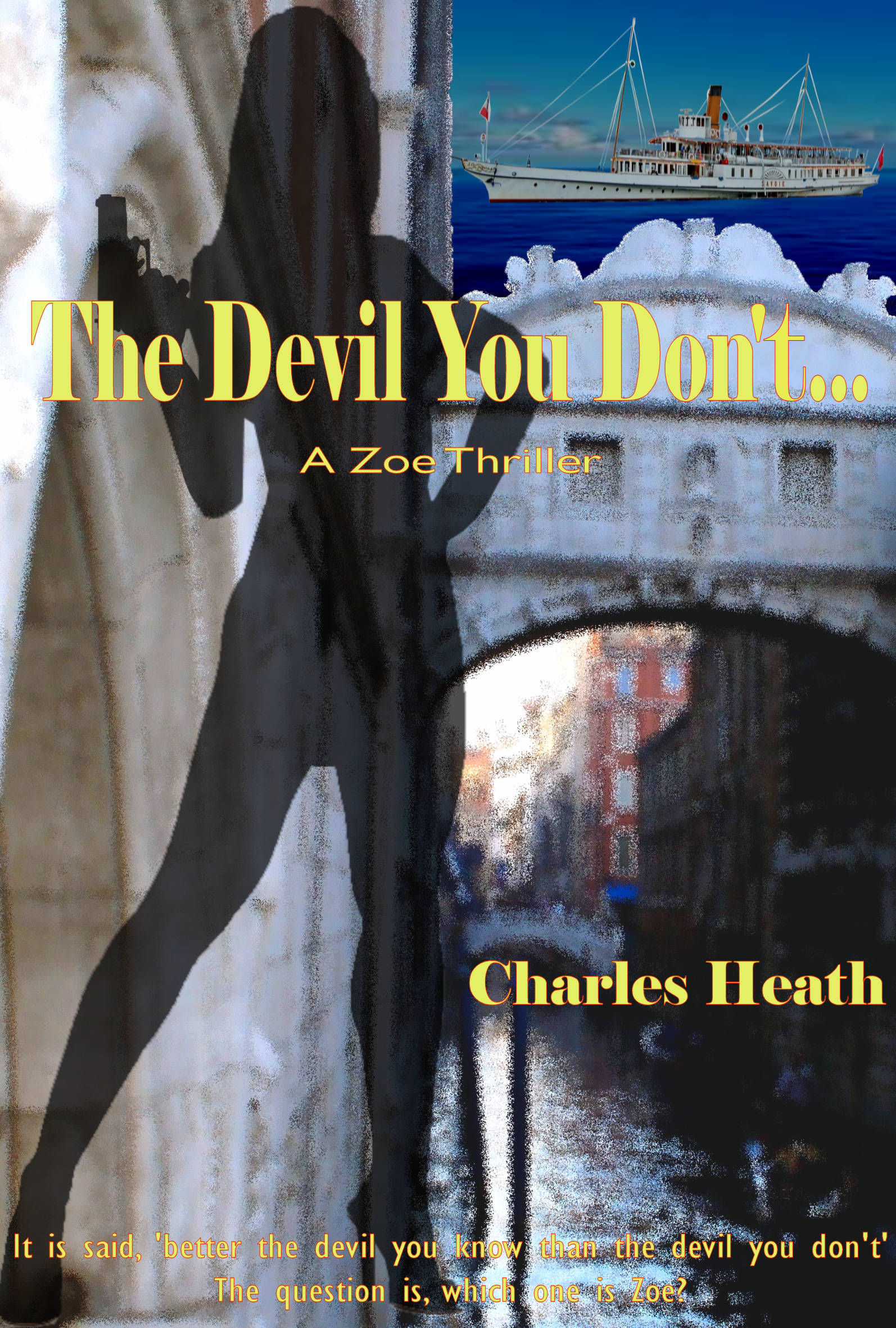
“The Devil You Don’t” – A beta readers view

It could be said that of all the women one could meet, whether contrived or by sheer luck, what are the odds it would turn out to be the woman who was being paid a very large sum to kill you.

John Pennington is a man who may be lucky in business, but not so lucky in love. He has just broken up with Phillipa Sternhaven, the woman he thought was the one, but relatives and circumstances, and perhaps because she was a ‘princess’, may also have contributed to the end result.

So, what do you do when you are heartbroken?

That is a story that slowly unfolds, from the first meeting with his nemesis on Lake Geneva, all the way to a hotel room in Sorrento, where he learns the shattering truth.

What should have been a high turns out to be something else entirely, and from that point every thing goes to hell in a handbasket.

He suddenly realises his so-called friend Sebastian has not exactly told him the truth about a small job he asked him to do, the woman he is falling in love with is not quite who she says she is, and he is caught in the middle of a war between two men who consider people becoming collateral damage as part of their business.

The story paints the characters cleverly displaying all their flaws and weaknesses. The locations add to the story at times taking me back down memory lane, especially to Venice where in those back streets I confess it’s not all that hard to get lost.

All in all a thoroughly entertaining story with, for once, a satisfying end.

Available on Amazon here: https://amzn.to/2Xyh1ow

‘Sunday in New York’ – A beta reader’s view

I’m not a fan of romance novels but …

There was something about this one that resonated with me.

This is a novel about a world generally ruled by perception, and how people perceive what they see, what they are told, and what they want to believe.

I’ve been guilty of it myself as I’m sure we all gave one time or another.

For the the main characters Harry and Alison there is others issues driving their relationship.

For Alison, it is a loss of self worth through losing her job and from losing her mother and, in a sense, her sister.

For Harry it is the fact he has a beautiful and desirable wife, and his belief she is the object of other men’s desires, and one in particular, his immediate superior.

Between observation, the less than honest motives of his friends, a lot of jumping to conclusions based on very little fact, and you have the basis of one very interesting story.

When it all come to a head, Alison finds herself in a desperate situation, she realises only the truth will save their marriage.

But is it all the truth?

What would we do in similar circumstances?

Rarely does a book have me so enthralled that I could not put it down until I knew the result. They might be considered two people who should have known better, but as is often the case, they had to get past what they both thought was the truth.

And the moral of this story, if it could be said there is one, nothing is ever what it seems.

Available on Amazon here: amzn.to/2H7ALs8

The cinema of my dreams – I always wanted to see the planets – Episode 46

Back on the alien vessel

Here’s the thing.

I personally believed that we wouldn’t be sitting on this alien vessel unless we had some value, or there was something about the group of so-called criminals that the alien captain didn’t have the authority to take decisive action.

“Hold that thought,” I said to him.  Then, “Number one?”

“Sir?”

“Are you still with the alien group?”

“Yes sir, awaiting orders?”

“Is the spokesman for the prisoners nearby?”

“A moment, sir.”  Silence for a minute, then, “He’s here, sir.”

“You wish to speak to me?” 

An odd thought, they all sounded the same.

“Yes.  I find it odd that the alien captain of this vessel hasn’t just destroyed our vessels and moved on, after all, if they have determined you are all criminals, what would be the difference between being left in a prison, or being executed? 

“I’m not sure what you are getting at.  For all intents and purposes, we are dead, to them and our homeworlds.”

It wasn’t the way he said it, but the way it was spoken.  And what was left unsaid.  It was a moment when you didn’t get the answer you wanted because you didn’t ask the right question.

“Now is not the time to be keeping secrets, because when our host comes back, the situation is going to end badly for you, and just as badly for us.  We’re all still here because you have something they want.  What is it?”

There was silence, but it was not generated by a refusal to speak, but more than the answer might have worse consequences than no answer.

Then, very quietly, he said, “Jai Ti.”

There are only three reasons that drive people to do the unthinkable.  Money, power, and a woman.

“She is not a so-called criminal, is she?”

“No.  She was indiscreet and found herself banished to the same detention center like us.  We are high-level detainees, rather than prisoners, who live in far better conditions than the more common criminal classes.”

“Let me guess, she was a so-called friend of one of the high council or someone of consequence in the political power structure.”

“In a manner of speaking, yes.”

“And they’re worried if she gets free, she might denounce the injustice?”

“She feels she did nothing wrong.  She claims she did not tell anyone, as per her agreement with the individual in question.  The situation is exacerbated by the fact they people have a very strict moral code, and relationships, shall we say, that is extra, and severely frowned upon, and for a leader who is expected to set an example.”

“And this leader…”

“The rules don’t necessarily apply depending on who you are.  Unfortunately, it is a problem across the many homeworlds here.  An enlightened society doesn’t necessarily mean what we and others are led to believe.”

“We have the same problems.  Thank you for your honesty, it may help, it might not.”  I had all I needed.  “Number One.”

“Sir.”

“No need to stay, I have no intention of getting between the passengers or the alien captain, so get back to the ship as quickly as you can and be ready on the bridge.  General?”

“Sir?”

“You are ordered to defend the ship by whatever means at your disposal, without regard to that personnel not aboard.  Do you understand?”

I expected a but because I was basically telling him that if he had to fire upon the Russian ship or the Alien ship, both senior officers and some crew would be in danger.

As far as I was concerned, the ship and 2000 others were more important.

“Under protest, but I understand.  Sir.”

“Number one?”

I also expected to get the standard lecture, which was well within his purview, but instead, “Understood, sir but let’s hope it doesn’t come to that.”

“Second?”

“Sir?”

“You have the bridge until either Number One or I return, otherwise you know what the standing orders are.”

“Understood.”

It was the precise moment the alien captain returned.

“I’ve spoken to the high council.  We are also monitoring a high level of activity on your ship.”

“If it’s a war you want, it’s a war you’ll get.  I think it’s time for the truth, something you have been playing, as we say, fast and loose with.  I told you exactly why we’re here, you haven’t.  I don’t approve of my compatriots’ actions, but he has, as anyone from our world would grant preliminary asylum to anyone who asks for it, pending a thorough investigation.  That investigation starts and ends with two words, Jai Ti.”

For a man with an expressionless face, it wasn’t hard to tell I’d hit the nerve.

“Alas, as you may or may not appreciate, we are in a difficult situation.”

“Dare I say it, but for an enlightened civilization, you seem to have all the same problems we do.  We could have resolved this much earlier had you just stated the facts.”

“Then you are prepared to return the prisoners.”

“Prisoners, yes, but with a suggestion.  The princess, no.  Unfortunately, you’re going to have to censure the leader that broke the rules.”

“And if that’s not possible?”

“Then I will take her home, and whatever happens after that is on his head, and to a lesser extent, yours.”

“Even if it means your ship is destroyed, and all those crew members die needlessly.”

“More have died for less, but noble cause.  Do as you wish, but I strongly advise you not to test our resolve.”

The alien captain turned to the Russian captain.  “If you hand over the prisoners, all of the prisoners, you will free to leave.”

“Sorry.  It’s a tempting offer, but it doesn’t solve the problem for future explorers.  Eliminating us will just bring more, in the not-too-distant future, only they will be hostile.  You might be able to live with the short-term consequences, but given what we are learning about your relations with other worlds, who are they going to blame for the problems you caused in the name of short-term expediency?”

A few seconds later four new aliens appeared, each in a particular style of dress.

Members of the high council?

© Charles Heath 2021-2022

The cinema of my dreams – I always wanted to see the planets – Episode 45

Back on the alien vessel

If asking for and getting what you wanted was the technology of lesser beings, what was the other world’s technology like?

It was a question I asked myself, or perhaps a moment after, if the alien people we were currently talking to had difficulties with other more advanced people in their galaxy, where would we fit into the picture?

It was a worrying thought, because through time those that were inferior, in our world, were always subjugated by the more superior.

Granted we had spaceships making us seem reasonably advanced, but theirs were not like the one I was on.  We thought we were very clever getting the ship we were on into space, but out there, now, I certainly didn’t feel clever, or superior.

There was also the revelation that we had been observed for a long time, our progress monitored, and basically rejected as likely candidates for being welcomed.  Or being told we were not alone.

It must have been a dock to see us turn up one their proverbial doorstep, but not so great as out that they knew about us.  It was a case of our reputation preceded us, and it wasn’t the good, only the bad.

It would be true to say, given everything we’d done to our world through greed and selfishness, that finding off-world destinations for colonization was a definite requirement rather than an option, and along with that, to find and learn from other civilizations, especially those that had been in the same plight.

And having found what we had always believed, well, a lot of us anyway, that there was other life in the galaxy, it wasn’t going to sit well that we were basically in the ‘cane man’ stage of development as a civilization.

It was not much of a starting point for any sort of negotiation, diplomatic or otherwise, along with the prospect of meeting the other civilizations in this quadrant if it could be called that, basically from behind that proverbial eight-ball.

We were still no wiser as to where these people came from, or that it was near our first intended destination, Proxima Centauri.  We had a list NASA had compiled, earth-like exotic plants that were thought to be able to support life.

Several of the meetings between the world’s greatest scientific minds, when they were not off on one of their theoretical rants, all concluded that there should be life out in the universe somewhere, that all the known explanations of our existence were wrong, and we were descendants of aliens, possibly more than one species. 

It was a fanciful notion that drew interesting reactions from the Darwinians who believed we descended from the apes, the church, still stuck on their Adam and Eve theory, and others that we evolved after the ‘big bang’, or that our DNA arrived via a colliding meteor, which had me puzzled.

Now, I was not sure what I believed.

The Russian captain, now free of being threatened with an alien weapon, had completed a full circuit of the bridge, taken a moment to stare out into space, and where our ships were standing off, then come and join us.

I had a hundred questions, but the first was, “What was your mission?”

“Beat you lot into space.  To be honest we never expected you’d ever get that ship out of the space dock”

A year late, and people still arguing over staffing, fittings, weapons, technology, even bragging rights, if it hadn’t been for the Admiral, we might still be there.

“You didn’t answer the question, not specifically.  No one just wants to be first, and especially not brave about it.”

“Not yet.”

“I assume you’ve been in communication back home?”

“Communication wasn’t one of the strong points since no one really knew how to make instant calls work, so not really.  We’re basically flying by the seat of our pants.”

“I can see that, applying earth mentality to alien relations.  I would have thought you and your superiors would take a more diplomatic approach.”

“We tried.  You do realize were are technically inferior to this lot, and they don’t view us as being worthy of their time and effort.  Apparently, they knew exactly who we are, and where we were from, something I find hard to believe.”

“Did you visit the planet?”

“We were stopped by a patrolling ship, and they actually fired on us.”

I was not surprised.  We would have done exactly the same, in reverse.

“So, you started on the wrong foot and it only got worse from there.”

“What would you have done in the same situation?”

“Be less confrontational, but then, we’re on an exploratory mission, not one that takes whatever we can steal or in your case kidnap.  Did you realize who those people were?”

“They approached us.  Before we got to their planet we got a distress signal from what looked like a space station, quite a distance from the planet.  We didn’t know it was a prison, only that there were people in distress.  We rescued them, as anyone else would.  That’s when the proverbial hit the fan.”

“Did you know they had specialist knowledge?”

“Eventually, when the aliens came after us, I told them I needed to know why they were being so angry about a few criminals.  I offered them sanctuary if they were willing to share their knowledge.  They agreed.”

“They didn’t want to go home?”

“No.  They said they’d be killed by their own people.   We call it treason, they call it something else, but its more or less the same thing.  Now they’re going to kill all of us.”

© Charles Heath 2021-2022

The cinema of my dreams – Was it just another surveillance job – Episode 43

I’m back home and this story has been sitting on the back burner for a few months, waiting for some more to be written.

The trouble is, there are also other stories to write, and I’m not very good at prioritizing.

But, here we are, a few minutes opened up and it didn’t take long to get back into the groove.

Chasing leads, maybe

—–

“You left a paper trail, a car registration form at the flat in Bromley.”

I saw him shake his head. “I thought I’d removed any evidence.”

“Good thing then, that I found it, and not Severin who was next through the door.”

He nodded towards Jennifer. “What’s she doing here, she was one of your surveillance team.”

“She came with me. The department threw her out, I found her and asked her if she wanted to find out what was going on. Apparently, she did. Everyone can put their guns down now. We are, believe it or not, all friends here.”

Jennifer put her gun back in a pocket I hadn’t seen before.

Adam lowered his, but it was still ready to shoot if either of us made the wrong move. The old woman’s aim hadn’t changed; she was still intent on shooting me if I moved.

“Mother, give it up.”

A few seconds later she lowered the weapon, but it was still ready. To fire if I moved.

“Can we sit,” I asked. Having a gun aimed at you tended to make you feel week in the knees. I was.

There were three chairs in front of the fireplace, this room also having a fire ready but not lit, and one chair by the writing-table. We sat in the three chairs, the old woman over by the table. She put the rifle down on the desktop, within easy reach.

“My first question,” I said, “has to be, how are you still alive?”

“You left when Severin’s crew arrived to clean up. He left at the same time. Luckily. Then two of Dobbin’s agents arrived and cleaned up the cleaners, as it were, and took me to a safe place where it was discovered my injuries were not fatal.”

“You were hit by a sniper, that’s hard to believe he, or she, aimed to miss.”

“They didn’t. I think I moved slightly because of you, so I have you to thank for my life. Something else to remember, Dobbin doesn’t know I’m here, and I think the only link was that registration certificate. No one actually knows me by Adam Quigley, except, of course, my mother.

“And the USB everyone is after?”

A few seconds of silence, then, “It’s missing.”

“Were you the only one who knew where it was?”

“No, but as far as I’m aware, that person is dead, killed by the explosion you witnessed. We were due to meet there, just before the explosion which is why I was heading there.”

“You walked past it, as I recall.”

“Standard procedure. I walk past, check to see if the contact is there, then come back a few minutes later. I was running late, just got past when it went up. We would have both been in there, and dead.”

“And the USB gone with it?”

“Yes. My friend had it with him at the time. I was going there to pick it up.”

“No copies?” It was too much to expect there would be, even if it was worth more than life itself.

“No. That sort of information needs to be in as few places as possible.”

“You knew what it was about?”

“Yes.”

“And…”

“It’s above all our pay grades. But something I can tell you; I know why your Severin and Maury wanted it back.”

“It was theirs?”

“Yes. They originally stole it. I stole it from them and trying to return it to whom it belonged.”

“Nobbin?”

“God, no. I’ve since discovered he’s as crooked as all the rest. But now that it’s gone, it doesn’t matter who the owner of the information is. Just staying one step ahead of the jackals, that’s the job in hand.”

——-

© Charles Heath 2020-2021

Writing about writing a book – Day 5 continues – The complications of life

I hate it when other characters are drawn in, and without a proper introduction, the reader gets confused.

Well, let me tell you, the writer can get confused too.

The introduction of Jennifer cannot go without the introduction of Ellen Bill’s ex-wife, and we have talked a little about her background before.

She has a role, one that will have a major impact later on, but every now and then she is going to appear, adding to the backstory between her and Bill.  There is no real animosity between them, their parting amicable because both knew it was time to end.

Bill’s problems were brought about his military service, and her father has a part to play in the story, though I’m not sure how to weave this in yet.  But it’s not so much what Bill remembers of his service, but of what he has forgotten, or more to the point buried.

That will eventually rise to the surface.

However, at this time, it’s still at the part where the narrator has to introduce Jennifer.

There are three distinct stages to this relationship between the two most important characters, and as it happens it’s Ellen unknowingly that brings Bill and Jennifer together,


Then Ellen, my estranged, and sometimes difficult wife decided she wanted a divorce.  I had no objection, and that was most likely the problem.  Perhaps she had expected me to fight for her, but she had made it clear, many years before, that she was no longer interested in preserving the marriage and was only keeping it up until our two daughters were old enough to fend for themselves.

That time had come.

I found myself in a situation where I needed someone to talk to.  I was not one of those people who made friends easily, nor did I spend much time seeking the company of other women.  I had my work, and it had been enough.

But Ellen’s request for a divorce, for some reason, had shaken me, and the day I got the phone call, Jennifer has bustled into my office as she always did, dumping the pile of log file printouts on my desk, and instead of leaving, perhaps she had seen my look of dismay, or more to the point, utter shock, and stayed.

It caused a slight change in our relationship.


I’m still working on it, but there will be more.

Or fewer words perhaps, after all, it’s only meant to be a brief introduction.

See how simple things become complicated, very quickly.


© Charles Heath 2019