The cinema of my dreams – I never wanted to go to Africa – Episode 5

It a ‘Houston, we have a problem’ moment

Our hero has survived the crash, now he’s stuck in enemy territory.

This was supposed to be a milk run.  There had been no reported activity in our zone and the pilot had decided to go up just the log some more air time.

He was hoping after reaching a 1,000 hours so he might be able to move to fixed wing aircraft and then move on to becoming an airline pilot.  Unfortunately, he was not going become anything now.

That didn’t explain why we encountered a convoy out in the desert, especially one with a rocket launcher and English speaking soldier types.

Did we stumble across another outfit running a secret operation and mistook us for the enemy?  It didn’t seem the case, our helicopter was distinctively marked just so we wouldn’t be mistaken, and then there was the fact the man knew my name.

How could that happen?  It would need someone back at the base to tell someone of the fact the helicopter was going up and who was in it, and there weren’t too many people who knew that information.

And only one who knew exactly when and where we would be.  Unless, of course, the pilot had strayed into a no-fly zone.  There was only one that I knew of and it was nowhere near our flight path.  Of course, it wouldn’t take much to bamboozle me in the air because I had no sense of direction.

Unless the pilot had another agenda.  I could hardly tell where we were because desert all looked the same to me, and navigation wasn’t my strongest point.

After the first few miles of very bumpy road, I managed to get into a sitting position and look in the direction we were heading.

More desert.

Ten minutes later I could see an encampment in the distance, literally an oasis in the middle of nowhere.  A secret base camp or something else?

As we got closer I could see it was mostly covered by camouflage so it couldn’t be seen from above. Clever.  Chances were we had no idea this place was in the desert.

Who or what is waiting for him?

© Charles Heath 2019-2021

Writing about writing a book – Day 8

I am painfully reminded that I need to have Social Media presence.

Marilyn told me that if I was on ‘Facebook’ I would have been able to follow her ‘adventures’.  If I was on Twitter I could acquire reading followers, and Instagram, to share photos of book covers and my travels.

I drag out the dusty laptop computer, the one that had an email account that goes back to the early days of the internet, and used a VT52 mainframe interface, or at least that was what I think it was called, and fire it up.  The operating system is out of date, error messages on top of error messages.  Thankfully the desktop works, but it too, is out of date, running Windows 97.

Even my mobile phone is more powerful and sophisticated than both my boat anchors.

Time to get into the ‘real’ world!

My writing is now on hold.  Shopping for a new computer, and updating operating system software, is a priority.


I am pleasantly surprised at just how inexpensive reasonable good laptop computers cost.  I looked at tablets from Apple, Samsung, and the Surface.  All very nice, but a computer, as big and cumbersome as it is, is still the cheapest option.

My afternoon is taken up with installing windows 10, setting up a Gmail email account, investigating, and signing up for Twitter, Instagram, and Facebook.  I also take out a cheap subscription to Microsoft Office.  I need Word for manuscripts, and Excel to budget, Powerpoint to dazzle.

I take to reading the information about ‘creating an author presence on the internet’ and see that perhaps I need to have a ‘blog’, whatever that is, and a website.

There’s free and there’s not so free.

Damn.  A day wasted in computer and social media land.  They even had something called the ‘cloud’.  I think I have been out of the computer world too long, having transferred into middle management just as the next phase of the computer technology started making an impact.

Tomorrow I tackle blogging.


I can’t sleep, not without writing something for the day.  My thoughts have been swirling around Bill and Jennifer, and it’s time to bring them together, and by, guess what, a calamity!


I start scribbling:


Hospitals were places I rarely visited.  Like others who shared my fear, it would take a rather compelling reason to get me there.  On this occasion, it had been a compelling reason.  If I hadn’t got to the hospital when I did, I would now be dead.

When I woke, it was to disorientation and confusion.  I didn’t remember much of anything that had happened after having lunch with Jennifer, and running into Aitchison.

When I finally came from the depths of unconsciousness and returned to whatever version of reality that was running at the time, I found myself in a position where any movement, including breathing, was painful.

It was dark, the shapes were blurry, and some moved.  As objects slowly came into focus, activity increased, and more people arrived.  My major concern at that time was the sensation of immobility, and of how difficult it was to breathe, or, more to the point, how painful.  Muffled voices spoke in a strange language.  After a short time, consciousness slipped away, as, mercifully, did the pain.

It was another week, though it seemed like a month before I realized where I was.  It had taken a while, but it was definitely a hospital.  One of the shadowy figures also became recognizable.

Jennifer.

She, too, had a number of bandages, and the black and blue look of a person who’d just survived a hit and run.

Then I remembered.

Aitchison.

Outside the restaurant.

When my eyes finally came into focus I looked at her and saw her smile.  Another realization, though it became clearer sometime later, was that my hand was in hers, and as she squeezed it gently, I felt it give me strength.

“Welcome back.”  She was quite close, close enough for her perfume to overpower the clinical disinfectant.

“Where did I go?”  My voice was barely above a whisper, my throat dry.

“We’re not sure.  You died once.  Now you only have eight lives left.”

It was odd that I’d heard it before, somewhere in the distant past, so I believed I had fewer lives to spare.  I looked at her.  “Aitchison?”

“He didn’t make it.”

“You?”

“I got caught in the crossfire.  So did you.  The police said Aitchison was the target.  We were in the wrong place at the wrong time.”

I’d heard that before, too.  I think that was Richardson’s problem, and he’d suffered the same fate, but his end result was terminal.

The conversation had exhausted me, and the pain returned.  It was still difficult to breathe, and I dared not look where most of the tubes were going.  Tears ran down my cheeks as the pain became unbearable.  I heard her call a nurse, and not long after the pain receded.  So did my consciousness.


Enough, it’s time for sleep.


© Charles Heath 2016-2020

It’s a long hard road I’m still on…

Self published authors are fully aware that perhaps the easiest part of the writing journey is the actual writing.  Well, compared to the marketing aspect I believe it is.

I have read a lot of articles, suggestions and tips and tricks to market the book to the reading public.  It is, to say the least, a lot harder to market eBooks than perhaps their hard or paper covered relatives.  This is despite the millions of eReaders out there.

Then there is that other fickle part of the publishing cycle, the need for reviews.  Good reviews of course.  As we are learning, reviews can be bought.  Currently Amazon is out there seeking out these reviews and reviewers and it will be interesting to see the result of their actions.

All the advice I have seen and read tells me that reviews should not be paid for, that reviews will come with sales.  It might be a difficult cycle, more reviews means more sales, etc.  And getting those first sales …

Therein lies the conundrum.  It is a question of paying for advertising, or working it out for ourselves.  I guess if I were to get more sales, I could afford the advertising … yes, back on the merry-go-round!

And yet, the harder the road, the more I enjoy what I do.  It is exhilarating while writing, it is a joy to finish the first draft, it is accomplishment when it is published, but when you sell that first book, well, there is no other feeling like it.

I am inspired.

Now, where are those notes for the next story …

The cinema of my dreams – I never wanted to go to Africa – Episode 5

It a ‘Houston, we have a problem’ moment

Our hero has survived the crash, now he’s stuck in enemy territory.

This was supposed to be a milk run.  There had been no reported activity in our zone and the pilot had decided to go up just the log some more air time.

He was hoping after reaching a 1,000 hours so he might be able to move to fixed wing aircraft and then move on to becoming an airline pilot.  Unfortunately, he was not going become anything now.

That didn’t explain why we encountered a convoy out in the desert, especially one with a rocket launcher and English speaking soldier types.

Did we stumble across another outfit running a secret operation and mistook us for the enemy?  It didn’t seem the case, our helicopter was distinctively marked just so we wouldn’t be mistaken, and then there was the fact the man knew my name.

How could that happen?  It would need someone back at the base to tell someone of the fact the helicopter was going up and who was in it, and there weren’t too many people who knew that information.

And only one who knew exactly when and where we would be.  Unless, of course, the pilot had strayed into a no-fly zone.  There was only one that I knew of and it was nowhere near our flight path.  Of course, it wouldn’t take much to bamboozle me in the air because I had no sense of direction.

Unless the pilot had another agenda.  I could hardly tell where we were because desert all looked the same to me, and navigation wasn’t my strongest point.

After the first few miles of very bumpy road, I managed to get into a sitting position and look in the direction we were heading.

More desert.

Ten minutes later I could see an encampment in the distance, literally an oasis in the middle of nowhere.  A secret base camp or something else?

As we got closer I could see it was mostly covered by camouflage so it couldn’t be seen from above. Clever.  Chances were we had no idea this place was in the desert.

Who or what is waiting for him?

© Charles Heath 2019-2021

Writing about writing a book – Day 8

I am painfully reminded that I need to have Social Media presence.

Marilyn told me that if I was on ‘Facebook’ I would have been able to follow her ‘adventures’.  If I was on Twitter I could acquire reading followers, and Instagram, to share photos of book covers and my travels.

I drag out the dusty laptop computer, the one that had an email account that goes back to the early days of the internet, and used a VT52 mainframe interface, or at least that was what I think it was called, and fire it up.  The operating system is out of date, error messages on top of error messages.  Thankfully the desktop works, but it too, is out of date, running Windows 97.

Even my mobile phone is more powerful and sophisticated than both my boat anchors.

Time to get into the ‘real’ world!

My writing is now on hold.  Shopping for a new computer, and updating operating system software, is a priority.


I am pleasantly surprised at just how inexpensive reasonable good laptop computers cost.  I looked at tablets from Apple, Samsung, and the Surface.  All very nice, but a computer, as big and cumbersome as it is, is still the cheapest option.

My afternoon is taken up with installing windows 10, setting up a Gmail email account, investigating, and signing up for Twitter, Instagram, and Facebook.  I also take out a cheap subscription to Microsoft Office.  I need Word for manuscripts, and Excel to budget, Powerpoint to dazzle.

I take to reading the information about ‘creating an author presence on the internet’ and see that perhaps I need to have a ‘blog’, whatever that is, and a website.

There’s free and there’s not so free.

Damn.  A day wasted in computer and social media land.  They even had something called the ‘cloud’.  I think I have been out of the computer world too long, having transferred into middle management just as the next phase of the computer technology started making an impact.

Tomorrow I tackle blogging.


I can’t sleep, not without writing something for the day.  My thoughts have been swirling around Bill and Jennifer, and it’s time to bring them together, and by, guess what, a calamity!


I start scribbling:


Hospitals were places I rarely visited.  Like others who shared my fear, it would take a rather compelling reason to get me there.  On this occasion, it had been a compelling reason.  If I hadn’t got to the hospital when I did, I would now be dead.

When I woke, it was to disorientation and confusion.  I didn’t remember much of anything that had happened after having lunch with Jennifer, and running into Aitchison.

When I finally came from the depths of unconsciousness and returned to whatever version of reality that was running at the time, I found myself in a position where any movement, including breathing, was painful.

It was dark, the shapes were blurry, and some moved.  As objects slowly came into focus, activity increased, and more people arrived.  My major concern at that time was the sensation of immobility, and of how difficult it was to breathe, or, more to the point, how painful.  Muffled voices spoke in a strange language.  After a short time, consciousness slipped away, as, mercifully, did the pain.

It was another week, though it seemed like a month before I realized where I was.  It had taken a while, but it was definitely a hospital.  One of the shadowy figures also became recognizable.

Jennifer.

She, too, had a number of bandages, and the black and blue look of a person who’d just survived a hit and run.

Then I remembered.

Aitchison.

Outside the restaurant.

When my eyes finally came into focus I looked at her and saw her smile.  Another realization, though it became clearer sometime later, was that my hand was in hers, and as she squeezed it gently, I felt it give me strength.

“Welcome back.”  She was quite close, close enough for her perfume to overpower the clinical disinfectant.

“Where did I go?”  My voice was barely above a whisper, my throat dry.

“We’re not sure.  You died once.  Now you only have eight lives left.”

It was odd that I’d heard it before, somewhere in the distant past, so I believed I had fewer lives to spare.  I looked at her.  “Aitchison?”

“He didn’t make it.”

“You?”

“I got caught in the crossfire.  So did you.  The police said Aitchison was the target.  We were in the wrong place at the wrong time.”

I’d heard that before, too.  I think that was Richardson’s problem, and he’d suffered the same fate, but his end result was terminal.

The conversation had exhausted me, and the pain returned.  It was still difficult to breathe, and I dared not look where most of the tubes were going.  Tears ran down my cheeks as the pain became unbearable.  I heard her call a nurse, and not long after the pain receded.  So did my consciousness.


Enough, it’s time for sleep.


© Charles Heath 2016-2020

What makes a character – 1 – The beginnings of a writer

My characters are many, a diverse group of people that are based on people I know, people I’ve known, people I’ve met, or seen, or interacted with. Some of them make up a single character with several traits.

Some are like me, but most are people I would have like to have been rather than the dull as ditchwater person I am. No-one wants to read about dull people, they want someone larger than life, someone who can do the impossible, or at the very least, the improbably.

I’ve always wanted to be someone else. For a long time I never liked who I was, and, to a certain extent, I still don’t. That was a result of the early stages of my life, those years the form who we are going to be.

And, had you asked me 50 years ago whether I would be the person I am now, I’d probably laugh and say it would be impossible. Yet here I am, and it’s nothing like what I thought I would be.

But, for now, lets look at the traits that live in some of my characterisations.

For instance, to understand the influences people have on us, I use my father, a man always voted for a particular political party, and that alone was an influence on who I would vote for when I got old enough, after listening for years his reasons for hating the opposition. For years he aired his grievances, which, at the time, he believed were real and caused by that opposition party.

Politics can be very polarising. There’s also a saying, throw enough mud, some of it sticks. That, of course applied to a great many things. Another was only the rich could afford a University education, and for years I believed that. It was, he said, how the rich kept their influence over, and suppress the poor.

It was a similar case with religion, another polarising topic, and my family were Protestants and therefore didn’t like other religions such as Catholics. It didn’t strike me till much later in life why this was so. But as a child we were sent to Sunday school and, irregularly, to church services of the Presbyterian faith.

Then there were our relatives, none of whom we ever really met. I knew we had relatives, my fathers parents because for a while we used to visit them every month or so where my father would cut their lawn, and my mother had a mother, he father had died not long after I’d been born.

My father had a lot of brothers and a sister. My mother had a brother and a sister. She also had an aunt that I’m sure I met several times before she died. But these are fleeting memories. We saw my father’s brothers and sister rarely, so rarely now I don’t remember them. The same applied to my mother’s sister, of whom I got the impression she was immensely jealous of.

I never understood why. Not then, any way.

But as for my mother’s mother, our grandmother, she was a likable soul who lived in the country, and she never came to see us, we went to see her, but those visits were long after we stopped seeing my father’s parents.

At the time we were young, she lived in the country, and we had to drive there which took time we didn’t seem to have.

Later in my pre teens my brother and I used to stay at her house for a week or two during the school holidays. It was a very large house on a large block, very old with high ceilings and large rooms, and we always had lots to eat, and delicious food at that, and we couldn’t understand why we didn’t have the same with our parents.

Of course there was a reason for that too, but this only became clear a few years ago when my brother started collecting information for a family history. My brother hunted down all of the relatives that were still alive and began to learn why we never saw them. It was not because of them, but because of my parents.

One stark revelation was that nearly all of them were better off than we were.

So here was my early childhood in equally stark reality.

It would be easy to blame parents for everything, but that’s the easy way out, and probably what every child who felt they were deprived of a proper life would do. More than likely, for years, that’s exactly how I felt, and, equally, the reason why I withdrew into a whole different world, or worlds, of my own.

I might not have put words on paper, but in my mind stories were beginning and evolving, stories that I told others to hide what I really was, and what I felt.

It’s a long hard road I’m still on…

Self published authors are fully aware that perhaps the easiest part of the writing journey is the actual writing.  Well, compared to the marketing aspect I believe it is.

I have read a lot of articles, suggestions and tips and tricks to market the book to the reading public.  It is, to say the least, a lot harder to market eBooks than perhaps their hard or paper covered relatives.  This is despite the millions of eReaders out there.

Then there is that other fickle part of the publishing cycle, the need for reviews.  Good reviews of course.  As we are learning, reviews can be bought.  Currently Amazon is out there seeking out these reviews and reviewers and it will be interesting to see the result of their actions.

All the advice I have seen and read tells me that reviews should not be paid for, that reviews will come with sales.  It might be a difficult cycle, more reviews means more sales, etc.  And getting those first sales …

Therein lies the conundrum.  It is a question of paying for advertising, or working it out for ourselves.  I guess if I were to get more sales, I could afford the advertising … yes, back on the merry-go-round!

And yet, the harder the road, the more I enjoy what I do.  It is exhilarating while writing, it is a joy to finish the first draft, it is accomplishment when it is published, but when you sell that first book, well, there is no other feeling like it.

I am inspired.

Now, where are those notes for the next story …

The cinema of my dreams – I never wanted to go to Africa – Episode 3

Dreaming I was in the desert…

But it was just another episode of the helicopter story, we’re back on the ground after that fateful jump, things are not going quite as planned.

Do they ever in life or death situations?


Yards were like miles, and I didn’t have the time to reach the weapon.  I could see the pickup going around the burning wreck as he of the helicopter and approach me.

But, being the optimist I was I had to try.

And fail.

The pickup was on me before I’d made it halfway, stopping about a foot from me.  Any further and it would have run me over.

I got to my knees and put my hands on my head not giving them any immediate reason to kill me.  The man who had fired the rocket got out of the vehicle moments after it stopped.

A man in military garb, not very old.  And not a foreigner.  I was expecting South American, but not ostensibly one of us.  A glance inside the vehicle showed the driver was a woman, in civilian clothes.

A surprise, yes.

“Mr. James I presume.”  English, well spoken.

Another surprise or more than one, that he spoke English and knew who I was.

“We were expecting you but not be quite so dramatic entrance.  Please stand.”

Kneeling had been difficult; I was not quite sure how standing was going to work.  I was still recovered from the impromptu exit from the helicopter.

I tried and fell back on the ground.  I looked up at him.  “Sorry, the legs are still a little rubbery.”

He simply shook his head, leaned over and dragged me to my feet, then slung me over his shoulder, carried me to the rear of the pickup and tossed me in.  I just managed to avoid hitting my head on the floor.

The man climbed in the back and then slapped the back of the cab.

Crunching gears, an over-revving engine, then a jerky start.  It was not going to be a comfortable journey.

© Charles Heath 2019-2022

An excerpt from “What Sets Us Apart”, a mystery with a twist

See excerpt from the story below, just a taste of what’s in store…

http://amzn.to/2Eryfth

whatsetscover

McCallister was old school, a man who would most likely fit in perfectly campaigning on the battlefields of Europe during the Second World War. He’d been like a fish out of water in the army, post-Falklands, and while he retired a hero, he still felt he’d more to give.

He’d applied and was accepted as head of a SWAT team, and, watching him now as he and his men disembarked from the truck in almost military precision, a look passed between Annette, the police liaison officer, and I that said she’d seen it all before. I know I had.

There was a one in four chance his team would be selected for this operation, and she had been hoping it would be one of the other three. While waiting for them to arrive she filled me in on the various teams. His was the least co-operative, and the more likely to make ad-hoc decisions rather than adhere to the plan, or any orders that may come from the officer in charge.

This, she said quite bluntly, was going to end badly.

I still had no idea why Prendergast instructed me to attend the scene of what looked to be a normal domestic operation, but as the nominated expert in the field in these types of situations, it was fairly clear he wasn’t taking any chances. It was always a matter of opinion between us, and generally I lost.

In this case, it was an anonymous report identifying what the authorities believed were explosives in one of the dockside sheds where explosives were not supposed to be.

The only reason why the report was given any credence was the man, while not identifying himself by name, said he’d been an explosive expert once and recognized the boxes. That could mean anything, but the Chief Constable was a cautious man.

With his men settled and preparing their weapons, McCallister came over to the command post, not much more than the SUV my liaison and I arrived in, with weapons, bulletproof vests, and rolls of tape to cordon off the area afterward. We both had coffee, steaming in the cold early morning air. Dawn was slowly approaching and although rain had been forecast it had yet to arrive.

A man by the name of Benson was in charge. He too had groaned when he saw McCallister.

“A fine morning for it.” McCallister was the only enthusiastic one here.

He didn’t say what ‘it’ was, but I thought it might eventually be mayhem.

“Let’s hope the rain stays away. It’s going to be difficult enough without it,” Benson said, rubbing his hands together. We had been waiting for the SWAT team to arrive, and another team to take up their position under the wharf, and who was in the final stages of securing their position.

While we were waiting we drew up the plan. I’d go in first to check on what we were dealing with, and what type of explosives. The SWAT team, in the meantime, were to ensure all the exits to the shed were covered. When I gave the signal, they were to enter and secure the building. We were not expecting anyone inside or out, and no movement had been detected in the last hour since our arrival and deployment.

“What’s the current situation?”

“I’ve got eyes on the building, and a team coming in from the waterside, underneath. Its slow progress, but they’re nearly there. Once they’re in place, we’re sending McKenzie in.”

He looked in my direction.

“With due respect sir, shouldn’t it be one of us?” McCallister glared at me with the contempt that only a decorated military officer could.

“No. I have orders from above, much higher than I care to argue with, so, McCallister, no gung-ho heroics for the moment. Just be ready to move on my command, and make sure you have three teams at the exit points, ready to secure the building.”

McCallister opened his mouth, no doubt to question those orders, but instead closed it again. “Yes sir,” he muttered and turned away heading back to his men.

“You’re not going to have much time before he storms the battlements,” Benson quietly said to me, a hint of exasperation in his tone. “I’m dreading the paperwork.”

It was exactly what my liaison officer said when she saw McCallister arriving.

The water team sent their ‘in position’ signal, and we were ready to go.

In the hour or so we’d been on site nothing had stirred, no arrivals, no departures, and no sign anyone was inside, but that didn’t mean we were alone. Nor did it mean I was going to walk in and see immediately what was going on. If it was a cache of explosives then it was possible the building was booby-trapped in any number of ways, there could be sentries or guards, and they had eyes on us, or it might be a false alarm.

I was hoping for the latter.

I put on the bulletproof vest, thinking it was a poor substitute for full battle armor against an exploding bomb, but we were still treating this as a ‘suspected’ case. I noticed my liaison officer was pulling on her bulletproof vest too.

“You don’t have to go. This is my party, not yours,” I said.

“The Chief Constable told me to stick to you like glue, sir.”

I looked at Benson. “Talk some sense into her please, this is not a kindergarten outing.”

He shrugged. Seeing McCallister had taken all the fight out of him. “Orders are orders. If that’s what the Chief Constable requested …”

Madness. I glared at her, and she gave me a wan smile. “Stay behind me then, and don’t do anything stupid.”

“Believe me, I won’t be.” She pulled out and checked her weapon, chambering the first round. It made a reassuring sound.

Suited up, weapons readied, a last sip of the coffee in a stomach that was already churning from nerves and tension, I looked at the target, one hundred yards distant and thought it was going to be the longest hundred yards I’d ever traversed. At least for this week.

A swirling mist rolled in and caused a slight change in plans.

Because the front of the buildings was constantly illuminated by large overhead arc lamps, my intention had been to approach the building from the rear where there was less light and more cover. Despite the lack of movement, if there were explosives in that building, there’d be ‘enemy’ surveillance somewhere, and, after making that assumption, I believed it was going to be easier and less noticeable to use the darkness as a cover.

It was a result of the consultation, and studying the plans of the warehouse, plans that showed three entrances, the main front hangar type doors, a side entrance for truck entry and exit and a small door in the rear, at the end of an internal passage leading to several offices. I also assumed it was the exit used when smokers needed a break. Our entry would be by the rear door or failing that, the side entrance where a door was built into the larger sliding doors. In both cases, the locks would not present a problem.

The change in the weather made the approach shorter, and given the density of the mist now turning into a fog, we were able to approach by the front, hugging the walls, and moving quickly while there was cover. I could feel the dampness of the mist and shivered more than once.

It was nerves more than the cold.

I could also feel rather than see the presence of Annette behind me, and once felt her breath on my neck when we stopped for a quick reconnaissance.

It was the same for McCallister’s men. I could feel them following us, quickly and quietly, and expected, if I turned around, to see him breathing down my neck too.

It added to the tension.

My plan was still to enter by the back door.

We slipped up the alley between the two sheds to the rear corner and stopped. I heard a noise coming from the rear of the building, and the light tap on the shoulder told me Annette had heard it too. I put my hand up to signal her to wait, and as a swirl of mist rolled in, I slipped around the corner heading towards where I’d last seen the glow of a cigarette.

The mist cleared, and we saw each other at the same time. He was a bearded man in battle fatigues, not the average dockside security guard.

He was quick, but my slight element of surprise was his undoing, and he was down and unconscious in less than a few seconds with barely a sound beyond the body hitting the ground. Zip ties secured his hands and legs, and tape his mouth. Annette joined me a minute after securing him.

A glance at the body then me, “I can see why they, whoever they are, sent you.”

She’d asked who I worked for, and I didn’t answer. It was best she didn’t know.

“Stay behind me,” I said, more urgency in my tone. If there was one, there’d be another.

Luck was with us so far. A man outside smoking meant no booby traps on the back door, and quite possibly there’d be none inside. But it indicated there were more men inside, and if so, it appeared they were very well trained. If that were the case, they would be formidable opponents.

The fear factor increased exponentially.

I slowly opened the door and looked in. A pale light shone from within the warehouse itself, one that was not bright enough to be detected from outside. None of the offices had lights on, so it was possible they were vacant. I realized then they had blacked out the windows. Why hadn’t someone checked this?

Once inside, the door closed behind us, progress was slow and careful. She remained directly behind me, gun ready to shoot anything that moved. I had a momentary thought for McCallister and his men, securing the perimeter.

At the end of the corridor, the extent of the warehouse stretched before us. The pale lighting made it seem like a vast empty cavern, except for a long trestle table along one side, and, behind it, stacks of wooden crates, some opened. It looked like a production line.

To get to the table from where we were was a ten-yard walk in the open. There was no cover. If we stuck to the walls, there was equally no cover and a longer walk.

We needed a distraction.

As if on cue, the two main entrances disintegrated into flying shrapnel accompanied by a deafening explosion that momentarily disoriented both Annette and I. Through the smoke and dust kicked up I saw three men appear from behind the wooden crates, each with what looked like machine guns, spraying bullets in the direction of the incoming SWAT members.

They never had a chance, cut down before they made ten steps into the building.

By the time I’d recovered, my head heavy, eyes watering and ears still ringing, I took several steps towards them, managing to take down two of the gunmen but not the third.

I heard a voice, Annette’s I think, yell out, “Oh, God, he’s got a trigger,” just before another explosion, though all I remember in that split second was a bright flash, the intense heat, something very heavy smashing into my chest knocking the wind out of me, and then the sensation of flying, just before I hit the wall.

I spent four weeks in an induced coma, three months being stitched back together and another six learning to do all those basic actions everyone took for granted. It was twelve months almost to the day when I was released from the hospital, physically, except for a few alterations required after being hit by shrapnel, looking the same as I always had.

But mentally? The document I’d signed on release said it all, ‘not fit for active duty; discharged’.

It was in the name of David Cheney. For all intents and purposes, Alistair McKenzie was killed in that warehouse, and for the first time ever, an agent left the Department, the first to retire alive.

I was not sure I liked the idea of making history.


© Charles Heath 2016-2020
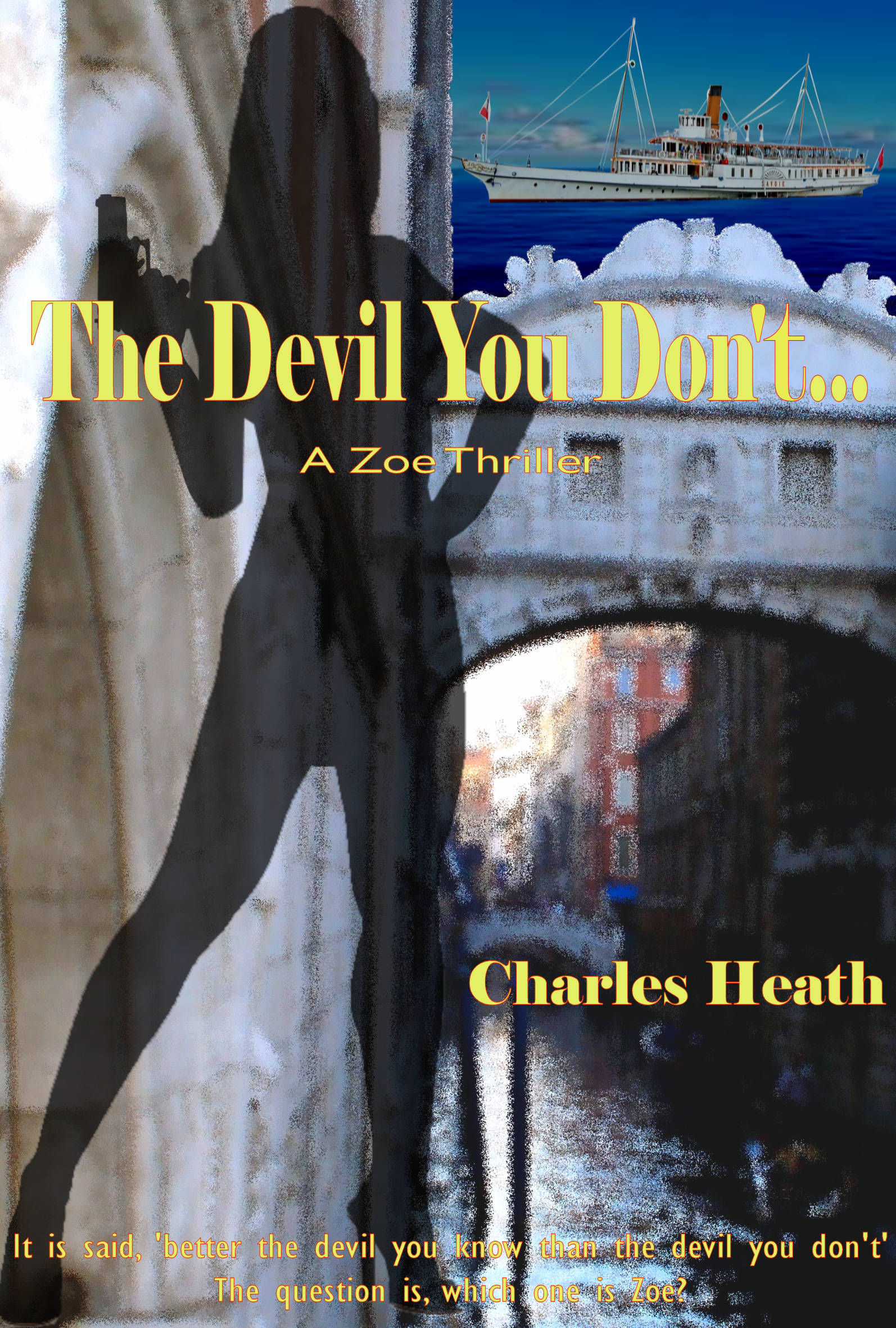
“The Devil You Don’t” – A beta readers view

It could be said that of all the women one could meet, whether contrived or by sheer luck, what are the odds it would turn out to be the woman who was being paid a very large sum to kill you.

John Pennington is a man who may be lucky in business, but not so lucky in love. He has just broken up with Phillipa Sternhaven, the woman he thought was the one, but relatives and circumstances, and perhaps because she was a ‘princess’, may also have contributed to the end result.

So, what do you do when you are heartbroken?

That is a story that slowly unfolds, from the first meeting with his nemesis on Lake Geneva, all the way to a hotel room in Sorrento, where he learns the shattering truth.

What should have been a high turns out to be something else entirely, and from that point every thing goes to hell in a handbasket.

He suddenly realises his so-called friend Sebastian has not exactly told him the truth about a small job he asked him to do, the woman he is falling in love with is not quite who she says she is, and he is caught in the middle of a war between two men who consider people becoming collateral damage as part of their business.

The story paints the characters cleverly displaying all their flaws and weaknesses. The locations add to the story at times taking me back down memory lane, especially to Venice where in those back streets I confess it’s not all that hard to get lost.

All in all a thoroughly entertaining story with, for once, a satisfying end.

Available on Amazon here: https://amzn.to/2Xyh1ow