Whilst I found this tree house to be interesting, it seems to be far from practical because there was little to keep the wind and rain out, though I suppose, in the book, that might not be such a problem.
Be that as it may, and if it was relatively waterproof, then the furnishings would probably survive, and one had to also assume that much of the furnishings, such as the writing desk below, would have washed up as debris from the shipwreck.
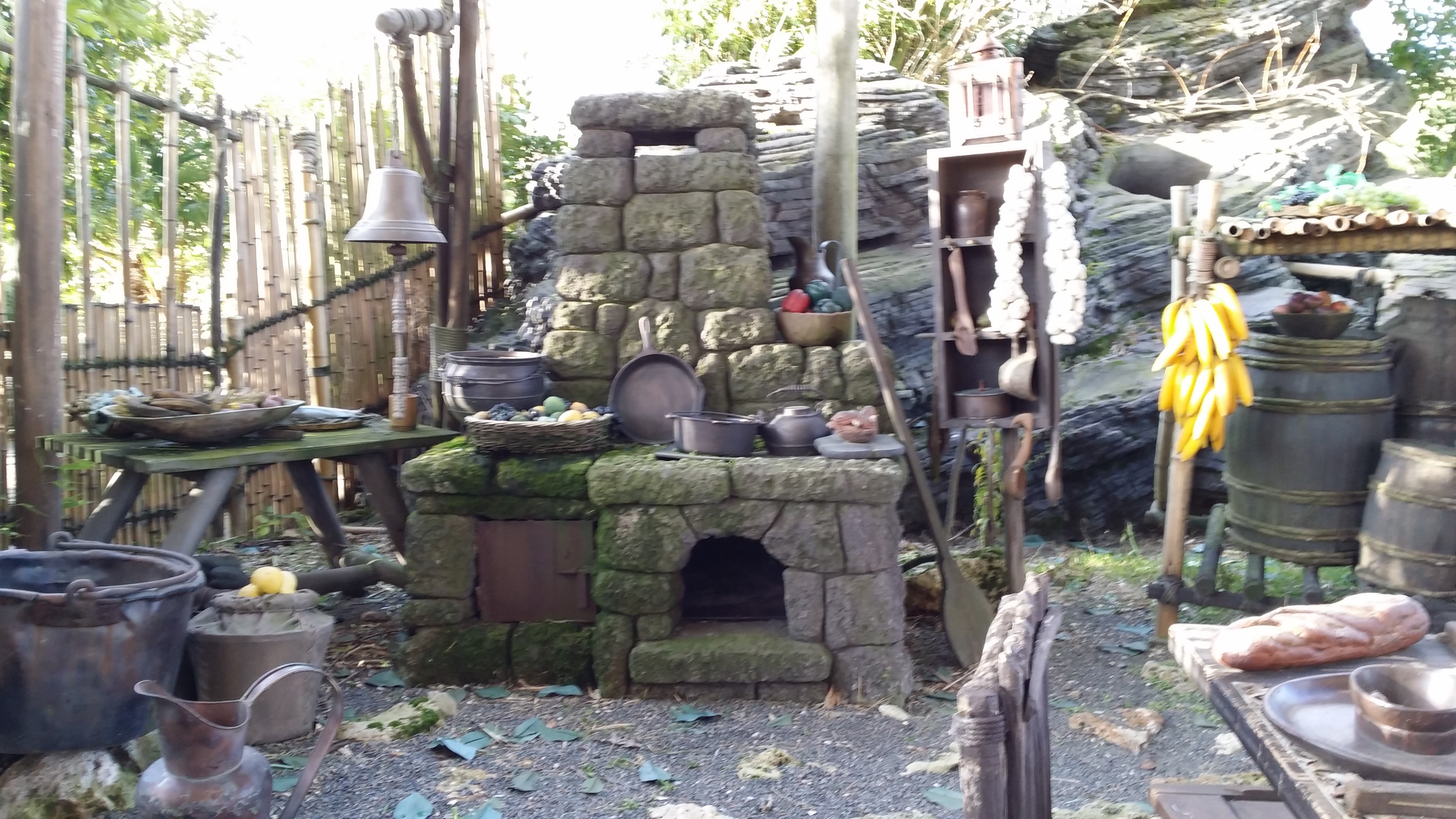
The stove and oven would have to be built by hand, and it is ‘remarkable’ such well-fitting stones were available. It doesn’t look like it’s been used for a while judging by the amount of gree on it. Perhaps it is not in a waterproof area.
The dining table and the shelf in the background have that rough-hewn look about them
A bit of man-made equipment here for drawing water from the stream
And though not made in the era of electricity, there is an opportunity to use the water wheel to do more than it appears to be doing
And tucked away in a corner the all-important study where one can read, or play a little music on the organ. One could say, for the period, one had all the comforts of home.
It could be said that of all the women one could meet, whether contrived or by sheer luck, what are the odds it would turn out to be the woman who was being paid a very large sum to kill you.
John Pennington is a man who may be lucky in business, but not so lucky in love. He has just broken up with Phillipa Sternhaven, the woman he thought was the one, but relatives and circumstances, and perhaps because she was a ‘princess’, may also have contributed to the end result.
So, what do you do when you are heartbroken?
That is a story that slowly unfolds, from the first meeting with his nemesis on Lake Geneva, all the way to a hotel room in Sorrento, where he learns the shattering truth.
What should have been a high turns out to be something else entirely, and from that point every thing goes to hell in a handbasket.
He suddenly realises his so-called friend Sebastian has not exactly told him the truth about a small job he asked him to do, the woman he is falling in love with is not quite who she says she is, and he is caught in the middle of a war between two men who consider people becoming collateral damage as part of their business.
The story paints the characters cleverly displaying all their flaws and weaknesses. The locations add to the story at times taking me back down memory lane, especially to Venice where in those back streets I confess it’s not all that hard to get lost.
All in all a thoroughly entertaining story with, for once, a satisfying end.
This is not a treatise, but a tongue in cheek, discussion on how to write short stories. Suffice to say this is not the definitive way of doing it, just mine. It works for me – it might not work for you.
…
You’ve got the place, now you want the who.
My main characters are quite often me.
Not the real me, because I’m boring. No, those characters are what I would like to be, that imaginary superhuman that can do everything.
Until, of course, reality sets in, and the bullets start flying. When that happens, we should be looking to run or at the very least get under cover, not walk into a hail of bullets, with a huge grin, staring down the enemy.
Hang on, that never happens except in superman comics.
What’s really needed here is a little vulnerability, a little humility and a lot of understanding, qualities at times I don’t have.
So, in order to create a more believable character, I start dragging traits from others I’ve met, or know, or really don’t want to know.
In a writer’s environment, there are a plethora of people out there that you can draw on for inspiration. I once spent and afternoon at a railway station just observing people. Even now, I make observations, some of which are true, and others, wildly off course.
I once tried to convince my other half that I could pick people’s traits, and we sat at a café outside a church in Venice. I was lucky, I got more than 75% correct.
Other characters in my stories I have met along the way.
Like a piano player in a restaurant. It was not so much the playing was bad, it was the way he managed to draw people into his orbit and keep them there. The man has charisma, but sadly no talent for the instrument.
Like an aunt I met only twice in a lifetime, and who left a lasting impression. Severe, angry looking, speaking a language I didn’t understand, even though it was English. It was where I learned we came from England, and she was the closest thing I came to as an example of nineteenth-century prim and proper. And, no, she didn’t have a sense of humour or time for silly little boys.
Like one of my bosses, a man of indeterminate age, but it had to be over 100, or so it seemed to my sixteen-year-old brain, who spoke and dressed impeccably, and yes, he did once say that I would be the death of him.
I can only hope I wasn’t.
Like a Captain of a ship I once met, a man who didn’t seem to have time for the minions, and a man who reeked authority and respect. I’ve always wanted to be like him, but unfortunately, it was not in the genes.
Those are only a few, there are thousands of others over the years, a built-in library, if you will, of characters waiting to be taken off the shelf and used where necessary or appropriate. We all have one of these banks.
For a story that was conceived during those long boring hours flying in a steel cocoon, striving to keep away the thoughts that the plane and everyone in it could just simply disappear as planes have in the past, it has come a long way.
Whilst I have always had a fascination with what happened during the second world war, not the battles or fighting, but in the more obscure events that took place, I decided to pen my own little sidebar to what was a long and bitter war.
And, so, it continues…
…
Leonardo was a fool, not that any of those who followed him would say that to his face, but all of them knew it and accepted that he made the best leader.
The reason for that, they all knew if anything went wrong, then the leader would be the first to be held accountable.
They all also knew that what Leonardo had done to Martina and Chiara, and the cold-blooded murder of the villagers, justifying it by saying they were collaborators, was also wrong, and had refused to take part in it.
Leonardo just thought they didn’t have the stomach to do what was necessary, failing to realize he was committing a crime, war or not.
Alberto, arguably the next man to take over the resistance group if anything happened to Leonardo, was nominally second in command and was there because he had the respect of the men, far more than their current leader.
He was the one who suspected there was something wrong at the castle, that the British soldiers there were not quite doing what they said they were there for. He had seen, even directed, Germans seeking sanctuary in England in exchange for information, come, but not go. Not like they did in the beginning.
And that man called Atherton, the one who arrived just before the paratroopers, he was British, and they had captured him. The talk was that he was a German collaborator, but Alberto wasn’t convinced.
But, not having the full allegiance of all the resistance fighters, he could not say anything or try to organize the men to be more careful in their approach to those at the castle. Leonardo still held sway with them.
For now.
.
The Italians had their own section of the cells in the dungeons where they stayed, Leonardo, deeming it not safe in the village. Alberto agreed because he had made several forays down there, only to discover that Leonardo would be shot on sight if he showed his face there again. Some resistance they made, he thought, where they didn’t have the confidence of their own people.
Leonardo was up supping with the devil, as Alberto had been known to say, put of Leonardo’s earshot, and several of the men were resting. The others, more loyal to Leonardo were in the cellar cell drinking their way through the wine stock and were most likely drunk and passed out.
Alberto didn’t care for the vintage, a subject that he was well versed in because before the war he had worked for the family of winemakers. The wines stored, he had recognized when they’d first discovered them, as being of inferior quality, and had been left there rather than throwing it away. Leonardo would not have known the difference.
“Something is not right.” A voice from the corner, belonging to a man named Bolini, broke his reverie. The truth was, he was tired and wished it were all done with.
“What makes you say that?” He asked.
“Killing the villagers. What did they do wrong, other than just trying to survive? It’s what we’re all trying to do. It’s not our war.”
“You know what it’s like, stuck in the middle. It’s a bit like the in-laws. You don’t want them, but you’re stuck with them.”
“In-laws. Don’t get me started.” The other, a man named Christo, weighed in.
“You do realize we may be held accountable for what happened back at the village,” Bolini had obviously been thinking about the repercussions.
“We brought the only witnesses here, and they sure as hell aren’t going to last long. Not after what Leonardo did to them.”
“That’s possible, but we all know what happened.”
“But there are others outside who also know what happened, and if we want to keep out of trouble, we are going to have to take care of them,” Bolini said.
Alberto hadn’t quite got through considering the ramifications of what Fernando just did, and the fact they’d helped him. Bolini was right, even if they hadn’t been as reckless, they were still going to be tarred with the same brush.
And Atherton was still out there.
The trouble with trying to clean up a mess is that eventually there’s a bigger mess to deal with. Maybe it was time to get rid of Fernando.
The man called Wallace, the one who seemed to be in charge, came around the corner and stopped when he saw Alberto.
“Where’s your leader?”
Alberto pointed his head in the direction of the wine cellar.
Wallace shook his head, knowing what that meant. “Tell him he’s got another pickup. Two hours in the village. A family, with two children. Tell him to sober up, and if he doesn’t in time, you have my permission to shoot him.”
Surely the man wasn’t serious.
“Well, what are you sitting around for? Get moving.”
Wallace cast a disapproving glance over the three, shook his head again, and left.
How often do we make a judgment call simply on what we see?
I knew what I saw, and it looked exactly like a situation that, if you asked any ten others who witnessed it, they would agree with me.
And then there would always be one that wouldn’t.
The prosecution had made a very good case, the defense counsel had woven a brilliant tale from start to finish, and he delivered in an almost persuading tone, with the subliminal message, the defendant was not guilty.
I felt sorry for the prosecution because his delivery had been halting, filled with ums and ers and in the end, everyone, from the judge down, wanted it to end.
As for the jury, it was an odd assortment of characters, a lawyer, a builder, a plumber, a housewife, two sales staff, two clerks, a janitor, two retirees, and a motor mechanic. I thought it would be the lawyer who would be the problem.
The trial had lasted 22 days, and over that time I noticed that groups would form, and discuss aspects of the case, each of the groups forming a different opinion. Sometimes, the dynamics of the groups changed as more evidence and testimony was revealed.
But, I think on those first few days, opinions were made, and judgment was passed.
In my opinion, based on looking at the defendant, it could be said that she didn’t look like a murderer, nor did she seem capable of committing such a heinous act. Having said that, as a throwaway first assumption, the lawyer nixed it in a second. Knowing something of how these trials worked, he said there would have been a lot of careful grooming, dress down, but not to drab, look demure, not aggressive, and speak in a modulated tone, like everyday conversation.
In other words, he was basically telling us she was giving an academy award performance.
I certainly looked at her in a different light after that, but the fact remained, for some of us, that initial assessment said not guilty.
A few days before we had to deliberate, a very damning piece of video was tendered and we all watched as the defendant was shown talking to her alleged accomplice, the victim’s current girlfriend, and passing an enveloped which the defense claimed was the payoff for helping her dispose of her husband.
It seemed odd to me that someone had known she would be in that bar, perfectly placed under the CCTV camera, both women so easily recognizable. Of course, the woman in question could not be found, and the inference was that she might also be one of the defendant’s victims.
Several people were called by the defense to assert a line of defense that the husband was a cruel man, who had treated his wife very badly indeed, to the extent her best friend remarked that she had turned up for work on several occasions with the results of what looked like a beating, and another, an ER nurse, had confirmed the defendant had visited the hospital on several occasions with lacerations consistent with what was considered spousal abuse.
Those photographs were quite confronting, but a question had to be asked, why had she not gone to the police with that evidence and let them deal with the husband.
The fact she hadn’t was one weakness in her defense. The thing there was why the defense introduced such testimony because, to me, it confused the issue by pushing the jury into thinking she had killed him, but in mitigating circumstances. Was she looking for a verdict of justifiable homicide?
From day two, after the lawyer had told us about how lawyers schooled their clients, I watched her carefully, when sitting beside her lawyer, or when on the stand. There were interesting actions she made when certain events occurred, like brushing a stray lock of hair back behind her ear, like teasing it out with a slight shake of the head, in a subtle but obvious show of displeasure. Like smoothing out the invisible wrinkles in her clothes, perfectly fitting and obviously made for her, but understated in a sense that she would stand out in a crown but not ostentatiously so. It was almost a ritual when she came in at the start, and when she took the stand, preparing herself.
Perfectionist, maybe. Or trying to convey a certain picture. Certainly, in the early days before the trial began, the media had a field day with the case, whipped into an even bigger frenzy when the police finally arrested the wife for the murder of her husband. Almost all of them said he had it coming, with page after page of revelations about a man who could not have done half the things he was accused of.
The trial by newspaper done, I suspect it was hard to find 12 unbiased men and women who could be trusted to make the right decision. I knew 100 would be jurors had been called up.
Now, in the jury room for the third day, trying to reach a verdict, it was the lawyer trying to wrap it up. He had a job to go back to. So did everyone else, for that matter.
“So, in essence, we are all agreed, that she is not guilty.”
It had been an interesting change in his position on the morning of day three of our deliberation. Before that, he wanted to hang her from the nearest yardarm. Interestingly enough, that morning, after he had given us his reasons for changing his mind, it would have been unanimous, and over.
The thing is, I didn’t like the way he changed sides so easily or for the reasons he spoke of.
So, in that vote, I changed my decision to guilty, and watch a group of people who had been friendly suddenly become enemies.
But at that moment, that other ten didn’t interest me, it was the expression on the lawyer’s face. He hadn’t expected the vote to go that way. It was like he had been goading everyone into voting not guilty and weathering the storm because of his stance. Had it been staged, had we been led down this path, and then all of a sudden, the verdict he wanted being reached?
I had to find out.
I watched the eleven raise their hands to vote not guilty. I did not. And immediately felt the looks of every one of those eleven on me.
“Why?” he asked.
By this time he had taken the lead, and the others had let him. Now I suspect they would let him do the talking.
“You’ve got it all wrong. The reasons are the same. There are two sides to that tale you came up with this morning. The problem I have is from being adamant she was guilty, and as you said, without a shadow of a doubt, now all of a sudden you’re having doubts.”
“So, you don’t think she’s guilty, you’re just voting that way because you suspect my motives?”
“What I think is irrelevant right now. You need to convince me that you truly think she’s not guilty. What is it you saw, or heard, or know that changed your mind. It certainly had nothing to do with that so-called video in the bar being staged. It has nothing to do with the fact they can’t find that woman so they can either verify or dispel the accusations being made she was an accomplice. It had nothing to do with the fact you think she might have been goaded into it and was left with no other option. In that case, it might well be a case of manslaughter rather than murder. Is that what you’re trying to suggest?”
“I think given the evidence, or lack of concrete evidence against her, she is not guilty.”
“But given everything you have said, it seems to me you think she had some crime to answer for.”
“Hasn’t she suffered enough?”
“That might well be the case, but it doesn’t give you an excuse to murder., and there’s certainly no forensic evidence that she was defending herself against an attack at the time. She should have taken her case to the police and have it investigated. She chose not to, for reasons that were never fully explained.”
“And didn’t we hear that the husband had links to various police that might have made such an investigation a waste of time. This was a woman trapped in a bad situation with no way out.”
It was a long way from where we, as jurors, were at the beginning of our deliberations. The first vote at the end of the first day was four voted not guilty and eight voted guilty. In the following days, a lot of arguments changed the decisions of those seven to vote not guilty, when they believed, in their own minds the defendant was guilty.
In my mind, the first instinct was usually correct. Over time that decision was only changed because of expediency, not necessarily for the right reasons. My first instinct was that she was, in fact, not guilty for all the reasons the lawyer cited.
“Look,” he said. “We’ve been here for three days. It’s an open and shut case. Let’s vote.”
We did with the same result. Eleven for not guilty and one against.
A hung jury. I wasn’t going to be moved on my position, and so it went back to the court. It was declared a mistrial and the defendant was returned to custody and a new trial was to be scheduled.
I was reading the paper’s version of events, and speculation on the result. Several of the jurors had featured in the discussion, but none were willing to talk about the result or who was responsible for the hung jury, only that one juror had not agreed with the majority. In some states, it was argued, it only required a majority, but in this and other states, quite rightly, it needed a unanimous decision to confer the death sentence.
Justice, it seemed to the writer of the piece, had prevailed.
They also believed that the plight of women trapped in marriages to violent men was a matter that should be looked at and that such women should be treated better in the eyes of the law. It was not a position that I disagreed with. What I disagreed with was the notion of jury tampering.
It was, apparently, the fifth time that a case such as this had a similar track record, that the deliberations of the jury had swung from an initial guilty verdict to not guilty at the hands of a single juror. In each of the five cases, the circumstances were similar, the wife had endured violence by her husband, and then, in odd circumstances, the husband had finished up dead.
Someone had discerned a pattern, and this had been a test case. In each of the other four cases, a not guilty verdict had been handed down by a jury that had also started with a majority guilty verdict, only to be worn down by a single juror with an agenda. To get the defendant a not guilty verdict.
My job was to find out which juror it was that was there to change minds. Then it was a case of finding links between him and four other jurors who were equally instrumental in obtaining a not guilty verdict. In each of the five cases, there was irrefutable evidence that the defendant was, in fact, guilty of the charge, and the expectation was the legal system would prosecute them.
And then, in each of the cases, a weak prosecutor was selected, and a particular juror was selected by that prosecutor. From there, the trail led back to a particular assistant District Attorney who had overseen each of the five cases. The fact was, justice was not served, and four out of the five defendants had escaped justice.
For a story that was conceived during those long boring hours flying in a steel cocoon, striving to keep away the thoughts that the plane and everyone in it could just simply disappear as planes have in the past, it has come a long way.
Whilst I have always had a fascination with what happened during the second world war, not the battles or fighting, but in the more obscure events that took place, I decided to pen my own little sidebar to what was a long and bitter war.
And, so, it continues…
…
It didn’t surprise Johannesen there were about twenty prisoners down in the dungeons, though he was surprised to find that the dungeon area was quite large, and in several sections. The fact they smelled of wine told him that once, the cells were used at storage areas for bottles of wine.
Several of the cells that were furthest from the downstairs entrance, and recently boarded over caused several overzealous resistance fighters of Leonardo’s to start smashing walls looking for it.
Johannsen tried not to think about Leonardo. He was the very worst of men, a pig even by German standards.
Martina had been put in a cell not far from Leonardo’s wine cache. There was purpose in that, he could get drunk and then take it out of the woman who had made him look stupid. Come to think of it, he thought, it wouldn’t be too hard for a ten-year-old to do that.
The cell door was locked, but Johannsen had a key. He had meticulously gone through all the keyrings and loose keys that had been found and those that didn’t have an immediate use had been stored in the dungeon guardroom.
Matching keys to locks had been one of his secret tasks, under the disguise of being given the job by Wallace to match keys to locks for them. There were a few short in the end, keys to rooms, and cells that seem to serve no purpose. One had become Johannessen’s hideaway.
It was part of a plan he had been formulating, one where he could take prisoners and hide them. Of course, it wouldn’t work for the moment because the prisoners had to be moved on as soon as possible, and staying in the castle, even if the others didn’t know where they were, would invite a microscopic search. It would need Atherton’s knowledge of the castle, and whether there was another escape route they could use.
It was another of his works in progress, one that was highly likely to fail.
He stood back from the door and looked at the crumpled heap on the floor that was once the leader of the resistance. Leonardo had interrogated her before bringing her back, half-dead, to the castle, and in doing so had made it impossible for anyone to interrogate her further. Had that been the reason why Leonardo had bashed her senseless?
He saw a hand move by her side, and a low groan.
He spoke quietly, in English, “Are you able to come closer to the door?” He knelt down, trying to get a better look at her injuries. Abrasions, and bruising. Swollen eyes, possible broken nose, blood spatter everywhere on her clothing which remarkably was relatively intact. He had suspected Leonardo of doing a lot worse and may still have.
She lifted her head slightly, “Who are you?”
“I could be a friend.”
She laughed, then coughed, and blood came out of her mouth. Broken ribs possibly, and a punctured lung. She might be too injured to move.
“There are no friends in this place, just Tedeschi.” She lowered her head and closed her eyes. Her breathing was irregular and shallow. Definitely broken ribs, he thought. And not likely to survive another interrogation. Not if Jackerby was going to conduct it.
“I’d like to help you if I can.”
“Everyone in here, we’re beyond help. You know that because you’re one of them.”
“Some of us care what happens to people.”
She pushed hard to move around slightly to face him, laying her head on the side to face him. “Which one are you?”
“Johannsen.”
“Yes, Johannesen. Atherton mentioned you. As untrustworthy as the rest. But for me, I’m all but dead, but I’ll humor you. Get me out of here and away from that bastardo Leonardo, and I might believe you.”
Atherton. This might be an opportunity to find out how he could get in contact with him, knowing of course, she wasn’t going to tell him where Atherton was.
“If you want to get away from here, we need Atherton. He’s the only one who knows this place inside out.”
He could see her shaking her head, as painful as that might be.
“He’s not.”
“Then is there anyone who does?”
“There is.”
“Who?”
Again she laughed and it sounded like the death rattle of her last breath. “You think I’m that far gone that I would tell you anything?”
“If you want to escape, I can only get you so far.”
“There is no escape. Believe me. If there was, I would be gone. Save your trickery and lies for someone who might be gullible enough to believe you. I’m quite prepared to die, the fact I’ve lived this long is what some would call a miracle.”
With that she turned away, coughed, and went silent. She wasn’t dead, but death wasn’t far away.
When Johannesen reluctantly left the cell, he only made it to the turn towards the steps up when he ran into Jackerby.
Had Jackerby been somewhere near and overheard their conversation.
“You have a rather interesting interrogation technique,” Jackerby said.
Johannesen groaned inwardly. He had heard.
“Sometimes it’s better to try and infuse hope in the subject rather than resignation. I was trying to get her to tell me where Atherton is.”
“And did she?”
“What do you think. After what Leonardo did, she’s not likely to tell us anything. I’m sure if we had taken a different approach…”
“Yes, softly softly. Doesn’t work. Just leave the heavy lifting to us, and don’t bother coming down to revisit the prisoners. Otherwise, I might believe you really are trying to help them escape.”
I hated it when I was younger, namely because my brothers always cheated, and that had been carried through to adulthood.
Now, I just avoided them.
It left me wondering how I managed to paint myself into a corner, and agree to do the one thing I assiduously avoided.
You could chalk it up to being persuaded by a pretty girl. Yes, I am the typical male, a sucker for a pretty face and a little flattery.
It would not have happened if I’d just gone home, instead of being asked to go and ‘just have one drink’ on the way home from work. I used to, once upon a time, before I got sick. But, perhaps it was a combination of cabin fever, and the monastic existence I’d adopted since that saw the one visit a chink of light at the end of a very long tunnel.
Whatever the reason, had I not gone, I would not have met Nancy. I’d seen her before, off and on, at work, and had noted, probably with a degree of disdain that where she was, was the most noise. You know, the one who talks loudest in the elevator, or the one who was the center of attention at a dining table.
And yet, underneath that, if or when anyone got close enough, there was something else. Something that fascinated me. But, having become reclusive had made me more reticent, and even though I was sitting at the same table, almost within arm’s length, I was too shy to strike up a conversation.
Until it was time to go home. I had moved out of the way so she could get out, and as she passed me she said, “You’ve been very quiet, Brian isn’t it?”
“Yes. And I know it’s rather lame but I don’t have as extensive knowledge of sports, which I guess I should. Ask me about old movies, and I’m your guy. Anyway, I pride myself on being a good listener.”
“Old movies eh. I’ll keep that in mind.” A smile, she went to leave, and then turned. “Look. I have this thing I have to go to, and I don’t want to go by myself. It’s not a date or anything like that, I just need someone to come with me. You might even find the people interesting.”
“I’m sure there’s someone else here more qualified than I am.” It was lame and I was floundering. It was not every day a girl asks you to go out with her. Even if it was, to a certain degree, and unflattering invitation.
“They all seem to have something else to do. Look, here’s my phone number,” she handed me a piece of paper with her cell number scrawled on it, “Call me if you change your mind. It’s not going to be as bad as you think.”
I should not have picked up the phone. I definitely should not have called her number. And I knew I was going to live to regret telling her I would go to her ‘thing’.
Before I walked out the door I looked at myself in the mirror. It seemed to be telling me, ‘you are a fool, Brian’, and I agreed. This had disaster written all over it. I hadn’t been out for a long time, and if anything, those few hours last evening were a sign I was not ready to face the world. Not after being so long away from it.
A lot had changed in the fifteen months I’d been in a coma. It was a miracle, the doctors said, that I came out of it with very little damage. I’d lost a chunk of memories, particularly surrounding the accident, and perhaps, I’d been told, that was a good thing. Cameron, the guy I worked with had summed up the change in a few short words, ‘you’ve gone from being the biggest dead shit in the world to something that resembles a human being’. I didn’t remember that person, though others did.
Maybe she remembered who I was, and, if she did, that didn’t explain why she asked me. The person Cameron described was not a person I would want to be with, so I guess the answer to my rhetorical question would soon be revealed.
Nancy was bright, talkative, and, at times, over the top. She was the loudest in the room and the center of attention. I wondered if the old Brian had been like that because if he was, I wouldn’t like him. It begged the question, why did I agree to go with her?
Curiosity? Maybe. That I might find some people who knew the old Brian? I certainly hoped not.
I had barely got out of the car to go and knock on her door when she came out, a small gym bag on her shoulder, dressed casually. I had to admit, in the morning sun and surrounded by an idyllic setting, she looked almost like an angel. She jumped in the car and all but slammed the door shut.
“You’re early.”
I looked at my watch, then the clock on the car’s dash. Both said the same, Eight a.m. exactly. “You did say eight a.m. and not p.m.” I couldn’t remember what she said, not right then.
“I mean most guys who come to collect me are always late.”
“Then I guess, by inference, I not like most guys.”
She smiled, one of those impish smiles I’d come to recognize from anther woman I’d dated somewhere in a distinct past, and who was trouble. I did, for some strange remember the night we spent in jail, though I couldn’t remember why, except the impish smile.
“I suspect you’re not. Cam said you were different.”
“Cam did, did he?” The mentioning of his name raised a red flag in the back of my mind. Cameron was not above playing complex pranks and I was beginning to see indications that this might be one. I would have to be careful.
“Not in a bad way, I mean. He had nothing but good things to say about you, though I had the feeling there was something he wasn’t saying. You’re not an ax murderer or anything like that?”
“Shouldn’t you have done some more research before asking me along?” I had also heard from another source, actually, a chap named, rather aptly, Jones, who was also at the party. He had left earlier but was still in the carpark, apparently his car parked next to mine, smoking a cigarette. A suspicious man might say he was waiting for me.
He had some ‘sage’ advice. “You want to be careful when you’re with Nancy. She’s not what she seems.”
I asked him to elucidate, but, cigarette finished, he stubbed it out rather violently under his blood, and left. He looked angry, sounded angry, and it was an angry warning. Perhaps he was a current or, more likely, ex-boyfriend. That ‘advice’ only added to the intrigue value.
Someone else, when he asked them about Nancy, had told him she was ‘brilliant’ with computers. Was that in programming, or hacking, or simply data entry? He only knew she had helped the web site programmers when the company had built its intranet. Computers and I never got on, and I was the only one who got a weekly visit from the IT help desk, just in case.
“I did. Do you remember anything from those fifteen months?”
“Like what?”
“They say that when you’re in a coma you can still hear people, you know, that sort of stuff.”
I thought about it for a minute. I wasn’t one of those lucky ones, though I did have one of those out of body experiences, where I suspect I’d nearly died. Just not my time, I’d thought, later.
“I’d like to meet the people who have that ubiquitous title of ‘they’. They have a lot of opinions, most of which are about the unknown.”
“So would I, to be honest. All you ever get to do is read about them. So, are you ready?”
“For what?”
“A weekend away. It will be fun if you want it to be.”
“Otherwise?”
“It’ll be fun. You have my promise.”
“And where is this ‘fun’ going to be?”
“Rhode Island. A friend of my parents, son is having a party and a few side events. There’s about 40 of us, so there’s no shortage of interesting if sometimes eclectic people. I’ll put the address in the GPS.”
Rhode Island, the other home of the New York rich, as well as others, and I hoped it was the others we were going to see. The host was the son of possible millionaires, so that was an interesting description for me to mull on. Would he be an ex? It seemed to me that Rhode Islanders would be less likely to mingle with the paupers, and if they did it would be for their own amusement.
There was a memory on the back of his mind, that popped up, albeit briefly when she mentioned the destination. The fact it didn’t want to come to the surface told me it was a bad memory. One from ‘old’ Brians days.
Nancy’s beauty, manner, and the fact she was clever might just win over the son of a millionaire, an heir to a fortune, whereas it would intimidate a lesser man. As for me, I was a means to an end, so it didn’t matter what I thought, other than it was better than staying home.
It was the house with all the cars parked out front. Multi stories, with towers that no doubt overlooked the ocean, and extensive gardens that seemed to be shared, that blocked the sightlines from the street front to that invisible ocean. I was will to be, once on the other side, the never-ending sound of the sea might be heard.
In winter, this would be bleak. In summer, well, what was the saying, anyone who is anyone would be here. Well, the sons and daughter thereof, perhaps.
I had expected the moment I parked the car she would be out, and gone, like a proverbial schoolgirl dying to get back to school after the holidays. She was not. She stood there, at the front of the car, and looked at the scene before us. To me, it was just a building, with trees, shrubs, and grass around it. To others, it was a portal into another world, one that would never be available to that 95% of the rest of the world. It was a phrase that popped into my mind, again, randomly, that said, the top 5% of any country held as much if not more of the wealth belongs to the other 95%.
I came up beside her and looked in the same direction, at one of the towers.
“Having a Rapunzel moment?” I hoped she had some memory of fairytales or it would seem an odd comment.
“I used to have long hair once. But, the last time I was here, I can’t remember. My mother’s hair was always long, some sort of hangover from hippy days, you know, the 1970s. She was here once. The stories she used to tell me about the houses, and the people she used to know. I’m ready. Are you?”
It was like a walk through the park, getting to the front door. There was a driveway, but there must have been a rule, no cars on the property. Or perhaps the front gate was locked and the owner had thrown away the key.
Or, more than likely, the butler, standing at the front door, welcoming guests, had it in his pocket. He was a tall, severe-looking man, with a military bearing. I somehow knew he was more than just the average butler.
Nancy gave him our names, and in return, he gave us a sheet of paper. The rules and the room number where we would be staying the night. I had thought that we would be given separate rooms, but that wasn’t the case, and it didn’t seem to worry Nancy that I would be staying with her. The only other words he said were, “The rotunda, 11 a.m.”
The room overlooked the ocean, today more or less a millpond, and a number of yachts were out making the most of the weather. There was a pier at the end of the property, and, yes, a reasonably large boat attached to it. There was also a view of a croquet lawn, the rotunda beside the rose garden. On the other side was a large pond, and seats where, no doubt on days when people like us were impinging on their solitude, they sat and contemplated how to make more money.
I didn’t realize I was that cynical.
The room had two beds, and it’s own bathroom. She had thrown her bag on one, checked out the bathroom, then dashed past saying, “I’ll see you at the rotunda.”
I followed her down about a half-hour later, descending the stairs at a more leisurely pace, looking at the paintings on the wall as I did. Forbears, and landscapes that were from around here. The one with the lighthouse was of particular interest. It brought another memory to the surface. I’d been there before, sometime in the distant past, and it was significant.
The Butler was standing at the bottom of the stairs, having stopped there when he saw me descending.
“It’s nice to see you again, Master Brian.”
“Not Master Brian, anymore, Jeffery. Sadly, I had to grow up.”
“We all do, sooner or later. Pity we can’t say the same for Chester.”
“Where is he?”
“You need to ask. I hope you’re up for a little X marks the spot.”
I groaned. Chester and his treasure hunts.
My last memory of that he had hidden a fluffy bunny stuffed with money. It was the weekend I had the crash the result I was told of too much booze, too much alcohol, too much of everything. I was just glad the girl I had brought up with me had left with another chap, a decision, I told her when she visited me in hospital, was probably the wisest thing she would ever do.
I just shook my head.
“Even if you don’t think so Brian, we have missed you.”
Another look around, I sighed, then went outside. My doctor had been right. Coming back had stirred up the mush in my brain, those thoughts, feelings, and memories of who I was, and what I was. And who I would never be again.
Nancy was waiting by the rotunda, talking to a more youthful version of myself, Chester. It was an awful name, one that our mother must have come up with in one of her drug-fuelled dreams, and he had taken a ribbing at school, and a willing participant in many a fight.
Chester looked surprised to see me, no, that wasn’t surprise, but shock.
“I thought you said you would never come back.”
Nancy looked from him, then to me, then back again.
“I’m not here, Chester. It’s just Nancy and Brian, here for the treasure hunt. And this time there better be more than a hundred dollars in that stuffed animal.”
Chester looked confused for a moment, then smiled he brand of childish smile, that of a child that would probably never grow up, the result of what I did to him, and would spend the rest of my life trying to earn forgiveness for.
“OK.”
“What was that about?” she asked.
“Long story. Remind me to tell you one day, if you stick around that long.”
In the background, I could hear Jeffery calling the treasure hunt participants together.
It was not for the first time, but this time was significant because he had basically agreed in principle to vote for both sides.
And, when he realized what had happened, he had, depending on how you looked at it, been tricked.
Not good for someone who was well respected by both sides, and whose vote would count towards picking up those who were undecided.
That was just pointed out to him by Amy, his personnel assistant, the moment he arrived back in the office.
He leaned back in his chair and stared at a point just past her head, a copy of a painting by one of the old masters, still an object of beauty.
“So, when did Cheney change sides?” He asked, dragging his attention back to the problem in hand.
He suddenly realized what had happened, and it was a well thought out scheme. Cheney had always been on board with the Board’s recommendation until he accepted Kane’s invitation to come to a meeting that would attempt to explain why the board’s recommendation was wrong.
He should have been skeptical of Cheney’s sudden change of mind, and then of the discussions he had attended with Cheney’s allies, with the objective of changing their minds too. In fact, he had left with the impression he had persuaded them, saying, in essence, they should all vote against.
Seeing Cheney that morning with the leader of the group agreeing to vote for the motion, should have set off alarm bells. The phone call from Williams, the head of the group voting for the board’s recommendation, saying he was pleased that Kane had finally seen ‘the light’ as he called it, had been interesting, to say the least, especially when he mentioned in passing, how very much the board appreciated Kane’s confidence in them.
He had done no such thing.
Instead, Cheney had put him on the spot, and his words were now being taken out of context.
“This morning. I just got word from Ellie, who told me he had a breakfast meeting with Jacobs and Meadows. She said he came back looking very pleased with himself.”
Jacobs was the chairman of the board and Meadows was the CEO who was pushing the new plan, which would break up, and sell-off, or disband, the underperforming divisions of the company. By having Meadows in attendance, Jacobs could basically offer Cheney anything he wanted.
And top of his list was my division.
“Yes, and I think we can guess why. He wants this division. Of course, if they gave it to him, it would not be the magic bullet he thinks it will be. Nor would it line the shareholders, and therefore the board members pockets as it has in the past.”
“Is this situation the proverbial double-edged sword?”
“It depends. I doubt you could quit out of dissatisfaction with a crappy board decision. I doubt anyone could in the current financial climate. But you won’t have to worry. It might mean going back to the pool for a while if you don’t want to work with Cheney.”
“No problem there. Ellie had already told me my days are numbered.”
Understandable. Ellie and Amy had put themselves forward for the role of Jake’s personal assistant, and Ellie had tried very hard to convince him Amy was not suitable for a variety of reasons, none of which he found valid, and appointed her. Ellie was not one who forgot or forgave easily.
Although he didn’t like denigrating anyone, he had said more than once to Amy, both Ellie and Cheney suited each other. Neither cared who or what they destroyed to get what they wanted.
“Then it looks like you and I are heading for the scrap heap.”
“Sounds like an excuse for a long lunch.” She smiled. For a woman who was about to lose a dream job, she was in remarkably good spirits.
“Ask me again in an hour. I have a few things to do.”
“Call in some favors, maybe?”
People didn’t rise in a company over several decades without making friends, making enemies, and stumbling over information which may or may not be used depending on circumstances at the time. He had a few interesting tidbits in his arsenal, but whether he would use them or not wasn’t uppermost in his mind.
“We’ll have to see.”
Jake watched her leave, and, not for the first time, he wondered what life with her might be like. He had never married, but had, for a number of years had a more or less relationship with the Chairman’s daughter, before she broke it off. He suspected the Chairman had instigated it given the number of times she had tried to contact him since parting.
That door had closed. As for Amy, she had a husband who was a member of the armed services and had been killed in Afghanistan. She had weathered that event and finally come out the other side of some very dark days, some of which he had witnessed personally, and tried to help where he could. But was she up to dipping her foot into the dating thing. He wasn’t prepared to ask. Not yet.
He sighed and picked up the phone. It was time to call Jacobs. It was the day I knew he would be in his office, not at the factory site where we all were housed, but in the top floor of a prestigious building in the city, twenty miles away You could call it an ivory tower, but the board did oversee the functioning of seven different and diversified companies.
Some time ago they had called for ideas on how to integrate a lot of the similar processes of those diversified companies, but in the end, they had paid a ‘crony’ a million dollars for an unworkable plan, and it had not gone any further. Now, the conglomerate was bleeding cash, someone had come up with a new, knee jerk, plan.
Jacobs was surprised to hear from him.
“I was told,” he said, “everyone is now on board.”
“They probably are. It’s just that it is no longer a problem for me. You’ll have my resignation on your desk by close of business.”
That statement was met with silence. Stunned, or was it smug satisfaction. He had always viewed Kane as a thorn in his side.
“Is that really necessary?”
“I think you know why, and whatever the plan was, it has backfired. I don’t need the job, nor do I need the aggravation of scheming and plotting.”
“I think you’re making a mistake, but let’s be very clear about this, you leave, there’s no coming back. If I were you, I would consider my position very carefully.”
Interesting reaction. The only conclusion from his reaction was that the thorn was now removed.
I expected just such a reaction.
Now, for the next job. Kane went down to the factory floor and called in all the production managers. Like himself, he knew most of them didn’t really have to stay, some could retire, some could go into business by themselves, most could walk into another job, even a better job, the next day.
Kane left that meeting a half-hour later, telling them the decision to stay and work under Cheney, a man none of them liked, was their decision but he was moving on.
He called Amy, asked if she had sent his resignation letter, which she had, and to pick the restaurant for lunch, the more expensive the better, and that he would pick her up outside the front of the office block.
For Kane, it was the 107th day of what he called the rest of his life. He was woken by the sun streaming in through the window of his hotel room. He had reached Singapore and had been told that Raffles Hotel was the place to stay.
He agreed. Old but new, the place just reeked of nostalgia.
The figure beside him stirred, opened her eyes, and smiled.
“Good morning, Amy.”
“It is a good morning, isn’t it Kane?”
Over lunch that fateful day 107 days ago, he took the chance of asking her if she would be interested in dating him. Nothing heavy, no strings, he would understand if she thought it inappropriate.
She didn’t think it was inappropriate, just wanted to know why it had taken him so long.
The had got married in Rome, 42 days ago, in a quaint little church, and after a week, moved to Venice for the honeymoon. They hadn’t set a limit on how long it should be. There was no reason to go back.
Of course, just when it’s least expected, the phone would ring. His cell phone. It was the first time in months.
“Hello?”
He was surprised it was Jacobs. He’d followed the fortunes of the company he had abruptly left, as it tried to implement the plan that Cheney and his ‘friends of the board’ had voted for. One problem after another; in three months the stock value of the parent company had lost 90% of its value. As Kane had expected, every one of his management team resigned the day after, knowing full well, once Cheney was installed as manager, the transition would fail.
Now, faced with hostile shareholders, a corporate watchdog investigation, someone had to turn around the company’s fortunes or it would slide into liquidation before the week was out.
“It seems that we have serious problems implementing the restructure. We have made some mistakes, but I think if I could tell the receivers that we have a plan and you would be heading up a new management team, we could save the company and all of the employees.”
The 2,500 left. They should have left well alone, and the whole 8,000 that had been there the day Kane left would still be employed.
The Board and upper management would do well out of the company going under. The staff, well, they always lost.
“I’m sorry to hear that. Now, if you don’t mind, I have business to attend to. Goodbye.”
I turned the phone off and put it back on the bedside table.
“Who was that?”
“Someone from another lifetime. Now, where were we?”
For a story that was conceived during those long boring hours flying in a steel cocoon, striving to keep away the thoughts that the plane and everyone in it could just simply disappear as planes have in the past, it has come a long way.
Whilst I have always had a fascination with what happened during the second world war, not the battles or fighting, but in the more obscure events that took place, I decided to pen my own little sidebar to what was a long and bitter war.
And, so, it continues…
…
Johannsen hadn’t signed up for this. He’d been in the room when Leonardo reported to Wallace, to tell him that the villagers had been neutralised, and he brought the ring leaders of the so-called resistance to the castle.
By his reckoning, Leonardo and his men had killed probably 20 or so people who had nothing to do with the war, other than try to live around the war going on in their backyard.
In fact, when he had arrived at the castle, the intention was to work with the locals and the resistance to facilitate the onward movement of prized defectors. Until Jackerby arrived, and the dynamic changed.
Johannsen hadn’t realised that Wallace was a double agent, not until it was too late.
The thing of it was, Wallace thought he was a double agent too, a belief Johannsen had taken extreme care not to dispel. And, where it was possible, he had tried to help those caught up in Wallace’s trap.
Wallace was already in situ at the castle when Johannsen arrived with another four men to join those already there, on order from London to vet the incoming defectors. Those four he had met at the plane, and he hadn’t realised they were not who they were supposed to be. By the time the four who had been replaced were found, it was too late to stop the mission.
That brought the complement to 10 including Wallace and himself. Then he received a message, one he assumed was from Thompson, advising the arrival of a further 5, Jackerby and four soldiers.
He soon discovered that those orders were false.
When Jackerby reported to Wallace, and the fact Wallace sent him out of the room, he stayed behind, hidden, to listen to the conversation. There he discovered he was in the midst of an enemy operation that had enlisted a number of double agents across Euprope from the German Army.
He then tried to warn Thompson in a coded message, but that had been substituted by Wallace with another, causing another lamb to be sent to the slaughter, Atherton. When Jackerby first arrived, he advised Wallace, not Johannsson, that Atherton was not one of them, so an attempt was made on,his life, but failed.
For a while that was the equivalent of throwing a cat among the pigeons.
By the time the paratroopers arrived, there was no effort to hide who they were or what they were doing. The castle was, for all intents and purposes, a Nazi stronghold, there to collect and execute defectors. All he had to do was play his part, and try not to rouse the suspicions of Jackerby, whom, it seemed, trusted no one.
Wallace wasn’t all that interested in being as suspicious as Jackerby, who had to be gestapo, or worse, one of the SS.
But luck was on Johansson side when he took a plan to Wallace that would essentially free Atherton, and then have Atherton lead them to the other resistance. It was also a master stroke to select Burke, a simple man who liked to think everything was his idea.
That Atherton had got away was no fault of his, but those charged with following him. Jackerby had tried to mess with him, but Wallace intervened, telling Jackerby that he had had missing people too and should be out there looking for them.
With any luck, Johansson thought, they would be dead, a likely result since none of them had come back yet. Now, all he could do was sit and wait for Atherton and whoever was left from the resistance to come and stop Wallace, and especially Jackerby.
Johansson knew that Atherton had a good working knowledge of the castle’s architecture, because on one occasion they had discussed archaeology. Johansson was not an archaeologist, but had worked with one and an assistant, before the war, at several digs.
He was hoping Atherton had a idea where there might be a secret entrance to the castle. It was old, and in his spare time, he had been pacing out room measurements, looking for nooks and crannies, and anything else that would be useful.
He had found a room full of swords, not exactly in fighting condition, but might be useful in a situation that called for a weapon. After all, he had taken a few sword fighting lessons at the university.
He had traversed several stone passageways, found two different passageways from the upstairs down to the radio room, and beyond that, where there was an exit or entrance, what in modern terminology would be called the tradesman’s entrance.
It was for all intents and purposes, a back door.
He had also gone around the whole perimeter of the outer castle wall, looking for holes. When he thought about it, leaving holes in the wall was asking for trouble because the idea was to keep people out, not to leave quickly and quietly in the middle of a siege.
And this castle had seen a few sieges in its time. More than once if he could travel back in time, he would have like to see what it was like 200 years ago, or more.
But there were only three entrances or exits that he knew of. There were no grates on the ground, or anywhere within 20 yards of the exterior wall, or conveniently hidden in the surrounding forests.
He was also sure there were hidden passageways inside the castle that must go somewhere, a result of checking internal measurements of rooms, and a few came up oddly short a few yards.
Still down in the dungeon on another of his subterfuges, the new arrivals guard had just appeared.
Can you actually say you know the exact moment a story is done, finished, and that’s it?
For me, the end never quite seems to be the end, that point where you finally draw a line in the sand and say, that’s it, I’m done, step away from the typewriter.
But are we ever satisfied the story is done, can we not make one more change, it’s just a little tweak, it won’t take long.
Please!
My editor tolerated three ‘minor’ changes.
Firstly, a change of name for a character
Secondly, consistency of word use, such as times and contractions
Thirdly, I wasn’t happy with the overall story, and it needed some more action. More writing, more editing, more prevaricating.
It took three weeks to sort out all of those issues, and last night I send the final draft to the Editor.
It’s like watching your child go to school on their first day. Not knowing what will happen but expecting everything will be fine.
This morning I sat in front of the computer, a blank sheet of paper on the screen. I know it’s not a matter of starting the next story from scratch; I have so many started and finished, sitting in the wings to be ‘tinkered with’.








 Thrills, Spills, and just a dash of Romance