Writing about writing a book – Day 2

Hang about.  Didn’t I read somewhere you need to plan your novel, create an outline, set the plot points, and flesh out the characters?

I’m sure it didn’t say, sit down and start writing!

Time to find a writing pad and put my thinking cap on.

I make a list, what’s the story going to be about? Who’s going to be in it, at least at the start?

Like a newspaper story, I need a who, what, when, where, and how.

Right now.


I pick up the pen.


Character number one:

Computer nerd, ok, that’s a little close to the bone, a computer manager who is trying to be everything at once, and failing.  Still me, but with a twist.  Now, add a little mystery to him, and give him a secret, one that will only be revealed after a specific set of circumstance.  Yes, I like that.

We’ll call him Bill, ex-regular army, a badly injured and repatriated soldier who was sent to fight a war in Vietnam, the result of which had made him, at times, unfit to live with.

He had a wife, which brings us to,

Character number two:

Ellen, Bill’s ex-wife, an army brat and a General’s daughter, and the result of one of those romances that met disapproval for so many reasons.  It worked until Bill came back from the war, and from there it slowly disintegrated.  There are two daughters, both by the time the novel begins, old enough to understand the ramifications of a divorce.

Character number three:

The man who is Bill’s immediate superior, the Services Department manager, a rather officious man who blindly follows orders, a man who takes pleasure in making others feel small and insignificant, and worst of all, takes the credit where none is due.

Oops, too much, that is my old boss.  He’ll know immediately I’m parodying him.  Tone it down, just a little, but more or less that’s him.  Last name Benton.  He will play a small role in the story.

Character number four:

Jennifer, the IT Department’s assistant manager, a woman who arrives in a shroud of mystery, and then, in time, to provide Bill with a shoulder to cry on when he and Ellen finally split, and perhaps something else later on.

More on her later as the story unfolds.

So far so good.

What’s the plot?

Huge corporation plotting to take over the world using computers?  No, that’s been done to death.

Huge corporation, OK, let’s stop blaming the corporate world for everything wrong in the world.  Corporations are not bad people; people are the bad people.  That’s a rip-off cliché, from guns don’t kill people, people kill people!  There will be guns, and there will be dead people.

There will be people hiding behind a huge corporation, using a part of their computer network to move billions of illegally gained dollars around.  That’s better.

Now, having got that, our ‘hero’ has to ‘discover’ this network, and the people behind it.

All we need now is to set the ball rolling, a single event that ‘throws a cat among the pigeons’.

Yes, Bill is on holiday, a welcome relief from the problems of work.  He dreams of what he’s going to do for the next two weeks.  The phone rings.  Benton is calling, the world is coming to an end, the network is down.  He’s needed.  A few terse words, but he relents.

Pen in hand, I begin to write.

© Charles Heath 2016-2025

Searching for Locations: Venice, Italy

Venice is definitely a city to explore.  It has an incredible number of canals and walkways, and each time we would start our exploration at St Marks square when it’s not underwater

Everyone I have spoken to about exploring Venice has told me how easy it is to get lost.  It has not happened to me, but with the infinite number of ways you can go, I guess it is possible.

We started our exploration of Venice in St Marks square, where, on one side there was the Museo di Palazzo Ducale and, next door, the Basilica di San Marco.  Early morning and/or at high tide, water can be seen bubbling up from under the square, partially flooding it.  I have seen this happen several times.  Each morning as we walked from the hotel (the time we stayed in the Savoia and Jolanda) we passed the Bridge of Sighs.

Around the other three sides of the square are archways and shops.  We have bought both confectionary and souvenirs from some of these stores, albeit relatively expensive.  Prices are cheaper in stores that are away from the square and we found some of these when we walked from St Marks square to the Railway station, through many walkways, and crossing many bridges, and passing through a number of small piazzas.

That day, after the trek, we caught the waterbus back to San Marco, and then went on the tour of the Museo di Palazzo Du which included the dungeons and the Bridge of Sighs from the inside.  It took a few hours, longer than I’d anticipated because there was so much to see.

The next day, we caught the waterbus from San Marco to the Ponte di Rialto bridge.  Just upstream from the wharf there was a very large passenger ship, and I noticed there were a number of passengers from the ship on the waterbus, one of whom spoke to us about visiting Venice.  I didn’t realize we looked like professional tourists who knew where we were going.

After a pleasant conversation, and taking in the views up and down the Grand Canal, we disembarked and headed for the bridge, looking at the shops, mostly selling upmarket and expensive gifts, and eventually crossing to the other side where there was a lot of small market type stalls selling souvenirs as well as clothes, and most importantly, it being a hot day, cold Limonata.  This was my first taste of Limonata and I was hooked.

Continuing on from there was a wide street at the end and a number of restaurants where we had lunch.  We had a map of Venice and I was going to plot a course back to the hotel, taking what would be a large circular route that would come out at the Accademia Bridge, and further on to the Terminal Fusina Venezia where there was another church to explore, the Santa Maria del Rosario.

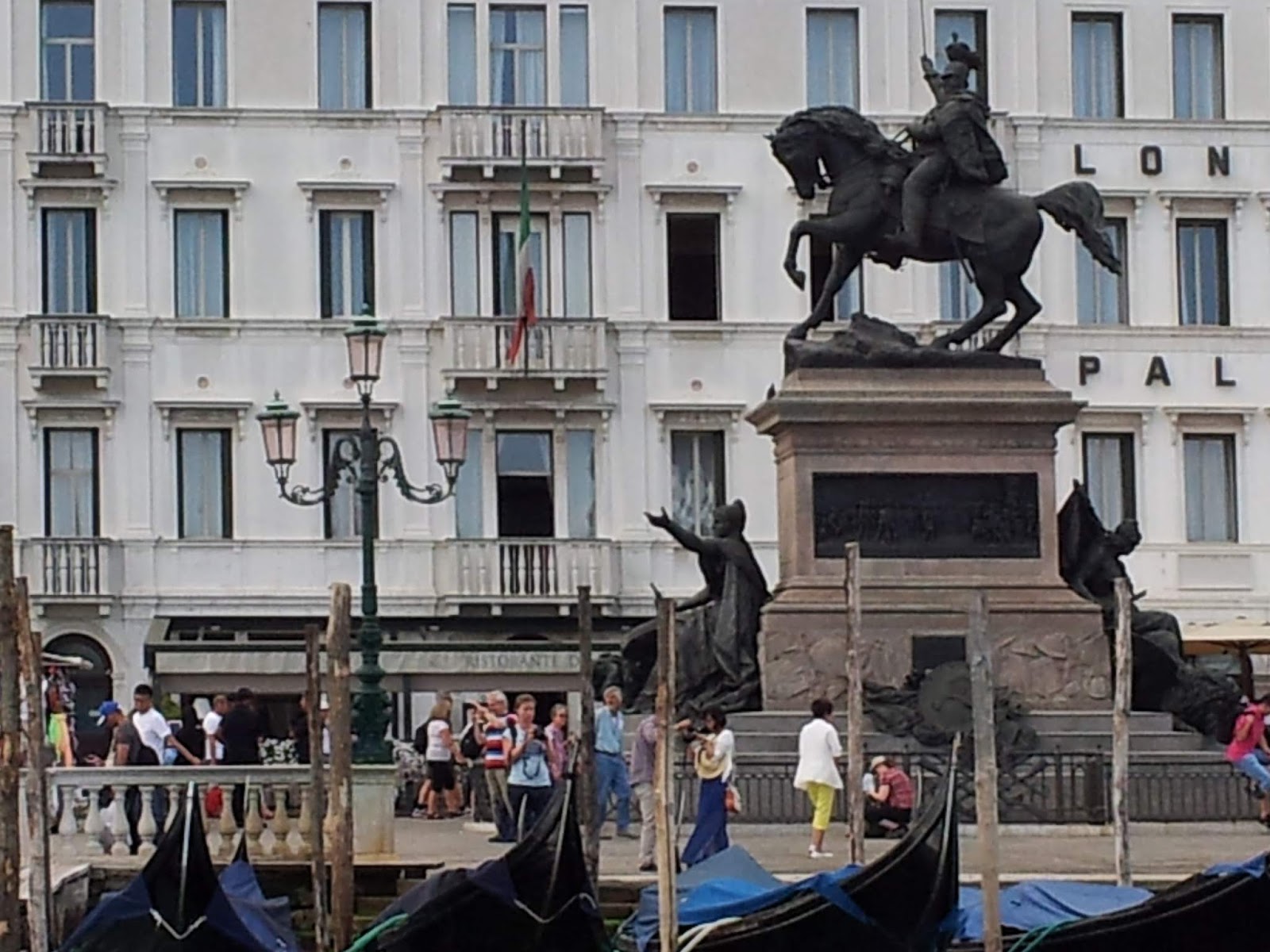
This is a photo of the Hilton Hotel from the other side of the canal.

It was useful knowledge for the second time we visited Venice because the waterbus from the Hilton hotel made its first stop, before San Marco, there.  We also discovered on that second visit a number of restaurants on the way from the terminal and church to the Accademia Bridge.

This is looking back towards San Marco from the Accademia Bridge:

And this, looking towards the docks:

Items to note:

Restaurants off the beaten track were much cheaper and the food a lot different to that in the middle of the tourist areas.

There are a lot of churches, big and small, tucked away in interesting spots where there are small piazza’s.  You can look in all of them, though some asked for a small fee.

Souvenirs, coffee, and confectionary are very expensive in St Marks square.

Searching for Locations: Venice, Italy

Venice is definitely a city to explore.  It has an incredible number of canals and walkways, and each time we would start our exploration at St Marks square when it’s not underwater

Everyone I have spoken to about exploring Venice has told me how easy it is to get lost.  It has not happened to me, but with the infinite number of ways you can go, I guess it is possible.

We started our exploration of Venice in St Marks square, where, on one side there was the Museo di Palazzo Ducale and, next door, the Basilica di San Marco.  Early morning and/or at high tide, water can be seen bubbling up from under the square, partially flooding it.  I have seen this happen several times.  Each morning as we walked from the hotel (the time we stayed in the Savoia and Jolanda) we passed the Bridge of Sighs.

Around the other three sides of the square are archways and shops.  We have bought both confectionary and souvenirs from some of these stores, albeit relatively expensive.  Prices are cheaper in stores that are away from the square and we found some of these when we walked from St Marks square to the Railway station, through many walkways, and crossing many bridges, and passing through a number of small piazzas.

That day, after the trek, we caught the waterbus back to San Marco, and then went on the tour of the Museo di Palazzo Du which included the dungeons and the Bridge of Sighs from the inside.  It took a few hours, longer than I’d anticipated because there was so much to see.

The next day, we caught the waterbus from San Marco to the Ponte di Rialto bridge.  Just upstream from the wharf there was a very large passenger ship, and I noticed there were a number of passengers from the ship on the waterbus, one of whom spoke to us about visiting Venice.  I didn’t realize we looked like professional tourists who knew where we were going.

After a pleasant conversation, and taking in the views up and down the Grand Canal, we disembarked and headed for the bridge, looking at the shops, mostly selling upmarket and expensive gifts, and eventually crossing to the other side where there was a lot of small market type stalls selling souvenirs as well as clothes, and most importantly, it being a hot day, cold Limonata.  This was my first taste of Limonata and I was hooked.

Continuing on from there was a wide street at the end and a number of restaurants where we had lunch.  We had a map of Venice and I was going to plot a course back to the hotel, taking what would be a large circular route that would come out at the Accademia Bridge, and further on to the Terminal Fusina Venezia where there was another church to explore, the Santa Maria del Rosario.

This is a photo of the Hilton Hotel from the other side of the canal.

It was useful knowledge for the second time we visited Venice because the waterbus from the Hilton hotel made its first stop, before San Marco, there.  We also discovered on that second visit a number of restaurants on the way from the terminal and church to the Accademia Bridge.

This is looking back towards San Marco from the Accademia Bridge:

And this, looking towards the docks:

Items to note:

Restaurants off the beaten track were much cheaper and the food a lot different to that in the middle of the tourist areas.

There are a lot of churches, big and small, tucked away in interesting spots where there are small piazza’s.  You can look in all of them, though some asked for a small fee.

Souvenirs, coffee, and confectionary are very expensive in St Marks square.

Short Story Writing: Don’t try this at home – Part 4

This is not meant to be a treatise on short story writing.  Far be it for me to advise anyone on the subject.  I prefer to say how it is that I do it so you can learn all of the pitfalls in one go.

I find inspiration in the most unlikely places.

Shopping malls are great, there is so many things going on, so many different types of people, there’s often enough to fill a journal.

Driving on the roads, you get to see some of the most amazing stunt driving, and it’s not even being filmed, it’s just playing out before your very eyes.

Waiting in hospitals, waiting for doctors, accountants, dentists, friends, hanging around coffee shops, cafes, bistros, restaurants, the list is endless.

But the best source, newspapers, and the more obscure the headline the better, and then just let your imagination run free, like:

Four deaths, four mysteries, all homeless.

This poses a few interesting scenarios, such as, were they homeless or were they made to look like they’re homeless.  Are they connected in any way?

The point is, far from the original story that simply covers four seemingly random murders, a writer can turn this into a thriller very easily.

It could follow a similar headline in another country where three headlines could be found, say, in London, where a man is found dead in an abandoned building, a week after he died, with no obvious signs of how he died.

A woman is killed in what seems from the outset an accident involving two cars, where, after three days, the driver of the second vehicle just simply disappears.

A man is reported missing after not reporting for work when he was supposed to return from a vacation in Germany.

Where an obscure piece says that a man was found at the bottom of a mountain, presumed to have fallen in a climbing accident.

It’s all in the joining of the dots.


Searching for Locations: Venice, Italy

Venice is definitely a city to explore.  It has an incredible number of canals and walkways, and each time we would start our exploration at St Marks square when it’s not underwater

Everyone I have spoken to about exploring Venice has told me how easy it is to get lost.  It has not happened to me, but with the infinite number of ways you can go, I guess it is possible.

We started our exploration of Venice in St Marks square, where, on one side there was the Museo di Palazzo Ducale and, next door, the Basilica di San Marco.  Early morning and/or at high tide, water can be seen bubbling up from under the square, partially flooding it.  I have seen this happen several times.  Each morning as we walked from the hotel (the time we stayed in the Savoia and Jolanda) we passed the Bridge of Sighs.

Around the other three sides of the square are archways and shops.  We have bought both confectionary and souvenirs from some of these stores, albeit relatively expensive.  Prices are cheaper in stores that are away from the square and we found some of these when we walked from St Marks square to the Railway station, through many walkways, and crossing many bridges, and passing through a number of small piazzas.

That day, after the trek, we caught the waterbus back to San Marco, and then went on the tour of the Museo di Palazzo Du which included the dungeons and the Bridge of Sighs from the inside.  It took a few hours, longer than I’d anticipated because there was so much to see.

The next day, we caught the waterbus from San Marco to the Ponte di Rialto bridge.  Just upstream from the wharf there was a very large passenger ship, and I noticed there were a number of passengers from the ship on the waterbus, one of whom spoke to us about visiting Venice.  I didn’t realize we looked like professional tourists who knew where we were going.

After a pleasant conversation, and taking in the views up and down the Grand Canal, we disembarked and headed for the bridge, looking at the shops, mostly selling upmarket and expensive gifts, and eventually crossing to the other side where there was a lot of small market type stalls selling souvenirs as well as clothes, and most importantly, it being a hot day, cold Limonata.  This was my first taste of Limonata and I was hooked.

Continuing on from there was a wide street at the end and a number of restaurants where we had lunch.  We had a map of Venice and I was going to plot a course back to the hotel, taking what would be a large circular route that would come out at the Accademia Bridge, and further on to the Terminal Fusina Venezia where there was another church to explore, the Santa Maria del Rosario.

This is a photo of the Hilton Hotel from the other side of the canal.

It was useful knowledge for the second time we visited Venice because the waterbus from the Hilton hotel made its first stop, before San Marco, there.  We also discovered on that second visit a number of restaurants on the way from the terminal and church to the Accademia Bridge.

This is looking back towards San Marco from the Accademia Bridge:

And this, looking towards the docks:

Items to note:

Restaurants off the beaten track were much cheaper and the food a lot different to that in the middle of the tourist areas.

There are a lot of churches, big and small, tucked away in interesting spots where there are small piazza’s.  You can look in all of them, though some asked for a small fee.

Souvenirs, coffee, and confectionary are very expensive in St Marks square.

Searching for Locations: Venice, Italy

Venice is definitely a city to explore.  It has an incredible number of canals and walkways, and each time we would start our exploration at St Marks square when it’s not underwater

Everyone I have spoken to about exploring Venice has told me how easy it is to get lost.  It has not happened to me, but with the infinite number of ways you can go, I guess it is possible.

We started our exploration of Venice in St Marks square, where, on one side there was the Museo di Palazzo Ducale and, next door, the Basilica di San Marco.  Early morning and/or at high tide, water can be seen bubbling up from under the square, partially flooding it.  I have seen this happen several times.  Each morning as we walked from the hotel (the time we stayed in the Savoia and Jolanda) we passed the Bridge of Sighs.

Around the other three sides of the square are archways and shops.  We have bought both confectionary and souvenirs from some of these stores, albeit relatively expensive.  Prices are cheaper in stores that are away from the square and we found some of these when we walked from St Marks square to the Railway station, through many walkways, and crossing many bridges, and passing through a number of small piazzas.

That day, after the trek, we caught the waterbus back to San Marco, and then went on the tour of the Museo di Palazzo Du which included the dungeons and the Bridge of Sighs from the inside.  It took a few hours, longer than I’d anticipated because there was so much to see.

The next day, we caught the waterbus from San Marco to the Ponte di Rialto bridge.  Just upstream from the wharf there was a very large passenger ship, and I noticed there were a number of passengers from the ship on the waterbus, one of whom spoke to us about visiting Venice.  I didn’t realize we looked like professional tourists who knew where we were going.

After a pleasant conversation, and taking in the views up and down the Grand Canal, we disembarked and headed for the bridge, looking at the shops, mostly selling upmarket and expensive gifts, and eventually crossing to the other side where there was a lot of small market type stalls selling souvenirs as well as clothes, and most importantly, it being a hot day, cold Limonata.  This was my first taste of Limonata and I was hooked.

Continuing on from there was a wide street at the end and a number of restaurants where we had lunch.  We had a map of Venice and I was going to plot a course back to the hotel, taking what would be a large circular route that would come out at the Accademia Bridge, and further on to the Terminal Fusina Venezia where there was another church to explore, the Santa Maria del Rosario.

This is a photo of the Hilton Hotel from the other side of the canal.

It was useful knowledge for the second time we visited Venice because the waterbus from the Hilton hotel made its first stop, before San Marco, there.  We also discovered on that second visit a number of restaurants on the way from the terminal and church to the Accademia Bridge.

This is looking back towards San Marco from the Accademia Bridge:

And this, looking towards the docks:

Items to note:

Restaurants off the beaten track were much cheaper and the food a lot different to that in the middle of the tourist areas.

There are a lot of churches, big and small, tucked away in interesting spots where there are small piazza’s.  You can look in all of them, though some asked for a small fee.

Souvenirs, coffee, and confectionary are very expensive in St Marks square.

The cinema of my dreams – I always wanted to write a war story – Episode 55

For a story that was conceived during those long boring hours flying in a steel cocoon, striving to keep away the thoughts that the plane and everyone in it could just simply disappear as planes have in the past, it has come a long way.

Whilst I have always had a fascination with what happened during the Second world war, not the battles or fighting, but in the more obscure events that took place, I decided to pen my own little sidebar to what was a long and bitter war.

And, so, it continues…

We were not leaving the castle the way we had found it, but we would blame the Germans.  Carlo understood because he was the one who had selectively destroyed parts of it, but I knew after we’d gone, he would blame us.

When Carlo discovered the empty cells below in the dungeons, he and the boy went back outside and looked for them.  I didn’t have the heart to tell him that Wallace would have ordered them removed and executed because Meyer had been the objective and everything else was a distraction.

Two of Blinky’s soldiers were assigned to bring back Chiara.

Blinky and the rest of his men moved into better quarters and had their first real meal in a week.  We posted sentries, but I didn’t think any Germans would be coming to see what happened.  The sentries were more to tell us when Meyer and his escort arrived.

Blinky would then be the official escort for Meyer back to England.  A plane was on standby waiting for our signal.

Several hours after Carlo left, he returned with Martina and Johanneson, the latter looking very worse for wear.

The last of the traitors.

Carlo shoved him into a chair and bound him very tightly.

“We found the prisoners, all shot.  Fernando’s remnants killed them.  I will make it my business to find every last one of them.  What do you want to do with this traitor?”  He nodded in Johannesen’s direction.

Martina had slumped into a chair.  She still wore the very recent scars of a severe beating and was out on her feet.  Despite that, I got the impression she was glad to be alive.

“Was he responsible for anything that happened while you were in the cells?” I asked her.

“He saved me if that could be called an act of kindness.  He did nothing to save the others.”

“If you had a choice?”

“I’d shoot him.”

“Now hang on.  Since when did good Samaritans get punished?”  Johannesen was outraged.

I shrugged.  “You will be judged on past sins.”

Martina looked up.  “He was the leader of the group that destroyed the church.  It was our original headquarters, down in the basement.  We managed to get away, with a few injuries, but it took out our equipment and radio.”

“There,” he said.  “My intention was destroying infrastructure not lives.”

“Coincidental.”

I got up and walked over to Martina and gave her my gun.  “I’ve done enough killing for today.  Perhaps a small token of retribution for those lost.”

“Chiara?”

“She will be here shortly.  We found her just in time.”

“Thank God for that.”

I don’t think she had it in her to enjoy the moment she executed Johannesen, I don’t think it was worth celebrating a death, more lamenting the loss of yet another person in a war that seemed to be dragging on.

At least he accepted his fate and didn’t plead for his life.

It was mission accomplished.

Blinky’s radioman finally reconnected with Thompson and told him that we were awaiting the arrival of Meyer and that he could tell those up the pipeline it was safe to bring him to the village.  He would then signal when the plane was in the air.  Thompson was pleased enough to give me a ticket back to London.  All we had to do was collect Meyer.

That was Carlo and my job, and for the last time, I went back down into the village and waited.

I was not sure who was more relieved, Meyer or myself.  I’d met him once before the war, at a University in Hamburg where he was working on a top-secret project, and I was studying the archaeology of some old castles nearby.

I’d been tasked to find out what he was doing, my rather bright future in archaeology was never going to take off in those dark months that followed Chamberlain’s peace treaty.  Everyone but him seemed to know that war was inevitable.

He’d spent time telling me about the stars and planets, and how wonderful it would be to visit them one day in the not-too-distant future.  From that, we inferred that the Germans were working on space travel, though you never really could tell what they were up to.

It simply meant if things went bad, we needed to touch base every now and then with Meyer, which I did, in a friendly manner and never directly asking what he was up to.  That contact had paid off, and he had made contact asking me if it was possible to come live in England.

Thompson had been very pleased.

“Herr Atherton,” he said, rather relieved to see me.

“Herr Meyer.”

We shook hands, and then he hugged me like an old friend would.  “You came.”

“You asked.  I do my best?”

“We leave now?’

“We very definitely leave now.”

I left Carlo with the escorts to explain the new arrangements, far away from the castle, and I took Meyer back to the castle.  Along the way we talked, not of rockets and death, but of old times in Berlin, and how Germany used to be before this crazy person called Hitler had sent them down the path to self-destruction.

Perhaps, he said, one day he might be able to return.

I hoped I would not, not until the war ended, but that being a forlorn hope, not until I had a very long, well-earned rest.

But this was Thompson we were talking about, and his favourite saying was ‘There’s no rest for the wicked’.

© Charles Heath 2021-2023

The cinema of my dreams – I always wanted to write a war story – Episode 54

For a story that was conceived during those long boring hours flying in a steel cocoon, striving to keep away the thoughts that the plane and everyone in it could just simply disappear as planes have in the past, it has come a long way.

Whilst I have always had a fascination with what happened during the Second world war, not the battles or fighting, but in the more obscure events that took place, I decided to pen my own little sidebar to what was a long and bitter war.

And, so, it continues…

When Carlo stopped, I was out of breath and gasping.  We all were.  The smoke was getting more intense.  At times it had made navigation almost impossible.

In front of us were more trees, but these looked different to those we had passed through.  I watched Carlo walk back and forth a few yards each way, then disappear into the bushes.  A minute later he put his head out and said, “This way.”

We followed him.  It was a hidden entrance down to a drain that was quite deep and headed back towards the castle one way and into the forest the other.

If the fire kept up by tomorrow the cover would be gone.

It was still a hard walk through the bushes, but we made it to a wireframe and door with a lock on it.  It looked ancient as if it hadn’t been used in decades, even longer.

Carlo produced a rather odd looking key and unlocked it.  I would have thought it was rusted shut, but appearances were deceptive.  The lock was almost new.

But the gate had not been used for a long time and it took Carlo a few minutes to force it to open.  It had rusted shut.  When it did finally move, it was with a very loud screeching sound.

We filed in and he relocked it.  Anyone thinking they heard something and came to investigate; it would end up on the other side of the gate.

So far so good.

For a moment I was back in my element, the archaeologist exploring caves, a wooden fire torch lighting the way, dampness underfoot, and the trickling of water down the walls.  All around the dankness from continual dampness.

It was easy the pretend if only for a few minutes I had not been caught up in the war, that I was on a quest for lost treasure, hidden away at the end of a labyrinth.

The reality was we were quite literally in an ancient sewer and the original builders of the castle had used an underground waterway to tap into to remove waste.  It was far more effective than modern systems and used the earth’s own ecology.

Inside the castle, the places where the waste used to drop down into the waterway had been covered over by trapdoors that were still there, and that was how we were going to gain access, through rooms that were no longer used.

We were going in via four access points, two men at each door, and mine with one of Blinkys men would be going into the area where the soldiers were camping to mop up whatever the bombs left behind, before closing off an exit.

Carlo had reserved the last one for himself and the boy, where he hoped to find Wallace and the new German commander.

Our cue to move: the bombs going off.

We just had time to get to the point and lower the trapdoors. Then climb up onto the floor and wait by the door.  From the other side, Carlo said, anyone in the castle would only see a continuation of the wall panelling.

We made it with seconds to spare.

We were closest to the bombs and the percussive effect was disorientating for a few seconds before we pushed through the door and into the smoke and dust raised by the explosions.

As the dust settled, we could see dead soldiers, and mess everywhere.  If a soldier was still alive, we shot them, systematically picking our way through the debris.  I counted thirty-one dead by the time we reached the other side, the other exit from the space.

In the distance, we could hear sporadic gunfire coming from other parts of the castle, and then, after taking up our position, near the tank, we waited.

Three soldiers came bursting out of the exit and we shot them too..

Ten minutes later Carlo yelled out, “It’s me, don’t shoot.”  Then he stepped out the door.  “It is done.”

The castle was ours.

“You wish to speak to your old commander before I execute him?

“Wallace?”

He nodded.

“Sure”

I followed him into the castle and walked through familiar passageways and rooms, much had not changed in a long time.

Wallace and the new commander were tied up in the dining room.  The remnants of a meal and several empty bottles of wine were on the table.

Wallace watched me from the doorway until I stood before him.

“I knew it was a mistake letting you go.  Jackerby was convinced you were a stupid fool who would unwittingly lead us directly to the resistance.  I told him you were cleverer than you looked.”

“And yet…”

“Perhaps I was tired of people like you being killed needlessly.  What just happened, that was a waste of human life.”

“I didn’t start the war, and for the record, I didn’t want any part of it.  Unfortunately, higher authorities deemed otherwise, and here I am.  This is not a victory to savour.”

“A victory nonetheless.”

I shrugged.  “It didn’t have to be like this, but at least we’ve weeded out a few more traitors.”

“Then no point asking for mercy?”

“No.”

With that said Carlo executed both men.

© Charles Heath 2021-2023

The cinema of my dreams – I always wanted to write a war story – Episode 53

For a story that was conceived during those long boring hours flying in a steel cocoon, striving to keep away the thoughts that the plane and everyone in it could just simply disappear as planes have in the past, it has come a long way.

Whilst I have always had a fascination with what happened during the Second world war, not the battles or fighting, but in the more obscure events that took place, I decided to pen my own little sidebar to what was a long and bitter war.

And, so, it continues…

War is hell. 

I remembered an old Sargeant Major was telling us that going to war was not fun, that the very real possibility of getting killed should be the only thing on our minds.

Along with keeping your head down and being very aware of your surroundings.

Apparently, he had been at a place called Gallipoli, and from what I had read, that was a special kind of hell.

He had also said fifty per cent of us wouldn’t return.  I hoped to be in the fifty per cent that did.  Just to spite the old bastard.

I knew it was going to get problematical sooner than we thought, I could smell the aroma of burning bush on the air, and as we got closer to the castle, the smoke got denser.

Wallace had a cunning plan, he’d used flame throwers to set the bush on fire so we couldn’t get to the castle under the cover of the forest.  It was a plan he hadn’t me about.

Carlo had stopped, also understanding what Wallace had done.  Would this interfere with us getting to the external entrances, or if the other three were unattainable, could we get to the secret entrance?

I caught up to him.  “Not exactly what we envisaged.  I had no idea Wallace was planning this?”

“It is a logical move.  He can’t leave the castle, and as it was, he knew the forest would give us cover until the very last moment.”

“And now?”

“Now we use another entrance.  Take longer, but we’ll get there.  Only problem, they will be expecting us, and waiting.”

The others joined me, just as Carlo did an about-face and started going back the way we came.

“Where is he going?” Blinky asked.

“Another way.  Wallace is burning our cover.”

He shrugged.  “I suppose it would be too much to ask for some rain?”

“Sadly no.  Fine and clear with a touch of fog, well, smoke maybe.”

He didn’t think it was funny.  War I guess could do that to you.

When Thompson and company were planning the operation that was set up primarily to get defecting Germans out of the country, there was only so much research that could be done.

It was one of the reasons I got a seat at the table, my exploits in Italy looking at ancient buildings suddenly became a red-hot reason to be included.  The war had all but petered out in that part of the country, the Germans were shoring up the Italians, and the Allies had bigger plans to invade via Sicily, or one of those islands.

Someone mentioned something hush-hush about Italy and the road back to peace, but at that point in time, the end of the war was not in sight.

The point was, the castle was in a strategic location, it was only being held by a small garrison, according to the resistance, ideal for what Thompson wanted.  Approvals gained, he sent in a team of German-speaking soldiers to replace those there, as if nothing had happened and then set up the pipeline.

It worked.

For a while anyway.  Several months after the new team had set themselves up and the personnel was moving through, it all stopped.

First thought was the Germans had discovered what was going on and switched the team again.  Until Thompson noted we were still getting reports from Wallace, one of his men on the ground.

That’s when Thompson decided to send me.

And. No, it was not just a matter of saying, great, I always wanted to holiday in Italy, and particularly Tuscany.  My excuse, I was not trained to be a commando or a secret agent.

Of course, I made that one fatal mistake, I had enlisted to fight in the war, and it was not my decision where they sent me.

So, I was on the next plane to Tuscany.

The trouble was, Thompson and I both agreed that it was more likely the men we selected had not changed their allegiances, they just went back to what they were before.  Wallace, Johannesen and Jackerby had all been extricated from blown missions, and Thompson had been left scratching his head as to who the mole was in his office.

Too many coincidences proved it wasn’t.

Except coincidentally, Thompson had teamed up all the traitors in one place.

So, my mission was twofold, first to ascertain if they were traitors, and, if they were, to execute them.

The next problem, the mission was almost over before it started, because even though Thompson had told Wallace the wrong pick-up point where my plane would be landing, cloud cover made it impossible to guarantee I’d be jumping at the correct spot.

As it turned out, the resistance had planned a huge ambush in exactly the same place my plane landed, and I was in the middle of it.  The rest as they say is history.

The thing is, ever since I landed, I had the benefit of a huge amount of good luck.

That couldn’t last.

Carlo seemed unfazed about the fire, perhaps he had expected it, but his only concern was time.  We had to be in the castle just as the explosions started.

With 23 minutes to go, Carlo stepped up the pace.  For a big man, he didn’t make much noise.  I wished I could say the same for myself.

© Charles Heath 2021-2023

Searching for Locations: Venice, Italy

Venice is definitely a city to explore.  It has an incredible number of canals and walkways, and each time we would start our exploration at St Marks square when it’s not underwater

Everyone I have spoken to about exploring Venice has told me how easy it is to get lost.  It has not happened to me, but with the infinite number of ways you can go, I guess it is possible.

We started our exploration of Venice in St Marks square, where, on one side there was the Museo di Palazzo Ducale and, next door, the Basilica di San Marco.  Early morning and/or at high tide, water can be seen bubbling up from under the square, partially flooding it.  I have seen this happen several times.  Each morning as we walked from the hotel (the time we stayed in the Savoia and Jolanda) we passed the Bridge of Sighs.

Around the other three sides of the square are archways and shops.  We have bought both confectionary and souvenirs from some of these stores, albeit relatively expensive.  Prices are cheaper in stores that are away from the square and we found some of these when we walked from St Marks square to the Railway station, through many walkways, and crossing many bridges, and passing through a number of small piazzas.

That day, after the trek, we caught the waterbus back to San Marco, and then went on the tour of the Museo di Palazzo Du which included the dungeons and the Bridge of Sighs from the inside.  It took a few hours, longer than I’d anticipated because there was so much to see.

The next day, we caught the waterbus from San Marco to the Ponte di Rialto bridge.  Just upstream from the wharf there was a very large passenger ship, and I noticed there were a number of passengers from the ship on the waterbus, one of whom spoke to us about visiting Venice.  I didn’t realize we looked like professional tourists who knew where we were going.

After a pleasant conversation, and taking in the views up and down the Grand Canal, we disembarked and headed for the bridge, looking at the shops, mostly selling upmarket and expensive gifts, and eventually crossing to the other side where there was a lot of small market type stalls selling souvenirs as well as clothes, and most importantly, it being a hot day, cold Limonata.  This was my first taste of Limonata and I was hooked.

Continuing on from there was a wide street at the end and a number of restaurants where we had lunch.  We had a map of Venice and I was going to plot a course back to the hotel, taking what would be a large circular route that would come out at the Accademia Bridge, and further on to the Terminal Fusina Venezia where there was another church to explore, the Santa Maria del Rosario.

This is a photo of the Hilton Hotel from the other side of the canal.

It was useful knowledge for the second time we visited Venice because the waterbus from the Hilton hotel made its first stop, before San Marco, there.  We also discovered on that second visit a number of restaurants on the way from the terminal and church to the Accademia Bridge.

This is looking back towards San Marco from the Accademia Bridge:

And this, looking towards the docks:

Items to note:

Restaurants off the beaten track were much cheaper and the food a lot different to that in the middle of the tourist areas.

There are a lot of churches, big and small, tucked away in interesting spots where there are small piazza’s.  You can look in all of them, though some asked for a small fee.

Souvenirs, coffee, and confectionary are very expensive in St Marks square.