Two novels are on special for $0.99 for the next two weeks.
They are
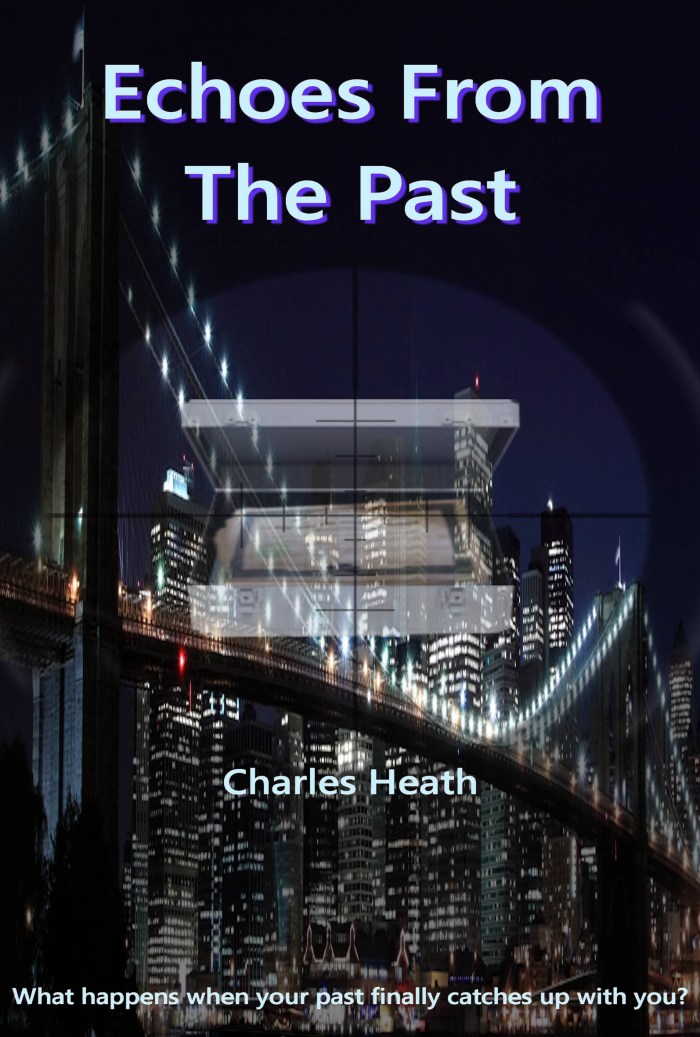
for “Echoes from the Past” go to

for “The Devil You Don’t” go to
Two novels are on special for $0.99 for the next two weeks.
They are
for “Echoes from the Past” go to
for “The Devil You Don’t” go to
Yes, this is an easy one.
I want to keep the car. Especially if it’s a Lamborghini and it didn’t cost $500,000.
This form of the word simply means to hang on to something, or up the proper definition, to have or retain possession of
Paring it with other words is where it gets complicated.
For instance,
Keepings off, make sure that the ball doesn’t get into someone else’s possession.
Keep it to yourself, yes, here’s your chance to become the harbinger of secrets and not tell anyone else. Not unless a lot of money is involved, or a Lamborghini.
You guessed it, the car is the running joke on this post.
How about, keep a low profile, been there tried that, it’s a lot harder than you think.
What about keeping your cards close to your chest, yes, this had both a literal and figurative meaning which makes it sort of unique.
That might follow the second definition, to continue, or cause to continue a particular state.
Another way of using keep is by delaying or stopping someone from doing something or getting somewhere; ie, I was kept waiting at the doctor’s surgery because he was late.
There are any number of examples of using the word keep in tandem with other words
One that specifically doesn’t relate to all the former examples, is simply the word keep.
What is it?
Usually the strongest part of the castle, and the last to fall in an attack.
At least, that was the theory.
A picture paints … well, as many words as you like. For instance:
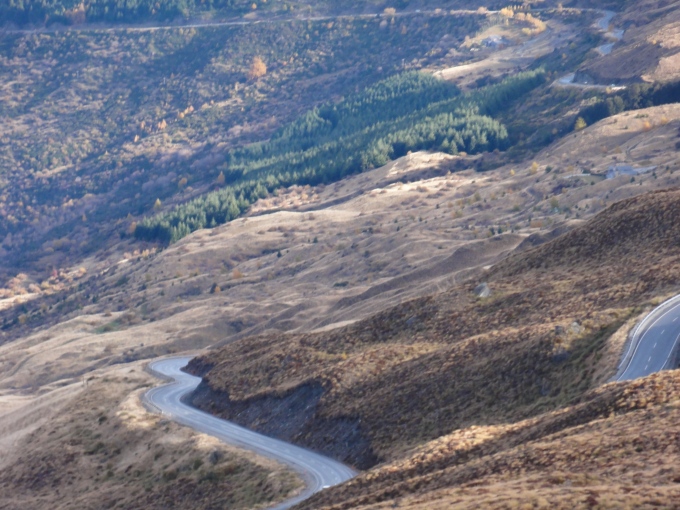
And the story:
It was once said that a desperate man has everything to lose.
The man I was chasing was desperate, but I, on the other hand, was more desperate to catch him.
He’d left a trail of dead people from one end of the island to the other.
The team had put in a lot of effort to locate him, and now his capture was imminent. We were following the car he was in, from a discrete distance, and, at the appropriate time, we would catch up, pull him over, and make the arrest.
There was nowhere for him to go.
The road led to a dead-end, and the only way off the mountain was back down the road were now on. Which was why I was somewhat surprised when we discovered where he was.
Where was he going?
“Damn,” I heard Alan mutter. He was driving, being careful not to get too close, but not far enough away to lose sight of him.
“What?”
“I think he’s made us.”
“How?”
“Dumb bad luck, I’m guessing. Or he expected we’d follow him up the mountain. He’s just sped up.”
“How far away?”
“A half-mile. We should see him higher up when we turn the next corner.”
It took an eternity to get there, and when we did, Alan was right, only he was further on than we thought.”
“Step on it. Let’s catch him up before he gets to the top.”
Easy to say, not so easy to do. The road was treacherous, and in places just gravel, and there were no guard rails to stop a three thousand footfall down the mountainside.
Good thing then I had the foresight to have three agents on the hill for just such a scenario.
Ten minutes later, we were in sight of the car, still moving quickly, but we were going slightly faster. We’d catch up just short of the summit car park.
Or so we thought.
Coming quickly around another corner we almost slammed into the car we’d been chasing.
“What the hell…” Aland muttered.
I was out of the car, and over to see if he was in it, but I knew that it was only a slender possibility. The car was empty, and no indication where he went.
Certainly not up the road. It was relatively straightforward for the next mile, at which we would have reached the summit. Up the mountainside from here, or down.
I looked up. Nothing.
Alan yelled out, “He’s not going down, not that I can see, but if he did, there’s hardly a foothold and that’s a long fall.”
Then where did he go?
Then a man looking very much like our quarry came out from behind a rock embedded just a short distance up the hill.
“Sorry,” he said quite calmly. “Had to go if you know what I mean.”
I’d lost him.
It was as simple as that.
I had been led a merry chase up the hill, and all the time he was getting away in a different direction.
I’d fallen for the oldest trick in the book, letting my desperation blind me to the disguise that anyone else would see through in an instant.
It was a lonely sight, looking down that road, knowing that I had to go all that way down again, only this time, without having to throw caution to the wind.
“Maybe next time,” Alan said.
“We’ll get him. It’s just a matter of time.”
© Charles Heath 2019
Find this and other stories in “Inspiration, maybe” available soon.

Which is how I feel sometimes.
It can be a paradox in that an ordinary man may strive to be recognised, that is, to rise above his inherent anonymity simply because he feels he has something more to offer mankind than just making up the numbers.
But sadly, that desire will often be met with staunch resistance, not because there’s an active campaign against him, it’s just the way of the world.
The fact is, most of us will always be anonymous to the rest of the world, but in being so in that respect it’s that anonymity we can live with. However, it’s far more significant if we become anonymous to those around us. And, sadly, it can happen.
It’s when we take someone for granted.
At the other end of the scale, there is the celebrity, who has finally found fame, discovers that fame is not all it’s cracked up to be. You find that meteoric rise from obscurity an adrenaline rush, and you’re no longer anonymous.
But all that changes when you are constantly bailed up in the street by well-meaning but annoying fans when you are being chased by the paparazzi and magazine reporters who thrive not on the fact that you are famous but watching and waiting for you to stumble.
Some often forget that there’s always a camera on them, or there’s a reporter lurking in the shadows, looking for the next scoop, capturing that awkward inexplicable moment when the celebrity is seen with someone who’s not their spouse, or worse, if it could be that, they get drunk and make a fool of themselves.
Do I really want to lose that anonymity that I have?
Not really. It seems to me like it might be the lesser of two evils.
Here’s the thing…
Every time I close my eyes, I see something different.
I’d like to think the cinema of my dreams is playing a double feature but it’s a bit like a comedy cartoon night on Fox.
But these dreams are nothing to laugh about.
Once again there’s a new installment of an old feature, and we’re back on the treasure hunt.
It was an understatement to say I was dreading going to Boggs’ place.
In fact, in the hour it took to get through the morning chores I had time to consider how and why I was in this position. Boggs was a friend. We were friends at school and as best we could we had each other’s back when the bullies came out to play.
At times that didn’t amount to much because as everyone knows, bullies hunt in packs. Six against two wasn’t much of an equation. And it those days, the teachers spent more time hiding from the students than being in front of them.
It was simply a case of what doesn’t kill you makes you stronger.
It didn’t feel like that, not for a very long time.
But, in the end, misfortune can make strange bedfellows, and in a town that depended on a single industry, it soon became apparent that there were more people against the Benderby’s and the Cossatino’s than for, and in small-town politics, that was more than an evening up. Out of school and separated from their acolytes, both Alex and Vince found that whatever influence they had once, was now gone, and all that was left was a grunt, and we were basically left alone.
Boggs was the dreamer.
He had idolized his father and when he went missing it broke him.
This map thing was the first signs of Boggs finally coming back to life, but the problem was, it was all pinned on false hopes. The Sherriff was right. Boggs was in over his head, playing with the two most vicious families from around here, and it was bad enough that his father had fallen foul of them, the Sherriff was not about to see his son go the same way. I was going to try and talk Boggs out of it.
Yet, on the other hand, it was people like us who needed a win, just to show there was still hope in this place. With threats every day that the factory might have to close, there were dark clouds hanging over everyone’s head.
If the factory closed, there was going to be a very large hole in the local economy and a lot of people in financial trouble. I’m not sure how finding the treasure might solve all of that, but I suspect Boggs’ had something up his sleeve.
I knocked on the door and his mother answered. She looked harried. She was a nurse and looked as though she just got home from the night shift at the hospital.
“Boggs is in his room.”
“How are you this morning?”
“Tired. And an afternoon shift, which I might not get to if I don’t get some sleep. You know where he is. Try not to make any noise.”
“Will do.”
I came in and closed the door, watching her dash off down the passage to the other end of the house.
She could not work endless double shifts for much longer, but like all of us, it was not out of desire but necessity. She had implored Boggs to get a job and help, but he seemed oblivious to the problem. I’d tried to speak to him, but he had that insufferable way of just not listening.
Boggs was in his room, sitting on the bed and staring at the ceiling.
I looed up too, but there was nothing there.
“Don’t tell me,” I said, “but you’ve suddenly discovered you’ve got X-Ray vision.”
“If only. I could use it right now to find something that’s missing>”
“Your cell phone?” Boggs was always misplacing something, of forgetting it. I’d lost count how many times he’d misplaced his phone.
“No. An underground river.”
OK. That was out of left field. I had no idea any rivers were missing, or, in fact, they could actually go missing.
Apparently, they could.
“There’s two,” he said. 300 years ago five or take this part of the coastline had several rivers that ran down from the mountain range. What we now call the hills on the edge of the coastal plain. There was also a lake, not very large, but it used to have several streams flow into it all year round and had an aqua flow that came out along the coastline.”
“And you figured all of this out from what? A copy of the treasure map.”
The moment he started quoting rivers, streams, and lakes, I remembered each of those geographical features appeared on several of the map versions. I had suggested, rather comically, that it would be funny if the treasure was buried in the lake.
It wasn’t all that funny. It was also possible.
“Imagine this. Drop anchor out to sea, in other words on the other side of the natural sandbar that formed at the seaward side of the river, get in the longboats and row inshore to the lake, across the lake, up another river to the base of the hills. Then do a little exploring, north or south, and find a cave. I reckon the treasure was buried in a cave. We know there are caves up there, not many, but I think there used to be more.”
“Someone already did a survey with some rather fancy electronic equipment with the same idea in mind. He found three, not very long, and certainly without treasure. Two had substantial falls inside, which is why they were buried.”
“There’s more.”
He jumped up off the bed and went over to the robe and opened the door. Tacked on the back was a copy of an ordnance survey map of this part of the coastline, and a tracing of the treasure map, to the same scale on top.
“As you can see, I think ‘I’ve found the correlation between the real, and what was real 300 years ago.”
Except there’s no rivers and no lake. And no sand bar as I recall. There was a small marina in what might have been where the river met the sea, but that’s gone. They filled it in and build a shopping mall on it. A huge, now half empty, shopping mall. A modern wonder 40 years ago that was supposed to bring business and shoppers to the town. For a few years it did, until another town 50 miles away got the same idea, sold the land for half the price, and made the rents a quarter of what they were here.
They called it progress.
We called it piracy.
“Then we can hardly row our boat inshore and up the stream, if it’s not there.”
I hated to state the obvious.
“But,” he said, looking like the cat who’d swallowed the canary. “What if it is still there, but we just can’t see it?”
© Charles Heath 2020

This is Chester. He’s unimpressed with the fact it’s father’s day.
Why?
Because, it seems, we have never given him the opportunity to become a father.
It’s an interesting point, but one that requires an explanation. In fact, the serious expression, bordering on smoke coming out of his ears, demands one.
Firstly, if I let you out the chances are you will become roadkill. We’ve had this argument before, a number of times, and that it is not safe outside the confines of this house.
And if I promise not to stray…
I laugh. A cat cannot promise anything, because, well, you’re a cat. That’s what cats do, stray, wander, play chicken with cars, fight with other male cats for practically no reason at all, and worse, chase after any female cat that’s on heat.
I’m not like those other cats, he says. Also, he seems amused by that expression, on heat.
It’s hard to explain, but you’ll hear it before you see it, I say.
And then there’s that look of recognition. We’ve had a few female cats wandering the streets lately that have caused him to become very restless, and make strange guttural sounds.
So, he says, I’m not likely to become a father?
Maybe, I say, if he behaves himself, eats what is put in front of him, and use the litter properly instead of a general target, and stop using plastic bags as an alternate litter.
Yes, finally, a guilty look crosses his face.
I think I just found some leverage.
John Pennington’s life is in the doldrums. Looking for new opportunities, prevaricating about getting married, the only joy on the horizon was an upcoming visit to his grandmother in Sorrento, Italy.
Suddenly he is left at the check-in counter with a message on his phone telling him the marriage is off, and the relationship is over.
If only he hadn’t promised a friend he would do a favour for him in Rome.
At the first stop, Geneva, he has a chance encounter with Zoe, an intriguing woman who captures his imagination from the moment she boards the Savoire, and his life ventures into uncharted territory in more ways than one.
That ‘favour’ for his friend suddenly becomes a life-changing event, and when Zoe, the woman who he knows is too good to be true, reappears, danger and death follows.
Shot at, lied to, seduced, and drawn into a world where nothing is what it seems, John is dragged into an adrenaline-charged undertaking, where he may have been wiser to stay with the ‘devil you know’ rather than opt for the ‘devil you don’t’.
That’s what it feels like some days.
The story is there waiting to be written, I know where it’s coming from, I know where I want it to go, but the words are not working.
I read it once, yuk, I read it twice, it’s begging me to press the delete button. Now!
This is how it looks:
My life was going nowhere. If I took a step back and took a good, long, hard look at it, what could I say was the one defining moment?
There was no defining moment.
I’d bounced around schools till the day I decided I was not cut out to learn anything more, or perhaps the teachers had given up trying to impart knowledge. Whatever the reason, I dropped out of college, and drifted. Seasonal laborer, farm hand, factory worker, night watchman.
At least now I had a uniform and looked like I’d made something of myself.
Until I went home.
My parents were distinctly disappointed I was not married with children.
My overachieving brother always said I was a loser, and would never make anything of myself.
My ultra successful sister, married into a very wealthy family, had the regulation 2.4 children and lived in the lap of luxury, mostly pretended I didn’t exist, didn’t invite me to the wedding, and I had yet to meet the husband and children. I guess she was ashamed of me.
This year I was avoiding going home.
This year I volunteered to work the holidays.
Yep, time to walk away and do something entirely different, like wrapping Christmas presents, my second favorite job to mowing the lawn. Maybe if I contrive an accident with the lawnmower …
Back in front of the page, some hours later, an idea pops into my head. The story continues:
It was 3 a.m. and it was like standing on the exact epicenter of the South Pole. I’d just stepped from the warehouse into the car park.
The car was covered in snow. The weather was clear now, but more snow was coming.
A white Christmas? That’s all I needed. I hoped I remembered to put the antifreeze in my radiator this time.
As I approached my car, the light went on in an SUV parked next to my car. The door opened and what looked to be a woman was getting out of the car.
“Graham?”
It was a voice I was familiar with, though I hadn’t heard it for a long time.
My ultra successful sister, Penelope. She was leaning against her car door, and from what I could see, she didn’t look too well.
“What do you want?”
“Help.”
My help, I was the last person to help her or anyone for that matter. But curiosity got the better of me. “Why?”
“Because my husband is trying to kill me.”
With that said, she slid down the side of the car, and I could see, in the arc lamps lighting the car park, a trail of blood.
It desperately needs work, and I’ll walk away now and find something else to do.
Anything on paper is better than nothing on paper. Tomorrow, or the next day, I will edit and rewrite and see what happens.
Stay tuned.
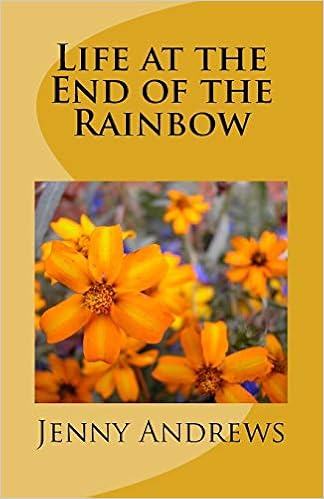
Life at the end of the Rainbow, by Jenny Andrews
Poetry is like art, its beauty is in the eye of the beholder.
But, while art can be very subjective, poetry often has a special meaning, to both the writer and then the reader. In turn, for each of us readers, a poem will have a different meaning, some will see what it represents, and others may not.
And, whilst I have not read a lot of poetry over the years, that changed recently when I subscribed to several blogs and discovered this whole new class of literature.
This view was strengthened when I came across a volume of poems by Jenny Andrews, titled Life at the End of the Rainbow.
For me, each poem is an insight into an extraordinary life, where the author sometimes lays bare those raw emotions, which, at times, we will find ourselves drawing parallels.
In a sense, I think we have all been to this mythical place called, The End of the Rainbow, and sometimes need a gentle reminder that it took a lot of ups and downs to get there.
This is, to my mind, a remarkable piece of work.
I, for one, can’t wait to see what the next stage of the journey will be.
A sleigh ride wasn’t the first activity that came to mind, but that first day we saw the sleighs lining up and thought it might be a bit of a lark.
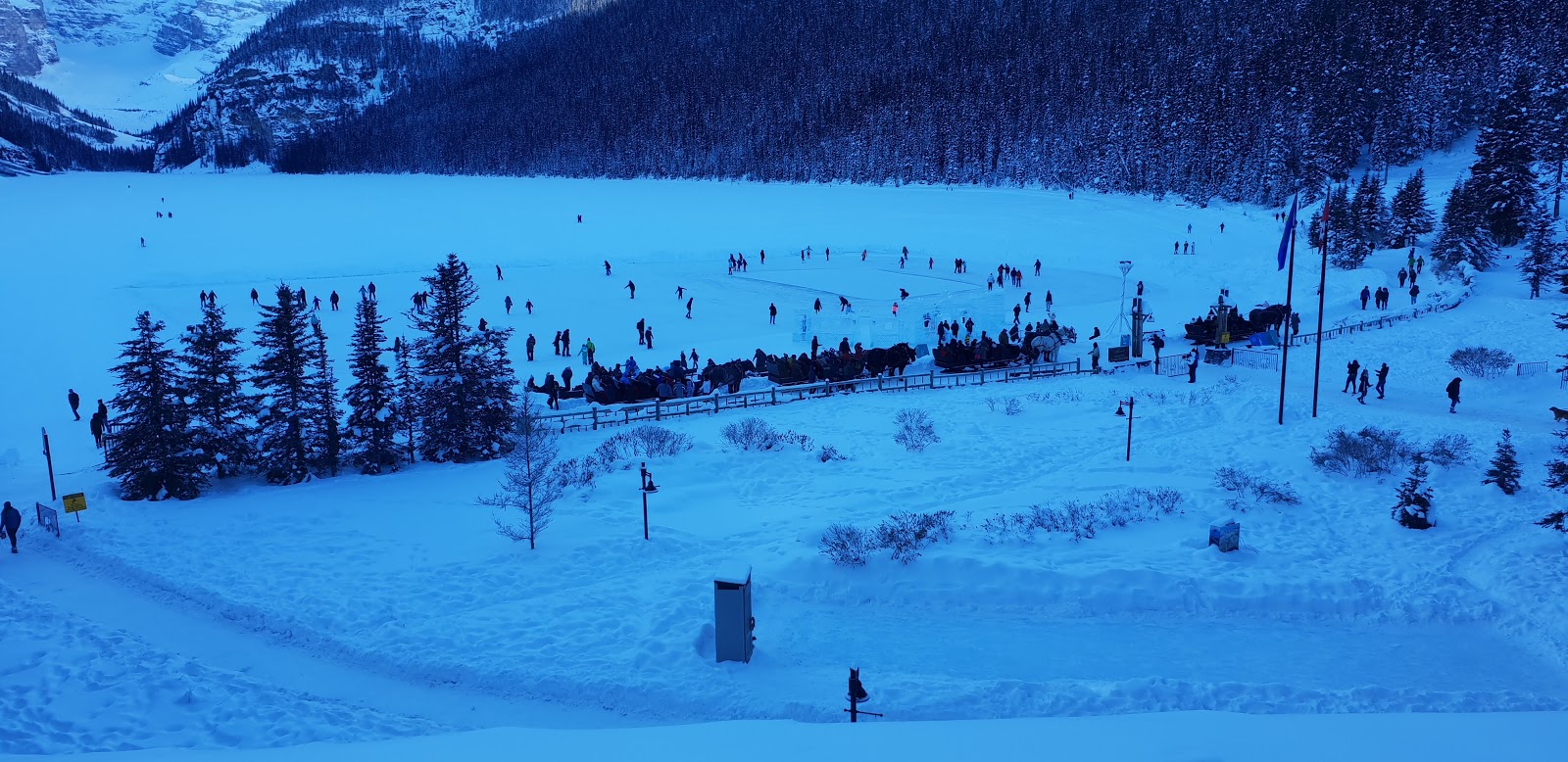

It was New Year’s Eve and we booked a 2pm sleigh ride. I figured any later we’d probably freeze to death. The ride was for about 45 minutes, out around the edge of the lake and back.
Rides were on the hour and sometimes run at night.
We arrived at the departure point about 15 minutes before the ride and watched those who had been on the ride before come back looking somewhat frozen. The only covering you had provided was a red blanket.
Wisely we put on many layers of clothing, hats, and gloves.
We managed to get a seat for ourselves where the maximum per seat was three. The blanket wasn’t the thickest.
It was cold, and according to my phone, about minus 15 degrees Fahrenheit. You could feel it, and it was lucky we were not moving fast.
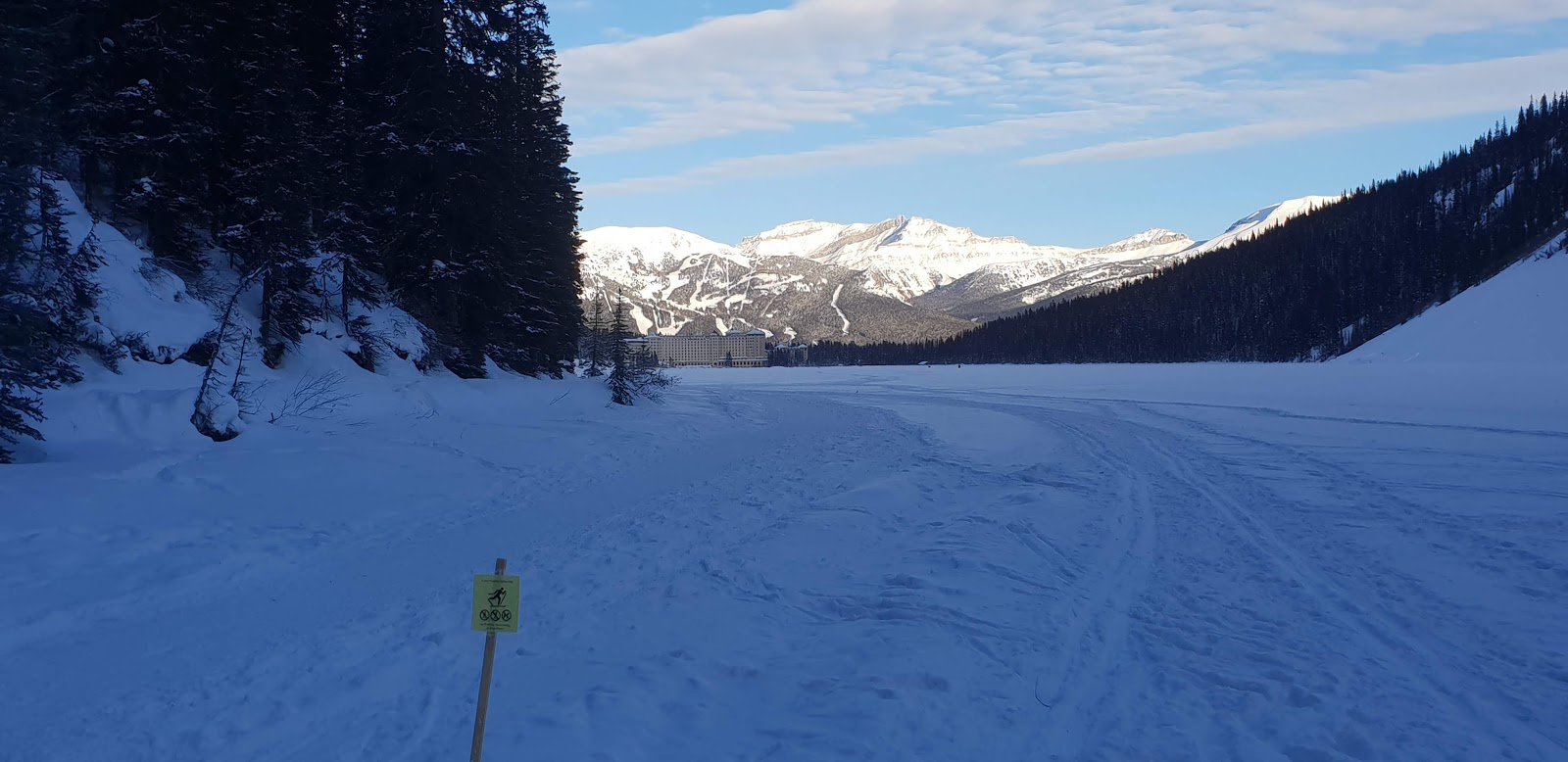
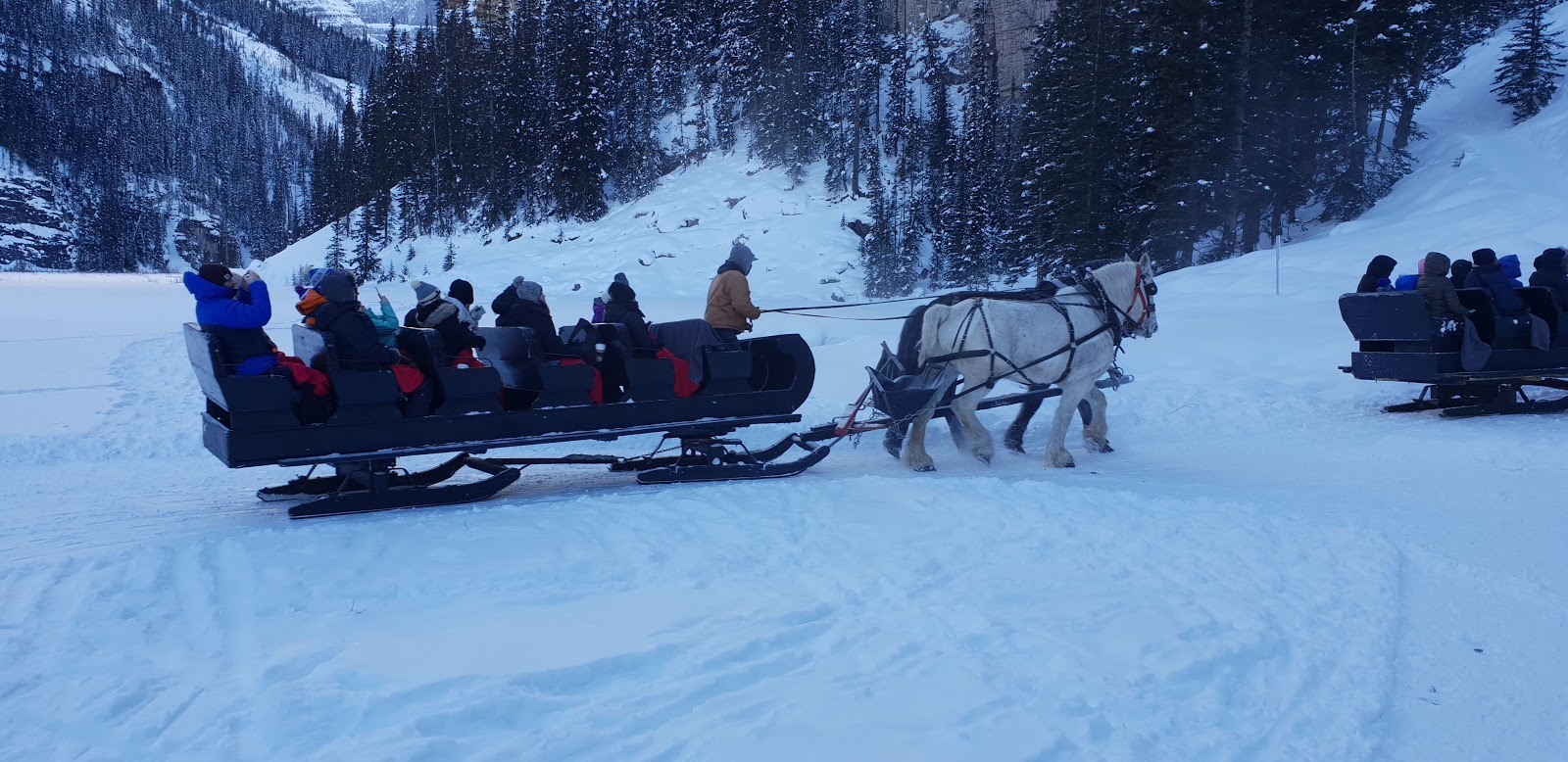
At the halfway point, we went out onto the lake to turn around. It gave us a chance to take a photo of the sleigh, and the horses pulling it. I felt sorry for the horses out in the cold.
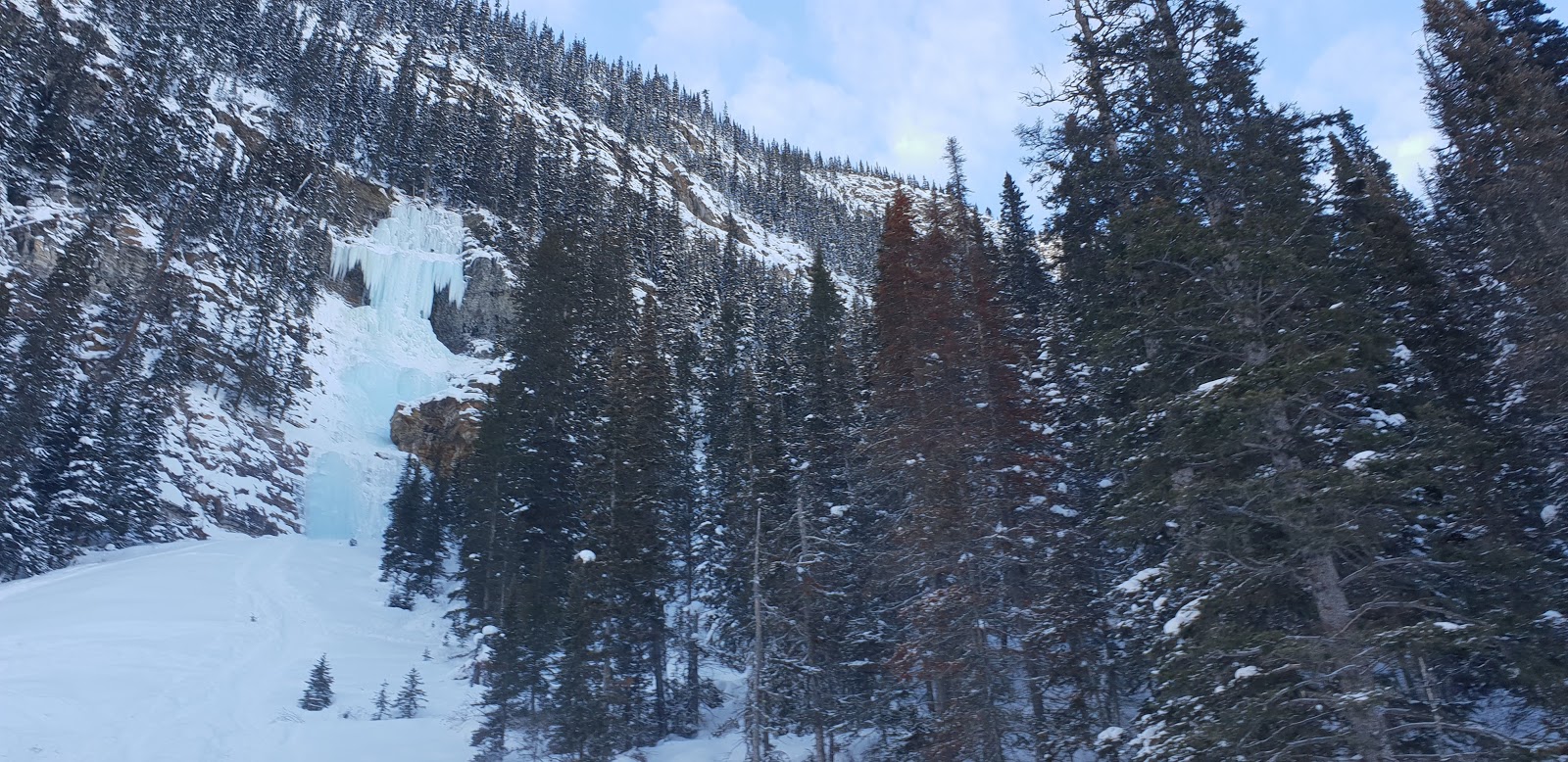
As we turned around, we got to see a frozen waterfall.
 Thrills, Spills, and just a dash of Romance