First Dig Two Graves

A sequel to “The Devil You Don’t”

Revenge is a dish best served cold – or preferably so when everything goes right

Of course, it rarely does, as Alistair, Zoe’s handler, discovers to his peril. Enter a wildcard, John, and whatever Alistair’s plan for dealing with Zoe was dies with him.

It leaves Zoe in completely unfamiliar territory.

John’s idyllic romance with a woman who is utterly out of his comfort zone is on borrowed time. She is still trying to reconcile her ambivalence, after being so indifferent for so long.

They agree to take a break, during which she disappears. John, thinking she has left without saying goodbye, refuses to accept the inevitable, calls on an old friend for help in finding her.

After the mayhem and being briefly reunited, she recognises an inevitable truth: there is a price to pay for taking out Alistair; she must leave and find them first, and he would be wise to keep a low profile.

But keeping a low profile just isn’t possible, and enlisting another friend, a private detective and his sister, a deft computer hacker, they track her to the border between Austria and Hungary.

What John doesn’t realise is that another enemy is tracking him to find her too. It could have been a grand tour of Europe. Instead, it becomes a race against time before enemies old and new converge for what will be an inevitable showdown.

Writing a book in 365 days – 231

Day 231

Write the first page of a story based on a strong memory of a trip you once took.

Nancy also had a ticket, but had complicated her situation with Corrigan, so it would be interesting to see if she could extricate herself without appearing to follow me to the ferry terminal.

But it was not a deal breaker if she couldn’t get away.

As I came out the front entrance, a short way down the road, I saw a flurry of flashing lights and a bevy of policemen, and among them was the man without glasses, gesturing and protesting his innocence.  One of the two Chinese that had been in the lobby watching him was there, on the side, observing.

Good.  Keith, the man without glasses or the Chinese, would be following me.  That didn’t rule out someone else I hadn’t seen, so I still needed to be careful.

At least I hadn’t tried to conceal where I was going, letting the concierge know and telling him that if anyone was looking for me, that’s where I’d be for the next few hours.

I figured it would be the first place anyone would go to, after the front desk, whom I’d also told, if they, whoever they were, wanted me.

The taxi driver drove past the group, and I could see a man without glasses was fighting a losing battle.  The only good thing about it, he was providing a very noticeable distraction for me.

When I arrived at the terminal, it was pandemonium.

Organised perhaps, but barely.  Buses were arriving every few minutes, dropping off another 50 or so tourists, adding to the throng of about a thousand, all either lining up or waiting on groups for the guide to tell them where to go.

The disembarkation area was about a mile long with terminal buildings for what must be quite a few boats going out that night.

I went into the first building I could see and found an office, and with the few Chinese words I glad, found myself directed to another office further along.

There, my ticket was taken, a stub ripped off by what seemed to be a harassed officer, then pointed to the door that exited onto the wharf. I was told the picture of the boat was the one I was looking for.

Found.

It was behind the office, so I went up the gangway and onto the boat.

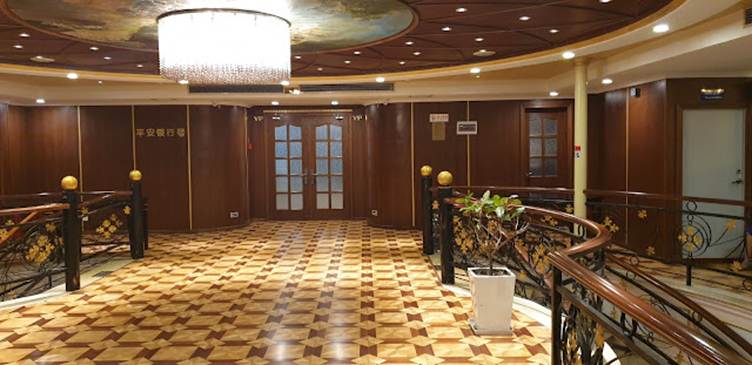
For a cruise vessel, it was, if anything, over the top.  Marble staircase, marble floors and the decor of a palace rather than a cruise vessel.

I went up the staircase to the middle level, just reaching the floor as a crowd of tourists streamed up behind me, some almost running.  Perhaps there were vantage points on each of the decks that I didn’t know about, but it seemed they considered the top deck the place to be for the best views and those all-important photographs.

I joined the throng; it was hard not to be caught up in the surging mass, to the rear of the ship and a small section of open space, where the throng was reduced to squeezing through a narrow doorway way and I found myself being jostled briefly until I reached the railing.

Still, the crowds came, and I realised this was the main way to get to the upper deck.  I was surprised the ferry didn’t have a staff member in place to make the process more orderly.

15 minutes later, the vessel cast off, everyone had found somewhere to stand or sit, and the flow of people going up had been reduced to a trickle more coming back down than going up.

I took a quick look myself, and the top deck was filled to capacity with every vantage point taken.

Downstairs again, I crossed the deck to the VIP room and showed the crew member my ticket, after which she opened the door and ushered me in.

A lot fewer people in there, perhaps due to the price of gaining entrance.  I ordered a drink then found a seat next to the window.

By this time, we were underway, moving out into the middle of the river, heading towards the Bund.  I could see the buildings on the nearest riverbank lit up, colourful enough to keep those around me and doubtless everywhere else on the boat, taking endless photographs.

They didn’t notice, and I had almost not, the arrival of the same two policemen who had been at the hotel watching the man now without his glasses.  I did a quick scan of the room, trying not to look like I was doing a quick scan of the room, and couldn’t see him.

Nor had I seen him earlier, before and during boarding.  That didn’t mean he wasn’t on board somewhere.

The two policemen seemed satisfied he was not in the room and went back out again.  They had not given me a second look, or perhaps they were that good.  It didn’t matter; they were gone.

When I sat down, another short, rotund Chinese man was sitting in the seat beside me.  I had no idea if this was the man I was sent to meet, or if he had just sneaked in while everyone’s attention was elsewhere.

I wasn’t going to ask.

He didn’t speak.  He simply sat there, not looking sideways but just straight ahead at the buildings on the Bund, all lit in what seemed to be a continuous line of lights.

And then, all of a sudden, the building lights went out, much to the dismay of all on board, and those in the room who’d been crowding all the available window space.

Then the lights in the room went out, and for a few seconds, there was confusion.  A minute in darkness, at the most, and the lights went back on, and the man was gone.

I’d neither seen nor heard him leave.  But I did feel a slight bump, and out of curiosity, I checked my jacket pocket.

Something small.  Most likely a USB memory stick.  The files I’d been sent to pick up.

Now, all I had to do was get off the boat, back to the hotel, act normal for the next two days, and then go home, acting as if nothing had happened.

Of course, if this weren’t China, that might happen.  But it was, and when I looked over at the door leading back to the exit, I saw the two policemen I’d seen earlier in the hotel escorting what looked to be the man who’d just been briefly sitting next to me out of the room.

That couldn’t be a coincidence, could it?

©  Charles Heath  2025

Searching for Locations: Venice, Italy

Venice is definitely a city to explore.  It has an incredible number of canals and walkways, and each time we would start our exploration at St Marks square when it’s not underwater

Everyone I have spoken to about exploring Venice has told me how easy it is to get lost.  It has not happened to me, but with the infinite number of ways you can go, I guess it is possible.

We started our exploration of Venice in St Marks square, where, on one side there was the Museo di Palazzo Ducale and, next door, the Basilica di San Marco.  Early morning and/or at high tide, water can be seen bubbling up from under the square, partially flooding it.  I have seen this happen several times.  Each morning as we walked from the hotel (the time we stayed in the Savoia and Jolanda) we passed the Bridge of Sighs.

Around the other three sides of the square are archways and shops.  We have bought both confectionary and souvenirs from some of these stores, albeit relatively expensive.  Prices are cheaper in stores that are away from the square and we found some of these when we walked from St Marks square to the Railway station, through many walkways, and crossing many bridges, and passing through a number of small piazzas.

That day, after the trek, we caught the waterbus back to San Marco, and then went on the tour of the Museo di Palazzo Du which included the dungeons and the Bridge of Sighs from the inside.  It took a few hours, longer than I’d anticipated because there was so much to see.

The next day, we caught the waterbus from San Marco to the Ponte di Rialto bridge.  Just upstream from the wharf there was a very large passenger ship, and I noticed there were a number of passengers from the ship on the waterbus, one of whom spoke to us about visiting Venice.  I didn’t realize we looked like professional tourists who knew where we were going.

After a pleasant conversation, and taking in the views up and down the Grand Canal, we disembarked and headed for the bridge, looking at the shops, mostly selling upmarket and expensive gifts, and eventually crossing to the other side where there was a lot of small market type stalls selling souvenirs as well as clothes, and most importantly, it being a hot day, cold Limonata.  This was my first taste of Limonata and I was hooked.

Continuing on from there was a wide street at the end and a number of restaurants where we had lunch.  We had a map of Venice and I was going to plot a course back to the hotel, taking what would be a large circular route that would come out at the Accademia Bridge, and further on to the Terminal Fusina Venezia where there was another church to explore, the Santa Maria del Rosario.

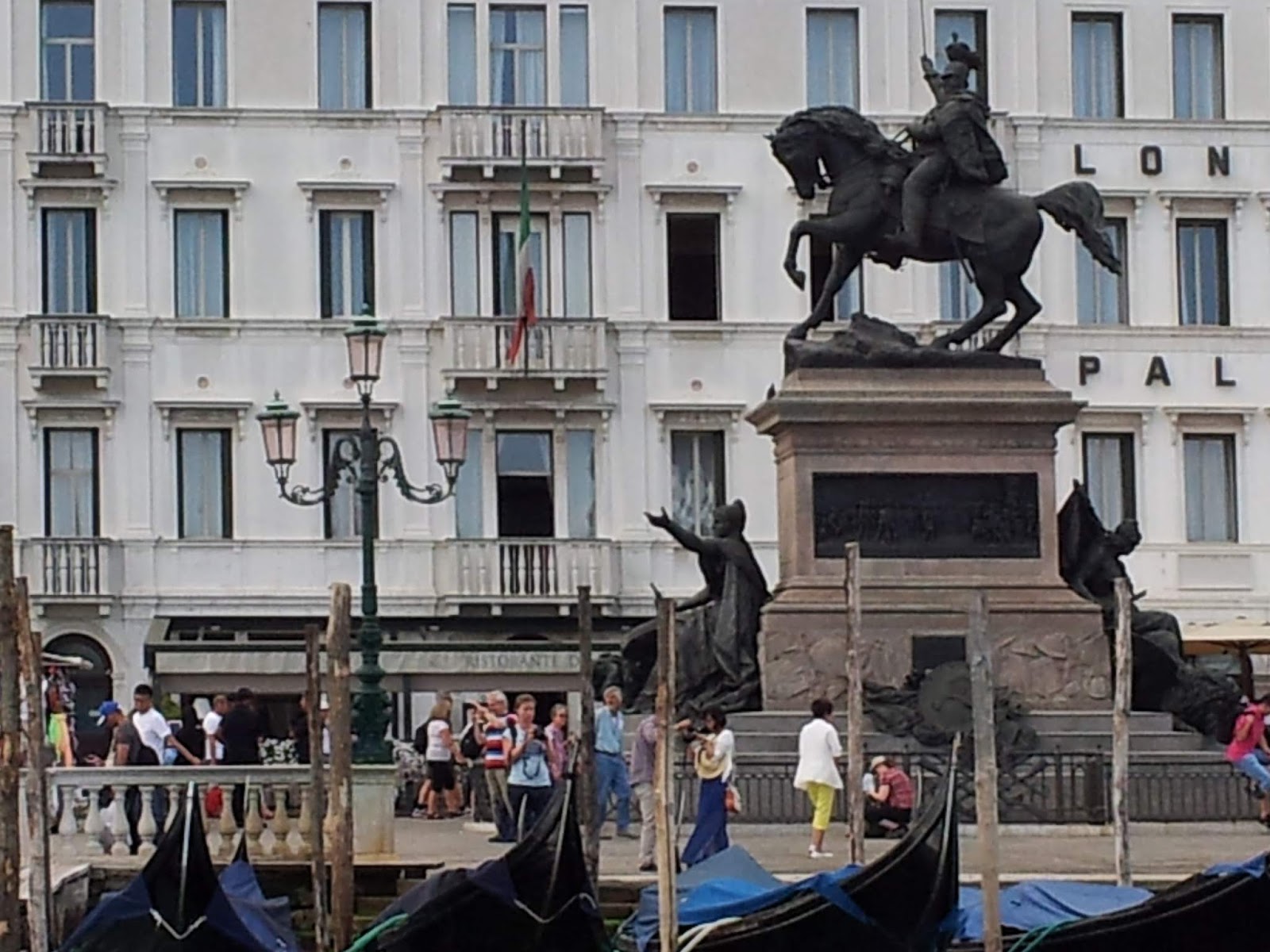
This is a photo of the Hilton Hotel from the other side of the canal.

It was useful knowledge for the second time we visited Venice because the waterbus from the Hilton hotel made its first stop, before San Marco, there.  We also discovered on that second visit a number of restaurants on the way from the terminal and church to the Accademia Bridge.

This is looking back towards San Marco from the Accademia Bridge:

And this, looking towards the docks:

Items to note:

Restaurants off the beaten track were much cheaper and the food a lot different to that in the middle of the tourist areas.

There are a lot of churches, big and small, tucked away in interesting spots where there are small piazza’s.  You can look in all of them, though some asked for a small fee.

Souvenirs, coffee, and confectionary are very expensive in St Marks square.

Another excerpt from ‘Betrayal’; a work in progress

My next destination in the quest was the hotel we believed Anne Merriweather had stayed at.

I was, in a sense, flying blind because we had no concrete evidence she had been there, and the message she had left behind didn’t quite name the hotel or where Vladimir was going to take her.

Mindful of the fact that someone might have been following me, I checked to see if the person I’d assumed had followed me to Elizabeth’s apartment was still in place, but I couldn’t see him. Next, I made a mental note of seven different candidates and committed them to memory.

Then I set off to the hotel, hailing a taxi. There was the possibility the cab driver was one of them, but perhaps I was slightly more paranoid than I should be. I’d been watching the queue, and there were two others before me.

The journey took about an hour, during which time I kept an eye out the back to see if anyone had been following us. If anyone was, I couldn’t see them.

I had the cab drop me off a block from the hotel and then spent the next hour doing a complete circuit of the block the hotel was on, checking the front and rear entrances, the cameras in place, and the siting of the driveway into the underground carpark. There was a camera over the entrance, and one we hadn’t checked for footage. I sent a text message to Fritz to look into it.

The hotel lobby was large and busy, which was exactly what you’d want if you wanted to come and go without standing out. It would be different later at night, but I could see her arriving about mid-afternoon, and anonymous among the type of clientele the hotel attracted.

I spent an hour sitting in various positions in the lobby simply observing. I had already ascertained where the elevator lobby for the rooms was, and the elevator down to the car park. Fortunately, it was not ‘guarded’ but there was a steady stream of concierge staff coming and going to the lower levels, and, just from time to time, guests.

Then, when there was a commotion at the front door, what seemed to be a collision of guests and free-wheeling bags, I saw one of the seven potential taggers sitting by the front door. Waiting for me to leave? Or were they wondering why I was spending so much time there?

Taking advantage of that confusion, I picked my moment to head for the elevators that went down to the car park, pressed the down button, and waited.

The was no car on the ground level, so I had to wait, watching, like several others, the guests untangling themselves at the entrance, and an eye on my potential surveillance, still absorbed in the confusion.

The doors to the left car opened, and a concierge stepped out, gave me a quick look, then headed back to his desk. I stepped into the car, pressed the first level down, the level I expected cars to arrive on, and waited what seemed like a long time for the doors to close.

As they did, I was expecting to see a hand poke through the gap, a latecomer. Nothing happened, and I put it down to a television moment.

There were three basement levels, and for a moment, I let my imagination run wild and considered the possibility that there were more levels. Of course, there was no indication on the control panel that there were any other floors, and I’d yet to see anything like it in reality.

With a shake of my head to return to reality, the car arrived, the doors opened, and I stepped out.

A car pulled up, and the driver stepped out, went around to the rear of his car, and pulled out a case. I half expected him to throw me the keys, but the instant glance he gave me told him was not the concierge, and instead brushed past me like I wasn’t there.

He bashed the up button several times impatiently and cursed when the doors didn’t open immediately. Not a happy man.

Another car drove past on its way down to a lower level.

I looked up and saw the CCTV camera, pointing towards the entrance, visible in the distance. A gate that lifted up was just about back in position and then made a clunk when it finally closed. The footage from the camera would not prove much, even if it had been working, because it didn’t cover the life lobby, only in the direction of the car entrance.

The doors to the other elevator car opened, and a man in a suit stepped out.

“Can I help you, sir? You seem lost.”

Security, or something else. “It seems that way. I went to the elevator lobby, got in, and it went down rather than up. I must have been in the wrong place.”

“Lost it is, then, sir.” I could hear the contempt for Americans in his tone. “If you will accompany me, please.”

He put out a hand ready to guide me back into the elevator. I was only too happy to oblige him. There had been a sign near the button panel that said the basement levels were only to be accessed by the guests.

Once inside, he turned a key and pressed the lobby button. The doors closed, and we went up. He stood, facing the door, not speaking. A few seconds later, he was ushering me out to the lobby.

“Now, sir, if you are a guest…”

“Actually, I’m looking for one. She called me and said she would be staying in this hotel and to come down and visit her. I was trying to get to the sixth floor.”

“Good. Let’s go over the the desk and see what we can do for you.”

I followed him over to the reception desk, where he signalled one of the clerks, a young woman who looked and acted very efficiently, and told her of my request, but then remained to oversee the proceeding.

“Name of guest, sir?”

“Merriweather, Anne. I’m her brother, Alexander.” I reached into my coat pocket and pulled out my passport to prove that I was who I said I was. She glanced cursorily at it.

She typed the name into the computer, and then we waited a few seconds while it considered what to output. Then, she said, “That lady is not in the hotel, sir.”

Time to put on my best-confused look. “But she said she would be staying here for the week. I made a special trip to come here to see her.”

Another puzzled look from the clerk, then, “When did she call you?”

An interesting question to ask, and it set off a warning bell in my head. I couldn’t say today, it would have to be the day she was supposedly taken.

“Last Saturday, about four in the afternoon.”

Another look at the screen, then, “It appears she checked out Sunday morning. I’m afraid you have made a trip in vain.”

Indeed, I had. “Was she staying with anyone?”

I just managed to see the warning pass from the suited man to the clerk. I thought he had shown an interest when I mentioned the name, and now I had confirmation. He knew something about her disappearance. The trouble was, he wasn’t going to volunteer any information because he was more than just hotel security.

“No.”

“Odd,” I muttered. “I thought she told me she was staying with a man named Vladimir something or other. I’m not too good at pronouncing those Russian names. Are you sure?”

She didn’t look back at the screen. “Yes.”

“OK, now one thing I do know about staying in hotels is that you are required to ask guests with foreign passports their next destination, just in case they need to be found. Did she say where she was going next?” It was a long shot, but I thought I’d ask.

“Moscow. As I understand it, she lives in Moscow. That was the only address she gave us.”

I smiled. “Thank you. I know where that is. I probably should have gone there first.”

She didn’t answer; she didn’t have to, her expression did that perfectly.

The suited man spoke again, looking at the clerk. “Thank you.” He swivelled back to me. “I’m sorry we can’t help you.”

“No. You have more than you can know.”

“What was your name again, sir, just in case you still cannot find her?”

“Alexander Merriweather. Her brother. And if she is still missing, I will be posting a very large reward. At the moment, you can best contact me via the American Embassy.”

Money is always a great motivator, and that thoughtful expression on his face suggested he gave a moment’s thought to it.

I left him with that offer and left. If anything, the people who were holding her would know she had a brother, that her brother was looking for her, and equally that brother had money.

© Charles Heath – 2018-2025

Writing a book in 365 days – 231

Day 231

Write the first page of a story based on a strong memory of a trip you once took.

Nancy also had a ticket, but had complicated her situation with Corrigan, so it would be interesting to see if she could extricate herself without appearing to follow me to the ferry terminal.

But it was not a deal breaker if she couldn’t get away.

As I came out the front entrance, a short way down the road, I saw a flurry of flashing lights and a bevy of policemen, and among them was the man without glasses, gesturing and protesting his innocence.  One of the two Chinese that had been in the lobby watching him was there, on the side, observing.

Good.  Keith, the man without glasses or the Chinese, would be following me.  That didn’t rule out someone else I hadn’t seen, so I still needed to be careful.

At least I hadn’t tried to conceal where I was going, letting the concierge know and telling him that if anyone was looking for me, that’s where I’d be for the next few hours.

I figured it would be the first place anyone would go to, after the front desk, whom I’d also told, if they, whoever they were, wanted me.

The taxi driver drove past the group, and I could see a man without glasses was fighting a losing battle.  The only good thing about it, he was providing a very noticeable distraction for me.

When I arrived at the terminal, it was pandemonium.

Organised perhaps, but barely.  Buses were arriving every few minutes, dropping off another 50 or so tourists, adding to the throng of about a thousand, all either lining up or waiting on groups for the guide to tell them where to go.

The disembarkation area was about a mile long with terminal buildings for what must be quite a few boats going out that night.

I went into the first building I could see and found an office, and with the few Chinese words I glad, found myself directed to another office further along.

There, my ticket was taken, a stub ripped off by what seemed to be a harassed officer, then pointed to the door that exited onto the wharf. I was told the picture of the boat was the one I was looking for.

Found.

It was behind the office, so I went up the gangway and onto the boat.

For a cruise vessel, it was, if anything, over the top.  Marble staircase, marble floors and the decor of a palace rather than a cruise vessel.

I went up the staircase to the middle level, just reaching the floor as a crowd of tourists streamed up behind me, some almost running.  Perhaps there were vantage points on each of the decks that I didn’t know about, but it seemed they considered the top deck the place to be for the best views and those all-important photographs.

I joined the throng; it was hard not to be caught up in the surging mass, to the rear of the ship and a small section of open space, where the throng was reduced to squeezing through a narrow doorway way and I found myself being jostled briefly until I reached the railing.

Still, the crowds came, and I realised this was the main way to get to the upper deck.  I was surprised the ferry didn’t have a staff member in place to make the process more orderly.

15 minutes later, the vessel cast off, everyone had found somewhere to stand or sit, and the flow of people going up had been reduced to a trickle more coming back down than going up.

I took a quick look myself, and the top deck was filled to capacity with every vantage point taken.

Downstairs again, I crossed the deck to the VIP room and showed the crew member my ticket, after which she opened the door and ushered me in.

A lot fewer people in there, perhaps due to the price of gaining entrance.  I ordered a drink then found a seat next to the window.

By this time, we were underway, moving out into the middle of the river, heading towards the Bund.  I could see the buildings on the nearest riverbank lit up, colourful enough to keep those around me and doubtless everywhere else on the boat, taking endless photographs.

They didn’t notice, and I had almost not, the arrival of the same two policemen who had been at the hotel watching the man now without his glasses.  I did a quick scan of the room, trying not to look like I was doing a quick scan of the room, and couldn’t see him.

Nor had I seen him earlier, before and during boarding.  That didn’t mean he wasn’t on board somewhere.

The two policemen seemed satisfied he was not in the room and went back out again.  They had not given me a second look, or perhaps they were that good.  It didn’t matter; they were gone.

When I sat down, another short, rotund Chinese man was sitting in the seat beside me.  I had no idea if this was the man I was sent to meet, or if he had just sneaked in while everyone’s attention was elsewhere.

I wasn’t going to ask.

He didn’t speak.  He simply sat there, not looking sideways but just straight ahead at the buildings on the Bund, all lit in what seemed to be a continuous line of lights.

And then, all of a sudden, the building lights went out, much to the dismay of all on board, and those in the room who’d been crowding all the available window space.

Then the lights in the room went out, and for a few seconds, there was confusion.  A minute in darkness, at the most, and the lights went back on, and the man was gone.

I’d neither seen nor heard him leave.  But I did feel a slight bump, and out of curiosity, I checked my jacket pocket.

Something small.  Most likely a USB memory stick.  The files I’d been sent to pick up.

Now, all I had to do was get off the boat, back to the hotel, act normal for the next two days, and then go home, acting as if nothing had happened.

Of course, if this weren’t China, that might happen.  But it was, and when I looked over at the door leading back to the exit, I saw the two policemen I’d seen earlier in the hotel escorting what looked to be the man who’d just been briefly sitting next to me out of the room.

That couldn’t be a coincidence, could it?

©  Charles Heath  2025

Writing a book in 365 days – 230

Day 230

Writing comedy

The Mirthful Art of Misunderstanding: Why Comedy Needs More Than Just Punchlines

What makes you laugh? Is it a clever turn of phrase? A perfectly timed pratfall? Or that specific, delicious moment when two realities collide in delightful chaos? For anyone who’s ever tried to craft a joke, a sketch, or an entire sitcom, you know that comedy is far more intricate than simply stringing together funny words. And at its heart, it requires one non-negotiable ingredient: a genuine sense of humor.

The Non-Negotiable: A Sense of Humor

It sounds obvious, doesn’t it? Writing comedy requires a sense of humor. Yet, you’d be surprised how often people try to reverse-engineer “funny” without that innate spark. You can learn comedic timing, structure, and even how to write a killer punchline, but if you don’t possess a fundamental understanding of what makes things absurd, ironic, or just plain ridiculous, your efforts will often fall flat.

A sense of humor isn’t just about telling jokes; it’s a way of seeing the world. It’s the ability to spot the unexpected juxtaposition, the human foibles, the inherent absurdity in everyday life. Without this lens, writing comedy becomes a technical exercise rather than an act of genuine creation. It’s like trying to be a chef without taste buds – you can follow the recipe, but you’ll never truly understand balance or flavor. So, if you’re venturing into comedy writing and find yourself consistently baffled by what causes laughter, that might be your first clue.

The Ingenious Engine: Creating the Misunderstanding

Once you have that internal funny bone, the next step is understanding comedy’s most powerful, enduring engine: the misunderstanding. This is the basic premise upon which so much successful comedy is built. It’s not about malice or cruelty, but about a delightful divergence of perception or information.

Think about it:

  • Mistaken Identity: Character A thinks Character B is someone else entirely.
  • Misinterpreted Intentions: Character C says something innocent, but Character D hears it in the worst possible way.
  • Conflicting Knowledge: The audience knows something the characters don’t, leading to dramatic (and comedic) irony.
  • Literal vs. Figurative: One character takes an idiom or figure of speech literally, while the other means it figuratively.

The brilliance of the misunderstanding lies in the tension it creates. We, the audience, are often in on the secret (or we quickly piece it together), and we squirm with anticipation as the characters dig themselves deeper into their respective holes. We see the train wreck coming, not with dread, but with a giddy excitement, knowing that the inevitable collision will be hilarious. The humor isn’t just in the individual lines; it’s in the gap between what is perceived and what is real.

The Satisfying Release: Clearing It Up

But the tension isn’t meant to last forever. The true comedic genius of the misunderstanding formula comes in the resolution. At the end, everything is cleared up. The mistaken identity is revealed, the intentions are clarified, the truth comes out.

Why is this so satisfying?

  • Relief: After the build-up of tension and absurdity, the release of understanding is a physical and emotional relief, often expressed through laughter.
  • The “Aha!” Moment: We see how all the threads connect, how the initial false premise led to all the hilarious subsequent events. It’s a puzzle solved, and often, the simple truth is funnier than the elaborate mistaken reality.
  • Catharsis: The characters (often) learn a lesson, or at least come to terms with the absurdity of what just transpired. And crucially, everyone is happy – not necessarily every character in the story (some might be embarrassed!), but the audience is left feeling satisfied, amused, and with a sense of completion. The world, briefly thrown into comical disarray, has been righted.

The Dance of Art and Instinct

So, for aspiring comedy writers, remember this dual approach. Cultivate that innate sense of humor – watch people, observe irony, find the funny in the everyday. But then, layer it with the powerful, proven structure of the misunderstanding. Build that tension, escalate the ridiculousness, and then, with a flourish, clear it all up, letting your audience bask in the delightful “aha!” of laughter.

Because ultimately, comedy isn’t just about telling jokes. It’s about taking us on a journey from confusion to clarity, from tension to release, and leaving us with that wonderful, unifying feeling of joy. And that, my friends, is no laughing matter. (Except, of course, when it is.)

Writing a book in 365 days – 230

Day 230

Writing comedy

The Mirthful Art of Misunderstanding: Why Comedy Needs More Than Just Punchlines

What makes you laugh? Is it a clever turn of phrase? A perfectly timed pratfall? Or that specific, delicious moment when two realities collide in delightful chaos? For anyone who’s ever tried to craft a joke, a sketch, or an entire sitcom, you know that comedy is far more intricate than simply stringing together funny words. And at its heart, it requires one non-negotiable ingredient: a genuine sense of humor.

The Non-Negotiable: A Sense of Humor

It sounds obvious, doesn’t it? Writing comedy requires a sense of humor. Yet, you’d be surprised how often people try to reverse-engineer “funny” without that innate spark. You can learn comedic timing, structure, and even how to write a killer punchline, but if you don’t possess a fundamental understanding of what makes things absurd, ironic, or just plain ridiculous, your efforts will often fall flat.

A sense of humor isn’t just about telling jokes; it’s a way of seeing the world. It’s the ability to spot the unexpected juxtaposition, the human foibles, the inherent absurdity in everyday life. Without this lens, writing comedy becomes a technical exercise rather than an act of genuine creation. It’s like trying to be a chef without taste buds – you can follow the recipe, but you’ll never truly understand balance or flavor. So, if you’re venturing into comedy writing and find yourself consistently baffled by what causes laughter, that might be your first clue.

The Ingenious Engine: Creating the Misunderstanding

Once you have that internal funny bone, the next step is understanding comedy’s most powerful, enduring engine: the misunderstanding. This is the basic premise upon which so much successful comedy is built. It’s not about malice or cruelty, but about a delightful divergence of perception or information.

Think about it:

  • Mistaken Identity: Character A thinks Character B is someone else entirely.
  • Misinterpreted Intentions: Character C says something innocent, but Character D hears it in the worst possible way.
  • Conflicting Knowledge: The audience knows something the characters don’t, leading to dramatic (and comedic) irony.
  • Literal vs. Figurative: One character takes an idiom or figure of speech literally, while the other means it figuratively.

The brilliance of the misunderstanding lies in the tension it creates. We, the audience, are often in on the secret (or we quickly piece it together), and we squirm with anticipation as the characters dig themselves deeper into their respective holes. We see the train wreck coming, not with dread, but with a giddy excitement, knowing that the inevitable collision will be hilarious. The humor isn’t just in the individual lines; it’s in the gap between what is perceived and what is real.

The Satisfying Release: Clearing It Up

But the tension isn’t meant to last forever. The true comedic genius of the misunderstanding formula comes in the resolution. At the end, everything is cleared up. The mistaken identity is revealed, the intentions are clarified, the truth comes out.

Why is this so satisfying?

  • Relief: After the build-up of tension and absurdity, the release of understanding is a physical and emotional relief, often expressed through laughter.
  • The “Aha!” Moment: We see how all the threads connect, how the initial false premise led to all the hilarious subsequent events. It’s a puzzle solved, and often, the simple truth is funnier than the elaborate mistaken reality.
  • Catharsis: The characters (often) learn a lesson, or at least come to terms with the absurdity of what just transpired. And crucially, everyone is happy – not necessarily every character in the story (some might be embarrassed!), but the audience is left feeling satisfied, amused, and with a sense of completion. The world, briefly thrown into comical disarray, has been righted.

The Dance of Art and Instinct

So, for aspiring comedy writers, remember this dual approach. Cultivate that innate sense of humor – watch people, observe irony, find the funny in the everyday. But then, layer it with the powerful, proven structure of the misunderstanding. Build that tension, escalate the ridiculousness, and then, with a flourish, clear it all up, letting your audience bask in the delightful “aha!” of laughter.

Because ultimately, comedy isn’t just about telling jokes. It’s about taking us on a journey from confusion to clarity, from tension to release, and leaving us with that wonderful, unifying feeling of joy. And that, my friends, is no laughing matter. (Except, of course, when it is.)

Writing a book in 365 days – 228/229

Days 228 and 229

Mortal danger and the story that saves you

The Scheherazade Challenge: If My Life (and Your Attention) Depended On It…

Let’s play a dangerous game, shall we?

Imagine, for a fleeting moment, that the weight of an ancient dynasty rests on your shoulders. The Sultan, broken by betrayal and consumed by cynicism, has vowed to take a new bride each night and execute her by dawn. And then, there’s you. A single, fragile life against the tide of his despair, with only one weapon: a story.

Not just any story. A story so compelling, so intricate, so profoundly human, that it can outwit the executioner, melt a frozen heart, and stretch the boundaries of time itself. Your very survival, the fate of all women in the kingdom, hinges on your ability to spin a tale that leaves the Sultan hanging on your every word, desperate for the next sunrise to reveal its continuation.

Now, take a deep breath. We’re not in a dusty, lamp-lit palace, and (thankfully) my head isn’t on a literal chopping block. But as a writer in this wild, wonderful, and wonderfully noisy digital age, there are still stakes. My “Sultan” is you, dear reader, scrolling through an endless bazaar of content. My “dawn” is the moment you might click away, drawn by the siren song of another tab. And my “life” (or at least, my creative soul and my ability to connect with you) depends on telling an amazing story.

So, if I were Scheherazade, faced with that impossible mandate, what tale would I weave?

It wouldn’t be a simple adventure, nor a flat romance. It would need layers, heart, and a message so subtle yet profound that it could soften the hardest of souls.

My Life-Saving Story: “The Loom of Whispers and the Cartographer of Hidden Threads”

My story would begin in a city unlike any other, not built of stone and mortar, but of stories themselves. Let’s call it Aethelgard, the City of Echoes. Its streets are paved with forgotten proverbs, its buildings rise from ancient legends, and the very air hums with the whispers of every life ever lived within its bounds.

Our protagonist would be Elara, not a warrior or a princess, but a reclusive Cartographer of Hidden Threads. Her unique gift (and burden) is that she can see the invisible, iridescent threads that connect every living being in Aethelgard. Each thread represents a shared experience, a glance exchanged, a kindness given, a betrayal suffered, a dream whispered in unison. Most people only see their own thread, a solitary line stretching from their heart. But Elara sees the entirety: a magnificent, terrifying, ever-shifting tapestry of countless lives interwoven.

The story would begin with a creeping malaise. Aethelgard, once vibrant, is losing its color. Its echoes are fading. People are growing isolated, suspicious, convinced their own struggles are unique and paramount. The threads, once brilliantly intertwined, are fraying, even breaking. Elara knows the city is dying because its people are forgetting how deeply they are connected.

Her quest is not to slay a monster, but to mend the tapestry. She must journey not across lands, but through the stories themselves.

Each night, I would begin one of Elara’s “thread-following” expeditions:

  • Night One: She follows a flickering, almost invisible thread from a lonely old baker who believes no one cares for him. The thread leads her back through generations, revealing how his great-grandmother, a woman he never knew, once saved a merchant’s fortune with a single, anonymous act of kindness, and how that merchant’s lineage later funded the very orphanage where the baker himself found refuge as a child. The baker’s life, he would discover, was built on an ancient, forgotten thread of generosity.
  • Night Two: Elara traces a taut, angry thread between two feuding families, their hatred centuries old. As she follows it, she uncovers the true origin: not a grand slight, but a misinterpreted joke, a stolen flower, and a series of escalating misunderstandings, each fueled by pride and a refusal to truly listen. But she also finds faint counter-threads – moments of shared joy, unspoken longing for peace, nearly-forgiven transgressions – that still hum beneath the surface.
  • Night Three: She investigates a vibrant thread of innovation and creativity, discovering it’s not the solitary genius of a famous artist, but the culmination of countless, unacknowledged inspirations: a child’s forgotten drawing, a beggar’s hummed tune, a weaver’s discarded pattern, each contributing a vital, invisible strand to the masterpiece.

Through Elara’s journey, the Sultan (and you, dear reader) would witness the profound irony of human existence: we are all singular, yet inextricably bound. Our greatest joys and deepest pains are rarely our own alone. Every act, every word, every silence sends ripples through the great tapestry.

The “cliffhanger” each night wouldn’t be a sword fight, but a dawning realization. Elara would be on the verge of revealing a crucial, heart-wrenching, or profoundly beautiful connection that implicates seemingly disparate characters, perhaps even hinting at the Sultan’s own lineage, his own perceived isolation, as being a part of this vast, interconnected web.

The story would be a mirror, reflecting the Sultan’s own life back at him – not judging, but revealing. It would show him that just as a breaking thread in the farthest corner of Aethelgard could unravel the entire city, so too did his own actions send tremors through the lives of everyone around him. It would demonstrate that true power comes not from severing connections, but from understanding and honoring them.

By the final night, the Sultan wouldn’t just be entertained; he would be transformed. He would see himself not as an isolated ruler, but as a vital, powerful weaver in the Loom of Whispers. And with that understanding, perhaps, the desire to cut threads would vanish, replaced by a profound respect for the intricate, beautiful, and utterly inescapable tapestry of life.

What about you? If your life depended on it, what story would you tell? And what hidden threads would you uncover?

“The Things we do for Love”, the story behind the story

This story has been ongoing since I was seventeen, and just to let you know, I’m 71 this year.

Yes, it’s taken a long time to get it done.

Why, you might ask.

Well, I never gave it much interest because I started writing it after a small incident when I was 17, and working as a book packer for a book distributor in Melbourne

At the end of my first year, at Christmas, the employer had a Christmas party, and that year, it was at a venue in St Kilda.

I wasn’t going to go because at that age, I was an ordinary boy who was very introverted and basically scared of his own shadow and terrified by girls.

Back then, I would cross the street to avoid them

Also, other members of the staff in the shipping department were rough and ready types who were not backwards in telling me what happened, and being naive, perhaps they knew I’d be either shocked or intrigued.

I was both adamant I wasn’t coming and then got roped in on a dare.

Damn!

So, back then, in the early 70s, people looked the other way when it came to drinking, and of course, Dutch courage always takes away the concerns, especially when normally you wouldn’t do half the stuff you wouldn’t in a million years

I made it to the end, not as drunk and stupid as I thought I might be, and St Kilda being a salacious place if you knew where to look, my new friends decided to give me a surprise.

It didn’t take long to realise these men were ‘men about town’ as they kept saying, and we went on an odyssey.  Yes, those backstreet brothels where one could, I was told, have anything they could imagine.

Let me tell you, large quantities of alcohol and imagination were a very bad mix.

So, the odyssey in ‘The things we do’ was based on that, and then the encounter with Diana. Well, let’s just say I learned a great deal about girls that night.

Firstly, not all girls are nasty and spiteful, which seemed to be the case whenever I met one. There was a way to approach, greet, talk to, and behave.

It was also true that I could have had anything I wanted, but I decided what was in my imagination could stay there.  She was amused that all I wanted was to talk, but it was my money, and I could spend it how I liked.

And like any 17-year-old naive fool, I fell in love with her and had all these foolish notions.  Months later, I went back, but she had moved on, to where no one was saying or knew.

Needless to say, I was heartbroken and had to get over that first loss, which, like any 17-year-old, was like the end of the world.

But it was the best hour I’d ever spent in my life and would remain so until I met the woman I have been married to for the last 48 years.

As Henry, he was in part based on a rebel, the son of rich parents who despised them and their wealth, and he used to regale anyone who would listen about how they had messed up his life

If only I’d come from such a background!

And yes, I was only a run away from climbing up the stairs to get on board a ship, acting as a purser.

I worked for a shipping company and they gave their junior staff members an opportunity to spend a year at sea working as a purser on a cargo ship that sailed between Melbourne, Sydney and Hobart in Australia.

One of the other junior staff members’ turn came, and I would visit him on board when he would tell me stories about life on board, the officers, the crew, and other events. These stories, which sounded incredible to someone so impressionable, were a delight to hear.

Alas, by that time, I had tired of office work and moved on to be a tradesman at the place where my father worked.

It proved to be the right move, as that is where I met my wife.  Diana had been right; love would find me when I least expected it.

Writing a book in 365 days – 228/229

Days 228 and 229

Mortal danger and the story that saves you

The Scheherazade Challenge: If My Life (and Your Attention) Depended On It…

Let’s play a dangerous game, shall we?

Imagine, for a fleeting moment, that the weight of an ancient dynasty rests on your shoulders. The Sultan, broken by betrayal and consumed by cynicism, has vowed to take a new bride each night and execute her by dawn. And then, there’s you. A single, fragile life against the tide of his despair, with only one weapon: a story.

Not just any story. A story so compelling, so intricate, so profoundly human, that it can outwit the executioner, melt a frozen heart, and stretch the boundaries of time itself. Your very survival, the fate of all women in the kingdom, hinges on your ability to spin a tale that leaves the Sultan hanging on your every word, desperate for the next sunrise to reveal its continuation.

Now, take a deep breath. We’re not in a dusty, lamp-lit palace, and (thankfully) my head isn’t on a literal chopping block. But as a writer in this wild, wonderful, and wonderfully noisy digital age, there are still stakes. My “Sultan” is you, dear reader, scrolling through an endless bazaar of content. My “dawn” is the moment you might click away, drawn by the siren song of another tab. And my “life” (or at least, my creative soul and my ability to connect with you) depends on telling an amazing story.

So, if I were Scheherazade, faced with that impossible mandate, what tale would I weave?

It wouldn’t be a simple adventure, nor a flat romance. It would need layers, heart, and a message so subtle yet profound that it could soften the hardest of souls.

My Life-Saving Story: “The Loom of Whispers and the Cartographer of Hidden Threads”

My story would begin in a city unlike any other, not built of stone and mortar, but of stories themselves. Let’s call it Aethelgard, the City of Echoes. Its streets are paved with forgotten proverbs, its buildings rise from ancient legends, and the very air hums with the whispers of every life ever lived within its bounds.

Our protagonist would be Elara, not a warrior or a princess, but a reclusive Cartographer of Hidden Threads. Her unique gift (and burden) is that she can see the invisible, iridescent threads that connect every living being in Aethelgard. Each thread represents a shared experience, a glance exchanged, a kindness given, a betrayal suffered, a dream whispered in unison. Most people only see their own thread, a solitary line stretching from their heart. But Elara sees the entirety: a magnificent, terrifying, ever-shifting tapestry of countless lives interwoven.

The story would begin with a creeping malaise. Aethelgard, once vibrant, is losing its color. Its echoes are fading. People are growing isolated, suspicious, convinced their own struggles are unique and paramount. The threads, once brilliantly intertwined, are fraying, even breaking. Elara knows the city is dying because its people are forgetting how deeply they are connected.

Her quest is not to slay a monster, but to mend the tapestry. She must journey not across lands, but through the stories themselves.

Each night, I would begin one of Elara’s “thread-following” expeditions:

  • Night One: She follows a flickering, almost invisible thread from a lonely old baker who believes no one cares for him. The thread leads her back through generations, revealing how his great-grandmother, a woman he never knew, once saved a merchant’s fortune with a single, anonymous act of kindness, and how that merchant’s lineage later funded the very orphanage where the baker himself found refuge as a child. The baker’s life, he would discover, was built on an ancient, forgotten thread of generosity.
  • Night Two: Elara traces a taut, angry thread between two feuding families, their hatred centuries old. As she follows it, she uncovers the true origin: not a grand slight, but a misinterpreted joke, a stolen flower, and a series of escalating misunderstandings, each fueled by pride and a refusal to truly listen. But she also finds faint counter-threads – moments of shared joy, unspoken longing for peace, nearly-forgiven transgressions – that still hum beneath the surface.
  • Night Three: She investigates a vibrant thread of innovation and creativity, discovering it’s not the solitary genius of a famous artist, but the culmination of countless, unacknowledged inspirations: a child’s forgotten drawing, a beggar’s hummed tune, a weaver’s discarded pattern, each contributing a vital, invisible strand to the masterpiece.

Through Elara’s journey, the Sultan (and you, dear reader) would witness the profound irony of human existence: we are all singular, yet inextricably bound. Our greatest joys and deepest pains are rarely our own alone. Every act, every word, every silence sends ripples through the great tapestry.

The “cliffhanger” each night wouldn’t be a sword fight, but a dawning realization. Elara would be on the verge of revealing a crucial, heart-wrenching, or profoundly beautiful connection that implicates seemingly disparate characters, perhaps even hinting at the Sultan’s own lineage, his own perceived isolation, as being a part of this vast, interconnected web.

The story would be a mirror, reflecting the Sultan’s own life back at him – not judging, but revealing. It would show him that just as a breaking thread in the farthest corner of Aethelgard could unravel the entire city, so too did his own actions send tremors through the lives of everyone around him. It would demonstrate that true power comes not from severing connections, but from understanding and honoring them.

By the final night, the Sultan wouldn’t just be entertained; he would be transformed. He would see himself not as an isolated ruler, but as a vital, powerful weaver in the Loom of Whispers. And with that understanding, perhaps, the desire to cut threads would vanish, replaced by a profound respect for the intricate, beautiful, and utterly inescapable tapestry of life.

What about you? If your life depended on it, what story would you tell? And what hidden threads would you uncover?