Writing a book in 365 days – My story 35

More about my story

IT’s time to put together a suitable blurb – or summary

El Qatar: Beyond the Golden Sands – A Destination with Secrets?

Sun-drenched shores, opulent hotels, and a world-class convention scene. Welcome to El Qatar, the glittering jewel of the desert, where luxury knows no bounds and every desire can be met. Or so it seems.

The Gilded Cage: An Invitation to Indulgence

Imagine stepping off the plane into the cool, air-conditioned embrace of San Madre, El Qatar’s vibrant capital and bustling port. You’re whisked away to a six-star resort, where endless amenities await. El Qatar prides itself on being a peaceful, world-class destination, perfect for international conferences, business elite, and those seeking unparalleled indulgence. From gourmet dining to exhilarating desert safaris, every experience is meticulously crafted to ensure your stay is nothing short of spectacular. Here, the phrase “satisfy any appetite” takes on a new, liberating meaning, catering to every whim with discreet efficiency and a touch of local charm. It is, by all accounts, a flawless facade of luxury and freedom, an oasis of calm in a turbulent world.

Whispers in the Desert Wind: A Glimpse Behind the Veil

Yet, beneath the polished marble and towering glass facades, El Qatar is an ancient land – arid, hot, and often dusty. Its history is as deep as the desert wadis, and its governance, while providing stability, operates with a certain… unspoken understanding. The peaceful exterior is a carefully maintained veneer, one that requires the right connections and, naturally, the right reciprocations. For those who look closely, the occasional flicker in the eyes of a local, a hushed conversation in a back alley of San Madre, or a sudden, unexplained absence might hint at a different reality, one far removed from the pristine resort brochures. This is a country where power is absolute, and dissent is a dangerous whisper.

The Looming Storm: A Paradoxical Conference

As the world prepares for a paradoxical Human Rights Conference to be hosted in El Qatar – an event that has raised more than a few eyebrows globally – there’s a palpable shift in the desert air. Whispers of discontent, once suppressed, have grown into a undeniable murmur among the citizens. Old stories of a democratic past are being retold with renewed fervor, and there’s talk of a prodigal son, the heir of a previous, more open government, poised to return and reclaim a legacy, stirring hopes and fears among the populace. The rebel factions, once relegated to the shadows, are growing bolder, sensing an opportunity to ignite a revolution that could redefine El Qatar’s future. The stage is set for an upheaval, disguised as an international gathering, with the very fabric of the nation about to be tested.


Discover the Untold Story: A Thriller Unveiled

It is into this crucible of luxury and rebellion that you are drawn. An unsuspecting visitor, or perhaps, a vital piece in a game you never knew you were playing. With the world’s eyes on El Qatar, and the very foundations of its power about to crack, alliances are fragile, loyalties are tested, and betrayal lurks in the shadows.

Into this powder keg steps our protagonist, tasked with protecting a woman whose safety could unravel everything. In San Madre, amid the gilded cages and the simmering revolution, their mission is not just about survival, but about holding the threads of a nation’s destiny. Will they simply be pawns in this desert game, or the catalysts for a new dawn? Discover the untold story of El Qatar, where the line between peace and revolution is as thin as the desert air, and every secret has a price.

Writing a book in 365 days – My story 35

More about my story

IT’s time to put together a suitable blurb – or summary

El Qatar: Beyond the Golden Sands – A Destination with Secrets?

Sun-drenched shores, opulent hotels, and a world-class convention scene. Welcome to El Qatar, the glittering jewel of the desert, where luxury knows no bounds and every desire can be met. Or so it seems.

The Gilded Cage: An Invitation to Indulgence

Imagine stepping off the plane into the cool, air-conditioned embrace of San Madre, El Qatar’s vibrant capital and bustling port. You’re whisked away to a six-star resort, where endless amenities await. El Qatar prides itself on being a peaceful, world-class destination, perfect for international conferences, business elite, and those seeking unparalleled indulgence. From gourmet dining to exhilarating desert safaris, every experience is meticulously crafted to ensure your stay is nothing short of spectacular. Here, the phrase “satisfy any appetite” takes on a new, liberating meaning, catering to every whim with discreet efficiency and a touch of local charm. It is, by all accounts, a flawless facade of luxury and freedom, an oasis of calm in a turbulent world.

Whispers in the Desert Wind: A Glimpse Behind the Veil

Yet, beneath the polished marble and towering glass facades, El Qatar is an ancient land – arid, hot, and often dusty. Its history is as deep as the desert wadis, and its governance, while providing stability, operates with a certain… unspoken understanding. The peaceful exterior is a carefully maintained veneer, one that requires the right connections and, naturally, the right reciprocations. For those who look closely, the occasional flicker in the eyes of a local, a hushed conversation in a back alley of San Madre, or a sudden, unexplained absence might hint at a different reality, one far removed from the pristine resort brochures. This is a country where power is absolute, and dissent is a dangerous whisper.

The Looming Storm: A Paradoxical Conference

As the world prepares for a paradoxical Human Rights Conference to be hosted in El Qatar – an event that has raised more than a few eyebrows globally – there’s a palpable shift in the desert air. Whispers of discontent, once suppressed, have grown into a undeniable murmur among the citizens. Old stories of a democratic past are being retold with renewed fervor, and there’s talk of a prodigal son, the heir of a previous, more open government, poised to return and reclaim a legacy, stirring hopes and fears among the populace. The rebel factions, once relegated to the shadows, are growing bolder, sensing an opportunity to ignite a revolution that could redefine El Qatar’s future. The stage is set for an upheaval, disguised as an international gathering, with the very fabric of the nation about to be tested.


Discover the Untold Story: A Thriller Unveiled

It is into this crucible of luxury and rebellion that you are drawn. An unsuspecting visitor, or perhaps, a vital piece in a game you never knew you were playing. With the world’s eyes on El Qatar, and the very foundations of its power about to crack, alliances are fragile, loyalties are tested, and betrayal lurks in the shadows.

Into this powder keg steps our protagonist, tasked with protecting a woman whose safety could unravel everything. In San Madre, amid the gilded cages and the simmering revolution, their mission is not just about survival, but about holding the threads of a nation’s destiny. Will they simply be pawns in this desert game, or the catalysts for a new dawn? Discover the untold story of El Qatar, where the line between peace and revolution is as thin as the desert air, and every secret has a price.

Writing a book in 365 days – 234

Day 234

First lines have to make an impact

The Art of the Opening Line: Impact, Promise, and the Perfect Sentence

In the sprawling landscape of literature, where countless stories vie for attention and untold universes beckon, there’s a single, vital pivot point: the first line. It’s more than just a gentle nudge; it’s a carefully constructed piece of prose, a declaration, a whisper, or a shout that sets everything in motion. And if you’re a writer, or simply a discerning reader, you know this truth deep in your bones: the first line has to make an impact.

The immediate, undeniable truth is this: a first line must make an impact. In a world saturated with content, where endless scrolls and countless tabs compete for precious moments, your opening sentence is your do-or-die moment. It isn’t merely about grabbing attention; it’s about demanding it. It might shock, mystify, intrigue, or present a profound truth that resonates instantly. Think of “It was the best of times, it was the worst of times,” or “Call me Ishmael.” These aren’t just words; they’re literary thunderclaps, perfectly thrown darts hitting the bullseye of the reader’s curiosity. They don’t just invite you in; they pull you in, often before you even realize you’ve been hooked.

But impact alone, while crucial, is only half the story. While the subsequent chapters unfurl the full tapestry of your narrative, why wait? Why not offer a tantalizing glimpse, a foundational understanding of what awaits, right from the start? A well-crafted first line or paragraph subtly hints at the genre, the tone, the central conflict, or even the protagonist’s core dilemma. It’s a non-verbal contract with your reader, a promise of the journey to come. It says, “This is what you’re in for. This is the kind of world you’re about to enter.” It might promise wonder, dread, humor, or profound introspection. Even if the full qualification of these hints comes much later, the initial setup creates an expectation, a framework that encourages the reader to lean in and commit.

Which brings us to the bedrock of all this: the art of the sentence itself. The first line isn’t just a container for ideas; it is an idea, perfectly formed. It’s about meticulous word choice, the rhythm and cadence, the conciseness that packs a punch, and the elegance that makes it linger in the mind. Every word must earn its place, every punctuation mark serve a purpose. This isn’t just about conveying information; it’s about crafting an experience. When we talk about the “art of the first line,” we are, in essence, talking about the art of the sentence – its power to evoke, to define, to resonate, and to stand as a miniature masterpiece in its own right. It elevates prose from mere communication to an experience.

So, when you sit down to craft your opening, whether you’re a seasoned novelist or a budding blogger, remember it’s not just a starting point; it’s a destination in itself. It’s the initial impact that makes a reader pause, the subtle promise that makes them stay, and the sheer artistry of the sentence that makes them marvel. Invest in your first line. Polish it, perfect it, and let it sing. For in that one perfect sentence lies the entire universe of your story, waiting to unfold.

Writing a book in 365 days – 234

Day 234

First lines have to make an impact

The Art of the Opening Line: Impact, Promise, and the Perfect Sentence

In the sprawling landscape of literature, where countless stories vie for attention and untold universes beckon, there’s a single, vital pivot point: the first line. It’s more than just a gentle nudge; it’s a carefully constructed piece of prose, a declaration, a whisper, or a shout that sets everything in motion. And if you’re a writer, or simply a discerning reader, you know this truth deep in your bones: the first line has to make an impact.

The immediate, undeniable truth is this: a first line must make an impact. In a world saturated with content, where endless scrolls and countless tabs compete for precious moments, your opening sentence is your do-or-die moment. It isn’t merely about grabbing attention; it’s about demanding it. It might shock, mystify, intrigue, or present a profound truth that resonates instantly. Think of “It was the best of times, it was the worst of times,” or “Call me Ishmael.” These aren’t just words; they’re literary thunderclaps, perfectly thrown darts hitting the bullseye of the reader’s curiosity. They don’t just invite you in; they pull you in, often before you even realize you’ve been hooked.

But impact alone, while crucial, is only half the story. While the subsequent chapters unfurl the full tapestry of your narrative, why wait? Why not offer a tantalizing glimpse, a foundational understanding of what awaits, right from the start? A well-crafted first line or paragraph subtly hints at the genre, the tone, the central conflict, or even the protagonist’s core dilemma. It’s a non-verbal contract with your reader, a promise of the journey to come. It says, “This is what you’re in for. This is the kind of world you’re about to enter.” It might promise wonder, dread, humor, or profound introspection. Even if the full qualification of these hints comes much later, the initial setup creates an expectation, a framework that encourages the reader to lean in and commit.

Which brings us to the bedrock of all this: the art of the sentence itself. The first line isn’t just a container for ideas; it is an idea, perfectly formed. It’s about meticulous word choice, the rhythm and cadence, the conciseness that packs a punch, and the elegance that makes it linger in the mind. Every word must earn its place, every punctuation mark serve a purpose. This isn’t just about conveying information; it’s about crafting an experience. When we talk about the “art of the first line,” we are, in essence, talking about the art of the sentence – its power to evoke, to define, to resonate, and to stand as a miniature masterpiece in its own right. It elevates prose from mere communication to an experience.

So, when you sit down to craft your opening, whether you’re a seasoned novelist or a budding blogger, remember it’s not just a starting point; it’s a destination in itself. It’s the initial impact that makes a reader pause, the subtle promise that makes them stay, and the sheer artistry of the sentence that makes them marvel. Invest in your first line. Polish it, perfect it, and let it sing. For in that one perfect sentence lies the entire universe of your story, waiting to unfold.

Harry Walthenson, Private Detective – the second case – A case of finding the “Flying Dutchman”

What starts as a search for a missing husband soon develops into an unbelievable story of treachery, lies, and incredible riches.

It was meant to remain buried long enough for the dust to settle on what was once an unpalatable truth, when enough time had passed, and those who had been willing to wait could reap the rewards.

The problem was, no one knew where that treasure was hidden or the location of the logbook that held the secret.

At stake, billions of dollars’ worth of stolen Nazi loot brought to the United States in an anonymous tramp steamer and hidden in a specially constructed vault under a specifically owned plot of land on the once docklands of New York.

It may have remained hidden and unknown to only a few, if it had not been for a mere obscure detail being overheard …

… by our intrepid, newly minted private detective, Harry Walthenson …

… and it would have remained buried.

Now, through a series of unrelated events, or are they, that well-kept secret is out there, and Harry will not stop until the whole truth is uncovered.

Even if it almost costs him his life.  Again.

Writing a book in 365 days – 233

Day 233

What is an acceptable age to stop writing

Pen Down? Never! Why There’s No ‘Acceptable Age’ to Stop Writing

It’s a question that might silently gnaw at writers, especially as the years accumulate: “Am I too old to be doing this? Is there an acceptable age to finally put the pen down?”

Let’s take a deep breath and shatter this myth right now.

The beautiful, liberating truth is: there isn’t one.

Unlike professional sports where physical peak defines a career, or industries that demand intense, rapid-fire innovation, writing thrives on something entirely different: life experience, wisdom, observation, and the enduring power of the human spirit. These are qualities that only deepen and enrich with time.

Why the Calendar Doesn’t Define Your Craft

The idea of an “acceptable age” to stop writing is a construct, a societal whisper that has no place in the world of storytelling. Here’s why you should ignore it:

  1. Wisdom is Your Superpower: Youth brings fresh perspectives, but age brings the nuanced understanding that only comes from living through joy, sorrow, triumph, and failure. Every single year you live adds another layer to your understanding of human nature, making your characters richer, your plots more profound, and your themes more resonant.
  2. A Richer Tapestry of Experience: Think of your life as a vast library. With every passing decade, you add new wings, new genres, new collections. This reservoir of lived experience is invaluable for a writer. You have more to draw from, more to reflect upon, and more unique insights to offer your readers.
  3. Writing as Lifelong Learning: The act of writing keeps your mind sharp, your curiosity piqued, and your creative muscles toned. It’s a fantastic form of mental exercise that can genuinely contribute to well-being as we age. Why would you want to stop something that is so beneficial?
  4. The Perspective of Time: Have you ever revisited an old memory and seen it in a completely new light? Age provides that distance and perspective, allowing you to craft narratives that explore complex emotions and historical events with greater clarity and depth. What felt overwhelming at 30 might become a powerful narrative at 70.
  5. Technology is Your Ally: Worried about typing speed or hand cramps? Dictation software, ergonomic keyboards, larger screens, and assistive technologies mean that physical limitations are no longer insurmountable barriers. Adaptation, not cessation, is the key.

Legends Who Wrote On (and On!)

History is filled with writers who found their voice late, or continued to produce masterpieces well into their golden years:

  • Laura Ingalls Wilder: Didn’t publish her first “Little House” book until she was 65!
  • Frank McCourt: Won a Pulitzer for Angela’s Ashes in 1997 when he was 66.
  • Agatha Christie: Continued to write bestsellers and intricate mysteries well into her 80s.
  • Toni Morrison: Published acclaimed novels throughout her 70s and 80s, including God Help the Child at 84.
  • Harriet Doerr: Published her first novel, Stones for Ibarra, and won a National Book Award at 74.

These are not anomalies; they are testaments to the enduring power of the written word and the human capacity for creation.

So, When Is the Acceptable Age to Stop Writing?

When the stories stop calling out to you. When your imagination runs dry. When the desire to connect, to share, to create, finally fades.

For most writers, that moment never truly arrives. The urge to tell stories is intrinsic, deeply woven into the fabric of who we are. It’s a fire that, if tended, can burn brightly for a lifetime.

Don’t let the calendar dictate your creative journey. Pick up that pen, open that laptop, and keep pouring your unique perspective onto the page. The world needs your stories, no matter how many candles are on your birthday cake.


What are your thoughts? Have you ever felt the pressure to “slow down” creatively because of your age? Share your experiences in the comments below!

Writing a book in 365 days – 233

Day 233

What is an acceptable age to stop writing

Pen Down? Never! Why There’s No ‘Acceptable Age’ to Stop Writing

It’s a question that might silently gnaw at writers, especially as the years accumulate: “Am I too old to be doing this? Is there an acceptable age to finally put the pen down?”

Let’s take a deep breath and shatter this myth right now.

The beautiful, liberating truth is: there isn’t one.

Unlike professional sports where physical peak defines a career, or industries that demand intense, rapid-fire innovation, writing thrives on something entirely different: life experience, wisdom, observation, and the enduring power of the human spirit. These are qualities that only deepen and enrich with time.

Why the Calendar Doesn’t Define Your Craft

The idea of an “acceptable age” to stop writing is a construct, a societal whisper that has no place in the world of storytelling. Here’s why you should ignore it:

  1. Wisdom is Your Superpower: Youth brings fresh perspectives, but age brings the nuanced understanding that only comes from living through joy, sorrow, triumph, and failure. Every single year you live adds another layer to your understanding of human nature, making your characters richer, your plots more profound, and your themes more resonant.
  2. A Richer Tapestry of Experience: Think of your life as a vast library. With every passing decade, you add new wings, new genres, new collections. This reservoir of lived experience is invaluable for a writer. You have more to draw from, more to reflect upon, and more unique insights to offer your readers.
  3. Writing as Lifelong Learning: The act of writing keeps your mind sharp, your curiosity piqued, and your creative muscles toned. It’s a fantastic form of mental exercise that can genuinely contribute to well-being as we age. Why would you want to stop something that is so beneficial?
  4. The Perspective of Time: Have you ever revisited an old memory and seen it in a completely new light? Age provides that distance and perspective, allowing you to craft narratives that explore complex emotions and historical events with greater clarity and depth. What felt overwhelming at 30 might become a powerful narrative at 70.
  5. Technology is Your Ally: Worried about typing speed or hand cramps? Dictation software, ergonomic keyboards, larger screens, and assistive technologies mean that physical limitations are no longer insurmountable barriers. Adaptation, not cessation, is the key.

Legends Who Wrote On (and On!)

History is filled with writers who found their voice late, or continued to produce masterpieces well into their golden years:

  • Laura Ingalls Wilder: Didn’t publish her first “Little House” book until she was 65!
  • Frank McCourt: Won a Pulitzer for Angela’s Ashes in 1997 when he was 66.
  • Agatha Christie: Continued to write bestsellers and intricate mysteries well into her 80s.
  • Toni Morrison: Published acclaimed novels throughout her 70s and 80s, including God Help the Child at 84.
  • Harriet Doerr: Published her first novel, Stones for Ibarra, and won a National Book Award at 74.

These are not anomalies; they are testaments to the enduring power of the written word and the human capacity for creation.

So, When Is the Acceptable Age to Stop Writing?

When the stories stop calling out to you. When your imagination runs dry. When the desire to connect, to share, to create, finally fades.

For most writers, that moment never truly arrives. The urge to tell stories is intrinsic, deeply woven into the fabric of who we are. It’s a fire that, if tended, can burn brightly for a lifetime.

Don’t let the calendar dictate your creative journey. Pick up that pen, open that laptop, and keep pouring your unique perspective onto the page. The world needs your stories, no matter how many candles are on your birthday cake.


What are your thoughts? Have you ever felt the pressure to “slow down” creatively because of your age? Share your experiences in the comments below!

Writing a book in 365 days – 232

Day 232

Sometimes, the best books for writers bear little similarity to their medium

The Unconventional Muse: When Your Best Writing Lesson Comes From Anywhere But a ‘How-To’ Guide

We writers are always chasing that elusive spark, that deeper understanding of human nature and narrative that elevates our work from good to truly profound. We devour books on craft, attend workshops, and pore over articles dissecting plot points and character arcs. All valuable, of course.

But what if the most potent lessons for your writing don’t come from a book with “How To Write” in the title? What if your greatest storytelling mentor isn’t a famous novelist, but a philosopher, a historian, or even a scientist?

This isn’t just a quirky idea; it’s a fundamental truth for many successful writers. Sometimes, the best books for writers bear little similarity to their medium.

Why Look Beyond the Craft?

Writers are, at heart, observers and interpreters of the human condition. We craft worlds, yes, but those worlds gain their resonance from reflecting or distorting truths about our world. To truly understand the stories we tell, we need to understand the world itself – its history, its psychology, its moral dilemmas, its scientific wonders.

This is where seemingly unrelated disciplines become invaluable. They offer different lenses through which to view conflict, motivation, and the very fabric of reality.

The Playwright, the Philosopher, and the Clash of Two Rights

Let’s take a specific example that perfectly illustrates this premise: the playwright. Should a playwright read philosophy? An emphatic yes.

Consider the profound wisdom offered by thinkers like George Wilhelm Friedrich Hegel. His work, particularly his dialectical approach to history and conflict, provides an incredible framework for understanding the deepest dramatic tensions.

For Hegel, the true tragedy – and the most compelling drama – lies not in a clear-cut battle between good and evil, but in the irreconcilable clash of two rights.

Think about that for a moment. It’s not the simple Hollywood narrative where the hero is unequivocally good and the villain is purely evil. That kind of story, while sometimes entertaining, often lacks the true grit and complexity of human experience.

Instead, Hegel pointed to the underlying issues in Greek tragedy as a case in point. Take Sophocles’ Antigone. Here, the conflict isn’t between a righteous hero and an evil tyrant. It’s between Antigone’s undeniable moral right to bury her brother, honoring the divine laws and family duty, and Creon’s equally legitimate right to uphold the laws of the state, ensuring order and preventing further rebellion.

Both characters are, in their own frameworks, right. Both are acting out of deeply held convictions and duties. And it is precisely because both are “right” that their collision is so utterly devastating, leading to a profound, unavoidable tragedy. Neither can simply concede without betraying their core identity or belief system.

A Golden Key for Every Writer

This isn’t just an academic point for philosophers; it’s a golden key for anyone crafting a narrative, whether it’s a novel, a screenplay, a short story, or even a compelling blog post.

  • Complex Characters: When your antagonists aren’t just “bad” but are operating from their own deeply held, morally defensible (to them) positions, your characters instantly gain depth. Their motivations become understandable, even if you disagree with their actions.
  • Richer Conflict: The “two rights” dilemma elevates your plot beyond simplistic good vs. evil. It forces your characters, and your readers, to grapple with true moral ambiguity, making the stakes feel far higher and more authentic. Think of a nuanced political drama, a family saga fraught with misunderstanding, or even a personal internal struggle where the protagonist is torn between two equally valid, yet conflicting, desires.
  • Deeper Themes: This approach allows you to explore profound themes about ethics, justice, loyalty, and the inherent contradictions of human existence, without needing to preach. The conflict itself becomes the exploration.

When your characters operate from their own deeply held, morally defensible positions, the story becomes infinitely more resonant because it mirrors the complexities of real life.

Broaden Your Mind, Deepen Your Stories

So, what does this mean for your reading list?

Don’t limit yourself to books on plot structure or character arcs (though those are valuable!). Dive into history, neuroscience, poetry, economics, art criticism, and yes, philosophy. Seek out texts that grapple with ethics, existence, and the nature of reality. Read the great thinkers, not necessarily to agree with them, but to understand how they thought and what they wrestled with.

You’re not just reading to learn facts; you’re reading to broaden your understanding of the human experience itself. And that, my fellow writers, is the wellspring from which truly compelling stories flow. Expand your mind, expand your world, and watch your own narratives deepen and soar.

What unconventional books or fields of study have unexpectedly impacted your writing? Share your discoveries in the comments below!

Searching for Locations: Venice, Italy

Venice is definitely a city to explore.  It has an incredible number of canals and walkways, and each time we would start our exploration at St Marks square when it’s not underwater

Everyone I have spoken to about exploring Venice has told me how easy it is to get lost.  It has not happened to me, but with the infinite number of ways you can go, I guess it is possible.

We started our exploration of Venice in St Marks square, where, on one side there was the Museo di Palazzo Ducale and, next door, the Basilica di San Marco.  Early morning and/or at high tide, water can be seen bubbling up from under the square, partially flooding it.  I have seen this happen several times.  Each morning as we walked from the hotel (the time we stayed in the Savoia and Jolanda) we passed the Bridge of Sighs.

Around the other three sides of the square are archways and shops.  We have bought both confectionary and souvenirs from some of these stores, albeit relatively expensive.  Prices are cheaper in stores that are away from the square and we found some of these when we walked from St Marks square to the Railway station, through many walkways, and crossing many bridges, and passing through a number of small piazzas.

That day, after the trek, we caught the waterbus back to San Marco, and then went on the tour of the Museo di Palazzo Du which included the dungeons and the Bridge of Sighs from the inside.  It took a few hours, longer than I’d anticipated because there was so much to see.

The next day, we caught the waterbus from San Marco to the Ponte di Rialto bridge.  Just upstream from the wharf there was a very large passenger ship, and I noticed there were a number of passengers from the ship on the waterbus, one of whom spoke to us about visiting Venice.  I didn’t realize we looked like professional tourists who knew where we were going.

After a pleasant conversation, and taking in the views up and down the Grand Canal, we disembarked and headed for the bridge, looking at the shops, mostly selling upmarket and expensive gifts, and eventually crossing to the other side where there was a lot of small market type stalls selling souvenirs as well as clothes, and most importantly, it being a hot day, cold Limonata.  This was my first taste of Limonata and I was hooked.

Continuing on from there was a wide street at the end and a number of restaurants where we had lunch.  We had a map of Venice and I was going to plot a course back to the hotel, taking what would be a large circular route that would come out at the Accademia Bridge, and further on to the Terminal Fusina Venezia where there was another church to explore, the Santa Maria del Rosario.

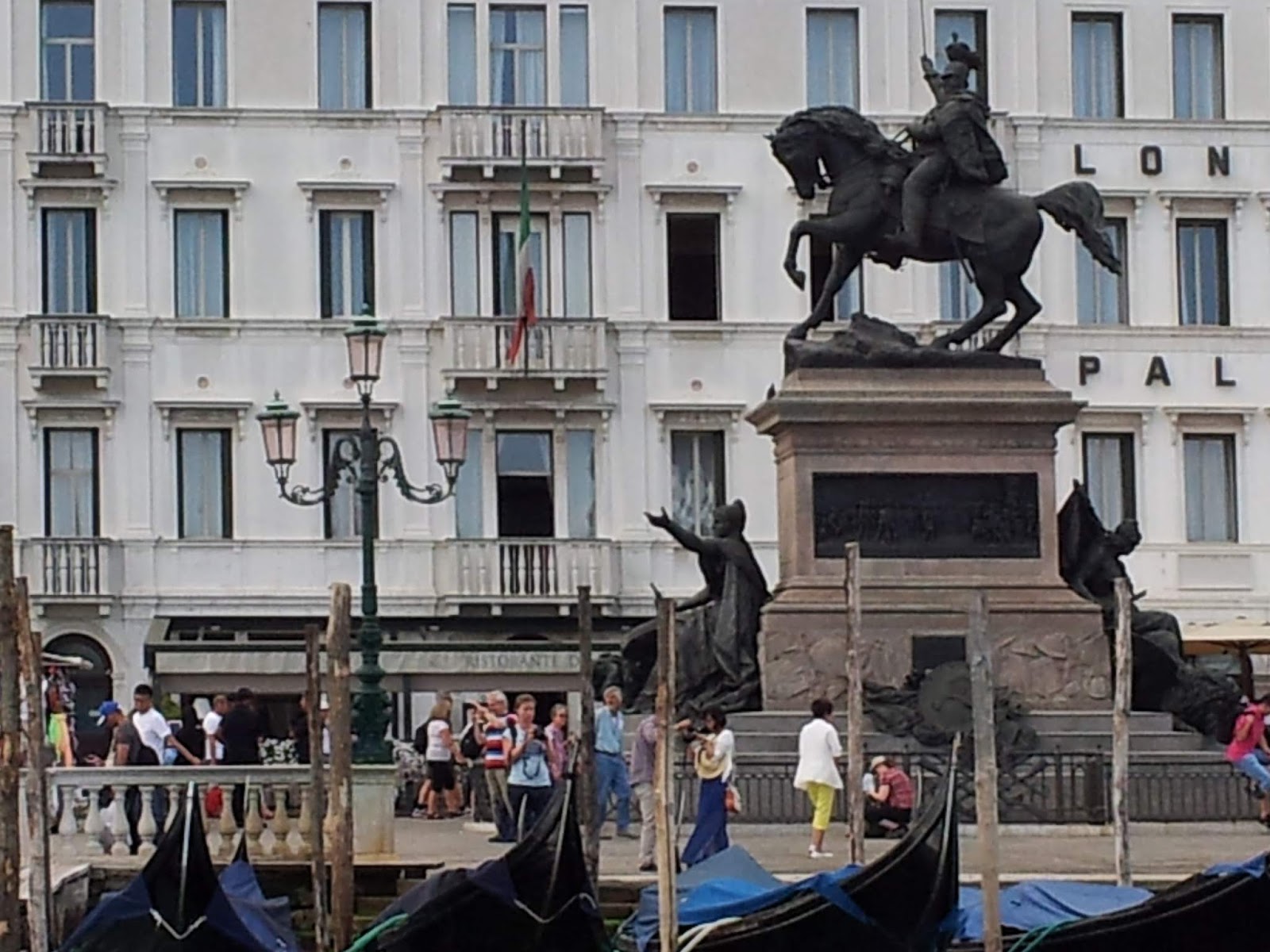
This is a photo of the Hilton Hotel from the other side of the canal.

It was useful knowledge for the second time we visited Venice because the waterbus from the Hilton hotel made its first stop, before San Marco, there.  We also discovered on that second visit a number of restaurants on the way from the terminal and church to the Accademia Bridge.

This is looking back towards San Marco from the Accademia Bridge:

And this, looking towards the docks:

Items to note:

Restaurants off the beaten track were much cheaper and the food a lot different to that in the middle of the tourist areas.

There are a lot of churches, big and small, tucked away in interesting spots where there are small piazza’s.  You can look in all of them, though some asked for a small fee.

Souvenirs, coffee, and confectionary are very expensive in St Marks square.

Writing a book in 365 days – 232

Day 232

Sometimes, the best books for writers bear little similarity to their medium

The Unconventional Muse: When Your Best Writing Lesson Comes From Anywhere But a ‘How-To’ Guide

We writers are always chasing that elusive spark, that deeper understanding of human nature and narrative that elevates our work from good to truly profound. We devour books on craft, attend workshops, and pore over articles dissecting plot points and character arcs. All valuable, of course.

But what if the most potent lessons for your writing don’t come from a book with “How To Write” in the title? What if your greatest storytelling mentor isn’t a famous novelist, but a philosopher, a historian, or even a scientist?

This isn’t just a quirky idea; it’s a fundamental truth for many successful writers. Sometimes, the best books for writers bear little similarity to their medium.

Why Look Beyond the Craft?

Writers are, at heart, observers and interpreters of the human condition. We craft worlds, yes, but those worlds gain their resonance from reflecting or distorting truths about our world. To truly understand the stories we tell, we need to understand the world itself – its history, its psychology, its moral dilemmas, its scientific wonders.

This is where seemingly unrelated disciplines become invaluable. They offer different lenses through which to view conflict, motivation, and the very fabric of reality.

The Playwright, the Philosopher, and the Clash of Two Rights

Let’s take a specific example that perfectly illustrates this premise: the playwright. Should a playwright read philosophy? An emphatic yes.

Consider the profound wisdom offered by thinkers like George Wilhelm Friedrich Hegel. His work, particularly his dialectical approach to history and conflict, provides an incredible framework for understanding the deepest dramatic tensions.

For Hegel, the true tragedy – and the most compelling drama – lies not in a clear-cut battle between good and evil, but in the irreconcilable clash of two rights.

Think about that for a moment. It’s not the simple Hollywood narrative where the hero is unequivocally good and the villain is purely evil. That kind of story, while sometimes entertaining, often lacks the true grit and complexity of human experience.

Instead, Hegel pointed to the underlying issues in Greek tragedy as a case in point. Take Sophocles’ Antigone. Here, the conflict isn’t between a righteous hero and an evil tyrant. It’s between Antigone’s undeniable moral right to bury her brother, honoring the divine laws and family duty, and Creon’s equally legitimate right to uphold the laws of the state, ensuring order and preventing further rebellion.

Both characters are, in their own frameworks, right. Both are acting out of deeply held convictions and duties. And it is precisely because both are “right” that their collision is so utterly devastating, leading to a profound, unavoidable tragedy. Neither can simply concede without betraying their core identity or belief system.

A Golden Key for Every Writer

This isn’t just an academic point for philosophers; it’s a golden key for anyone crafting a narrative, whether it’s a novel, a screenplay, a short story, or even a compelling blog post.

  • Complex Characters: When your antagonists aren’t just “bad” but are operating from their own deeply held, morally defensible (to them) positions, your characters instantly gain depth. Their motivations become understandable, even if you disagree with their actions.
  • Richer Conflict: The “two rights” dilemma elevates your plot beyond simplistic good vs. evil. It forces your characters, and your readers, to grapple with true moral ambiguity, making the stakes feel far higher and more authentic. Think of a nuanced political drama, a family saga fraught with misunderstanding, or even a personal internal struggle where the protagonist is torn between two equally valid, yet conflicting, desires.
  • Deeper Themes: This approach allows you to explore profound themes about ethics, justice, loyalty, and the inherent contradictions of human existence, without needing to preach. The conflict itself becomes the exploration.

When your characters operate from their own deeply held, morally defensible positions, the story becomes infinitely more resonant because it mirrors the complexities of real life.

Broaden Your Mind, Deepen Your Stories

So, what does this mean for your reading list?

Don’t limit yourself to books on plot structure or character arcs (though those are valuable!). Dive into history, neuroscience, poetry, economics, art criticism, and yes, philosophy. Seek out texts that grapple with ethics, existence, and the nature of reality. Read the great thinkers, not necessarily to agree with them, but to understand how they thought and what they wrestled with.

You’re not just reading to learn facts; you’re reading to broaden your understanding of the human experience itself. And that, my fellow writers, is the wellspring from which truly compelling stories flow. Expand your mind, expand your world, and watch your own narratives deepen and soar.

What unconventional books or fields of study have unexpectedly impacted your writing? Share your discoveries in the comments below!