Searching for locations – Gold Coast, Queensland, Australia – 4

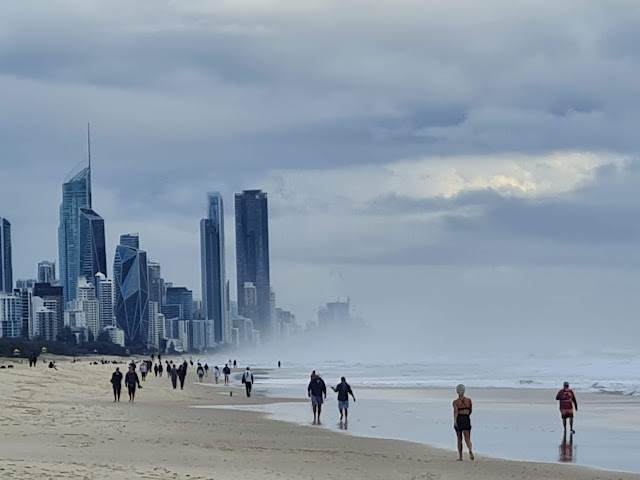
Today’s theme for the arduous early morning walk is – spot the house that doesn’t have people out on the veranda having coffee and taking in the breathtaking scenery.

The cloud formations in the early morning are simply amazing and are literally worth getting out of bed just to see the early morning riding sun come up behind them.

As usual, at 7 am, the walkways and the beach had a large number of people, half of whom have dogs, and yes, even today, it’s hard to tell who’s walking whom. But it is the start of the working week, and there are fewer people around than the weekend.

It’s cool but refreshing, and I’m doing my best impression of Walter Brennan in Rio Bravo, my limp more accentuated after yesterday’s foray along the sandy beach.

He has an excuse. He got injured being a stuntman in the early years of Hollywood. I have no excuse and should be doing more of this exercise. Especially the trudging through loose sand. It’s like walking in a vat of treacle.

Mores the pity I don’t live by the ocean and have a dog that needs exercise.

Not that I’d I wanted to I could afford it. Just the tiny piece of land is worth a small fortune, but to put a three – or four-story house with a viewing veranda would be very expensive. This is one being built and there would be no change out of two or three million to buy it:

But it would make a statement and I would have no end of friends and acquaintances who would want to come around and join me.

Candles and French Champagne on the veranda, it has such a ring to it.

Sorry, I’m dreaming again.

It is back to the affordable suburbs with the one-floor house with no patio, overlooking the side fence, a weed-infested lawn, and a few succulents in pots.

And no exercise. There are too many hills to climb.

Perhaps I should try to get away more often.

But before we go home, the last stop is lunch at one of the surf life-saving clubs where patronising their establishment helps to fund the rescue of people in trouble in the ocean.

We opt for lunch in the dining room where there is an extensive selection of items. We have buffalo chicken wings, duck spring rolls, and pork belly as appetisers. Mains are more chicken wings, a vegetarian burger, and a Wagu beef burger.

There’s a lot to eat.

As far as I’m concerned, the service is great, the food is great, and I’d go back again. It was the perfect end to a very good lunch and the end of our sojourn.

Writing a book in 365 days – 255

Day 255

Editing mistakes

Sharpen Your Prose: Banishing Blunders Like Mixed Metaphors, Faulty Parallelism, and Tense Troubles

Ever read something that makes your brain do a little somersault? You know, where you start nodding along, then suddenly hit a snag, and have to backtrack to figure out what the writer actually meant? More often than not, these jarring moments stem from a few common writing errors.

Today, we’re going to tackle three of the most prevalent culprits: mixed metaphors, faulty parallelism, and incorrect tense. Mastering these will not only make your writing clearer and more impactful but will also elevate your credibility as a communicator. Let’s dive in!

The Tangled Web of Mixed Metaphors

Metaphors are beautiful things. They allow us to paint vivid pictures in our readers’ minds by likening one thing to another, creating deeper understanding and engagement. But when you try to weave too many disparate comparisons together, or let a metaphor stray too far from its original intent, you end up with a tangled, nonsensical mess.

The Goal: To use a single, consistent, and effective metaphor to illustrate a point.

The Blunder: Combining two or more unrelated metaphors, creating confusion and often unintentional humor.

Examples:

  • Wrong: “We need to get our ducks in a row before we can really hit the ground running and climb the ladder of success.
    • Why it’s wrong: “Ducks in a row” implies organization and order. “Hit the ground running” suggests immediate action and speed. “Climb the ladder of success” is about progress and achievement. These are all fine individual ideas, but crammed together, they create a jumbled image. Are we a team of organized ducks, a sprinter, or a mountaineer?
  • Right: “We need to get our ducks in a row before we can begin implementing our new strategy.”
    • Why it’s right: This focuses solely on the “ducks in a row” metaphor, meaning to organize things properly, and it works.
  • Right: “We need to be ready to hit the ground running when the project launches.”
    • Why it’s right: This uses the “hit the ground running” metaphor to convey the need for immediate and energetic action.
  • Right: “Her dedication and hard work were instrumental in her climb up the ladder of success.”
    • Why it’s right: This uses the “ladder of success” metaphor effectively to describe career progression.

The Uneven Scales of Faulty Parallelism

Parallelism, or parallel structure, is about balance and rhythm in your writing. It means using the same grammatical form for elements in a series or comparison. When this balance is disrupted, your sentences can feel clunky and awkward, like a song with a broken beat.

The Goal: To present items in a series or comparison with consistent grammatical structure for clarity and flow.

The Blunder: Using different grammatical forms for elements that should be treated equally.

Examples:

  • Wrong: “She enjoys hikingto read, and swimming.”
    • Why it’s wrong: “Hiking” is a gerund (verb acting as a noun). “To read” is an infinitive. “Swimming” is another gerund. The shift from gerund to infinitive and back breaks the parallel structure.
  • Right: “She enjoys hikingreading, and swimming.”
    • Why it’s right: All elements are gerunds, creating a smooth and consistent list.
  • Right: “She enjoys to hiketo read, and to swim.”
    • Why it’s right: All elements are infinitives, also creating parallel structure.
  • Wrong: “The new software offers speedefficiency, and it is easy to use.”
    • Why it’s wrong: “Speed” and “efficiency” are nouns. “It is easy to use” is a clause.
  • Right: “The new software offers speedefficiency, and ease of use.”
    • Why it’s right: All elements are nouns, providing consistent structure.

The Shifting Sands of Incorrect Tense

Verb tense is the anchor that grounds your narrative in time. It tells your reader when an action is happening. Inconsistent or incorrect tense can lead to confusion about the sequence of events or the overall timeframe of your writing.

The Goal: To consistently use the appropriate verb tense to accurately reflect the time of the actions being described.

The Blunder: Shifting verb tenses unnecessarily within a sentence, paragraph, or narrative.

Examples:

  • Wrong: “Yesterday, I go to the store and buy some milk.”
    • Why it’s wrong: The action happened “yesterday,” which is in the past. The verbs should reflect this past action.
  • Right: “Yesterday, I went to the store and bought some milk.”
    • Why it’s right: Both verbs are in the simple past tense, accurately describing past events.
  • Wrong: “The character wakes uprealizes he is late, and runs for the bus.”
    • Why it’s wrong: While this can be used for vivid storytelling (present tense for immediacy), if the rest of the narrative is in the past tense, this shift is jarring.
  • Right (if the narrative is in the past): “The character woke uprealized he was late, and ran for the bus.”
    • Why it’s right: Consistent use of the past tense for a narrative set in the past.
  • Wrong: “She will tell you the secret if you ask her nicely.”
    • Why it’s wrong: Mixing future and present tense for actions that are concurrent or related in time.
  • Right: “She will tell you the secret if you ask her nicely.” (This is actually correct as it describes a future conditional event).
    • Let’s try another wrong example: “She told me that she will visit tomorrow.”
    • Why it’s wrong: “Told” is past tense, but “will visit” refers to a future event.
  • Right: “She told me that she would visit tomorrow.” (Using “would” for reported future in the past).
    • Or Right: “She tells me that she will visit tomorrow.” (If the telling is happening now).

Practice Makes Perfect (and Polished Prose!)

Don’t be discouraged if you find yourself making these errors. Most writers do, especially when they’re developing their voice. The key is to be aware of them and to actively proofread with these concepts in mind.

  • Read aloud: Hearing your writing can help you catch awkward phrasing and inconsistencies.
  • Enlist a fresh pair of eyes: Ask a friend or colleague to review your work.
  • Use grammar checkers: While not foolproof, they can highlight potential issues.
  • Study examples: Keep an eye out for effective (and ineffective) uses of metaphors, parallelism, and tense in the writing you admire.

By paying attention to these fundamental aspects of grammar and style, you can transform your writing from merely understandable to truly compelling. So, go forth and banish those blunders! Your readers will thank you for it.

Writing a book in 365 days – 254

Day 254

Storytelling

More Than Just Words: Why We’re All Hungry for Stories

Ever found yourself completely engrossed in a book, a captivating film, or even a friend’s animated anecdote? There’s a reason for that. It’s not just our idle entertainment; it’s a primal, fundamental part of who we are. We are, quite literally, hardwired for stories.

Think about it. From the earliest cave paintings depicting hunts and rituals to the grand epics passed down through generations, humanity has always relied on narrative. It’s how we make sense of the world, how we connect with each other, and how we leave our mark.

The Ancient Art of Immortality

At its core, storytelling is a form of history. It’s how we preserve the experiences, the triumphs, and the struggles of those who came before us. Before written records, oral traditions were the lifeblood of cultures, passing down knowledge, wisdom, and identity. The stories of elders became the lessons for the young, the myths explained the inexplicable, and the legends inspired courage.

But it’s more than just a historical record. Storytelling is also a profound act of immortality. When we share a story, we breathe life back into memories. We keep alive the spirit of individuals, the essence of moments, and the impact of events. A well-told story can transcend time, allowing us to feel present with people who are no longer with us, to understand perspectives different from our own, and to learn from their journeys. It’s through stories that our ancestors, our heroes, and even our ordinary lives can continue to resonate in the present and echo into the future.

Feeding the Soul

Beyond its historical and immortalizing qualities, storytelling simply feeds our souls. In a world often characterized by fleeting information and digital overload, a good story offers depth, connection, and emotional resonance.

  • Connection: Stories allow us to step into someone else’s shoes, fostering empathy and understanding. They remind us that despite our differences, we share universal human experiences – love, loss, fear, hope.
  • Meaning-Making: We use stories to process our own lives and the complexities of the world around us. They help us identify patterns, understand causes and effects, and find meaning in the chaos.
  • Inspiration: Stories of resilience, innovation, and courage can ignite our own imaginations and empower us to pursue our dreams. They show us what’s possible.
  • Escape and Joy: Sometimes, we just need to get lost in a different world. Stories offer a welcome escape, a chance to experience adventure, romance, or mystery, and to simply find joy in a well-crafted narrative.

The Power is in Your Hands (and Voice!)

So, the next time you’re drawn to a narrative, remember you’re tapping into something ancient and essential. And even more importantly, remember that you, too, are a storyteller. Your experiences, your memories, your unique perspective – they all have the power to inspire, to connect, and to offer a piece of yourself to the world.

Don’t underestimate the stories you hold. Share them. Write them down. Tell them to your children, your friends, your colleagues. Because in a world hungry for connection and meaning, every story is a gift, a tiny act of immortality, and a vital thread in the rich tapestry of human experience.

What I learned about writing: The murky art of plotting! (1)

Truth is stranger than fiction

Google Maps: More Than Just Directions – A Portal to Phantom Mysteries?

We all use Google Maps. It’s our trusty co-pilot, guiding us through unfamiliar streets, helping us find the nearest coffee shop, and even letting us snoop on our old childhood homes (admit it, you’ve done it!). But what if I told you that sometimes, beneath the familiar satellite imagery, Google Maps offers a glimpse into something far stranger than your aunt’s meticulously manicured lawn?

Lately, chatter has been building around peculiar anomalies popping up on the platform – digital specters appearing where they absolutely shouldn’t. Imagine panning over a dense, untouched forest, far from any airport, only to find a colossal Airbus A320 or Boeing 737 perfectly intact, sitting in a clearing. No missing plane reports, no emergency landings, just a commercial jetliner chilling amongst the trees. How did it get there? And more importantly, why?

This isn’t an isolated incident. There are numerous reports of cars, sometimes multiple vehicles, resting eerily at the bottom of lakes, visible from above. While many of these are indeed phantom images, some chillingly prove to be real. You might recall the story of the car discovered in a lake in Florida, which, upon investigation, contained the remains of a man who had been missing for over two decades. The digital anomaly led to a very real, very tragic discovery.

So, before we reach for our tinfoil hats, there’s a rational explanation for most of these ghostly appearances. The phenomenon is often an instance of image overlay or “ghosting.” Google Maps stitches together countless satellite and aerial photographs taken at different times. When an object, like a low-flying aircraft, is captured in one image over a particular spot, and a later, object-free image of the same spot is layered on top, a faint “ghost” of the original object can remain visible. The plane in the forest? It’s highly probable it was just flying incredibly low when the initial photograph was taken, leaving its digital imprint on the landscape.

Mystery solved, right? Well, mostly.

But what if, just what if, these digital echoes aren’t always mere glitches? What if, sometimes, they are whispers of something more, waiting to be heard?


Mick knew all about those lonely leisure hours when there was nothing else to do. He wasn’t one for idly scrolling social media; Mick was a tramper, a genuine trailblazer. His idea of relaxation was poring over topographical maps, looking for untouched corners of the world, sketching out potential new paths through forests, and dreaming of odd discoveries. Years ago, one such expedition had led him to uncover a lost village of significant archaeological value. He had a knack for finding things.

One drizzly afternoon, with the rain drumming against his window, Mick found himself drifting through Google Maps, exploring remote stretches of a national forest known for its dense, ancient foliage. He zoomed in, panned around, his cursor tracing imaginary trails. He wasn’t looking for glitches, but for inspiration, for the subtle hints of untamed beauty.

Then he saw it.

Not a ghost, not a blur, but what seemed to be distinct wreckage dispersed in a clearing. Glimpses of what looked like metal fragments, incongruous against the deep green canopy. It wasn’t the clean, whole plane of famous internet anomalies, but a scattering, undeniably man-made and out of place. He noted the date of the photograph – nearly a year prior.

A chill ran down his spine. He immediately checked local news archives, aviation reports, anything about missing small planes or crashes in the area. Nothing. Not a single mention. It was too remote for a simple crash to go unnoticed, yet too significant to be naturally occurring.

He kept the location saved, revisiting it over the next few days. It gnawed at him. Was it a trick of the light? A bizarre anomaly of the photo processing? He called a friend, an equally seasoned bushwalker, and explained his digital discovery, asking him to verify it on his own map.

“Right, mate, I’m looking,” came his friend’s voice over the phone a few minutes later. “Where exactly did you say?”

Mick guided him, pixel by pixel. “See it? Right there, by that cluster of three oaks…”

There was a pause. “Uh, Mick? There’s just… trees.”

Mick’s stomach dropped. He clicked back to his own map. The wreckage was gone. The clearing was pristine, just an unbroken expanse of forest. He felt a wave of self-doubt. Had his mind been playing tricks, wanting to find something remarkable, perhaps fabricating the whole thing?

But then he noticed it. The date of the photograph displayed on his screen had updated. It was no longer the nearly-a-year-old image. It was a new one, taken just a few weeks ago.

The digital ghost had vanished, but the seed of a real-world mystery had been planted. With the rain still falling and nothing better to do, Mick knew exactly what his next walking holiday would entail. He wasn’t just going to look at maps anymore. He was going to see what was really there.


Searching for locations – Gold Coast, Queensland, Australia – 3

Quite often on holidays, we train ourselves to get up early because when you’re away in a different place, you don’t want to waste the day.

I’d like to think that since we can’t do a lot of the usual touristy activities we can sleep in and take a more leisurely approach to the day.

Not this morning.

Not yesterday, either, but for different reasons.

Today, it was the shooting pains down my leg from the bad back. Perhaps that walk to the coffee shop aggravated it, but since when did exercise harm you?

Anyway, finally giving up the notion of sleeping, I bounded out of bed, sorry slowly climbed out of bed with care, at 6:40 a.m. Unless you’re going on a tour that is the greatest thing since sliced bread, who, on holidays, gets out of bed at that hour.

Me, apparently.

Just four minutes after sunrise, which I missed.

I managed to get yesterday’s and was hoping to go one better and catch the sun coming over the horizon. Maybe tomorrow.

So, what do you do in such a hideous hour of the morning?

With the beach just 50 meters away, it was beckoning me to take a walk. When I looked, there were probably a half dozen people with their dogs taking a walk. And another three or four out for a power walk.

For me, it was going to be a leisurely stroll after picking my way across the loose sand to where it was a lot more solid.

The tide was on the way in, so every now and then, the water came up the beach near where most people walked.

By the time I started the foot traffic on the path had increased exponentially as had that on the shoreline along with the number of dogs exercising their owners, and a number of fishermen perhaps trying to land a fish for breakfast.

I had time to keep an eye on the cloud formations, and the waves came in, some a lot higher than others. That meant there were also a small number of die-hard surfers hoping to catch a big one.

You could see the rain out to sea, and with the forecast for rain later I entered of it was sitting out there waiting to arrive at the appointed time. I was just hoping it didn’t rain while I was out.

All in all, it was a pleasant hour or so up the beach and back. The hardest part, trudging over the loose sand, particularly after walking for the hour.

The fishermen had caught nothing.

The number of dogs had increased, but the power walkers had been replaced by families, visitors, and older people. I think if I lived here, I would be one more of the old people, out getting my daily exercise, and then stopping off at the coffee shop for a flat white and a cake.

And the best thing about it. It was still only half past eight in the morning and just in time for breakfast.

Pity I was the designated chef.

Writing a book in 365 days – 254

Day 254

Storytelling

More Than Just Words: Why We’re All Hungry for Stories

Ever found yourself completely engrossed in a book, a captivating film, or even a friend’s animated anecdote? There’s a reason for that. It’s not just our idle entertainment; it’s a primal, fundamental part of who we are. We are, quite literally, hardwired for stories.

Think about it. From the earliest cave paintings depicting hunts and rituals to the grand epics passed down through generations, humanity has always relied on narrative. It’s how we make sense of the world, how we connect with each other, and how we leave our mark.

The Ancient Art of Immortality

At its core, storytelling is a form of history. It’s how we preserve the experiences, the triumphs, and the struggles of those who came before us. Before written records, oral traditions were the lifeblood of cultures, passing down knowledge, wisdom, and identity. The stories of elders became the lessons for the young, the myths explained the inexplicable, and the legends inspired courage.

But it’s more than just a historical record. Storytelling is also a profound act of immortality. When we share a story, we breathe life back into memories. We keep alive the spirit of individuals, the essence of moments, and the impact of events. A well-told story can transcend time, allowing us to feel present with people who are no longer with us, to understand perspectives different from our own, and to learn from their journeys. It’s through stories that our ancestors, our heroes, and even our ordinary lives can continue to resonate in the present and echo into the future.

Feeding the Soul

Beyond its historical and immortalizing qualities, storytelling simply feeds our souls. In a world often characterized by fleeting information and digital overload, a good story offers depth, connection, and emotional resonance.

  • Connection: Stories allow us to step into someone else’s shoes, fostering empathy and understanding. They remind us that despite our differences, we share universal human experiences – love, loss, fear, hope.
  • Meaning-Making: We use stories to process our own lives and the complexities of the world around us. They help us identify patterns, understand causes and effects, and find meaning in the chaos.
  • Inspiration: Stories of resilience, innovation, and courage can ignite our own imaginations and empower us to pursue our dreams. They show us what’s possible.
  • Escape and Joy: Sometimes, we just need to get lost in a different world. Stories offer a welcome escape, a chance to experience adventure, romance, or mystery, and to simply find joy in a well-crafted narrative.

The Power is in Your Hands (and Voice!)

So, the next time you’re drawn to a narrative, remember you’re tapping into something ancient and essential. And even more importantly, remember that you, too, are a storyteller. Your experiences, your memories, your unique perspective – they all have the power to inspire, to connect, and to offer a piece of yourself to the world.

Don’t underestimate the stories you hold. Share them. Write them down. Tell them to your children, your friends, your colleagues. Because in a world hungry for connection and meaning, every story is a gift, a tiny act of immortality, and a vital thread in the rich tapestry of human experience.

“The Things we do for Love”, the story behind the story

This story has been ongoing since I was seventeen, and just to let you know, I’m 71 this year.

Yes, it’s taken a long time to get it done.

Why, you might ask.

Well, I never gave it much interest because I started writing it after a small incident when I was 17, and working as a book packer for a book distributor in Melbourne

At the end of my first year, at Christmas, the employer had a Christmas party, and that year, it was at a venue in St Kilda.

I wasn’t going to go because at that age, I was an ordinary boy who was very introverted and basically scared of his own shadow and terrified by girls.

Back then, I would cross the street to avoid them

Also, other members of the staff in the shipping department were rough and ready types who were not backwards in telling me what happened, and being naive, perhaps they knew I’d be either shocked or intrigued.

I was both adamant I wasn’t coming and then got roped in on a dare.

Damn!

So, back then, in the early 70s, people looked the other way when it came to drinking, and of course, Dutch courage always takes away the concerns, especially when normally you wouldn’t do half the stuff you wouldn’t in a million years

I made it to the end, not as drunk and stupid as I thought I might be, and St Kilda being a salacious place if you knew where to look, my new friends decided to give me a surprise.

It didn’t take long to realise these men were ‘men about town’ as they kept saying, and we went on an odyssey.  Yes, those backstreet brothels where one could, I was told, have anything they could imagine.

Let me tell you, large quantities of alcohol and imagination were a very bad mix.

So, the odyssey in ‘The things we do’ was based on that, and then the encounter with Diana. Well, let’s just say I learned a great deal about girls that night.

Firstly, not all girls are nasty and spiteful, which seemed to be the case whenever I met one. There was a way to approach, greet, talk to, and behave.

It was also true that I could have had anything I wanted, but I decided what was in my imagination could stay there.  She was amused that all I wanted was to talk, but it was my money, and I could spend it how I liked.

And like any 17-year-old naive fool, I fell in love with her and had all these foolish notions.  Months later, I went back, but she had moved on, to where no one was saying or knew.

Needless to say, I was heartbroken and had to get over that first loss, which, like any 17-year-old, was like the end of the world.

But it was the best hour I’d ever spent in my life and would remain so until I met the woman I have been married to for the last 48 years.

As Henry, he was in part based on a rebel, the son of rich parents who despised them and their wealth, and he used to regale anyone who would listen about how they had messed up his life

If only I’d come from such a background!

And yes, I was only a run away from climbing up the stairs to get on board a ship, acting as a purser.

I worked for a shipping company and they gave their junior staff members an opportunity to spend a year at sea working as a purser on a cargo ship that sailed between Melbourne, Sydney and Hobart in Australia.

One of the other junior staff members’ turn came, and I would visit him on board when he would tell me stories about life on board, the officers, the crew, and other events. These stories, which sounded incredible to someone so impressionable, were a delight to hear.

Alas, by that time, I had tired of office work and moved on to be a tradesman at the place where my father worked.

It proved to be the right move, as that is where I met my wife.  Diana had been right; love would find me when I least expected it.

Writing a book in 365 days – 253

Day 253

Using another author’s style

The Echo Chamber vs. The Trailblazer: Finding Your Authorial Voice

The blank page stares back, a vast expanse of possibility. As writers, we stand at a familiar crossroads, a debate as old as storytelling itself: should we meticulously study and emulate the voices of those who have come before us, or forge a path entirely our own? Should we lean into the comfortable and the familiar, or strive to create a new artistic vogue?

This isn’t just an abstract literary question; it’s a fundamental one that shapes our creative journey and ultimately, the impact of our words.

The Allure of the Echo: Why Copying Feels Right (Sometimes)

Let’s be honest, there’s a powerful temptation to mimic. When we encounter an author whose prose sings, whose characters leap off the page, or whose plot twists leave us breathless, it’s natural to want to bottle that magic.

  • Learning the Craft: Studying established authors is an invaluable apprenticeship. By dissecting their sentence structures, their pacing, their use of metaphor, we learn the mechanics of compelling storytelling. It’s like a musician learning scales before composing symphonies.
  • Finding Your Feet: Especially when starting out, adopting a style that resonates can provide a scaffolding. It offers a sense of direction and a model to follow, reducing the paralyzing fear of the unknown.
  • Connecting with an Audience: Sometimes, a familiar style taps into a pre-existing reader base. If you write in a genre with established conventions, a comfortable and predictable style can be a draw for those seeking that specific experience.

However, a life spent solely in the echo chamber risks becoming a pale imitation. The danger lies in mistaking appreciation for appropriation, and in becoming so enamored with another’s voice that we silence our own.

The Audacity of the Original: Charting Your Own Course

Conversely, the call to create something new, to be the trailblazer, is equally potent. It’s the spirit of innovation, of pushing boundaries, of leaving an indelible mark that is uniquely yours.

  • Authenticity and Connection: A truly original voice resonates deeply because it’s born from genuine experience, observation, and perspective. Readers connect with authenticity; they feel a genuine spark when they encounter something that feels fresh and true to the author.
  • Innovation and Evolution: Literature, like any art form, needs to evolve. New voices bring new ideas, new ways of seeing the world, and new techniques that can invigorate the literary landscape. Think of the authors who fundamentally changed how we tell stories – they weren’t afraid to deviate from the norm.
  • Finding Your Unique Power: Your life experiences, your quirks, your individual way of processing the world – these are the raw materials of your unique voice. To suppress them in favor of someone else’s is to dim your own light.

The Sweet Spot: Where Familiarity Meets the New

So, where does this leave us? Is it an either/or proposition? Not necessarily. The most compelling authors often strike a delicate balance.

  • Influence, Not Imitation: We are all influenced by what we read. The key is to absorb those influences, to understand why they work, and then to filter them through your own unique lens. Your voice is not built in a vacuum; it’s a tapestry woven with the threads of your experiences and the inspiration you’ve drawn from others.
  • Mastering the Familiar to Subvert It: Sometimes, the most groundbreaking work arises from a deep understanding of existing conventions. By mastering the familiar, you gain the power to play with it, to bend it, and ultimately, to subvert it in exciting and unexpected ways.
  • Seeking Your “Why”: Before you choose your path, ask yourself: Why am I writing this? What is the core message or feeling I want to convey? Your “why” will often guide you towards the most authentic and impactful voice, whether it’s a whisper of the familiar or a roar of the new.

The Verdict: Cultivate Your Own Garden

Ultimately, the pursuit of a unique authorial voice is not about rejecting all external influence. It’s about engaging with those influences critically, learning from them, and then, crucially, integrating them into your own distinct expression.

Don’t be afraid to experiment. Don’t be afraid to stumble. Don’t be afraid to sound a little like yourself, even if that self is still under construction. The world of literature is rich because of its diversity. It needs your echoes, yes, but more importantly, it thirsts for your original song. So, embrace the challenge, cultivate your own garden of words, and let your unique voice bloom.

Searching for locations – Gold Coast, Queensland, Australia – 3

Quite often on holidays, we train ourselves to get up early because when you’re away in a different place, you don’t want to waste the day.

I’d like to think that since we can’t do a lot of the usual touristy activities we can sleep in and take a more leisurely approach to the day.

Not this morning.

Not yesterday, either, but for different reasons.

Today, it was the shooting pains down my leg from the bad back. Perhaps that walk to the coffee shop aggravated it, but since when did exercise harm you?

Anyway, finally giving up the notion of sleeping, I bounded out of bed, sorry slowly climbed out of bed with care, at 6:40 a.m. Unless you’re going on a tour that is the greatest thing since sliced bread, who, on holidays, gets out of bed at that hour.

Me, apparently.

Just four minutes after sunrise, which I missed.

I managed to get yesterday’s and was hoping to go one better and catch the sun coming over the horizon. Maybe tomorrow.

So, what do you do in such a hideous hour of the morning?

With the beach just 50 meters away, it was beckoning me to take a walk. When I looked, there were probably a half dozen people with their dogs taking a walk. And another three or four out for a power walk.

For me, it was going to be a leisurely stroll after picking my way across the loose sand to where it was a lot more solid.

The tide was on the way in, so every now and then, the water came up the beach near where most people walked.

By the time I started the foot traffic on the path had increased exponentially as had that on the shoreline along with the number of dogs exercising their owners, and a number of fishermen perhaps trying to land a fish for breakfast.

I had time to keep an eye on the cloud formations, and the waves came in, some a lot higher than others. That meant there were also a small number of die-hard surfers hoping to catch a big one.

You could see the rain out to sea, and with the forecast for rain later I entered of it was sitting out there waiting to arrive at the appointed time. I was just hoping it didn’t rain while I was out.

All in all, it was a pleasant hour or so up the beach and back. The hardest part, trudging over the loose sand, particularly after walking for the hour.

The fishermen had caught nothing.

The number of dogs had increased, but the power walkers had been replaced by families, visitors, and older people. I think if I lived here, I would be one more of the old people, out getting my daily exercise, and then stopping off at the coffee shop for a flat white and a cake.

And the best thing about it. It was still only half past eight in the morning and just in time for breakfast.

Pity I was the designated chef.

Searching for locations – Gold Coast, Queensland, Australia – 2

No, there was no fish and chips on the menu today.

In fact, we did not venture far from the apartment. The only foray outside was to find a cafe and get a decent cup of coffee and breakfast if they had a reasonable breakfast menu.

We found a quaint cafe, which appeared to be an old house converted, with tables inside and out. That aged factor gave the place atmosphere, and it seemed a lot of people agreed; there were few tables free, and it was very busy.

Like most places these days, they have QR codes on the table that allow you to get the menu us on your phone, opening up a wide selection of fare.

Since we were there for breakfast and I like bacon and eggs, I ordered a bacon and egg burger (naturally) and a flat white coffee (my usual).

The coffee was perfect, but the bacon and egg burger? Well, it would have been great if they’d dialled down the tomato relish. I’m still trying to work out why gourmet burgers have to be ruined by lashings of very sharp relish.

Needless to say, tomorrow I will be getting it without the relish. It was fine other than that.

The walk was our morning exercise, and it bothers me that as we are getting older and our mobility issues worsening, the distance was almost a challenge. For people who find going to the supermarket difficult, it’s the idea of going out that makes us think twice about going away.

Because isn’t going away all about discovering new places and visiting the sights, all of which requires, you guessed it, walking.

This walk was slow but pleasant in the morning sun. In Queensland, this is the best time of the year where the temperatures are between 21 and 25, the skies are blue, and the days are almost idyllic. It is that period before the heat and humidity come and stay for 5 months.

That same walk in two months would be physically debilitating.

It’s for this reason we now select places to go where we don’t have to walk far or do much walking at all, just be able to sit and watch the world go by.

Or, in this case, the many different people who go out for a walk during the day, and when tired of that, watch the tide come in or go out.

It might be for some people a waste of time being in a place that certainly would merit a lot more exploring, we’ve been here and done that, and much prefer, these days, to watch the world go by.

And these apartments are just the place to do that!