Writing a book in 365 days – 276

Day 276

Making it manageable

The Epic Dream & The First Word: Conquering Your Biggest Writing Projects (One Step at a Time)

Picture this: You’ve got an incredible idea brewing – a sprawling fantasy epic, a gritty crime trilogy, a non-fiction deep dive into a complex subject that demands multiple volumes. Your imagination soars, your fingers itch… and then, a tidal wave of overwhelm crashes over you.

The sheer scale of it. The endless pages, the character arcs, the world-building, the research, the plot twists across three (or more!) books… it feels less like a project and more like a mountain range you’re expected to scale in a single bound. It’s daunting, terrifying even. The dream of “a three-book series” can quickly paralyse you before you’ve even written a single chapter of the first.

But here’s the quiet wisdom that veteran writers (and anyone who’s ever tackled a seemingly insurmountable task) learn: No one climbs Everest in a single leap. They take one step, then another, then another.

The secret isn’t to think about writing a three-book series; it’s to write this sentence. Then this paragraph. Then this scene. Then this chapter.

Eating the Elephant, One Bite at a Time

Our brains, wonderful as they are, struggle with “massive.” They crave manageable chunks. When you stare at the blank page with “Book One” echoing in your mind, your brain screams, “Impossible!” But when you tell it, “Today, we’re just outlining Chapter 3,” or “Let’s focus on nailing this one dialogue exchange,” suddenly, it feels achievable.

This isn’t just about managing the external task; it’s about managing your internal self-talk. Breaking down an overwhelming project into small, actionable pieces transforms it from an insurmountable beast into a series of achievable tasks.

  • A book series? Break it into individual books.
  • A single book? Break it into acts, then chapters.
  • A chapter? Break it into scenes.
  • A scene? Break it into beats, key actions, or dialogue exchanges.
  • A page? Break it into paragraphs.

You get the idea. Each small victory builds momentum, chipping away at that intimidating mountain until, suddenly, you’re at the summit, looking back at the path you’ve forged.

The Power of the First Step

And this is where that timeless piece of wisdom rings so profoundly true: “The secret of getting ahead is getting started.” (Attributed to Mark Twain, and eternally valid).

It’s not about the perfect first sentence, or having the entire plot mapped out in glorious detail. It’s about showing up. It’s about putting anything down. That blank page, that empty document, is the biggest hurdle. Once there’s something on it, no matter how rough, how imperfect, how far from your grand vision, you’ve begun. You’ve broken the spell of inaction.

Think of it:

  • You can’t edit a blank page.
  • You can’t refine a scene that doesn’t exist.
  • You can’t finish a series you haven’t started.

The act of starting generates its own energy. It creates a tiny gravitational pull that helps you take the next step, and the next. That first word, that first paragraph, that first outline sketch – it’s the anchor that stops you from drifting in the sea of “what ifs” and pulls you towards “what is.”

Your Action Plan for Tackling Giants:

  1. Deconstruct Your Dream: Don’t just see “Book One.” See “Book One, Part 1, Chapter 1, Scene 1, Character X enters the room.”
  2. Set Micro-Goals: Instead of “write a book,” try “Today, I’ll write 250 words” or “I’ll outline the next three scenes” or “I’ll spend 15 minutes brainstorming character names.”
  3. Embrace Imperfection: Your first draft is meant to be bad. Get it done, then make it good. Don’t let the fear of not being perfect stop you from being prolific.
  4. Celebrate Small Wins: Finished a chapter? High five yourself! Outlined a whole book? Treat yourself to a nice coffee. These small acknowledgments reinforce positive habits.

So, if you’re standing at the foot of your own literary Everest, feeling the chill of overwhelm, remember these two powerful truths: Break it down, and just start. Your masterpiece isn’t waiting for perfection; it’s waiting for your first word.

What will it be?

Writing a book in 365 days – 275

Day 275

Poetry, again

The Necessary Madness: Why Poetry Demands a Certain Unsoundness of Mind

There are few pronouncements in literature as instantly arresting and delightfully unsettling as the suggestion that to truly engage with poetry—to write it, or even to enjoy it—requires “a certain unsoundness of mind.”

This quote, often attributed to the Romantic critic and essayist William Hazlitt (though sometimes debated), doesn’t just demand our attention; it challenges the very foundation of how we define sanity, rationality, and the purpose of art.

If the quote holds any truth, it suggests that the purest forms of human expression are found not in the center of logic, but on the fringes of accepted thought.

The Tyranny of the ‘Sound’ Mind

Before we celebrate this poetic madness, we must first define what the “sound mind” represents.

The ‘sound mind’ is the mind built for survival and efficiency. It is pragmatic, literal, and relentlessly focused on the material world. It asks: How does this benefit me? Is this efficient? What is the demonstrable return on investment? A sound mind appreciates a spreadsheet more than a sonnet.

Poetry, by its nature, is profoundly unsound. It is impractical. It sacrifices plain meaning for music, clarity for color, and the material for the transcendent. In the purely economic or rational sense, poetry is useless.

The poet, therefore, must reject the tyranny of the purely rational. They must be willing to stare at a blade of grass not as an element of photosynthesis, but as a small, green miracle demanding an ode. This ability to divert focus from the practical necessities of life to the consuming fire of feeling—this is the first hint of “unsoundness.”

The Poet as the Maximalist of Feeling

When we talk about the “unsoundness” necessary for poetry, we are generally not talking about pathology, but rather maximal sensitivity.

The poet is often someone who feels the world too intensely. They do not merely observe tragedy; they absorb it. They do not just see beauty; they are momentarily blinded by it. This heightened level of empathy and emotional responsiveness is exhausting, destabilizing, and deeply incompatible with the smooth running of mundane life.

To be a poet is to stand permanently outside the insulating wall of detachment that most people build to cope with existence. You must be vulnerable to the overwhelming sensory and emotional data the world constantly provides.

In this context, poetry becomes a necessary defense mechanism. It is the obsessive, painstaking labor of translating this overwhelming internal cacophony into structured sound. The rhyme, the meter, the perfect metaphor—these elements are not arbitrary decorations; they are the cage the poet builds to house their wild, excessive feelings.

Unsoundness is the Engine of Metaphor

Perhaps the greatest sign of poetic “unsoundness” is the absolute reliance on metaphor.

The logical mind deals strictly with A = A. The poetic mind insists that A = B, even when A and B share no literal qualities. It sees a lover’s eyes and calls them stars; it sees a city and calls it a sleeping animal.

This non-linear connection—this immediate leap across the chasm of logic—is the signature mental deviation required for the art form. The poet must briefly abandon empirical reality to create a new reality, one governed by emotional resonance rather than physics.

To create the brilliant, jarring imagery that defines great verse, the poet must be willing to let their mind wander into territory that the logical world deems nonsensical. They must embrace the illogical truth.

The Reader’s Necessary Leap

The quote states that even enjoying poetry demands this mental deviation. This is perhaps the more insidious and intriguing part of the claim.

If the poet is the architect of illogical truth, the reader must be willing to temporarily relocate their own mind to that space.

To truly enjoy a poem, you cannot read it primarily for information. You must allow yourself to be led away from the concrete ground you stand upon. The appreciation of poetry requires the reader to:

  1. Suspend Literal Meaning: To understand why the moon might weep or the wind might whisper secrets, we must momentarily sideline our rational understanding of astronomy and meteorology.
  2. Embrace Emotional Logic: We must prioritize the feeling the poem evokes over the fact it describes.
  3. Accept the Unexplained: We must allow the poem to exist outside the need for easy answers, recognizing that the beauty lies in the ambiguity.

In the brief time we spend with a stanza, we are happily infected by the poet’s particular brand of “madness.” We choose to be unsound, and in that fleeting moment of voluntary irrationality, we find profound emotional clarity.

A Celebration of Necessary Deviance

The history of poetry—from the romantic excess of Lord Byron to the stark, fragmented vision of Sylvia Plath—is littered with geniuses who struggled to align their profound internal lives with the demands of the pragmatic world.

The quote, therefore, is not an insult or a diagnosis. It is a profound observation about the nature of creativity. The “unsoundness of mind” is simply the maximal awareness of the human condition—the courage to feel disproportionately and to articulate those feelings without filtering them through the gauze of acceptable, practical thought.

If sanity is defined by the refusal to look beyond the mundane, then thank heaven for the glorious, necessary unsoundness that gives us the words to describe the sublime.


What Do You Think?

Do you agree that a departure from strict logic is necessary to appreciate poetry? Who is your favorite poet whose work seems to thrive on this “unsoundness” of mind? Share your thoughts in the comments below!

Searching for locations: The Golden Mask Dynasty Show, Beijing, China

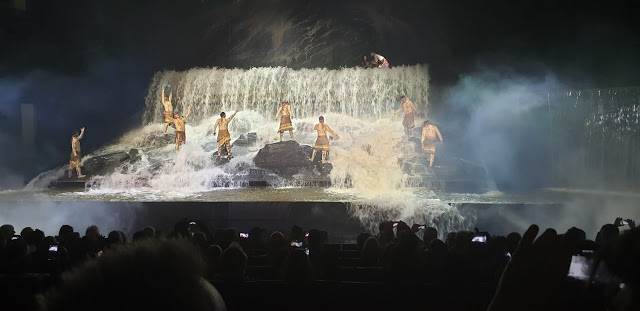
The Golden Mask Dynasty Show was located at the OCT Theatre in Beijing’s Happy Valley. 

The theatre was quite full and the seats we had were directly behind the VIP area; as our guide told us, we had the best seats in the house. 

The play has 20 different dance scenes that depict war, royal banquets, and romance.  There are eight chapters and over 200 actors, and throughout the performance we were entertained by dancers, acrobats, costumes, lighting, and acoustics.

The story:

It is of romantic legend and historical memories, the Golden Mask Queen leads her army in defeating the invading Blue Mask King’s army, and afterwards the lands return to a leisurely pastoral life until the Queen forges a ‘mysterious tree’.  When the tree has grown, the Queen has a grand celebration, and releases the captured Blue soldiers, much to the admiration of the Blue Mask King.
This is followed by monstrous floods, and to save her people, and on the advice from the ‘mysterious tree’, the Queen sacrifices herself to save her people.  The Queen then turns into a golden sunbird flying in the sky blessing the people and that of the dynasty.

Billed as the best live show in China, described as a large scale dramatic musical, “The Golden Mask Dynasty” it lived up to its reputation and was thoroughly enjoyed by all.

It was not just singing dancing and acrobatics, it had a story and it was told so that language and cultural issues aside, it worked.  There was a narration of the story running beside the stage, but it was hard to divide attention between what was happening, and what was being related.

Then came the peacock dance, with live peacocks

And this was followed by a waterfall, well, I don’t think anyone in that audience could believe what they were seeing.

I know I was both astonished and in awe of the performance.

What a way to finish off our first day in Beijing.

Oh, sorry, that high was dented slightly when we had to go back to our room.

Writing a book in 365 days – 275

Day 275

Poetry, again

The Necessary Madness: Why Poetry Demands a Certain Unsoundness of Mind

There are few pronouncements in literature as instantly arresting and delightfully unsettling as the suggestion that to truly engage with poetry—to write it, or even to enjoy it—requires “a certain unsoundness of mind.”

This quote, often attributed to the Romantic critic and essayist William Hazlitt (though sometimes debated), doesn’t just demand our attention; it challenges the very foundation of how we define sanity, rationality, and the purpose of art.

If the quote holds any truth, it suggests that the purest forms of human expression are found not in the center of logic, but on the fringes of accepted thought.

The Tyranny of the ‘Sound’ Mind

Before we celebrate this poetic madness, we must first define what the “sound mind” represents.

The ‘sound mind’ is the mind built for survival and efficiency. It is pragmatic, literal, and relentlessly focused on the material world. It asks: How does this benefit me? Is this efficient? What is the demonstrable return on investment? A sound mind appreciates a spreadsheet more than a sonnet.

Poetry, by its nature, is profoundly unsound. It is impractical. It sacrifices plain meaning for music, clarity for color, and the material for the transcendent. In the purely economic or rational sense, poetry is useless.

The poet, therefore, must reject the tyranny of the purely rational. They must be willing to stare at a blade of grass not as an element of photosynthesis, but as a small, green miracle demanding an ode. This ability to divert focus from the practical necessities of life to the consuming fire of feeling—this is the first hint of “unsoundness.”

The Poet as the Maximalist of Feeling

When we talk about the “unsoundness” necessary for poetry, we are generally not talking about pathology, but rather maximal sensitivity.

The poet is often someone who feels the world too intensely. They do not merely observe tragedy; they absorb it. They do not just see beauty; they are momentarily blinded by it. This heightened level of empathy and emotional responsiveness is exhausting, destabilizing, and deeply incompatible with the smooth running of mundane life.

To be a poet is to stand permanently outside the insulating wall of detachment that most people build to cope with existence. You must be vulnerable to the overwhelming sensory and emotional data the world constantly provides.

In this context, poetry becomes a necessary defense mechanism. It is the obsessive, painstaking labor of translating this overwhelming internal cacophony into structured sound. The rhyme, the meter, the perfect metaphor—these elements are not arbitrary decorations; they are the cage the poet builds to house their wild, excessive feelings.

Unsoundness is the Engine of Metaphor

Perhaps the greatest sign of poetic “unsoundness” is the absolute reliance on metaphor.

The logical mind deals strictly with A = A. The poetic mind insists that A = B, even when A and B share no literal qualities. It sees a lover’s eyes and calls them stars; it sees a city and calls it a sleeping animal.

This non-linear connection—this immediate leap across the chasm of logic—is the signature mental deviation required for the art form. The poet must briefly abandon empirical reality to create a new reality, one governed by emotional resonance rather than physics.

To create the brilliant, jarring imagery that defines great verse, the poet must be willing to let their mind wander into territory that the logical world deems nonsensical. They must embrace the illogical truth.

The Reader’s Necessary Leap

The quote states that even enjoying poetry demands this mental deviation. This is perhaps the more insidious and intriguing part of the claim.

If the poet is the architect of illogical truth, the reader must be willing to temporarily relocate their own mind to that space.

To truly enjoy a poem, you cannot read it primarily for information. You must allow yourself to be led away from the concrete ground you stand upon. The appreciation of poetry requires the reader to:

  1. Suspend Literal Meaning: To understand why the moon might weep or the wind might whisper secrets, we must momentarily sideline our rational understanding of astronomy and meteorology.
  2. Embrace Emotional Logic: We must prioritize the feeling the poem evokes over the fact it describes.
  3. Accept the Unexplained: We must allow the poem to exist outside the need for easy answers, recognizing that the beauty lies in the ambiguity.

In the brief time we spend with a stanza, we are happily infected by the poet’s particular brand of “madness.” We choose to be unsound, and in that fleeting moment of voluntary irrationality, we find profound emotional clarity.

A Celebration of Necessary Deviance

The history of poetry—from the romantic excess of Lord Byron to the stark, fragmented vision of Sylvia Plath—is littered with geniuses who struggled to align their profound internal lives with the demands of the pragmatic world.

The quote, therefore, is not an insult or a diagnosis. It is a profound observation about the nature of creativity. The “unsoundness of mind” is simply the maximal awareness of the human condition—the courage to feel disproportionately and to articulate those feelings without filtering them through the gauze of acceptable, practical thought.

If sanity is defined by the refusal to look beyond the mundane, then thank heaven for the glorious, necessary unsoundness that gives us the words to describe the sublime.


What Do You Think?

Do you agree that a departure from strict logic is necessary to appreciate poetry? Who is your favorite poet whose work seems to thrive on this “unsoundness” of mind? Share your thoughts in the comments below!

Harry Walthenson, Private Detective – the second case – A case of finding the “Flying Dutchman”

What starts as a search for a missing husband soon develops into an unbelievable story of treachery, lies, and incredible riches.

It was meant to remain buried long enough for the dust to settle on what was once an unpalatable truth, when enough time had passed, and those who had been willing to wait could reap the rewards.

The problem was, no one knew where that treasure was hidden or the location of the logbook that held the secret.

At stake, billions of dollars’ worth of stolen Nazi loot brought to the United States in an anonymous tramp steamer and hidden in a specially constructed vault under a specifically owned plot of land on the once docklands of New York.

It may have remained hidden and unknown to only a few, if it had not been for a mere obscure detail being overheard …

… by our intrepid, newly minted private detective, Harry Walthenson …

… and it would have remained buried.

Now, through a series of unrelated events, or are they, that well-kept secret is out there, and Harry will not stop until the whole truth is uncovered.

Even if it almost costs him his life.  Again.

Writing a book in 365 days – 274

Day 274

The day the story found me

The Day the Story Found Me: From Struggle to Sudden Spark

Every writer knows it. That dull ache in the chest, the persistent whisper of doubt, the relentless battle with the blank page. For the struggling writer, it’s a daily grind, a Sisyphean task where the boulder of ambition is constantly rolling back down the hill of reality. Rejection letters pile up, the coffee runs cold, and the endless pursuit of the perfect word feels less like a passion and more like a cruel cosmic joke.

You’ve tried everything. Outlines, free writing, prompts, word sprints. You’ve haunted libraries, notebooks clutched tight, hoping for osmosis to spark some brilliance. You’ve watched other writers soar, their words effortless, their stories finding homes, while yours remain orphans, lingering in the digital ether or gathering dust in a forgotten drawer. The financial strain is real, the sacrifices profound, and the question echoes louder each day: Am I even good enough? Is this all just a delusion?

You’re tired. Bone-deep, soul-weary tired.

And then, it happens.

It rarely comes when you’re looking for it, certainly not when you’re diligently sitting at your desk, forcing words onto the page. No, it’s often in the liminal spaces: while staring out a rain-streaked window on a bus, stirring sugar into cheap coffee at a diner, or perhaps in the hazy, half-awake moments just before dawn.

A vision.

It might be a place you’ve never seen, yet feel instantly familiar – a cobblestone street under a sky of bruised purple, a forgotten lighthouse crumbling into the sea, a bustling market stall overflowing with exotic spices. Or perhaps it’s a scene: a hushed conversation in the shadows, a desperate chase through a moonlit forest, a quiet moment of profound grief or unexpected joy that punches you in the gut with its raw emotion.

Sometimes, it’s a person. A face in a crowd that catches your eye, not because they’re strikingly beautiful, but because their expression holds a story – a flicker of sadness, a mischievous glint, a world-weary sigh. Or a voice, a fragment of dialogue overheard, that resonates with a truth so deep, it feels like it was meant for you alone.

It’s not just an idea; it’s an insistence. It’s a spark that hits the kindling of your tired soul, and suddenly, everything snaps into focus. It’s vivid, overwhelming, and utterly, undeniably real. It demands attention, a story clamoring to be told through your fingers, your voice. It vibrates with life, a fully formed universe begging to be unleashed.

And, suddenly…

The quiet hum of doubt is drowned out by a roar of possibility. The blank page, once a terrifying void, transforms into an eager canvas. Your fingers, which moments ago felt heavy and useless, now fly across the keyboard, barely keeping pace with the torrent of words pouring from your mind. The characters, the settings, the plot twists – they aren’t being invented; they’re being uncovered, as if they’ve always existed, just waiting for you to find them.

The weariness vanishes, replaced by an electrifying surge of energy. Hours bleed into minutes, the outside world fading into a blurry background. The coffee grows cold again, but this time, you don’t notice. You are a conduit, a vessel, connected to something vast and ancient and utterly magical. The story isn’t a task; it’s a fever, a joyous obsession. You are no longer struggling; you are creating. You are finally the writer you always knew you could be, because the story, in all its raw, vibrant glory, has finally found you.

This is the writer’s miracle. The moment when persistence meets pure, unadulterated inspiration. It’s a testament to showing up, even when it feels pointless. Because sometimes, all it takes is one single, unforgettable vision to remind you why you started, and to finally set your wildest tales free.

Have you ever experienced a moment like this? Share your stories of sudden inspiration in the comments below!

Searching for locations: The Golden Mask Dynasty Show, Beijing, China

The Golden Mask Dynasty Show was located at the OCT Theatre in Beijing’s Happy Valley. 

The theatre was quite full and the seats we had were directly behind the VIP area; as our guide told us, we had the best seats in the house. 

The play has 20 different dance scenes that depict war, royal banquets, and romance.  There are eight chapters and over 200 actors, and throughout the performance we were entertained by dancers, acrobats, costumes, lighting, and acoustics.

The story:

It is of romantic legend and historical memories, the Golden Mask Queen leads her army in defeating the invading Blue Mask King’s army, and afterwards the lands return to a leisurely pastoral life until the Queen forges a ‘mysterious tree’.  When the tree has grown, the Queen has a grand celebration, and releases the captured Blue soldiers, much to the admiration of the Blue Mask King.
This is followed by monstrous floods, and to save her people, and on the advice from the ‘mysterious tree’, the Queen sacrifices herself to save her people.  The Queen then turns into a golden sunbird flying in the sky blessing the people and that of the dynasty.

Billed as the best live show in China, described as a large scale dramatic musical, “The Golden Mask Dynasty” it lived up to its reputation and was thoroughly enjoyed by all.

It was not just singing dancing and acrobatics, it had a story and it was told so that language and cultural issues aside, it worked.  There was a narration of the story running beside the stage, but it was hard to divide attention between what was happening, and what was being related.

Then came the peacock dance, with live peacocks

And this was followed by a waterfall, well, I don’t think anyone in that audience could believe what they were seeing.

I know I was both astonished and in awe of the performance.

What a way to finish off our first day in Beijing.

Oh, sorry, that high was dented slightly when we had to go back to our room.

Searching for locations: The Jade Factory, Beijing, China

The first stop is at a Jade Museum to learn the history of jade. In Chinese, jade is pronounced as “Yu” and it has a history in China of at least four thousand years.  On the way there, we are given a story about one of the guide’s relatives who had a jade bracelet, and how it has saved her from countless catastrophes.It is, quite literally ‘the’ good luck charm.  Chinese gamblers are known to have small pieces of jade in their hands when visiting the casinos, for good luck.  I’m not sure anything could provide a gambler with any sort of luck given how the odds are always slanted towards the house.

At any rate, this is neither the time of the place to debunk a ‘well-known fact’.

 On arrival, our guide hands us over to a local guide, a real staff member, and she begins with a discussion on jade while we watch a single worker working on an intricate piece, what looks to be a globe within a globe, sorry, there are two workers, and the second is working on a dragon.

At the end of the passage that passes by the workers, and before you enter the main showroom, you are dazzled by the ship and is nothing short of magnificent.

Then it’s into a small room just off the main showroom where we are taken through the colors, and the carving process in the various stages, without really being told how the magic happens.

Then it’s out into the main showroom where the sales are made, and before dispersing to look at the jade collection, she briefly tells us how to tell real and fake jade, and she does the usual trick of getting one of the tour group to model a piece.

Looks good, let’s move on.  To bigger and better examples.

What interested me, other than the small zodiac signs and other smallish pieces on the ‘promotion’ table, was the jade bangle our tour guide told us about on the bus.  If anyone needs one, it is my other half, with all the medical issues and her sometimes clumsiness, two particular maladies this object is supposed to prevent.
Jade to the Chinese is Diamonds to westerners, and the jade bangle is often handed down to the females of the family from generation to generation, often as an engagement present, to be worn on the left hand, the one closest to the heart.

There are literally thousands of them, but, they have to be specially fitted to your wrist because if it’s too large, you might lose it if it slips off and I didn’t think it could be too small.  
Nor is it cheap, and needing a larger size, it is reasonably expensive.  But it is jadeite, the more expensive of the types of jade, and it can only appreciate in value, not that we are interested in the monetary value, it’s more the good luck aspect.

We could use some of that.

But, just to touch on something that can be the bugbear of traveling overseas, is the subject of happy houses, a better name for toilets, and has become a recurrent theme on this tour.  It’s better than blurting out the word toilet and it seems there can be some not so happy houses given that the toilets in China are usually squat rather than sit, even for women.
And apparently, everyone has an unhappy house story, particularly the women, and generally in having to squat over a pit.  Why is this a discussion point, it seems the jade factory had what we have come to call happy, happy houses which have more proper toilets, and a stop here before going on the great wall was recommended, as the ‘happy house’ at the wall is deemed to be not such a happy house.

Not even this dragon was within my price range.  Thank heaven they had smaller more affordable models.  The object of having a dragon, large or small, is that it should be placed inside the main door to the house so that money can come in.

It also seems that stuffing the dragon’s mouth with money is also good luck.  We passed on doing that.

After spending a small fortune, there was a bonus, free Chinese tea.  Apparently, we will be coming back, after the Great Wall visit, to have lunch upstairs.


Writing a book in 365 days – 274

Day 274

The day the story found me

The Day the Story Found Me: From Struggle to Sudden Spark

Every writer knows it. That dull ache in the chest, the persistent whisper of doubt, the relentless battle with the blank page. For the struggling writer, it’s a daily grind, a Sisyphean task where the boulder of ambition is constantly rolling back down the hill of reality. Rejection letters pile up, the coffee runs cold, and the endless pursuit of the perfect word feels less like a passion and more like a cruel cosmic joke.

You’ve tried everything. Outlines, free writing, prompts, word sprints. You’ve haunted libraries, notebooks clutched tight, hoping for osmosis to spark some brilliance. You’ve watched other writers soar, their words effortless, their stories finding homes, while yours remain orphans, lingering in the digital ether or gathering dust in a forgotten drawer. The financial strain is real, the sacrifices profound, and the question echoes louder each day: Am I even good enough? Is this all just a delusion?

You’re tired. Bone-deep, soul-weary tired.

And then, it happens.

It rarely comes when you’re looking for it, certainly not when you’re diligently sitting at your desk, forcing words onto the page. No, it’s often in the liminal spaces: while staring out a rain-streaked window on a bus, stirring sugar into cheap coffee at a diner, or perhaps in the hazy, half-awake moments just before dawn.

A vision.

It might be a place you’ve never seen, yet feel instantly familiar – a cobblestone street under a sky of bruised purple, a forgotten lighthouse crumbling into the sea, a bustling market stall overflowing with exotic spices. Or perhaps it’s a scene: a hushed conversation in the shadows, a desperate chase through a moonlit forest, a quiet moment of profound grief or unexpected joy that punches you in the gut with its raw emotion.

Sometimes, it’s a person. A face in a crowd that catches your eye, not because they’re strikingly beautiful, but because their expression holds a story – a flicker of sadness, a mischievous glint, a world-weary sigh. Or a voice, a fragment of dialogue overheard, that resonates with a truth so deep, it feels like it was meant for you alone.

It’s not just an idea; it’s an insistence. It’s a spark that hits the kindling of your tired soul, and suddenly, everything snaps into focus. It’s vivid, overwhelming, and utterly, undeniably real. It demands attention, a story clamoring to be told through your fingers, your voice. It vibrates with life, a fully formed universe begging to be unleashed.

And, suddenly…

The quiet hum of doubt is drowned out by a roar of possibility. The blank page, once a terrifying void, transforms into an eager canvas. Your fingers, which moments ago felt heavy and useless, now fly across the keyboard, barely keeping pace with the torrent of words pouring from your mind. The characters, the settings, the plot twists – they aren’t being invented; they’re being uncovered, as if they’ve always existed, just waiting for you to find them.

The weariness vanishes, replaced by an electrifying surge of energy. Hours bleed into minutes, the outside world fading into a blurry background. The coffee grows cold again, but this time, you don’t notice. You are a conduit, a vessel, connected to something vast and ancient and utterly magical. The story isn’t a task; it’s a fever, a joyous obsession. You are no longer struggling; you are creating. You are finally the writer you always knew you could be, because the story, in all its raw, vibrant glory, has finally found you.

This is the writer’s miracle. The moment when persistence meets pure, unadulterated inspiration. It’s a testament to showing up, even when it feels pointless. Because sometimes, all it takes is one single, unforgettable vision to remind you why you started, and to finally set your wildest tales free.

Have you ever experienced a moment like this? Share your stories of sudden inspiration in the comments below!

Writing a book in 365 days – 273

Day 273

Writing Exercise

Wind back 22 years, 145 days, 15 hours, 17 minutes, and let’s not get down to seconds, but that was how long it had stuck in my mind, not for one minute letting it go.

When Angelique Bouvier dropped a note into the mailbox at home, telling me it was over. She did not say goodbye, she did not tell me she was leaving town, she just left me hanging.

She not only shocked me, but also just about everyone in our little town. We had known each other since we were five, went to grade school, middle school, and high school together, at at the end, we were going to the Prom, and then to college.

Or so I thought.

I arrived at her house in the hired limousine, willing to go the whole nine yards, as expected, only to find a completely empty house. No furniture, no people, nothing. Gone.

I was devastated. A lot of people were.

Wind on 22 years and 140 days, my life had just taken another turn, where I had just come home from the funeral of the woman I eventually married, once I could get past the grief. Annabel was, perhaps, more my counterpart because I knew I had been punching above my weight with Angelique. I did not have the sophistication, the languages, the grace or the knowledge she had, and more than once I felt her frustration at my provincial background.

But I thought she liked the idea of not being with someone as competitive, someone who could keep her grounded. I was wrong. Annabel convinced me of that, but not in a way that disparaged her rival, but that was Annabel. Friends with everyone, even her enemies. It was a testament that the whole town turned out at her funeral.

David and Jennifer were home, coming back from where they had started their adult lives, married and yet to start their own families. It was different now; they wanted to establish their careers first, then settle down. They would be around for the rest of the week and then gone.

It had been bearable with Annabel pottering about, but now she was gone, I was not looking forward to being alone in a great big house full of memories.

I took the children to the airport and saw them off. They promised to return soon, but promises I knew were easily broken. Work and life got in the way, and somehow time just passes, and the past slips into the ether. People come and people go, especially in small towns like ours, with little to keep them there.

Only three of those we went to school with remained, and only because they were the last generation of those who owned businesses, which one by one closed through lack of customers. People now went to the city just up the interstate, to malls that had everything cheaper.

I stopped in at the diner on the way back, one of the few places still thriving, for coffee and pie. Wilma, a fellow student and long-time resident, made the pies herself and still ran the diner with her children. Ray, her husband, had succumbed to cancer a few years back.

I sat on a stool, and she delivered a cup of coffee. “Pie?”

I nodded. When she returned, she put it in front of me, adding a dollop of cream.

“Kids on the way home?”

“Just dropped them off.”

“Back for Christmas?”

“They said so, but you know what it’s like. Big cities suck you into their vortex.”

She smiled. “You could always pay them a surprise visit.”

I could. Annabel was never in favour of surprising people, so we had not gone, not without asking first, and discovering they had always made other arrangements. She never let the disappointment show, but I knew it hurt her.

“Maybe, maybe not.”

She went away to tend another customer, then wandered back. She had been a good friend over the years, especially for Annabel during the worst time, after the diagnosis.

“See, your ex is splashed all over the internet.”

I never looked at the internet. That was Annabel’s thing. And Wilma always referred to Angelique as my ex. I guess she was, in a way.

“Annabel never mentioned it.”

“This is in the last few days.”

“Should I be interested?” I wasn’t, but I was just being polite.

“Maybe. She just got out of jail.”

I lie. I was always interested in the woman who could have destroyed my life. Where she went, who she met, what she did. And where she finished up.

Her life in a paragraph: she met the wrong man, willingly or otherwise, helping him to destroy a lot of lives, then he disappeared, and she was caught, and was paying for his crimes. He had set her up to take the fall, and take the fall she did. 20 years, 15 with parole. They let her out, and the woman I saw in the photos was nothing like the woman I once knew.

I didn’t feel sorry for her. Perhaps I should, but I didn’t.

A week later, I answered a knock on the door. I wasn’t going to because i knew who it would be.

“Hello, Eddie.”

That same voice, the one that sent shivers down my spine. Aged 40 years instead of the 20-odd that had passed. Prison could do that.

“Angel.”

I stayed behind the wire door, more than just a barrier between us.

“I came in person to apologise. It’s meaningless after all this time, but it was top of my list the moment I got out. I know you know where I’ve been, so I won’t insult your intelligence by lying.”

I wanted to ask the question, made up my mind if she turned up on my doorstep that I would ask her, and, now that she was here, that seemed irrelevant.

Instead, it slipped out. “Why?”

“We were hiding out in this place. My father and mother were criminals, and the day of the Prom, their past caught up with them. I was just collateral damage.”

“You didn’t have to follow in their footsteps.” OK, breaking all my promises to Annabel.

“It’s a story you would never believe, and again, not insulting your intelligence. Shit happened. Sometimes you’re so deep in the quicksand, there’s no getting out. I heard about Annabel, and I’m very sorry for your loss. I was happy when I heard you two got together. She was your perfect match, Ed, not me. Had we got together, you would have been collateral damage too.” She smiled wanly. “Job done. You won’t see me again.”

She turned away and started walking down the steps.

“I never got over what you did to me. I want to forgive you, but I just can’t.”

She stopped, turned around, and I could see the tears.

“I am truly sorry, Ed. I’ve had 22 years, 145 days, 15 hours, and,” She looked at her watch, “22 minutes to regret everything. I will never forgive myself. I could have told you what was going to happen, but I didn’t. I could have asked you to hide me away, but I didn’t. I knew what was going to happen and I did nothing about it.”

One decision can change your life. Completely.

“Where will you go?”

“Probably hell. I don’t deserve anything less.”

I shook my head. Annabel would be annoyed with me, not because of what I was thinking of doing, but because I had behaved the way I had.

I opened the door. “You can stay here until you figure it out. It’s hell of a different kind, so you’ll feel right at home.”

©  Charles Heath  2025