No stone unturned… – A short story

Mondays were usually a slow day to start the week, a brief few hours after the storm the was every Friday. Some chose to come in late, others gathered on arrival to have a team debriefing.

Our department chose to have a debriefing, and it was my job to analyze all the data and turn it into a graphical representation that basically said the business was heading in the right direction – up.

But, this Monday morning, the circumstances were slightly different.

The head of the company had personally sent both an email and a memo to every employee, an event that had never happened before.

In fact, for most of us, it was an eye-opening discovery, one where had the company not become engulfed in a scandal of international proportions, his identity might have remained a secret.

Not that it mattered to the 15,000 odd people who worked for the company, because the bottom line was that it would not affect us, or our employment.  Well, that was the message the email and the memo was primarily about.

Was it too little too late?

The problem was that the morning’s paper’s headlines screamed scandal in large letters and then went on to describe how the company was basically a front for laundering money associated with various criminal activities. It stopped short of accusing the company’s upper management of being criminals, but it was clear, reading between the lines, they had to know something was wrong.

I walked into the meeting room where all of the Department’s staff were seated, talking among themselves, that dying down the moment I closed the door behind me. On the desk in front of each was one of the three morning papers, all with basically the same story.

I didn’t bring a paper in with me, nor a copy of the email, or the memo. I was hoping the meeting was not going to be about the scandal.

I was wrong.

It was one of those companies where everyone knew everyone. I knew everyone in the room, and regarded most as friends as well as workmates. The company promoted from within and on merit, and with this, I had the respect of everyone who worked under me.

I could see by the mood, and looks of expectation, that trust was going to be tested.

“I suspect that everyone has seen the news, and hopefully read both missives from management regarding the situation the company finds itself.”

That was met with a murmur of agreement.

“It was also, for some, a surprise.”

For others, it was not. Our department was basically in place to ensure that all transactions were conducted properly and that clients’ accounts were managed within the guidelines set by the company, and the various government institutions responsible for financial affairs.

Several of the senior officers had come to me with what they regarded as anomalies, and I have given them the authority to investigate. It was also within my remit to advise the relevant government authority. Most of the anomalies had simply been oversights by the account manager, except for one, which as far as I was aware, had been cleared.

Or not.

“Can we safely assume that Wally Anderson’s somewhat abrupt was not as described?”

Wally Anderson’s abrupt departure had been described to me in a one-line email, ‘taking some personal time to work through some family issues’. In the week leading up to his departure he had become increasingly agitated, and one call one of the others had taken in his absence was from a reporter.

It was one of his accounts that remained doubtful, until shortly after he left when an external investigator was brought in.

But I had a difficult line to walk, trying to placate both sides of the spectrum and management, and as a leader. Respect could be won or lost in a matter of words.

“That might or might not be the case, but the odds are, given what we’re reading, that there may be room for doubt. However, despite what we may conclude, or deduce, it is better for all of us to keep an open mind. I suspect, at some point, again based on what I read, we might be approached by the police or representatives of a number of regulatory organizations for information.”

It was as far as I got.

The side door swung open, and my superior, the Chief Accountant, strode in, along with the mystery man who was, the papers said, the Owner, followed by the harried personal assistant.

“Mr. Nelson…”

The Chief Accountant stood front and center to the group. I thought it wise to stand off to one side, the opposite, in fact, the Owner, now standing just inside the door, next to his PA who was quietly talking into her cell phone.

“I’ll take over from here, Max.”

He switched his attention back to the group and took a few seconds to run his eye over all over them, almost as if he was looking for someone or something.

“I have spent the last 48 hours in rather tedious discussions with the regulators who insist that they received information about the Ridley investigation. Unfortunately, without consulting the company, he took part of the results of the investigation to them. Was anyone here aware of his actions?”

Another eye cast over the group, and, in the end, a glance at me.

I felt responsible to answer for the group.

“Investigations are conducted by individuals, and as far as I was concerned, the Ridley investigation was his. As equally that after he departed, that investigation was completed and cleared. Are you intimating that it wasn’t?”

I knew as much about it as the others.

“It was, until someone else reopened it, and reported it. We believe it was someone in this room.”

“That’s not possible,” I said. “I have oversight of all the officers in this room, and the ability to monitor everything they do and everything they look at. You know the security protocols in place in the software itself.”

“An investigation into the software has been implemented, and it shows that certain log files were altered so that the user log wouldn’t show who looked at the records. Someone with database experience.”

“We’re basically auditors not database managers.”

“Well, someone apparently is. Everyone is on notice. We will find out who it was, and believe me when I say we will leave no stone unturned in the process.”

An almost imperceptible not from the Owner, the harried PA was still on the cell phone, the Chief Accountant gave the group another steely look, then glared at me, said, “My office, one hour,” then left pulling the other two along in his wake.

I cast an eye over the group, picking out those whom I suspected were capable of performing such a search and destroy operation. Three.

“My door is open for anyone who might have any information, with the promise of anonymity.”

I left them with that and also left.

What should have been a quiet morning’s discussion just became a witch hunt where someone would be burnt at the stake. Whether they were guilty or not.


© Charles Heath 2020-2021

The story behind the story – Echoes from the Past

The novel ‘Echoes from the past’ started out as a short story I wrote about 30 years ago, titled ‘The birthday’.

My idea was to take a normal person out of their comfort zone and led on a short but very frightening journey to a place where a surprise birthday party had been arranged.

Thus the very large man with a scar and a red tie was created.

So was the friend with the limousine who worked as a pilot.

So were the two women, Wendy and Angelina, who were Flight Attendants that the pilot friend asked to join the conspiracy.

I was going to rework the short story, then about ten pages long, into something a little more.

And like all re-writes, especially those I have anything to do with, it turned into a novel.

There was motivation.  I had told some colleagues at the place where I worked at the time that I liked writing, and they wanted a sample.  I was going to give them the re-worked short story.  Instead, I gave them ‘Echoes from the past’

Originally it was not set anywhere in particular.

But when considering a location, I had, at the time, recently been to New York in December, and visited Brooklyn and Queens, as well as a lot of New York itself.  We were there for New Years, and it was an experience I’ll never forget.

One evening we were out late, and finished up in Brooklyn Heights, near the waterfront, and there was rain and snow, it was cold and wet, and there were apartment buildings shimmering in the street light, and I thought, this is the place where my main character will live.

It had a very spooky atmosphere, the sort where ghosts would not be unexpected.  I felt more than one shiver go up and down my spine in the few minutes I was there.

I had taken notes, as I always do, of everywhere we went so I had a ready supply of locations I could use, changing the names in some cases.

Fifth Avenue near the Rockefeller center is amazing at first light, and late at night with the Seasonal decorations and lights.

The original main character was a shy and man of few friends, hence not expecting the surprise party.  I enhanced that shyness into purposely lonely because of an issue from his past that leaves him always looking over his shoulder and ready to move on at the slightest hint of trouble.  No friends, no relationships, just a very low profile.

Then I thought, what if he breaks the cardinal rule, and begins a relationship?

But it is also as much an exploration of a damaged soul, as it is the search for a normal life, without having any idea what normal was, and how the understanding of one person can sometimes make all the difference in what we may think or feel.

And, of course, I wanted a happy ending.

Except for the bad guys.


Get it here:  https://amzn.to/2CYKxu4

newechocover5rs


Searching for Locations: Hong Kong

Sometimes the experiences we have often find their way into stories.  This was certainly one of them:

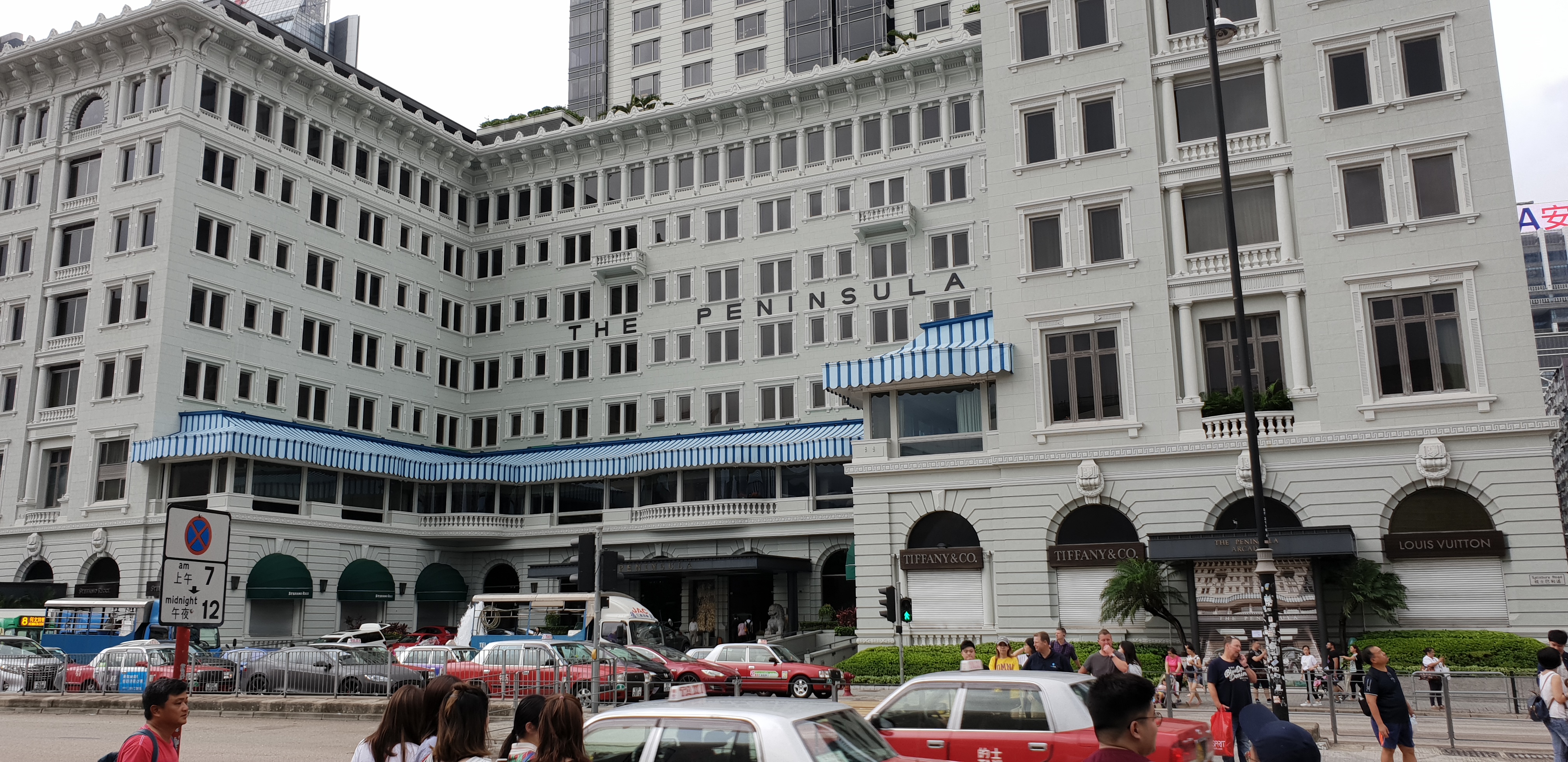
Remarkably, the Peninsula Hotel experience began at the arrival gate.

The moment we stepped out of the air bridge and into the terminal building, a representative of the Hong Kong airport was waiting with a card with our name on it.  She was there, with driver and electric car (sometimes called a golf cart) to ease our way through the immigration and baggage formalities.

20180607_070908

No walking for us, which was fine by me.  It’s a train ride and a long walk from the gate to immigration.  And after all the sitting on the airplane, walking was not the first thing I was looking forward to.

The drive took a few minutes, slowed down by many other passengers walking towards the same destination, most wondering why two relatively young people like us (even if we are in our 60’s) were getting a ride.

After clearing immigration, which took very little time, and where there was a very short queue considering the number of arrivals they handle, we were met on the other side by our airport representative, and taken to the baggage carousel.

Another simple process, our bags were almost waiting for us.  From there we exited customs, and out representative handed us over to the representative of the hotel.  I thought he was the driver.

He took us through to the limousine lounge and directly to our car, a very clean shiny new looking green Rolls Royce, the ultimate in the airport to hotel transportation.

Inside it was immaculate, and astonishing, and very, very comfortable.  I could image the Queen riding in the back of one.  It took about 30 to 40 minutes, one of the quietest, most smooth rides I’d ever had, and worth every cent we paid for it.

The bucket list now has one less item on it.

20180607_080651

The arrival at the hotel was effortlessly handled.  We were met by two of the check-in staff and escorted to our room on the fourth floor.

There was just enough time to take in the amazing foyer, front entrance and twin staircases leading to a mezzanine floor, before getting into a waiting elevator and taken to our floor.  As an aside, the mirrors in the elevator were like something out of a hall of mirrors, you look into the mirror and see dozens of yourself looking back.

It’s an effect I’ll have to take a photo of.

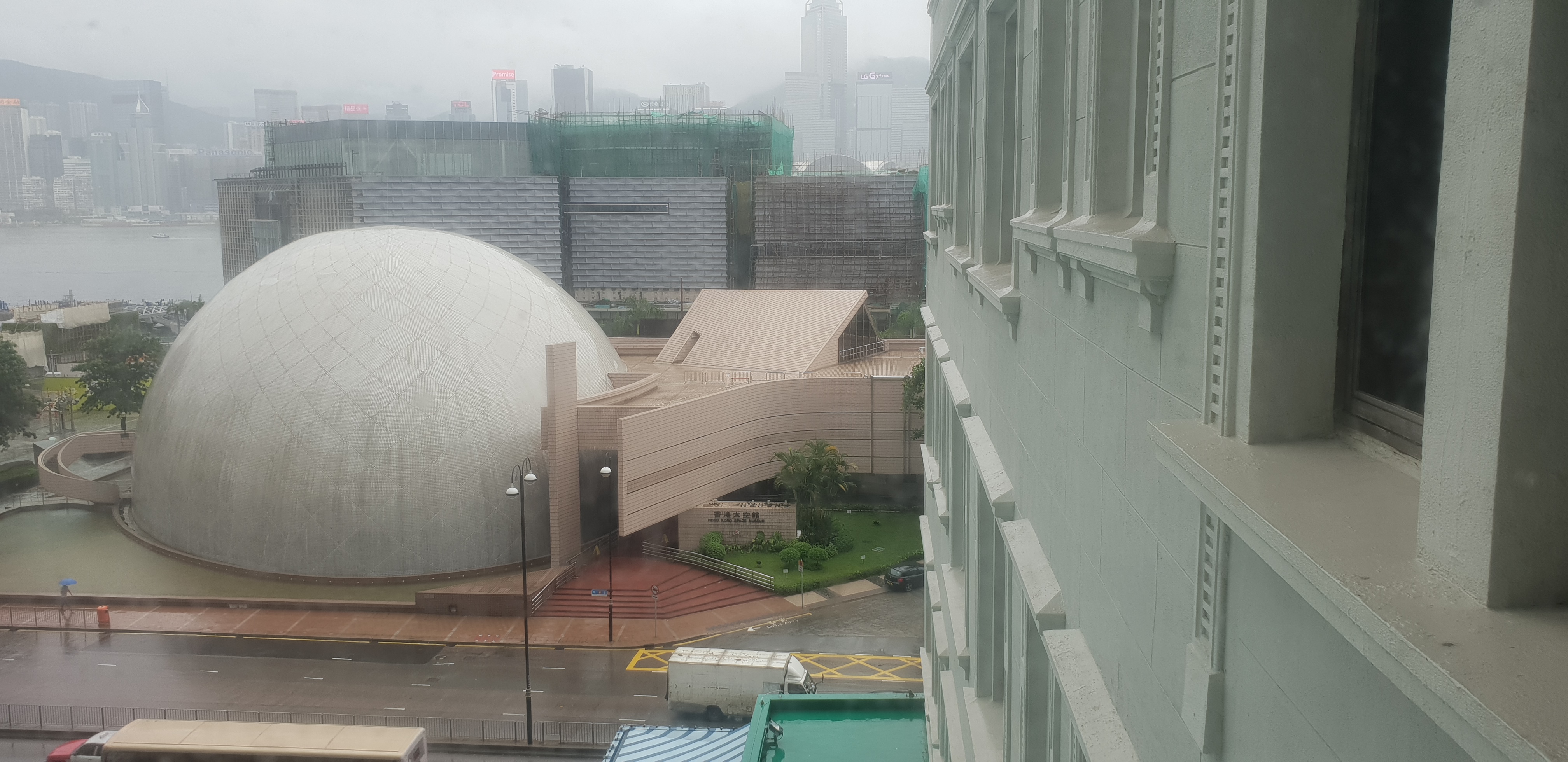
We have been upgraded, and out room is larger than the one originally allocated.  It has a view of the Space Museum, the Veranda Cafe roof, and parts of Hong Kong harbor.  It is overcast and raining so it does not matter about the view.

20180608_113856

It’s Hong Kong, and that view will change every hour.

Formalities over, we are left standing in stunned silence.

We have arrived.

20180607_153541

They say getting there is half the fun.

They’re wrong.

Or at least in the case of the Peninsular Hotel they are.

If just getting to the hotel via the signature Green Rolls Royce is any indication, there had to be a lot more in store.

We booked a room in the ‘old’ hotel and it was categorized as ‘deluxe’.  The Peninsula adds a whole new meaning to the word Deluxe.  If this was one of their lower priced rooms, then I’d love to see their better rooms.

But the room itself is not the sum of the experience; it is also the aura within the building, the service, which is quiet and unassumingly polite and unobtrusive.  You are ushered from the front door, held open by a very elegantly dressed concierge, to your room without so much as a heartbeat.

The details, well, they are mere details that cause no concern, all taken care of before you arrived.  We arrived early, before the advertised check-in, and this fazed no one.  Room available, tired travelers sigh in relief, knowing a hot shower and several hours sleep would not be possible.

I was more than pleasantly surprised, and exploring the hotel would have to wait.

For a few hours anyway.

In a word: Port

So, I wonder if it’s true, any port in a storm, except perhaps Marsailles

Or, if you are a lothario type sailor, you would have a girl in every port.

Yes, the most common definition of a port is a place where ships dock.

And, while talking of ships we don’t call the sides left and right, we call them port and starboard.  Just in case you didn’t know, port is the left side of the ship when facing forward.

And of course, ships have portholes, ie windows, traditionally round and rather small.


It could be an alcoholic drink, imbibed mostly after dinner with coffee and cigars, though no one seems to smoke cigars any more.

There is still coffee, for now.  No doubt sometime in the future someone will link it to death and dying, and it will fall out of favour, like sugar, weedkillers and asbestos.

The best port seems to come from Portugal, strange about that.


You can port a program (app in phone speak) from one platform to another, which basically means from Android to Apple IOS, but not without a reasonable amount of work.

It can also be an outlet plug on a computer that accepts cables from other devices (USB) and many years ago, a printer port, and a serial port.


In certain places in the world a port is a child’s schoolbag, a definition I was not aware of until we moved to a different state.

I’m still having a problem with it 30 years on.

Lost and Found, a short story

I had once said that Grand Central Station, in New York, was large enough you could get lost in it. Especially if you were from out of town.

I know, I was from out of town, and though I didn’t quite get lost, back then I had to ask directions to go where I needed to.

It was also an awe-inspiring place, and whenever I had a spare moment, usually at lunchtime, I would go there and just soak in the atmosphere. It was large enough to make a list of places to visit, or find, or get a photograph from some of the more obscure places.

Today, I was just there to work off a temper. Things had gone badly at work, and even though I hadn’t done anything wrong, I still felt bad about it.

I came in the 42nd street entrance and went up to the balcony that overlooked the main concourse. A steady stream of people was coming and going, most purposefully, a few were loitering, and several police officers were attempting to move on a vagrant. It was not the first time.

But one person caught my eye, a young woman who had made a circuit of the hall, looked at nearly every destination board, and appeared to be confused. It was the same as I had felt when I first arrived.

Perhaps I could help.

The problem was, a man approaching a woman from out of left field would have a very creepy vibe to it, so it was probably best left alone.

Another half-hour of watching the world go by, I had finally got past the bad mood and headed back to work. I did a wide sweep of the main concourse, perhaps more for the exercise than anything else, and had reached the clock in the centre of the concourse when someone turned suddenly, and I crashed into them.

Not badly, like ending up on the floor, but enough for a minor jolt. Of course, it was my fault because I was in another world at that particular moment.

“Oh, I am sorry.” A woman’s voice, very apologetic.

I was momentarily annoyed, then, when I saw who it was, it passed. It was the lost woman I’d seen earlier.

“No. Not your fault, but mine entirely. I have a habit of wandering around with my mind elsewhere.”

Was it fate that we should meet like this?

I noticed she was looking around, much the same as she had before.

“Can I help you?”

“Perhaps you can. There’s supposed to be a bar that dates back to the prohibition era here somewhere. Campbell’s Apartment, or something like that. I was going to ask…”

“Sure. It’s not that hard to find if you know where it is. I’ll take you.”

It made for a good story, especially when I related it to the grandchildren, because the punch line was, “and that’s how I met your grandmother.”


© Charles Heath 2020

“One Last Look”, nothing is what it seems

A single event can have enormous consequences.

A single event driven by fate, after Ben told his wife Charlotte he would be late home one night, he left early, and by chance discovers his wife having dinner in their favourite restaurant with another man.

A single event where it could be said Ben was in the wrong place at the wrong time.

Who was this man? Why was she having dinner with him?

A simple truth to explain the single event was all Ben required. Instead, Charlotte told him a lie.

A single event that forces Ben to question everything he thought he knew about his wife, and the people who are around her.

After a near-death experience and forced retirement into a world he is unfamiliar with, Ben finds himself once again drawn back into that life of lies, violence, and intrigue.

From London to a small village in Tuscany, little by little Ben discovers who the woman he married is, and the real reason why fate had brought them together.

It is available on Amazon here:  http://amzn.to/2CqUBcz

Searching for locations: Terracotta Warriors and Horses Museum, X’ian, China

Terracotta Warriors and Horses Museum

A little history, and anecdotal advice first:

In 1974 a 26-year-old farmer, Yang Jide, was drilling a well and found fragments of the terracotta soldiers and bronze weapons.

What was discovered later was one of the biggest attended burial pits of China’s first feudal Emperor, Qin Shi Huang.  In the following years remains had been found in 3 pits, yielding at least 8,000 soldiers and horses, and over 100 chariots.  The soldiers were infantry, cavalry, and others.

Emperor Qin was born in 259 BC and died in 210 BC.  He began building a mausoleum for himself at the foot of Mount Li when he was 13.  Construction took 38 years, from 247 BC to 208 BC.  It was divided into 3 stages and involved 720,000 conscripts.

The pits of pottery figures are 1.5 km east of Emperor Qin’s mausoleum.  Pit 1 has about 6,000 terracotta armored warriors and horses and 40 wooden chariots.  Pit 2 is estimated to have over 900 terracotta warriors and 350 terracotta horses with about 90 wooden chariots.  Pit 3 had so far yielded only 66 pottery figures and one chariot drawn by four horses.

Official records say it was discovered later that it was likely Xiang Yu, a rebel, intentionally damaged the Mausoleum and the soldiers in the pits, by setting fire to the wooden roof rafters, and these fell on and broke the warriors into pieces.

However, we were told that after the terracotta warriors were completed, the Emperor ordered the builders to be killed so that they would not tell anyone about the warriors, and then of those that remained alive deliberately smashed all of the artifacts.

The thing is, all of the terracotta figures that have been found are in pieces, and they need computers to piece them back together again.

The visit:
The first impression is the size of the car park and the number of buses parked in the lot, and a hell of a lot more outside up the road an off on side streets.  Obviously, it costs money to park in the parking lot.

The other first impressions; the numbers waiting to get in were not as many as yesterday outside the forbidden city, in fact, a lot less.

Be warned there’s a long walk from the entrance gate where your bags are scanned and a body scan as well, before admittance.  This walk is through a landscaped area which it is expect might sometime in the future reveal more soldiers, or other artifacts.

At the end of the walk that takes about ten minutes, you can get a one-way ride to the second checkpoint, but we opted not to as no one else in our group did.

That walk is the warm-up exercise to an organized viewing of the exhibits after going through a second ticket checkpoint.  On the other side, we had to hand our tickets back to the tour guide which was disappointing not to end up with a memento of actually having been there.

So, on the other side in the courtyard, the guide told us the most important parts of the exhibition, that we should spend most of the time looking at pit 1, and then spent a little time in 2 which is only there in the first stages of excavation.  Then move onto the museum if only to see the replica chariots.

We do.

The chariots were small but interesting

The horses were better and intricately detailed

These are soldiers, perhaps complete examples of those types found in the end pit.

This is one of the archers.  You can tell by the way he wears his hair.

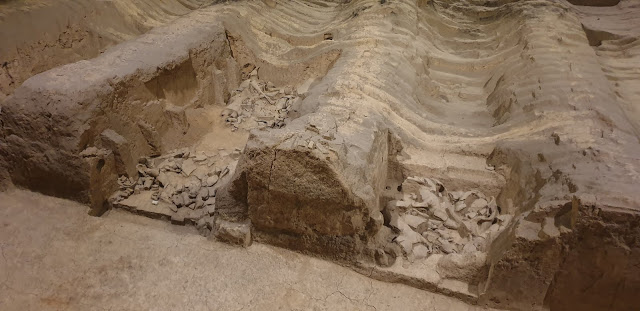
Pit 2

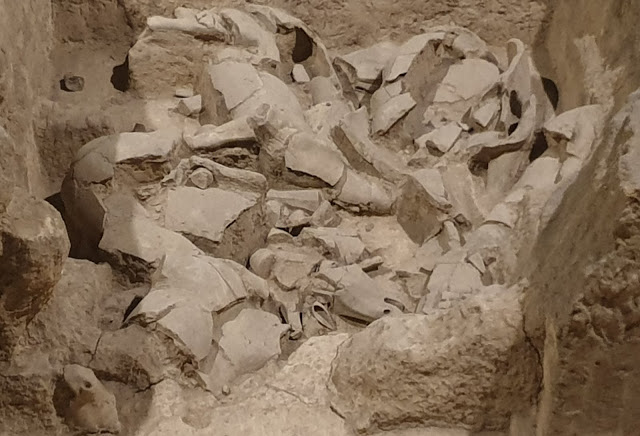
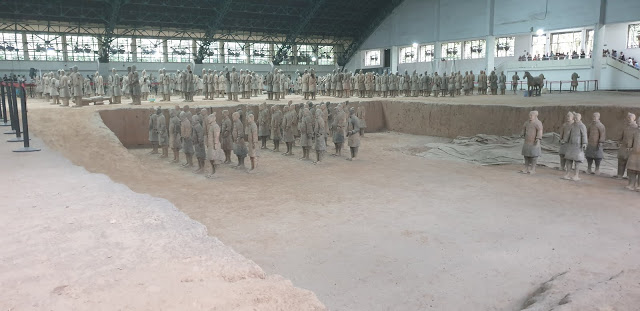
The excavation of this pit has only just begun, so it is possible to see where they have carefully removed the top cover, and you can see the broken parts of the warriors lying in a heap.

Some parts of the warriors are more discernible closer up

These parts are carefully extracted and taken to the ‘hospital’ where they are digitised and the computer will match each part with the warrior it belongs to.

Pit 1

This has quite a number of standing soldiers that have been glued back together, but not necessarily complete and I notice a number if the statues were incomplete. And if they cannot find the missing pieces, then they are not added to or filled in.

The scale of the pit is enormous, and they have hardly scratched the surface in the restoration process.

What is there is a number of horses as well.

That’s at the front of the pit, a long line of statues, and what is clear is the location of the well where the first fragments were found by a farmer.

There are about eight lines of soldiers, and some lining the sides.

Midway down there is a large area currently under excavation

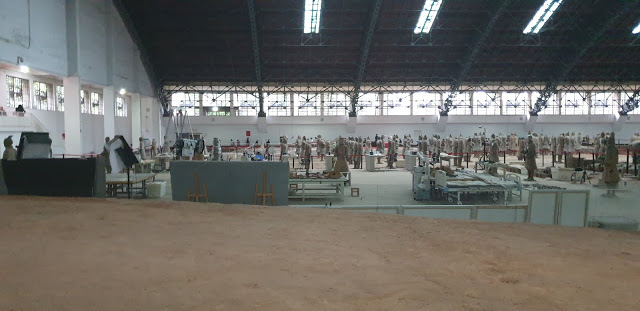
At the back is the hospital where the soldiers are reassembled.  There’s nearly a hundred in the various stages of rebuilding.  These days the soldiers are rebuilt using computer imaging.

The hospital area is where they are put back together

And these are some of the statues in various stages of reconstruction

Another two views of the size and scale of the reconstruction project

The coffee shop is also a sales centre, but there are too many people waiting for coffee and too few places to sit down.

In a word: Toe

A toe is one of five at the end of your foot, and from time to time you wriggle.  It’s also one of the first things to go when you get frostbite.

And when was the last time you stubbed your toe?  It hurts!

It can also mean something at the tip or point, such as the toe of a country like Italy, or England.

What does it mean when someone treads on your toes?   You upset or annoy them.

What if you go toe to toe with someone?  Two people having a ‘robust discussion’.

What about that boss that keeps you on your toes, especially when he’s looking over your shoulder!

And what about a toe-poke, a hard kick of the football with your toe?

Of course, it’s not to be confused with the word tow, which basically means to pull something behind you.

Like a tow truck, pulling a broken down, or smashed up, vehicle.

But, do you toe the line, or tow the line?  Or both at different times?

It seems that to toe the line means to do as you are told, or conform to a standard.

Sadly, that doesn’t describe me!

The story behind the story: A Case of Working With the Jones Brothers

To write a private detective serial has always been one of the items at the top of my to-do list, though trying to write novels and a serial, as well as a blog, and maintain a social media presence, well, you get the idea.

But I made it happen, from a bunch of episodes I wrote a long, long time ago, used these to start it, and then continue on, then as now, never having much of an idea where it was going to end up, or how long it would take to tell the story.

That, I think is the joy of ad hoc writing, even you, as the author, have as much idea of where it’s going as the reader does.

It’s basically been in the mill since 1990, and although I finished it last year, it looks like the beginning to end will have taken exactly 30 years.  Had you asked me 30 years ago if I’d ever get it finished, the answer would be maybe?

My private detective, Harry Walthenson

I’d like to say he’s from that great literary mold of Sam Spade, or Mickey Spillane, or Phillip Marlow, but he’s not.

But, I’ve watched Humphrey Bogart play Sam Spade with much interest, and modeled Harry and his office on it.  Similarly, I’ve watched Robert Micham play Phillip Marlow with great panache, if not detachment, and added a bit of him to the mix.

Other characters come into play, and all of them, no matter what period they’re from, always seem larger than life.  I’m not above stealing a little of Mary Astor, Peter Lorre or Sidney Greenstreet, to breathe life into beguiling women and dangerous men alike.

Then there’s the title, like

The Case of the Unintentional Mummy – this has so many meanings in so many contexts, though I image back in Hollywood in the ’30s and ’40s, this would be excellent fodder for Abbott and Costello

The Case of the Three-Legged Dog – Yes, I suspect there may be a few real-life dogs with three legs, but this plot would involve something more sinister.  And if made out of plaster, yes, they’re always something else inside.

But for mine, to begin with, it was “The Case of the …”, because I had no idea what the case was going to be about, well, I did, but not specifically.

Then I liked the idea of calling it “The Case of the Brother’s Revenge” because I began to have a notion there was a brother no one knew about, but that’s stuff for other stories, not mine, so then went the way of the others.

Now it’s called ‘A Case of Working With the Jones Brothers’, finished the first three drafts, and at the editor for the last.

I have high hopes of publishing it in early 2021.  It even has a cover.

PIWalthJones1

Lost and Found, a short story

I had once said that Grand Central Station, in New York, was large enough you could get lost in it. Especially if you were from out of town.

I know, I was from out of town, and though I didn’t quite get lost, back then I had to ask directions to go where I needed to.

It was also an awe-inspiring place, and whenever I had a spare moment, usually at lunchtime, I would go there and just soak in the atmosphere. It was large enough to make a list of places to visit, or find, or get a photograph from some of the more obscure places.

Today, I was just there to work off a temper. Things had gone badly at work, and even though I hadn’t done anything wrong, I still felt bad about it.

I came in the 42nd street entrance and went up to the balcony that overlooked the main concourse. A steady stream of people was coming and going, most purposefully, a few were loitering, and several police officers were attempting to move on a vagrant. It was not the first time.

But one person caught my eye, a young woman who had made a circuit of the hall, looked at nearly every destination board, and appeared to be confused. It was the same as I had felt when I first arrived.

Perhaps I could help.

The problem was, a man approaching a woman from out of left field would have a very creepy vibe to it, so it was probably best left alone.

Another half-hour of watching the world go by, I had finally got past the bad mood and headed back to work. I did a wide sweep of the main concourse, perhaps more for the exercise than anything else, and had reached the clock in the centre of the concourse when someone turned suddenly, and I crashed into them.

Not badly, like ending up on the floor, but enough for a minor jolt. Of course, it was my fault because I was in another world at that particular moment.

“Oh, I am sorry.” A woman’s voice, very apologetic.

I was momentarily annoyed, then, when I saw who it was, it passed. It was the lost woman I’d seen earlier.

“No. Not your fault, but mine entirely. I have a habit of wandering around with my mind elsewhere.”

Was it fate that we should meet like this?

I noticed she was looking around, much the same as she had before.

“Can I help you?”

“Perhaps you can. There’s supposed to be a bar that dates back to the prohibition era here somewhere. Campbell’s Apartment, or something like that. I was going to ask…”

“Sure. It’s not that hard to find if you know where it is. I’ll take you.”

It made for a good story, especially when I related it to the grandchildren, because the punch line was, “and that’s how I met your grandmother.”


© Charles Heath 2020