Whilst I found this tree house to be interesting, it seems to be far from practical because there was little to keep the wind and rain out, though I suppose, in the book, that might not be such a problem.
Be that as it may, and if it was relatively waterproof, then the furnishings would probably survive, and one had to also assume that much of the furnishings, such as the writing desk below, would have washed up as debris from the shipwreck.
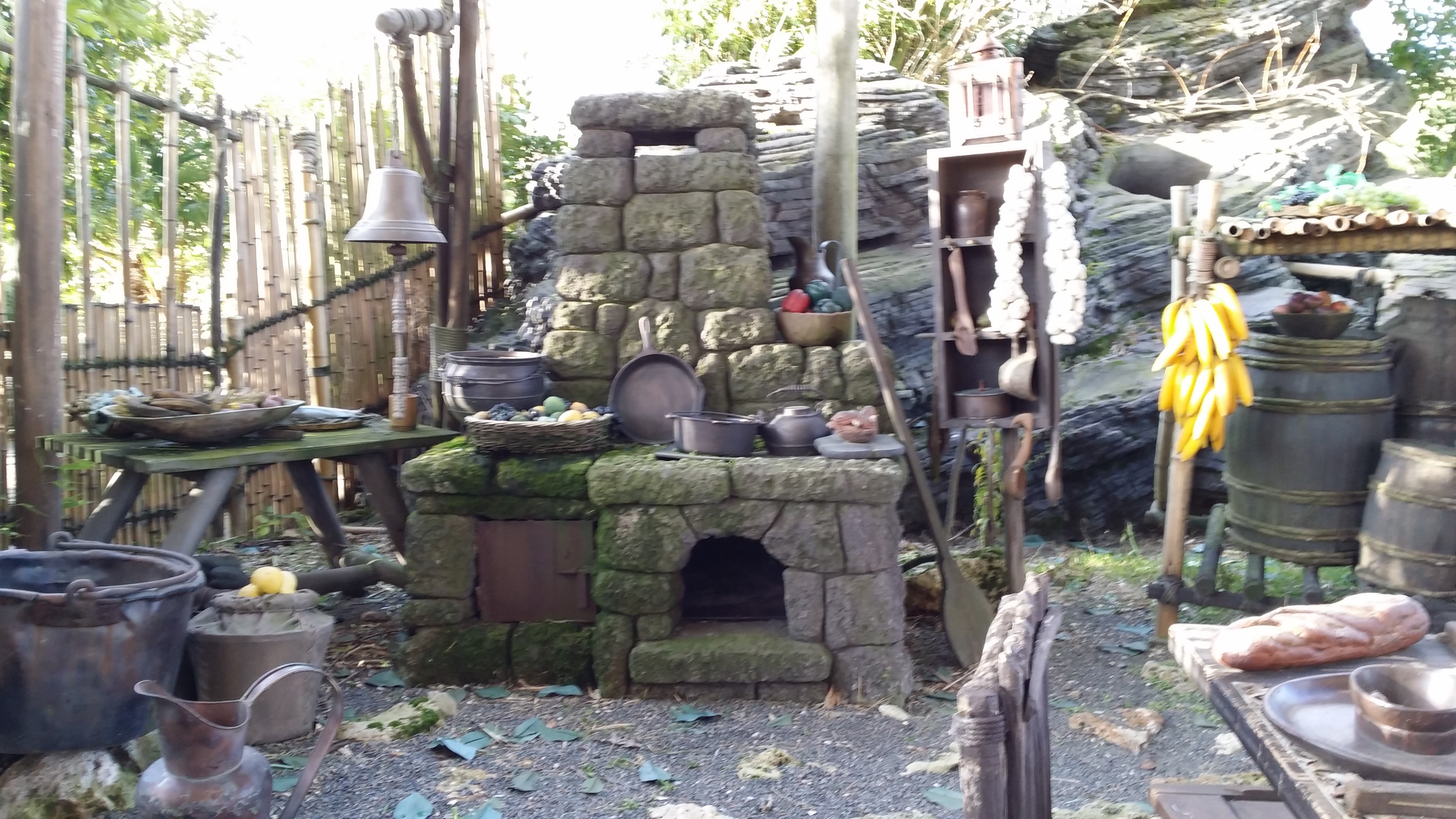
The stove and oven would have to be built by hand, and it is ‘remarkable’ such well-fitting stones were available. It doesn’t look like it’s been used for a while judging by the amount of gree on it. Perhaps it is not in a waterproof area.
The dining table and the shelf in the background have that rough-hewn look about them
A bit of man-made equipment here for drawing water from the stream
And though not made in the era of electricity, there is an opportunity to use the water wheel to do more than it appears to be doing
And tucked away in a corner the all-important study where one can read, or play a little music on the organ. One could say, for the period, one had all the comforts of home.
Investigation of crimes don’t always go according to plan, nor does the perpetrator get either found or punished.
That was particularly true in my case. The murderer was very careful in not leaving any evidence behind, to the extent that the police could not rules out whether it was a male or a female.
At one stage the police thought I had murdered my own wife though how I could be on a train at the time of the murder was beyond me. I had witnesses and a cast-iron alibi.
The officer in charge was Detective Inspector Gabrielle Walters. She came to me on the day after the murder seeking answers to the usual questions when was the last time you saw your wife, did you argue, the neighbors reckon there were heated discussions the day before.
Routine was the word she used.
Her Sargeant was a surly piece of work whose intention was to get answers or, more likely, a confession by any or all means possible. I could sense the raging violence within him. Fortunately, common sense prevailed.
Over the course of the next few weeks, once I’d been cleared of committing the crime, Gabrielle made a point of keeping me informed of the progress.
After three months the updates were more sporadic, and when, for lack of progress, it became a cold case, communication ceased.
But it was not the last I saw of Gabrielle.
The shock of finding Vanessa was more devastating than the fact she was now gone, and those images lived on in the same nightmare that came to visit me every night when I closed my eyes.
For months I was barely functioning, to the extent I had all but lost my job, and quite a few friends, particularly those who were more attached to Vanessa rather than me.
They didn’t understand how it could affect me so much, and since it had not happened to them, my tart replies of ‘you wouldn’t understand’ were met with equally short retorts. Some questioned my sanity, even, for a time, so did I.
No one, it seemed, could understand what it was like, no one except Gabrielle.
She was by her own admission, damaged goods, having been the victim of a similar incident, a boyfriend who turned out to be a very bad boy. Her story varied only in she had been made to witness his execution. Her nightmare, in reliving that moment in time, was how she was still alive and, to this day, had no idea why she’d been spared.
It was a story she told me one night, some months after the investigation had been scaled down. I was still looking for the bottom of a bottle and an emotional mess. Perhaps it struck a resonance with her; she’d been there and managed to come out the other side.
What happened become our secret, a once-only night together that meant a great deal to me, and by mutual agreement, it was not spoken of again. It was as if she knew exactly what was required to set me on the path to recovery.
And it had.
Since then we saw each about once a month in a cafe. I had been surprised to hear from her again shortly after that eventful night when she called to set it up, ostensibly for her to provide me with any updates on the case, but perhaps we had, after that unspoken night, formed a closer bond than either of us wanted to admit.
We generally talked for hours over wine, then dinner and coffee. It took a while for me to realize that all she had was her work, personal relationships were nigh on impossible in a job that left little or no spare time for anything else.
She’d always said that if I had any questions or problems about the case, or if there was anything that might come to me that might be relevant, even after all this time, all I had to do was call her.
I wondered if this text message was in that category. I was certain it would interest the police and I had no doubt they could trace the message’s origin, but there was that tiny degree of doubt, whether or not I could trust her to tell me what the message meant.
I reached for the phone then put it back down again. I’d think about it and decide tomorrow.
It’s something that I have never been able to get a handle on, and I seem to stagger from one day to the next without getting anything done.
Over the years many people tried, some with limited success, others completely failing.
I guess I’m one of those freeform sorts of people and I guess it goes with the star sign, Gemini.
Yes, I’ve been to those time management courses with the books and diaries to seem to want you to time manage your life. I considered it bit like micromanagement where your supervisor had access to the diary and put in the work, the estimated time and when it was expected to be finished.
I didn’t work well with deadlines.
But oddly enough most of the jobs I’ve had over the years have involved time management of one sort or another and I have survived.
Now, in semi-retirement, I really need something to organize my days so something gets done. As a writer allocating 12 midnight to 2am for writing doesn’t seem to be a good idea.
Unfortunately it is the best time for me to write.
Anyone else out there with the same problem, and if so what was your answer to the time management problem?
With my attention elsewhere, I walked into a man who was hurrying in the opposite direction. He was a big man with a scar running down the left side of his face from eye socket to mouth, and who was also wearing a black shirt with a red tie.
That was all I remembered as my heart almost stopped.
He apologized as he stepped to one side, the same way I stepped, as I also muttered an apology.
I kept my eyes down. He was not the sort of man I wanted to recognize later in a lineup. I stepped to the other side and so did he. It was one of those situations. Finally getting out of sync, he kept going in his direction, and I towards the bus, which was now pulling away from the curb.
Getting my breath back, I just stood riveted to the spot watching it join the traffic. I looked back over my shoulder, but the man I’d run into had gone. I shrugged and looked at my watch. It would be a few minutes before the next bus arrived.
Wait, or walk? I could also go by subway, but it was a long walk to the station. What the hell, I needed the exercise.
At the first intersection, the ‘Walk’ sign had just flashed to ‘Don’t Walk’. I thought I’d save a few minutes by not waiting for the next green light. As I stepped onto the road, I heard the screeching of tires.
A yellow car stopped inches from me.
It was a high powered sports car, perhaps a Lamborghini. I knew what they looked like because Marcus Bartleby owned one, as did every other junior executive in the city with a rich father.
Everyone stopped to look at me, then the car. It was that sort of car. I could see the driver through the windscreen shaking his fist, and I could see he was yelling too, but I couldn’t hear him. I stepped back onto the sidewalk, and he drove on. The moment had passed and everyone went back to their business.
My heart rate hadn’t come down from the last encounter. Now it was approaching cardiac arrest, so I took a few minutes and several sets of lights to regain composure.
At the next intersection, I waited for the green light, and then a few seconds more, just to be sure. I was no longer in a hurry.
At the next, I heard what sounded like a gunshot. A few people looked around, worried expressions on their faces, but when it happened again, I saw it was an old car backfiring. I also saw another yellow car, much the same as the one before, stopped on the side of the road. I thought nothing of it, other than it was the second yellow car I’d seen.
At the next intersection, I realized I was subconsciously heading towards Harry’s new bar. It was somewhere on 6th Avenue, so I continued walking in what I thought was the right direction.
I don’t know why I looked behind me at the next intersection, but I did. There was another yellow car on the side of the road, not far from me. It, too, looked the same as the original Lamborghini, and I was starting to think it was not a coincidence.
Moments after crossing the road, I heard the roar of a sports car engine and saw the yellow car accelerate past me. As it passed by, I saw there were two people in it, and the blurry image of the passenger; a large man with a red tie.
Now my imagination was playing tricks.
It could not be the same man. He was going in a different direction.
In the few minutes I’d been standing on the pavement, it had started to snow; early for this time of year, and marking the start of what could be a long cold winter. I shuddered, and it was not necessarily because of the temperature.
I looked up and saw a neon light advertising a bar, coincidentally the one Harry had ‘found’ and, looking once in the direction of the departing yellow car, I decided to go in. I would have a few drinks and then leave by the back door if it had one.
It is sometimes quite trashy and that’s saying something!
Having been a journalist in a previous lifetime, and one that always believed that the truth mattered, it didn’t take long to realise that journalists should never let the truth get in the way of a good story.
Newspapers, and all other forms of media, will only write what they believe will sell, or what they think the public wants to read. The truth, sadly, is not the first thing on the readers mind, only that someone is to blame for something they have no control over, and it doesn’t matter who.
And the more outlandish the situation, the more the public will buy into it.
This, I guess, is why we like reading about celebrities and royalty, not for the good they might do, but the fact they stumble and make mistakes, and that somehow makes us feel better about ourselves.
Similarly, if the media can beat up a subject, like the corona-virus, and make it worse that it is, then people will lap up the continuing saga, as it relates to them, and will take one of two stances, that they believe the horror of it, and do as they’re asked, or disbelieve it because nothing can be that bad, and ignore it and the consequences of disobedience. knowing the government will not press too hard against the non compliers simply because of domocracy issues it will stir up.
That is, then the media will get a hold of this angle and push it, and people will start to think disobedience is a good thing not a bad.
So, our problems of trying to get a fair and balanced look at what the coronavirus is all about is nigh on impossible. We are continuously bombarded with both right and wrong information, and the trouble is, both sides are very plausibly supported by facts.
And that’s the next problem we have in reporting. We can get facts to prove anything we want. It;s called the use and abuse of statistics, and was an interest part of the journalism degree I studied for. We were told all about statistics, good and bad, and using them to prove the veracity of our piece.
I remember writing a piece for the tutor extolling the virtues of a particular person who was probably the worst human since Vlad the Impaler, using only the facts that suited my narrative. I also remember the bollocking he gave me for doing so, but had to acknowledge that sometimes that would happen.
Integrity of reporting only went as far as the editor, and if the editor hated something, you had to hate it too. This is infamously covered in various texts where newspaper publishers pick sides, and can influence elections, and governments. It still happens.
So, the bottom line is, when I;m reading an article in the media, I always take it with a grain of salt, and do my own fact checking, remembering, of course, not just to fact check to prove the bias one way of the other, but the get a sense of balance.
We have state elections coming up where I live, but it does not sink to the personal sniping level as it does in the US, we haven’t sunk that low yet, but we haven;t got past the sniping about all the wrongs and failed promises of the govern,ment of the day, or the endless tirade against the opposition and how bad a job they did whenb they were previously in government.
You can see, no one is talking about what they’re going to do for us, no one is telling us what their policies are. It’s simply schoolyard tit for tat garbage speak. What happened to the town hall meeting, a long and winding speech encompassing the policies, what the government plans to do for its people in the next three years, and then genuinely answer questions?
Perhaps we should ban campaigning, and just get each party to write a book about what they intend to do, and keep them away from the papers, the TV, and any other form of media, in other words, don’t let them speak!
And don’t get me started about the drivel they speak in the parliament. Five year olds could do a better job.
50 photographs, 50 stories, of which there is one of the 50 below.
They all start with –
A picture paints … well, as many words as you like. For instance:
And, the story:
Have you ever watched your hopes and dreams simply just fly away?
Everything I thought I wanted and needed had just left in an aeroplane, and although I said I was not going to, i came to the airport to see the plane leave. Not the person on it, that would have been far too difficult and emotional, but perhaps it was symbolic, the end of one life and the start of another.
But no matter what I thought or felt, we had both come to the right decision. She needed the opportunity to spread her wings. It was probably not the best idea for her to apply for the job without telling me, but I understood her reasons.
She was in a rut. Though her job was a very good one, it was not as demanding as she had expected, particularly after the last promotion, but with it came resentment from others on her level, that she, the youngest of the group would get the position.
It was something that had been weighing down of her for the last three months, and if noticed it, the late nights, the moodiness, sometimes a flash of temper. I knew she had one, no one could have such red hair and not, but she had always kept it in check.
And, then there was us, together, and after seven years, it felt like we were going nowhere. Perhaps that was down to my lack of ambition, and though she never said it, lack of sophistication. It hadn’t been an issue, well, not until her last promotion, and the fact she had to entertain more, and frankly I felt like an embarrassment to her.
So, there it was, three days ago, the beginning of the weekend, and we had planned to go away for a few days and take stock. We both acknowledged we needed to talk, but it never seemed the right time.
It was then she said she had quit her job and found a new one. Starting the following Monday.
Ok, that took me by surprise, not so much that it something I sort of guessed might happen, but that she would just blurt it out.
I think that right then, at that moment, I could feel her frustration with everything around her.
What surprised her was my reaction. None.
I simply asked where who, and when.
A world-class newspaper, in New York, and she had to be there in a week.
A week.
It was all the time I had left with her.
I remember I just shrugged and asked if the planned weekend away was off.
She stood on the other side of the kitchen counter, hands around a cup of coffee she had just poured, and that one thing I remembered was the lone tear that ran down her cheek.
Is that all you want to know?
I did, yes, but we had lost that intimacy we used to have when she would have told me what was happening, and we would have brainstormed solutions. I might be a cabinet maker but I still had a brain, was what I overheard her tell a friend once.
There’s not much to ask, I said. You’ve been desperately unhappy and haven’t been able to hide it all that well, you have been under a lot of pressure trying to deal with a group of troglodytes, and you’ve been leaning on Bentley’s shoulder instead of mine, and I get it, he’s got more experience in that place, and the politics that go with it, and is still an ally.
Her immediate superior and instrumental in her getting the position, but unlike some men in his position he had not taken advantage of a situation like some men would. And even if she had made a move, which I doubted, that was not the sort of woman she was, he would have politely declined.
One of the very few happily married men in that organisation, so I heard.
So, she said, you’re not just a pretty face.
Par for the course for a cabinet maker whose university degree is in psychology. It doesn’t take rocket science to see what was happening to you. I just didn’t think it was my place to jump in unless you asked me, and when you didn’t, well, that told me everything I needed to know.
Yes, our relationship had a use by date, and it was in the next few days.
I was thinking, she said, that you might come with me, you can make cabinets anywhere.
I could, but I think the real problem wasn’t just the job. It was everything around her and going with her, that would just be a constant reminder of what had been holding her back. I didn’t want that for her and said so.
Then the only question left was, what do we do now?
Go shopping for suitcases. Bags to pack, and places to go.
Getting on the roller coaster is easy. On the beginning, it’s a slow easy ride, followed by the slow climb to the top. It’s much like some relationships, they start out easy, they require a little work to get to the next level, follows by the adrenaline rush when it all comes together.
What most people forget is that what comes down must go back up, and life is pretty much a roller coaster with highs and lows.
Our roller coaster had just come or of the final turn and we were braking so that it stops at the station.
There was no question of going with her to New York. Yes, I promised I’d come over and visit her, but that was a promise with crossed fingers behind my back. After a few months in t the new job the last thing shed want was a reminder of what she left behind. New friends new life.
We packed her bags, three out everything she didn’t want, a free trips to the op shop with stiff she knew others would like to have, and basically, by the time she was ready to go, there was nothing left of her in the apartment, or anywhere.
Her friends would be seeing her off at the airport, and that’s when I told her I was not coming, that moment the taxi arrived to take her away forever. I remember standing there, watching the taxi go. It was going to be, and was, as hard as it was to watch the plane leave.
So, there I was, finally staring at the blank sky, around me a dozen other plane spotters, a rather motley crew of plane enthusiasts.
Already that morning there’s been 6 different types of plane depart, and I could hear another winding up its engines for take-off.
People coming, people going.
Maybe I would go to New York in a couple of months, not to see her, but just see what the attraction was. Or maybe I would drop in, just to see how she was.
As one of my friends told me when I gave him the news, the future is never written in stone, and it’s about time you broadened your horizons.
For those who break the law, they will be very familiar with the eaning of the word cell. It’s a room a jail, not very big, with an uncomfortable bed, and no sharp edges.
And I’m sure the prisoners are not supplied with knives so they can dig through the mortar and remove bricks on their way to the great escape. That, I’m sure only happens at the movies.
A cell can also be a building block in the creation of humans, animals, fish, and plants. No doubt there are a million other things that require cells.
Perhaps the most interesting aspect of this cellular activity is whether or not there is life, and therefore cells, on Mars. I’m guessing we’ll have to wait a little longer to find out.
We can have a cell phone, which in some parts of the world is also the name of a mobile phone.
Don’t get me started on what I think of cell phones, or how intrusive they are on our everyday lives, the number of people who seem to be continually glued to the screen, or how many near misses there are in the street and crossing the road.
On the other hand cell phones in the hands of a writer are very useful because when we get flashes of story or plotlines in one of those once awkward moments, we can now jot it down on a cell phone scribbling pad.
A cell can also be used to describe a smaller unit within a larger organisation, or, if you are a thriller writer who dabbles in espionage, you will be very familiar with the concept of a sleeper cell.
Who knows, in reality, there might be some living next door to us and we would never know. Oops, been watching too much television again.
Digging deeper into the more obscure definitions of the word cell, we come up with a single transparent sheet that has a single drawing on it, one of many that make up an animated film, or film. If a film runs at 32 frames per second, that means there are 32 cells.
There are fuel cells
There are dry cell batteries
And as a general warning, don’t go too near cell towers or you will be a victim of radiation that might be extremely harmful to your health.
And, yes, the simple description for this word is that area of the earth that isn’t covered by water.
It could also describe that little patch that my house is built on, and is generally covered by the expression, house and land as a package.
After all, a piece of land is not much used to you unless there’s a dwelling on it, or, on rare occasions, under it. Does that mean then that land in this instance only as what you can see?
OK, now it’s getting confusing.
What if I wanted to live off the land. A small patch will not do, in this case, is need a large area, perhaps thousands if hectares.
It is said that the Australian aborigines have lived off the land for thousands of years, with a nomadic lifestyle.
No small patch of land for them.
Now, what if I come down out of the sky. Oddly enough this means I have to land, even if I come back to earth over later. It’s still a landing.
Now it’s getting interesting.
So what if you wanted to refer to where you live? That would be your homeland or motherland, and it describes a country.
So it’s my patch, my country, any area where there isn’t water. What about describing a country, say the land of the long white cloud, or the land of the rising sun?
And just to add to the confusion
I can land a fish
Make land, after being all at sea, and,
Best of all, land that much desired job.
Wow.
I’m beginning to think it’s another one of those ‘four-letter words’
Stranger’s We’ve Become, a sequel to What Sets Us Apart.
The blurb:
Is she or isn’t she, that is the question!
Susan has returned to David, but he is having difficulty dealing with the changes. Her time in captivity has changed her markedly, so much so that David decides to give her some time and space to re-adjust back into normal life.
But doubts about whether he chose the real Susan remain.
In the meantime, David has to deal with Susan’s new security chief, the discovery of her rebuilding a palace in Russia, evidence of an affair, and several attempts on his life. And, once again, David is drawn into another of Predergast’s games, one that could ultimately prove fatal.
From being reunited with the enigmatic Alisha, a strange visit to Susan’s country estate, to Russia and back, to a rescue mission in Nigeria, David soon discovers those whom he thought he could trust each has their own agenda, one that apparently doesn’t include him.
We have been to Paris a number of times over the years.
The last time we visited Paris we brought the two eldest grandchildren. We took the Eurostar train from St Pancras station direct to Disneyland, then took the free bus from the station to the hotel. The train station was directly outside Disneyland.
We stayed at the Dream Castle Hotel, rather than Disneyland itself as it was a cheaper option and we had a family room that was quite large and breakfast was included every morning. Then it was a matter of getting the free bus to Disneyland.
We spent three days, time which seem to pass far too quickly, and we didn’t get to see everything. They did, however, find the time to buy two princess dresses, and then spent the rest of the time playing dress-ups whenever they could.
In Paris, we stayed at the Crown Plaza at Republique Square.
We took the children to the Eiffel Tower where the fries, and the carousel at the bottom of the tower, seemed to be more memorable than the tower itself. The day we visited, the third level was closed. The day was cold and windy so that probably accounted for the less than memorable visit. To give you some idea of conditions, it was the shortest queue to get in I’ve ever seen.
We traveled on the Metro where it was pointed out to me that the trains actually ran on rubber tires, something I had not noticed before. It was a first for both children to travel on a double-decker train.
The same day, we went to the Louvre.
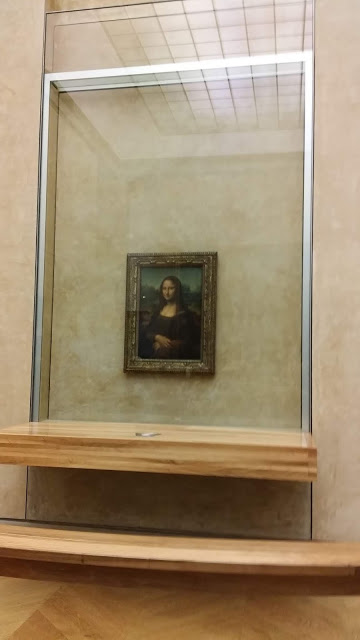
Here, it was cold, wet and windy while we waited, Once inside we took the girls to the Mona Lisa, and after a walk up and down a considerable numkber of stairs, one said, “and we walked all this way to see this small painting”.
It quickly became obvious their idea of paintings were the much larger ones hanging in other galleries.
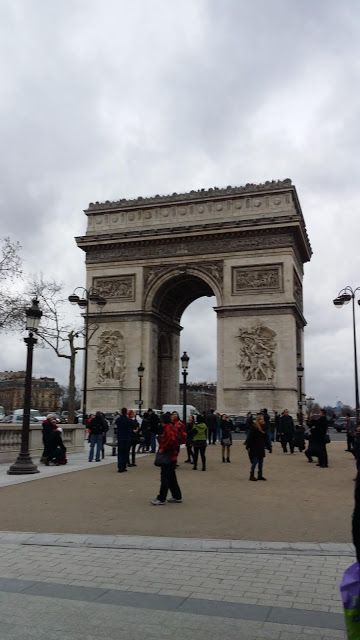
We also took them to the Arc de Triomphe.
We passed, and for some reason had to go into, the Disney shop, which I’m still wondering why after spending a small fortune at Disneyland itself.
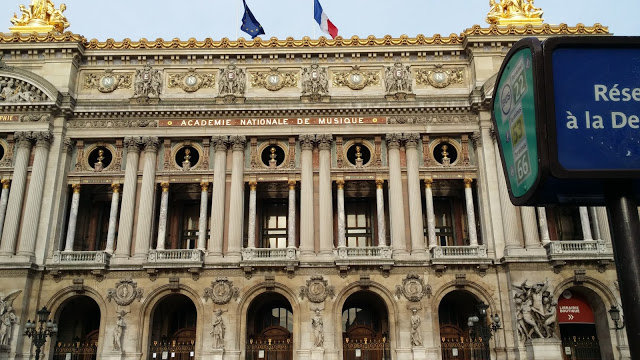
Next on the tour list was the Opera House.
where one of the children thought she saw the ghost and refused to travel in one of the elevators. At least it was quite amazing inside with the marble, staircases, and paintings on the roof.
Sadly, I don’t think they were all that interested in architecture, but at the Opera House, they did actually get to see some ballet stars from the Russian Bolshoi ballet company practicing. As we were leaving the next day we could not go and see a performance.
Last but not least was Notre Dame with its gargoyles and imp[osing architecture.
All in all, traveling with children and experiencing Paris through their eyes made it a more memorable experience.
The first we visited Paris was at the end of a whirlwind bus tour, seven countries in seven days or something like that. It was a relief to get to Paris and stay two nights if only to catch our breath.
I remember three events from that tour, the visit to the Eiffel Tower, the tour of the night lights, not that we were able to take much in from the inside of the bus, and the farewell dinner in one of the tour guides specially selected restaurants. The food and atmosphere were incredible. It was also notable for introducing us to a crepe restaurant in Montmartre, another of the tour guide’s favorite places.
On that trip to Paris, we also spent an afternoon exploring the Palace of Versailles.
The next time we visited Paris we flew in from London. OK, it was a short flight, but it took all day. From the hotel to the airport, the wait at the airport, departure, flying through time zones, arrival at Charles De Gaulle airport, now there’s an experience, and waiting for a transfer that never arrived, but that’s another story.
I can’t remember where we stayed the first time, it was somewhere out in the suburbs, but the second time we stayed at the Hilton near both the Eiffel Tower and the Australian Embassy, notable only because the concierge was dating an Australian girl working in the Embassy. That was our ticket for special treatment, which at times you need to get around in Paris.
It was the year before 2000 and the Eiffel Tower was covered in lights, and every hour or so it looked like a bubbling bottle of champagne. It was the first time we went to Level 3 of the Tower, and it was well worth it. The previous tour only included Level 2. This time we were acquainted with the fries available on the second level, and down below under the tower.
This time we acquainted ourselves with the Metro, the underground railway system, to navigate our way around to the various tourist spots, such as Notre Dame de Paris, The Louvre, Sacre-Coeur Basilica, and Les Invalides, and, of course, the trip to the crepe restaurant.
We also went to the Louvre for the express purpose of seeing the Mona Lisa, and I came away slightly disappointed. I had thought it to be a much larger painting. We then went to see the statue of Venus de Milo and spent some time trying to get a photo of it without stray visitors walking in front of us. Aside from that, we spent the rest of the day looking at the vast number of paintings, and Egyptian artifacts in the Museum.
We also visited the Opera House which was architecturally magnificent.
The third time we visited Paris we took our daughter, who was on her first international holiday. This time we stayed in a quaint Parisian hotel called Hotel Claude Bernard Saint Germain, (43 Rue Des Ecoles, Paris, 75005, France), recommended to us by a relation who’d stayed there the year before. It was small, and the elevator could only fit two people or one person and a suitcase. Our rooms were on the 4th floor, so climbing the stairs with luggage was out of the question.
It included breakfast and wifi, and it was quite reasonable for the four days we stayed there.
It was close to everything you could want, down the hill to the railway station, and a square where on some days there was a market, and for those days when we were hungry after a day’s exploring, a baguette shop where rolls and salad were very inexpensive and very delicious.
To our daughter we appeared to be experienced travelers, going on the Metro, visiting the Louvre, going, yes once again, to the crepe restaurant and the Basilica at Montmartre, Notre Dame, and this time by boat to the Eiffel Tower. We were going to do a boat rode on the Seine the last time but ran out of time.
We have some magnificent photos of the Tower from the boat.
Lunch on one of the days was at a restaurant not far from the Arc de Triomphe, where our daughter had a bucket of mussels. I was not as daring and had a hamburger and fries. Then we went to the center of the Arch and watched the traffic.
Our first time in Paris the bus driver got into the roundabout just to show us the dangers of driving in an unpredictable situation where drivers seem to take huge risks to get out at their exit. Needless to say, we survived that experience, though we did make a number of circuits.





 Thrills, Spills, and just a dash of Romance