Going once, going twice… – a short story

It was the small town that we had visited once, some years ago, that had enticed me back.

Those had been happier times, times when the stench of money hadn’t overtaken sensibility, and who we really were.

Not that I had changed all that much, except for the upper west side apartment, and posh car to go with it, but what had disappointed me was the change in Liz, the woman I thought once as the love of my life.

Without the trappings of wealth, she was the kindest, most thoughtful and generous person I knew, but that had changed when I became the recipient of an inheritance that beggared belief.  We both made a promise from the outset that it would not change us, but unfortunately, it did.

And that was probably the main reason why I was standing outside an old fixer-upper house on several acres overlooking the ocean.

I’d asked Liz to come, but she was having a weekend away in Las Vegas with her new friends, or as one of the ladies rather salaciously said, a what happens in Vegas stays in Vegas kind of weekend.

Charmaine had told me about the house, one that she had admired for a long time, but didn’t have the means to buy it.

Charmaine was a painter, a rather good one, and both Liz and I had met her on a weekend away upstate, and I’d bought one of her landscapes to hang in our new apartment.  Liz hated it, but I think that had more to do with the painter than the painting, and that was because Charmaine had flirted with me, and that, I had observed over time, was how she was with everyone.

She called it her sales technique.  After all, it had worked on me.

I listened to the auctioneer go through the rules of the action and then move on to a physical description of the property.  I’d been to several viewings and got a good idea of what was needed if I was to buy it.  It had good foundations and had suffered from a lack of TLC.  It was how the auctioneer summed up.

When he called for the first bid, I felt a hand slip into mine, and a glance sideways showed it to be Charmaine.  I had asked her along for support but she had something else to do, but it appeared now, she hadn’t.

“So,” she whispered next to my ear, “you were serious about this place?”

I had been dithering, not being able to make my mind up, but Liz, in the end, made the decision for me.  I’d overheard a snippet of conversation with one of her new friends, and, to be honest, I’d been surprised.

“Perhaps it was time to find a hideaway.”

“Things that bad?”

I shrugged.  “Maybe I’m writing too much into it.  At any rate, I needed an excuse to get out of town, and being here was as good as any.”

The first bid came in at 450,000.   I knew the reserved was about 700,000, and I was prepared to 850,000.  But I was hoping to spend less than that because the renovations would be about 250,000.

“We could go and have a picnic.  It’ll certainly cost less than buying this place.”

“I’m here now.”

Holding hands was just one of Charmaine’s ‘things’, and I had never written anything into what might have been called a relationship of sorts.  We were not lovers, and the conversation had never been steered in that direction, but I did find myself gravitated towards her when Liz was off doing her thing with her friends.  To be honest, I just liked the idea of a picnic and watching Charmaine paint her landscapes.

I raised the bid to 500,000.  Another from the previous bidder, 550,000.  Another at 600,000.  It seems there were three bidders for the property.  The other sixteen people attending were observers, probably locals interested in how this would help their property value.

I went 625,000 when the auctioneer changed the increment after a lack of bidding.  It was countered, moving to 650,000.  Another at 657,000, and then the first bidder went to 700,000, the reserve.

“You do realize the other bidders are friends of the owner and are there to push the price up?” Charmaine whispered in my ear.

I’d heard of it happening, but I’d not suspected it until she mentioned it.

“Going once, going twice at 700,000.”  The auctioneer looked at me.  “I’ll accept 10,000 increments.”

I nodded.  710,000.  It quickly moved to 800,000, after I bid 790,000.

The auctioneer looked at me expectantly.  “810,000, sir?”

That was more than I wanted to spend though an elbow in the ribs was the clincher, and when I declined, there was an air of disappointment.

“Going once, going twice, all done at 800,000?”  A look around the crowd confirmed we were all done, and the gavel came down.

“Looks like we’re going on a picnic,” she said.  “I’d expect a call in an hour or so.”

Two things happened that weekend, both of which surprised me.  The first, Charmaine was right, I did get a call, and finished up with a hideaway in the country, overlooking the ocean.  The second, Liz didn’t come back from Las Vegas.  She had apparently found someone new, someone more exciting, or so she said.

I guess I was disappointed but not overly concerned.  She had changed and I had not and if the truth be told, we were drifting apart.  We parted amicably, sold the apartment, and moved on, each in a different direction.

I had a new residence, and renovations to take my mind off the break-up, and when I told Charmaine, she was just said she didn’t believe we were that perfect match.  And in the light of my new status, I could now ask her to come and stay in the spare bedroom, a lot better, I said, than the one person tent she had been using, an offer she readily accepted.

Until, a year later, it became something more than that.

© Charles Heath 2020-2021
Writing about writing a book – Day 22 continues

The main character, like all main characters, has a very interesting, deep, and very complicated background story, some of which will be played out later when the story develops.  Needless to say, at the start, we need to know as much as the story needs so that there are no real surprises.

So that’s why I’m still working on Bill’s backstory, and how he got mixed up in the war, and as a general background to his situation, and life before Davenport.

His story, of course, will be told told in the first person, over a series of flashbacks each necessarily preceding part of the action that requires a lead-in:


But whether we were stupid or naive, or completely mad, we were all eager to get into battle, filled with the sort of hate only Army propaganda films could fill you with.  They were our enemy, and they deserved to concede or die.

A fresh face in a hardened platoon, I was eager to get on with it.  They looked knowingly, having seen it all before.  No idea of the reality, and no time to tell us.  Have a few beers to celebrate, and then, the next morning, go out on patrol.  No problem.

There was camaraderie, but it was subdued.  We walked single file, the seasoned campaigners in front and at the rear, treading carefully, demanding quiet, and a general cautiousness.  In the middle of nowhere, where only the sound of rain, or the animals and birds for company, we were naive enough to think this was going to be a doddle.

Then it happened, six hours out, and just before we reached a small clearing.  I thought to myself it was odd there should be such a clear space with jungle all around it.  There must be a reason.

There was.

We had walked into an ambush, and everyone hit the ground.  I was bringing up the rear with another soldier, a veteran not much older than myself whose name was Scotty, a little farther back from the main group.  Bullets sprayed the undergrowth, pinging off trees and leaves.  I buried my face in the dirt, praying I would not die on my first patrol.

We became separated from the others, lying in a hollow, with no idea how far away help was.  He was muttering to himself.  “God, I hate this.  You can never see the bastards.  They’re out there, but you can never bloody well see them.”  Then he crawled up the embankment, gun first.

He let off a few rounds, causing a return of machine-gun fire, spattering the dirt at the top.  Next thing I knew he was sliding down the hill with half his face shot away.  Dead.  I threw up there and then.  What an initiation.

Then one of the enemy soldiers came over the hill to check on his ‘kill’.  I saw him at the same time he saw me and aimed my gun and shot.  It was instinct more than anything else, and I hadn’t stopped to think of the consequences.  He fell down, finishing up next to me, staring at me from black, lifeless eyes. 

Dead. 

I’ll never forget those lifeless eyes.  I just got up and ran, making it back to the rest of the group without getting hit.  No one could explain how I made it safely through the hail of gunfire, from our side and theirs.

Back in the camp later, the veterans remarked on how unlucky Scotty was and how lucky I was to shoot one of the enemies, and not be killed myself.  They all thought it was worth a celebration.

Before we went out the next day to do it all again.

I spent the night vomiting, unable to sleep, haunted look on his face, one I finally realized that reflected complete astonishment.


There will be more, as the story develops.


© Charles Heath 2016-2020

That helicopter story that kept me awake – Episode 39

Our hero knows he’s in serious trouble.

The problem is, there are familiar faces and a question of who is a friend and who is foe made all the more difficult because of the enemy, if it was the enemy, simply because it didn’t look or sound or act like the enemy.

Now, it appears, his problems stem from another operation he participated in, and because of it, he has now been roped into what might be called a suicide mission.


“Are there?  How many should I have?”

The only way he could know there was not a full complement as if he had been told by someone how many people were in our group from the outset.  I looked at Jacobi, and he shrugged.

“This is not a good time to be playing games, Sergeant James.”

The guards gripped their weapons a little tighter and looked ready to use them.

“The only one playing games here would be you.  It would be irrelevant if I had more or I had fewer people here because you have more than enough to cover us, and then some.  But you would agree it would be imprudent for me to put all my eggs in one basket as it were, and yes, there are several others, but they are waiting for me to call them, further down the track.  Not to put too fine a point on it, distrust works both ways.  We don’t come back, I can assure you, your losses will be bigger than ours.  Oh, and a word of advice, don’t go looking for them, not unless you want good men to die needlessly.”

Tough talk, and could get us killed, but I was hoping that until he had the diamonds in his hands, he would humor me.  A minute or so passed where I assumed he was making a calculation on what the odds were, then he shrugged.  There was merit in what I’d told him.  Monroe and Shurl had plenty of ammunition and would have a foxhole that wouldn’t be over-run or penetrated.

“I think you might be right, so let’s not get bogged down in an argument that’s going nowhere.  We have what you want, and you have what we want.  Let’s go inside and talk.”

Was that a sigh of relief moment?  Perhaps.  But it was clear he needed us out of the way before his men could search the cars.  I was happy to let him think he had the upper hand.

“Lead the way.”

We all filed into the building and sat down around a large table.  There were bottles of water out, and we might have drunk from them but I could see the seal had been broken on min so it looked like we would be going thirsty.

The commander drank from his, no doubt as a gesture that the water was safe.  None of my people were buying it.

“I’ll kick it off,” I said.  “Are our people in good health?”

“Of course.  Healthy enough to walk out of here of their own accord.  Did you bring the compensation with you?”

“I did.”

“Can I see it?”

“Can I see our people.”

Friendly, and time-consuming double talk.  I could see he was waiting impatiently.  “All in good time.  “Did you have any trouble getting here?” he asked casually.  “I heard there were some local militias on the road collecting road taxes earlier today.”

“If there was, we didn’t see any.  Smooth run, except for the state of the roads.  I hope the road taxes those people are collecting are to fix the roads.”

He smiled.  “It is what it is.  This is the Democratic Republic of the Congo, not the United States of America.  Things are done differently here.  We put the people first, and the roads second.”

There was a discreet knock on the door, followed by a cowering man coming into the room and walking up behind the commander.  He took a few seconds to whisper into his ear, during which the commander’s expression turned very dark.

I had to assume that they had found all the weapons we had left for them to find, and not done a very close inspection to find those we did not want them to find.  It was a bold assumption and could make a difference once we left, and if we were attacked.  I was sure that was part of the message the man had relayed to his commander.

The man almost ran out of the building, slamming the door behind him.

The commander looked at me.  “Where are the diamonds?”

That was as direct as he could get.

“At this point, that’s for me to know until I’m assured you intend to honor your part of the agreement.  Searching our cars for the diamonds tells me you are not a man to be trusted, and, you should have realized in making that discovery, you’re not dealing with fools.”

The dark expression eased, and he tried to look like the man who held all the cards.  He probably did, but it would be interesting to see to what extent he would press his advantage.  We had nothing to lose, though it didn’t send a very good message to the team that I was willing to sacrifice them.  This was after all supposed to be a suicide mission.

“What’s to stop me from just shooting your people one by one until you tell me.”

“The same reason I told you at the gate.  You will lose a lot more than I will.  Something you might not be aware of is that the people who sent me have control over satellites.  You might not be familiar with satellite technology, but be assured that we are being observed, and have been on this little odyssey.  It also means that they, sitting in a bunker somewhere in the world, also have access to nasty drones, you know, the sort that leaves craters where villages and settlements once were.  This place would not withstand a direct hit, and there would be no one left alive after it.  Killing any or all of us will incur wrath you really don’t want to deal with.  Put simply, if I don’t drive out of here with my people within half an hour this whole area will become an uninhabitable crater.”

Bamfield had said as one option, not that he could order such a strike, was to threaten them with a drone strike.  I hadn’t done that in as many words, but the commander looked as though he got the inference.

“You could do that anyway.”

“I could, but that’s not the way I work.  For some odd reason. The people I work for seem to think you might be useful to them in the future, and Jacobi here will be happy to stay and talk about it.  Now, the clock is ticking.”

He took a moment, then stood.  “Let’s go meet your people then.”


Ⓒ Charles Heath  2020

I go missing for a day, and…

It’s like dying a literary death.

The silence is deafening.

It seems, after a lot of trial and error, trying this that and the other, I’ve discovered that you only get out of social media what you put into it.

And it means that unless you are on it 24 hours a day, every day, spruiking, or whatever it is we writers are supposed to do promoting ourselves and our work, nothing happens.

Don’t get me wrong, there are those who are raging successes, and I am happy for them.

But for us living on the fringe, and there is quite a lot of us, trying valiantly to reach the public eyes, the battle is just that, a battle.

When do you get time to write?

Is it a choice between writing, or trying to garner support and a following?

The authors who are published by the large publishers will tell you that it is the only way to become an author, where all of the marketing is done by the publisher and all they have to do is put in an appearance and pocket the royalties.

I don’t think that’s necessarily true.

But when I find that happy medium between marketing and writing, I’ll let you know.

Until then, I guess there will be more days like today, and that battle going on in your head that is telling you to give up, it’s never going to get any better.

Maybe not.

But give up? Not today, nor tomorrow.

After all, we live in a world where anything is possible.

“Uncanny good luck shines upon me…” – a short story


I never did take advice very seriously.  Especially when they were issued by old man Taggard, a man of some mystery that we all, adults and children alike wanted to know about.

Everyone in the street knew him as he had lived in the almost derelict mansion at the end of the cul-de-sac forever, way longer than anyone else in the neighborhood had.  In fact, it was rumored he had owned all the land around and sold it off bit by bit over time, the reason why there were so many houses of varying age in the estate.

Ours was one of the older houses, a few doors up from it.  We were close enough to observe Taggard’s habit, like sitting gon the porch on an old swing chair in the afternoons, to the late-night wanderings in the street.  Some said he was accompanied by the ghost of his long-dead wife, which led to stories being told of the house he lived in being haunted.

As children, we had been brought up on a diet of TV shows such as ‘The Munsters’ and ‘The Addams Family’, and had invented our own make-believe show called ‘The Taggard Mansion’, the house with ghosts, and the neighborhood center for strange goings-on.

And as children were wont to do, we had to ‘investigate’.

There was a ‘gang’ even though we didn’t refer to it as such, about seven of us who lived in nearby houses, and all of whom had very active imaginations.  We also met in the cubby house out the back of our house to plan forays to find out whether the rumors were true.  The thing is we never got very far as he seemed to know when we were sneaking in and scared us off, so for years, the rumors remained just that, rumors.

But as grown-ups, and by that I mean, middle teens, our plans became bolder and more sophisticated, based on a whole new breed of TV shows, where the seemingly impossible was no longer that.  And Andy Boswell, my older brother’s best friend, his father was a private detective, or so he told us, and he had managed to ‘secure’ some of his father’s tools of the trade; a camera on the end of a wire that could connect to a cell phone, a listening device that could hear through walls, and in-ear communicators.  We could now, if we were close enough, see under doors, and hear if anyone was in.  We could all keep in touch, though I couldn’t see how this would help.

But a plan was formulated.  All seven of us had a role to play.  My brother Ron and Delilah, his girlfriend, were taking point, whatever that meant, Andy and I were going to take point, while Jack, Jill, and Kim were going to run distraction.  The theory was, they’d make enough noise to keep the old man occupied chasing them.  No one had been inside the house, ever.  Andy and I were going to be the first.

Andy had drawn up a plan and it was up on the wall.  He had charted the house, and had a very accurate picture of the house’s footprint, where doors and windows were, likely entrance points, including a hatchway down into what he assumed was a basement, though he preferred to call it the dungeon, and a layout of the grounds.  Apparently under the undergrowth were paths and gardens, even a large fountain that once graced the grounds of the three-story mansion made of sandstone, and built sometime during the middle of the 1800s.

Andy had done some research, mostly from old newspapers, and also discovered that the old man had once been married, they had a half dozen children, three of whom had died, the others scattered around the world.  It explained why no one ever visited the place.

The distraction team would be going in through the front gate, easy enough because it had come off its hinges and just needed a shove to open.  The old man usually emerged from the house via the driveway, or what was once a drive that cars could enter one side of the property, stop under a huge canopy, and emerge onto the road further along.  But it’s overgrown stare, the width of the pathway was now about six feet.  The fact it was once an amazing feature was the roadside lights, now all but disappearing behind the undergrowth.

Andy had found a photograph in the paper of it, and it had looked magnificent, as had the gardens, the overhanging canopy, and all the lights.  To think such magnificence was now lost.  And having seen it for what it once was, it was not hard to imagine any number of scenarios, my favorite, rescuing a damsel in distress from the tower.  Yes, it even had a tower, two, in fact, at each end of the house.  My brother always said I had an overactive imagination.

Andy and I would be going in by the less used car exit, and heading for the left side of the building where Andy said was several floor-to-ceiling windows that looked to him like French doors.  Of course, none of us knew what French doors were, and my brother cut Andy short when he tried to explain.

Failing that, there was a door at the rear that seemed to be open, and we’d try that next.  We would get into position, advise the distraction team, and the operation would be a go.  The only debate was what time of the day were we going to do it.  My brother preferred late in the afternoon.  Andy said it was better at dawn, or soon after if we were looking for maximum confusion of the target.

Dawn, confusion, tactics, target, Andy was in his element.  He was going to be a spy when he grew up.  My brother said he would never grow up, but then, my brother said I was a dreamer and would never amount to anything.  We ignored his advice, well, we pretty much ignored everything he said.

We were going in at dawn.

At 5 a.m. on Saturday morning, we gathered at the cubby house ready for action.  We all took a communicator and put it in our ears, and then had fun saying stupid stuff, and hearing it through the earpieces.  It was weird but added an exciting element to the adventure.  I know my heart was beating faster in anticipation.  Andy was pretending to be cool and failing.  I suspected my brother and Delilah had other plans when we left them alone in the cubby house.  The distraction team was ready to go.

Shortly after the sun came up, it was cool and the air still.  It was going to be a hot day, and that first hour, everything was almost perfect.  It seemed a waste to do anything but let the early morning serenity settle over us.  Not today.  Andy and I went to our position, slowly feeling our way through the bushes, taking bearings from the light poles, and every now and then seeing the guttering and what looked to be a concrete path.  Beyond that was once a garden, and I tried, more than once, to imagine what it was like.

In my ear I could hear the others in the distraction team setting up at the start of the driveway, ready to go.  We reached our position, about twenty feet from the so-called French windows, the view into the house blocked by curtains, but beyond that, what we could see was darkness inside the house.  Taking in the whole side of the house, there were no lights on behind any of the windows.  If we didn’t know better, we could have assumed the house was empty.

I heard Andy say, “Ready.  Start making noise.”

A minute later we could both hear the distraction team in the distance and through the communicators.  It took two minutes before we heard the old man, yelling, “What the hell do you think you’re doing?”  Their job done, getting him out of the house, all they had to do was retreat.

Time for Andy and I to go.

Working on the basis that no one else was at the house, and the fact we had no evidence there was, we were not overly worried about making a stealthy approach.  I could hear in my earpiece, the gasping of those in the distraction team having just made it outside the gate, and to tell us the old man had stopped at the gate.  I doubt he had been running, but his yelling was just as effective.

That had stopped, and a sort of silence fell over the area.

We were now at the French doors, and Andy produced another tool that he’d forgotten to tell us about, a lock pick.  The fact it didn’t take long to unlock the door told me he was either very talented, or the lock was old and presented no problems.  Either way, he opened the door and ushered me in.

I brushed the curtains aside for him to follow, then moved in as he followed, closing the door behind him.

I’d taken five steps before I heard a woman’s voice say.  “Uncanny good luck shines upon me.  My knights in shining armor.  You’ve come to rescue me, no?”

© Charles Heath 2020-2021

Writing about writing a book – Day 22

More of Bill’s backstory, and, if it’s possible, I’m beginning to like this guy.

I suspect, for him as well as many others, it wasn’t easy, but in war zones, it’s either hot or cold, but never any pleasant in any weather conditions, and perhaps if there was a possibility of a fine, balmy, day, there would be no time to enjoy it.

Sleep was difficult. 

Sleep was always difficult, if not impossible. 

Whilst I had lived in barracks, in the tropics as part of my training and acclimatization, it was nothing like this.  Nothing could have prepared me for the endless, oppressive heat.

It started from the day the plane had landed on the tarmac at Saigon airport, the crew opened the door to the cabin, and we walked down the stairs.  The heat came from above, and from the tarmac below.  We were soaked in sweat by the time we reached the buildings.

And it was difficult not to be exhausted, even if you were lucky enough to get a few hours sleep.  That constant feeling of exhaustion was the biggest enemy, and what caused many of the unnecessary deaths.  In the end, for many, it was just too much.  For me, it was training that kept me alive, because of that little voice in my head that kept me vigilant.

That and a keen sense of self-preservation.

Our platoon was still recovering from the shock of seeing the death of two of our mates the previous day.  Although in the camp only a week, already it felt like a year.  We’d been sent out on a patrol, trying to find a group of the enemy who was responsible for cutting one of the supply lines, and it hadn’t taken long for us to realize we didn’t really know if it was the Viet Cong or the people we were supposed to be protecting.  They all looked the same to me, and we had to rely on our South Vietnamese Army liaison to ensure we didn’t shoot the wrong people.

After an eventless day, if you discounted the rain, the heat, and the scares, the Lieutenant ordered us to make camp, just before darkness set in.  We had not seen the enemy, and, as I was finally getting to understand, we probably wouldn’t until they were prepared to show themselves.

At that moment of maximum unpreparedness, when our attention was diverted, and after a long and debilitating day, they chose to attack.

I had no doubt they had been tracking us, and for quite some distance.  I had that effect of hair standing up on the back of my neck.  It actually saved me from getting shot.

The attack killed three of our men and shattered our confidence.

No one slept that night, either from fear the attackers would return, or because we were just plain terrified.  I volunteered for guard duty.  It was easier to be up and about instead of on a camp stretcher staring at the roof of the tent waiting for the inevitable.

Seeing our mates killed so horrifically, before our eyes, had the desired effect.  In the beginning, we expected it to be a walk in the park, with some hoping that we would just stumble around in the jungle for a week or so, then go back to the camp for a well-earned rest.  None had counted on the reality of war, or the fact some of us might die.  Some were even hoping they would not have to shoot their gun.

All of those illusions had now gone after three months had passed, and as reality set in.

Some had sobbed openly, such was their preparedness.  I had to say, I was a little more prepared, but had hoped for a little more time before the battle.  And it surprised me how calm I was when all around me it was chaos.

“Bastards,” Killer muttered.

We called him ‘Killer’ because it was the nickname the Army had given him.  We were sharing the guard duty and had spoken briefly over the watch, but up till then, the silence had stretched over an hour or so.  It didn’t take long for anyone to realize he was a man of few words.

He’d been in the regular army for years and asked for the posting.  He’d made Sergeant several times, only to lose those same stripes for fighting, usually after R&R and a bout of heavy drinking.  Now assigned to our platoon to lend his experience, the conscripts were expecting him to ‘look after’ them.  Other than myself and the Lieutenant, he was the only other regular soldier.  Unfortunately for them, he hated both conscripts and the Viet Cong in varying degrees, and depending on his mood there was little tolerance left for the rest of us.

“The people who sent us here or the people trying to kill us?” I asked before I realized I’d spoken.

I didn’t hear the reply, the skies opening up with another torrential downpour that lasted for about five minutes, and going as fast as it came.  When the sun finally came up, it would make the atmosphere steamy, hot, and unbearable.  It was quite warm now, and I was feeling both uncomfortable, and fatigued.

Killer looked just as stoic as he had before the rain.  He looked at me.  “Damn weather.  Worse than home.”

“Scotland?”

“Scapa Flow, Kirkwall.  I should have been an engineer on ships like my father, but I was too stupid.  Joined the Army, finished up here.  What’s your excuse?”

“Square peg in a round hole.  The army seems to handle us in its stride.”  It was more or less the truth.  I joined the Army to get away from my parents.

“That it does.  That it does.”

The rain came and went, during which the rest of the camp roused and went about its business.  It had been a long night for some, still getting over the shock of the attack, and the ever-pervading thought the enemy was still out there, biding their time.  It would be, for them, a waiting game, waiting for the conditions to wear us down, and lose concentration as inevitably we would.

Certainly, by the time we were relieved from sentry duty, I felt I was in no condition to match wits with a donkey, let alone the enemy on his own home ground.  When I stumbled over to the mess area and looked at the tired and haggard looks on the faces of the platoon, I realized that went for all of us.

Killer and I managed to get about an hour’s rest before the call came to move out, rain or no rain, and after a breakfast to make anyone ill, we left.  For hours it rained.  No one spoke as we strained to listen over the rain spattering on the undergrowth, all the time expecting the unexpected.  That was the benefit of the surprise attack; we no longer took for granted we would be safe.

Water gathered in pools along the trail, hiding any chance of seeing landmines.  Rainwater and sweat ran into our eyes, making it difficult to see.  Water leaked everywhere, making it very uncomfortable.  This was not a war; this was utter stupidity.

I was about to remark on the futility of it all to the Lieutenant, who had taken the lead, when one second he was talking to me and the next he crashed to the ground, a sniper’s bullet killing him instantly.   Someone yelled “Contact” and we hit the ground, bullets flying all around us. 

Too late, I thought, as I felt the hit of what seemed to be a large rock, then the searing pain in my leg, just as I hit the ground…


© Charles Heath 2016-2021

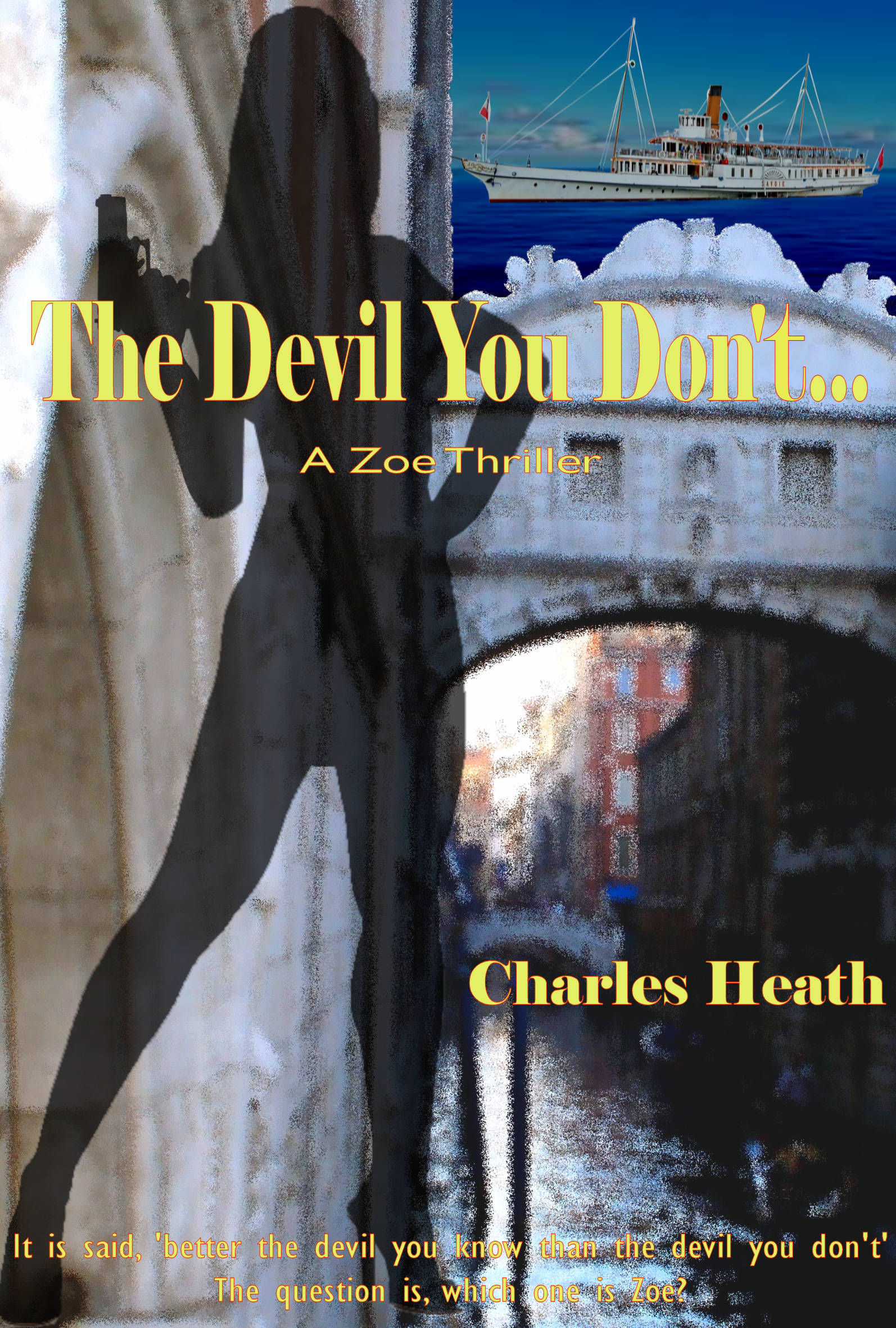
‘The Devil You Don’t’ – A beta reader’s view

It could be said that of all the women one could meet, whether contrived or by sheer luck, what are the odds it would turn out to be the woman who was being paid a very large sum to kill you.

John Pennington is a man who may be lucky in business, but not so lucky in love. He has just broken up with Phillipa Sternhaven, the woman he thought was the one, but relatives and circumstances, and perhaps because she was a ‘princess’, may also have contributed to the end result.

So, what do you do when you are heartbroken?

That is a story that slowly unfolds, from the first meeting with his nemesis on Lake Geneva, all the way to a hotel room in Sorrento, where he learns the shattering truth.

What should have been solace after disappointment, turns out to be something else entirely, and from that point, everything goes to hell in a handbasket.

He suddenly realizes his so-called friend Sebastian has not exactly told him the truth about a small job he asked him to do, the woman he is falling in love with is not quite who she says she is, and he is caught in the middle of a war between two men who consider people becoming collateral damage as part of their business.

The story paints the characters cleverly displaying all their flaws and weaknesses. The locations add to the story at times taking me back down memory lane, especially to Venice where, in those back streets I confess it’s not all that hard to get lost.

All in all a thoroughly entertaining story with, for once, a satisfying end.

Available on Amazon here: https://amzn.to/2Xyh1ow

Today was a noteworthy milestone

Not in terms of age, though it plays a small part in the event.

Not in terms of a loss, though there is loss involved in another form.

Not in terms of overt significance, but it is significant in a small way.

Today my youngest granddaughter finished her last day at primary school, that is to say, an end to the first seven years of her schooling. Next year, she will be going to secondary school, the next scholastic milestone.

I can’t remember that far back as to how it felt leaving the safety of having a single teacher and a single classroom and moving on to many teachers, many classrooms, different students, and having to organize yourself getting to each.

She is facing it with some trepidation.

But on another level, it is the last day I will be picking her up from school on a Friday, or any other day if needed, and there will be no more interesting discussions of what went on at school that day.

Some of those discussions were quite lively, some about fellow students whom she disliked, or liked, depending on how the wind blew, about the lack of talent in the talent show, of how track and field events were cancelled, and she could not get to improve in her high jumping.

And just to let you know, in grade 6 she was age champion for high jumping, not only at her school but in the local district and the region.

Track events, not so good.

Swimming, it was just fun to get in the water.

School camps, the food was terrible, the activities sucked, the other kids, they could be better.

I never went on camp, but if it is half as bad as she described it, I’m glad I didn’t.

Being the last day, we took her to what she called her ‘graduation’ lunch, so she could have her favourite meal, sushi.

Now it’s the school holidays for the next 6 or so weeks, during which she and her sister will be staying with us, and we will be going on what I call magical mystery tours, just driving around until we find something interesting. These tours have ended up in Train museums, historical exhibits, art galleries, strange restaurants, and national parks with trails and waterfalls.

I am reminded that all of this will disappear, once they get older, have new friends, even discover boys. It’s the cycle of life. Already the eldest granddaughter has turned 18, finished school, has a job, and gone out into the world.

Until then, I will cherish the moments we have, and hope, by the time I reach the old folks home, I’ll have an abundance of memories to look back on.

That helicopter story that kept me awake – Episode 38

Our hero knows he’s in serious trouble.

The problem is, there are familiar faces and a question of who is a friend and who is foe made all the more difficult because of the enemy, if it was the enemy, simply because it didn’t look or sound or act like the enemy.

Now, it appears, his problems stem from another operation he participated in, and because of it, he has now been roped into what might be called a suicide mission.

“So, Jacobi, tell me what I don’t know.”

I was taking the track slowly and keeping within a short distance of the cars behind me.  The road was little more than a dirt track, and in places, there were almost un-navigable ruts.  We would not have got a truck down this road.

He looked sideways at me.  “You know as much as I do.”

“That’s not possible.  I know nothing.  You set this up.  Tell me about the leader of this group.  Is he the heard of his own militia group?”

“An area commander of a larger group spread out across the top of the Republic, bordering onto Sudan.  They get their guns and other military hardware across that border.  Where we’re going, it’s their main camp in this location.”

“How many men will be here?”

“Twenty, thirty.  Sometimes they train new recruits.”

“Those militia back there, were they his people?”

“I don’t know.”

“I think you do, Jacobi.  And I think if you want to come out of this alive, you might consider giving me all the facts.  If they were his men, there could be ramifications if they don’t report back, especially if he was expecting to add to his payday.”

“Even if they were, there’s no communication lines out here.  They would have to report back to the camp first.  And then there’s the possibility with all the money they were supposed to collect, there might be a detour.  It’s why I think they asked for 10,000 rather than the 5,000.  The commander was going to take a cut.  Loyalty only goes so far in these places.”

“No likely surprises?”

“None that I’m aware of.  You killed them all anyway.  Dead men do not get up, walk back to come and inform.”

No, they didn’t.


A mile to go I saw the rear car stop for a few seconds and Monroe and Stark get out and disappear into the bush.  The chances were they could walk through the bush faster than we could drive on the track, and beat us there.

And, then, the checkpoint was in sight, a pair of empty petrol drums with a piece of wood across the road, each end resting on a drum.  Behind the barrier were three men, one I presumed to be the commander, the other two, guns at the ready, his guard.  Behind them was a clearing with several buildings and to one side several huts that might belong to some villagers.  There were a truck and two Toyota tray utilities parked to one side.

All in all, I could see about ten men.

When I reached the barrier, I stopped but left the engine running.  Just before we arrived, I gave the order to hide the hand weapons.  It was risky going in unarmed, but the chances were they’d take the guns if we were wearing them.  This way, if we needed them, there was a slight chance we might be able to retrieve them.

Both Jacobi and I got out.  I left my door open.  Jacobi closed his.

“Sergeant James, I presume.”  Good English, beaming smile, friendly manner.

“I think I know how Dr. Livingston felt.  I am he.”

A puzzled look for a moment, then the resumption of good nature.  He didn’t understand the nuances of British history in Africa.

There was no handshake, none was expected.  Jacobi stepped forward.  “I assume the packages are here, and in good condition.”

“Of course.  I assume that you have brought the exchange material.”

“We have.  Now, if we can just park these cars, we can get on with the exchange.”

“In a hurry, Jacobi?  Somewhere else to be?”

“Yes, as it happens.  I’m a busy man, as you are aware.”

Politeness disappeared from his face as quickly as the sun sometimes went behind a cloud.

The commander looked over towards a hut just back from the road, one I hadn’t seen from the car because it was hidden by a grove of bushes.  Two men came out.

“Move the barrier.”

As they did, he said to me, “Tell your men to get out of the vehicles and come slowly up the track.  My men will bring the vehicles into the camp.  Tell them also not to make any sudden or suspicious moves, or there will be trouble.”

A glance back showed another four of his men, also armed, appearing out of the bush towards the driver’s side of the cars.

I’d brought the radio and gave them the instructions the commander had given me.

Five minutes later we were standing outside one of the huts, the cars were parked neatly in a row, and each of us had been frisked as I thought we would.  The four who acted as drivers were now our guards, not with weapons trained on us, but they could be very quickly.

The commander waited until the guards at the checkpoint had replaced the barrier, then came striding towards us.  I could see he was counting heads and seemed perplexed by the time he reached us.

“There are men missing.  Where are they?”


© Charles Heath 2019-2021

Bloody hell… – a short story

The cell phones insistent and shrill ring dragged my mind away from the crossword, and after a fairly mild curse, I picked it up.

Sidney, my brother.  Odd he was calling me at this hour of the night.

“What,” I barked into the speaker.

“That’s no way to speak to your baby brother.”  His smooth tones rarely reached a screaming point, which was often the reason why mine did.

And who called the younger brother ‘baby’ brother these days?

“What do you want?”

A hesitation.  He was in trouble again, I could feel it.

“Can you come down to the bar.  I seem to have left my wallet at home.”  Sheepish, and just enough to stop me from yelling at him.  It was not the first time, nor would it be the last.

“I told you the last time was the last time.”

“Just this once, please?”

I shook my head.  That was probably my biggest fault, giving in to him.  After our mother had died, and our father had to work, it was left to me to bring him up.  He was going to be the death of me yet.  “Where?”

“The usual place.”

I was surprised because the last I’d heard they’d banned him from going in there.  It was only a twenty-minute walk from my apartment, but, late at night, and winter, there was snow in the air.  And the odd snowflake falling, a prelude to much worse.

About a hundred yards from the bar I had a shiver go down my spine.  I’d not had that for a long time, not since school, and the trouble with Wiley, the school bully.  Wiley had graduated to the local thug, done a few stints in jail, and last I heard he had been sent down for a few years for an assault.

I stopped and took a moment.  Perhaps karma was trying to tell me something.

I shrugged.  Just in my imagination.  I reached the door, took a moment then went in.  He was standing by the bat looking a little apprehensive.  He was in more trouble than just not paying his bar bill.

Close up I could see the fear in his expression.  “Bloody hell, Sid, what have you done now?”

“A problem that he insists his older brother would be happy to pay for.”

I knew that voice and felt instant dread.

Wiley.

In the flesh, and not looking very happy at all.

© Charles Heath 2020-2021