It all started in Venice – Episode 8

Cecilia and Juliet – trouble

How do you run into someone by accident, or randomly when it is neither an accident or random?

There was that problem of looking obvious, that it was staged, that, well you get the idea.

O was hoping staying at the same hotel on the same floor would solve the problem, but when I thought about it, living in Venice, why would I be staying in a hotel?

There was that unofficial reason I’d told Cecilia, that I was renovating, just in case of prying ears, but I was a bit slow in picking up on the new surveillance team Larry had out on Juliet, do he’d know what  I was up to, and if he informed Juliet, then it would ruin the surprise.

It all depended on whether or not the surveillance team was aware of who I was, which could be unlikely, given Giuseppe’s lack of recognition of my identity.  Larry’s mistrust of her might yet work to my advantage.

Then there was the name Juliet knew me by which was not the one Cecilia knew me, so I had to make sure that story was straight between us just in case she was with me when I ran into Juliet.

The trouble was, it was becoming a logistical nightmare.

So, it was rather a surprise when we finally did run into each other, in the restaurant the following morning after Cecilia arrived, and we were just sitting down.

I hadn’t seen Juliet, tucked away in a corner, not until she called out.  And I was with Cecilia, who was the consummate actor.

I heard my name and turned.  Cecilia looked over then sat.  I went over.

“What are you doing here, of all places?”

Was there a note of suspicion or surprise in her tone?

“I’m with an old friend, Cecilia, she’s in Venice for the film festival.  She’s an actor you know.  I didn’t until she called me.”

Juliet gave Cecilia the once over, then looked back at me.  I could see the unspoken question, ‘you still haven’t answered the question’.

“She needed a place to stay and my place is a renovator’s nightmare, so I decided to stay here with her for the duration.”

“Together?”

Not the first thing I expected from her.

“No, separate rooms.  She’s a bit above my pay grade.”

“Oh.”

“We’re off to the festival, she’s agreed to show me around, but if you’re free tonight perhaps we could meet up?  Dumb question, but what are you doing here?”

“I’m staying here.”

“Are you.  No surprise, of course, it’s a good hotel.  I guess we have the same taste in hotels.  Good to see you again, but I’d better go.”

I’d looked around a few times and Cecilia was making to sort of gestures an impatient movie star, ex-girlfriend type might make.

“You’d better go.  I’ll think about it.”

I could see her, ‘this is not a coincidence, look in her eyes and thought it oddly amusing.

Back at the table where Cecilia was waiting, she had been looking covertly in Juliet’s direction.  I sat down.

“She an old girlfriend, or something?”

“Or something.”

“You can tell.  I could feel the death stare.”

“That train left the station a long time ago.”

“Then someone forgot to tell her.  That whole encounter seemed very odd from where I’m sitting.”

“It was.  I asked her for dinner, but I’m not expecting a reply.  It caught me off guard.”

“Then a small suggestion, get your head back in the game.”

She was right.  Catching me by surprise put me on the back foot, and being so meant that the distraction could cause trouble.  I could remember back to the old days, and the training instructor’s words, ‘it only takes a fraction of a second, and you’re dead’.

He was right, it had happened once and I barely survived, coincidentally just before the first time I met Juliet.  That incident kept me vulnerable, a feeling I had hated at the time.

I glanced over at Cecilia, submersed in a text exchange on her cell phone, the conversation playing out in expressions, one of which was quite dark.

But, nevertheless, at least one of us was prepared.  I wondered if Rodby had spoken to her.  He knew of my association with Juliet, before Violetta, and the effect it had on me, especially after the mission that had almost left me broken.

And that, I thought, was another reason for my momentary loss of control; the effect she had on me when I was not prepared, not like the last encounter.  Taking me by surprise, she could still bring those old feelings to the surface, feelings I didn’t want to deal with.  I was still getting over the loss of Violetta which until this moment I had thought I was in a good place.

The text exchange ended.

“Trouble in paradise?” I asked.

“Men can be such idiots sometimes.”

“I know.  Who is he and do you want me to deal with him?”

“A pleasant thought, but no.  I can do that, but you might have to deal with Juliet by yourself.  Oh, she’s coming over.”

By the time I looked up, she was next to me.  “Tonight, here.  Bring your friend if you like.”  Juliet gave her a meaningful glare.

“Sorry, got to attend to man troubles.”

“Sorry to hear that.”  Back to me.

“Eight OK?”

“Fine.  See you then “

I watched her leave the restaurant, not sure what she hoped to gain other than once again to put me on the back foot.

“She has surveillance, the girl who looks like a librarian on holiday, by the door.”

I’d seen her before.  “There’ll be another.  Larry seriously doesn’t trust Juliet.”

“Of course.  French guy, pink shirt, so obvious you’d not think it was him.  Watch yourself.  I have to go for a while but don’t worry, I can find you later.  We need to talk about tonight.”

“Yes.  Later, then.”

© Charles Heath 2022

The cinema of my dreams – I always wanted to go on a treasure hunt – Episode 70

Here’s the thing…

Every time I close my eyes, I see something different.

I’d like to think the cinema of my dreams is playing a double feature but it’s a bit like a comedy cartoon night on Fox.

But these dreams are nothing to laugh about.

Once again there’s a new installment of an old feature, and we’re back on the treasure hunt.

The beach, and a body

I had expected to find the rocks we were slowly and carefully chambering over to be smooth, worn down by the constant washing over by the waves.

They were, to a certain extent, but there were places where the jagged edges were as sharp as a knife, and I had more than one cut on my hand.

Even with the stiff breeze coming in off the water, it was still hot, laborious work and it took over an hour to reach the first part of Sandy Beach, a thin strip below the rock line, and soaring behind it, a rocky cliff face that would required rock climb training to scale, and then notwithstanding a lot of safety gear.

It didn’t surprise me that Nadia was an expert rock climber.  She was built like a finely tuned cat, as lithe and graceful moving across the hazards.

At times she held my hand, keeping me from falling off, or worse, into danger, and certain injury.  At times, I didn’t want to let go.

Then on the windswept beach, she looked every bit the conqueror, hair blowing in the breeze, completely ignoring the conditions.  She belonged here, I didn’t.

The beach stretched for 200 yards or so and was, at times, up to 50 feet wide. Nothing had walked on this beach since the last tide, but more than likely, not for a long time because it was inaccessible from the shoreline unless you were a rock climber

But it was private land, and a fading sign, with Ormistons fading name at the bottom, told anyone who came ashore that trespassers would be prosecuted.

And, I thought. If they survived the reefs, at this tide semi-exposed and covered the whole of the distance.  No boat could get through. 

That also meant it was highly unlikely that the pirate had landed here, but we did a sweep with the metal detectors.  I had my hopes built up where my detector started making a lot of noise, but it was only a cupboard door with a metal hinge that had set it off, a bit of flotsam washed ashore.

We were both disappointed, then lamenting our luck or lack of it, we started heading towards the neck stretch of sand, barely discernable in the distance, but not before another hazardous trek across the rocks.

It took half an hour carefully picking our across the rocks before it was good to be on the sand again.  I helped her down from the rock perch and took a moment to rest.

“Did you see something further up the beach, just before you jumped?”

I had, but I thought it was the carcass of a beached fish. Perhaps a dolphin that had been savaged by sharks.  Or just a lump of kelp, of which some was scattered along the Highgate line.

“It might be just kelp.  Or more flotsam.  I’m sure we’ll soon find out.”

We also had to keep an eye on the tide, having started out just ashore or so before low tide, giving ourselves sufficient time to search and get back.

This part of the shoreline was longer, and closer to the edge of the property line, accessible only by climbing the rocks that jutted out into the sea, not exactly the easiest of tasks.  In fact, it served as a deterrent, and as far as Nadia was aware, no one had ever scaled that cliff face.

The object on the ground was no closer to being identified from a distance, but now, closer, it looked to me like it might be a body, my first thought, another of the Cossatino’s hit jobs, the shore being so remote it would never be discovered.

“That’s a body,” I heard the panic in her tone, right behind me.

We both dropped the detectors and ran, discovering as we came up to it, that we were both right.

It was covered from head to toe in black, including a balaclava covering the face.  It was impossible to tell what sex it was, lying front down with the head tilted to one side as if the ocean had washed it ashore.

The fact there were no tears in the clothing told me, I’d there were reefs out there, the body had not been washed ashore.  Just how did it get there.

These were all momentary thoughts because there was a more urgent thing to be done

“Help me roll it over,” I said.

She took the bottom half and I the top and gently lifted it just enough to turn it over onto the back, then I slowly pulled the balaclava off.

As soon as I saw the face, bruised and swollen, I knew who it was.

Nadia shrieked, then said, “What the hell is he doing here?”

The missing Boggs.

I could tell by the look on her face she was assuming her family had something to do with him being here.

But, all that aside, I tried not to panic, or let my surprise or shock take over, letting the medical training I’d received during a stint with the local fire station take over, first checking to see if he had a pulse.

It was faint, but there.  That meant we needed medical help. And fast.  I pulled my phone out and checked for a signal.  Then, with maps, got our location.  There was something familiar about the numbers, but their significance eluded me.  There were bigger problems to worry about.

Then I dialed 911, and when they answered, described the situation, gave them the location, and with a few other instructions to me from the dispatcher, I went back to Boggs.

By this time Nadia was beside him, wiping his face gently with tissues she must have had in her pocket.  I tried not to give her the impression I blamed her family for his situation, simply because that might not be the case.

The last time I saw him he had a rope and his mother had said he was an experienced climber.  And with his proximity to the cliff face, it wasn’t hard to put two and two together.

I checked his pulse again and listened closely to his breathing, shallow with a slight rattle.  I unzipped his jacket and lifted his shirt, and could see the discoloration from bruising.  It was possible he slipped, or lost his footing, and crashed against an outcrop, knocking himself out, or falling to the ground with the same effect.  A closer inspection showed the bare minimum of climbing equipment set up, and now, looking closer at the cliff face, I could see the rope dangling, but stopping short by about 20 feet.

Nadia didn’t speak, but I could see she was scared.

I touched her on the shoulder and she jumped.

“It’s not your fault,” I said.

“But it could be…”

“I don’t think so.  He looks like he tried coming down the side of the cliff and slipped or fell.  I think he may have collapsed here, but the tide has removed any foot or drag marks so it’s hard to tell what happened.”

“Why not go the way we did?”

“He might not know about it or considered it too far.  Or the climbing fanatic in him took over.  I have to say, I never knew he was a climber, in fact, there’s probably a lot I don’t know.  Maybe if I’d spent more time with him this mightn’t have happened.”

While waiting I called Boggs mother and relayed what had happened, where he’d been taken and the prognosis, which was good.  He was in no danger of dying, though had he not been found, that would have been a different story.  Then I called the sheriff’s office to let them know, but he had already had the news passed on, and I said I would drip in and answer any questions they might have.  I guess Boggs might have to explain why he was trespassing. 

Not long after that, I turned to look back towards the way we’d just come in response to the sound of a helicopter.  If it was, that was a remarkably quick response time.  When it came closer I could see it was one of the Coast Guards’ distinctive red Sikorski’s, which was surprising.

The helicopter veered inland and the sound of the approach was somewhat muffled.  I had thought they might come on on a sea approach, but then it occurred to me it might be an opportunity to fly over the Cossatino kingdom, having a legitimate excuse to do so.  Then it crossed the cliff line with a roar, and hovered while the pilot assessed a landing spot.

I could see several people at the side door making preparations as the pilot brought it down, gently landing on the sand.  As soon as it touched down two men jumped out, one, I assumed, a medic.

“You were quick.”

It had been less than a half-hour since I called.

“We just wrapped up at another accident.  What do we have here?”

I went through all the things I’d done and ended by showing him the chest bruising.

His was a more thorough check and confirmed what I’d discovered, no broken bones, possible cracked ribs, or sprains to both ankles, indicating he had fallen a short distance.

A stretcher was brought over, and they carefully put Boggs on it, then took him to the helicopter, the whole operation taking no more than ten minutes.  I declined the offer of going back with him, there being space only for one other passenger.  He gave me the name of the hospital they would be taking him to, and I watched the helicopter leave.

The whole time Nadia had kept her distance, and, I’d noticed, glanced up the cliff.  Did she think the arrival of a helicopter on their beach would summon a posse of Cossatinos?  That thought had also occurred to me, especially where there were signs, now somewhat faded, that said trespassers would be shot on sight.

I looked too.

And saw something I had not expected to see.

© Charles Heath 2020-2022

Writing about writing a book – Day 5 continues – The complications of life

I hate it when other characters are drawn in, and without a proper introduction, the reader gets confused.

Well, let me tell you, the writer can get confused too.

The introduction of Jennifer cannot go without the introduction of Ellen Bill’s ex-wife, and we have talked a little about her background before.

She has a role, one that will have a major impact later on, but every now and then she is going to appear, adding to the backstory between her and Bill.  There is no real animosity between them, their parting amicable because both knew it was time to end.

Bill’s problems were brought about his military service, and her father has a part to play in the story, though I’m not sure how to weave this in yet.  But it’s not so much what Bill remembers of his service, but of what he has forgotten, or more to the point buried.

That will eventually rise to the surface.

However, at this time, it’s still at the part where the narrator has to introduce Jennifer.

There are three distinct stages to this relationship between the two most important characters, and as it happens it’s Ellen unknowingly that brings Bill and Jennifer together,


Then Ellen, my estranged, and sometimes difficult wife decided she wanted a divorce.  I had no objection, and that was most likely the problem.  Perhaps she had expected me to fight for her, but she had made it clear, many years before, that she was no longer interested in preserving the marriage and was only keeping it up until our two daughters were old enough to fend for themselves.

That time had come.

I found myself in a situation where I needed someone to talk to.  I was not one of those people who made friends easily, nor did I spend much time seeking the company of other women.  I had my work, and it had been enough.

But Ellen’s request for a divorce, for some reason, had shaken me, and the day I got the phone call, Jennifer has bustled into my office as she always did, dumping the pile of log file printouts on my desk, and instead of leaving, perhaps she had seen my look of dismay, or more to the point, utter shock, and stayed.

It caused a slight change in our relationship.


I’m still working on it, but there will be more.

Or fewer words perhaps, after all, it’s only meant to be a brief introduction.

See how simple things become complicated, very quickly.


© Charles Heath 2019

The Perils of Travelling: Every plane trip is different

Brisbane to Melbourne – First time flying after the pandemic

So, it’s the end of the restrictions induced by the pandemic, and against my better judgement, we’re travelling again.

The pandemic is not over, it’s just we’ve moved it to one side and trying our best to ignore it.  Try as we may, it ain’t going nowhere.

But we can’t all stay locked up forever.

It’s been over two years since we’ve been to Melbourne where our relatives are, and it’s going to be a two-and-a-half-hour flight, wearing masks, and hoping against hope there’s no one with Covid on the plane.

It’s a forlorn hope, by the way.

These days people have it but aren’t isolated because they can’t afford to.  All the government handouts are finished, making it impossible for people not to be working.

Of course, the country had a very high vaccination rate, and I’m covered, having just had a booster.  If comes died to susceptibility, and so far I’ve managed to avoid it, even with my better half working in an office where nearly everyone has had Covid at some time or other, and at a stage where it could be passed on 

Perhaps it’s just been blind luck.

Going on this plane will be a good test.

We decided to park the car for the six days in the long-term car park.  We were going to get dropped off but it was wet, raining very hard, and the roads were a nightmare, with ghastly traffic jams.

Our driver would have been out recently licence’s granddaughter and it would have been too much for her, even though she wouldn’t say no.

The walk from the car park was long but direct.  Sometimes it can be convoluted when having to park on the higher floors.  We’re on the ground, and it’s easy just to jump in the car and drive out.

Inside the terminal building, its masks on.  This place doesn’t recognise the end to mask restrictions, so the threat of covid I’d very real.  I hope they got that memo on the plane.

It would be pre-flight entertainment if they had to bodily drag a dissenter off kicking and screaming, or dies that only happen in America?

The food choices are still as appalling as they were before the pandemic, and I still don’t get why all the reasonably good choices are down one end, and, you guessed it, not the end we’re departing from.

I go for a walk, but an angry customer returning half-cooked food puts me off everything until I got a chicken schnitzel roll, which after I got it failed to show any sign of chicken, schnitzel or otherwise.

It did have ham, slightly dry around the edges, cheese, tomato, and lettuce, sad the roll itself was quite tasty, so a three out of ten for trying.

The price, like all airport food, nearly broke the bank.  But here’s the thing, they wouldn’t charge it if people didn’t pay it, so it’s everyone else’s fault!

Of course, we wouldn’t need to buy food, if you could call it that, before getting on the plane if the miserly airlines weren’t cutting costs, i.e. food, to make that extra buck to put in the CEO annual bonus.

Once, the meal options were quite good, but over time, these have got less and less and less, until now if you get a cookie, you’re lucky.

It will be interesting to see how further the standards have fallen, anywhere hearing sane said CEO wailing about not being able to fly during the pandemic, showing that he is more concerned about profits than passenger safety.

All while everyone else is citing the mantra, ‘your safety is our priority’.  I guess one day the message might come from the top down, but I won’t be holding my breath.

I read up on the safety procedures they implement in between flights so I’m expecting to get on a disinfectant-smelling plane with shiny clean surfaces.  It would be a huge improvement over that which prevailed before the pandemic where planes could be anything from apparently clean to don’t look below the surface.

Like I said, having not flown for so long, and the fact the pandemic is anything but dead and buried, there are so many things that could go wrong.

Meanwhile, we’re sitting in the gate lounge ticking off the minutes before boarding.  No matter what changes Covid had brought, that will be the same, people ignoring the seat road loading instructions and others pushing in as though the plane might leave without them if they didn’t.

Good News!

The incoming flight is here, 20 minutes before boarding time, so we’re going to be late leaving.

Or will they sacrifice the deep cleanse?

Stay tuned.

News flash…  9ur crew is coming in on another flight which is running late, no, just landed, so they have to finish up there, and come on over, go through pre-flight, and then we can board.

Yep, we’re going to be late leaving.  Who would have guessed?

Boarding as always is amusing but it’s made even more so by the constant reminder to keep our distance from other passengers, and if you can’t, and as you know sardines have nowhere to go, we should rely on the mask.

Wow.  These people seem to think masks will save us.  Sadly, they won’t, but they know that.  But it looks good and makes them feel better while cramming people into their small planes.

We were supposed to leave at 6:15 pm.  The late arrival of the operating aircraft and waiting for the crew from yet another late-arriving aircraft takes its toll.  

Good news though.  More time to clean the plane.  It looks clean, but there’s no tell-tale disinfectant aroma, so what did they do?

6:37 push back.  Overall, it’s not a bad result, pushing back 22 minutes late.  It’s time, they say, they can make up in the air.

They allow 2 hours and 20 minutes for the end-to-end departure and arrival from and at the gate.  The actual flying time, give or take, is 1 hour and 45 minutes, so we have 45 minutes for taxiing.

6:47 take off, so 1 hour 45 minutes added means we have a touch-down time of 8:32.  Our scheduled arrival time was 6:15 plus 2 hours and 20 minutes, so it would be 8:35.  Three minutes from touch-down to disembarking at the gate.

I don’t think so.

We’ll just have to wait and see.

I must have dozed off for a few minutes because the next thing that happens is food service, and it’s going to be arancini balls, which I like, so it sounds good.  But it’s airline food so it will be interesting

Something else that’s bordering me, the woman on the seat next to me gas a persistent cough.  Mask or no mask this is a problem, especially if she had Covid, and doesn’t know it yet.  Or it’s symptomatic or something else. 

I’m immuno-compromised so anything floating around in that tin can I’m likely to be susceptible to.  Time will tell if it’s serious.

Past that fear, the balls were delicious, all four of them, and a coke for a drink.  We’ve moved on from tea and coffee, and polite flight attendants, because they insisted, that we keep masks on till after they passed handing out the food.

It shows the staff have no faith in the company’s health directives, so they know each flight they’re dicing with death.

Scary thought. 

But, all’s well that ends well, and we make up the time and end up being 7 minutes late which is acceptable in anyone’s language.

8:37 on the runway with a bang, the pilot or co-pilot has not fully learned the subtle art of getting the plane on the ground at the end of a gentle drop from the sky. Those asleep are unceremoniously wakened, thinking the plane has crashed.

8:42 at the gate. It’s always a short time from landing to gate, the pilot wants to get an early night. It would not be the first time we are leaving the plane and the pilots are long gone. One of the advantages of being at the front of the plane!

My take on travelling by plane in the post-pandemic world, it’s too soon and vaccinated or not, we are all still susceptible to getting the virus and it is killing us.  I have to travel home yet, but I have to hope the lady in the next seat hasn’t hexed me.

Not after dodging it for so long by keeping myself safe, a proper distance between me and the rest of the world, and keeping away from those in isolation, because those few I could trust would stay in isolation.

For the rest of the world, when money is the driving object to disobey or flout the rules, they become a serious problem, one that nothing is going to overcome, and therefore we will quite feasibly never get rid of the virus.

Let’s hope the trip back is less traumatic.

The cinema of my dreams – It’s a treasure hunt – Epilogue

Here’s the thing…

Every time I close my eyes, I see something different.

I’d like to think the cinema of my dreams is playing a double feature but it’s a bit like a comedy cartoon night on Fox.

But these dreams are nothing to laugh about.

Once again there’s a new installment of an old feature, and we’re back on the treasure hunt.

A little treasure!

After a hot day, it was now the middle of the night, still quite warm, but a thunderstorm had just passed and the sound of the residual rain on the tile roof and plants outside the windows was soothing.

Nadia stirred momentarily beside me, and although it was quite dark, I could see the outline of her body and had to resist the temptation of running my finger along the contours.

She was the most beautiful girl in the world to me and had made the transition from a nervous, even frightened, young man, into something I never thought I could be, and I loved her more than anything else in the world

It was nearly a year now since the events back home, and still, whenever I closed my eyes, all I could see was Boggs, wide-eyed and eager to find that missing treasure, not knowing it was a fruitless and eventually deadly quest, not only for him but everyone in his family.

And I still blamed myself for what happened.

Shortly after Mrs. Boggs last stand, she died.  There had been a third bullet, one that the paramedics hadn’t detected, that eventually killed her, but from the last words I heard her speak, just before the paramedics took her to the hospital, it was clear she wanted to die.

I could understand that, and perhaps in the same place, I would too.

My mother was beside herself when she found out what happened, not only because Benderby was dead, and her chances of getting out of the poverty cycle swiftly taken away, but of what might have happened to me.

An alternative suitor, the sheriff, was off the table because of his actions, so it was a sorry sight to see her back where she had started, alone, and the mother of an inquisitive, impetuous young man who should be making something of himself.

Sadly, all I wanted to was crawl into a hole and stay there, not only because of my role in the whole mess, but the fact Nadia had inexplicably disappeared, nowhere to be found and not answering her phone.

To be honest, I was not surprised.  Anyone in their right mind would not see me as anything but trouble.

The funeral of Boggs, and his mother, was a sad affair attended by seven people, the sheriff, Charlene, Rico, three women who had known her, and myself.  It rained that day, with thunder and lightning of such ferocity, it was like God was making a statement.

So wrapped up in my grief I failed to notice a hand slipping into mine and a head leaning on my shoulder, until a whisper, “Sorry I’m late,” told me it was the missing girl of my dreams, Nadia.

I guess that was the first day of my new life.

Within a week, I left behind the last vestiges of my life in that dismal town and got on a very large airplane, for the first time in my life, heading for a new world, and new possibilities.

Nadia had made it all happen, not only for me, but also for my mother, who was reluctant at first, but warmed to the idea because I told her I was never coming back.

We moved to Italy, to a large vineyard in Tuscany, near a town with a funny name, though it wasn’t funny to those who lived there.

We lived with the other family members in a large villa in our own large room, in what used to be an old factory.  Community and family were everything to these people, and when they realized Nadia loved me as much as I loved her, I and my mother became family, and it was like we always had been.

We had work, we had leisure, we had each other.  The work was hard but satisfying.  We got married and had a traditional wedding where the family all came to eat, drink, and be merry.

Life was, indeed, beautiful.

“Still having bad dreams?” A voice whispered in my ear.

Nadia was used to my restlessness.

“It’ll probably take a little more time, but I guess eventually I’ll get past it.”

Time, as they say, was supposed to heal all wounds.  It was a belief I fervently wanted to believe.

“Perhaps what you need is something to take your mind off everything.”

I knew that voice, and Nadia at her most mischievous was something to behold.

“Oh, and what’s that?”

“Some news.  I was waiting until our anniversary tomorrow, but I think now is the time.”

Nadia was one of those girls who had anniversaries for everything, first meeting, first kiss, first, well you get the idea.  I was just trying to think of what this one was.  Unfortunately, I was one of those boys who could never remember anything like that.

And over the last day or so, she had been particularly happy, for the first time since we arrived where she now called home.  The problems with her parents, what happened to Vince although he was only a stepbrother, and the fallout from the treasure hunt, it had taken a toll she had tried very hard to hide.

Being home, among her real family, the wedding, the purpose, and the satisfaction of work helped, but we both had our demons to deal with, and each of us strived to help the other as much as we could.

But it was like something was missing, like that single sky piece in a jigsaw puzzle.

And then I knew.

© Charles Heath 2020-2022

An excerpt from “What Sets Us Apart”, a mystery with a twist

See excerpt from the story below, just a taste of what’s in store…

http://amzn.to/2Eryfth

whatsetscover

McCallister was old school, a man who would most likely fit in perfectly campaigning on the battlefields of Europe during the Second World War. He’d been like a fish out of water in the army, post-Falklands, and while he retired a hero, he still felt he’d more to give.

He’d applied and was accepted as head of a SWAT team, and, watching him now as he and his men disembarked from the truck in almost military precision, a look passed between Annette, the police liaison officer, and I that said she’d seen it all before. I know I had.

There was a one in four chance his team would be selected for this operation, and she had been hoping it would be one of the other three. While waiting for them to arrive she filled me in on the various teams. His was the least co-operative, and the more likely to make ad-hoc decisions rather than adhere to the plan, or any orders that may come from the officer in charge.

This, she said quite bluntly, was going to end badly.

I still had no idea why Prendergast instructed me to attend the scene of what looked to be a normal domestic operation, but as the nominated expert in the field in these types of situations, it was fairly clear he wasn’t taking any chances. It was always a matter of opinion between us, and generally I lost.

In this case, it was an anonymous report identifying what the authorities believed were explosives in one of the dockside sheds where explosives were not supposed to be.

The only reason why the report was given any credence was the man, while not identifying himself by name, said he’d been an explosive expert once and recognized the boxes. That could mean anything, but the Chief Constable was a cautious man.

With his men settled and preparing their weapons, McCallister came over to the command post, not much more than the SUV my liaison and I arrived in, with weapons, bulletproof vests, and rolls of tape to cordon off the area afterward. We both had coffee, steaming in the cold early morning air. Dawn was slowly approaching and although rain had been forecast it had yet to arrive.

A man by the name of Benson was in charge. He too had groaned when he saw McCallister.

“A fine morning for it.” McCallister was the only enthusiastic one here.

He didn’t say what ‘it’ was, but I thought it might eventually be mayhem.

“Let’s hope the rain stays away. It’s going to be difficult enough without it,” Benson said, rubbing his hands together. We had been waiting for the SWAT team to arrive, and another team to take up their position under the wharf, and who was in the final stages of securing their position.

While we were waiting we drew up the plan. I’d go in first to check on what we were dealing with, and what type of explosives. The SWAT team, in the meantime, were to ensure all the exits to the shed were covered. When I gave the signal, they were to enter and secure the building. We were not expecting anyone inside or out, and no movement had been detected in the last hour since our arrival and deployment.

“What’s the current situation?”

“I’ve got eyes on the building, and a team coming in from the waterside, underneath. Its slow progress, but they’re nearly there. Once they’re in place, we’re sending McKenzie in.”

He looked in my direction.

“With due respect sir, shouldn’t it be one of us?” McCallister glared at me with the contempt that only a decorated military officer could.

“No. I have orders from above, much higher than I care to argue with, so, McCallister, no gung-ho heroics for the moment. Just be ready to move on my command, and make sure you have three teams at the exit points, ready to secure the building.”

McCallister opened his mouth, no doubt to question those orders, but instead closed it again. “Yes sir,” he muttered and turned away heading back to his men.

“You’re not going to have much time before he storms the battlements,” Benson quietly said to me, a hint of exasperation in his tone. “I’m dreading the paperwork.”

It was exactly what my liaison officer said when she saw McCallister arriving.

The water team sent their ‘in position’ signal, and we were ready to go.

In the hour or so we’d been on site nothing had stirred, no arrivals, no departures, and no sign anyone was inside, but that didn’t mean we were alone. Nor did it mean I was going to walk in and see immediately what was going on. If it was a cache of explosives then it was possible the building was booby-trapped in any number of ways, there could be sentries or guards, and they had eyes on us, or it might be a false alarm.

I was hoping for the latter.

I put on the bulletproof vest, thinking it was a poor substitute for full battle armor against an exploding bomb, but we were still treating this as a ‘suspected’ case. I noticed my liaison officer was pulling on her bulletproof vest too.

“You don’t have to go. This is my party, not yours,” I said.

“The Chief Constable told me to stick to you like glue, sir.”

I looked at Benson. “Talk some sense into her please, this is not a kindergarten outing.”

He shrugged. Seeing McCallister had taken all the fight out of him. “Orders are orders. If that’s what the Chief Constable requested …”

Madness. I glared at her, and she gave me a wan smile. “Stay behind me then, and don’t do anything stupid.”

“Believe me, I won’t be.” She pulled out and checked her weapon, chambering the first round. It made a reassuring sound.

Suited up, weapons readied, a last sip of the coffee in a stomach that was already churning from nerves and tension, I looked at the target, one hundred yards distant and thought it was going to be the longest hundred yards I’d ever traversed. At least for this week.

A swirling mist rolled in and caused a slight change in plans.

Because the front of the buildings was constantly illuminated by large overhead arc lamps, my intention had been to approach the building from the rear where there was less light and more cover. Despite the lack of movement, if there were explosives in that building, there’d be ‘enemy’ surveillance somewhere, and, after making that assumption, I believed it was going to be easier and less noticeable to use the darkness as a cover.

It was a result of the consultation, and studying the plans of the warehouse, plans that showed three entrances, the main front hangar type doors, a side entrance for truck entry and exit and a small door in the rear, at the end of an internal passage leading to several offices. I also assumed it was the exit used when smokers needed a break. Our entry would be by the rear door or failing that, the side entrance where a door was built into the larger sliding doors. In both cases, the locks would not present a problem.

The change in the weather made the approach shorter, and given the density of the mist now turning into a fog, we were able to approach by the front, hugging the walls, and moving quickly while there was cover. I could feel the dampness of the mist and shivered more than once.

It was nerves more than the cold.

I could also feel rather than see the presence of Annette behind me, and once felt her breath on my neck when we stopped for a quick reconnaissance.

It was the same for McCallister’s men. I could feel them following us, quickly and quietly, and expected, if I turned around, to see him breathing down my neck too.

It added to the tension.

My plan was still to enter by the back door.

We slipped up the alley between the two sheds to the rear corner and stopped. I heard a noise coming from the rear of the building, and the light tap on the shoulder told me Annette had heard it too. I put my hand up to signal her to wait, and as a swirl of mist rolled in, I slipped around the corner heading towards where I’d last seen the glow of a cigarette.

The mist cleared, and we saw each other at the same time. He was a bearded man in battle fatigues, not the average dockside security guard.

He was quick, but my slight element of surprise was his undoing, and he was down and unconscious in less than a few seconds with barely a sound beyond the body hitting the ground. Zip ties secured his hands and legs, and tape his mouth. Annette joined me a minute after securing him.

A glance at the body then me, “I can see why they, whoever they are, sent you.”

She’d asked who I worked for, and I didn’t answer. It was best she didn’t know.

“Stay behind me,” I said, more urgency in my tone. If there was one, there’d be another.

Luck was with us so far. A man outside smoking meant no booby traps on the back door, and quite possibly there’d be none inside. But it indicated there were more men inside, and if so, it appeared they were very well trained. If that were the case, they would be formidable opponents.

The fear factor increased exponentially.

I slowly opened the door and looked in. A pale light shone from within the warehouse itself, one that was not bright enough to be detected from outside. None of the offices had lights on, so it was possible they were vacant. I realized then they had blacked out the windows. Why hadn’t someone checked this?

Once inside, the door closed behind us, progress was slow and careful. She remained directly behind me, gun ready to shoot anything that moved. I had a momentary thought for McCallister and his men, securing the perimeter.

At the end of the corridor, the extent of the warehouse stretched before us. The pale lighting made it seem like a vast empty cavern, except for a long trestle table along one side, and, behind it, stacks of wooden crates, some opened. It looked like a production line.

To get to the table from where we were was a ten-yard walk in the open. There was no cover. If we stuck to the walls, there was equally no cover and a longer walk.

We needed a distraction.

As if on cue, the two main entrances disintegrated into flying shrapnel accompanied by a deafening explosion that momentarily disoriented both Annette and I. Through the smoke and dust kicked up I saw three men appear from behind the wooden crates, each with what looked like machine guns, spraying bullets in the direction of the incoming SWAT members.

They never had a chance, cut down before they made ten steps into the building.

By the time I’d recovered, my head heavy, eyes watering and ears still ringing, I took several steps towards them, managing to take down two of the gunmen but not the third.

I heard a voice, Annette’s I think, yell out, “Oh, God, he’s got a trigger,” just before another explosion, though all I remember in that split second was a bright flash, the intense heat, something very heavy smashing into my chest knocking the wind out of me, and then the sensation of flying, just before I hit the wall.

I spent four weeks in an induced coma, three months being stitched back together and another six learning to do all those basic actions everyone took for granted. It was twelve months almost to the day when I was released from the hospital, physically, except for a few alterations required after being hit by shrapnel, looking the same as I always had.

But mentally? The document I’d signed on release said it all, ‘not fit for active duty; discharged’.

It was in the name of David Cheney. For all intents and purposes, Alistair McKenzie was killed in that warehouse, and for the first time ever, an agent left the Department, the first to retire alive.

I was not sure I liked the idea of making history.


© Charles Heath 2016-2020
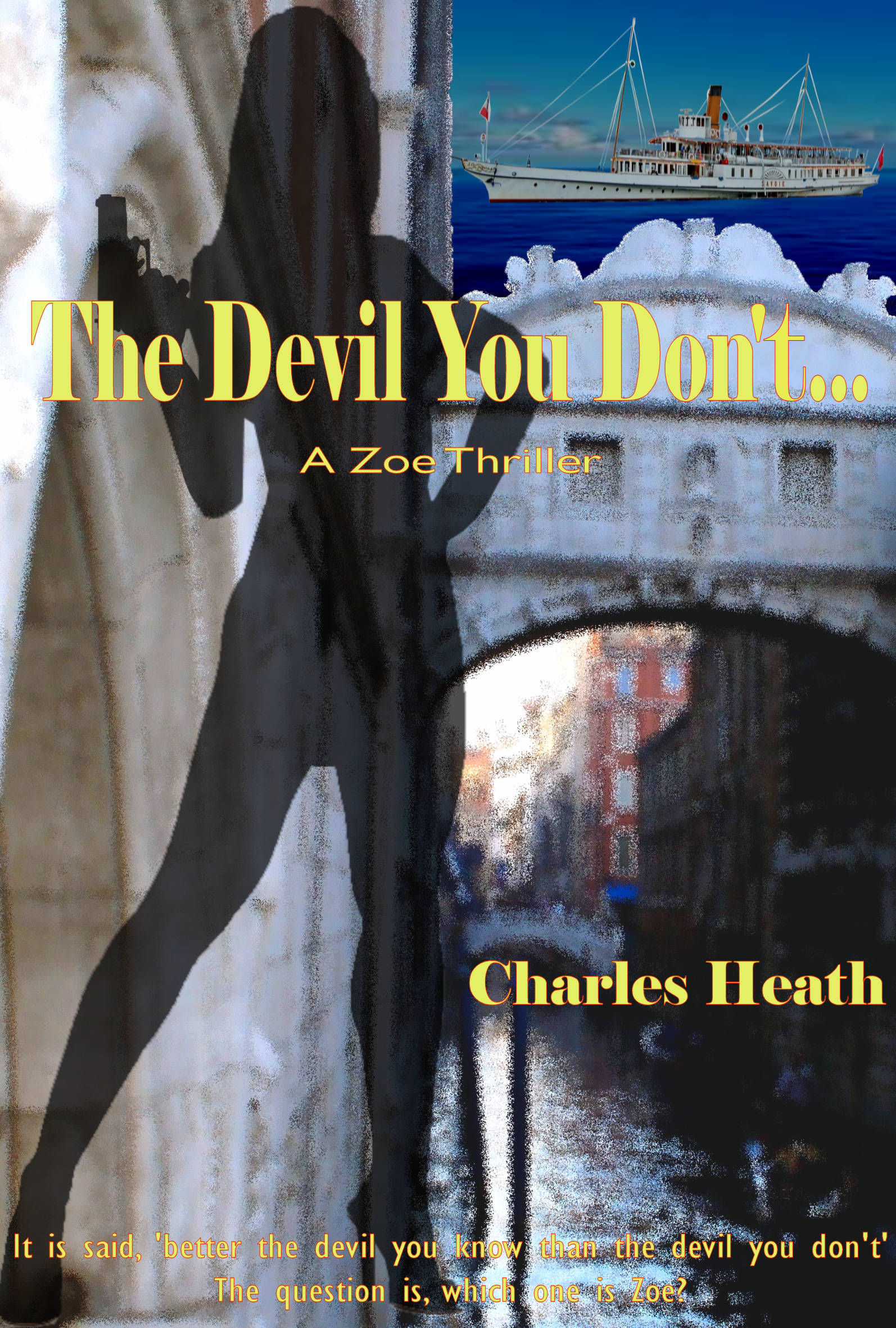
“The Devil You Don’t” – A beta readers view

It could be said that of all the women one could meet, whether contrived or by sheer luck, what are the odds it would turn out to be the woman who was being paid a very large sum to kill you.

John Pennington is a man who may be lucky in business, but not so lucky in love. He has just broken up with Phillipa Sternhaven, the woman he thought was the one, but relatives and circumstances, and perhaps because she was a ‘princess’, may also have contributed to the end result.

So, what do you do when you are heartbroken?

That is a story that slowly unfolds, from the first meeting with his nemesis on Lake Geneva, all the way to a hotel room in Sorrento, where he learns the shattering truth.

What should have been a high turns out to be something else entirely, and from that point every thing goes to hell in a handbasket.

He suddenly realises his so-called friend Sebastian has not exactly told him the truth about a small job he asked him to do, the woman he is falling in love with is not quite who she says she is, and he is caught in the middle of a war between two men who consider people becoming collateral damage as part of their business.

The story paints the characters cleverly displaying all their flaws and weaknesses. The locations add to the story at times taking me back down memory lane, especially to Venice where in those back streets I confess it’s not all that hard to get lost.

All in all a thoroughly entertaining story with, for once, a satisfying end.

Available on Amazon here: https://amzn.to/2Xyh1ow

The cinema of my dreams – It’s a treasure hunt – Episode 90

Here’s the thing…

Every time I close my eyes, I see something different.

I’d like to think the cinema of my dreams is playing a double feature but it’s a bit like a comedy cartoon night on Fox.

But these dreams are nothing to laugh about.

Once again there’s a new installment of an old feature, and we’re back on the treasure hunt.

Mrs Boggs has a gun and will use it

The sheriff was looking at me.

“Don’t you have a negotiator?”

“Tried.  We have fifteen minutes before she starts shooting them.”

“Given the circumstances, surely there is a more simple solution.”

“She’s not in a position where we could neutralize the problem.”

I could see the scene in my mind.  Benderby’s passion for privacy was going to be his undoing.

“Why me?”

“She wants the truth about her son’s death.”

“I wasn’t there when he was killed.”

“You were when they confessed.”

“So were you?”

“The recording was inadmissible evidence, a confession gained under duress.”

“Then it doesn’t matter what I say, the same argument applies.”

“Just tell her what she wants to hear and get the gun.  We’ll take care of the rest.”

“And if she shoots Sam in the process?”  Finally, my mother decided to speak.

“I don’t think she will, but we will take precautions.”

“I’m not going to change her mind, but if it saves her life, I’ll try.”

I didn’t see how the bulletproof vest was going to help if her aim was off, a very genuine possibility.  It made me feel like I was overweight, and it restricted movement.

A large crowd had formed outside the venue, and it was hard to tell what they were thinking, other than this was yet another random act of gun violence.

The deputies cleared a path, and we went into the large room that was usually full of diners.  People within a six-table radius had moved away, leaving Benderby, and Alex, sitting somewhat stultified, glancing in the direction where Elsie Boggs was.

She was not visible from where we were standing, yet it appeared she could see us.

“That’s far enough, Sheriff.  Just send Sam here, and back off.

As the sheriff backed away, I walked slowly towards the table where I could now clearly see Benderby and Alex, and then I felt a shiver.  His first wife, rarely seen in public, and daughter, Alex’s younger sister were also at the table.  She had left him long before Benderby had embarked on his questionable ventures.

Wrong place, wrong time, and possible collateral damage.

I stopped about fifteen feet from both Elsie Boggs and the Benderby’s.   The two women were visibly terrified.

Elsie Boggs said nothing, which surprised me after asking for me.

“If you want justice for your son, this is not going to achieve it.  At least consider letting some of these people leave.  They have nothing to do with this.”

“No.  They’re witnesses.”

“To what exactly?”

“Alex’s confession.”

“It isn’t a confession if it’s under duress.  It won’t be admissible in a court of law, and you know as well as I do that Alex would confess to anything if he believed it would save himself.”

“It’s not him he’s going to save.”

I heard once the effective range of a handgun was about twenty feet, and in the hands of an amateur far less.  I was not sure if Mrs. Boggs knew how to use it, but she was certainly holding it steady, using both hands, like I’d seen on TV.

I suspect the weapon was Rico’s, because Boggs had shown me a gun he had found hidden away in the closing in the spare bedroom where Rico had been staying before being arrested.

I remembered it had a safety lock, but I couldn’t see it from where I was standing.

But the threat was real, she was aiming the gun at Alex’s sister.  That was not going to help her case when this was over.  It also brought into focus her state of mind, which was more than likely all over the place after losing her son.

I had to try, and talk her out of this course of action.

“This is not the way to get things done.  It’s a matter for the police, and I’m sure they will investigate any claims you make.”

She shook her head.  “The sheriff is in Benderby’s picket.  There will be no investigation.  Their minds are already made up.”

She was right of course, and without any real assurances the sheriff was going to do anything, regret seemed little point to stop her.

“Look…”

She raised the gun towards the roof, over the heads of the Benderby’s, and shot a round into the ornate plasterwork, breaking it and showering them with plaster dust and normal dust.

It caused three of them to cough.

Two distinct points were resolved at that moment, the safety was off, and she could shoot.  Would distance be the only factor?

“You’re running out of time, Alex.”

I saw a slight movement in what would have been her peripheral vision, more armed police moving into several more accessible places, one improving the firing line for a marksman to eliminate the problem.

Unfortunately, she saw it too, and shot another round in that direction, hitting a female police officer who was one of three with weapons drawn.

Mrs. Boggs situation just went from bad to worse.

“I told you all to leave,” she yelled, “so whatever happens now is on you.”

The other two officers had to hold their fire because returning fire might hit one of the Benderby’s.  I hadn’t realized until then that she had also positioned herself so the Benderby’s became shields.

And if she shot at me, she would have to take the Benderby’s out of her sights, which might give a quick-thinking, or quick moving officer a chance of a shot.

This was where I should come up with some calming words, but it was clear that the last foray by the sheriff’s people had rattled her.  The gun was getting more unsteady in her hands.

“Alex,” she said, a tinge of hysteria on her tone, and an edge that indicated time was running out for someone at that table, “You’ve got five seconds.”

Alex was not the bravest of souls, but, sitting at that table with his father, maybe he feared being a failure in front of him, than losing a sister.

He turned towards her, and said, “Go to hell.”

Five seconds later it was over.

Mrs. Boggs changed the target and shot Alex in the head, changed aim, and shot Benderby, and before either body hit the floor, three officers shot Mrs. Boggs. 

The moment Alex spoke his words, I dropped to the floor, only registering what had happened after the five shots, and watching Mrs. Boggs collapse to the floor.  No husband, no son, Rico in jail, she had nothing left to live for.

© Charles Heath 2020-2022

In a word: Story

All of us writers know what this is, the sort of combination of words that all come together as a story.  A tale about anything whether it is true or just plain fiction.

A story can be long, or it can be short.  It could be a magazine or newspaper article, it could be what a child tells his or her mother or father when they get into trouble.

Come to think of it, I think that’s where I got an interest in writing stories because as a child I was always in trouble.

Of course, if you are telling certain types of stories,, then it’s bound to be a lie.  And made even worse if it is gossip!

That story might even be my interpretation of events, and as it happens, it’s possible no two stories are the same, especially if I and others had witnessed the same event.

This is not to be confused with the other version, storey, which is a single level in a building, one that might have thirty or more stories.

And, just to add to the confusion, living in Brisbane in Australia we have the Storey Bridge.

Writing about writing a book – Day 4

Of course, by this time, a lot has changed and what I had discussed before now needs a few changes, so I have made the necessary amendments where required to the narrative, but that doesn’t mean I won’t revisit it sometime in the future.


It was a late night last night, reading and rereading, considering plot lines, new characters, and demolishing a six-pack.

It’s debatable if it is helping the creative process.  It has left me with a slight headache.

I drag myself out of bed and look out the window.  Bright sunshine, blue sky, slight breeze.

11:00 am.  Half the day is gone.

My stomach rumbles, I need something to eat.  I stagger out to the kitchen and look in the fridge.  OK, too busy to go shopping, time to make time.  A writer has to eat!


Three hours have passed and it’s mid-afternoon.  A new plan is required.  I need to make sure I don’t waste the day and write a certain number of words, otherwise, this book will never get written.

Bed: midnight

Rise: 7:00 am, go for a run to clear the head

Breakfast: 8:00 am

Writing: 9:00 am to ??

Let’s just see if that works tomorrow.


I sit down and stare at the pad.

Plotting:  Our main character is an IT department manager, whose main responsibility from the start, and at that time, he was alone and not the manager of anything, was setting up and keeping the network running.  These were the early days of Ethernet, token ring, and 3-Com, in moving from mainframes to desktops and servers.

I remember it well, and my first client/server network was 3-Com and Ethernet.

In the story scenario, Bill literally is indispensable because the job he performs is single point sensitive, even though Benton refuses to act on employing another network engineer.  This is art imitating life because so many places have similar situations.

So the reason why Benton is calling Bill; there is a crisis.

Some accountant is found shot dead at his desk, novel but not unheard of.  I know a few accountants who deserve just that.

That’s not the problem though, it’s the fact the network is down, and Benton is almost hysterical (after he makes a promise to his superiors that he can’t keep!).  Nothing unusual there with the sort of person he is, and like many in similar situations.


Scribble, scribble …


Another five minutes, then the phone began its shrill insistence again.  Before it rang again, I’d moved it from the floor to the bed.  I counted the rings, to ten, and then picked up the receiver.

“Bill?  Don’t hang up.”  Almost pleading.

“Why?  You said I should go, away from work, away from the phones, away to recharge my batteries, I believe you said.”

“That was Friday.  This is Monday. You’re needed.  Richardson has been found shot dead by his desk.  All hell has broken loose!”  Benton rarely used adjectives, so I assumed when he said all hell had broken loose, it meant something had happened he couldn’t fix.  His flowery language and telegram style had momentarily distracted my attention from Richardson’s fate.

Harold Richardson was an accountant, rather stuffy, but good at his job.  I’d spoken to him probably twice in as many years, and he didn’t strike me as the sort who would kill himself.  So why did I think that?  Benton had only said he was shot.

Benton’s voice went up an octave, a sure sign he was going into meltdown.  “It’s a circus down here.  Jennifer is missing, Giles is not in yet, the network is down, and that bunch of nincompoops you call support staff are running around the office like headless chooks.”

It all came out in a nonstop sentence, followed by a gasp for air.  It gave me time to sift the facts.  Jennifer, the Assistant Manager, and responsible for data entry and accounts maintenance, was not there, which in itself was unusual, because she kept longer hours than me, Peter Giles, my youthful assistant, just out of university and still being beaten into shape was also not in, and that was usual, so it could only mean one thing.

The network was down.

It was my responsibility since I’d recommended it and then won the support of management over his objections, and following that it had become a point of continual contention, a petty war neither of us was going to win.

I tried to keep the joy out of my voice. 

He’d also vetoed my recommendation for an extra full-time network engineer as my alternative, and in doing so Benton had made my job become single point sensitive.  There was no one to replace me if anything went wrong.


Richardson has nothing to do with the plot, he just happened to be in the wrong place at the wrong time, but someone else further up the chain of command will be.  That’s something to look forward to, though I’ve yet to decide what happens.

As for Benton, he will linger around for a while, but has no real part to play, except perhaps as the comic light relief.  He will get a rude awakening at the end.

Try not to make it too technical, no one really wants to know about computer systems, just the machinations of the people who are creating the problems and why.


© Charles Heath 2016 – 2020