This book has been written for some time and the manuscript was sitting in a box with half a dozen others gathering dust and not quite as complete, so this month it is going to get the makeover, a first draft for the editor.
And so it begins…
…
The finish line is in sight
…
And everything is going to hell in a handbasket.
The end I had all formed in my mind and ready to put down, well, I don’t think I should have gone to bed last night.
I had a dream.
Sounds a bit like a familiar speech, doesn’t it.
My dream wasn’t quite as prophetic, it was a new ending.
Damn.
Had I stayed up and wrote the damn thing as it was, I wouldn’t be here now, trying to pull down walls and re-cement them back together a different way, two hours before the official opening.
This book has been written for some time and the manuscript was sitting in a box with half a dozen others gathering dust and not quite as complete, so this month it is going to get the makeover, a first draft for the editor.
And so it begins…
…
The final two chapters are coming
…
That’s right.
Two chapters to go, before I get to type those two wonderful words. ‘The End’ again.
Of writing that revised second draft, of course.
But not the end of the process. A little rest time away from it and then the next laborious task begins.
Editing after the beta readers are finished with it.
Perhaps we should have a NaNoWriMo, with a Ma standing for May, and setting a month aside to do that edit.
Come to think of it, maybe I’ll do anyway it just to see how it goes.
West Lake is a freshwater lake in Hangzhou, China. It is divided into five sections by three causeways. There are numerous temples, pagodas, gardens, and artificial islands within the lake.
Measuring 3.2 kilometers (2 miles) in length, 2.8 kilometers (1.7 miles) in width, and 2.3 meters (7.5 feet) in average depth, the lake spreads itself in an area totaling 6.5 square kilometers (2.5 square miles).
The earliest recorded name for West Lake was the “Wu Forest River”, but over time it changed to two distinct names. One is “Qiantang Lake”, due to the fact that Hangzhou was called “Qiantang” in ancient times. The other, “West Lake”, due to the lake being west of the city
It’s about to get busy, with a number of activities planned, and the warmth of the day is starting to make an impact.
The tour starts in the car park about a kilometer away, but the moment we left the car park we were getting a taste of the park walking along a tree-lined avenue.
When we cross the road, once again dicing with death with the silent assassins on motor scooters.
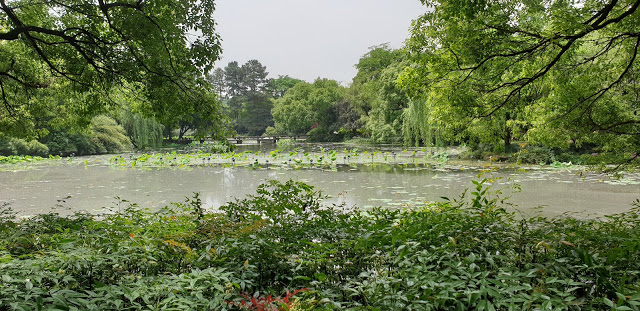
We are in the park proper, and it is magnificent, with flowers, mostly at the start hydrangeas and then any number of other trees and shrubs, some carved into other flower shapes like a lotus.
Then there was the lake and the backdrop of bridges and walkways.
.
And if you can tune out the background white noise the place would be great for serenity and relaxation.
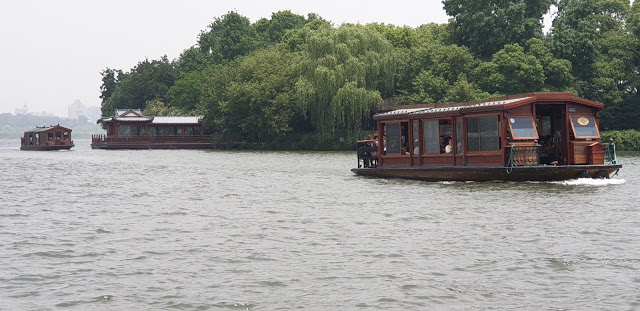
That, in fact, was how the boat ride panned out, about half an hour or more gliding across the lake in an almost silent boat, by an open window, with the air and the majestic scenery.
No, not that boat, which would be great to have lunch on while cruising, but the boat below:
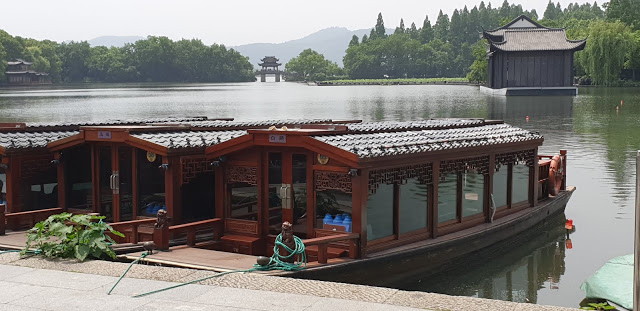
Not quite in the same class, but all the same, very easy to tune out and soak it in.
It was peaceful, amazingly quiet, on a summery day
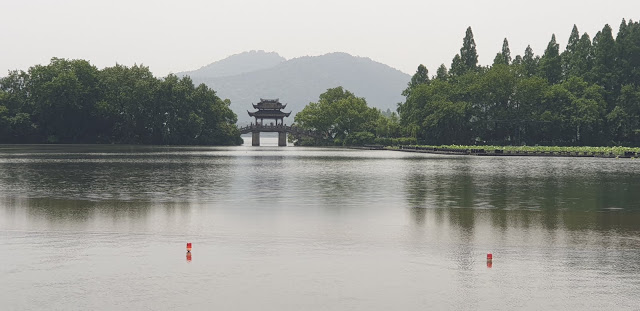
A pagoda in the hazy distance, an island we were about to circumnavigate.
Of all the legends, the most touching one is the love story between Bai Suzhen and Xu Xi’an. Bai Suzhen was a white snake spirit and Xu Xi’an was a mortal man.
They fell in love when they first met on a boat on the West Lake, and got married very soon after.
However, the evil monk Fa Hai attempted to separate the couple by imprisoning Xu Xi’an. Bai Suzhen fought against Fa Hai and tried her best to rescue her husband, but she failed and was imprisoned under the Leifeng Pagoda by the lake.
Years later the couple was rescued by Xiao Qing, the sister of Baisuzhen, and from then on, Bai Suzhen and Xu Xi’an lived together happily.
The retelling of the story varied between tour guides, and on the cruise boat, we had two. Our guide kept to the legend, the other tour guide had a different ending.
Suffice to say it had relevance to the two pagodas on the far side of the lake.
There was a cafe or restaurant on the island, but that was not our lunch destination.
Nor were the buildings further along from where we disembarked.
All in all the whole cruise took about 45 minutes and was an interesting break from the hectic nature of the tour.
Oh yes, and the boat captain had postcards for sale. We didn’t buy any.
Lunch
At the disembarkation point there was a mall that sold souvenirs and had a few ‘fast food’ shops, and a KFC, not exactly what we came to China for, but it seemed like the only place in town a food cautious Australian could eat at.
And when tried to get in the door, that’s where at least 3 busloads were, if they were not in the local Starbucks. Apparently, these were the places of first choice wherever we went.
The chicken supply by the time we got to the head of the line amounted to pieces at 22.5 RMB a piece and nuggets. Everything else had run out, and for me, there were only 5 pieces left. Good thing there were chips.
And Starbucks with coffee and cheesecake.
At least the setting for what could have been a picnic lunch was idyllic.
This book has been written for some time and the manuscript was sitting in a box with half a dozen others gathering dust and not quite as complete, so this month it is going to get the makeover, a first draft for the editor.
And so it begins…
…
All’s well if it ends well
…
Three days to go, so much to do.
Although I’ve reached nearly 62,000 words, much longer than the original 50,000 word target I have not finished the novel, and the plot changes are causing a little consternation.
I know now how it is going to end, but it’s getting there, in three days that’s the problem.
So, back and forth I go, laying the groundwork in the earlier chapters and I now have only one more piece to fix, the words on the document that set the series of events in motion.
Novel writing is exhausting.
The editor’s draft is not going to be the horrible mess covered in post-it notes like the first draft, but after all is said and done it will be a novel that was revised and a lot more coherent in 30 days, a remarkable achievement.
This book has been written for some time and the manuscript was sitting in a box with half a dozen others gathering dust and not quite as complete, so this month it is going to get the makeover, a first draft for the editor.
And so it begins…
…
All’s well if it ends well
…
Three days to go, so much to do.
Although I’ve reached nearly 62,000 words, much longer than the original 50,000 word target I have not finished the novel, and the plot changes are causing a little consternation.
I know now how it is going to end, but it’s getting there, in three days that’s the problem.
So, back and forth I go, laying the groundwork in the earlier chapters and I now have only one more piece to fix, the words on the document that set the series of events in motion.
Novel writing is exhausting.
The editor’s draft is not going to be the horrible mess covered in post-it notes like the first draft, but after all is said and done it will be a novel that was revised and a lot more coherent in 30 days, a remarkable achievement.
West Lake is a freshwater lake in Hangzhou, China. It is divided into five sections by three causeways. There are numerous temples, pagodas, gardens, and artificial islands within the lake.
Measuring 3.2 kilometers (2 miles) in length, 2.8 kilometers (1.7 miles) in width, and 2.3 meters (7.5 feet) in average depth, the lake spreads itself in an area totaling 6.5 square kilometers (2.5 square miles).
The earliest recorded name for West Lake was the “Wu Forest River”, but over time it changed to two distinct names. One is “Qiantang Lake”, due to the fact that Hangzhou was called “Qiantang” in ancient times. The other, “West Lake”, due to the lake being west of the city
It’s about to get busy, with a number of activities planned, and the warmth of the day is starting to make an impact.
The tour starts in the car park about a kilometer away, but the moment we left the car park we were getting a taste of the park walking along a tree-lined avenue.
When we cross the road, once again dicing with death with the silent assassins on motor scooters.
We are in the park proper, and it is magnificent, with flowers, mostly at the start hydrangeas and then any number of other trees and shrubs, some carved into other flower shapes like a lotus.
Then there was the lake and the backdrop of bridges and walkways.
.
And if you can tune out the background white noise the place would be great for serenity and relaxation.
That, in fact, was how the boat ride panned out, about half an hour or more gliding across the lake in an almost silent boat, by an open window, with the air and the majestic scenery.
No, not that boat, which would be great to have lunch on while cruising, but the boat below:
Not quite in the same class, but all the same, very easy to tune out and soak it in.
It was peaceful, amazingly quiet, on a summery day
A pagoda in the hazy distance, an island we were about to circumnavigate.
Of all the legends, the most touching one is the love story between Bai Suzhen and Xu Xi’an. Bai Suzhen was a white snake spirit and Xu Xi’an was a mortal man.
They fell in love when they first met on a boat on the West Lake, and got married very soon after.
However, the evil monk Fa Hai attempted to separate the couple by imprisoning Xu Xi’an. Bai Suzhen fought against Fa Hai and tried her best to rescue her husband, but she failed and was imprisoned under the Leifeng Pagoda by the lake.
Years later the couple was rescued by Xiao Qing, the sister of Baisuzhen, and from then on, Bai Suzhen and Xu Xi’an lived together happily.
The retelling of the story varied between tour guides, and on the cruise boat, we had two. Our guide kept to the legend, the other tour guide had a different ending.
Suffice to say it had relevance to the two pagodas on the far side of the lake.
There was a cafe or restaurant on the island, but that was not our lunch destination.
Nor were the buildings further along from where we disembarked.
All in all the whole cruise took about 45 minutes and was an interesting break from the hectic nature of the tour.
Oh yes, and the boat captain had postcards for sale. We didn’t buy any.
Lunch
At the disembarkation point there was a mall that sold souvenirs and had a few ‘fast food’ shops, and a KFC, not exactly what we came to China for, but it seemed like the only place in town a food cautious Australian could eat at.
And when tried to get in the door, that’s where at least 3 busloads were, if they were not in the local Starbucks. Apparently, these were the places of first choice wherever we went.
The chicken supply by the time we got to the head of the line amounted to pieces at 22.5 RMB a piece and nuggets. Everything else had run out, and for me, there were only 5 pieces left. Good thing there were chips.
And Starbucks with coffee and cheesecake.
At least the setting for what could have been a picnic lunch was idyllic.
This book has been written for some time and the manuscript was sitting in a box with half a dozen others gathering dust and not quite as complete, so this month it is going to get the makeover, a first draft for the editor.
And so it begins…
…
Something had to change
…
And that, my friends, is the words on the document.
When I conceived the original story, the words were quite simple, a memo from one man to another, words that should not be committed to paper.
Ah, yes, the dreaded paper trail.
Those words were adequate at the time, but now, with developments in the story and a shift or two in the plotline, it’s time to change those words.
They need to be damaging enough to kill a lot of people in the line of making both the words and the document they appear on, disappear forever.
And here’s the thing…
No one ever counted on the fact deleting on a computer is not deleting.
China is renowned for its exquisite silk, so naturally, a visit to the Silk Spinning Factory is part of today’s tour.
After that, we will be heading downtown to an unspecified location where we’re getting a boat ride, walk through a typical Chinese shopping experience, and coffee at a coffee shop that is doubling as the meeting place, after we soak up the local atmosphere.
The problem with that is that if the entire collective trip a deal tourists take this route then the savvy shopkeepers will jack up their prices tenfold because we’re tourists with money. It’ll be interesting to see how expensive everything is.
So…
Before we reach the silk factory, we are told that Suzhou is the main silk area of China, and we will be visiting a nearly 100 years old, Suzhou No 1 Silk Mill, established in 1926. Suzhou has a 4,700-year history of making silk products. It is located at No. 94, Nanmen Road, Suzhou, Jiangsu, China.
Then we arrive at the Silk Factory, another government-owned establishment with a castiron guarantee of quality and satisfaction.
The look and feel of the doona cover certainly backs up that claim
And the colors and variety is amazing (as is the cost of those exquisite sets)
We get to see the silk cocoon stretched beyond imagination, and see how the silk thread is extracted, then off to the showroom for the sales pitch.
It isn’t a hard sell, and the sheets, doonas, pillows, and pillowcases, are reasonably priced, and come with their own suitcase (for free) so you can take them with you, or free shipping, by slow boat, if you prefer not to take the goods with you.
We opt for the second choice, as there’s no room left in our baggage after packing the Chinese Medicine.
This book has been written for some time and the manuscript was sitting in a box with half a dozen others gathering dust and not quite as complete, so this month it is going to get the makeover, a first draft for the editor.
And so it begins…
…
The end is nigh, for someone!
…
For all those people out there who think the end of the world is coming, it is not.
For all those people out there who think my story is getting to the end, I really hope so.
I’m writing three separate chapters, each a little at a time, trying to dovetail the sequence of events that will lead to the unmasking of the murderer and finding the whereabouts of 30-odd missing persons.
What had begun as a simple quest has turned into a convoluted tale of lies, distortions, and people whose propensity for being something other than who they appear, had muddied the waters,.
Yep, everything you’d expect in a completely unexpected ending.
50 photographs, 50 stories, of which there is one of the 50 below.
They all start with –
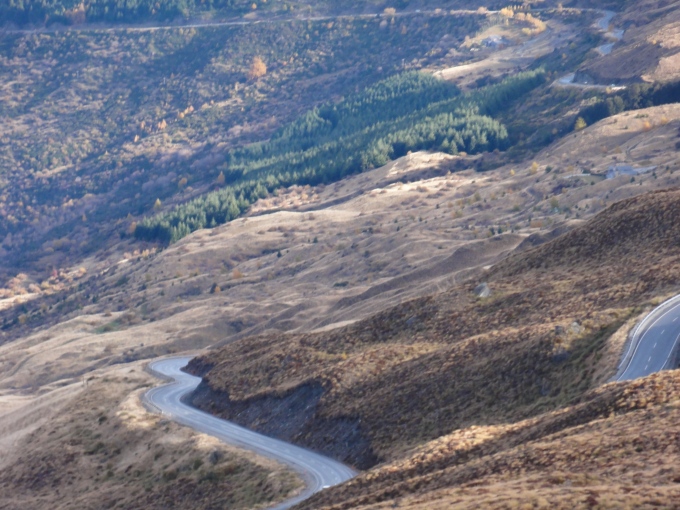
A picture paints … well, as many words as you like. For instance:
And the story:
It was once said that a desperate man has everything to lose.
The man I was chasing was desperate, but I, on the other hand, was more desperate to catch him.
He’d left a trail of dead people from one end of the island to the other.
The team had put in a lot of effort to locate him, and now his capture was imminent. We were following the car he was in, from a discrete distance, and, at the appropriate time, we would catch up, pull him over, and make the arrest.
There was nowhere for him to go.
The road led to a dead-end, and the only way off the mountain was back down the road were now on. Which was why I was somewhat surprised when we discovered where he was.
Where was he going?
“Damn,” I heard Alan mutter. He was driving, being careful not to get too close, but not far enough away to lose sight of him.
“What?”
“I think he’s made us.”
“How?”
“Dumb bad luck, I’m guessing. Or he expected we’d follow him up the mountain. He’s just sped up.”
“How far away?”
“A half-mile. We should see him higher up when we turn the next corner.”
It took an eternity to get there, and when we did, Alan was right, only he was further on than we thought.”
“Step on it. Let’s catch him up before he gets to the top.”
Easy to say, not so easy to do. The road was treacherous, and in places just gravel, and there were no guard rails to stop a three thousand footfall down the mountainside.
Good thing then I had the foresight to have three agents on the hill for just such a scenario.
Ten minutes later, we were in sight of the car, still moving quickly, but we were going slightly faster. We’d catch up just short of the summit car park.
Or so we thought.
Coming quickly around another corner we almost slammed into the car we’d been chasing.
“What the hell…” Aland muttered.
I was out of the car, and over to see if he was in it, but I knew that it was only a slender possibility. The car was empty, and no indication where he went.
Certainly not up the road. It was relatively straightforward for the next mile, at which we would have reached the summit. Up the mountainside from here, or down.
I looked up. Nothing.
Alan yelled out, “He’s not going down, not that I can see, but if he did, there’s hardly a foothold and that’s a long fall.”
Then where did he go?
Then a man looking very much like our quarry came out from behind a rock embedded just a short distance up the hill.
“Sorry,” he said quite calmly. “Had to go if you know what I mean.”
I’d lost him.
It was as simple as that.
I had been led a merry chase up the hill, and all the time he was getting away in a different direction.
I’d fallen for the oldest trick in the book, letting my desperation blind me to the disguise that anyone else would see through in an instant.
It was a lonely sight, looking down that road, knowing that I had to go all that way down again, only this time, without having to throw caution to the wind.









 Thrills, Spills, and just a dash of Romance