It could be the catalyst for someone who makes a decision to join the space program and head for the moon.
It could be that there is already a space program, there are bases on the moon, and we’re about to head off to Mars.
It could be just someone skulking in the dark up to no good cursing the fact the moon just came out from under the clouds and exposed their position.
Or it could be a war story, ships on the ocean stalking the enemy under the cover of darkness, only to be foiled by the moon, which sometimes can be quite bright.
I often wonder what it might have been like in the North Atlantic between America and England when the convoys were hoping to get to England without being sunk. A dark moonless night would have helped.
There are so many reasons why the moon could be important to a story. Perhaps I will write one now!
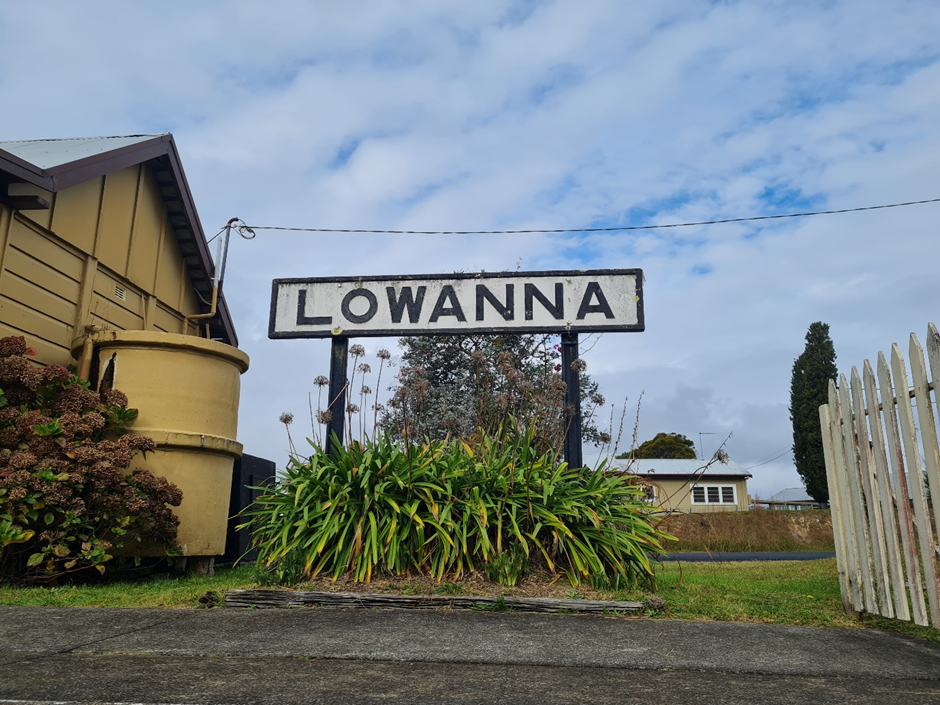
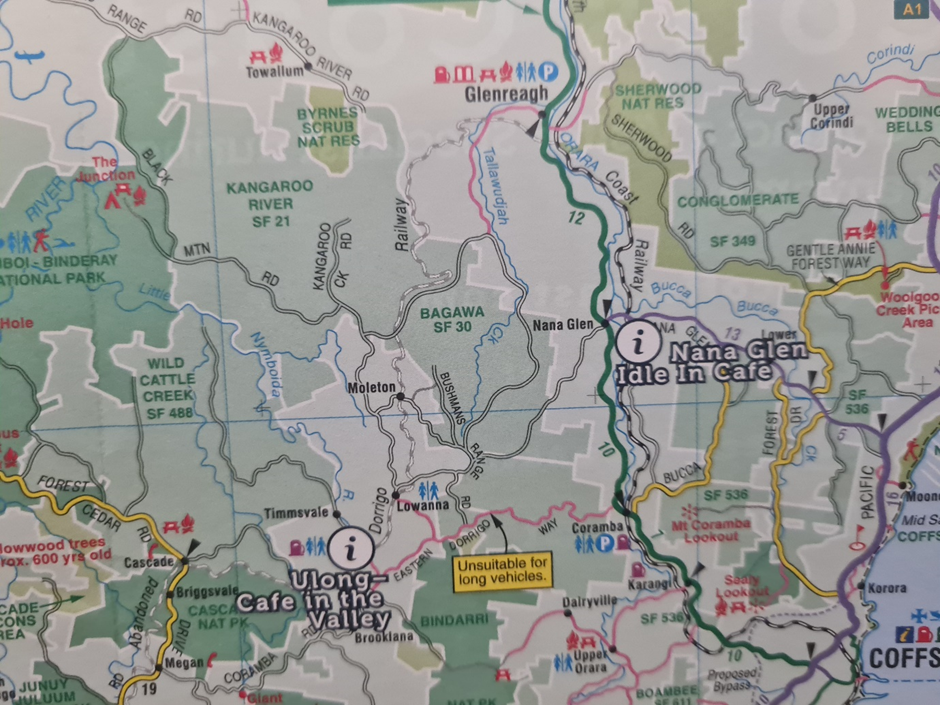
When You pick up a document that describes tourist attractions in Coffs Harbour, there’s one about the Orara Valley, and what caught my eye was firstly the Lowanna Railway Station.
To get there, you pass through Coramba, which has a railway line running through it, but any attempt to find the railway station will be met with disappointment.
But …
That’s not the railway story, that is the Glenreagh to Dorrigo line, first mooted in 1906, but not getting started until 1910, then halted because of the First World War and not completed until December 1924, and ran until October 1972.
However, back to Coramba…
The North Coast railway (the primary rail route in the Mid North Coast and Northern Rivers regions of New South Wales) passes through Coramba, which had a now-closed railway station from 1922. An attempt to find the station took us to a private residence, which obviously was once the station.
And then to the right historic station, in Lowanna…
Lowanna was the largest of the intermediate stations. It was an attended station, with a crossing loop and siding. Most of the timber was loaded at this location.
Opened 23-Dec-1924 and Closed 20-Sep-1975
What we were really looking for was the Lowanna Railway Station, which, when we put it in the GPS almost got us lost. We eventually found the refurbished station, and a rather run down platform, and rail tracks.
Lowanna was on the Dorrigo branch and lies on the north coast of NSW. It branches off the North Coast Line at Glenreagh and climbs up to the Dorrigo Plateau.
The Dorrigo area was settled in the early 1900s by pastoralists and tree fellers. Due to the steep terrain, it was decided to build a railway to allow products to be brought to nearby port towns. Several routes were surveyed, with the route from Glenreagh eventually chosen. The line climbs 664m over a length of 69km.
Apart from the endpoints of Dorrigo and Glenreagh, the station on this line was very small, often consisting of a short platform with a small shelter. The major traffic on this line was timber.
While in reality, this is just an ordinary lake at a resort we stayed at a while back and can be used for canoeing.
During summer the surrounding undergrowth is a haven for snakes, and it is not a good idea to wander too close.
Hardly the place to spur the imagination…
Unless, of course, you start thinking about the ethereal aspects it could possess. For instance, it might be the place where the ghosts of those who drowned come out to play at night.
It might be a lake in the middle of what was once an experimental site that needed a lot of water, and that tainted water might be the haven for mysterious creatures.
Ot it just might be part of a disused government secret site, long abandoned, with buildings and infrastructure just waiting for the right explorer to visit. Again, the ghosts of those who once were there could just be the reason why no one goes near the place.
And, what if there was an extensive, and invisible network of underground rooms. Above ground, just a pond and surrounding overgrown gardens, underneath, well, that’s up to you.
while poking around in what could be considered part of our colonial past, we came across a place that had a few remnants.
It’s hard to imagine that in the 1800s wagons like the above were a principal means of transport, with variations for transporting goods, or people, drawn by horses.
Whereas these days we can travel 300, 400 miles in a day in the modern car, and in relative comfort, to do the same distance in a horse-drawn vehicle, with no spring loaded axels, would take days.
And the journey is particularly uncomfortable over any distance. There would have to be a series of Inns and Hotels to stay overnight because travel at night would be difficult.
It’s hard to imagine where we would be without the modern motor car.
I have had a ride in a stagecoach once, over a short journey, and it was not something I would contemplate over a long distance.
But, then, what if we suddenly have no oil to create petrol, and we use up all the minerals needed for electric car batteries?
I think it could inspire a post-apocalypse world we would bearly be able to survive in.
This is taken from a rather bleak part of the coast near Coffs Harbour in New South Wales, Australia.
There was something about the sea on a particularly bleak day and not the sort of weather anyone would want to be out doing the touristy things.
We, on the other hand, are ready to visit anywhere anytime in any condition.
We never quite got as far as the end of the cliffs, but the notion that there were caves, and once upon a time, pirates or smugglers makes for a good story.
Certainly, with our convict settlement beginnings, it’s not hard to imagine the convicts stealing a boat, and sailing south from Sydney, the only settlement at the time, and landing in a place like this.
There is always something not quite right when you literally reach the end of the road.
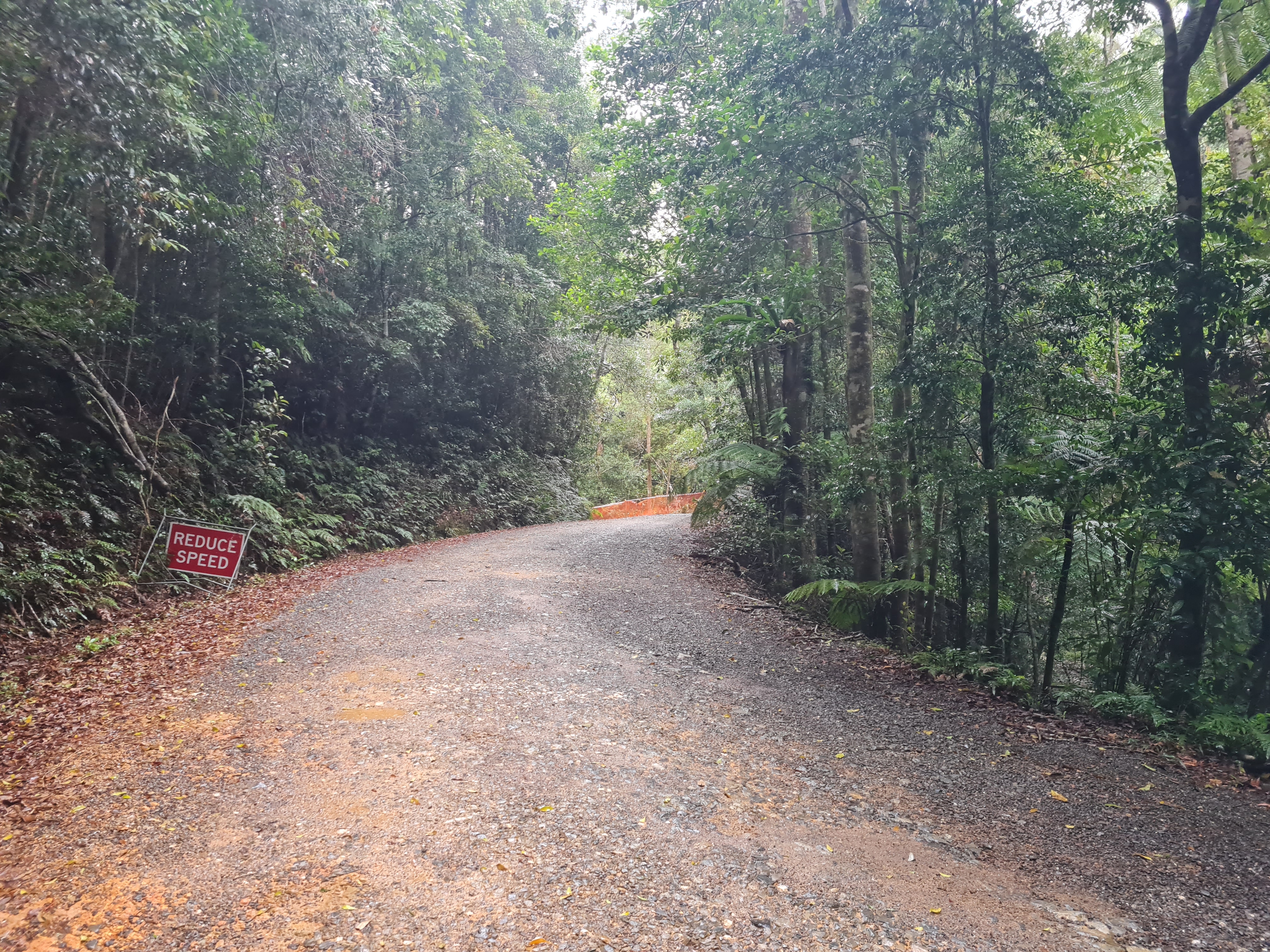
At the time we were looking for a place called Never Never.
Yes, you read that correctly, Never Never. It is a place on the map, and the GPS navigator knew where we were going, and took us to where it thought it was.
That place you can see is identified by the red plastic fencing across the road. The truth of the matter, we were not allowed to go to Never Never.
So, as for inspiration, it seems we have Never Never, the Americans have got Area 51.
And no, I’m not hanging around to see if spacemen and UFOs are coming to visit after darkness falls.
This photo was taken at a Castello in Tuscany, Italy, and was quite interesting.
I was fascinated as to what was behind the door in front, and up the stairs to the right. I was guessing, up the stairs was the exit from the ballroom, but it might be something else quite banal.
Behind me was the room that had all the names of the family who had lived at the castle.
More interesting was the fact there was the old castle, going back centuries, and the new castle, not so old.
But…
One could cast their minds back to the 1500s perhaps and imagine the castle, on a hill, overlooking what are now vineyards, but could once have been the forest.
Extensive gardens at the back could have been where the jousting and other games could have taken place.
There would be a feasting hall, the kitchens, the servants, and there was a keep.
Italy had a rich history of each of the towns launching raids on other towns, and these towns were walled in, like San Gimignano, with 14 watch towers around the perimeter, where the fortifications were such they kept out the oncoming marauders.
Siena is much the same, a walled town.
Each had a large central square, and Siena famously holds the Il Palio di Siena every year in theirs.
Just being in Tuscany is almost inspiration enough for any sort of story with Tuscany as the backdrop.
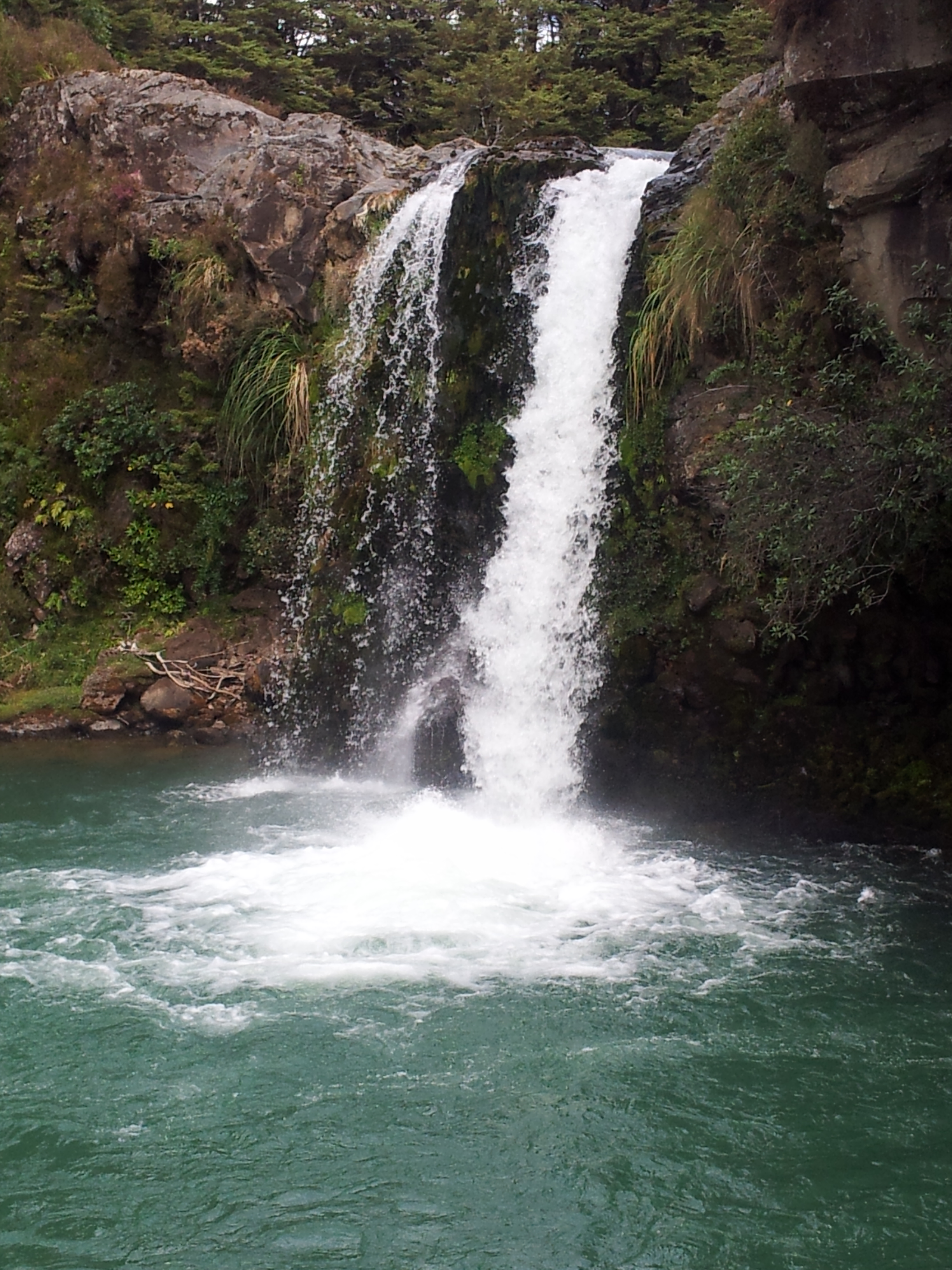
This photograph represents an idyllic scene, a pool at the bottom of a waterfall, which on a fine day would be perfect.
The fact it looks to be in the middle of nowhere is neither here nor there because…
That’s where the writer’s inventiveness kicks in.
So…
How do we get there? If it’s below the waterfall, then we came up the river, which is basically how you would go anyway, it’s just the depth of the river that determines how far you can go.
We had a situation like that where the depth of the river nearly stopped us from getting far enough up the river into the mountains to discover some amazing territory.
You could also go downriver, but since this river might start up in the mountains, it might be a long way.
Why would we be there?
The boring answer, we are on holiday.
The better answer, we’re searching for gold, and so are others who are trying to get us to move on, or we’re searching for something, just insert what you want to find. I was thinking: an intrepid brother or sister who has gone missing, and the waterfall was the last place they were seen.
And, what if there’s a secret entrance behind the waterfall, that opens into an underground complex with sophisticated, very strange and never seen before equipment, that hasn’t been used in a very long time.
Somehow I like the last one best.
And, just to add a new twist, you find a human-like body in a pod, and when someone accidentally leans on a button, it comes to life. Is it human, or is it a robot?
This book has finally come back from the Editor, so this month it is going to get a second revision, a second draft for the editor, and beta readers.
…
We are now up to the part where we introduce Isobel properly and find out why such a talented person is drifting in the doldrums of Rupert’s private detective agency.
Aside from being a once high-flying legal eagle, she is also a computer hacker, or perhaps that’s what she evolved into in a devil finds work for idle hands type person.
This hacking is going to be useful, but it’s also going to bring problems, especially when she starts tracking down Zoe.
And, it seemed she had struck up a dark online relationship with another hacker with the handle Tzar. What are the odds he is Russian?
She’s digging for information, and Tzar helps, and, suddenly it appears, briefly, then is gone, with a warning. Stop digging.
And if she doesn’t.
People were coming for her.
Meanwhile, in the basement, Zoe has had enough time to devise a mask that might stave of the effects of the gas long enough to affect an escape.
And, it almost works, the mask that is.
She manages to get past all of the guards, but Romanov is waiting.
He doesn’t kill her, but he does give her some information, then leaves. He knows how dangerous she can be, especially when wounded.
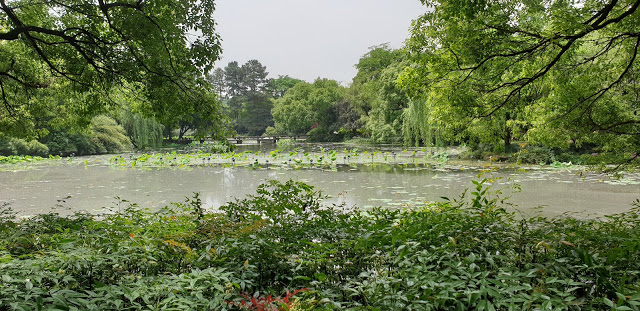
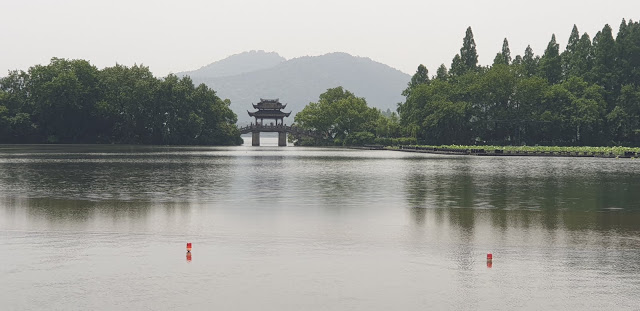
West Lake is a freshwater lake in Hangzhou, China. It is divided into five sections by three causeways. There are numerous temples, pagodas, gardens, and artificial islands within the lake.
Measuring 3.2 kilometers (2 miles) in length, 2.8 kilometers (1.7 miles) in width, and 2.3 meters (7.5 feet) in average depth, the lake spreads itself in an area totaling 6.5 square kilometers (2.5 square miles).
The earliest recorded name for West Lake was the “Wu Forest River”, but over time it changed to two distinct names. One is “Qiantang Lake”, due to the fact that Hangzhou was called “Qiantang” in ancient times. The other, “West Lake”, due to the lake being west of the city
It’s about to get busy, with a number of activities planned, and the warmth of the day is starting to make an impact.
The tour starts in the car park about a kilometer away, but the moment we left the car park we were getting a taste of the park walking along a tree-lined avenue.
When we cross the road, once again dicing with death with the silent assassins on motor scooters.
We are in the park proper, and it is magnificent, with flowers, mostly at the start hydrangeas and then any number of other trees and shrubs, some carved into other flower shapes like a lotus.
Then there was the lake and the backdrop of bridges and walkways.
.
And if you can tune out the background white noise the place would be great for serenity and relaxation.
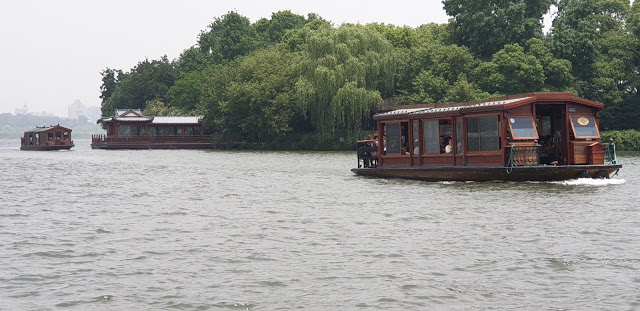
That, in fact, was how the boat ride panned out, about half an hour or more gliding across the lake in an almost silent boat, by an open window, with the air and the majestic scenery.
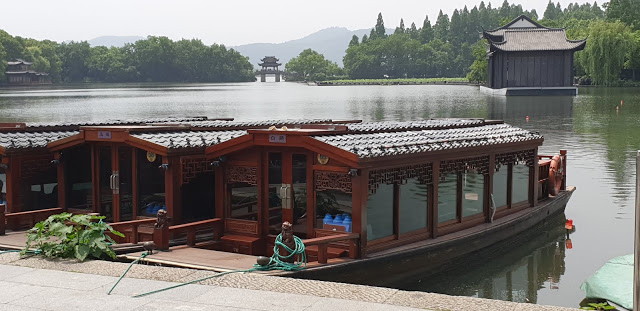
No, not that boat, which would be great to have lunch on while cruising, but the boat below:
Not quite in the same class, but all the same, very easy to tune out and soak it in.
It was peaceful, amazingly quiet, on a summery day
A pagoda in the hazy distance, an island we were about to circumnavigate.
Of all the legends, the most touching one is the love story between Bai Suzhen and Xu Xi’an. Bai Suzhen was a white snake spirit and Xu Xi’an was a mortal man.
They fell in love when they first met on a boat on the West Lake, and got married very soon after.
However, the evil monk Fa Hai attempted to separate the couple by imprisoning Xu Xi’an. Bai Suzhen fought against Fa Hai and tried her best to rescue her husband, but she failed and was imprisoned under the Leifeng Pagoda by the lake.
Years later the couple was rescued by Xiao Qing, the sister of Baisuzhen, and from then on, Bai Suzhen and Xu Xi’an lived together happily.
The retelling of the story varied between tour guides, and on the cruise boat, we had two. Our guide kept to the legend, the other tour guide had a different ending.
Suffice to say it had relevance to the two pagodas on the far side of the lake.
There was a cafe or restaurant on the island, but that was not our lunch destination.
Nor were the buildings further along from where we disembarked.
All in all the whole cruise took about 45 minutes and was an interesting break from the hectic nature of the tour.
Oh yes, and the boat captain had postcards for sale. We didn’t buy any.
Lunch
At the disembarkation point there was a mall that sold souvenirs and had a few ‘fast food’ shops, and a KFC, not exactly what we came to China for, but it seemed like the only place in town a food cautious Australian could eat at.
And when tried to get in the door, that’s where at least 3 busloads were, if they were not in the local Starbucks. Apparently, these were the places of first choice wherever we went.
The chicken supply by the time we got to the head of the line amounted to pieces at 22.5 RMB a piece and nuggets. Everything else had run out, and for me, there were only 5 pieces left. Good thing there were chips.
And Starbucks with coffee and cheesecake.
At least the setting for what could have been a picnic lunch was idyllic.















 Thrills, Spills, and just a dash of Romance