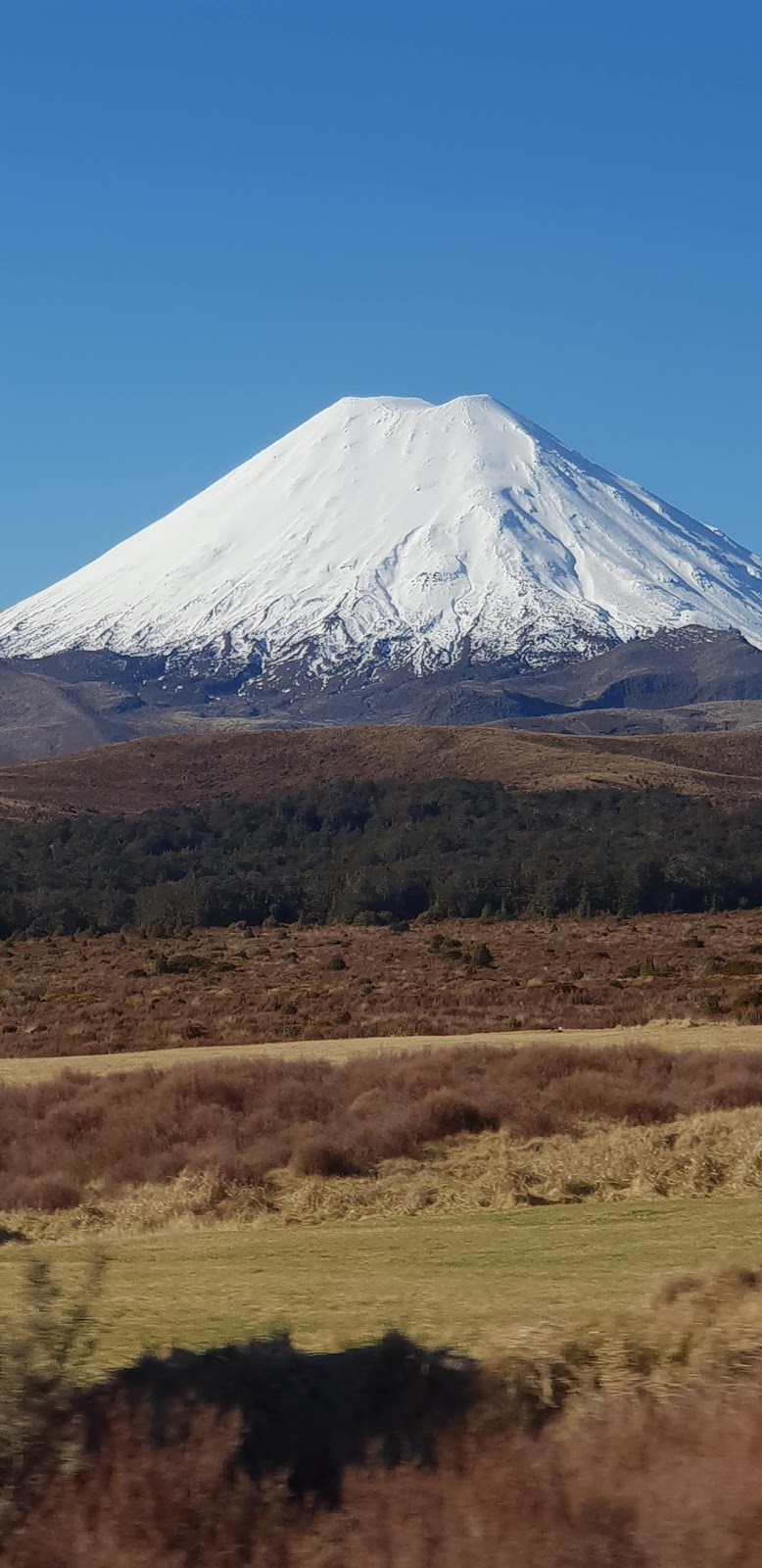
Mount Ngauruhoe is apparently still an active volcano, has been for 2,500 years or so, and last erupted on 19th February 1975, and reportedly has erupted around 70 times since 1839.
The mountain is usually climbed from the western side, from the Mangatepopo track.
This photo was taken in summer from the Chateau Tongariro carpark.
In late autumn, on one of our many visits to the area, the mountain was covered with a light sprinkling of snow and ice.
On our most recent visit, this year, in winter, it was fully covered in snow.
It’s a matter of getting from a normal busy life, running a very successful and very well-regarded institution, that from the outside was one everyone was envious of to where she is lying in an induced coma following an accident that is still being investigated.
Perhaps we get a glimpse into the detective who will be later called on for a more complex investigation into her life and sadly death.
The question we have to ask is, was this just an accident as a result of her poor health, some were saying a result of her wild childhood early years of dung and alcohol abuse (the privileged life of the youth of the elite wealthy being paid back in spades) or something else.
Is there something about charities that’s not all above board? With a new management team installed by her father, is the money getting to those who need it, or is it to pat the names needed to be in the high-profile donors?
It strikes me that ages ago when I was talking to a group of others about making donations to a charity that had a high-profile person as spokesperson it had to be good if they spoke on behalf of it for nothing in return.
My illusion was shattered in seconds. That personality was paid plenty to spruik the charity, drove around on a large expensive car provided, and hosted endless lunches and functions for those who seemed to live an already lavish lifestyle.
It’s a premise I am investigating and will use as a possible outcome to what should be a beneficiary-orientated charity versus one that is there to principally serve the high-profile spruikers.
Yes, I was one of those nervous fliers, professing more than once that if God had meant us to fly, he would have given us wings.
You can imagine the response that got after repeated quotations on just how safe flying was. I agree. Based on statistics, flying was safer than driving, and I didn’t fear driving.
Go figure?
So, for years, I avoided planes, and took trains, and ships. I was wealthy enough and had the time to take ships when I wanted to travel to other countries. It was a more serene method of travel, but these days, everyone was in a hurry.
Everyone.
Now, it seemed I had to be as well. It was a day I knew would come one day.
I had avoided the idea of getting married for a long time, telling myself I would never find someone who would understand the foibles I carried as baggage. Most could not believe a grown man could be so afraid of something like travelling in an aeroplane.
Annabel was different. She was not in a hurry either. She loved travelling in ships, taking our time to go anywhere and everywhere. It was her idea that we should have our own ship. We were working on it.
But, truth be told, she did not fear flying and travelled frequently for business. I preferred the train.
Annabel originally came from Italy and had left her family behind when she came to America to work, and then live. She hadn’t expected to meet me or anyone else, let alone get married. And because I wanted to please her, I agreed that it should happen in her hometown in Italy.
What was the problem, you ask.
Well, to start with, there wasn’t. There was plenty of time to get there before the wedding, travelling in the usual manner. Then her father got sick and sicker until it was discovered he had stage four cancer.
Wedding plans had to be moved up so that, as a final deathbed request, he would be able to walk his only daughter down the aisle.
All we had to do was fly over.
Simple.
I had a plan. It was a simple one. Fly first class, take a sedative that would put me to sleep and hopefully wake up on the ground on the other side.
After all, I would do anything for Annabel.
The day arrived. I was nervous, yes, but not overly worried. We boarded the plane, had a glass of champagne, and just as the plane was taxiing to the runway, I closed my eyes, and everything faded into black
My last memory was of Annabel holding my hand and telling me she would see me in Italy.
When I woke, it was uncharacteristically cold. There was a loud whooshing sound coming from behind us just about drowned out by a screaming sound of metal on metal.
For a moment, I thought I was in an SUV driving over a very rough road, such was the pronounced jerking movements.
I looked sideways, and first, I noticed Annabel, unquestionably terrified. Second, I realised we were on the aeroplane, almost in darkness, and something had gone horribly wrong.
It was only seconds before Annabel realised, I was awake, and she turned to me. She had been crying and tears were in her eyes.
“I’m so, so sorry.”
“What happened?”
She looked quizzically at me, and I realised I would have to speak louder.
I leaned closer. “What happened?”
“Of all the flights, on any day, we had to take on board a hijacker.”
“Hijacker?”
I thought that measures had been taken to prevent this from happening.
“He said he had a bomb, and if the pilot didn’t redirect the plane to some obscure place in Africa, he would detonate it. The pilot refused, and we’re now in the middle of a nightmare.”
It didn’t take much to realize what happened. The pilot called his bluff, he exploded the bomb, and at 30,000 feet, the result was almost catastrophic. I looked back and could see a hole in the side of the plane, and through the windows, smoke pouring from one of the engines.
Given the jerkiness of the flight path, there was damage to the controls, and the pilot was using the engines to fly as straight as possible, slowly because of the stress on the frame and the damaged engine. Another glance showed we were not far from the water, so the plane was down low enough not to need pressurisation.
I did a mental calculation for time elapsed, and I was expecting to wake up eight and a half hours after dropping off to sleep. I was awake, and we were not there.
“How long have we been like this?”
“Six hours. We’re flying at about 160 knots, and the last advice from the pilot was that we were heading to Vigo in Spain and,” she looked at her watch, “we have about six hours before we get there.”
There was no chance I could go back to sleep and wake up on the ground. What was surprising was how calm I felt.
I had nothing to say, and perhaps she had mistaken my silence for anger or annoyance at her insistence we fly and assurances of how safe it was.
I wasn’t annoyed or angry. Perhaps it was fate.
“Say something, anything.”
I smiled, though it was hard to project confidence that everything would be fine. Perhaps, if I did, she might get the wrong idea that I had simply given up. The truth was I had no control over what happened, and there was no point getting upset over what you couldn’t do anything about.
“It’s not your fault.”
“If I hadn’t…”
I squeezed her hand. “You’re here, now with me, and if anything happens, we will go through it together. I believe the pilot doesn’t want to die any more than any of us on this plane, and he will do everything he can to make sure we survive.”
I leaned back in the seat. With the blanket, it was still reasonably cold, but at least we were not moving through a storm. That would have been a lot harder to weather. As it was, the noise was bad enough. I was still tired from the sedative, and listening to Annabel telling me what we were going to do when we got off the plane, lulled me back to sleep.
My last thought was that I’d had the life I had never expected to have. Annabel had always been the one, but I never dared to ask her out. Instead, I watched from afar as her life took many twists and turns until I accidentally ran into her.
I smiled at the thought. If only I’d seen what was in front of me. I finally did.
I opened my eyes just as the wheels hit the runways, slightly harder than I expected for such a large aircraft. I’d heard that one couldn’t feel the take-off or the landing.
Annabel was smiling.
“We made it?”
“Of course, we did.”
It was then I realised that there was no noise, and looking around, no hole.
“No hijacker. Or a bomb going off?”
“What are you talking about?”
I sighed. “A bad dream.”
“Well, you don’t have to worry. We’re on solid ground, and nothing happened. Thank you for doing this.”
“There isn’t anything I wouldn’t do for you. You know that.”
“Of course.”
She leaned over to give me a kiss on the cheek, and a second later, there was a huge explosion.
This book has finally come back from the Editor, so this month it is going to get a second revision, a second draft for the editor, and beta readers.
…
It’s the final battle.
Never trust anyone else to do the job you should have done yourself in the first place.
It’s an interesting premise, but somehow encapsulates the ethos of this story.
Who is Romanov? Zoe, Irina, whatever you want to call her, he’s her father.
But…
The notion that anonymously putting out a finder’s fee on his daughter’s head, coupled with the ire of Olga over the death of her son, sent everyone from the Minister in the Kremlin down into a tailspin.
The first effort, had the kidnappers just followed the rules, would have got an enormous payday, and everything would have been resolved there and then, in Marseilles.
No, people got greedy.
So did all the others, getting wind of what was at stake, enough to retire, or continue to retire in style.
Dominica, Yuri, and even Olga had she been smart.
She was not.
People didn’t have to die. Zoe could have been spared a killing spree, and John some maybe quality time with Olga. It’s a mistake Olga won’t make again.
And John, now with a father-in-law, well it’s just another surprise in a long list of surprises.
We’re unravelling the mystery behind the slow deterioration of our main character.
When did this mysterious malady first manifest itself?
The point here is that there is always a starting point or a catalyst. It might not always be pinpointed by the person but by someone else who can look from the outside and assess all of the evidence.
And it’s not always an easy task when you don’t really know when it first began because it creeps up on you without you realising it.
Until one morning, you can’t get out of bed.
Of course, there are convenient answers to Amy’s question, and in moments of extreme paranoia, only one name will come to the fore, the name of the person you hate the most at the time.
And then it’s not difficult to attach the reasons to that name, correctly or not. In her debilitated state, it was easy. Whether she could prove it, was the hard part.
This book has finally come back from the Editor, so this month it is going to get a second revision, a second draft for the editor, and beta readers.
…
It’s the final battle.
Never trust anyone else to do the job you should have done yourself in the first place.
It’s an interesting premise, but somehow encapsulates the ethos of this story.
Who is Romanov? Zoe, Irina, whatever you want to call her, he’s her father.
But…
The notion that anonymously putting out a finder’s fee on his daughter’s head, coupled with the ire of Olga over the death of her son, sent everyone from the Minister in the Kremlin down into a tailspin.
The first effort, had the kidnappers just followed the rules, would have got an enormous payday, and everything would have been resolved there and then, in Marseilles.
No, people got greedy.
So did all the others, getting wind of what was at stake, enough to retire, or continue to retire in style.
Dominica, Yuri, and even Olga had she been smart.
She was not.
People didn’t have to die. Zoe could have been spared a killing spree, and John some maybe quality time with Olga. It’s a mistake Olga won’t make again.
And John, now with a father-in-law, well it’s just another surprise in a long list of surprises.
It was the mantra my mother used all the time to lament our bad luck; that it was always someone else’s fault.
Like the family cutting her off when she married my father, like when my father left when my brother and I were very young, like my mother’s choice of partners after he left.
Like when our mother died, we were sent to the orphanage. Like when I was allotted to a family and my brother was kept in the orphanage because of his so-called bad behaviour.
I was probably too young to understand because he had been his normal self to me, except perhaps when he was protecting me from other children, and some of the supervisors, but that was what big brothers did. I wanted to stay with him, but he told me to go, to get away as far as I could, and never look back.
He promised he could come and find me sooner rather than later, and I trusted him.
But for some reason, I did not hear from him again. He did not answer my letters, and twice I tried to go back to the orphanage, only to be taken home again. My foster parents, as nice as they were, refused to take me there, but in the end, they agreed to send someone to investigate.
Many months later, they showed me a letter from the head of the orphanage advising that Jake, my brother, had found a suitable situation with a family on the other side of the country. No other details were forthcoming, just that he was no longer there.
It didn’t seem right, but as a twelve-year-old there was little I could do, and although my foster parents were sympathetic and said they would do what they could to find out more, they hired a private detective to see what he could find; and after a year, the report had very little detail, he had simply disappeared. He said, as time passed, the trail, as they called it, had gone cold.
A dozen more years passed and although I hadn’t forgotten Jake, I told myself he had been as lucky as I was, in a home where he was loved and treated with kindness, something that had been lacking in the orphanage.
But in that time, memories of what happened during that time I was there came back, memories that I was too young at the time to process, memories that pointed to what could only be described as a house of horrors.
When the psychiatrist I’d been seeing had worked out exactly what had happened to me, he had alerted the police to what was happening there. It wasn’t a revelation that I was not the only child that had been put through hell.
But by the time everyone realised what that place was, it was too late.
I did my time at school, followed in the footsteps of my adoptive parents by studying law, and came out the other end with offers from some very prestigious law firms.
I spoke to the one I wanted to accept, advising them there would be one condition that I wanted to find my brother. They set a limit of three months, and I believed, at that time, it would take less.
That was until I arrived in the town where the orphanage was located and discovered it was now a city, and worse still, where there was once a church, orphanage and farm, it was now the site of a half-finished shopping mall, and there was nothing left behind.
One of the foremen saw me standing near the gate and came over.
“Can I help you?”
“There used to be an orphanage and church here?”
“They pulled it down a year ago. Property developers snapped it up, and we’re building a shopping mall and a thousand houses, give or take.”
“Where did the records go?”
He shrugged. “I just build stuff. What happens before I get here is someone else’s problem. I did hear a rumour bad stuff went on here, and the state shut it down a few years back. Perhaps you should go to the county records office and talk to them. They’d know more.”
“Thanks.”
When I didn’t move and stood there with glistening eyes reliving a bad moment, he asked, “What’s your interest in this place? Are you a reporter? There’s been a few over the last month or so.”
I shook off the memory and looked at him, “My brother and I were sent here. They found us homes to go to but not the same one. I’m trying to find him.”
He didn’t answer, and I got the feeling he knew more about what happened here but was reluctant to talk about it. He walked off, and I got out of the way of a cement truck, one of three that had passed through the gates while I’d been there.
I spent a few minutes staring at where the main orphanage building had been, and the memories that had laid dormant for many years suddenly came flooding back. I shuddered. This place was cursed.
He’d mentioned reporters, and they only came when there was news. My first stop should be the newspaper office. They’d know the story of what happened.
The sign across the top of the large window said, ‘The Sentinel’, and I got the feeling something was missing. The city name, perhaps. A shopfront could not be the home of such a newspaper, but perhaps in the internet age, papers had lost their dominance.
I know I read my news from my cell phone.
I had also considered running a search on the orphanage but when it came back with several billion hits, I thought it better to see if I could find someone with first-hand knowledge.
Then, finally, in the place where I could get some answers, there was something about the truth I didn’t think I wanted to know. It was what was stopping me from going through that door because deep down, I knew whatever I learned, it was not going to be good.
For a while now, after I discovered some of the stuff that went on in that place, I think deep down I knew that Jake didn’t survive, that Jake being Jake, he would have put himself in harm’s way to save someone who was not able to help themselves as he had done for me.
And I was here, now, because of him.
Again, someone noticed I was hanging around outside, and instead of calling the police, they came out to ask if I had a problem.
I didn’t but I said I wanted some information.
Inside, it looked nothing like what I imagined a newspaper office would look like, just a half dozen people sitting at desks, and one of three offices with a man in shirt sleeves and a harassed look.
The person who came out was Naomi. She was the events reporter. She took me to a desk that had the name Robert Rand. He was, she said, the investigative reporter and worked on the orphanage story. He was just out doing the coffee run. Five minutes later he came back. It was a face that seemed familiar. He was not much older than I was,
He stood in front of me for a minute, then said, “You’re Jake’s little brother, aren’t you?”
And then I saw a tear in his eyes.
“Are you alright?”
“No. But I will be. Look, give me a minute to sort out the work, and we can talk in the meeting room. I won’t be long.”
He pointed to the room and I walked over and sat down. I was in two minds whether I wanted to know the truth, and in the end, I decided to let him tell me what he wanted.
He was more composed when he finally joined me. “He was our hero, nnn. I was so glad he got you out of there. He saved at least fifty of us and if you like, I can put you in touch with all of them. They would be so grateful to meet you. It’s sort of like a survivor’s club.”
“I would like that, yes. These people knew my brother?”
“We did. He knew what those people were doing, and he fought them, at great cost to himself. One by one, he got us out of there, and when we eventually convinced the authorities about the bad things that were happening, he was gone. We were told he had been sent away in a placement, but we believed he was killed, the fate of quite a few others who fought back, and buried somewhere on that plot. No one is quite sure what happened, it was so hectic in the last few months, certainly, once the police started investigating, all of the children, some two hundred and thirty were transferred out and the place shut down.”
“Does anyone have the records?”
“They tried to burn everything, but we managed to rescue a lot of the paperwork. Enough to find out that at least four thousand children went through that place, nearly a thousand simply disappeared, another thousand placed, and the rest were molested, some quite horrifically. And it wasn’t just the priests who were the perpetrators, some of the staff, the townspeople who worked there, were just as bad, people you would not expect. This place will never be the same. Not for us, anyway. How did you go after you left?”
“I had the two best foster parents a child could get. I was lucky. I wanted to know what happened to Jake, they tried to find out, but they couldn’t. Not even a private detective had any luck.”
“No one could. They had everyone on their side, either paying them off or admitting them to their inner circle. At first, no one would believe us, you know, who would believe a child over a grown responsible adult? It was how they got away with it. Then as more and more children came forward, they had to believe us.”
I came back to the part of the conversation where he said he believed Jake might be buried there. “Who would know?”
“The head priest, Father Wollmer. He was the worst of them all. He knows where the bodies are buried, but he’ll never tell.”
“Is he still alive?”
“Yes. In the county jail, maximum security. And away from the other prisoners. They would kill him if they saw him. Even the other prisons, no matter how bad they are, do not like people like him.”
“Do you think I would be able to see him?”
“You don’t want to. He is evil personified, nnnn. The devil incarnate, the prosecutor said. He had an excuse and a reason for everything he did. The Lord’s work was his excuse, over and over, and he honestly believed he did nothing wrong.”
“Just the same, I would like to see him.”
“I’ll see what I can do, but don’t get your hopes up. I doubt they’ll let one of his victims in to see him.”
Three weeks later, after several court appearances, and many hurdles crossed, not the least of which were put up by the priest himself, I found myself sitting in a room with a lawyer on one side and Rober Rand on the other.
This was going to be an interesting follow-up story, though it had the potential of being very distressing all over again for both of us.
I wasn’t sure how I would feel, or react to seeing that monster again, and continually told myself it was all about Jake, that my feelings or hatred or disgust was not to get in the way of finding out where he was.
We waited a half hour and then following several thunks of locks being opened and the squeaking of an opening door, the man I had come to dread came into the room.
He was no longer the figure in my nightmares; he was just this dishevelled old man who was nothing like the man he once pretended to be. No cassock, just ill-fitting prison clothes, battered and bruised. He looked like he’d been hit by a bus.
He was basically dragged to the chair and shoved into it. Both guards stood on either side of him.
His head was bowed, not looking at me. Nor had he, other than a brief glance, to see who it was.
“You can continue to ignore me, but I’m not going anywhere until you tell me where my brother is.”
A mousy little voice returned, “I have no idea who you are talking about.”
“Look at me,” I said with a calmness that belied what I was feeling.
I could feel the anger building in me, and I knew I had to quell it. I wanted to get out of my chair, go over to him, and just keep hitting him over and over and over.
He didn’t lift his head, so one of the guards grabbed him by the hair and jerked his head up. “Look at him, or there will be consequences.”
The so-called priest opened his eyes and looked at me.
“You know exactly who I am. I know who you are and what you did to me and others until Jake stopped you. What did you do to him?”
“I sent him away.”
“You did not,” Robert spoke. “I was there too. A dozen of us know you punished him when he tried to help us, that you held him up as an example of what we should not be doing, but you never sent him away.”
“He was a troublemaker. He needed to be punished.”
“Where is he?” I asked again.
He just stared at me with a look of defiance. He knew exactly what I was asking. He knew where the bodies were buried.
I looked at one of the guards. “I know that look. I spent enough time with this animal to know everything there is to know. He trusted me with his secrets.”
His head shot up and glared at me. “You know nothing.”
Bad dreams or nightmares of not only the awful things he did to me and others, but there were also times when he fell asleep before sending us back to our dormitories.
I got as far away as I could, hiding in a corner where I couldn’t see him. But it came to be not so much about seeing him, about what he did to us. It was having his voice in our heads, hearing him talk in his sleep.
It was where, over time, I and others learned about a tormented childhood, the hold his mother had over him, and what she put him through. It was exactly what he did to us. It was not an excuse, it was not a reason for that behaviour, it was like it was ingrained into his soul and done without thought of consequences.
Because I was too young at the time, a lot of it made no sense at the time, but when I grew up and the nightmares returned, so did the whole story. Everything he had done he had done for his mother, and she was out there enjoying her life of luxury off the backs of us children.
“I know everything. And I’m going to give you one chance to tell me where Jake is. Otherwise, I will go to the authorities and tell them the whole story, and particularly that of Isobel Mackenzie. It’s the one name that never came up in the investigation. You can’t protect her.”
It got the reaction I wanted. He tried very hard to get out of that chair and get me, with such ferocity and screaming the foulest language about what he’d do to me when he clothes his hands on me, the guards had to virtually beat him back down on the chair.
It scared the hell out of me and Robert.
I waited until he was quiet and then asked, “Where is Jake?””
After a minute, he lifted his head and looked at me. He was deranged, there was no question about it, and to me, it looked like the demon had taken over his body and mind.
“He’s in a place where you will never find him. He’s with Mary Magdalene now, who has forgiven his sins, and he is now and will forever be resting in peace. As for anything else you think you might know, you don’t, and it’s not a path you want to take. Your brother gave up his freedom and his life to save you, Nnnn, don’t throw away that gift. No go, and never come back. I will answer no more of your questions, now or ever.”
And that was basically it. He didn’t answer any more questions. He didn’t do much of anything after that final speech because the exertion of trying to get to me had caused him to have a stroke, and three days later, he died.
It didn’t give me closure when I was told of his passing. There was no absolution, there was no forgiveness, and my only thought was that he should now be in a special kind of hell for all eternity.
It didn’t get me any further in my quest, and having hit a brick wall, it was time to go back home, get myself together, and concentrate on living the rest of my life.
The psychiatrist had continually emphasised that I had to concentrate on moving on from the past and not let that define who I was. It was now all about the future. What made it hard was not knowing what happened to Jake or where he was now.
Woolmer had said he was dead. I had to believe him. I had to believe he was in a better place, and I would put in a prayer for him every night.
Bags packed. I had one last stop before getting on the bus. I wanted to say goodbye to Robert and thank him for all of his help. He was going to give me the names of other victims so we could talk because, for him and a lot of other victims, it was part of the healing process.
He was at his desk when I arrived, looking at photographs of the orphanage grounds. I was standing behind him as he slowly scrolled through them, a historical montage of hell on earth.
Some would argue that it would be better if they were destroyed so that they could not remind people of the terrible events that had taken place there. I would argue that the world needed to be reminded that this was only the tip of the iceberg.
Whatever it was, for a few minutes, it took me back, and for once, it did not reduce me to a quivering emotional mess. I was stronger now, a survivor, and one of the lucky people. There were a lot who got past the horror.
Then I noticed the hedge. We all thought that hedge was part of the wall that surrounded the property, with a single gate, one we had thought might be the route to freedom.
No one had gotten it open, and no one had ever seen it open. No one knew what was on the other side. Once we went into the orphanage, we never left unless we were placed in a foster home.
“Did anyone find out what was on the other side?” I asked.
“As a matter of fact, yes. A garden. It had a fountain with a statue in the middle, and going out in concentric circles, rose and flower beds, and lawn pathways. It was quite large.”
He showed the next three photographs of the garden that had fallen into disrepair s lot of the roses overgrown and the lawns just tall weeds.
The fountain was broken and slimy and the statue covered over with ivy. The next two were after someone had cleared away the overgrowth and it showed the statue to be that of a woman.
Then Robert simply said, “Fuck,” which seemed to me to be an entirely inappropriate response. “You know who that is, that statue. They were always banging in about the mother of Jesus. Mary Magdalene. That’s a statue of Mary Magdalene.”
And in that exact moment, we both know the significance of what Woolmer had said, believing that the development company would have bulldozed everything and therefore erased it from memory. It was probably one of the conditions of sale.
“The rose bushes were markers. Buried under the careful watch of Mary Magdalene.”
I did not make a friend with the construction supervisor because the moment Robert spoke to the sheriff, all work stopped on the site.
The garden was now a carpark, one of the first parts of the site to be completed, where the site officers were located, and the workers parked their cars.
The garden site was painstakingly measured our and then the concrete was removed. Then, the forensic archaeologists moved in, and over the next six months, the bones of 146 children and 45 adults were found, one of whom was identified as Jake through a DNA match. He had been dead for at least five years.
A year after that, he was given a proper burial after a service that was attended by nearly 400 of the victims all of whom knew him or knew of him, a lot thankful that he had sacrificed so much that they may live.
I was reminded at the end that bad things happened to good people, but the memory of their deeds will live on forever.
In contrast, bad things also happened to bad people, and in their case, no one cared what happened to them. Woolmer disappeared, no one knew where the body was buried, and no one cared.
Take all the paper out of the file, throw it up in the air, wait until it all lands on the floor, and then take the first piece of paper nearest to you to start.
Perhaps fate is being kind to me because the sheet had the word paranoia on it.
To begin the story, we need to paint a picture of a successful woman running a charitable offshoot that manages the money her inheritance had bequeathed to be used for charitable purposes.
Why not just hand it over to a proper charity and let them do the dirty work?
She did once and found most of it went to administration and very little landed in the hands of those who needed it.
There’s no problem with that except …
Her father thinks there are better things to do, and she has spent considerable time and effort to dissuade her from doing so.
Perhaps his ultimate motive is to get a hold of her money because his own investments are not exactly faring well with the changes he made years before and he does have a wealthy lifestyle and image to keep up.
Then there’s the problem with the mysterious illness she had contracted, making it difficult to work, and necessitates the employment of a new head to administer the charity while she finds out why she’s ill and then recovering.
Her mistake is trusting her father to find the right man.
Then there’s her children, twins, and trouble with a capital T.
The real problem I’d of course that the illness manifests itself in unpredictable ways making her behaviour erratic, her moments of lucidly shorter and her stays in care longer, and her paranoia that someone is trying to kill her slowly taking over.
Who can she trust?
Her lawyer friend, or is he?
Her best friend, who seems above boats?
Her father, who is more interested in his own life than hers?
The new manager has his own agenda and a lot of money to play with.
Her children hate her because she abandoned them to boarding schools.
The doctors keep telling her they can’t find anything wrong.
Or the private detective she had hired to deep dive into all her so-called friends’ lives and find someone who could tell her what was wrong with her.
Oh, and lastly, find her ex-husband Michael, the only man she ever really loved, and whom she now realises she pushed away.
That first chapter of setting the scene has just become five or six.
Our graduation yearbook billed our rivalry as one for the ages, one to watch over the forthcoming years when discoveries would be made, and reputations won or lost.
Jackson Jamieson, son of the famous, world-renowned Aristotle Jamieson who found the intact tomb of a previously unknown Egyptian Pharaoh in a period no one really knew about
Questions were still being asked about the veracity of the discovery.
That fame acquired by the father, rubbed off on the son and it didn’t matter whether he knew anything about Archaeology, having a degree and a father to work for and with, gave him the job that all of us fellow graduates would have given anything to have. Access to one of the greatest finds since Howard Carter and the tomb of Tutankhamun.
At the other end of the scale, I studied hard and learned everything there was to know about just about every Pharaoh. I didn’t have the renowned parent or be a part of any number of digs providing very valuable first-hand experience, just a few minor digs that gave the requisite equivalent for grading purposes, and probably wouldn’t get that all-important photograph.
Chalk and cheese.
That’s what Elizabeth Wilkins said. A fellow graduate, also of the study and knowledge variety, and although the object of Jackson Jamieson’s affections, and on the end of multiple offers to bask in his father’s glory, she chose me over fame.
Perhaps that was because she didn’t believe a word about the discovery. I hadn’t put that idea in her head. She, like I, had put the numbers through the archaeological wringer, and to her, like me, they didn’t add up.
I remember the first time we sat down together. I had admired her from afar, we had talked, but I didn’t think she knew I existed. It was after the third attempt on Jackson’s part to get her to accompany him to his father’s dig, a rare privilege he kept telling her, and she refused, more definitively this time.
It became heated, and I thought it best to step in before it became something else. It earned me a glowering look from Jackson, a slight he would never forget, and a haughty shove from Elizabeth and being told in no uncertain terms to mind my own business.
The next day, she came over and sat at my table. I thought it was to give me a second serve. I was shocked when she apologised. That was when she said, “Don’t you think it’s interesting he picked a date range that we have no definite data or history. I bet the name is an invention.”
“You have to admit the artefacts are fairly compelling.”
“What we’ve seen of them. They’re not releasing everything, just bits and pieces, while they fabricate the story around them. It’s like they are adjusting it to meet expectations.”
“Then you think it’s fake?”
“It’s Jackson Jameson. Everything about him and his father is fake. Some of the earlier artifacts he found, they’re as suspect as this whole Pharaoh thing. I know you think so, too.”
“It doesn’t matter what I think. I’m just the poor man’s pathetic excuse for an archaeologist. It’s not as if we’re going to make a name for ourselves.”
“Ancient Egypt is not the only place we can make a discovery. You just have to be patient and trust your instincts. And forget about Jackson Jamieson. I have.”
I was sitting at the desk in a large bookstore doing the umpteenth signing of my father’s best-selling thriller.
I did not get to pursue the life I wanted. Instead, I extrapolated existing findings into stories that could be true after twisting the facts to suit the story.
And yes, one was the discovery of a previously unknown Pharaoh. That was the story that got the ball rolling.
It was a tiring but necessary part of being a successful author. Or so I was told. We were near the end of the tour, and I couldn’t wait for it to be over.
I’d got to the end of the queue and was hoping it was the last. I looked at my watch and sighed.
“It can’t be that bad?”
I looked up. Elizabeth Wilkins. Seven years older and more beautiful than ever. We had dallied for a month or so, but then she got an invitation to a project in the Caribbean, her pet subject Pirates.
It was the subject of her Theseus, and I was considering it as the subject of my next book. In fact, I was seriously considering taking a break and going to look for her.
Great minds and all that.
“I’ve missed you.”
“Not that much, apparently. No 1 best-selling author, hobnobbing with the likes of James Patterson? Who’d have thought.”
“I couldn’t make a living out of it, so I took up journalism, thought I’d do some investigative pieces, and then while digging around the Jamieson discovery I got an idea for a story. And as they say, the rest is history.”
“He tried stopping publication.”
“Closer to the truth than he expected? Maybe, but no one put two and two together, and I left out quite a bit so I wouldn’t get sued.”
“But you got to the truth?”
“No. They still haven’t released anything to definitely prove or disprove the discovery. Seven years of milking a cash cow. Enough for two generations to bask in glory and live like kings. Good luck to them. Enough about them. What have you been doing?”
“Buy me dinner and I’ll tell you.”
It was an offer too good to refuse.
It was an amazing dinner, a romantic stroll back to the hotel where she chose to stay in my suite rather than her small airless box in Queens, as she described it, and rekindled a flame that had not been extinguished over time.
And continued for another three days, because my agent had forgotten to tell me about three more book signings, all of which were made more bearable with Elizabeth opting to come with me.
She, like me, was surprised at the number of people interested in fictional Archaeology, so much so, that she began to tell me about the site she had found and was hoping would be her Aristotle Jamieson moment. It was all very low-key, and she had not shared the results of her finds with anyone but our old Archaeology professor, the only person she felt she could trust, and now me.
I was honoured she included me on that very small list. But there was an ulterior motive, and I should have recognised the signs. Perhaps I didn’t want to because of the way our relationship was developing.
It was dinner on the last day, and we were discussing my next book. I told her I always had a story in the planning stages rather than after a hiatus having to come up with another outline. Publishers were always nervous about the next book, especially when it was a best-selling series.
But I was curious…
“Pirate treasure. A fabled treasure belonging to a minor pirate that no one really believes exists, but where there are endless references.”
“And I assume you could pick any island in the Caribbean where this treasure could be found.”
“Almost, but not quite. The clues are there if you now know where to look.”
“And you think you know where it is?”
“I think I do, yes, and it could be a brilliant idea for a story, teasing out details as the dig progresses, not only a journalistic account of the actual finds but in the research it would save you.”
That’s when the penny dropped. “And you believe I would want to do this because…”
“The university pulled my funding, and I thought…”
Perhaps my expression belied my thoughts, and I had to ask, trying to keep the disappointment out of my tone, and probably failing. “I hope you didn’t just spend the last three days with me because you need money.” It needed to be said, no matter how bluntly put. I think she knew that was coming.
“No. And I’ll be honest, I don’t want what we have, now, to end. I didn’t want to put you in this position and wasn’t going to ask, not after our time together, but in the spirit of being honest, when I saw you were here, I did come up with the idea that I would ask you if you would be interested. Why do you think it took so long to summon the courage to even raise the subject?”
She was right. If she was simply mercenary, she would not have waited so long knowing it was more rather than less likely I’d say no.
“You could simply ask? I thought you knew me better than that.”
“Like I said, I intended to, but seeing you again and how you looked at me, and knowing that I had hurt you leaving the way I did, I couldn’t. I’m sorry. I’m making a mess of things, again, aren’t I?”
She could have if I was not feeling the way I did about her. She hadn’t been faking her emotions or her feelings.
“Why did they stop the funding? It didn’t amount to a lot as I recall.”
“They were just cutting the smaller projects, and mine just happened to be one of them. Like I said. The clues are there, but I haven’t been interpreting them correctly. I’ve made some small finds and I know there’s more, they just didn’t see it progressing. It’s just me and several local archaeologists now, and we’re taking a break. I was hoping that you would come back with me, and help, perhaps share some of the glory.”
It was a tempting offer. I had visited several sites but never got an invitation to stay. And it was Elizabeth, and it would allow us to work and be together in close contact. Those sorts of situations always bring out both the best and worst in people and are a good indication of whether you could live together in a relationship, although it was a little early to contemplate that.
“How much?”
“Last year it was about fifty thousand dollars, mostly living expenses, some wages for help, and permit fees.”
“I would get exclusive publication rights if you found anything?”
“Yes. And another best-selling novel from tagging along for the ride. It’s a win-win for both of us.”
“Then I think I’m now funding an archaeological dig.”
This book has finally come back from the Editor, so this month it is going to get a second revision, a second draft for the editor, and beta readers.
…
In all of the goings-on, with Zoe chasing down old acquaintances in Bucharest, then moving on to Yuri, then Olga, we forget that Isobel and Rupert are on her trail, with Sebastian in tow.
It’s not so much Sebastian in charge anymore, not after going rogue and shooting his boss and John’s mother, an act that Rupert witnesses after following Sebastian on the hunch that he was up to something.
Rupert realizes that Worthington still presents a major problem, and on the basis that Worthington is going to realize it’s not Zoe shooting at him, Worthington has to be taken off the chessboard.
Unfortunately, he has to enlist Sebastian to get a crew together to kidnap him and take him to a safe house.
Meanwhile, Isobel, with a computer in hand, takes up vigil at the hospital with John’s mother, pretending she is her daughter. There she tracks Zoe via her cell phone to an address in Zurich.
Then, miraculously John’s cell phone reappears and is active long enough for her to get a location, and see that a 96-second phone call is made to a phone in Zurich, Zoe’s.
Then it disappears again.
Isobel then calls Zoe and gives her the address. It’s a short call.
Calls to Sebastian and Rupert mobilize them, and everyone is on their way to John’s location.







 Thrills, Spills, and just a dash of Romance