Writing a book in 365 days

Day 13

The bible, believe it or not, is just a collection of stories handed down over the years, from one language to the next, ending up in English so we English-speaking people could read it.

But, originally, these stories were told by people, not written down and read out, not for a long time when someone thought it would be a good idea to get them down before they were lost in the mists of time.

It’s not unlike the stories we tell our children about those who came before them, of what we knew about them, and sometimes a few embellishments to make them sound larger than life. I mean, who wants to have boring relatives?

Coming from another angle, when writing a story, sometimes it’s a good idea to read it out aloud. That will tell you if there are any problems. The first time I did this, I had to ask myself what I was thinking … people didn’t talk like that!

Now I get the text-to-voice feature working on the words, which is just as good. It tries to interpret the badly and wrongly spelled words. AI is good but not that good.

Then, if you write a good enough story, you can hold readings in bookstores and libraries, and not have storage looks cast in your direction when something is not quite right.

Everybody’s a critic, yes?

Searching for locations: The Pagoda Forest, near Zhengzhou City, Henan Province, China

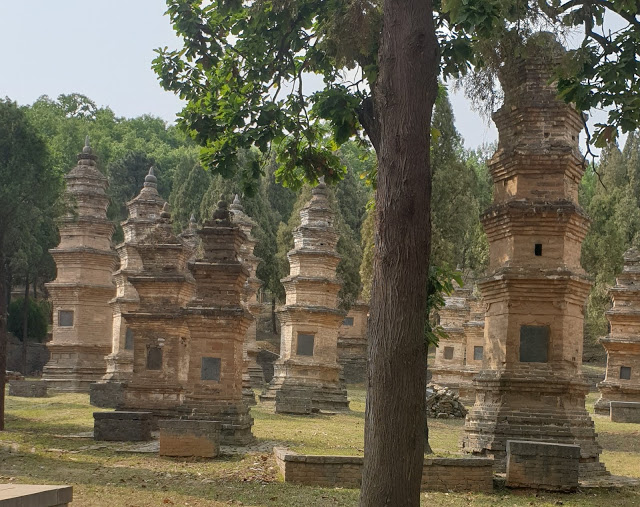
The pagoda forest

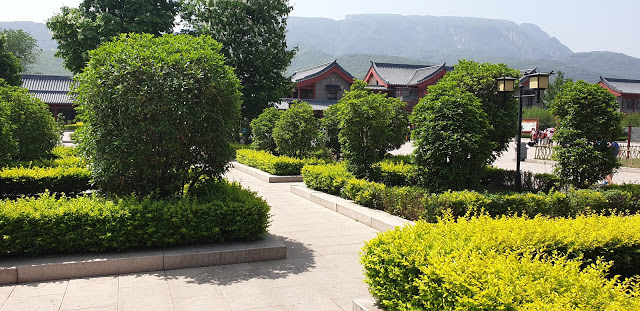
After another exhausting walk, by now the heat was beginning to take its toll on everyone, we arrived at the pagoda forest.

A little history first:

The pagoda forest is located west of the Shaolin Temple and the foot of a hill.  As the largest pagoda forest in China, it covers approximately 20,000 square meters and has about 230 pagodas build from the Tang Dynasty (618-907) to the Qing Dynasty (1644-1911).

Each pagoda is the tomb of an eminent monk from the Shaolin Temple.  Graceful and exquisite, they belong to different eras and constructed in different styles.  The first pagoda was thought to be built in 791.

It is now a world heritage site.

No, it’s not a forest with trees it’s a collection of over 200 pagodas, each a tribute to a head monk at the temple and it goes back a long time.  The tribute can have one, three, five, or a maximum of seven layers.  The ashes of the individual are buried under the base of the pagoda.

The size, height, and story of the pagoda indicate its accomplishments, prestige, merits, and virtues. Each pagoda was carved with the exact date of construction and brief inscriptions and has its own style with various shapes such as a polygonal, cylindrical, vase, conical and monolithic.

This is one of the more recently constructed pagodas

There are pagodas for eminent foreign monks also in the forest.

From there we get a ride back on the back of a large electric wagon

to the front entrance courtyard where drinks and ice creams can be bought, and a visit to the all-important happy place.

Then it’s back to the hotel.

Writing a novel in 365 days – 6e

Day 6 Continued – It’s all in the detail

While we get to talk about characters and characteristics later, part of what sets the scene is the details, those little things about people, places, and sometimes just everyday items that will make a story from routine to, well, slightly more interesting.

For others to find these details relatable makes it even better.

I’ve been to the Eiffel Tower, but I’m sure there’s a detail that can transform words on a page into a picture in the reader’s mind.

Walking across a meadow isn’t just walking, it’s watching the swirling grass as the breeze pushes it one way then another, all around the sounds of birds, and insects.

For added colour you could add a dog, about the same height as the grass, one minute bounding through the grass, the next hot on the trail of a small animal like a field mouse or rabbit.

Above, the sky is blue, the sun is shining, not a hot day, but warm, the sort you don’t need a jumper.

It could be the first day or the last day of the holidays, or you could be staying with an aunt or uncle on a farm in the countryside, in the distance the farmhouse sitting in a familiar position overlooking the valley before it.

There could be a babbling brook, a small bridge to cross, even though it is not very deep, and hiding in the rocks, fish waiting to be caught, taken back to the house, and later become part of supper.

And tying the elements together:

It was almost the end of the holidays and I didn’t want to go back to the city. The last few weeks had opened my eyes to a world I had never known existed.

Sitting under the apple tree on the edge of the grove I looked out across the meadow that fell gently down towards the creek when the other day I had taken my aunt’s advice and went for a dip to cool off.

Now, looking out and trying to put a permanent image of the scene before me in my mind so I could remember it in the coming weeks and months, there was something new, different, than the other days.

Yes, the grass, as high as Cyclops, my aunt’s dog, was swirling in the breeze, and was bounding as he always did through the grass, searching for a rabbit, or he just caught a scent. Yes, the sky was blue, though now there were whispy clouds in the distance, perhaps an omen the weather was about to change, but that was not it.

A different sound from the birds chirping and the insects buzzing, someone singing not loudly but as they would to themselves when they knew no one else was around.

And, then I saw her, a girl my age, long blonde hair tousled by the breeze, in a summery dress with flowers and birds. The elusive Erica, the girl from the next farm, who, my aunt said, sometimes came to pick some apples to take back to her mother to bake apple pie.

Apple pie that was to die for.

When she reached the grove she saw me and stopped. The happy, cheerful expression turned to one of curiosity.

“Who are you?”

“Andy. I’m staying with my aunt. How come I haven’t seen you before?”

“I’ve been here. You have not or I would have seen you.”

True. I had spent most of my time, up until this day working with my uncle in the barn and on the tractor ploughing other fields. I was only here because my aunt had sent me to get some apples fresh from the tree.

“I have been helping my uncle.”

It started out as an awkward conversation because I was not very comfortable around girls. Those that I knew, in the city, were not very nice. By the end, I had found a new friend, and it made it all the more impossible that I had to go home.

And, although I didn’t know it then, it was the start of a relationship that would continue until the day we both died.

It of course needs refinement and more interweaving of the elements around us, but it;s a start.

©  Charles Heath  2025


Writing a book in 365 days

Days 11 and 12

It’s a writing exercise, not one I particularly like, but it’s another step – building characters

This one, a car lover, has more interest in his car than anything else. We’re looking to gauge his reactions when various events occur.

I must say, I don’t really know anyone like this.

Firstly, the car was stolen but returned a week later undamaged and a full tank of petrol.

Well, it’s certainly not a group of 12 to 14-year-olds stealing cars, they’d wrap it around a lamp post and kill everyone but the driver who would be unscathed, taken to the station, charged, let out because he’s a juvenile, and get caught the following week doing the same thing.

But that’s not the brief.

What really happened? A relative borrowed the vehicle. Who else would do such a thing?

Second, a tree falls on it and wrecks it, and the son of the car lover thinks it’s funny.

It probably is, to a certain degree. The irony of someone who so lovingly cares for it, watches it get destroyed with such ease? There’s always insurance, isn’t there?

Third, While cleaning the truck he finds a secret compartment and a note.

Yes, this is the stuff to feed a fertile imagination. My reaction, a note left by a previous lover after they made out on the back seat, advising him he’s a father. The fact he had a girlfriend, married her, and had children already, this has to be a shock.

There is a dozen other scenarios, and maybe it might fuel a story … one day.

Searching for locations: The Pagoda Forest, near Zhengzhou City, Henan Province, China

The pagoda forest

After another exhausting walk, by now the heat was beginning to take its toll on everyone, we arrived at the pagoda forest.

A little history first:

The pagoda forest is located west of the Shaolin Temple and the foot of a hill.  As the largest pagoda forest in China, it covers approximately 20,000 square meters and has about 230 pagodas build from the Tang Dynasty (618-907) to the Qing Dynasty (1644-1911).

Each pagoda is the tomb of an eminent monk from the Shaolin Temple.  Graceful and exquisite, they belong to different eras and constructed in different styles.  The first pagoda was thought to be built in 791.

It is now a world heritage site.

No, it’s not a forest with trees it’s a collection of over 200 pagodas, each a tribute to a head monk at the temple and it goes back a long time.  The tribute can have one, three, five, or a maximum of seven layers.  The ashes of the individual are buried under the base of the pagoda.

The size, height, and story of the pagoda indicate its accomplishments, prestige, merits, and virtues. Each pagoda was carved with the exact date of construction and brief inscriptions and has its own style with various shapes such as a polygonal, cylindrical, vase, conical and monolithic.

This is one of the more recently constructed pagodas

There are pagodas for eminent foreign monks also in the forest.

From there we get a ride back on the back of a large electric wagon

to the front entrance courtyard where drinks and ice creams can be bought, and a visit to the all-important happy place.

Then it’s back to the hotel.

Writing a book in 365 days

Day 10

Apparently, we are still discussing the implements with which we choose to put words on paper, and it seems that choice of implement might make a difference.

I have a degree of scepticism because I generally get words down on my phone, the only implement that is nearby at all times., no matter where I am.

Of course, many years ago I always travelled with little pocket-sized notebooks and a pen, rather than a pencil, to write. I still have all of these, several hundred in fact, in several shoeboxes in the cupboard in my writing room.

Over the years I have accumulated many A5-sized notebooks I bought where there were stationery sales, and now use these to both make notes or write. I tend not to use the smaller notebooks now, but I have a hundred or so sitting in a drawer just in case.

But do you like to write using a biro, with smudgy ink, a pen with a rollerball tip with less smudge, a felt-tip pen, which, depending on the paper type, can leach through, making it difficult to write on both sides, a fountain pen with ink, the old-fashioned way of writing letters, and some of the older writers back in the day?

I remember my early days I’m school, grade three in primary school, when we switched from pencil to pen and ink. It was very messy, to begin with, but I remember vividly being the ink monitor, the one who filled the ink wells, and discovering my schoolmate’s prelidiction for stuffing bits of blotting paper into the well for whatever reason.

Even now it would be a messy way to write.

But the choice is yours.

Tomorrow, at last, we get to do some more writing.

Writing a book in 365 days

Day 10

Apparently, we are still discussing the implements with which we choose to put words on paper, and it seems that choice of implement might make a difference.

I have a degree of scepticism because I generally get words down on my phone, the only implement that is nearby at all times., no matter where I am.

Of course, many years ago I always travelled with little pocket-sized notebooks and a pen, rather than a pencil, to write. I still have all of these, several hundred in fact, in several shoeboxes in the cupboard in my writing room.

Over the years I have accumulated many A5-sized notebooks I bought where there were stationery sales, and now use these to both make notes or write. I tend not to use the smaller notebooks now, but I have a hundred or so sitting in a drawer just in case.

But do you like to write using a biro, with smudgy ink, a pen with a rollerball tip with less smudge, a felt-tip pen, which, depending on the paper type, can leach through, making it difficult to write on both sides, a fountain pen with ink, the old-fashioned way of writing letters, and some of the older writers back in the day?

I remember my early days in school, grade three in fact, when we switched from pencil to pen and ink. It was very messy, to begin with, but I remember vividly being the ink monitor, the one who filled the ink wells, and discovering my schoolmate’s prelidiction for stuffing bits of blotting paper into the well for whatever reason.

Even now it would be a messy way to write.

But the choice is yours.

Tomorrow, at last, we get to do some more writing.

Writing a novel in 365 days

Day 9

OK. We’re not doing much writing, and today, we have another suggestion, one that might cause an unnecessary rush at the stationary store for pencils.

I was in one today, a place called Office Works, getting some folders to put the printed copies of my latest books about to be published.

I’d previously bought, pencils – a box of 24, a motorised pencil sharpener, cards – though I intend to use these for a non fiction book, pens – red, blue, black, erasable – for doing crosswords. I’ve not had to buy notebooks for a while, small and large, but last time I got some journalist note books.

But, I digress…

It is suggested and I think it’s a great idea that at times it is better to write down the story, mainly because I can write as fast as the ideas come, and I cannot type that fast. Not without a million errors and a lot of indecipherable words.

There are exponents for both means of getting words on paper, but I have to say the majority of my original books were written in small notepads, at work and elsewhere because ideas and storylines come to me at the sometimes most awkward moments.

Consider carrying around d a notebook and pencil or pen.

Otherwise, my other means of getting ideas down is a note-taking app on my phone, the best at the moment being Somnote.

And tired of waiting for the moment when the book gets underway, stand by, news on that front is coming.

Writing a novel in 365 days

Day 8

I guess before you actually begin writing, or planning, or however it will be when you finally get started, there are a number of preparations to be made, and advice to be taken.

Advice is always good, and today’s is probably more relevant in a few months when the creativity might start flagging.

Writing a novel requires stamina and dedication. That saying ‘when the going gets tough, the tough get going’ is probably a sign on the wall of your writing room.

But that’s only one aspect of this particular item.

It is also relevant when you’ve finally finished the novel, firstly when you sit down and do that first reading, before the editing, or perhaps that first edit.

You are going to think perhaps it’s not as good as you thought it would be.

No, we don’t think like that. it can be fixed by some editing, by you or someone else. Just remember all those days, weeks, and months you put into it, working your fingers to the bone, sharpening the two hundred pencils you wrote it with. Or smudgy biros or leaking ink pens.

Don’t lose heart.

Don’t give up.

There are days when I write absolute drivel, but I always go back, rewrite, re-read, and rewrite until I’m happy.

That first draft is just the ideas, strung together, that will, eventually become that best-selling novel.

Searching for locations: Hutongs, Beijing, China

What are Hutongs?

In Beijing Hutongs are formed by lines of traditional courtyard residences, called siheyuan.  Neighborhoods were formed by joining many hutongs together. These siheyuan are the traditional residences, usually occupied by a single or extended family, signifying wealth, and prosperity. 

Over 500 of these still exist.Many of these hutongs have been demolished, but recently they have become protected places as a means of preserving some Chinese cultural history.  They were first established in the Yuan Dynasty (1279-1368)Many of these Hutongs had their main buildings and gates built facing south, and lanes connecting them to other hutongs also ran north to south.

Many hutongs, some several hundred years old, in the vicinity of the Bell Tower and Drum Tower and Shichahai Lake are preserved and abound with tourists, many of which tour the quarter in pedicabs.

The optional tour also includes a visit to Shichahai, a historic scenic area consisting of three lakes (Qianhai, meaning Front Sea; Houhai, meaning Back Sea and Xihai, meaning West Sea), surrounding places of historic interest and scenic beauty and remnants of old-style local residences, Hutong and Courtyard.  

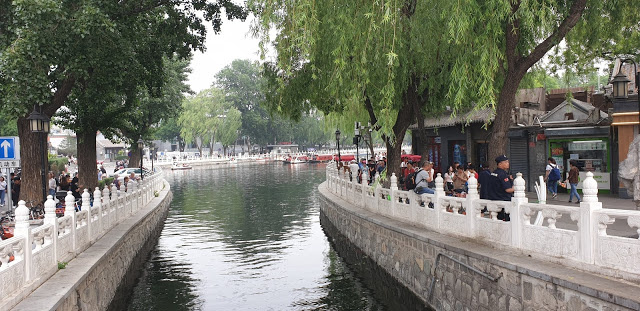
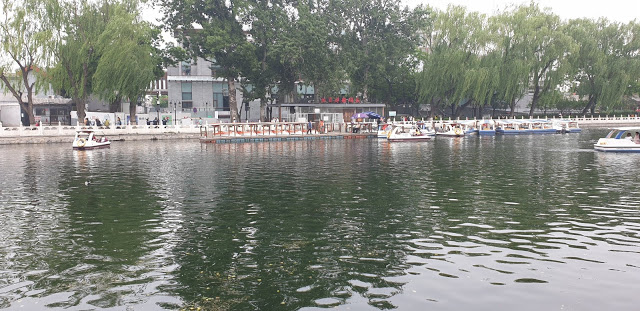
First, we had a short walk through the more modern part of the Hutong area and given some free time for shopping, but we prefer just to meander by the canal.  

There is a lake, and if we had the time, there were boats you could take.

With some time to spare, we take a quick walk down one of the alleyways where on the ground level are small shops, and above, living quarters.

Then we go to the bell and drum towers before walking through some more alleys was to where the rickshaws were waiting.
The Bell tower

And the Drum tower. Both still working today.

The rickshaw ride took us through some more back streets where it was clear renovations were being made so that the area could apply for world heritage listing.  Seeing inside some of the houses shows that they may look dumpy outside but that’s not the case inside.

The rickshaw ride ends outside the house where dinner will be served, and is a not so typical hose but does have all the elements of how the Chinese live, the boy’s room, the girl’s room, the parent’s room, the living area, and the North-south feng shui.

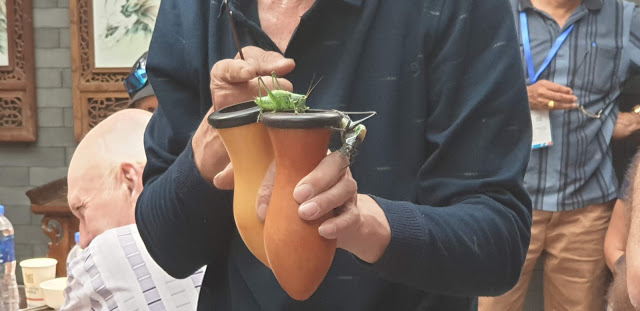
Shortly after we arrive, the cricket man, apparently someone quite famous in Beijing arrives and tells us all about crickets and then grasshoppers, then about cricket racing.  He is animated and clearly enjoys entertaining us westerners.

I’m sorry but the cricket stuff just didn’t interest me.  Or the grasshoppers.

As for dinner, it was finally a treat to eat what the typical Chinese family eats, and everything was delicious, and the endless beer was a nice touch.

And the last surprise, the food was cooked by a man.