A to Z Blog Challenge – April 2025 – B

B is for — Behind the green door.  A game show with a difference

It was the anniversary of my mother’s death and a day when my father usually just remained in bed and refused to get up.

He had never quite coped with it, and now, quite a few years later, he was still struggling.  The pity of it was my birthday was the same as the day she died, and I guess it was why for years he had not celebrated it

However, this year was different.  I was looking forward to turning 30, a milestone and something of an achievement in our community, considering what we had all endured.

But it was what it was.  We were alive, reasonably well, and looking forward to the time when we could once again go outside, though no one really knew what that meant.

We had photographs of how the planet looked before the cataclysmic seismic events of 2031.  Overnight, volcanoes erupted, and huge fissures appeared. And poisonous gas filled the air.  It happened so suddenly and so quick that most of the planet’s population died.

So much smoke and dark particles got into the atmosphere it drowned out the sun, and after that, it didn’t take long for everything that wasn’t killed by the sulphuric acid to die from lack of light.

Fortunately, my family was one of the lucky groups that were given a ticket to the huge underground facility built for just such an event, one of thousands all over the world, a completely self-contained microcosm of human life.

Waiting for the air to be clear and for life to reappear.  We had been waiting 400 years.

That was as much as we knew or cared to.  We all had other things to worry about, like getting through the day with the cheerful disposition my mother brought to everyone who knew her, and in her stead, by me.  Everyone had said how much I was like her, and that perhaps didn’t help my father’s disposition.

It was also the day I was being brought into my father’s circle of friends.  I mean, I knew them already and frequently met them when we all got together as a group of families.  But this, he had said, was something different, and I would have to swear on a bible, of all things, that I would keep it a secret, a secret that I would take to the grave.

It had me intrigued.  There were no secrets among the people.  Everyone basically knew everyone else’s business, not hard in a place that only houses 25,000 people, roughly the size of a small town.

This group, he said, had people from all of the work groups, like medical, sanitation, engineering, communications, and community services.  There were about 50 in all, and now that I was a detective, I was going to be confirmed as the newest member of the team, adding a new field and expertise.

It was a team I didn’t know until he first told me, but being formally introduced to all of them was going to be exciting.  These people, I discovered were basically the ones who made our community work.

It also meant my father wouldn’t be wallowing in self-pity today.  He would have better things to do.

I was surprised to discover the meeting place was a gymnasium.  It was reasonably large and looked rather old and worn out.  A new one had been built not far away, but people still preferred to use this one. The reason I discovered later was that there was no surveillance.

Yes, that was just one of the things about our existence that was a nuisance.  It was everywhere and you had to be on your best behaviour at all times.

The other 48 members had already arrived, and my father and I were the last two. I had to sit up at the main table until the others voted to formalise my addition to the team.

My father rang a bell, and silence took over from the low roar of my simultaneous conversations.

“Welcome, fellow members of the brains trust.  For the edification for what I hope will be our newest member,” A glance in my direction followed by 39 other sets of eyes, “we are a group of experts in our fields and when there a problem the brains trust will come together and brain storm a solution.”

“Our main business today is to formalise the inclusion of my son, Michael, as a member.  He will bring the expertise of a Detective and the use of his skills as one to help us find resolutions to future problems.  If anyone has an objection, make it known now.”

We waited for a minute of so, then he continued, “As there are no objections, it is now time for the oath.”

He motioned me to stand as he took a musty looking volume off the table where he was standing.  I’d seen it before but never took much interest in it.  Now I knew it was a bible, one hardly of any use because religion, though not banned, was frowned upon

Equally, neither of my parents was interested or showed any interest.

He held the book in his hand and asked me to put my right hand on it.  I did.

“Do you swear to work with and help in every way possible as a member of the brain’s trust.”

“I will.”

“Do you swear never to tell anyone else, no matter what relationship you have with them?”

What sort of a secret society was this?

“I do.”

“Do you swear that no matter what duress you are under, you will never tell anyone what you have observed, heard, or performed for the group?”

OK, now it was getting a little scary.  Being a detective, I knew the rules by heart, and if this group was doing anything illegal, I was going to have to break the oath I made to become a detective.

What was more important?

“I will.”

“Then welcome to the brain’s trust.”

He shook my hand, and then everyone of the others did likewise.  It was like swearing an oath to each one of them.

That was the business out of the way.  Now, it was time to celebrate, and the wives and daughters had made food and set it out for all to partake.

There was one woman there who was different from the rest. When I asked one of the other girls who she was, she said her name was Elsie and a friend of another of the girls.

She also said she was new to the community, having come with her mother from one of the other communities nearby.

I was curious.  My father had been at me to find a nice girl and settle down but having been to school with and known most of the girls of my age since we were young children, I had not been able to form a rapport with any particular one.

There was only one reason why a woman came from another community, and that was to marry one of our men.  There were rules around marriage, and everyone had to be careful whom they married.

Not that I was thinking about that right then, but it did occur to me that she would be automatically eligible.

I picked a moment when she was alone and went over.  She saw me coming and I thought she might disappear, but she didn’t.

“Hello,” I said in a slightly breaking voice, nerves almost getting the better of me, “my name is Michael.”

She held out her hand, and I took it in mine.

“Hello, Michael.  My name is Elsie.”

“I have not seen you around.”

“I have only just arrived here with my mother.  She is ill at the moment, and I’m staying with my prospective stepfather’s relative.”

“How do you like this community?”

“It is exactly the same as the one I came from, just different people and different rules, but more or less the same.  Have you lived here all your life?”

“Yes.”

She took her hand back, but not in a way that made me think she didn’t like me.

“What do you do?”

“Science, mostly geology.  I study rocks.  Lately, it’s been monitoring seismic activity.  All numbers and lines, boring stuff.  What do you do?”  Then she smiled, and it was transformational.

“Of course, silly me, you’re a detective.  What do you detect?”

“Not a lot because I’m only new, but one day, murders or missing persons.  We didn’t have many murders or deaths, but we do have minor crimes.  Boring stuff, actually.”

“Well, I’m sure we’ll see each other again.  I must go now.”

I saw a man at the door looking sternly at her, perhaps for talking to me.  She walked quickly but not hastily towards him, and then they left.

My father appeared at my side.  “Interesting, young woman.  Do you know who she is?

“Someone from another community.  I believed her mother had come to marry one of us.”

He frowned and shook his head.

“That man at the door was a relative of the prospective groom,” I said.

“Then I suggest you keep your distance from them.  They’re trouble.”

That sounded ominous.  There were not many people my father didn’t like, so there was going to be a problem if, in the unlikely event, we met again.

For the next month or two, I worked on improving my skills as a detective and kept an eye out for Elsie.  When I didn’t see her again. I put my missing person skills to good use and tried to track her down.

I learned very quickly that what I thought was good work was nothing of the sort.  I told myself that I was not going to be much of a detective if I couldn’t find someone who was not even missing.

It never occurred to me that she might be hiding or keeping away from the general public for private reasons.  Whatever it was, I gave up trying because I assumed if she wanted to see me again, she would come and find me.

Then suddenly, she reappeared, at my favourite cafe and was ordering a takeout coffee.  I joined the queue behind, then touched her on the shoulder.  She both jumped and squealed but was genuinely surprised to see me again.

“Did you go back to your community?  I have been keeping an eye out for you,” I said

She hesitated, what I might have called confused, then said, “Yes, I had to go back.  Mother married and stayed here.  Now I’m back for good.  I didn’t get your last name, so I couldn’t find you.”

Although pleasant, I sensed something reticent in her manner.  Twice, she had been looking around but trying not to.  As if someone was watching her.

“Are you alright?”

She smiled, but there was no warmth in it.  “A relative is somewhere near here.  I’m just waiting for him.  So that I can find you again, can you give me your last name?”

I gave it to her along with my address, which she carefully folded and put in her bag.

Then she caught sight of the person she was looking for.  “Got to go.  Sorry.  We will talk again, I promise.”  And then she was gone.

Cloak and dagger were words I read in a book that I’d found in a suspect’s residence, a book from a long time ago, one that was banned and shouldn’t exist.

Instead of submitting it as evidence, evidence I knew would disappear, and to be told I should not speak of it again, I kept it.  It also told me there must be a cache of such volumes somewhere in the facility and added it to my secret mission list.

I didn’t tell my father, knowing it would set him off on another rant, that we were kept in the dark, that we were being manipulated by an unseen group of pf murderous people who didn’t care about us.  The death of my mother by them had turned him into a bitter old man.

But the courtship, if you could call it that, with a woman named Elsie Myers, was every bit of a cloak and dagger operation.  We would both sneak away to various locations we knew of that rarely saw other people.  At first, we talked about my community and about her community, how much she didn’t like ours and wished she could go home.

It wasn’t long before I realised that her community was the same one my mother came from.  Did she know this?  I knew she couldn’t be related to my mother because she’d know the rules about inter-community relationships.  And if there was, the recording of any relationships would be investigated.

But, whether or not I was supposed to know this, I decided not to speak of it.  She didn’t seem to want to be forthcoming.

Whatever it was we were doing, it proceeded to the point where I took her home to meet my father.  He was now in the twilight of his years and thinking about Rule 71, the one that decreed that everyone turning 65, took a last trip to the community headquarters, spent a week being debriefed ready for the next person to take over their job, and they move into the next phase of their life.

In other words, put bluntly, you reach 65, and you die.  It was an arbitrary age, the beginning of the end, and that age where everything went wrong.  The thing is, in 400 years, medicine had not improved to the point where we could sustainably live past 65 and be useful

We were told it had something to do with having to live under a mountain, the lack of fresh air and sunshine, and the processing of our food.

Besides, I got it.  Who would want to live longer than that?

My father had got a reminder of his human frailty that morning in a card from the administration advising him that he was due for a check-up.

It was a bad choice to pick the same day to introduce Elsie.  It wasn’t until we were outside the door that I remembered what he had said about her all those months ago.

I unlocked the door and ushered her in.  Once, we didn’t have to lock the doors, but there had been a growing discontent between the haves and have-nots.  He was in his favourite chair, reading the newspaper.

“Dad, this is Elsie.”

Rather than him becoming the polite host, he simply glared at me and said, “I told you what thought ages ago.  Take heed or don’t, I don’t care.”

Thus began a long-running and strained relationship between the two of us, and perhaps I should have heeded his advice from the beginning.  It never improved from that day.

When I should have considered what was behind his attitude I didn’t and on top of the indifference he had for everything since mother had died, I decided to strike my own path, neither participating with the brains trust, and continuing to be disappointed with my workplace, not realizing that it might have had something to do with Elsie.

It wasn’t until sometime after I married her and I was complaining about yet another missed opportunity that one of the other detectives intimated that I should wonder how it was a woman like Elsie had deigned to marry someone so inferior to her station.

She had never mentioned anything about her station, but it was about the time when I started to get better cases, and we moved into better accommodation, and then, she had apparently got a promotion, more and important work.

Perhaps that might never have mattered. I had not seen her out and about with another man, not behaving in the manner I would have expected.  I knew she was a flirt as at some of the parties we were invited to, I saw her being friendly with her fellow workers, but I put that down to her manner.

And while I might have dwelled on it longer than I should, it soon became equally apparent that the new cases I was being allocated were leading me down a dark path whether intentionally designed to distract me from questioning her behaviour, or whether I was meant to discover there was a whole other side to our community that no one else could see.

Had Elsie facilitated that, or was I just imagining it?

Whatever the reason, my life took a very different path, for a period a very intense relationship with Elsie as if we only had a very short time left together, I had uncovered a series of missing persons and subsequent deaths that were linked, something I could not report because there was a possible link between them and my father and other members of the brains trust.

Then my father’s time was up, and I took him to the judiciary, trying to make up for those years since I chose Elsie over him, only for him to cryptically tell me that things happened for a reason, and I would soon learn what that reason was.  He was not bitter, not anymore, and was glad to move on.

Then, in one stultifying moment, Elsie was gone.  I had, on occasion, followed her out and about, seeing who she met, who she was more friendly with, and finding out who they were.  It was interesting that they were all top-level scientists and the sort of men she should have married.

And then, it was one of them that killed her in a jealous rage.  It was not the story they told me, a bunch of shadowy men in black calling, explaining, and then leaving with the ominous threat that I should accept the findings of the investigation and get on with my life.  A CCTV video gave me the real answer much later, but it didn’t make me feel any better.

In the end, I got to my retirement date, rather satisfied in the end that I had done my job to the best of my ability, I had met and lived with the woman I believed I was meant to be with and that I was probably the only one of the 25,000 inhabitants in our community who knew what had happened over the last 400 years that got us to the point where we were now.

©  Charles Heath  2025

Writing a book in 365 days – 76

Day 76

Write as you speak

If I did, it would be a jumble of words that might not make any sense. But, for the purposes of this exercise, I shall try…

I’m guessing that the point of this is that conversations have to sound natural, and often the words running around in my head sound fine but it’s when you read them out aloud that’s when it sounds wrong.

More than once, I’ve read out a sentence I’ve written and cringed. “Who talks like that?”

More than once, someone has said to me, “Did you just hear what you said?” and of course, we don’t listen to what we say, especially when we are angry and just spitting out words.

Kids make you see red, and once I did actually hear what I said, and if the neighbours had they would no doubt call the police. My eldest son had made me so angry I think I threatened to kill him in several different ways.

Not long after I read an article that said parents frequently threatened their kids with death or worse, and it was the reason why the just laughed at them. As if we were going to kill them.

But it did strike a chord about the sort of conversations my characters would have, and when I read over some of the stuff that I’d written, how much it sounded like me. In fact, one of my relatives was beta-reading a story I’d written, and she said how much it was like me to the point where she could see me as the character.

IT made me think twice every time I write conversations, and now I deliberately listen to other people and pick up on their speech patterns, words used, and manner of speaking to get a better feel for what is needed.

Of course, I’m not perfect, but it’s fun trying to assume different identities and imagine how they would react in any given situation, and particularly what they might say.

NANOWRIMO – April 2025 – Day 2

The Fourth Son

So here’s the thing.

Our protagonist’s parents have decided they want him back home, and he’s not playing the game

They talk to some reporters, and a large weekend spread about the royal family is published with photographs.

If he’s not coming back, then everyone should know who he is, and the media will then hound him into returning.

Royal parents are like that.

Of course, there is always one reporter who puts two and two together, one who had no compunction in hounding the victim to the ends of the earth for a story, and one who does.

Confronting him and his girlfriend, in his favourite restaurant, on the day he decided that it was time to make his intentions known.

Even knowing that ousting was going to be sooner rather than later, it’s still a shock, to him and his girlfriend Ruth, who is very dismayed at the braveness of the media on pursuing their pretty.

But the jig is up.  No matter how many denials, the truth is the truth, and now a whole restaurant full of diners is left to wonder.

His charmed life till now is gone.

Writing a book in 365 days – 76

Day 76

Write as you speak

If I did, it would be a jumble of words that might not make any sense. But, for the purposes of this exercise, I shall try…

I’m guessing that the point of this is that conversations have to sound natural, and often the words running around in my head sound fine but it’s when you read them out aloud that’s when it sounds wrong.

More than once, I’ve read out a sentence I’ve written and cringed. “Who talks like that?”

More than once, someone has said to me, “Did you just hear what you said?” and of course, we don’t listen to what we say, especially when we are angry and just spitting out words.

Kids make you see red, and once I did actually hear what I said, and if the neighbours had they would no doubt call the police. My eldest son had made me so angry I think I threatened to kill him in several different ways.

Not long after I read an article that said parents frequently threatened their kids with death or worse, and it was the reason why the just laughed at them. As if we were going to kill them.

But it did strike a chord about the sort of conversations my characters would have, and when I read over some of the stuff that I’d written, how much it sounded like me. In fact, one of my relatives was beta-reading a story I’d written, and she said how much it was like me to the point where she could see me as the character.

IT made me think twice every time I write conversations, and now I deliberately listen to other people and pick up on their speech patterns, words used, and manner of speaking to get a better feel for what is needed.

Of course, I’m not perfect, but it’s fun trying to assume different identities and imagine how they would react in any given situation, and particularly what they might say.

A to Z Blog Challenge – April 2025 – A

A is for – “Anyone want to go on safari?”

“You are asking for trouble,” Jennifer, my sister, said with the usual condescending tone.

She hated the fact I was footloose and fancy free, unlike her, shackled to a bad husband and three demanding and bratty children.

It had been an idyllic marriage until she decided she wanted children, and Mike, her husband, didn’t.  Not until they had secured their future.  She went off the script, and everything had gone downhill since then.

She looked tired and, as a result, sounded irritable.

“It’s been cleared by the government, and it’s not the first one.  They’ve run it successfully for two years now without incident.”

We were talking about my latest holiday destination, a safari that ventured across three African nations, one of which had recently been in the news after an unsuccessful coup.

The last safari had been cancelled as a precaution, but the particular nation had said everything was now settled, and the safaris could restart.

It was no surprise that the revenue from the tours was much-needed income for the government.

“I thought you were going ice fishing in Alaska and camping out in an igloo. That would be safer.”

I had thought about it, but that I could do anything.  A safari sounded a lot more interesting, especially when a lot of the animals they had in the wild could basically only be seen in Zoos.

“It’s a once-in-a-lifetime thing, Jen.  My mind is made up.”

“When do you go?”

“Next Tuesday.  It takes about a month, give or take, depending on the weather.”

“I can’t talk you out of it?”

“It’s booked, and I’ve cleared my calendar.  Don’t worry, I’ll report in every day.”

I took the train to Heathrow to avoid the hassle of driving.  I was travelling light and following the tour guide documentation.

Arriving with a few hours to spare, I found a cafe and had a late breakfast and coffee, and whiled away the time researching the countries and animals likely to be seen.

There was an obscure news article filed the day before by a neighbouring country’s national newspaper on a matter of civil unrest in one of the provinces, but it was nowhere near where the tour would be passing through

I also looked at the tour company’s Web page for an update on the tour conditions, where they advised whether there were any problems, and all there was was a nod to the weather, which might turn bad for a day or two.

There was nothing about civil unrest.

About a half hour before boarding commenced, I went to the gate and spent the time evaluating who of the two hundred or so passengers would be my fellow safari travellers.

Until my cell phone vibrated, signalling an incoming message.  I was expecting one from work, but the number it was from was not familiar.

“Jennifer has got it into her head she needs a break from us.  She was muttering something about a safari you were going on.  If this is so, please talk her out of this silliness and tell her to come home.”

What the hell?  Jennifer had never shown any inclination for adventure, so it was difficult to believe she would join me on a safari or anywhere else.  And I was not surprised that Brian had messaged me.  Their home would not survive without her.

I sent back, “If she does come here, you have my word. I will do my utmost to convince her to go home.”

I hope she was not trying to make a point at my expense.  Brian disliked me enough as it was.

A few minutes later, the message I was waiting on arrived.  These two words had great significance, and after going through the presentation, I got the feeling the answer would be no.

I opened the message.  “Operation approved.  Settling wheels in motion.”

I took a deep breath.  It was going to make the time away just a little more interesting if anything happened, although my assessment at the time had been it could take weeks, even months.

Perhaps I should just enjoy the safari and the time away while I could.

Boarding commenced forty minutes before the scheduled departure time.  In my experience, there was no plane I’d ever been on from any airport in the world left on time.

Having opted to pay more for a better seat in business class, I was allowed to board with the first class and frequent fliers with those cards I’d never attain.

It was a refined group for first class, with one exception: a family who looked like they’d stumbled upon the billion ff miles needed for the upgrade, and a more motley group in business class.  I had dressed for the occasion, but some hadn’t.

I think they were university types because they both looked like the lecturers I had, and they had no dress sense either.

The seat next to me was empty, though I expected someone would eventually fill it because I was told the plane was full.  It took the full forty minutes to get everyone on, including a late straggler, the occupant of the seat next to me.

And I was not surprised to see my sister Jennifer.

Perhaps she had left her boarding to the last minute and presented a fait-accompli as the door was closed behind her.  That showed a deliberate intent to come with me.

I frowned at her as she sat, as well as shake my head.

“Don’t look at me in that tone of voice, Jeremy.”

I shrugged.  “What are you doing here?”

“Simple.  I needed a break.  I don’t want to go anywhere by myself, so I chose to go on your safari.”

“You don’t do adventure,” I said, remembering the one and only time she was forced to go on such a holiday.  It didn’t end well.

“Perhaps that’s what’s missing in my life.”

“Brian sent me a message to tell you to go home.”

“To be his and those wretched children’s slave.  No, I’m done with that for a month.  They can either choose to go in without me or perish.”

The steward came past to hand out a drink, orange juice, water, or champagne.  Jennifer picked the champagne.  I had water.

There was a shudder through the plane, and then we started moving back.  For better or worse, we were on our way.

“So, you’re determined to do this?”

“I am.”

The look on her face, of determination tinged with despair, told me all I needed to know.  I was not going to enjoy this holiday.

©  Charles Heath  2025

Writing a book in 365 days – 74/75

Days 74 and 75

Write about a character through dress, expressions, gait, and mannerisms and what makes them memorable. Then, who do they love or fear, where are they going, and do they have a secret?

If there was one definable item about Jacqueline Bennet, it would be that she could not disappear in a crowd.

I know, I was sent by head office to collect her from the railway station, with the only identification, the fact she was wearing a red coat.

If only…

For the last six months it had been my assignment to collect people. From the airport, from the bus station, from the train station. The least favourite was the train station.

I had to try and find the new interns in the throngs of people who all got off the train and swelled up into a swirling mass of bodies so thick sometimes all I could see was heads.

Today was no exception, except…

Jacqueline was wearing a hat, purple, almost the shape of a peacock, and as large. I saw the hat before the red coat. That, itself, was so bright it hurt my eyes.

It took three attempts to introduce myself and convince her I was not trying to kidnap her and have her sent to some harem in Arabia. I said there was no such place as Arabia, and it elicited one of seven expressions which by the time I got her to the office I’d worked out to be, incredulous, surprised, dismayed, disappointed, happy, sad, and angry. These expressions were accompanied by little mannerisms, a tic in her left eye, blinking excessively, pursing her lips and sighing. There was a nervous giggle, but I was not sure where that fitted.

She was mostly disappointed, mainly because Mr Brightman, the CEO, had not come to greet her, and instead it was some minion.

I knew this much about her before we got out the main entrance to Grand Central Station, and it was more than I cared to know.

Outside the station, we caught a cab to the office and then spent the next thirty-five minutes in traffic. For some reason, it was unusually bad because the normal time it took was between ten and fifteen minutes.

The first five minutes were rather tense, so I thought I would lighten the atmosphere by asking, “Where did you come from?”

At first, I thought she was going to ignore me, but then, after a sideways glance that suggested she didn’t tell minions such personal things about herself, she said, “Bridgewater, Ohio.”

When I asked if it was big or small, she said it was a place no one had heard of because it wasn’t a real town. It was a hell hole that everyone wanted to escape. I can’t imagine any place, especially your hometown, as being somewhere you would want to leave willingly, but apparently, the highway that passed through and kept all the businesses going had its route changed and had now bypassed the town. It was the reason for her move, the cafe she worked at had closed, as did just about everything else.

Then there was the toxic relationship with her high school sweetheart, which had been affected by everything else and forced her to make the decision to get away. New city, new start. Our employment agency was recommended by one of her friends who had also made the decision to leave, and had found a happy situation in Florida. Jacqueline was hoping for California.

I had lived in New York all my life and had never suffered the problems that seem to plague the Midwest. Jacqueline was not the first or the last person who had fled their previous existence, but the story seemed to the the same.

But listening to her story tumble out in short, breathless sentences, I felt there was something more behind her move. It was that one statement, thrown in there among the others, that if you were not listening, you would have missed it. “Big cities, they provide an anonymity that can give you that ability to reinvent yourself.”

They could. But equally, a person could simply disappear and never be found again. It had happened to several of the people who had come to us for employment, and this girl, who was under all of that bravado and camouflage, people who had come from abusive homes or relationships, the production of bad education, wasted opportunities, and economic downturn. Anything had to be better than what they had.

“Don’t do it,” I said. We were about five minutes away from the office.

“Don’t do what?”

“Walk in the door, go and see Mr Brightman, accept the job he has picked out for you. Don’t.”

She picked up on the urgency in my tone. I knew what was going to happen, as much as I told myself over and over, it wouldn’t.

“Why? Why on earth would you say such a thing?”

“Because I think you were right when you said you’d finish up in a harem in one of those Arab states. Girls come and girls go, but when I try to find out where they’ve gone, they either never arrived or left soon after they started.”

She looked at me like she thought I was an axe murderer, not a messenger.

“How come you’re telling me this?”

“I don’t know. He’s going to kill me when he finds out, but I don’t like this job any more, and talking to you, hearing what it is he is using to lure people like you, that idea that ‘it’s too good to be true’ just reverberates in my head. I was like you three years ago. Small town boy with big aspirations, running away from an abusive father and a town full of bullies. I’m still that boy, big town, small town, the fears are the same, only here, it can swallow you up.”

I’d walked out of the boarding house that morning with nothing but the money I had saved and the notion that I could get on a train to anywhere, that I would not meet the girl, and hope that she would think she had been abandoned and do something else. Then, at the station, like the times before, I lost my nerve.

I pulled out the money and divided it into two. “Take this, find somewhere to stay, and don’t go to Mr Brightman. You can’t trust him. I’m not going back.”

“Now you’re scaring me.”

“You should be. Stop the cab. We’ll get out here.”

“But…”

“If you make one right decision in your life, let it be this one. Take the money. Please.”

The cab stopped, and I paid the fare. I got out and held the door. In that moment, I could see all of the fears that I had myself the first day I arrived, and the girl that Mr Bightman had sent to fetch me. If I’d known then what I know now…”

“Please.”

Finally, she stepped out of the cab. We both watched it drive off.

“Now what?”

“Take the money, and believe that it is the first day of the rest of your life.”

The sun chose that moment to finally come out from behind the clouds and transform that cold, wintry morning into a world filled with possibilities. She looked at me and smiled, the look of a woman who had made a decision.

“Did you have a plan when you left home this morning?”

“Other than I was not going to work for Mr Brightman any more, no. I was going to the station, but I was going to get on a train to anywhere but here.”

She shrugged. “I always wanted to go to California, but I didn’t want to go there alone. Fancy joining me? I mean, I still don’t trust you completely, but I can tell if you are telling me the truth or not.”

“Are you sure?”

“No. But what’s the alternative if your suspicions are right?”

Decisions are made, rightly or wrongly, based sometimes on reality, but often on a hunch.

We went back to the station on foot, taking the opportunity to talk. I think it was her idea that if I was an axe murderer, I would lose patience and simply move on or show my true colours. That I
was willing to talk, tell her all my hopes and aspirations, and how I’d settled for three years in a rut that felt safe.

We had lunch and spent the afternoon getting ourselves from Grand Central to Penn station, and then the next three days sewing the seeds of a friendship that lasted the rest of our lives.

It was interesting to read a small article in the paper about three weeks later, as I settled into a new job working for a large distribution centre as dispatch clerk, the arrest of Mr Brightman, aka Chuck Sentry, aka Walter Winsome, aka Jonathon Bentley on charges relating to the disappearance of at least fourteen people.

They were all the names I could remember, and I wrote them down in a letter and sent it anonymously to the NYPD.

©  Charles Heath  2025

NANOWRIMO – April 2025 – Day 1

The Fourth Son

It is sometimes quite strange where the ideas for a story come from.

This one started with a man on the roof of an apartment block with a telescope, a place where he can seek refuge from work and people.

Being in New York, of course, made it all the more impossible to get a clear night and a clearer sky, but perhaps it was more about the solitude.

Then I read about the planets lining up, which doesn’t happen very often, and you know the saying, when the planets line up, maybe. .

So, I had my protagonist.

Now, I needed someone to interrupt the solitude and then focus him on the notion that when one door closes, another opens.

Of course the protagonist who is hiding something out of the ordinary, someone with a secret, and someone who has feelings for another who in the greater schene of things in his life, is someone who would not be ‘the right choice’.

Except his position allows him the freedom to choose whom he wants.

A scare finds him beginning to realise that he can not remain behind that veil of anonymity for much longer, and one way or another, it is going to be exposed.

But, by the time he decides to make his feelings known, his secret is no longer a secret.

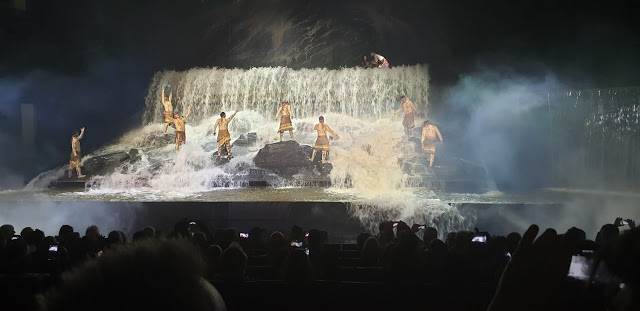
Searching for locations: The Golden Mask Dynasty Show, Beijing, China

The Golden Mask Dynasty Show was located at the OCT Theatre in Beijing’s Happy Valley. 

The theatre was quite full and the seats we had were directly behind the VIP area; as our guide told us, we had the best seats in the house. 

The play has 20 different dance scenes that depict war, royal banquets, and romance.  There are eight chapters and over 200 actors, and throughout the performance we were entertained by dancers, acrobats, costumes, lighting, and acoustics.

The story:

It is of romantic legend and historical memories, the Golden Mask Queen leads her army in defeating the invading Blue Mask King’s army, and afterwards the lands return to a leisurely pastoral life until the Queen forges a ‘mysterious tree’.  When the tree has grown, the Queen has a grand celebration, and releases the captured Blue soldiers, much to the admiration of the Blue Mask King.
This is followed by monstrous floods, and to save her people, and on the advice from the ‘mysterious tree’, the Queen sacrifices herself to save her people.  The Queen then turns into a golden sunbird flying in the sky blessing the people and that of the dynasty.

Billed as the best live show in China, described as a large scale dramatic musical, “The Golden Mask Dynasty” it lived up to its reputation and was thoroughly enjoyed by all.

It was not just singing dancing and acrobatics, it had a story and it was told so that language and cultural issues aside, it worked.  There was a narration of the story running beside the stage, but it was hard to divide attention between what was happening, and what was being related.

Then came the peacock dance, with live peacocks

And this was followed by a waterfall, well, I don’t think anyone in that audience could believe what they were seeing.

I know I was both astonished and in awe of the performance.

What a way to finish off our first day in Beijing.

Oh, sorry, that high was dented slightly when we had to go back to our room.

Writing a book in 365 days – 74/75

Days 74 and 75

Write about a character through dress, expressions, gait, and mannerisms and what makes them memorable. Then, who do they love or fear, where are they going, and do they have a secret?

If there was one definable item about Jacqueline Bennet, it would be that she could not disappear in a crowd.

I know, I was sent by head office to collect her from the railway station, with the only identification, the fact she was wearing a red coat.

If only…

For the last six months it had been my assignment to collect people. From the airport, from the bus station, from the train station. The least favourite was the train station.

I had to try and find the new interns in the throngs of people who all got off the train and swelled up into a swirling mass of bodies so thick sometimes all I could see was heads.

Today was no exception, except…

Jacqueline was wearing a hat, purple, almost the shape of a peacock, and as large. I saw the hat before the red coat. That, itself, was so bright it hurt my eyes.

It took three attempts to introduce myself and convince her I was not trying to kidnap her and have her sent to some harem in Arabia. I said there was no such place as Arabia, and it elicited one of seven expressions which by the time I got her to the office I’d worked out to be, incredulous, surprised, dismayed, disappointed, happy, sad, and angry. These expressions were accompanied by little mannerisms, a tic in her left eye, blinking excessively, pursing her lips and sighing. There was a nervous giggle, but I was not sure where that fitted.

She was mostly disappointed, mainly because Mr Brightman, the CEO, had not come to greet her, and instead it was some minion.

I knew this much about her before we got out the main entrance to Grand Central Station, and it was more than I cared to know.

Outside the station, we caught a cab to the office and then spent the next thirty-five minutes in traffic. For some reason, it was unusually bad because the normal time it took was between ten and fifteen minutes.

The first five minutes were rather tense, so I thought I would lighten the atmosphere by asking, “Where did you come from?”

At first, I thought she was going to ignore me, but then, after a sideways glance that suggested she didn’t tell minions such personal things about herself, she said, “Bridgewater, Ohio.”

When I asked if it was big or small, she said it was a place no one had heard of because it wasn’t a real town. It was a hell hole that everyone wanted to escape. I can’t imagine any place, especially your hometown, as being somewhere you would want to leave willingly, but apparently, the highway that passed through and kept all the businesses going had its route changed and had now bypassed the town. It was the reason for her move, the cafe she worked at had closed, as did just about everything else.

Then there was the toxic relationship with her high school sweetheart, which had been affected by everything else and forced her to make the decision to get away. New city, new start. Our employment agency was recommended by one of her friends who had also made the decision to leave, and had found a happy situation in Florida. Jacqueline was hoping for California.

I had lived in New York all my life and had never suffered the problems that seem to plague the Midwest. Jacqueline was not the first or the last person who had fled their previous existence, but the story seemed to the the same.

But listening to her story tumble out in short, breathless sentences, I felt there was something more behind her move. It was that one statement, thrown in there among the others, that if you were not listening, you would have missed it. “Big cities, they provide an anonymity that can give you that ability to reinvent yourself.”

They could. But equally, a person could simply disappear and never be found again. It had happened to several of the people who had come to us for employment, and this girl, who was under all of that bravado and camouflage, people who had come from abusive homes or relationships, the production of bad education, wasted opportunities, and economic downturn. Anything had to be better than what they had.

“Don’t do it,” I said. We were about five minutes away from the office.

“Don’t do what?”

“Walk in the door, go and see Mr Brightman, accept the job he has picked out for you. Don’t.”

She picked up on the urgency in my tone. I knew what was going to happen, as much as I told myself over and over, it wouldn’t.

“Why? Why on earth would you say such a thing?”

“Because I think you were right when you said you’d finish up in a harem in one of those Arab states. Girls come and girls go, but when I try to find out where they’ve gone, they either never arrived or left soon after they started.”

She looked at me like she thought I was an axe murderer, not a messenger.

“How come you’re telling me this?”

“I don’t know. He’s going to kill me when he finds out, but I don’t like this job any more, and talking to you, hearing what it is he is using to lure people like you, that idea that ‘it’s too good to be true’ just reverberates in my head. I was like you three years ago. Small town boy with big aspirations, running away from an abusive father and a town full of bullies. I’m still that boy, big town, small town, the fears are the same, only here, it can swallow you up.”

I’d walked out of the boarding house that morning with nothing but the money I had saved and the notion that I could get on a train to anywhere, that I would not meet the girl, and hope that she would think she had been abandoned and do something else. Then, at the station, like the times before, I lost my nerve.

I pulled out the money and divided it into two. “Take this, find somewhere to stay, and don’t go to Mr Brightman. You can’t trust him. I’m not going back.”

“Now you’re scaring me.”

“You should be. Stop the cab. We’ll get out here.”

“But…”

“If you make one right decision in your life, let it be this one. Take the money. Please.”

The cab stopped, and I paid the fare. I got out and held the door. In that moment, I could see all of the fears that I had myself the first day I arrived, and the girl that Mr Bightman had sent to fetch me. If I’d known then what I know now…”

“Please.”

Finally, she stepped out of the cab. We both watched it drive off.

“Now what?”

“Take the money, and believe that it is the first day of the rest of your life.”

The sun chose that moment to finally come out from behind the clouds and transform that cold, wintry morning into a world filled with possibilities. She looked at me and smiled, the look of a woman who had made a decision.

“Did you have a plan when you left home this morning?”

“Other than I was not going to work for Mr Brightman any more, no. I was going to the station, but I was going to get on a train to anywhere but here.”

She shrugged. “I always wanted to go to California, but I didn’t want to go there alone. Fancy joining me? I mean, I still don’t trust you completely, but I can tell if you are telling me the truth or not.”

“Are you sure?”

“No. But what’s the alternative if your suspicions are right?”

Decisions are made, rightly or wrongly, based sometimes on reality, but often on a hunch.

We went back to the station on foot, taking the opportunity to talk. I think it was her idea that if I was an axe murderer, I would lose patience and simply move on or show my true colours. That I
was willing to talk, tell her all my hopes and aspirations, and how I’d settled for three years in a rut that felt safe.

We had lunch and spent the afternoon getting ourselves from Grand Central to Penn station, and then the next three days sewing the seeds of a friendship that lasted the rest of our lives.

It was interesting to read a small article in the paper about three weeks later, as I settled into a new job working for a large distribution centre as dispatch clerk, the arrest of Mr Brightman, aka Chuck Sentry, aka Walter Winsome, aka Jonathon Bentley on charges relating to the disappearance of at least fourteen people.

They were all the names I could remember, and I wrote them down in a letter and sent it anonymously to the NYPD.

©  Charles Heath  2025

Writing a book in 365 days – My story 9

More about my story

There’s always something about that knock on the door in a hotel when you’re not expecting anyone.

This is more so when you are staying in the hotel for reasons other than what you intimated to the desk clerk.

The art of not being noticed is to be anonymous, the sort of person that does not stand out, that no one gives a second look.  That’s a bit hard if you are an Englishman in a foreign country.  Language, skin colour, dietary requirements, allergies, heat or cold, and travelling alone are all features which will catch someone’s attention.

Yes, like the arrivals hall at an international airport, as in a hotel lobby, there are spies watching the spies.

That’s why a universal occupation like journalist flies well in these situations.  And given there is an international conference, he can hide in plain sight.

Except, the police chief likes to know who he’s dealing with and meets up for a little discussion about protocol.  After all, he wouldn’t the first or last journalist to find himself in breach of the customs of the country.

Mind what you write.

And yes, there is a chief of the secret police, a man who scares everyone from the president down, the man who makes people disappear, and we’re going with the dark sunglasses, immaculate uniform, I think I’m a god, tropes.