Or, more to the point, we all want to use words that will emphasise the description or the point we want to make.
The trick is not to make it so obscure that we send the readers to the Thesaurus too many times before they get bored.
Then there is that other problem of using the same word over and over and that too gets boring.
Such a word is said. But you have to be careful not to use too flowery a description of what is being said, or the manner in which is being imparted.
Gushed – I mean, who gushes these days?
Snapped – that’s what alligators do, and they don’t speak.
Quietly, whispered, demanding, spitefully, angrily. Try to think of how you would impart the words if you were in the place of your character.
How would you feel on the other end of a verbal barrage?
Perhaps therein lies a possible solution to the problem of describing conversations, arguments, heated exchanges, or what do they call them these day, robust discussions.
K is for — Knight in shining armour. A surprising twist in a simple rescue
…
To tell my mother that a large orchestra was not a necessity for a ‘ball’ thrown in my honour was the same as telling her I didn’t want one. Missives that she totally ignored.
I knew my father agreed with me, a man who didn’t like the idea of showing extravagance for the sake of it in the face of the current economic climate. We were going to feature not only in the society pages, but also near page one as a hot news item. Some of it was going to be for all the wrong reasons.
I’d seen several roving reporters, scribbling in their notebooks.
When Madeleine and I returned, the orchestra had fired up and was regaling the attendees with a waltz, though not that many had taken to the floor. Perhaps the art of ballroom dancing at balls was no longer a thing.
“Perhaps we should set an example,” she said.
“You dance?”
“I’ve been around the floor once or twice. I’m assuming your boarding school taught you the finer points?”
“Mademoiselle Garmin. You learned, or it was twenty lashes. I learned.”
Odd, too, that I found by the time we reached the dance floor, we were holding hands. She was subtle and sneaky.
“I’m willing if you are.”
And, yes, after a few hesitant first steps and getting closer to her than I had ever been since the first day I met her, I found she was very competent. Perhaps she was equally surprised I was quite good and could actually lead.
Our demonstration pulled others out of their seats and into the vortex. It got a round of applause at the end, and then the orchestra slipped into something less challenging for those without formal training.
She still had my hand, and I don’t think she was giving it back. Did this mean I had to take her home with me? It was an interesting thought, given the Madeleine/Oscar dynamic. Or was that why she sent him away, so she could advance this relationship?
Even more interesting. I found myself almost as intrigued as a member of the public would be when reading about us.
We reached the edge of the dance floor when I heard my mother advancing, “There you are.” She was very quick when she wanted to be, perhaps thinking I was about to disappear again.
“Where have you been?”
“On the dance floor, demonstrating that you didn’t waste your money sending me to that awful school.”
She smiled at Madeleine. “You dance beautifully.”
And I didn’t? Sometimes, my mother could be aggravating. I glared at her.
“So did you,” she said to me. Then back to Madeleine, “Come, there’s some people I’d like you meet.”
She gave me a baleful look then the link was severed, and she reluctantly left with my mother. Rather her than me, meeting all that ‘old money’ and then unattractive daughters. It was a compelling reason to stay with Madeleine if only to keep the others at bay.
A hand on my shoulder and words in my ear. “You two make an attractive couple out there,” he waved his hand towards the dance floor, “but it didn’t seem you were ‘together’ if you know what I mean.”
Howard was both a keen judge of character and could spot a phony a mile off. I’d have to work hard to convince him we were ‘together’.
“Early days, Howie. I’m not like you. A sideways glance from a girl and you are taking her to a cheap motel.”
“You should try it?”
“A cheap motel? Sorry. It has, at the very least, five stars before I walk in the door.”
“Snob.”
“Expensive boarding schools will do that to you.”
He punched me in the arm, playfully but hard enough. “So, seriously, do you like her?”
“Do you?”
He shook his head. “When you start answering questions with questions, I know there’s trouble in paradise. What is it?”
“Nobody is that perfect, Howie.”
Before I overheard a conversation that suggested an ulterior motive, it was one of the foremost items on my mind. She was almost perfect, which meant there had to be something. And the timing. Girls like her do not come out of left field like she did; they are noticed and talked about. No one I knew had any idea who she was or anything about their family. And internet searchers found very little. It was interesting that she did not have a digital footprint or social media presence.
Even I had one of those, albeit tended by a personal assistant.
“Then grab her while you can, before there’s a line of eligible bachelors beating a path to her door.”
I was about to tell him they could but decided not to.
“I’m working on it.”
“Work harder.”
Another pat on the back, and he was gone.
The whole time Howard was with me, I’d seen her glancing in my direction, in between being attentive to the women in the group, giving me the ‘come hither’ look, suggesting she wanted to be rescued.
I gave it a few more minutes and then wandered slowly over to the group. My mother’s cronies, the morning tea reading group, I think.
“Have you finished torturing my partner in crime?” I asked Mother when she looked condescendingly in my direction.
“You make it sound like you’re bank robbers.”
“We’re working on it. I don’t know yet if she’s going to be the safecracker or the getaway driver.”
It got the required response for the elderly group: a look of disdain from all of them.
“And with that, ladies, I must whisk her away. I hear the orchestra is working towards a tango, and that is one of my criteria in a girlfriend.”
“Tango,” she said, almost in disbelief.
Was that mantle of perfection starting to slip?
“What’s a ball without a tango, and the honourees not being able to lead from the front?” I made the bold move of taking her hand and gently extracting her from the group.
“Oh, do so if you must, Sam.”
She smiled as I led her away. “You are my gallant knight in shining armour.”
“Overly expensive tuxedo, perhaps. Not one for shining armour, though. But I can handle a sword if necessary.”
“Another boarding school class?”
“Senor Rafael, Olympic champion no less. Until that first lesson, I idolised Zorro and wanted to be just like him.”
“Anything you haven’t done?”
“Sweep a girl off her feet.”
“Then let the sweeping begin.”
If there was a moment that I could say I fell in love with Madeleine, it was during the tango. I would never admit it, but there it was.
Such a line, ‘you had me at the tango’.
This was going to be painful if it didn’t work out.
Is there a reason why you would not want to tell it or that if you did, some people might find it uncomfortable?
The problem is, no matter what you write someone out there isn’t going to like it.
And there is a raft of subjects to write about that causes concern, but these are sometimes stories that have to be told.
I have one such story, and to me, the telling of it would not fit the mainstream opinion because people are very divided over it. There are reasons for this, and they are being, in my opinion, sensationalised to polarise a particular stance.
The subject: Transgenders.
Like I said, it’s a story I would like to write about, but I know what the response is going to be.
And that isn’t to say that I do not have my own biases, the baggage that we are given when we are younger, where schools and teachers teach us what is supposedly the norms they will need to work within for the rest of their lives.
In my day it was that the man went to work to earn the living that provided a house, food, and everything else, while the woman stayed home, had children and looked after the man.
Yes, I can hear 50 percent of the population laughing at that one, but how different is that societal norm to that where we are now taught that transgenders are sub humans that should be scorned and abandoned because they don’t fit the definition of man or woman?
Thankfully, I grew out of that, and women can vote, work, drive cars, and do anything they desire, though it seems there is a new movement that wants to take away all those rights and go back to the Stone Age.
Again, another very touchy subject, and that will eventually prevent the possibility of writers putting forward the various viewpoints for larger discussion.
Try going back another hundred years, when women were the sub-human species, little more than a man’s possession.
This is probably the only time I will raise the subject, as an instance of what writers may or may not write about, a highlight that public opinion fueled by people in power does eventually affect what can be written.
It’s something that we should all be mindful of, as well as keeping an open mind.
For the first time on this trip, we encounter problems with Chinese officialdom at the railway station, though we were warned that this might occur.
We had a major problem with the security staff when they pulled everyone over with aerosols and confiscated them. We lost styling mousse, others lost hair spray, and the men, their shaving cream. But, to her credit, the tour guide did warn us they were stricter here, but her suggestion to be angry they were taking our stuff was probably not the right thing to do.
As with previous train bookings, the Chinese method of placing people in seats didn’t quite manage to keep couples traveling together, together on the train. It was an odd peculiarity which few of the passengers understood, nor did they conform, swapping seat allocations.
This train ride did not seem the same as the last two and I don’t think we had the same type of high-speed train type that we had for the last two. The carriages were different, there was only one toilet per carriage, and I don’t think we were going as fast.
But aside from that, we had 753 kilometers to travel with six stops before ours, two of which were very large cities, and then our stop, about four and a half hours later. With two minutes this time, to get the baggage off the team managed it in 40 seconds, a new record.
After slight disorientation getting off the train, we locate our guide, easily found by looking for the Trip-A-Deal flag. From there it’s a matter of getting into our respective groups and finding the bus.
As usual, the trip to the hotel was a long one, but we were traveling through a much brighter, and well lit, city.
As for our guide, we have him from now until the end of the tour. There are no more train rides, we will be taking the bus from city to city until we reach Shanghai. Good thing then that the bus is brand new, with that new car smell. Only issue, no USB charging point.
The Snowy Sea hotel.
It is finally a joy to get a room that is nothing short of great. It has a bathroom and thus privacy.
Everyone had to go find a supermarket to purchase replacements for the confiscated items. Luckily there was a huge supermarket just up from the hotel that had everything but the kitchen sink.
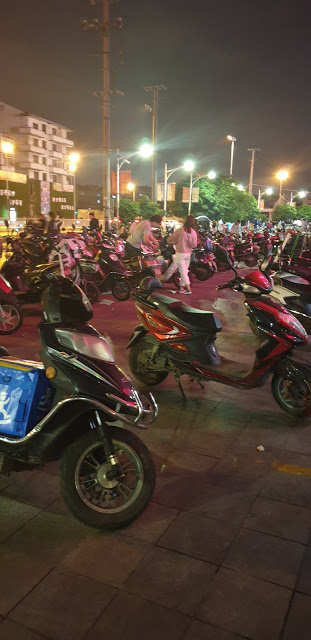
But, unlike where we live, the carpark is more of a scooter park!
It is also a small microcosm of Chinese life for the new more capitalistic oriented Chinese.
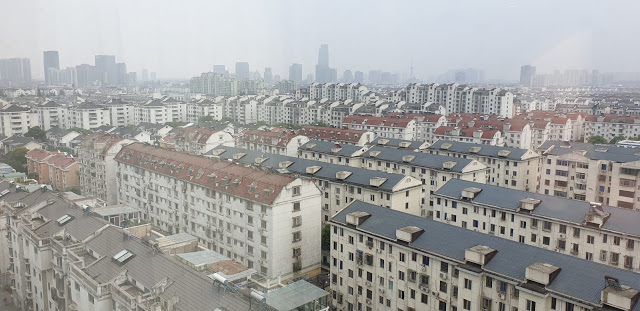
The next morning we get some idea of the scope of high-density living, though here, the buildings are not 30 stories tall, but still just as impressive.
These look like the medium density houses, but to the right of these are much larger buildings
The remarkable thing about this is those buildings stretch as far as the eye can see.
Is it possible to be so apprehensive and get to heave a sigh of relief?
His mother is nowhere to be seen, sedated after the death of her husband, and they are only confronted by his sisters and stepsisters.
As well as all the other dignitaries like the Chancellor and parliamentarians, justices, councillors, and selected citizens.
It’s brief because there are more documents to sign. And there’s going to be a welcome home banquet and no rest for the wicked.
Susie, yes we haven’t forgotten her, hasn’t stopped saying Oh my God, since she got on the plane, and that only increased in intensity from the plane to the castle. She honestly believes she is in Disneyland.
I’ll try not to make it sound like she is.
Ruth is trying not to be overwhelmed, but she is beginning to understand a little of his world and how different it is, and realizing just how much it will impinge on their lives.
Hasn’t changed her mind, though. Perhaps the thought of being a real-life princess is starting to crystallise in the back of her mind.
Is there a reason why you would not want to tell it or that if you did, some people might find it uncomfortable?
The problem is, no matter what you write someone out there isn’t going to like it.
And there is a raft of subjects to write about that causes concern, but these are sometimes stories that have to be told.
I have one such story, and to me, the telling of it would not fit the mainstream opinion because people are very divided over it. There are reasons for this, and they are being, in my opinion, sensationalised to polarise a particular stance.
The subject: Transgenders.
Like I said, it’s a story I would like to write about, but I know what the response is going to be.
And that isn’t to say that I do not have my own biases, the baggage that we are given when we are younger, where schools and teachers teach us what is supposedly the norms they will need to work within for the rest of their lives.
In my day it was that the man went to work to earn the living that provided a house, food, and everything else, while the woman stayed home, had children and looked after the man.
Yes, I can hear 50 percent of the population laughing at that one, but how different is that societal norm to that where we are now taught that transgenders are sub humans that should be scorned and abandoned because they don’t fit the definition of man or woman?
Thankfully, I grew out of that, and women can vote, work, drive cars, and do anything they desire, though it seems there is a new movement that wants to take away all those rights and go back to the Stone Age.
Again, another very touchy subject, and that will eventually prevent the possibility of writers putting forward the various viewpoints for larger discussion.
Try going back another hundred years, when women were the sub-human species, little more than a man’s possession.
This is probably the only time I will raise the subject, as an instance of what writers may or may not write about, a highlight that public opinion fueled by people in power does eventually affect what can be written.
It’s something that we should all be mindful of, as well as keeping an open mind.
J is for — Journey through danger. The travails of people seeking a new place
…
There were four stages of recovery, each approximately six weeks in length. Alpha, Beta, Gamma, and Delta.
Sitting around the table discussing in detail what was expected, it was assumed that the fallout would be between an extinction event and a totally destroyed planet surface, that our plans were to be optimistic, assuming the lesser of the two evils, and that we would be out and about sooner rather than later.
Six years advance notice, three years of denying it would hit us, one year of squabbling between major political parties, and now leadership, or lack of it, that was dictated by the oligarchs, made it difficult, if not impossible, for those who wanted to help to enact plans. Everything that required funding had to be approved, and that approval was subject to profiteering.
It basically created two factions. The idea of making money off a crisis situation, abhorrent as it was, had become the driver for everything and eventually spawned It created the newspaper headline, “The race to save the world, but not by whom you think it is!”
I don’t think those who were in control realised there wasn’t going to be a world in which wealth would mean anything. It was why, with one year to go, a group of other billionaires realised they were going to be left out in the cold and unilaterally decided to create their own solution, one that went against the prevailing government, one that was only going to be able to pick up the pieces, if there were any pieces left.
A meteor was coming, all efforts to knock it off course had failed, and there was a last-ditch plan to try and blow it to pieces. It was the ultimate Hail Mary, but it wasn’t our bailiwick.
They were building underground rescue centres, and after the meteor hit or shattered, the military that wasn’t aligned with the government would be running their own rescue effort. There was no time or space to save everyone.
That was the plan. And I and thousands of others were also part of the plan.
Lieutenant Giselle Landers, the closest thing we had to a meteor and space expert, had just concluded the presentation to a packed hall of about one thousand servicemen and women of all ranks and branches, one of a dozen held around the country.
There was stunned silence.
I was not surprised.
In the alpha phase, we just stayed underground and hoped for the best. Either the meteor hit us and, like in dinosaur times, obliterated the life-giving rays of the sun, or if the Hail Mary worked, the meteor was destroyed, and then it rained shrapnel down for days, weeks, or months.
No one knew for sure what would happen, other than life as we knew it would be over. And quite possible for all those who didn’t get an invite to a shelter, what amounted to 95 per cent of the population.
Gabby’s final statement, that most of the 95 per cent would die in the first six months, was that moment when it started to feel real. She had run model after model, scenario after scenario, but the result was the same. The government had left it too late to do anything to help the people, only themselves.
The best case scenario:
In the beta phase, the teams sent to individual recovery centres would start monitoring the outside to see when it was safe to commence operations.
Gamma phase, six weeks after impact, it was assumed that by this time, it would be reasonably safe to go out and start searching for survivors
Delta phase, having collected our first quota of survivors ready to transport to the new city that was expected to be under construction and ready to take refugees, we called base and started moving people.
Like I said, it all sounded feasible when sitting around that table.
Then came the reality.
They succeeded in destroying the meteor, shattering it into a million or more pieces, pieces that broke through the atmosphere and rained down for a week. What no one knew was that there was a smaller meteor in the tail of the larger one, totally undetectable until too late, and it hit the earth in the middle of Africa.
It made all the plans we made almost irrelevant.
Each phase was meant to be measured in weeks, but in the end, by the time we could execute the Gamma phase, nearly eight months had passed, and most of us believed that no one could have survived the aftermath, let alone the actual event.
The collision created a huge crater, set off a chain reaction of explosions, and set in motion a large number of volcanoes, all in turn heating the atmosphere and the oceans, creating steam and ash that blotted everything. In the end, the meteor storms were the least of the planet’s problems.
And we, buried in our bunkers, barely survived ourselves. It was a tribute to the designers and builders, and the redundancy that was built in kept us alive.
Until everything outside settled down. There was still ash in the air, and the landscape that we could see was desolate, destroyed, and uninhabitable.
Giselle and I, and four others, were in the first team to go outside, initially to see if life could be sustained, and if not, to begin operations to find anyone who survived.
We were dressed in special Hazmat suits with independent oxygen supplies. The air was still polluted with dust, and for 10 am, it was very gloomy, the sun barely penetrating the thick air.
All around us, the once lush forest was simply a swauve of blackened rocks and scree and charred stumps where trees once grew. Nothing could survive very long in those conditions.
Nothing.
The outside temperature was registered at 45 degrees Celsius. The air had 400 times the required level of pollution and was, therefore, unbreathable.
Our facility was built deep in the forest, about five miles from a highway, about 20 miles from the nearest town. We had managed to save a hundred and fifty people from the town, those that hadn’t tried to escape north. They were told their best chance of survival would be to head for the Arctic Circle, which Giselle said would have been good advice if there were shelters.
We could have saved more if they had listened to reason.
Each facility had a version of the vehicles that were used on the moon landings, specifically designed to traverse rough terrain. It was rough between the facility and the highway, and we had to go slowly.
When we reached the highway, there were thousands of cars in every direction, with bodies inside and out as far as the eye could see. They would not have died straight away. It would have taken a few days, a week, perhaps longer for the nearest volcanic activity to overcome them.
From the highway, we drove down to the town with no break in the traffic that had clogged the road. The town wasn’t much better, the buildings relatively intact and filled with those people who thought it would protect them.
It did not. Those bodies were not charred like those outside. We checked all the buildings, and in local government offices that housed the sheriff’s station and law courts, the inside was remarkably intact and almost as it would have been before the event.
Giselle was intrigued and found on investigation that the walls were made of mud bricks and over two feet thick. The doors were three inch cast iron and the window shutters about the same, closed and locked.
It was odd that the door was closed but not locked.
And unlike the other buildings crammed with people trying to hide, it was relatively empty. A quick search uncovered three bodies, remarkably intact.
We brought a doctor, and his examination told us they had only recently died.
People who had almost lived to tell about it.
That’s when Giselle said, “There will be more, somewhere. These places have basements, deep underground. Start looking.”
It didn’t take long. Another cast iron door led to a passage and stairs going down. At the bottom, another door unlocked and easily opened.
I took the lead and drew my weapon in case there might be trouble. I switched on my torch and walked slowly down the passage towards an underground room.
It was in darkness, and standing at the entrance, I moved the light around the room. 20 cots with 17 people on them. None were moving or had reacted to the light.
I called out to the doctor. “17 people, they don’t look like they have survived.”
The doctor followed me in and went to the first cot. I held the light over the body while he examined it. It was a middle-aged woman who looked malnourished but otherwise in reasonable condition.
Then he almost yelled, “She’s alive, barely.” And them went to each cot and after a brief examination, “and another, and another…”
We had brought water and rations, and I sent two up to get the supplies.
I kneeled down beside the cot and looked at her more closely. I knew the face and then remembered who she was. The Mayor. We had stopped briefly on our way to tell her we would be back to collect anyone who wanted to come with us. She had rounded up all the townspeople she could but volunteered to stay behind to fetch the rest. I guess she had found them, and by then it was too late..
When the others returned, I shook her gently by the shoulder, and after a minute, her eyelids fluttered, then opened.
“You made it.”
“Did I.” Her voice was more a dry rasp. “I thought I was in heaven. The others?”
“I’m checking them now.” I handed her a bottle of water after removing the lid. It might be an idea to sip first.”
“How long since…”
“Three weeks the food ran out, four days the water. I told everyone to lie down and conserve energy. I think we all knew our time was up. Did you make it with the others?”
“Yes. We saved about a hundred and fifty.”
The doctor yelled out, “Fifteen alive, two dead, but only in the last hour or so. Ration the water for a few minutes so they can recover.”
“What happened, other than the end of the world?”
“Have you seen outside?”
She shook her head. One day there was endless traffic passing through, the next the skies turned black, with rocks falling like hail, tje air swirling with ash and smoke so thick you couldn’t see, with the sound of continuous thunder, and people just started dying, slowly at first, the screams made it feel like we’re were in hell, and then nothing. By that time, we had locked ourselves in and came down here and barricaded the doors. It was nearly six months before we came out to look. Is it all like this?”
“We don’t know. This is the first time we’ve left the facility. No one can survive yet, so we’ll take you back in suits. Soon.”
She reached out and took my hand in hers. “Is there any hope?”
When I set out earlier, I didn’t have any. I expected to discover we were the only people left, other than those on other facilities. Now, finding these people alive, even if barely, there was hope.
“Yes. There’s nearly three hundred of us, and there’s more. If you can survive, then others will have. So, let’s pray we find them as quickly as we found you. Are there any other places in town we might find people?”
“Thank you. And yes, there might. But I will need a few minutes.”
“OK.” I looked over at Giselle, who was talking to a young girl. She glanced my way and smiled.
The first step, she had said to the team before we left the facility, of a very long journey into danger.
So, here’s the thing. If I thought I could get James Patterson’s opinion on one of my novels, I would try, but I don’t think, given the prolific output he maintains, that he would have the time to put an amateur like me on the straight and narrow.
But…
Who’s to say that if I found another struggling author like me who was of a mind to offer an opinion, I wouldn’t take it?
I would have to say the best critic would be someone who writes similar genre stories to yours.
So…
Here’s the deal, minus the steak knives.
Join a writing group, a bunch of fellow writers who write the same stuff, and take on board contemporary reviews.
Something else that might help, in the absence of those great authors who probably have no time to look over our work, is to get the opinions of beta readers. I’ve been looking, but it seems a lot of them want payment. I guess there’s a good living out there, but they would have to be both reputable and good at it.
Other than that, there’s always a possibility that one day…
For someone who had not had to be the public face of anything and who was living in an environment where in America only two people knew who he was, stepping out of the plane at the small international airport, he is staggered to discover half the principality has turned out to see him.
The fear he feels extends to whether it is going to be a problem for Ruth.
He need not have worried. She is far more experienced in fronting up to, sometimes hostile, crowds, having worked for an accounting firm that specialised in takeovers, mergers, and bankruptcy.
A crowd of adoring people is grist to the mill for her.
Of course, meeting people who are pleased to see you is one thing, but there’s also the drive to the castle and the people who might not want to see you or make you welcome.
Our new king is not so sure about what his family’s reaction might be, and he was definitely very scared of what his mother was going to do or say.
The Henan Museum is one of the oldest museums in China. In June 1927, General Feng Yuxiang proposed that a museum be built, and it was completed the next year. In 1961, along with the move of the provincial capital, Henan Museum moved from Kaifeng to Zhengzhou.
It currently holds about 130,000 individual pieces, more of which are mostly cultural relics, bronze vessels of the Shang and Zhou Dynasties, and pottery and porcelain wares of the various dynasties.
Eventually, we arrive at the museum and get off the bus adjacent to a scooter track and despite the efforts of the guide, there’s no stopping them from nearly running us over.
We arrive to find the museum has been moved to a different and somewhat smaller building nearby as the existing, and rather distinctively designed, building is being renovated.
While we are waiting for the tickets to enter, we are given another view of industrial life in that there is nothing that resembles proper health and safety on worksites in this country, and the workers are basically standing on what looks to be a flimsy bamboo ladder with nothing to stop them from falling off.
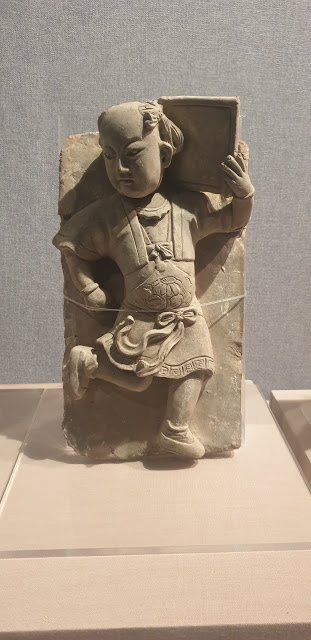
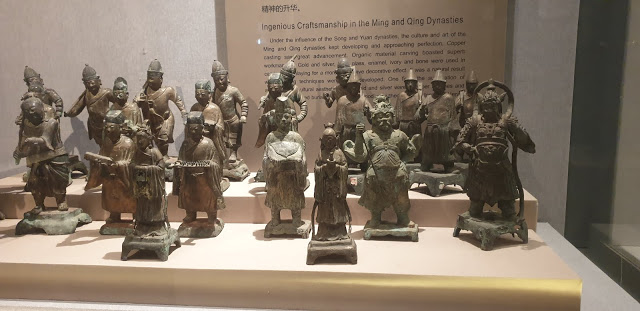
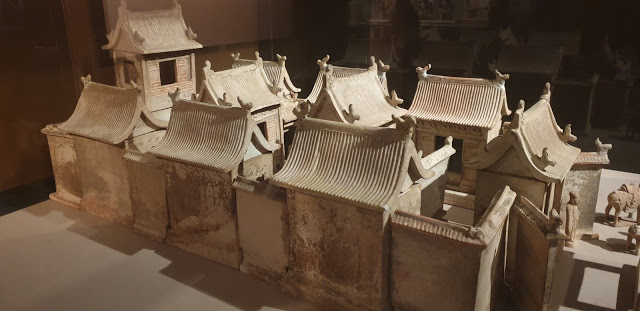
The museum itself has exhibits dating back a few thousand years and consist of bronze and ceramic items. One of the highlights was a tortoiseshell with reportedly the oldest know writing ever found.
Other than that it was a series of cooking utensils, a table, and ceramic pots, some in very good condition considering their age.




 Thrills, Spills, and just a dash of Romance