Writing a book in 365 days – My story 15

More about my story

If we are going to have a dictatorship with a benign president, and rebels, and a missing leader of the opposition party in what is purported to be a democracy of sorts, then there must be a revolution in the offing.

And what better time to have a coup d’état than when there is a human rights conference going on?

So far, a group of rebels have been thwarted by our protagonist, who is trying to do his job or protecting the keynote speaker, and who is a long-ago love interest.  And yes, we will get past the notion that the woman in white is his daughter.  She is not.

Then we get to the notion that some of the journalists might be agents for the various intelligence agencies in the world, and one in particular, a British journalist who may or may not be MI6.

Of course, that leader of the opposition is not dead, just missing, and the rumours of the catacombs being a vast underground network of tunnels and dungeons, and quite possibly torture chambers, is a good enough notion that someone should have a poke around.

And let’s not forget that the protagonist’s diverting assistant he didn’t want, has now managed to catch the eye of the very nasty head of the secret police.  It’s just one more thing to worry about.

While the, of course, the human rights conference carries on regardless of the antics outside.

Writing a book in 365 days – My story 15

More about my story

If we are going to have a dictatorship with a benign president, and rebels, and a missing leader of the opposition party in what is purported to be a democracy of sorts, then there must be a revolution in the offing.

And what better time to have a coup d’état than when there is a human rights conference going on?

So far, a group of rebels have been thwarted by our protagonist, who is trying to do his job or protecting the keynote speaker, and who is a long-ago love interest.  And yes, we will get past the notion that the woman in white is his daughter.  She is not.

Then we get to the notion that some of the journalists might be agents for the various intelligence agencies in the world, and one in particular, a British journalist who may or may not be MI6.

Of course, that leader of the opposition is not dead, just missing, and the rumours of the catacombs being a vast underground network of tunnels and dungeons, and quite possibly torture chambers, is a good enough notion that someone should have a poke around.

And let’s not forget that the protagonist’s diverting assistant he didn’t want, has now managed to catch the eye of the very nasty head of the secret police.  It’s just one more thing to worry about.

While the, of course, the human rights conference carries on regardless of the antics outside.

Writing a book in 365 days – 115

Day 115

Writing in the first person or in the third person

Writing in the first or third person is a matter of preference; the former can sometimes be limiting because only one point of view is generally available to the reader, while the latter enables the reader to get more than one point of view.

In the first instance, this is how we tell a story from one perspective that doesn’t necessarily require others.  In the second instance, it is useful for writing a murder mystery where different perspectives, attitudes, and characters, depending on circumstances, add to the story in ways a single perspective can not.

However, as I see it, when writing in the 3rd person, the author has to have multiple personalities in order to write different points of view.  To me, that’s difficult, but not impossible. It simply means you have to get into character so you can write their story.

That, in turn, takes more time and, to a certain degree, a lot more planning for character development.  It’s where a minor character can get to steal the show, as is known to happen in movies.  Sometimes, it’s a pleasant surprise; others are not so much.

A pitfall not to fall into is adopting the same persona type for all the characters.  You would need to sit down and plan each of the individual characters, no matter how small a role they play.

Writing a book in 365 days – 115

Day 115

Writing in the first person or in the third person

Writing in the first or third person is a matter of preference; the former can sometimes be limiting because only one point of view is generally available to the reader, while the latter enables the reader to get more than one point of view.

In the first instance, this is how we tell a story from one perspective that doesn’t necessarily require others.  In the second instance, it is useful for writing a murder mystery where different perspectives, attitudes, and characters, depending on circumstances, add to the story in ways a single perspective can not.

However, as I see it, when writing in the 3rd person, the author has to have multiple personalities in order to write different points of view.  To me, that’s difficult, but not impossible. It simply means you have to get into character so you can write their story.

That, in turn, takes more time and, to a certain degree, a lot more planning for character development.  It’s where a minor character can get to steal the show, as is known to happen in movies.  Sometimes, it’s a pleasant surprise; others are not so much.

A pitfall not to fall into is adopting the same persona type for all the characters.  You would need to sit down and plan each of the individual characters, no matter how small a role they play.

Writing a book in 365 days – 114

Day 114

Do you write what you feel, or do you write what you must?

I don’t think I have ever written a story because I had to, well, not until now in the process of writing a book in 365 days, from my literary calendar.

But..

The stories I write for this are not to any sort of format. Yet, I guess because I have to write something specifically asked for, then in that case, I write what I must.

But for everything else, I write what I feel like, and quite often those stories follow a set of feelings that are created or prompted by what I see around me, what I see on TV, what
I hear on the radio, and what I read.

It’s nothing to glance at the headlines and sift out one or two, or a set and weave them into an idea that might be the basis of a story. I like the idea of unconnected and random events, and from these, I weave them into a story.

For example:

There was a TV show on, one of a series, and it was in part about a spy network being wound up because they were about to be blown. I write about spies, especially those who have tried to escape from their former lives, and this was too good an opportunity to pass up.

Then there was another, of which I only saw a preview, but it had an interesting premise: what if you didn’t really know the person you had been living with for the past twenty-five years? Yes, you guessed it, a spy.

Writing a book in 365 days – 114

Day 114

Do you write what you feel, or do you write what you must?

I don’t think I have ever written a story because I had to, well, not until now in the process of writing a book in 365 days, from my literary calendar.

But..

The stories I write for this are not to any sort of format. Yet, I guess because I have to write something specifically asked for, then in that case, I write what I must.

But for everything else, I write what I feel like, and quite often those stories follow a set of feelings that are created or prompted by what I see around me, what I see on TV, what
I hear on the radio, and what I read.

It’s nothing to glance at the headlines and sift out one or two, or a set and weave them into an idea that might be the basis of a story. I like the idea of unconnected and random events, and from these, I weave them into a story.

For example:

There was a TV show on, one of a series, and it was in part about a spy network being wound up because they were about to be blown. I write about spies, especially those who have tried to escape from their former lives, and this was too good an opportunity to pass up.

Then there was another, of which I only saw a preview, but it had an interesting premise: what if you didn’t really know the person you had been living with for the past twenty-five years? Yes, you guessed it, a spy.

Writing a book in 365 days – 113

Day 113

Do you have a pet writing project or subject

In my case, I do. The history of my family. This had only become a project in the last few months, and it is one of those things that we would all like to know something about, and probably think it’s too hard to do.

After all, time passes, the first-hand sources of material die, and you have to go the hard road and start digging for information. I’m lucky in a sense, my older brother has been doing this for a few years now and has been visiting the places where we came from.

But, from my standpoint, this is an excellent exercise in characterisation, especially if you want to write historical fiction. It has led me down a path of searching for records in the most unlikely places, discovering just how much information from the past has been digitised and is accessible.

It has also led to the discovery of newspaper archives, one of the more interesting sources of information, and just a little thrill every time I uncover another snippet about one of my ancestors.

And no, not yet, have I discovered a true gem of a discovery, though one path led to a possible connection, very remote, to J R R Tolkien, and another to Harriet Beecher Stowe.

They have yet to be proved, but I don’t think we could be that lucky.

Writing a book in 365 days – 113

Day 113

Do you have a pet writing project or subject

In my case, I do. The history of my family. This had only become a project in the last few months, and it is one of those things that we would all like to know something about, and probably think it’s too hard to do.

After all, time passes, the first-hand sources of material die, and you have to go the hard road and start digging for information. I’m lucky in a sense, my older brother has been doing this for a few years now and has been visiting the places where we came from.

But, from my standpoint, this is an excellent exercise in characterisation, especially if you want to write historical fiction. It has led me down a path of searching for records in the most unlikely places, discovering just how much information from the past has been digitised and is accessible.

It has also led to the discovery of newspaper archives, one of the more interesting sources of information, and just a little thrill every time I uncover another snippet about one of my ancestors.

And no, not yet, have I discovered a true gem of a discovery, though one path led to a possible connection, very remote, to J R R Tolkien, and another to Harriet Beecher Stowe.

They have yet to be proved, but I don’t think we could be that lucky.

Writing a book in 365 days – 112

Day 112

Writing exercise

The Smithsons had always lived in a house at the middle of the cul-de-sac on the nice side of the neighbourhood, where they never quite made the grade.

That’s not to say they didn’t belong there, and they might well have fitted in if it had not been for the rather gregarious behaviour of Mrs Smithson.

Or so my mother said, many times in hushed tones, when stealing a glance out the front window, and Mrs Smithson would be standing in the front yard in attire that, as my mother so bluntly described it, a decent woman would not wear inside the house, let alone out.

My father, being the polite man he was, would also glance out the window, but I always thought his look was one of appreciation. I know my older brother had the same look, but with a different set of feelings. I was too young, at the time, to understand such things.

Where had they come from?

Why had the realtor sold them the house, especially when he knew that only a certain type of person would be welcomed into the neighbourhood, or was it for some other reason?

Years later, when my home for many years was finally handed down to the last family member, me, I got to discover the truth.

The Smithsons had a daughter, well, that’s another story, but a girl about my age turned up one morning outside the front of their house, in a rather strange manner.

Or given how the neighbourhood perceived the Smithsons, perhaps it was in character for them.

A rather posh car stopped out front, and my mother, not to miss anything that happened there, happened to be peering through the blinds.

“Come and look at this,” she said, excited, to my father, who was about to leave for work.

“Jenny, don’t you have better things to do?”

Like take us to school, of course, but for the gossip session later…

He didn’t join her but continued on his way out. I went over instead.

Just in time to see a man get out of the driver’s side and come around to open the door for a lady who was dressed differently from us. The man had a hat and a suit on.

Then a girl got out of the car, about eight or nine, with a small suitcase. The woman who I assumed was her mother grabbed her hand and literally dragged her to the front door of the Smithsons’ residence, then started pounding on the door.

When there was no answer, but I did see movement of one of the curtains indicating someone from within was watching, she yelled out, “Daniel, you’d better get out there and collect your little brat, because I’m leaving her here. You hear me, Daniel? You’ll be hearing from my lawyers.”

She waited a minute, said something to the girl that made her start crying, then stomped back to the car. The man opened the door for her, she got in, and then they left.

Only then did the front door open, and the girl and the suitcase dragged her in and slammed the door.

And from that point, there were nothing but heated arguments that often spilled out into the cul-de-sac, until one morning, it all ended. Mrs Smithson left with her own suitcase.

I used to play by myself because most of the children in the cul-de-sac were much older, in a field behind the Smithsons’ house, and gained access to it by a narrow walkway between the Smithson house and their neighbour.

Sometimes Smithson was waiting for anyone who dared to use that walkway, or his two eldest boys, who were bullies. It became a game in itself to get past them, and one I succeeded in doing more often than not.

Once, I ran into ‘the little brat’, named Eloise. That much I knew from the shouting matches. She was hiding down in the makeshift hut I’d built out of builders’ waste, a summer holiday project.

“Who are you?” she asked.

“The owner of this hut.”

“It doesn’t belong to anyone.”

“It’s not yours.”

“I’m here.”

“So am I. Who are you?”

“Eloise. What’s your name?”

“Jack.”

“You live over the road. Does your mother always peer out from behind the curtains? My mother says she should mind her own business.”

“That’s what my dad says. What do your parents argue about all the time?”

“Me.”

“Why?”

“I’m supposed to be the result of my Daddy’s sordid affair with my mother. Now my mother no longer wants me, and neither does Daddy.”

“You could come and live with us,” I said without thinking and without knowing the ways of the world. To me, it seemed an easy thing to do.

“That would be nice, but I’m being sent to a relative in New York. That will be better than staying here where I’m not wanted. I’d better go before they send those two horrible boys to find me.”

When I came home from school about a week after Mrs Smithson left, my mother told me that ‘obnoxious little brat over the road’ had been taken away. I didn’t bother telling her just how wrong she was about Eloise.

By a quirk of fate and a very bad year, I found myself the new owner of the house I grew up in.

How it happened was another of those stories that fitted into that category, ‘you wouldn’t believe if I told you’.

I was surprised when the lawyer called me, and even more surprised to learn of both my parents and brothers’ passing.  We had a falling out, some years before, over something quite trivial, but pride and stupidity on both sides created and perpetuated a stand-off that was never bridged.

The pity of it was that I did not feel the loss as keenly as I should have, and for a month or so, I dithered about returning.  In the end, I decided the happy memories outweighed the despair, and I decided to move back home.

Now, standing in the lounge, I stole a glance towards the window that my mother had spent so much time at, stickybeaking at the neighbours.  For a moment, I was tempted.

But, the moving boxes weren’t going to move themselves, the movers running out of time, and had dumped the last twenty in the foyer.

Until there was a knock on the door.

Was this the neighbourhood welcoming committee?  There had been one when we first moved in. I went over and opened the door.

“Hello, Jack”

A woman about my age but very familiar stood on the front porch, looking back towards the Smithsons’ house.

“I know you, don’t I?”

“Yes, you do.”

“Then give me a minute… Oh, yes.  Eloise?”

She smiled.  “Very good.  I see you have just moved in.  I’m loath to say I was watching through the front window.”

“A regular pastime in this neighbourhood.  God, the number of hours my mother wasted.  I apologise for her behaviour.”

“It doesn’t matter.  Never did, for me anyway.  I wasn’t there long enough for it to matter.  Are you staying or passing through?”

“Staying.”

“Your family?”

“Passed.  A car accident a while back.”

“Oh, I’m sorry for your loss.”

“Thank you.  When did you return?”

“About a week ago.  A quirk of fate, really.  Last relative standing.  Parents divorced and passed, both to cancer, and those two beastly boys died in Afghanistan.  I guess being the result of an affair sometimes has its advantages.  So, here I am, and so are you.  I never forgot that moment of kindness.  I thought, if it were you, I would invite you over for dinner.  Unless you have other plans.”

I looked around at the mess.  “It can wait.  What time?”

“Now.”

©  Charles Heath  2025

Searching for locations: Port Macquarie – Day 1 – Part 1

In keeping with the new travel plan, we are picking places in Australia, where we can exchange our timeshare week.

Some people consider timeshares as a waste of time and money, and the process of getting one is very painful, which it can be. 

Certainly, in some of the places we have gone, they tried hard to sell you another which can be a downside to staying, but the fact we get to stay in a three-bedroom fully kitted apartment of bungalow for $200 for the week far outweighs the small inconveniences.

Previously, we stayed at Coffs Harbour, but this time, we decided to stay at Port Macquarie.

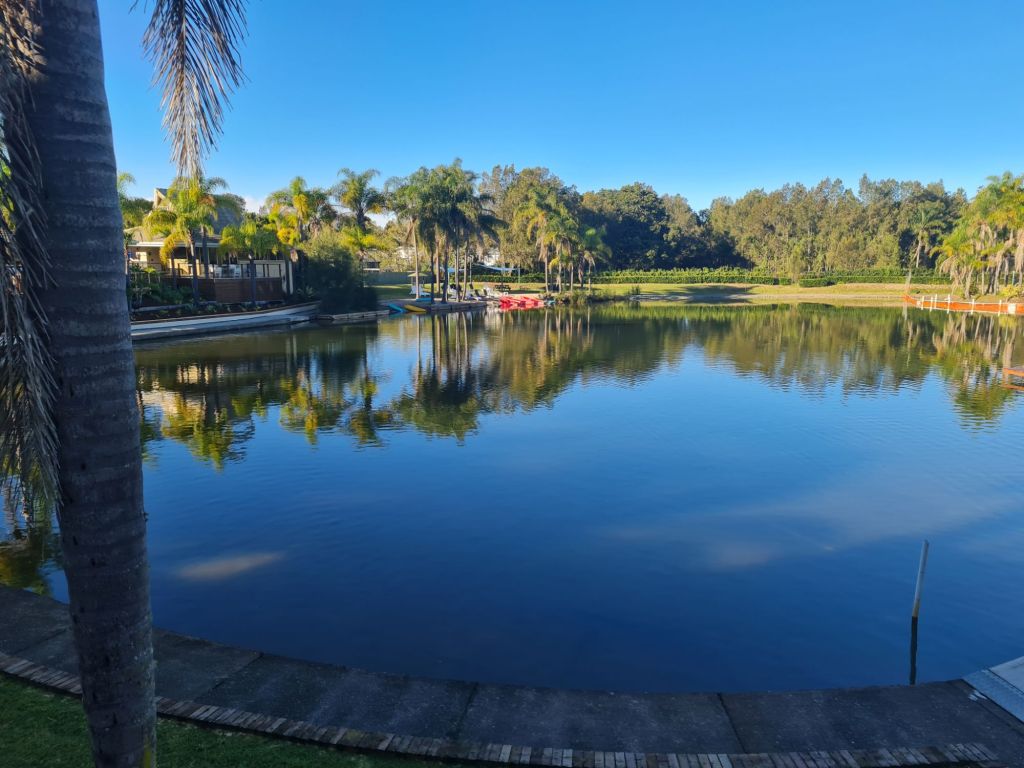
Our bungalow, as they are called, is on the edge of the lagoon, which has an island and has been stocked with fish, though I doubt we would be allowed to go fishing in it.

For the more adventurous, there are canoes.  I think I would prefer the BBQ, and watch the planes taking off and landing at the airport just on the other side of the tree line on the other side of the lagoon.

At least they are only smaller planes like the De Havilland Dash 8.

And, knowing the airport was only minutes away, we dropped in for a quick photo op and got the following