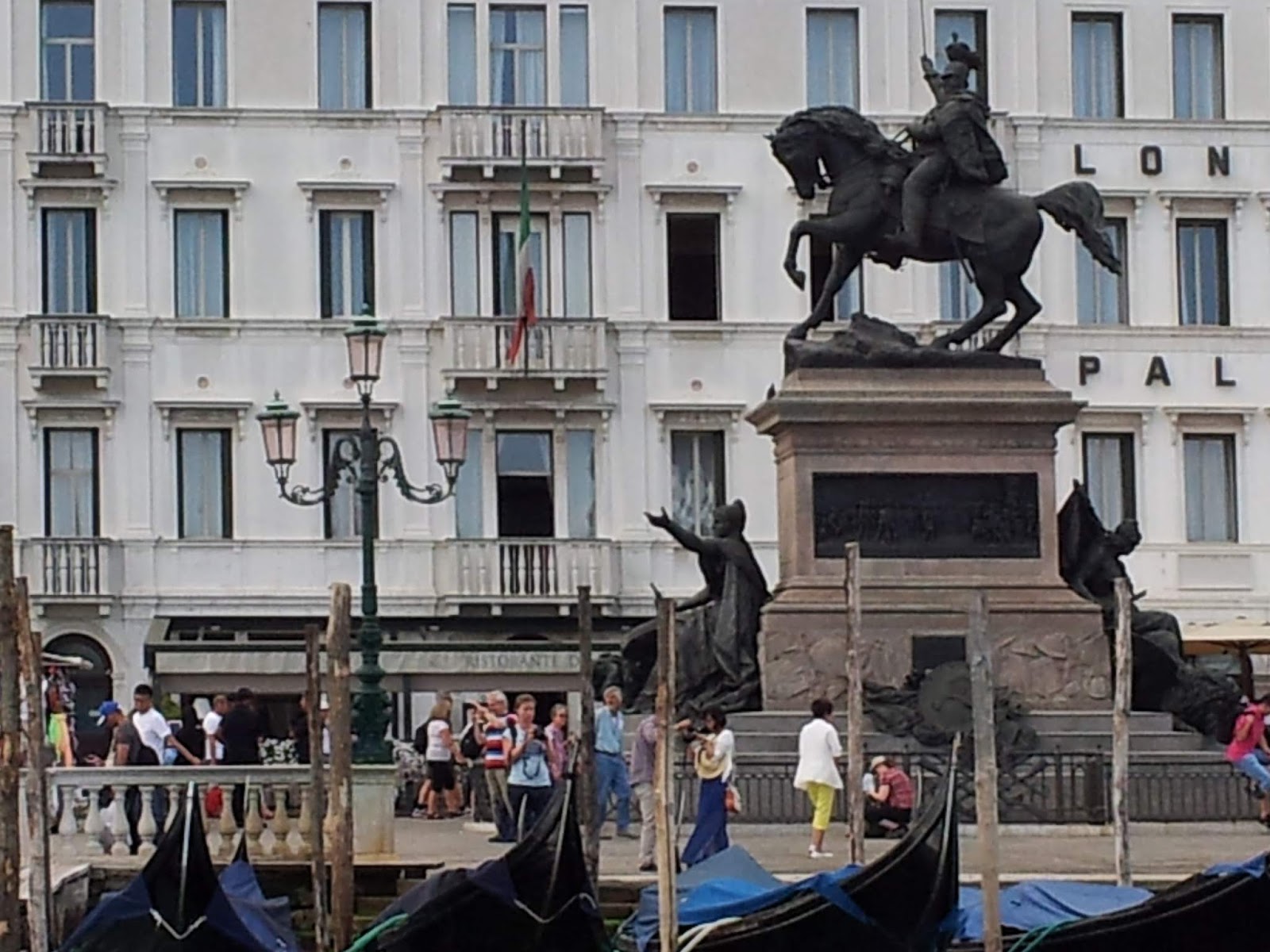
Searching for Locations: Venice, Italy

Venice is definitely a city to explore.  It has an incredible number of canals and walkways, and each time we would start our exploration at St Marks square when it’s not underwater

Everyone I have spoken to about exploring Venice has told me how easy it is to get lost.  It has not happened to me, but with the infinite number of ways you can go, I guess it is possible.

We started our exploration of Venice in St Marks square, where, on one side there was the Museo di Palazzo Ducale and, next door, the Basilica di San Marco.  Early morning and/or at high tide, water can be seen bubbling up from under the square, partially flooding it.  I have seen this happen several times.  Each morning as we walked from the hotel (the time we stayed in the Savoia and Jolanda) we passed the Bridge of Sighs.

Around the other three sides of the square are archways and shops.  We have bought both confectionary and souvenirs from some of these stores, albeit relatively expensive.  Prices are cheaper in stores that are away from the square and we found some of these when we walked from St Marks square to the Railway station, through many walkways, and crossing many bridges, and passing through a number of small piazzas.

That day, after the trek, we caught the waterbus back to San Marco, and then went on the tour of the Museo di Palazzo Du which included the dungeons and the Bridge of Sighs from the inside.  It took a few hours, longer than I’d anticipated because there was so much to see.

The next day, we caught the waterbus from San Marco to the Ponte di Rialto bridge.  Just upstream from the wharf there was a very large passenger ship, and I noticed there were a number of passengers from the ship on the waterbus, one of whom spoke to us about visiting Venice.  I didn’t realize we looked like professional tourists who knew where we were going.

After a pleasant conversation, and taking in the views up and down the Grand Canal, we disembarked and headed for the bridge, looking at the shops, mostly selling upmarket and expensive gifts, and eventually crossing to the other side where there was a lot of small market type stalls selling souvenirs as well as clothes, and most importantly, it being a hot day, cold Limonata.  This was my first taste of Limonata and I was hooked.

Continuing on from there was a wide street at the end and a number of restaurants where we had lunch.  We had a map of Venice and I was going to plot a course back to the hotel, taking what would be a large circular route that would come out at the Accademia Bridge, and further on to the Terminal Fusina Venezia where there was another church to explore, the Santa Maria del Rosario.

This is a photo of the Hilton Hotel from the other side of the canal.

It was useful knowledge for the second time we visited Venice because the waterbus from the Hilton hotel made its first stop, before San Marco, there.  We also discovered on that second visit a number of restaurants on the way from the terminal and church to the Accademia Bridge.

This is looking back towards San Marco from the Accademia Bridge:

And this, looking towards the docks:

Items to note:

Restaurants off the beaten track were much cheaper and the food a lot different to that in the middle of the tourist areas.

There are a lot of churches, big and small, tucked away in interesting spots where there are small piazza’s.  You can look in all of them, though some asked for a small fee.

Souvenirs, coffee, and confectionary are very expensive in St Marks square.

Writing a book in 365 days – 130/131

Days 130 and 131

Writing exercise – use the following with new similies incorporated into the story:

His face was worn, like a … , The sky turned stormy, as though it was … , She was … as a … , He felt miserable as a …

I had been warned that the weather could change instantly, but I believed that to be an exaggeration.

Why?

I had been told that while the place I wanted to visit was once an old alluvial gold mine with some very interesting geological structures as well as an archaeological site that had the remnants of buildings dating back to what was believed to be an ancient advanced society, it was also owned by a mysterious old man, some of whom thought him to be a ghost whose permission had to be sought first before going there.

An old man, no one seemed to know his location.

It only added to the intrigue that surrounded the area.

Numerous newspaper reports suggested that it was Dargeville’s own Bermuda Triangle, where cell phones ceased to work, where apparitions could appear, of an old man, or a young girl dressed in period costume, where strange weather could erupt at any moment.

In my mind, something was going on there that someone didn’t want anyone to discover.

I’d stopped in at the diner, one of seven shops on a short main street that boasted a drapery, a hardware store, a drug store, a gas station, and a sheriff’s office. The opposite side of the road was a park, one that had just the bare minimum of maintenance.

Dargeville was literally a one-horse town. There was a horse hitching bar, and a horse was tethered to it. There was no sign of the owner, or anyone else for that matter.

Herb, the cook, the waiter, the server, in the diner was behind the server, and I could feel him watching me from the moment I stopped the car, till I walked into his diner.

The pie holder on the counter was empty. No, ‘only Dargeville can make such delicious apple pies’ apple pie was going to be tasted today, a slight disappointment.

“Where are you headed?” was his opening gambit.

“The gold fields.”

“You need permission. Old man Dargeville doesn’t like intruders.”

“Where can I find him then?”

“That’s just it, you can’t. He domes, he goes, but no one knows exactly where he is.”

“Where was he seen last?”

“Here. Three days ago. Took the last of the apple pie.”

We both looked at the empty pie holder. I could see several crumbs that had been left behind.

“Pity,” I said. “It was the other reason why I came here. Nowhere else can I find him.”

The man waved his hand, “Out there, somewhere.”

“No pie, and no old man. What does he look like?”

He looked at me thoughtfully, thinking perhaps, correctly, I was not going to leave that easily.

“Old, dusty, bushy-bearded, battered hat. Sometimes he drops a line in at the river that’s at the end of the park, that way.” He pointed across the street and along the road. “Past the gas station.”

There was a sudden crack of thunder, followed by a few more rumblings.

Odd. The sky had been clear, except for some distant clouds.

“Time to move on, before the weather sets in. You don’t want to get stuck here; the motel is not a place I’d recommend you stay.”

Very welcoming. Not!

I shrugged. “As you say, not a place to be stranded. Thanks for your help.”

When I stepped outside and looked up, the sky was the same as it had been all morning. It made the thunder I’d just heard … Or was it my imagination?

I looked back to see the man in the diner on his cell phone. Perhaps he was telling the old man that I was coming. Or someone else.

I checked the riverside fishing spot at the end of the park, almost opposite the gas station, and indeed it showed signs that someone had been there very recently, a roll-your-own cigarette still burning through the last of the tobacco.

The call had been a heads-up that I was coming to see him.

So, the old man did exist. I decided to go ahead and visit the site, and took out my notebook to find the page with the instructions on how to get there.

Along the road I was on, for a further five miles where there was a rusted sign with a skull and cross bones and Hazardous materials written under it.

Five miles up the road, I found the sign, almost hidden behind overgrown bushes, very faded. More words, freshly painted, were added under Hazardous, ‘to your health’. Beside it was a drawing of a man with his head cut off and blood spurting out of the neck.

Someone had a sense of humour.

It was a further two miles up a track that sometimes disappeared except for tire ruts. I was glad I brought the off-road SUV. At precisely two miles, I stopped. I had to. A brand-new steel wire fence and gate had been erected, blocking the way.

Previously, from all the reports, there had been no fences or gates.

Another crack of thunder had me looking up, and there was a change. The sky turned stormy, as though it was a roiling witch’s cauldron, clouds swirling and shades of grey from dark to light changing almost like an electronic display.

I could smell rain in the air. The wind picked up and swished through the trees. Another crack of thunder, this time coming after a bolt of lightning that wasn’t far away.

On the gate was a sign. “Trespassers will be shot”, with several bullet holes above and below the words to emphasise the fact.

It did make me think twice before I got a weapon of my own, and then while searching for a way over the fence, I found a pedestrian gate about thirty yards along to the right, that wasn’t locked.

Curious. Just on the other side, I found an almost burnt-out cigarette, the same as that at the fishing spot. Whoever had been there was here.

There was a worn track on either side of the fence, so I followed it carefully. It was one of those wooded areas where you always had the feeling someone was watching you. The scrub was dense but not very high. There were trees, but sparse in number.

Long before I reached it, I could hear a river, or creek perhaps, but the sound of running water.

A few minutes later, I reached the edge of a clearing, and on the other side, away from where the track led, I saw a girl, dressed in old-fashioned clothes, not of this civilisation, dancing. She was the epitome of a summer’s day, so brightly dressed and so carefree.

She had neither seen nor heard me coming. I stayed and watched for a few minutes, and then she disappeared into the woods. I thought of following her, but it was off mission. The weather was holding off, but it might not last. I continued on towards the river.

Coming out of the woods, noting I had been following the creek for about three hundred yards, before me were the ruins of several structures that looked to me to have been built of mud bricks, and part of a much larger structure. The whole area back from the creek was paved in stones that made up a very sophisticated design.

It looked a bit like a town square, built around a well, and on the other side, what looked to be the ruins of a temple. What the gold miners made of it was anyone’s guess, but very few of their writings included anything about any ruins.

Further on from that was a seat, and there sat a man with his back to me. Battered hat, dusty clothes. I walked towards him. He didn’t turn around, as if he were expecting a visitor.

I stopped when I was alongside the seat, and then he turned to look at me. His face was worn, like that of an old leather chair, from years of exposure to the elements. I wondered if he felt as miserable as he looked.

He sighed. “I knew you’d come.”

“Hello, gramps.”

©  Charles Heath  2025

Writing a book in 365 days – My story 17

More about my story

There’s always another story hidden somewhere within the main story.

Sometimes.

This underlying theme was borne out of a dream I had, or perhaps it could be called a nightmare.

Our protagonist hadn’t started out as a broken man, but after an incident that I wrote about his first days on his new assignment, it was out of character, and I had to go back and create a whole backstory.

It’s why the story has a prelude that starts in a hotel room, the beginning of questioning what he’s doing, and ends up in a garage where he and his partner were on the other end of a sanctioned hit.

He survives, but it does fuel the notion that perhaps he’s no longer fit for purpose, that he begins to question the very essence of why he does what he does

It goes deeper than that, and the unseen connection is really a guilt-by-association thing.  His boss, the old stoic and perhaps out-of-date leader of the department our protagonist works for, was asked to retire and refused.

Old Spies never retire, they are removed.

Unfortunately, that also means those loyal to them, and a purge of the department heads’ loyal acolytes is underway.  By the time our protagonist gets back out in the field, his boss is under siege, and he himself is basically sidelined with a job a first-year rookie could do.  It was sold on the basis that he was being eased back in.

So, his boss smells a rat and decides to do his own legwork and find out who wants to destroy him and his organisation.  This investigation is going to simmer, and by the time a second attempt to remove our protagonist goes wrong in the middle of a couple, his boss is executed.

Problem resolved.

Or is it?

Writing a book in 365 days – My story 17

More about my story

There’s always another story hidden somewhere within the main story.

Sometimes.

This underlying theme was borne out of a dream I had, or perhaps it could be called a nightmare.

Our protagonist hadn’t started out as a broken man, but after an incident that I wrote about his first days on his new assignment, it was out of character, and I had to go back and create a whole backstory.

It’s why the story has a prelude that starts in a hotel room, the beginning of questioning what he’s doing, and ends up in a garage where he and his partner were on the other end of a sanctioned hit.

He survives, but it does fuel the notion that perhaps he’s no longer fit for purpose, that he begins to question the very essence of why he does what he does

It goes deeper than that, and the unseen connection is really a guilt-by-association thing.  His boss, the old stoic and perhaps out-of-date leader of the department our protagonist works for, was asked to retire and refused.

Old Spies never retire, they are removed.

Unfortunately, that also means those loyal to them, and a purge of the department heads’ loyal acolytes is underway.  By the time our protagonist gets back out in the field, his boss is under siege, and he himself is basically sidelined with a job a first-year rookie could do.  It was sold on the basis that he was being eased back in.

So, his boss smells a rat and decides to do his own legwork and find out who wants to destroy him and his organisation.  This investigation is going to simmer, and by the time a second attempt to remove our protagonist goes wrong in the middle of a couple, his boss is executed.

Problem resolved.

Or is it?

Writing a book in 365 days – 129

Day 129

To plan or not to plan.

Well, it depends.

Most of the time, I fly by the seat of my pants because I like the idea of the story unfolding in the same way it does for the reader.

Until…

Yes, it’s that little thing called painting yourself into a corner.

It happens.

Luckily for me, when I run aground, I just have to walk away from it for a few days, a week, perhaps a month, and suddenly, an idea pops into my head and we’re off again.

It’s why I write most of my stories in episodic form, and I work on three or four, not just the one.

However, there are pros and cons, and yes, I do actually plan.

When a story gets a good start and then the ideas start drying up.

Or…

I find myself having to create a biography for the characters, family trees, and getting the dates correct.  Flying high is great, but there comes a time when the timeline gets confused.

Usually, about halfway through, we’re getting down to the serious side of the story.  So, on balance, nearly all of my states are a blend of the two methodologies.

Which of the two is best?.

I’d say planning.

My only problem with that is that it’s not always apparent what is going to happen at the end, though if I sat down and thought about the process I used foe the 20 or so books that I have written, the end was nor a surprise, so perhaps it was always there in the back of my mind.

For the two sequels I’m working on, they were more planned than pantsed.  With one, I knew the end before it started.  With the second, nearly done, I didn’t to a certain extent.  I know how I want it to end, but writing it is taking it in a different direction.

Perhaps a third book is needed for them to finally realise they should be together.

Writing a book in 365 days – 129

Day 129

To plan or not to plan.

Well, it depends.

Most of the time, I fly by the seat of my pants because I like the idea of the story unfolding in the same way it does for the reader.

Until…

Yes, it’s that little thing called painting yourself into a corner.

It happens.

Luckily for me, when I run aground, I just have to walk away from it for a few days, a week, perhaps a month, and suddenly, an idea pops into my head and we’re off again.

It’s why I write most of my stories in episodic form, and I work on three or four, not just the one.

However, there are pros and cons, and yes, I do actually plan.

When a story gets a good start and then the ideas start drying up.

Or…

I find myself having to create a biography for the characters, family trees, and getting the dates correct.  Flying high is great, but there comes a time when the timeline gets confused.

Usually, about halfway through, we’re getting down to the serious side of the story.  So, on balance, nearly all of my states are a blend of the two methodologies.

Which of the two is best?.

I’d say planning.

My only problem with that is that it’s not always apparent what is going to happen at the end, though if I sat down and thought about the process I used foe the 20 or so books that I have written, the end was nor a surprise, so perhaps it was always there in the back of my mind.

For the two sequels I’m working on, they were more planned than pantsed.  With one, I knew the end before it started.  With the second, nearly done, I didn’t to a certain extent.  I know how I want it to end, but writing it is taking it in a different direction.

Perhaps a third book is needed for them to finally realise they should be together.

Writing a book in 365 days – 128

Day 128

Writing is the supreme solace.

Perhaps it can be.

I remember when my mother died. It was the closest I had ever been in the presence of death.

I got a phone call to tell me I should come to the hospital, she was not going to last much longer.  I was on the way out the door when the call said she had passed.

That was followed by going to the hospital, where I stayed for an hour, trying to assemble my thoughts.

In that moment when I first saw her, I felt numb.  And much as I hate to say it, she was not much of a mother to me or any of us, for that matter, and I never really understood why.

Our grandmother, her mother, had been more caring and considerate.

For a few days after, I guess I went through a period where I tried to think of all the good things about her, but the bad still intruded.  Those thoughts included my father, who was still alive, and had we been on speaking terms, perhaps it might have helped.

Instead, I was left with mixed emotions.

A few days later, I started putting words on paper, deciding that I would try to put together a eulogy of sorts, I’m case it was called for.

Writing about it was a form of solace, a period where I could address what it was that I felt, and at the end of it, I felt better.

Only later, much later, when I started digging into the family genealogy, that a lot of stuff started making sense.

Like most people, she was as complicated as the day was long. 

She had an older sister whom I believe she was very jealous of; she had a boyfriend who was a local boy, since she was sixteen, writing continually during the war after he signed up, and writing about the life they would have together.

She had an explosive temper and managed at one time or another to alienate or get on the wrong side of everybody she cared about, and girlfriends in particular.  That tempered extended, eventually to her boyfriend, now home from the war, and I believe they were looking forward to getting married.

A row put an end to it.  He didn’t answer her letters of apology and ignored a telegram she sent, an indication of how badly she had fractured their relationship.

It’s 1946, and she’s working in Melbourne. 

My father had gone overseas, why well never know, and ended up with his own matrimonial disaster, and having a wedding planned called off, he returns home disappointed and alone, going back to his old job of projectionist that he had before he enlisted.

It’s 1947, and he’s in the Snowy Mountain district as a roving projectionist.

I could only imagine how she and her family managed her disappointment situation, and her sister, who herself had married and had her own life, might account for my mother’s feelings towards her.

With that failed relationship in the past, her matrimonial prospects are now in the hands of a woman who is charged with finding a suitable husband.

That man was my father.

He gets the introduction, goes to see her, and she has gone home for the weekend to her parents’ house.  It’s not surprising she had had another row with her girlfriends, and she faces time alone in her room.

He writes, not in the same romantic flowery prose of her last boyfriend, but of how domestic his life is, and how much he needs a wife to do those chores.

The thing is, he is a returned serviceman and used to fending for himself.  This is not going to be a match made in heaven.  He has his own anger management issues and battles with his own family, and it’s no surprise to learn there were ultimatums and threats to call off the wedding.

And yet, in 1950, it finally went ahead.  There may have been compelling reasons, but one thing that was assured, neither of them advertised the fact that they had families, and we, as children, rarely, if ever, saw our aunts and uncles, only on rare occasions our grandparents.

Does snake me feel any better writing this down?

No.  It does, however, provide a deeper understanding of the two people who were my parents and sadness at the loss of never knowing my aunts, uncles and grandparents, and goes a long way towards explaining why I am the way I am.

Writing a book in 365 days – 128

Day 128

Writing is the supreme solace.

Perhaps it can be.

I remember when my mother died. It was the closest I had ever been in the presence of death.

I got a phone call to tell me I should come to the hospital, she was not going to last much longer.  I was on the way out the door when the call said she had passed.

That was followed by going to the hospital, where I stayed for an hour, trying to assemble my thoughts.

In that moment when I first saw her, I felt numb.  And much as I hate to say it, she was not much of a mother to me or any of us, for that matter, and I never really understood why.

Our grandmother, her mother, had been more caring and considerate.

For a few days after, I guess I went through a period where I tried to think of all the good things about her, but the bad still intruded.  Those thoughts included my father, who was still alive, and had we been on speaking terms, perhaps it might have helped.

Instead, I was left with mixed emotions.

A few days later, I started putting words on paper, deciding that I would try to put together a eulogy of sorts, I’m case it was called for.

Writing about it was a form of solace, a period where I could address what it was that I felt, and at the end of it, I felt better.

Only later, much later, when I started digging into the family genealogy, that a lot of stuff started making sense.

Like most people, she was as complicated as the day was long. 

She had an older sister whom I believe she was very jealous of; she had a boyfriend who was a local boy, since she was sixteen, writing continually during the war after he signed up, and writing about the life they would have together.

She had an explosive temper and managed at one time or another to alienate or get on the wrong side of everybody she cared about, and girlfriends in particular.  That tempered extended, eventually to her boyfriend, now home from the war, and I believe they were looking forward to getting married.

A row put an end to it.  He didn’t answer her letters of apology and ignored a telegram she sent, an indication of how badly she had fractured their relationship.

It’s 1946, and she’s working in Melbourne. 

My father had gone overseas, why well never know, and ended up with his own matrimonial disaster, and having a wedding planned called off, he returns home disappointed and alone, going back to his old job of projectionist that he had before he enlisted.

It’s 1947, and he’s in the Snowy Mountain district as a roving projectionist.

I could only imagine how she and her family managed her disappointment situation, and her sister, who herself had married and had her own life, might account for my mother’s feelings towards her.

With that failed relationship in the past, her matrimonial prospects are now in the hands of a woman who is charged with finding a suitable husband.

That man was my father.

He gets the introduction, goes to see her, and she has gone home for the weekend to her parents’ house.  It’s not surprising she had had another row with her girlfriends, and she faces time alone in her room.

He writes, not in the same romantic flowery prose of her last boyfriend, but of how domestic his life is, and how much he needs a wife to do those chores.

The thing is, he is a returned serviceman and used to fending for himself.  This is not going to be a match made in heaven.  He has his own anger management issues and battles with his own family, and it’s no surprise to learn there were ultimatums and threats to call off the wedding.

And yet, in 1950, it finally went ahead.  There may have been compelling reasons, but one thing that was assured, neither of them advertised the fact that they had families, and we, as children, rarely, if ever, saw our aunts and uncles, only on rare occasions our grandparents.

Does snake me feel any better writing this down?

No.  It does, however, provide a deeper understanding of the two people who were my parents and sadness at the loss of never knowing my aunts, uncles and grandparents, and goes a long way towards explaining why I am the way I am.

Writing a book in 365 days – 127

Day 127

What do you believe is your forte as a writer?

I have always liked English as a subject at school, starting at primary school and getting books for Christmas.

My favourite shop was a newsagent’s and bookstore up the road, and while my mother shopped in the grocery store, I would go looking at the books.

It wasn’t until secondary school and the introduction to English literature that my love of books took a new turn. The school had a library, and there I could discover all of the schoolboy heroes like Biggles and the adventures of the Famous Five and Secret Seven.

It also afforded me the chance to work as a librarian and learn the ropes, as it were, and for a while, the idea of going to university to become a proper librarian was firmly planted in my mind.

Of course, circumstances got in the way of that plan, and I finished up leaving school early and never quite making it to university.

But I did go to correspondence school and picked up English literature again, but this time, it was a study of various aspects of literature, such as poetry, fiction, plays, and nonfiction.

I didn’t like poetry. In fact, I did not understand it at all.

I liked the idea of writing a play and creating a screenplay, but I never got around to it.

No, my first foray into writing came when I started doing an off-campus degree that majored in literature and had units called narrative.

Yes, the expectation was to write stories. Short stories, and so I began. Those I wrote as assignments scored well. Those I wrote and submitted for publication did not.

Yes, it was the beginners’ story, the pile of rejections that started crushing that desire to succeed.

There was, around this time, a novel competition run by the Australian newspaper, and, like all naive beginners, I told myself my first entry would blow them away, and the prize was mine.

Nothing could be further from the truth.

But I wrote a novel every year until I was too old to participate. Unfortunately, I can’t find the manuscripts I wrote back then; perhaps disgusted, I threw them away. Pity, I would like to see them now, just to see how bad they were.

Writing a book in 365 days – 127

Day 127

What do you believe is your forte as a writer?

I have always liked English as a subject at school, starting at primary school and getting books for Christmas.

My favourite shop was a newsagent and bookstore up the road, and while my mother shopped in the grocery store, I would go looking at the books.

It wasn’t until secondary school and the introduction to English literature that my love of books took a new turn. The school had a library, and there I could discover all of the schoolboy heroes like Biggles and the adventures of the Famous Five and Secret Seven.

It also afforded me the chance to work as a librarian and learn the ropes, as it were, and for a while, the idea of going to university to become a proper librarian was firmly planted in my mind.

Of course, circumstances got in the way of that plan, and I finished up leaving school early and never quite making it to university.

But I did go to correspondence school and picked up English literature again, but this time, it was a study of various aspects of literature, such as poetry, fiction, plays, and nonfiction.

I didn’t like poetry. In fact, I did not understand it at all.

I liked the idea of writing a play and creating a screenplay, but I never got around to it.

No, my first foray into writing came when I started doing an off-campus degree that majored in literature and had units called narrative.

Yes, the expectation was to write stories. Short stories, and so I began. Those I wrote as assignments scored well. Those I wrote and submitted did not.

Yes, it was the beginners’ story, the pile of rejections that started crushing that desire to succeed.

There was, around this time, a novel competition run by the Australian newspaper, and, like all naive beginners, I told myself my first entry would blow them away, and the prize was mine.

Nothing could be further from the truth.

But I wrote a novel every year until I was too old to participate. Unfortunately, I can’t find the manuscripts I wrote back then; perhaps disgusted, I threw them away. Pity, I would like to see them now, just to see how bad they were.